ABS AUDI S8 2016 Owner's Manual
[x] Cancel search | Manufacturer: AUDI, Model Year: 2016, Model line: S8, Model: AUDI S8 2016Pages: 302, PDF Size: 75.68 MB
Page 218 of 302
Fuel and Refueling
nozzle. A worn or damaged nozzle or a noz
zle that is too small may not be ab le to open
the diesel m isfueling protector. If th is is the
case, try turning the nozzle before inserting
i t in the fuel f iller neck, use a different fuel
pump or see your authorized Audi dealer or
authorized repair facility for ass istance.
- The fuel filler flap of your vehicle is not
locked when you lock the veh icle from the
i nside .
Fuel filler flap emergency release
You can open the fuel filler flap by hand if the
power locking system should fail.
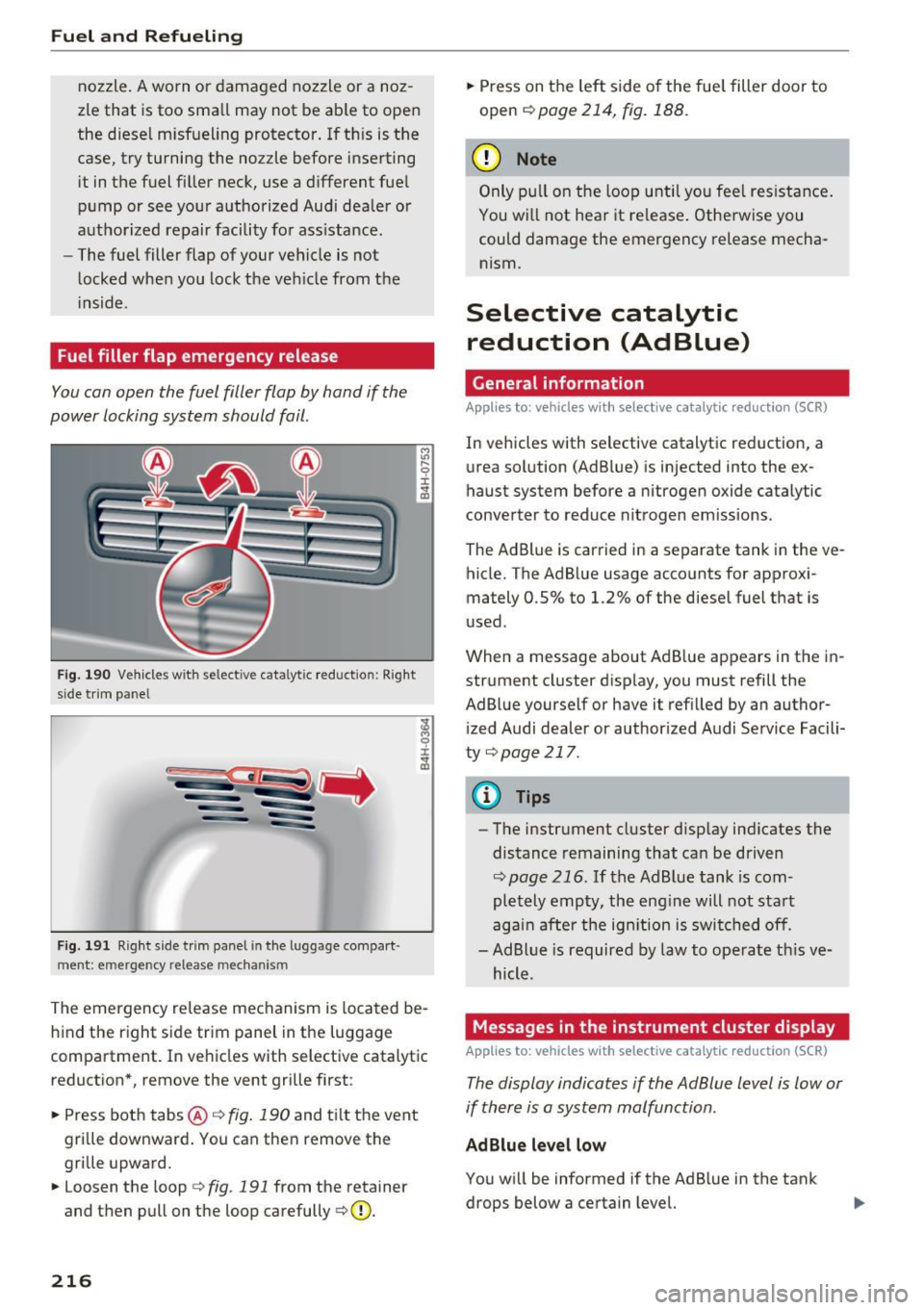
F ig . 190 Vehicles w ith se lect ive cata lytic reductio n: Right
side tr im pane l
Fig. 191 Right side trim panel in the lu ggage compart ·
ment: e mergency release mechan is m
...,
"' 9 ::i: ... (D
The emergency release mechanism is located be
hind the right side trim panel in the luggage
compartment. In vehicles with selective catalytic
reduction*, remove the vent grille first :
.. Press both tabs@¢
fig. 190 and tilt the vent
gri lle downward. You can then remove the
grille upward.
.. Loosen the loop¢
fig. 191 from the retainer
and then pull on the loop carefully ¢(D.
216
.. Press on the left side of the fuel filler door to
open
¢ page 214, fig. 188.
(D Note
Only pull on the loop until you feel resistance .
You wi ll not hea r it re lease . Otherwise you
could damage the emergency release mecha nism.
Selective catalytic reduction (Ad Blue)
General information
Applies to: vehicles with selective catalytic reduction (SCR)
In vehicles with selective catalytic reduction, a
urea solution (AdBlue) is injected into the ex
haust system before a nitrogen oxide catalytic
converter to reduce nitrogen emissions .
The Ad Blue is carried in a separate tank in the ve
hicle. The AdBlue usage accounts for approxi
mately 0.5% to 1.2% of the diesel fuel that is
used.
When a message about Ad Blue appears in the in
strument cluster display, you must refill the
Ad Blue yourself or have it refilled by an author ized Audi dealer or author ized Audi Service Facili
ty
¢ page 217.
@ Tips
-The instrument cluster display indicates the
distance remaining that can be driven
¢page 216. If the AdBlue tank is com
pletely empty , the eng ine will not start
again after the ign ition is switched off.
- Ad Blue is required by law to operate th is ve
hicle.
Messages in the instrument cluster display
Applies to: vehicles with selective catalytic reduction (SCR)
The display indicates if the Ad Blue level is Low or
if there is a system malfunction .
AdBlue level low
You will be informed if the AdBlue in the tank
drops below a certain level.
Page 232 of 302
Checking and Filling
Brake fluid
Checking brake fluid level
The brake fluid level can be checked with a quick
glance.
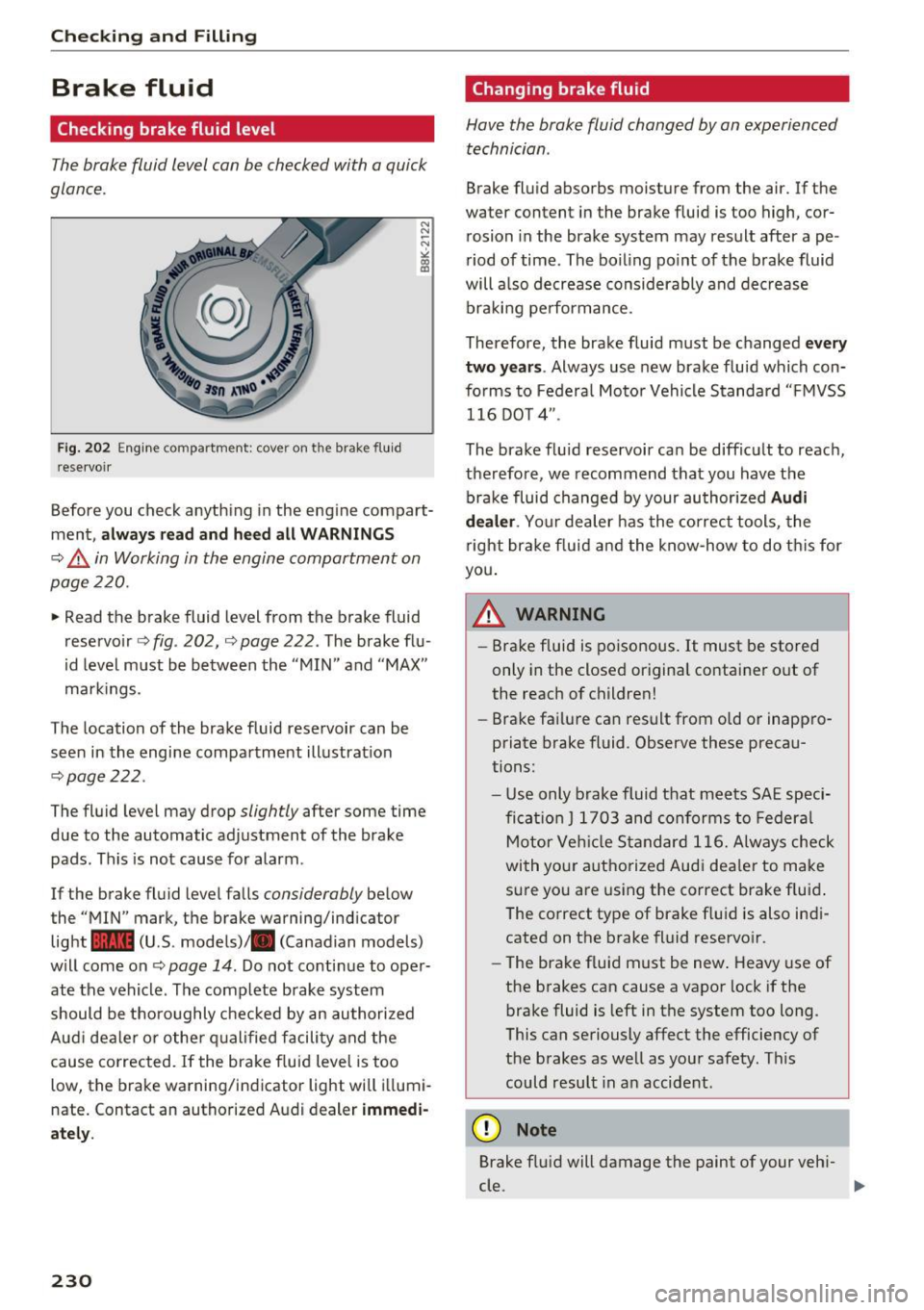
Fig. 202 Eng ine compartment: cove r o n th e brake flu id
r eservoi r
Before you check anything in the engine compart
ment,
always re ad a nd hee d all W ARNING S
¢ A in Working in the engine compartment on
page 220.
., Read the brake fluid level from the brake fluid
reservoir
<=> fig . 202, ¢page 222. The brake flu
id level must be between the "MIN" and "MAX"
mark ings.
The location of the brake fluid reservoir can be seen in the engine compartment illustration
¢ page 222.
The fluid level may drop slightly after some time
due to the automatic adjustment of the brake
pads . This is not cause for alarm .
If the brake fluid level falls
considerably below
the ' 'MIN" mark, the brake warning/indicator
light
1111 (U.S. models)/ . (Canadian models)
will come on¢
page 14 . Do not continue to oper
ate the vehicle . The complete brake system
should be thoroughly checked by an authorized
Aud i dealer or other q ualified facili ty and the
cause corrected.
If the brake f luid level is too
low, the brake warning/indicator light will i llumi
nate. Contact an authorized Audi dealer
immedi
at ely.
230
Changing brake fluid
Have the brake fluid changed by an experienced
technician .
Brake fluid absorbs moisture from the air. If the
water content in the brake fluid is too high, cor rosion in the brake system may result after ape
riod of time . The boiling po int of the brake fluid
will a lso decrease considerably and decrease
braking performance.
Therefore , the brake fluid must be changed
eve ry
two y ears . Always use new brake fluid which con
forms to Feder-al Motor Vehicle Standard "FMVSS 116 DO T 4".
The brake fluid reservoir can be difficult to reach ,
therefore, we recommend that you have the brake fluid changed by your author ized
Audi
d ea ler . Your dealer has the correct tools, the
right brake fluid and the know -how to do this for
you.
A WARNING
- Brake fluid is po isonous. It must be stored
only in the closed original container out of
the reach of children!
- Brake fai lure can result from o ld or inappro
priate brake fluid . Observe these precau
tions:
- Use only brake fluid that meets SAE speci ficat ion
J 1703 and conforms to Federal
Motor Ve hicle Standard 116. Always check
with your authorized Audi dealer to make
sure you are using the correct brake f luid .
The correct type of brake f luid is also indi
cated on the brake fluid reservoir.
- The brake fluid must be new . Heavy use of
the brakes can cause a vapor lock if the
brake fluid is left in the system too long .
This can seriously affect the efficiency of
the brakes as well as your safety. This
could result in an accident.
(D Note
Brake fluid will damage the paint of your vehi-
cle .
lilJJ,
Page 233 of 302
@ For the sake of the environment
Because of the problem of proper disposal of
brake fluid as we ll as the special toots re
quired and the necessary expertise, we rec
ommend that you have the brake fluid
changed by your authorized Audi dealer .
Battery
General information
Under normal operating conditions, the battery
in your Audi does not need any maint enance.
With
high outside temperatures or long daily
drives we recommend tha t you have the electro
lyte level checked by a service facility. The elec
trolyte level should also be checked each time
the battery is charged ¢
page 233.
Have the battery checked when you take your ve
hicle in for serv ice. You are well advised to re
place a battery that is older than 5 years .
With certain types of airbag deployment, the batte ry is disconnected from the vehicle electri
cal system for safety reasons¢
& in Repair, care
and disposal of the airbags on page 159 .
Disconnecting the battery terminals
Some vehicle functions (power window regu la
tors, for example) are lost if the battery te rmi
nals are disconnected. These functions have to be
relearned after the battery terminals are con
nected again. To prevent th is, the battery should
only be disconnected from the vehicle e lectr ica l
system when abso lutely necessary for repairs.
Vehicles not driven for long periods
If you do not drive your vehicle over a period of
several days or weeks, electrical components are
gradually cut back or sw itched off. This reduces
ene rgy consumption and ma inta ins starting ca
pability over a longer period ¢
page 195. Some
of the convenience functions may not operate,
such as the interior lights or the power seat ad
justment. The convenience funct ions will be
ava ilable again when you switch on the ignition
and start the engine.
Checking and Filling
Winter operation
During the winter months, battery capacity tends
to decrease as temperatures drop . This is be
cause more power is also consumed while start
ing, and the headlights, rear window defogger,
etc., are used more often.
Avo id unnecessary power consumption, particu
larly in city traffic or when traveling only short
distances . Let your authorized Audi dealer check
the capacity of the vehicle battery before winter
sets in ¢
page 233. A well charged battery will
not only prevent starting problems when the
weather is cold, but will also last longer .
(D Tips
If your vehicle is left standing for several
weeks at extremely low temperatures, the ve
hicle battery should be removed and stored
where it w ill not freeze . This will prevent it
from be ing damaged and having to be re
placed.
Working on the battery
Be especially careful when working on or near
the battery.
The battery is located in the luggage compart
ment under the floor . Before you check anything
in the luggage compartment,
read and heed all
WARNINGS ¢
&-
Always heed the safety warnings, when working
on the vehicle battery or the veh icle electrical
system to prevent injury.
The following WARNINGS are very important
when working on the battery:
Always heed the following WARNING SYM·
BOLS and safety precautions when working on
the battery.
®
Always wear eye protection.
~
Battery acid contains sulfuric acid. Al-
ways wear gloves and eye protection.
231
Page 246 of 302
Wheels
use a spare tire* that is the same
circumference as the regular
tires .
A WARNING
-Only use tire/rim combina
tions and suitable wheel bolts
that have been approved by
Audi. Otherwise, damage to
the vehicle and an accident
could result.
-For technical reasons, it is not
possible to use tires from oth
er vehicles -in some cases,
you cannot even use tires from the same vehicle model.
-Make sure that the tires you select have enough clearance
to the vehicle. Replacement
tires should not be chosen
simply based on the nominal
size, because tires with a dif
ferent construction can differ
greatly even if they are the
same size. If there is not
enough clearance, the tires or
the vehicle can be damaged and this can reduce driving
safety and increase the risk of an accident.
-Only use tires that are more than 6 years old when abso-
244
lutely necessary and drive
carefully when doing so.
-Do not use run-flat tires on
your vehicle. Using them when not permitted can lead to ve
hicle damage or accidents.
-If you install wheel covers on
the vehicle, make sure they al
low enough air circulation to
cool the brake system. If they
do not, this could increase the
risk of an accident.
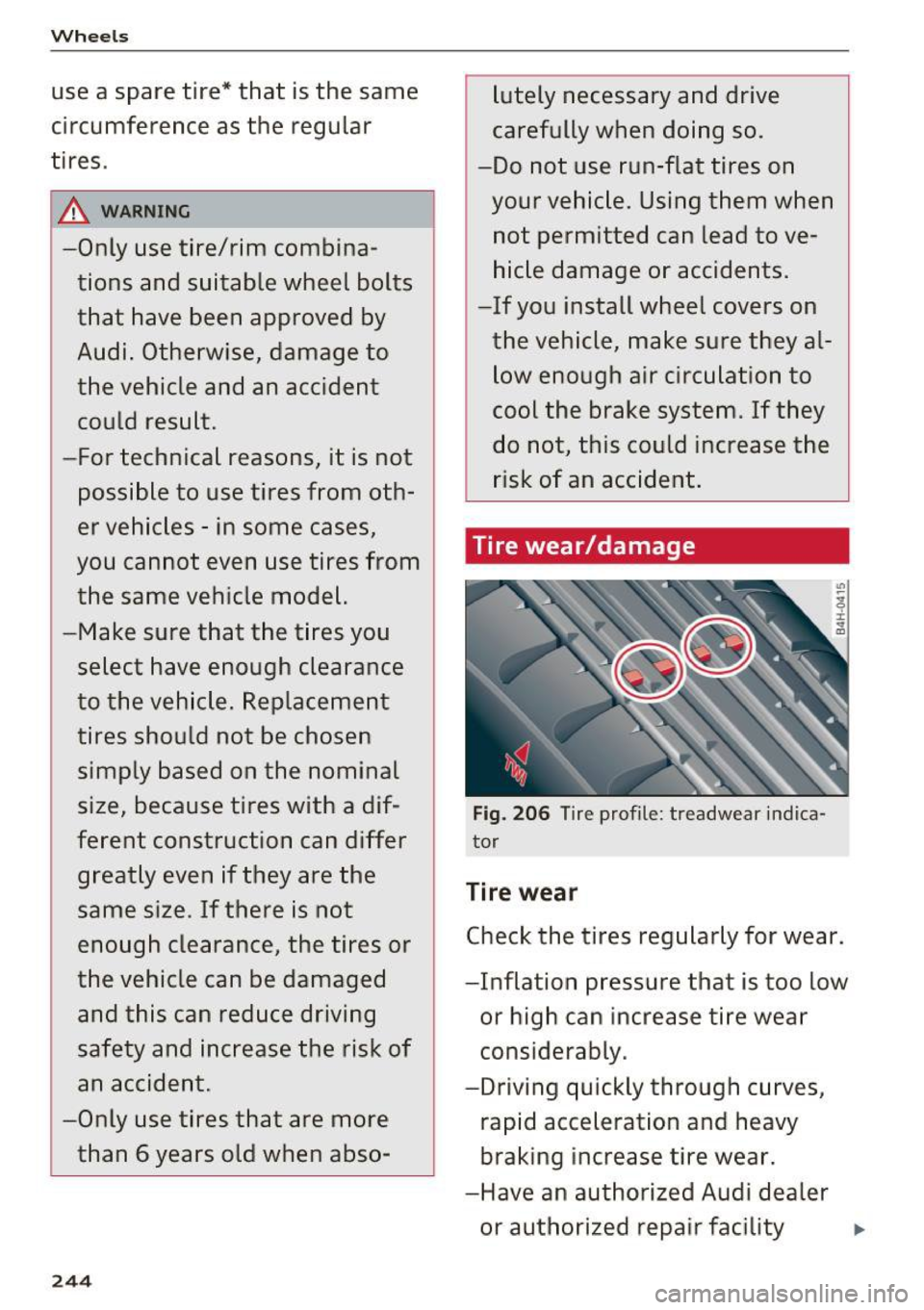
Tire wear/damage
Fig. 206 Tire profile: treadwear indica
tor
Tire wear
Check the tires regularly for wear.
-Inflation pressure that is too low or high can increase tire wear
considerably.
-Driving quickly through curves, rapid acceleration and heavy
braking increase tire wear.
-Have an authorized Audi dealer or authorized repair facility
i.
Page 256 of 302
Wheels
_& WARNING
Temperature grades apply to tires that are
properly inflated and not over or underinf lat
ed.
Tire pressure monitoring system
U) General notes
Applies to: vehicles with tire pressure monito ring system
Each tire, including the spare (if provided),
should be checked monthly when cold and inflat
ed to the inflation pressure recommended by the
vehicle manufacturer on the vehicle placard or
tire inflat ion pressure label. (If your vehicle has
tires of a different size than the size indicated on
the vehicle placard or tire inflation pressure la
bel, you should determine the proper tire infla
tion pressure fo r those tir es) .
As an added safety feature, your vehicle has been
equipped with a t ire pressure monitoring system
(TPMS) that illuminates a low tire pressure tell
tale when one or more of your tires is significant
ly under-inflated . Accord ingly, when the low tire
p ressure telltale illuminates, you should stop and
check your tires as soon as possible, and inflate
them to the proper pressure. Driving on a signifi
cantly under-inflated tire causes the tire to over
heat and can lead to tire failure. Under-inflation
also reduces fuel efficiency and tire tread life,
and may affect the vehicle's handling and stop
ping ability.
Please note that the TPMS is not a substitute for
proper tire maintenance, and it is the driver's re
sponsib ility to maintain correct tire pressure,
even if under-inflation has not reached the level
to trigger illumination of the TPMS low tire pres
sure telltale.
Your vehicle has also been equipped with a TPMS
malfunct ion indicator to indicate when the sys
tem is not operating properly. The TPMS mal
function indicator is comb ined w ith the low tire
pressure telltale. When the system detects a
malfunction, the telltale will flash for approxi
mately one minute and then remain cont inuous ly
illuminated. This sequence will continue upon
254
subsequent vehicle start-ups as long as the mal
function exists.
When the malfunction indicator is illum inated,
the system may not be able to detect or s ignal
low tire pressure as intended . TPMS malfunctions
may occur for a variety of reasons, including the
i nstallation of replacement or alternate tires or
wheels on the vehicle that prevent the TPMS
from functioning properly. Always check the
TPMS malfunction telltale after replacing one or
more tires or wheels on your vehicle to ensure
that the replacement or alternate tires and
whee ls allow the TPMS to continue to function
properly.
If the Tire Pressure Monitoring System
indicator appears
Applies to: vehicles with tire pressure monitoring system
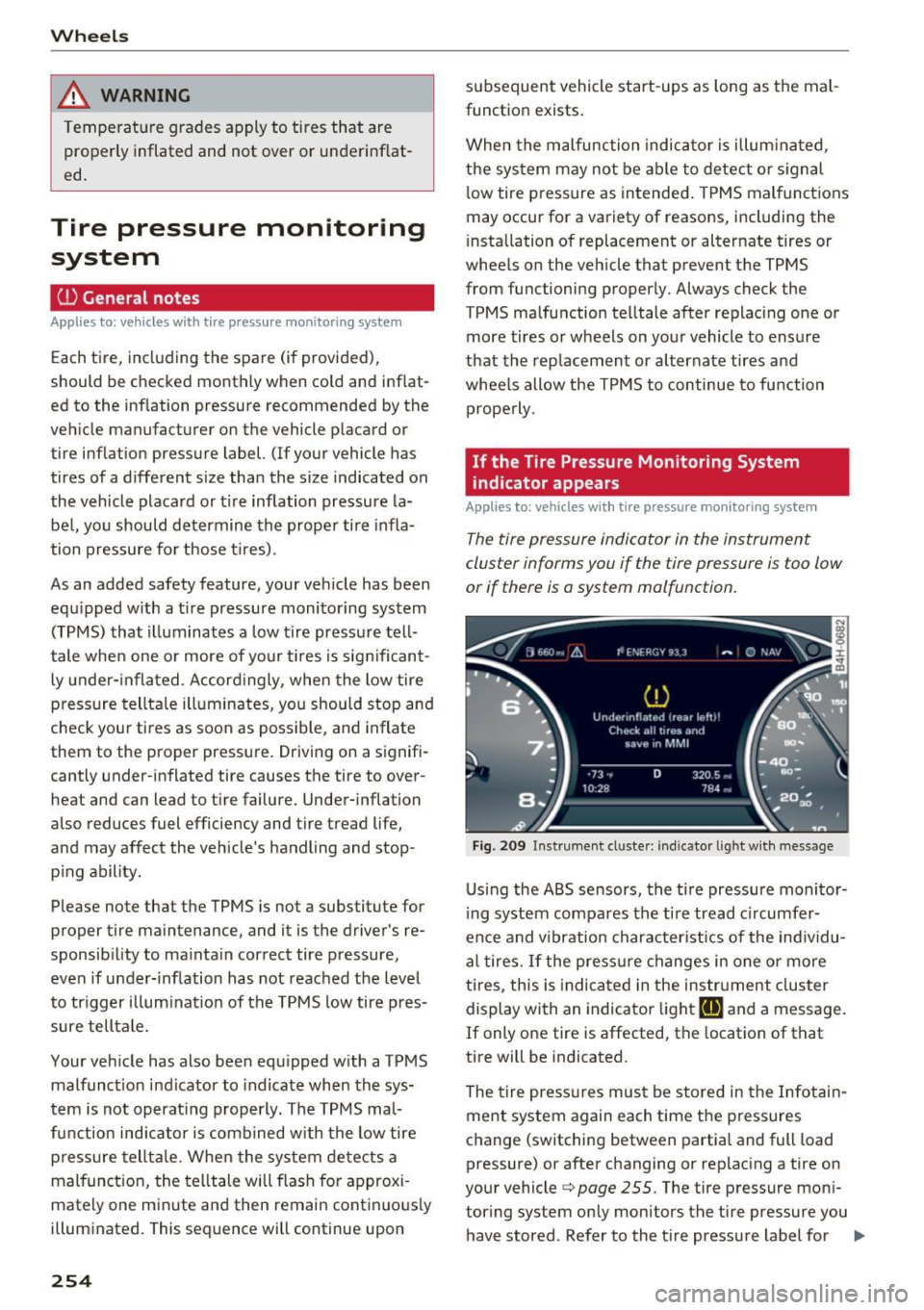
The tire pressure indicator in the instrument
cluster informs you if the tire pressure is too low
or if there is a system malfunction.
Fig . 209 Instrument cl uste r: indicator light with me ssage
Using the ABS sensors, the tire pressure monitor
ing system compares the tire tread c ircumfer
ence and v ibration characteristics of the individu
al tires.
If the pressure changes in one or more
ti res, this is ind icated in the instrument cluster
display with an indicator light
[I] and a message.
If only one tire is affected, the locat ion of that
tire will be indicated.
The tire pressures must be stored in the Infotain
ment system again each time the pressures
change (switching between partial and full load
pressure) or after changing or replacing a tire on
your vehicle ¢
page 255. The tire pressure moni
tor ing system only monitors the tire pressure you
have stored . Refer to the t ire pressure label for ..,.
Page 287 of 302
A
A/C (automatic climate control) . . . . . . . . . . 77
ABS
refer to Anti-lock braking system . . . . . . . 190
Accessories . . . . . . . . . . . . . . . . . . . . . . . . . . 283
Active lane assist . . . . . . . . . . . . . . . . . . . . . . 99
Activating and deactivating . . . . . . . . . . . . 100
C leaning the camera area . . . . . . . . . . . . . 207
Descr iption . . . . . . . . . . . . . . . . . . . . . . . . . . 99
Instrument cluster indicator light . . . . . . 100
Messages . . . . . . . . . . . . . . . . . . . . . . . . . . 100
Notes on instrument cluster display . . . . . 100
Sett ing the steering wheel vibration . . . . 101
Adaptive air suspension/sport . . . . . . . . . . . 106
Adapt ive cruise control . . . . . . . . . . . . . . . . . . 90
C leaning the sensor . . . . . . . . . . . . . . . . . . 207
Messages . . . . . . . . . . . . . . . . . . . . . . . . . . . 97
Request for driver intervention . . . . . . . . . . 95
Stop-and-go traffic . . . . . . . . . . . . . . . . . . . 94
Adapt ive Light (defective) . . . . . . . . . . . . . . . 22
AdBlue .. .. .. .. ................. ..... 216
Messages . . . . . . . . . . . . . . . . . . . . . . . . . . 216
Opening the tank door . . . . . . . . . . . . . . . . 217
Refilling . . . . . . . . . . . . . . . . . . . . . . . . . . . 217
Adding Engine coolant . . . . . . . . . . . . . . . . . . . . . . 228
Engine oil . . . . . . . . . . . . . . . . . . . . . . . . . . 225
Additives Engine oil 225
Adjustab le steer ing column . . . . . . . . . . . . . . 80
Adjusting Air distribution (automat ic cl imate control) .78
Instrument illuminat ion . . . . . . . . . . . . . . . 51
Steering column . . . . . . . . . . . . . . . . . . . . . . 80
Temperature (automatic climate control) . 78
Airbag . . . . . . . . . . . . . . . . . . . . . . . . . . . . . . 146
Airbag system . . . . . . . . . . . . . . . . . . . . . . . . 164
Advanced Airbag-System . . . . . . . . . . . . . . 150
Advanced Airbag System components . . . 152
Care . . . . . . . . . . . . . . . . . . . . . . . . . . . . . . 159
Children . . . . . . . . . . . . . . . . . . . . . . . . . . . 169
Ch ild restraints . . . . . . . . . . . . . . . . . . . . . 170
Components (front a irbags) . . . . . . . . . . . 152
Danger of fitting a child seat on the front
passenger seat . . . . . . . . . . . . . . . . . . . . . . 147
Disposal . . . . . . . . . . . . . . . . . . . . . . . . . . . 159
Fr ont airbags ................. .. 150, 151
Index
How do the front airbags work? . . . . . . . . 154
How many airbags does my vehicle have? 152
How the Advanced Airbag System compo-
nents work together . . . . . . . . . . . . . . . . . 154
Important information . . . . . . . . . . . . . . . 146
Important safety instructions on the knee
airbag system . . . . . . . . . . . . . . . . . . . . . . . 162
Knee airbags . . . . . . . . . . . . . . . . . . . . . . . . 160
Monitoring . . . . . . . . . . . . . . . . . . . . . . . . . 156
PASSENGER AIR BAG OFF light . . . . . . . . . 156
Repairs . . . . . . . . . . . . . . . . . . . . . . . . . . . . 159
Safety instructions . . . . . . . . . . . . . . . . . . . 158
Side airbags . . . . . . . . . . . . . . . . . . . . . . . . 162
S ide curta in a irbags . . . . . . . . . . . . . . . . . . 165
Warning/indicator lights . . . . . . . . . . . . . . . 18
Warning/Indicator lights . . . . . . . . . . . . . 156
Weight-sensing mat . . . . . . . . . . . . . . . . . 169
When must the system be inspected? 156
Aircraft Transporting your vehicle 274
Alcantara Cleaning . . . . . . . . . . . . . . . . . . . . . . . . . . . 209
Alignment pin (tire changing) . . . . . . . . . . . 256
All season ti res . . . . . . . . . . . . . . . . . . . . . . . 2 51
All Wheel Dr ive . . . . . . . . . . . . . . . . . . . . . . . 195
Alternator
refer to Generato r . . . . . . . . . . . . . . . . . . . . 15
Amb ience lighting . . . . . . . . . . . . . . . . . . . . . 50
Anti-freeze Windshield washer system . . . . . . . . . . . . 234
also refer to Engine coolant . . . . . . . . . . . 227
Anti-lock braking system . . . . . . . . . . . . . . . 190
Warning/indicator lights . . . . . . . . . . . . . . . 18
Anti-slip regulation . . . . . . . . . . . . . . . . . . . 190
Warning/indicator lights . . . . . . . . . . . . . . . 18
Anti-theft systems Electronic immobilizer . . . . . . . . . . . . . . . . . 31
ASR
refer to Anti-slip regulation . . . . . . . . . . . 190
Audi braking guard
refer to Braking guard . . . . . . . . . . . . . . . . . 90
Audi drive select
refer to Drive select . . . . . . . . . . . . . . . . . . 106
Audi Service Repair Manuals and Literature 281
AUTO Automat ic climate control . . . . . . . . . . . . . . 78
Automat ic headl ights . . . . . . . . . . . . . . . . . 46
285
Page 298 of 302
Index
Trunk
refer to Luggage compartment lid . . . . . . . 36
Trunk escape hand le . . . . . . . . . . . . . . . . . . . 256
Turn signals . . . . . . . . . . . . . . . . . . . . . . . . . . 48
Warning/indicator lights . . . . . . . . . . . . . . . 22
u
U LSD No. 2 (Diesel fuel) ......... .... .. . 213
Unfastening safety belts . . . . . . . . . . . . . . . 143
Uniform t ire quality grading . . . . . . . . . . . . 253
Unlocking Luggage compartment lid . . . . . . . . . . . . . . 36
Power locking switch . . . . . . . . . . . . . . . . . . 35
Remote control . . . . . . . . . . . . . . . . . . . . . . 33
Using the key . . . . . . . . . . . . . . . . . . . . . . . . 35
V
Valet parking . . . . . . . . . . . . . . . . . . . . . . . . . 41
Vanity m irrors . . . . . . . . . . . . . . . . . . . . . . 53, 54
Veh icle
Care/cleaning . . . . . . . . . . . . . . . . . . . . . . . 206
Vehicle control modules. . . . . . . . . . . . . . . . 189
Veh icle electrical system . . . . . . . . . . . . . . . . 15
Veh icle identification label . . . . . . . . . . . . . 277
Vehicle Identification Number (VIN) . . . . . . 277
Vehicle jack .. .. ... ........... 256, 261, 262
Veh icle shut-down . . . . . . . . . . . . . . . . . . . . 198
Veh icle tool kit . . . . . . . . . . . . . . . . . . . . . . . 256
Vehicle transport .... .. .. ... ... .. .. .. . 274
Ventilation . . . . . . . . . . . . . . . . . . . . . . . . . . . 76
Viny l
Cleaning . . . . . . . . . . . . . . . . . . . . . . . . . . . 209
w
Warning/indicator lights
Ai rbag system . . . . . . . . . . . . . . . . . . . . . . . 18
Anti-lock braking system (ABS) . . . . . . . . . . 18
Brake system . . . . . . . . . . . . . . . . . . . . . . . . 14
Electromechanical parking brake . . . . . . . . 15
E lectronic power control . . . . . . . . . . . . . . . 19
Electronic Stabili zation Control (ESC) . . . . . 18
Generator . . . . . . . . . . . . . . . . . . . . . . . . . . . 15
Glow plug system . . . . . . . . . . . . . . . . . . . . 20
Malfunction Indicator Lamp (MIL) . . . . . . . 20
296
Safety belt . . . . . . . . . . . . . . . . . . . . . . . . . . 16
Turn signals . . . . . . . . . . . . . . . . . . . . . . . . . 22
Warning/Indicator lights
A irbag system . . . . . . . . . . . . . . . . . . . . . . 156
PASSENGER AIR BAG OFF . . . . . . . . . . . . . 156
Warning triangle . . . . . . . . . . . . . . . . . . . . . 256
Warranty coverages . . . . . . . . . . . . . . . . . . . 281
Weights . . . . . . . . . . . . . . . . . . . . . . . . . . . . . 277
What happens if you wear your safety belt too loose? . . . . . . . . . . . . . . . . . . . . . . . . . . . . . . 142
What happens to unbelted occupants? . . . . 139
What impairs driving safety? . . . . . . . . . . . . 130
Wheel bolts . . . . . . . . . . . . . . . . . . . . . . . . . 251
Wheels ............................. 236
Cleaning . . . . . . . . . . . . . . . . . . . . . . . . . . . 207
G lossary of tire and loading terminology . 238
Replacing . . . . . . . . . . . . . . . . . . . . . . . . . . 259
Tires and vehicle load limits . . . . . . . . . . . 248
Wheel wrench . . . . . . . . . . . . . . . . . . . . . . . . 256
When must a safety belt be replaced? . . . . 140
When must the airbag system be inspected? .L56
Where are lower anchorages located? . . . . 181
Wild animal recogn ition . . . . . . . . . . . . . . . . 109
Window regulators . . . . . . . . . . . . . . . . . . . . . 40
Child safety lock . . . . . . . . . . . . . . . . . . . . . . 40
Windows Cleaning/removing ice . . . . . . . . . . . . . . . . 208
defrosting . . . . . . . . . . . . . . . . . . . . . . . . . . . 78
Windshield Cleaning . . . . . . . . . . . . . . . . . . . . . . . . . . . . 54
defrosting . . . . . . . . . . . . . . . . . . . . . . . . . . . 78
Windshield washer system . . . . . . . . . . 54, 234
Washer flu id level . . . . . . . . . . . . . . . . . . . . 21
Windshield wipers
Cleaning . . . . . . . . . . . . . . . . . . . . . . . . . . . . 55
Fo ldi ng up . . . . . . . . . . . . . . . . . . . . . . . . . . 55
Ind icator light . . . . . . . . . . . . . . . . . . . . . . . 21
Replacing windshield wiper blades . . . . . . . 55
Switch ing on/off . . . . . . . . . . . . . . . . . . . . . 54
Winter driving
Snow cha ins . . . . . . . . . . . . . . . . . . . . . . . . 251
Tires . . . . . . . . . . . . . . . . . . . . . . . . . . . . . . 251
Winter operation
Car washes . . . . . . . . . . . . . . . . . . . . . . . . . 206
Cooling system . . . . . . . . . . . . . . . . . . . . . . 227
Defrosting windows . . . . . . . . . . . . . . . . . . . 78
Removing ice from windows . . . . . . . . . . . 208