brakes AUDI S8 2016 Owner's Manual
[x] Cancel search | Manufacturer: AUDI, Model Year: 2016, Model line: S8, Model: AUDI S8 2016Pages: 302, PDF Size: 75.68 MB
Page 232 of 302
Checking and Filling
Brake fluid
Checking brake fluid level
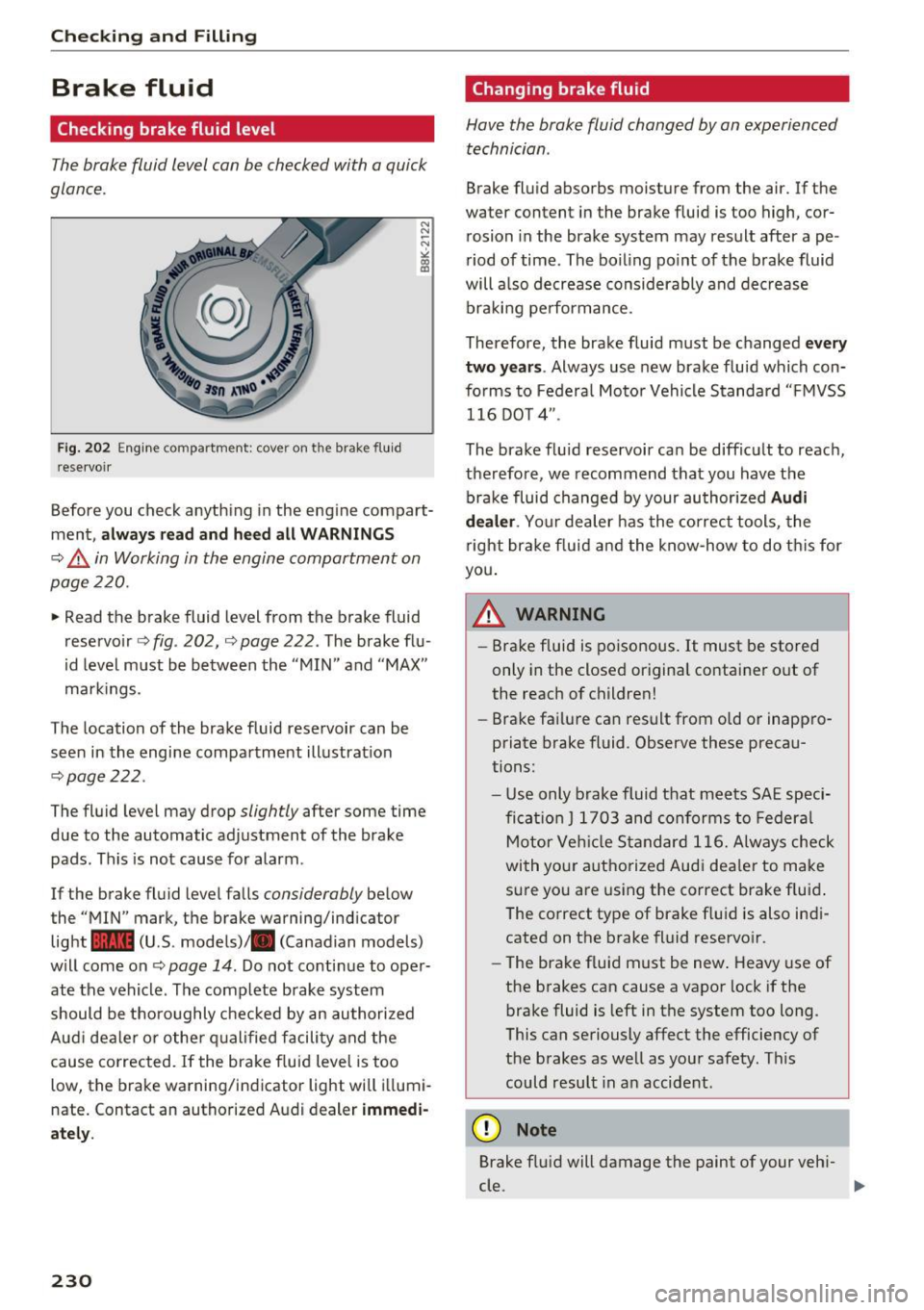
The brake fluid level can be checked with a quick
glance.
Fig. 202 Eng ine compartment: cove r o n th e brake flu id
r eservoi r
Before you check anything in the engine compart
ment,
always re ad a nd hee d all W ARNING S
¢ A in Working in the engine compartment on
page 220.
., Read the brake fluid level from the brake fluid
reservoir
<=> fig . 202, ¢page 222. The brake flu
id level must be between the "MIN" and "MAX"
mark ings.
The location of the brake fluid reservoir can be seen in the engine compartment illustration
¢ page 222.
The fluid level may drop slightly after some time
due to the automatic adjustment of the brake
pads . This is not cause for alarm .
If the brake fluid level falls
considerably below
the ' 'MIN" mark, the brake warning/indicator
light
1111 (U.S. models)/ . (Canadian models)
will come on¢
page 14 . Do not continue to oper
ate the vehicle . The complete brake system
should be thoroughly checked by an authorized
Aud i dealer or other q ualified facili ty and the
cause corrected.
If the brake f luid level is too
low, the brake warning/indicator light will i llumi
nate. Contact an authorized Audi dealer
immedi
at ely.
230
Changing brake fluid
Have the brake fluid changed by an experienced
technician .
Brake fluid absorbs moisture from the air. If the
water content in the brake fluid is too high, cor rosion in the brake system may result after ape
riod of time . The boiling po int of the brake fluid
will a lso decrease considerably and decrease
braking performance.
Therefore , the brake fluid must be changed
eve ry
two y ears . Always use new brake fluid which con
forms to Feder-al Motor Vehicle Standard "FMVSS 116 DO T 4".
The brake fluid reservoir can be difficult to reach ,
therefore, we recommend that you have the brake fluid changed by your author ized
Audi
d ea ler . Your dealer has the correct tools, the
right brake fluid and the know -how to do this for
you.
A WARNING
- Brake fluid is po isonous. It must be stored
only in the closed original container out of
the reach of children!
- Brake fai lure can result from o ld or inappro
priate brake fluid . Observe these precau
tions:
- Use only brake fluid that meets SAE speci ficat ion
J 1703 and conforms to Federal
Motor Ve hicle Standard 116. Always check
with your authorized Audi dealer to make
sure you are using the correct brake f luid .
The correct type of brake f luid is also indi
cated on the brake fluid reservoir.
- The brake fluid must be new . Heavy use of
the brakes can cause a vapor lock if the
brake fluid is left in the system too long .
This can seriously affect the efficiency of
the brakes as well as your safety. This
could result in an accident.
(D Note
Brake fluid will damage the paint of your vehi-
cle .
lilJJ,
Page 240 of 302
Wheel s
® Mud and snow capability
"M/5" or "M+S" indicates the tire
has characteristics that make it
suitab le for driving on mud and
snow. ~ indicates a winter tire.
@ Composition of the tire cord
and materials
The number of plies indicates the
number of rubberized fabric lay
ers in the tire . In general : the
more layers, the more weight a
tire can carry. Tire manufacturers
must also specify the materials
used in the tire. These include
steel, nylon, polyester and other materials.
@ Ma ximum permitted load
This number indicates the maxi
mum load in kilograms and
pounds that the tire can carry.
@ Uniform tire quality grade
standards for treadwear,
traction and temperature resistance
T readwear, traction and tempera
ture ranges ~
page 253.
@ Running direction
The arrows indicate the running
direction of unidirectional t ires.
You must always follow the speci-
238
fied running direction
~ page 264 .
(8) Maximum permitted
inflation pressure
This number indicates the maxi
mum pressure to which a tire can
be inflated under normal operat
ing condit ions.
Glossary of tire and loading
terminology
Accessory we ight
means the combined weight (in
excess of those standard items
which may be replaced) of auto matic transmission, power steer
ing, power brakes, power win
dows, power seats, radio, and
heater, to the extent that these
items are available as factory -in
stalled equipment (whether in
stalled or not).
Aspect rat io
means the rat io of the height to
the width of the tire in percent.
Numbers of 55 or lower indicate a
low sidewall for improved steer
ing response and better overa ll
handling on dry pavement.
Page 242 of 302
Wheels
(a) Curb weight
(b) Accessory weight
(c) Vehicle capacity weight, and
(d) Production options weight
Maximum (permissible )
inflation pressure
means the maximum cold infla
tion pressure to which a tire may be inflated. Also called "maxi
mum inflation pressure ."
Normal occupant weight
means 150 lbs . (68 kilograms)
times the number of occupants
seated in the vehicle up to the to
ta l seating capacity of your vehi
c le .
Occupant distribution
means distribut ion of occupan ts
in a vehic le .
Outer diameter
means the overall diamete r of an
inflated new tire.
Overall width
means the l inear distance be
tween the exter iors of the side
walls of an infla ted tire , including
elevations due to labeling , deco
rations, or protective bands or
r ibs.
2 4 0
Ply
means a layer of rubber -coated
pa rallel cords.
Production options weight
means t he comb ined we ight of
those insta lled regular production
options weighing over 5 lbs . (2 .3
kg) in excess of those standard
items which they replace , not pre
viously considered in curb weight or accessory weight, inc luding
heavy duty brakes, ride levelers,
roof rack, heavy duty battery, and
special trim.
Radial ply tire
means a pneumatic tire in which
the ply co rds that extend to the
beads are laid at subs tantially 90
deg rees to the centerline o f the
tread .
Recommended inflation
pressure
see~ page 239, Cold tire infla
tion pressure.
Reinforced tire
means a tire designed to operate
at highe r loads and at h igher in
flat ion pressures than t he corre
spond ing standa rd tire . R ein
forced tires may be identified as .,.
Page 251 of 302
Wheels
technically referred to as the vehi- sengers in the vehicle or passen-cle's
Gross Vehicle Weight Rat-gers who are heavier than the
ing ("GVWR"). standard weights assumed mean
The "GVWR" includes the weight that less weight can be carried as
of the basic vehicle, all factory in-luggage.
stalled accessories, a full tank of The Gross Vehicle Weight Rating
fuel, oil, coolant and other fluids and the Gross Axle Weight Rating
plus maximum load. The maxi- are listed on the safety compli-
mum load includes the number of ance sticker label located on the
passengers that the vehicle is in- driver's side B-pillar
c::::> page 246,
tended to carry ("seating capaci-fig. 207.
ty") with an assumed weight of
.&_ WARNING
150 lbs . (68 kg) for each passen-
Overloading a vehicle can cause
ger at a designated seating posi-
loss of vehicle control, a crash
tion and the total weight of any
or other accident, serious per-
luggage in the vehicle. If you tow
sonal injury, and even death.
a trailer, the weight of the trailer
-Carrying more weight than
hitch and the tongue weight of
your vehicle was designed to
the loaded trailer must be includ-
carry will prevent the vehicle
ed as part of the vehicle load.
from handling properly and
The
Gross Axle Weight Rating increase the risk of the loss of
("GAWR") is the maximum load vehicle control.
that can be applied at each of the -The brakes on a vehicle that
vehicle's two axles. has been overloaded may not
The fact that there is an upper be able to stop
the vehicle
limit to your vehicle's Gross Vehi- within a safe distance.
cle Weight Rating means that the -Tires
on a vehicle that has
total weight of whatever is being been overloaded can fail sud-
carried in the vehicle (including denly, including a blowout and
.... the weight of a trailer hitch and sudden deflation, causing loss
N the tongue weight of the loaded of control and a crash. ci ... :c ": trailer) is limited. The more pas-....
'° "? ....
'° ....
249
Page 288 of 302
Index
Auto Lock . . . . . . . . . . . . . . . . . . . . . . . . . . . . 32
Automatic belt retractor . . . . . . . . . . . . . . . 141
Automatic climate control Air vents . . . . . . . . . . . . . . . . . . . . . . . . . . . . 78
Automatic recirculation . . . . . . . . . . . . . . . . 79
Operation . . . . . . . . . . . . . . . . . . . . . . . . . . . 77
Setup . . . . . . . . . . . . . . . . . . . . . . . . . . . . . . 79
Automatic climate control system synchroni zing . . . . . . . . . . . . . . . . . . . . . . . . 78
Automatic post-collision braking system . . 191
Automatic transm ission . . . . . . . . . . . . . . . . 112
Automatic transmission (tiptronic) Emergency mode . . . . . . . . . . . . . . . . . . . . 116
Kick-down .. .. .. ................. ... 115
Manual shifting . . . . . . . . . . . . . . . . . . . . . 115
Parking lock emergency release . .. .. .. . 117
Selector lever positions . . . . . . . . . . . . . . . 112
Automatic wipers . . . . . . . . . . . . . . . . . . . . . . 54
Auto Safety Hotline . . . . . . . . . . . . . . . . . . . 136
Average consumption . . . . . . . . . . . . . . . . . . . 24
Average speed . . . . . . . . . . . . . . . . . . . . . . . . 24
Avoid damaging the vehicle . . . . . . . . . . . . . 197
B
Battery
Charge level . . . . . . . . . . . . . . . . . . . . . . . . 195
Charging . . . . . . . . . . . . . . . . . . . . . . . . . . . 233
E nergy management 195
Important warnings . . . . . . . . . . . . . . . . . 231
Location . . . . . . . . . . . . . . . . . . . . . . . . . . . 231
Replacing the battery . . . . . . . . . . . . . . . . 234
Working on the battery ........ .... .. . 231
Before driving . . . . . . . . . . . . . . . . . . . . . . . . 129
Belt tensioners . . . . . . . . . . . . . . . . . . . . . . . 144
Blended gasoline . . . . . . . . . . . . . . . . . . . . . 212
Blower (automatic climate control) . . . . . . . . 78
Booster seats . . . . . . . . . . . . . . . . . . . . . . . . 176
Brake fluid
Changing the brake fluid . . . . . . . . . . . . . . 230
Checking the brake fluid level . . . . . . . . . . 230
Brake system
Anti-lock brak ing system . . . . . . . . . . . . . . . 18
Brake assist system . . . . . . . . . . . . . . . . . . 190
Brake booster . . . . . . . . . . . . . . . . . . . . . . . 193
Brake fluid specifications for refill and re
placement . . . . . . . . . . . . . . . . . . . . . . . . . 230
286
Brake light defective . . . . . . . . . . . . . . . . . . 21
Brake power assist un it . . . . . . . . . . . . . . . 192
Brakes . . . . . . . . . . . . . . . . . . . . . . . . . . . . . 192
Electromechanical parking brake . . . . . . . . 83
Warning/indicator lights . . . . . . . . . . . . . . . 14
Worn brake pads symbol . . . . . . . . . . . . . . . 19
braking guard Messages . . . . . . . . . . . . . . . . . . . . . . . . . . . 97
Braking guard . . . . . . . . . . . . . . . . . . . . . . . . . 90
Settings . . . . . . . . . . . . . . . . . . . . . . . . . . . . 97
Break -in period
Brake pads . . . . . . . . . . . . . . . . . . . . . . . . . 192
Tires . . . . . . . . . . . . . . . . . . . . . . . . . . . . . . 197
Breaking in . . . . . . . . . . . . . . . . . . . . . . . . . . 197
New tires . . . . . . . . . . . . . . . . . . . . . . . . . . 243
Bulbs 270
C
California Proposition 65 Warning . . . . . . . 221
Battery specific . . . . . . . . . . . . . . . . . . . . . 232
Capacities . . . . . . . . . . . . . . . . . . . . . . . . . . . 278
AdBlue . .. .... .. .. .. ...... ......... 216
Engine oil . . . . . . . . . . . . . . . . . . . . . . . . . . 223
Carbon parts Cleaning . . . . . . . . . . . . . . . . . . . . . . . 208, 209
Car carrier Transporting your vehicle . . . . . . . . . . . . . 274
Care . . . . . . . . . . . . . . . . . . . . . . . . . . . . . . . . 206
Cargo area
refer to Luggage compartment . . . . . . . . . 135
Catalytic converter 197
Center armrest
Cockpit . . . . . . . . . . . . . . . . . . . . . . . . . . . . . 61
Central locking . . . . . . . . . . . . . . . . . . . . . . . . 32
Emergency locking . . . . . . . . . . . . . . . . . . . . 36
Certification . . . . . . . . . . . . . . . . . . . . . . . . . 284
Changi ng engine oil . . . . . . . . . . . . . . . . . . . 226
Checking Engine coolant level . . . . . . . . . . . . . . . . . . 22 7
Child restraints Danger of using child restraints in the front
seat . . . . . . . . . . . . . . . . . . . . . . . . . . . . . . . 147
Where can I get additional information about child restraints and their use? . . . . 186
Child restraint system anchors . . . . . . . . . . 180