airbag AUDI S8 2016 Workshop Manual
[x] Cancel search | Manufacturer: AUDI, Model Year: 2016, Model line: S8, Model: AUDI S8 2016Pages: 302, PDF Size: 75.68 MB
Page 179 of 302
body and the front of the passenger compart
ment, the airbag can inflate completely and pro
vide supp lemental protect ion in certain frontal
collisions.
_&. WARNING
Not using a booster seat, using the booster
seat improperly, incorrectly installing a boos
ter seat or using the vehicle safety belt im properly increases the risk of serious personal
injury and death in a collision or other emer
gency situat ion. To help red uce the risk of se
rious personal injury and/or death:
- T he shoulder be lt must lie as close to the
center of the child's collar bone as possible
and must lie f lat and snug on the upper
body. It must never lie across the throat or
neck. The lap belt must lie across the pelvis
and never across the stomach or abdomen.
Make sure that the belt lies flat and snug.
Pull on the belt to tighten if necessary.
- Failure to properly route safety belts over a
child's body will cause severe injuries in an
accident or other emergency situation
¢page 138.
-The rear side of the child safety seat should
be pos itioned as close as poss ible to the
backrest on the vehicle seat. Adjust the rear
seat head restraint if it is difficu lt to install
the ch ild seat with the head restraint in
place
¢page 132. Driv ing with head re
straints that are not properly adj usted in
creases the risk of serious or fatal neck in
jury dramatically .
- Children on the front seat of any car, even with Advanced Airbags, can be seriously in
jured or even killed when an airbag inflates.
- Never let a child stand or knee l on any seat,
for example the front seat.
- Never let a child ride in the cargo area of your vehicle.
- Always remember that a child leaning for ward, sitting sideways or out of position in any way during an accident can be struck by
a deploying airbag. This will result in ser ious
personal injury or death.
- If you must install a booster seat on the
front passenger seat because of exceptional
Ch ild safety
circumstances the PASSEN GER AIR BAG
O FF
light must come on and stay on, when
ever the ignition is switched on.
- If the
PASS ENG ER AIR BAG OF F light does
not come on and stay on, perform the
checks described¢
page 156, Monitoring
the Advanced Airbag System.
-Take the child restra int off the front passen
ger seat and install it properly at one of the rear seat positions if the
PA SSENGER A IR
BAG OFF
light does not stay on whenever
the ignition is switched on.
- Always read and heed all WARNINGS when
ever using a child restrained in a vehicle is
be ing used¢
page 138, Safety belts,
¢ page 146, Airbag system and
¢ page 168, Important information .
Securing child seats
Securing a child safety seat using a safety
belt
Safety belts for the rear seats and the front pas
senger can be locked with the convertible locking
retractor to properly secure child safety seats .
The safety belts emergency locking retractors for
the rear seats safety belts and for the front pas senger's seat safety belt have a convertible lock
i ng retractor for child restra ints . The safety be lt
must be lo ck ed so that be lt webb ing cannot un
ree l. The ret racto r can be activated to lock the
sa fety be lt and prevent the safety belt webbing
from loosening up during norma l driving. A chi ld
safety seat can on ly be properly installed when
the safety belt is locked so that the ch ild and
child safety seat will stay in place.
Always remember: Even though your vehicle is equipped with an Advanced Airbag system, all
children, especially those 12 years and younger,
shou ld always ride in the back seat proper ly re
strained for their age and size.
_&. WARNING
-Improperly installed child safety seats in
crease the risk of serious personal injury and
death in a co llision.
-
177
Page 180 of 302
Child safety
-Always make sure that the safety belt re
tractor is locked when installing a child
safety seat. An unlocked safety belt retrac
tor cannot hold the child safety seat in place during normal driving or in a crash.
- Always buckle the child safety seat firmly in
place even if a child is not sitting in it . A
loose child safety seat can fly around during
a sudden stop or in a collision.
- Always make sure that the rear seat back
rest to which the center rear safety belt is
attached is securely latched whenever the
rear center safety belt is being used to se
cure a child restraint .
- If the backrest is not securely latched, the
child and the child restraint will be thrown
forward together with the backrest and will
strike parts of the vehicle interior. The child
can be seriously injured or killed.
- Never install rear-facing child safety seats or infant carriers on the front passenger
seat. A child will be seriously injured and can be killed when the passenger airbag in
flates.
- The inflating airbag will hit the child safety
seat or infant carrier with great force and
will smash the child safety seat and child
against the backrest, center armrest, door
or roof .
- Always install rear-facing child safety seats
or infant carriers on the rear seat .
- Forward-facing child safety seats or infant
carriers installed on the front passenger's
seat may interfere with the deployment of
the airbag and cause serious injury to the
child.
- It is safer to install a forward-facing child
safety seat on the rear seat.
-Always read and heed all WARNINGS when
ever using a child restrained in a vehicle is
being used ¢
page 168. Special precautions
apply when installing a child safety seat on
the front passenger seat¢
page 147, Child
restraints on the front seat- some impor
tant things to know.
178
A WARNING , .
Always take special precautions if you must
install a forward or rearward-facing child re
straint on the front passenger's seat in excep
tional situations:
- Whenever a forward or rearward-facing child restraint is installed on the front pas
senger seat, the
PASSENGER AIR BAG OFF
light must come on and stay on whenever
the ignition is switched on.
- If the PASSENGER AIR BAG OFF light does
not come on and stay on, perform the
checks described¢
page 156, Monitoring
the Advanced Airbag System.
- Take the child restraint off the front passen
ger seat and install it properly at one of the
rear seat positions if the
PASSENGER AIR
BAG OFF
light does not stay on whenever
the ignition is switched on.
- Improper installation of child restraints can
reduce their effectiveness or even prevent
them from providing any protection.
- An improperly installed child restraint can
interfere with the airbag as it deploys and
seriously injure or even kill the child.
- Always carefully follow the manufacturer's
instructions provided with the child safety
seat or carrier .
- Never place additional items on the seat
that can increase the total weight registered
by the weight-sensing mat and can cause in
jury in a crash.
A WARNING
Forward-facing child restraints:
- Always make sure the forward-facing seat
has been designed and certified by its man
ufacturer for use on a front seat with a pas
senger front and side airbag .
- Never put the forward-facing child restraint up, against or very near the instrument pan
el.
- Always move the passenger seat into its
rearmost position in the seat's fore and aft
-
Page 181 of 302
adjustment range, as far away from the air
bag as possible before installing the for
ward-facing child restraint. The backrest must be adjusted to an upright posit ion .
- Make sure that the
PAS SEN GER AIR BAG
OFF
light comes on and stays on all the time
whenever the ignition is switched on .
A WARNING
Rearward-facing child restraints:
- A child in a rearward-facing child safety seat
installed on the front passenger seat will be
seriously injured and can be killed if the
front airbag inflates -even with an Ad
vanced Airbag System.
- The inflating a irbag w ill hit the child safety
seat or infant carrier with great force and
will smash the ch ild safety seat and chi ld
against the backrest, center armrest, door
or roof.
- Always be especially careful if you must in
stall a rearward facing child safety seat on
the front passenger seat in exceptional cir
cumstances.
- A tight tether strap on a rearward-facing
child restraint attached to the front passen
ger seat can put too much pressure on the
weight-mat in the seat and register a heavi
er weight in the Advanced Airbag System .
The heavier weight registered can make the system work as though an adult were on the
seat and deploy the Advanced Airbag when
it must be suppressed causing serious or
even fatal injury to the child.
- Make sure that the
PASSENGER AIR B AG
OFF
light comes on and stays on all the time
whenever the ignition is switched on.
- If the
PASSENGER AIR BAG OFF light does
not come on and stay on, immediately in
sta ll the rear-fac ing ch ild safety sea t in a
rear seating position and have the airbag
system inspected by your Audi dealer.
Ch ild safety
Activating the convertible locking retractor
Use the convertible locking retractor to secure a
child restraint .
Always heed the child sa fety seat manuf actu rer 's
ins truc tions when ins talling a child restraint in
your vehicle . To activate the convertible locking
retractor:
.. Place the child rest raint on a seat, prefe rably
on the rear sea t.
.. Slowly pull the belt
all the w ay out .
.. Route it around or through the child restra int
be lt path ¢,&. .
.. Push the ch ild safety seat down with you r full
weight to get the safety belt really tight.
.. Insert the belt tongue into the buckle for that
seating position.
.. Guide the safety belt back into th e retractor un
til the belt lies flat and snug on the child safety
seat .
.. You should hear a ''cl icking" noise as the belt
w inds back into the inertia reel. Test the con
vert ible lock ing retractor by pulling on the belt .
You shou ld no longer be able to pull the belt
out of the retractor. The convertib le locking re
t ractor is now activated.
.. Make sure that the red release button is facing
away from the child restraint so that it can be
unbuckled quickly .
.. Pull on the belt to make sure the safety belt is
properly tight and fastened so that the seat
cannot move forward or sideways more than
one inch (2 .5 cm) .
A WARNING
Using the wrong ch ild rest raint or an improp
e rly installed child restra int can cause se rious
personal injury or death in a crash .
- Always make sure that the safety be lt re
tr actor is locked when installing a child
safety seat . An un locked safety be lt retrac
tor cannot hold the chi ld safety seat in p lace
during normal driving or in a crash.
- Always buckle the child safety seat firm ly in
p lace even if a child is not sitting in it. A
loose child safety seat can fly around during
a sudden stop or in a crash. .,.
179
Page 186 of 302
Child safety
and the installation of child restraint sys
tems
r::> page 168 , Child safety.
(D Note
On vehicles with power adjustable rear seats*
some criteria must be observed when attach
ing the child restraint using the
LA TCH sys
tem:
- To attach the chi ld restraint securely, the
seat must be moved to the farthest rear po
sition, the seat height set to the lowest po
sition and the head restraint must be ad
justed to the vertical position
c'.:> page 61.
- If a ch ild safety seat is attached to one of
the rear seats , this seat must not be adjust
ed using the power controls under any cir
cumstances . The
Entr y ass is ta n ce for th is
seat must also be deactivated in the MMI
r::> page 64. The child safety seat as wel l as
the rear seat can be damaged by the adjust ment process .
Tether anchors and tether straps
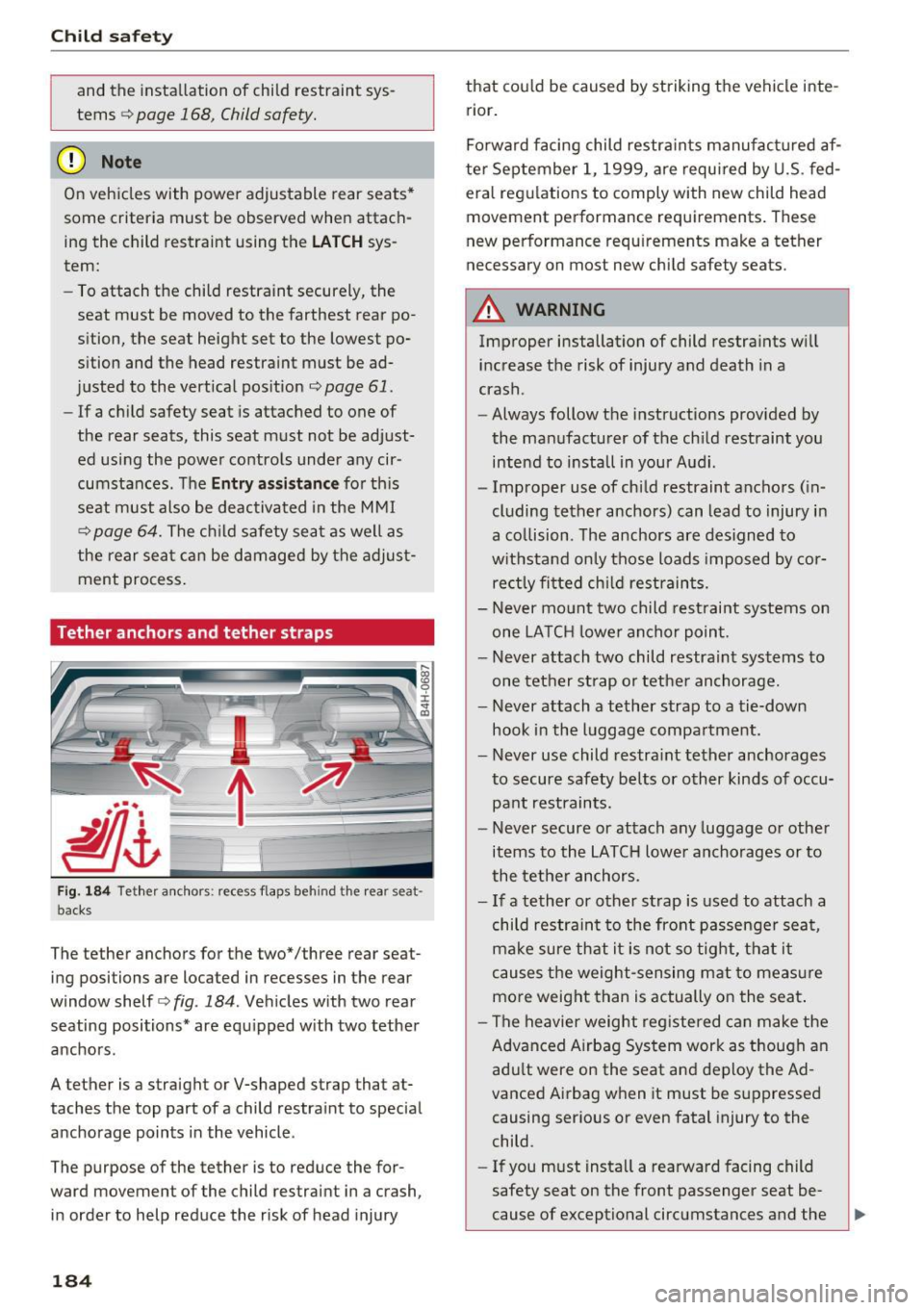
Fig. 18 4 Te ther a nch ors: recess flaps beh ind the rear sea t
ba cks
The tether anchors for the two* /three rear seat
ing positions are located in recesses in the rear
window shelf
r::> fig . 184 . Vehicles with two rear
seating positions* are equ ipped w ith two tether
anchors .
A tether is a straight or V-shaped strap that at taches the top part of a child restraint to special
anchorage points in the vehicle .
The purpose of the tether is to reduce the for
ward movement of the child restraint in a crash, in order to help reduce the risk of head injury
184
that cou ld be caused by striking the vehicle inte
r ior.
Forward facing child restra ints manufact ured af
ter September 1, 1999, a re required by U.S. fed
eral regu lations to comply with new child head
movement performance requirements . These
new performance requ irements make a tether
necessary on most new child safety seats.
A WARNING
Improper installation of child restraints wi ll
i ncrease the risk of injury and death in a
crash .
- Always follow the instructions provided by
the manufacturer of the ch ild restraint you
intend to install in your Audi .
- Improper use of chi ld restraint anchors (in
cluding tether anchors) can lead to injury in
a co llision. The anchors are designed to
w ithsta nd only those loads imposed by cor
rectly fitted ch ild restraints.
- Never mo unt two ch ild rest raint systems on
one LATC H lower anchor poin t.
- Never attach two child restraint systems to
one tether st rap or tethe r anchorage.
- Never attach a tether strap to a tie-down
hook in the luggage compa rtment .
- Never use child restra int tether anchorages
to secure safety belts or other kinds of occu
pant restraints.
- Never secure or attach any luggage o r other
items to the LATCH lowe r anchorages or to
the te ther anchors.
- I f a tether or other strap is used to attach a
child restra int to the front passenge r seat,
make sure that it is not so tight, tha t it
causes the weight-sensing mat to meas ure
more weight than is actually on the seat.
- The heavier weight reg istered can make the
Advanced A irbag Sys tem wor k as though a n
adu lt were on the seat and deploy the Ad
vanced Airbag when it must be suppressed
causing serious or even fatal injury to the
child.
- If you must insta ll a rearward facing child
safety seat on the front passenger seat be
cause of exceptional circumstances and the
Page 187 of 302
PASSENGER A IR BAG O FF light does not
come on and stay on, immediate ly install
the rear-fac ing child safety seat in a rear
seating posit ion and have the airbag system
inspected by your Audi dealer .
Installing the upper tether strap on the
anchorage
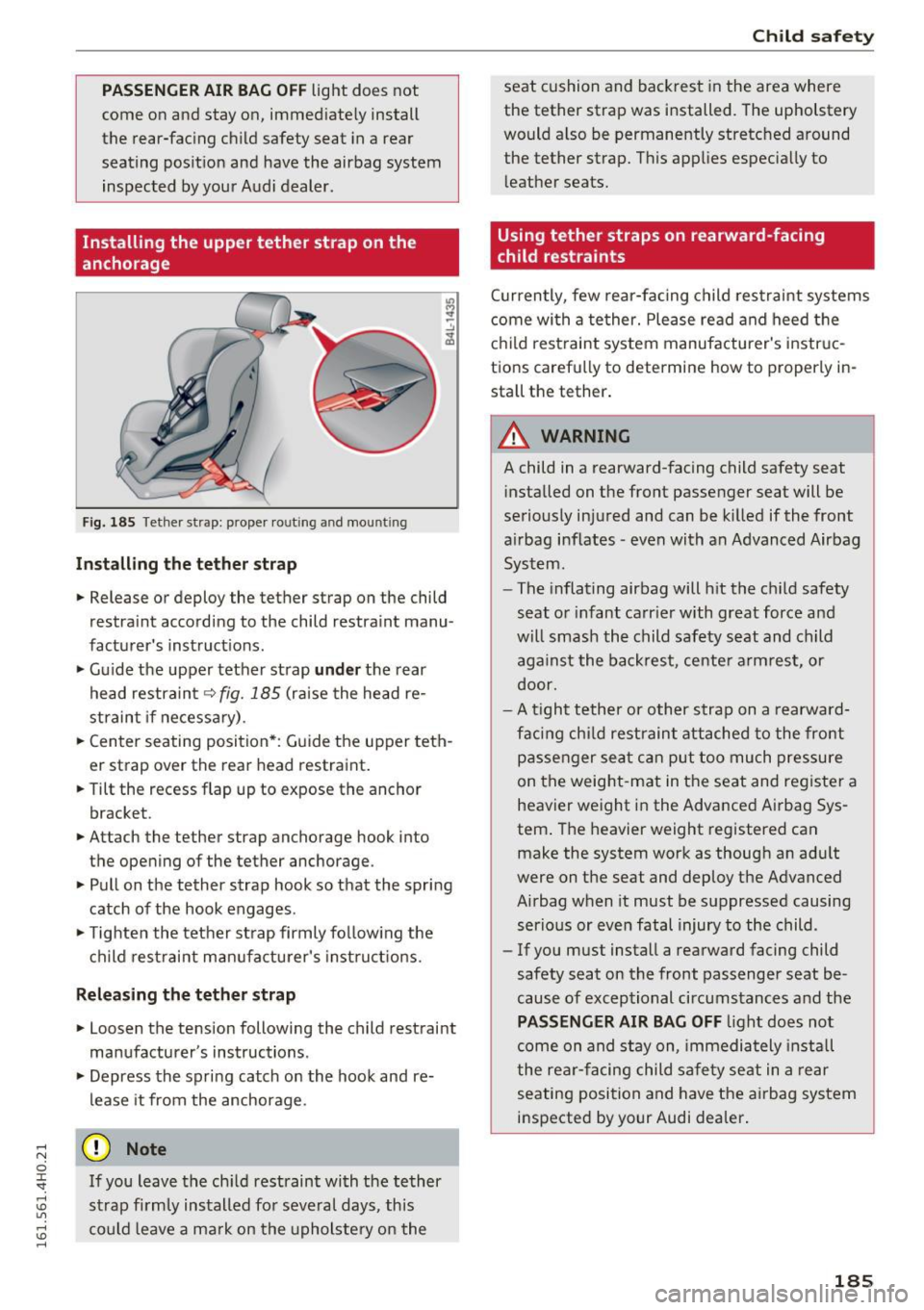
Fig. 185 Tether strap: p roper ro uting a nd moun tin g
In sta ll ing the tether strap
• Release or deploy the tether strap on the child
restraint according to the child restra int manu
facturer's instruct ions.
• Gu ide the upper tether strap
unde r the rear
head restra int ~
fig. 185 (raise the head re
straint if necessa ry) .
• Center seating position*: Guide the upper teth
er strap over the rear head restraint .
• Tilt the recess flap up to expose the anchor
bracket.
• Attach the tether strap anchorage hook into
the opening of the tether anchorage .
• Pullon the tether strap hook so t hat the spring
catch of the hook engages .
• Tighten the tether strap firmly fo llow ing the
c hild rest raint ma nufactu rer's inst ruct ions.
Releasing the tether strap
• Loosen the tens ion following the child restrai nt
manufacturer's instructions .
• Depress the spring catch on the hook and re
lease it from the anchorage .
(D Note
If you leave the child restraint with the tether
strap fi rm ly installed fo r several days, this
co uld leave a ma rk on the upholstery on the
Ch ild sa fety
seat cushion and backrest in the area where
the tether strap was installed. The upholstery
would a lso be permanently stretched around
the tether strap. T his applies espec ia lly to
leather seats.
Using tether straps on rearward-facing
child restraints
Currently , few rear-facing child restraint systems
come with a tether. Please read and heed the
child restraint system manufacturer's instruc
tions carefully to determine how to properly in
stall the tether .
A WARNING
- -
A child in a rearward-facing child safety seat
i nstalled on the front passenger seat will be
seriously in jured and can be killed if the front
a irbag inflates -even with an Advanced Airbag
System.
- The inflating airbag will hit the ch ild safety
seat or infant carr ier w ith great force and
w ill smash the child safety seat and ch ild
against the backrest, cente r a rm rest, or
door.
- A t ight tether or other strap on a rearward
faci ng chi ld restraint attached to the fro nt
passenger sea t can put too much pressure
on the weig ht-mat in the seat and register a
heavier weight in the Advanced Airbag Sys
tem . The heavier weight registered can
make the system work as though an adu lt
were on the seat and deploy the Advanced
A irbag when it must be suppressed causing
serious or even fatal injury to the child .
- If you must install a rearward facing child
safety seat on the front passenger seat be
cause of exceptional circumstances and the
PA SSEN GER AIR BA G OFF light does not
come on and stay on, immediately install
the rea r-facing child safe ty seat in a rear
seating posi tion and have the airbag system
inspected by your Audi dealer .
185
Page 190 of 302
Audi pre sense
(D Tips
-Certain Audi pre sense functions are not
available when ASR is switched
off (sport
mode) or when driving in reverse.
- The Audi pre sense functions may not be
available if there is a ma lfunction in the ESC
system or the airbag control module.
- The Audi pre sense front/plus functions are
not available if there is a malfunction in the
adaptive cruise control* system
c::;, page 97.
- The Audi pre sense rear/plus functions are
not available if there is a malfunction in the
Audi side assist* system
c::;, page 97.
188
Page 191 of 302
Smart Technology Notice about data
recorded by the Event
Data Recorder and
vehicle control modules
E vent Dat a Recorder
This vehicle is equipped wi th an Event Data Re
corder (EDR) . The main purpose of an EDR is to
record, in certain crash or near crash-like situa
tions, such as an a irbag deploym ent or hitting a
road obstacle, data that will assist in understand
ing how a veh icle 's systems performed . The EDR
is designed to record data related to veh icle dy
n amics and safety systems for a short period of
time, typically 30 seconds or less. The EDR in this
ve hicl e is designed to reco rd such data as :
- How various systems in your vehicle were oper
at ing;
- Whether or not the driver and passenger safety
belts were buckled/fastened;
- How far ( if at all) the dr iver was depressing the
accelerator and/or brake peda l; and,
- How fast the ve hicle was trave ling.
These data can he lp provide a better understand
ing of the c ircumstances in which crashes and in
juries occur. NOT E: EDR data are recorded by yo ur
veh icle only if a non-triv ia l crash situation occurs;
no da ta are recorded by the EDR under normal
driving conditions and no personal data (e .g .,
n ame, gender, age, and crash location) a re re
corded . H oweve r, other pa rties, such as law en
fo rcement, cou ld combi ne the EDR data w it h the
t ype of personally iden tifying dat a routine ly ac
q ui red during a crash invest iga tion .
To read data reco rded by an EDR , specia l equip
men t is req uired, a nd access to the ve hicle or the
E DR is needed. In add it ion to the vehicle man u
facturer, other parties, s uch as law enforcement,
that have the specia l equipment, can read the in
formation if they have access to the vehicle or the E DR .
Some state laws restrict the re trieval or down
l oading of data stored by ED Rs insta lled in a vehi
cle for the express purpose of retrieving data af-
Sma rt Technology
ter an accident or cras h event without the own
er 's consent.
Audi will not a ccess the EDR and/or sim ilar data
o r give it to o thers -
- unless the vehicle owne r (o r lessee if the vehi
cle has been leased) ag rees; o r
- upon the official request by the police; or
- upon the order of a court of law or a govern-
ment agency; or
- for the defense of a lawsuit through the jud ic ia l
discovery process.
- Aud i may a lso use the data for research about
veh icle operation and safety performance or
prov ide the data to a third party for research
purposes without identify ing the specific veh i
cle or info rmat io n about the ident ity of its own
er or lessee and only afte r th e re co rded veh icle
d ata has been a ccessed.
Vehicle control modules
Your vehicle is also equ ipped w ith a number of
electronic control modules for va rious vehicle
systems, such as engine ma nagement, emiss io n
contro l, airbags , and s afety be lts .
These elec tronic control modules record data
dur ing no rma l vehicle operation that may be
neede d by trained tech nicians for diagnost ic and
r e pa ir purposes. The re co rding c apab il ity of these
modules is lim ite d t o dat a (no sound is record
ed). Only a sma ll amount of data is actua lly re
corded over a very limited period of time, or stor
ed when a system fault is detected by a contro l
module . Some of the data stored may relate to
vehicle speed, direction, or braking, as well as re
straint system use and performance in the eve nt
of a crash . Stored da ta ca n also on ly be read a nd
down loaded w it h specia l equipment that is d i
r ectly connected to the vehicle.
(D Tips
Your vehicle may be equipped w ith Aud i con
nect . Your use of certai n Aud i connec t fea-
tures requi res wire less serv ices tha t are pro-
v ided by a third party wireless telecomm uni
cations provi der. For de tails regarding how in
formation obtained through Aud i connect is
collected, p rocessed, transmitted, used, and ..,.
189
Page 193 of 302
In extreme cases, EDL automatically switches off
to help keep the brake on the braked wheel from
overheating. EDL w ill switch on aga in a utomati
cally when conditions have returned to normal.
Ste ering recommendat ion
The ESC helps to stabilize the ve hicle by chang ing
the s teering torque .
I n vehicles with dynamic steering*, ESC also
h e lps to s tabilize the stee ring in critical s itua
tions.
Selective wh eel torqu e control
Select ive whee l torque control is used when driv
in g on curves . T he front wheel on the inside of
the cu rve or both wheels o n the inside of the
curve are br aked selec tively as needed . This al
l ows more precise driv ing in curves . The applica
b le system may not activate when driving in wet
or snowy conditions.
Automatic post-collision braking system
The "Automatic post-co llision bra king system"
can help to reduce the ris k of slid ing and of other
coll is ions after an accident. If the airbag contro l
module detects a col lision above a certain vehicle
speed, the vehicle is b raked by t he ESC.
The vehicle does not b rake automatica lly if :
- the driver p resses the accelerator pedal, or
- the braking force generated by the pressed
brake pedal is greate r than the brak ing force
that wou ld be initiated by the system, or
- the ESC, the brake system or the vehicle electri
ca l system are not f unction ing .
Sma rt Technology
A WARNING
- The ESC and its integrated systems cannot
overcome the limits posed by natural physi
cal laws . This is especia lly important on s lip
pe ry o r we t roads .
If the systems beg in act
i n g to stab iliz e your ve hicle, yo u should im
mediately change yo ur speed to ma tch the
road and traffic con dit ions . Do not let the
increased safety provided by these systems
tempt you to take r isks. Do ing so will in
crease the r isk of a loss of vehicle contro l,
coll is ion and serious pe rsonal in juries.
- Always adapt your speed to road, traffic and
weather conditions. The risk of losing con
trol of the vehicle increases when driving too fast, especially through curves and on
slippery or wet roads, and when driving too
close to vehi cles up ahead. The ESC and its
i n teg ra ted systems ca nnot alw ays preven t
coll is io ns -the re is s till a risk of accide nts!
- Always accelerate w ith specia l care on even,
smooth s urfaces su ch as those that are wet
or covere d wi th ice and snow. The d rive
whee ls can spin eve n wit h these assistance
systems that cannot always help to reduce
the risk of loss of vehicle contro l.
(D Tips
-ABS a nd ASR only wo rk cor rec tly when all
four wheels a re equipped wi th identi cal
tires. Diffe rent tire s izes can lead to a red uc
tion i n engine power .
- You may hear noises when the systems de
scribed are working .
191
Page 233 of 302
@ For the sake of the environment
Because of the problem of proper disposal of
brake fluid as we ll as the special toots re
quired and the necessary expertise, we rec
ommend that you have the brake fluid
changed by your authorized Audi dealer .
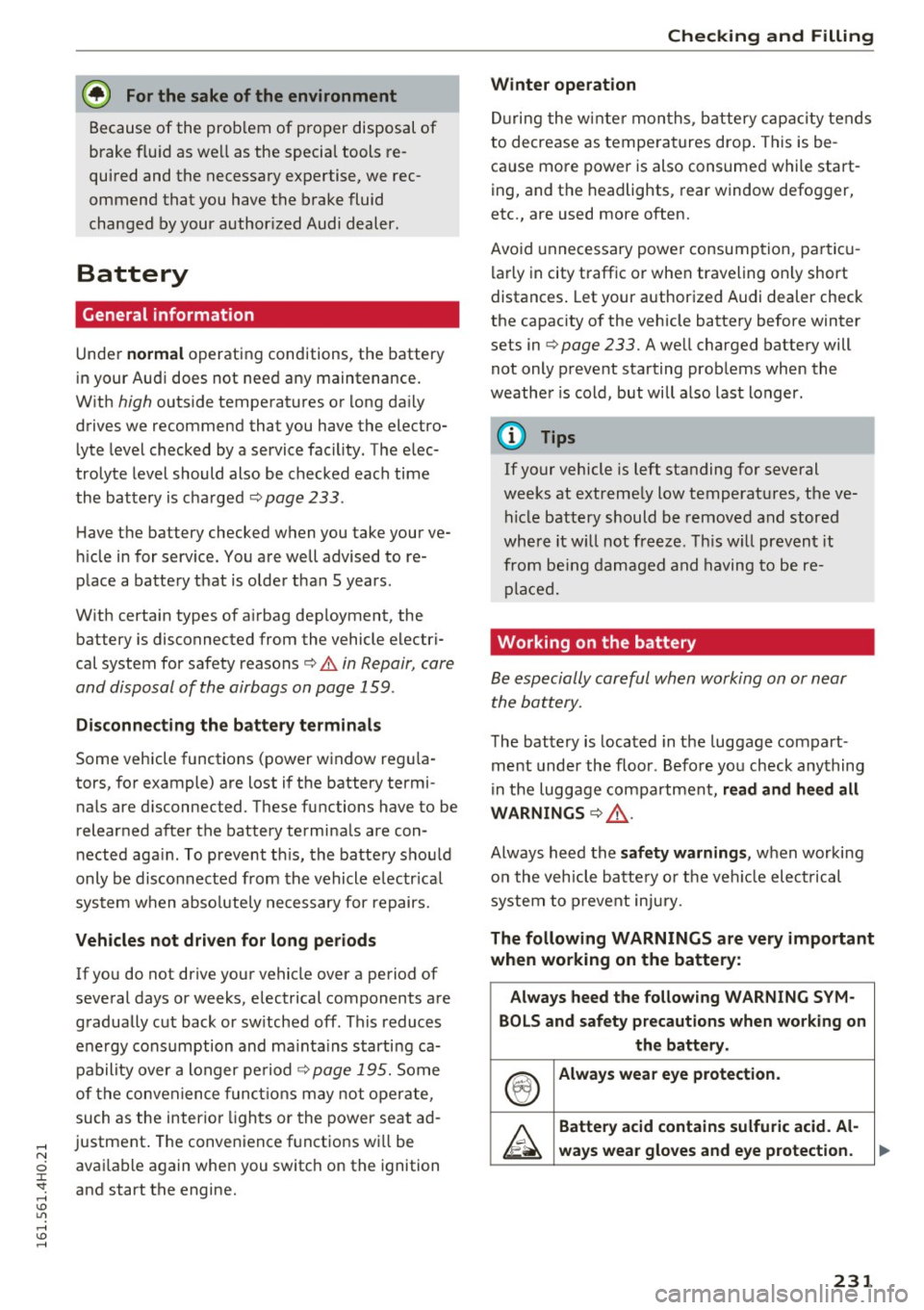
Battery
General information
Under normal operating conditions, the battery
in your Audi does not need any maint enance.
With
high outside temperatures or long daily
drives we recommend tha t you have the electro
lyte level checked by a service facility. The elec
trolyte level should also be checked each time
the battery is charged ¢
page 233.
Have the battery checked when you take your ve
hicle in for serv ice. You are well advised to re
place a battery that is older than 5 years .
With certain types of airbag deployment, the batte ry is disconnected from the vehicle electri
cal system for safety reasons¢
& in Repair, care
and disposal of the airbags on page 159 .
Disconnecting the battery terminals
Some vehicle functions (power window regu la
tors, for example) are lost if the battery te rmi
nals are disconnected. These functions have to be
relearned after the battery terminals are con
nected again. To prevent th is, the battery should
only be disconnected from the vehicle e lectr ica l
system when abso lutely necessary for repairs.
Vehicles not driven for long periods
If you do not drive your vehicle over a period of
several days or weeks, electrical components are
gradually cut back or sw itched off. This reduces
ene rgy consumption and ma inta ins starting ca
pability over a longer period ¢
page 195. Some
of the convenience functions may not operate,
such as the interior lights or the power seat ad
justment. The convenience funct ions will be
ava ilable again when you switch on the ignition
and start the engine.
Checking and Filling
Winter operation
During the winter months, battery capacity tends
to decrease as temperatures drop . This is be
cause more power is also consumed while start
ing, and the headlights, rear window defogger,
etc., are used more often.
Avo id unnecessary power consumption, particu
larly in city traffic or when traveling only short
distances . Let your authorized Audi dealer check
the capacity of the vehicle battery before winter
sets in ¢
page 233. A well charged battery will
not only prevent starting problems when the
weather is cold, but will also last longer .
(D Tips
If your vehicle is left standing for several
weeks at extremely low temperatures, the ve
hicle battery should be removed and stored
where it w ill not freeze . This will prevent it
from be ing damaged and having to be re
placed.
Working on the battery
Be especially careful when working on or near
the battery.
The battery is located in the luggage compart
ment under the floor . Before you check anything
in the luggage compartment,
read and heed all
WARNINGS ¢
&-
Always heed the safety warnings, when working
on the vehicle battery or the veh icle electrical
system to prevent injury.
The following WARNINGS are very important
when working on the battery:
Always heed the following WARNING SYM·
BOLS and safety precautions when working on
the battery.
®
Always wear eye protection.
~
Battery acid contains sulfuric acid. Al-
ways wear gloves and eye protection.
231
Page 270 of 302
Fuses and bulbs
Fuse panel @ (black) Fuse panel@ (black)
7 Front passenger door contro l module
10 ESC contro
l modu le
8 Front passenger powe r window 11 Righ t rear power window
9 ESC control module 12 Front passenger
's seat (pneumatic)
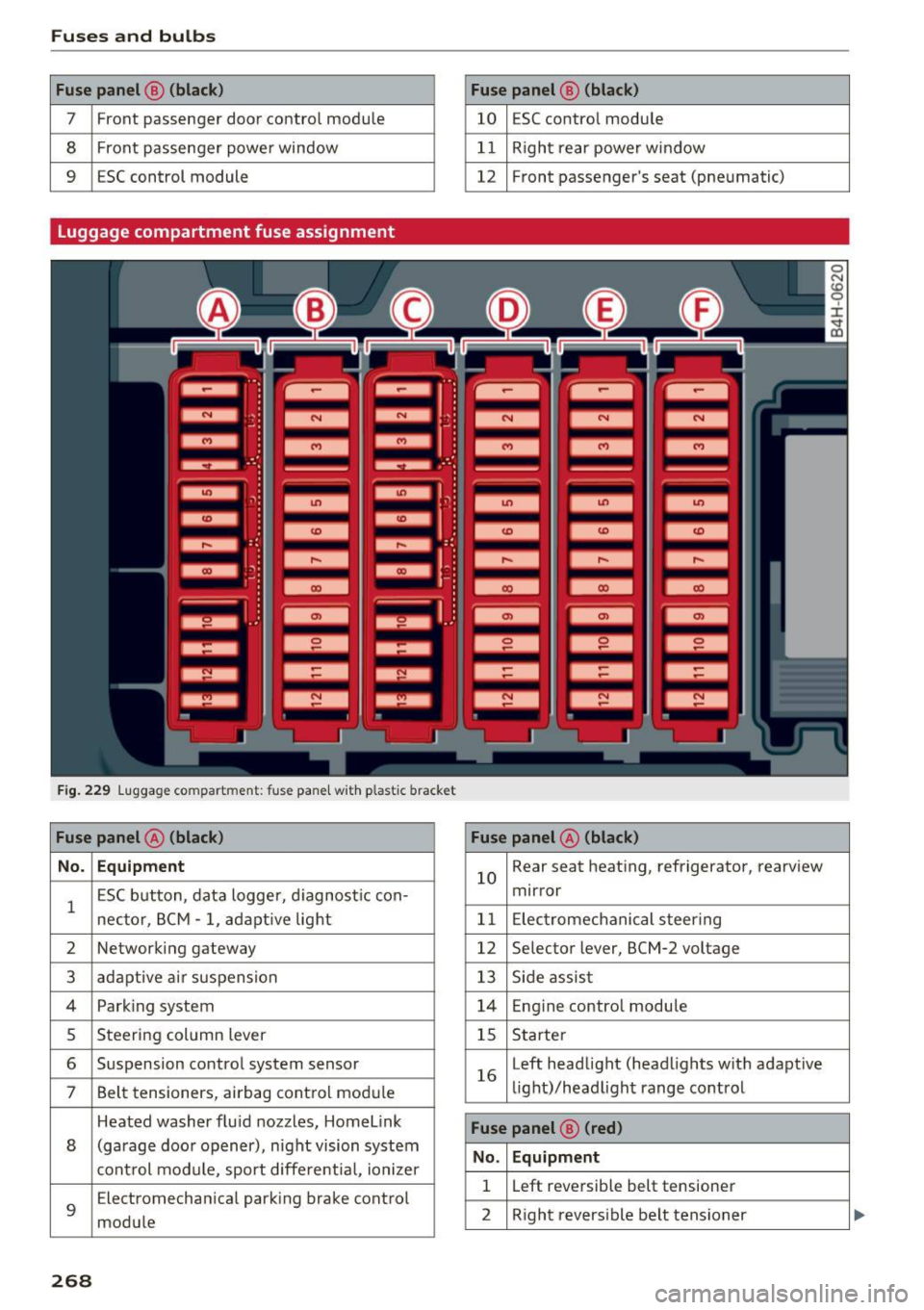
Luggage compartment fuse assignment
F ig. 22 9 lu ggage compartment: fu se pane l wit h plastic bracket
Fuse panel @ (black) Fuse panel@ (black)
No. Equipment
1 ESC b
utton, dat a logge r, d iagnos tic con-
necto r, B CM -1, ad apt ive lig ht 10
Rear
seat heating, refrigerator, rearview
mirror
1 1 E lectrome chanical s teer ing
2 Networking gateway
12 Se
lector lever, BCM-2 voltage
3 ad aptive a ir suspension 13 Side assis t
4 Park ing system 14 Engine contro l module
5 Steeri
ng column lever
15 S
tarter
6 Suspension contro
l system sensor
7 Belt tensioners, airbag cont rol mod ule 16
Left
headlight (headl ights w it h adapt ive
li ght)/headlight range co ntrol
Heated washer fluid nozzles, Home link
8 (garage doo r opener), night vision system
cont rol module, sport differe ntia l, ioni ze r
9
Electromechan ica l park ing brake control
mod ule
Fuse panel ® (red)
No. Equipment
1 L
eft reve rsible belt tensioner
2 R ight revers ible belt tens ioner
268