engine oil AUDI TT 2013 Owner´s Manual
[x] Cancel search | Manufacturer: AUDI, Model Year: 2013, Model line: TT, Model: AUDI TT 2013Pages: 262, PDF Size: 65.91 MB
Page 74 of 262
72 On the road
you leave your veh icle . This makes a vehicle
theft even more difficult ¢ .&. .
Ignition ke y saf ety lock
After swi tching off the ignition, the ig nit ion
key can on ly be removed from the ign it ion
lock when the se lector lever is in the "P"
(Park) position . After you have removed the
key, the selector lever is locked and cannot be
moved.
Ignition on @
If it is diffic ult to turn the key after you have
inserted it into the ignition lock, turn the
steering wheel back and forth. This will take
the load
off the steering lock mechanism and
you will be able to turn the key freely and
start the engine.
Starting the engine @
In this position the engine starts . While the
engine is starting, the power supply to the headlights and other e lectrica l consumers is
temporari ly interrupted to conserve battery
power. After the engine has started, release
the key and it will return to posit ion
(D .
Before the starter can be operated again the
key must be turned back to position @. The
non -repeat loc k prevents you from damaging
the starter when the engine is runn ing .
A WARNING
-Never remove the key from the ign ition
lock whi le the vehicle is moving. The
steeri ng wheel will lock causing loss of
c ontrol.
- If you have to leave your vehicle -even
for just a m inute -always remove t he ig
nition key and take it with you. This is es
pecially important if you a re going to
leave ch ildren behind in the vehicle. The
children co uld start the engine or use
other vehicle controls. Unsupervised use
of vehicle controls (for examp le, power
windows) can cause serious personal in
jur ies .
(!) Tips
If the vehicle battery has been disconnect
ed and then reconnected, then you must
l eave the key in position
(D for about 5
seconds before you can start the engine.
Starting and stopping
the engine
Starting the engine
The engine can only be started with an origi
nal Audi key.
.,. Set the park ing brake.
.,. Move the se lector lever to the neutral posi
tion (automatic transmission): selector lever
in
P or N) ¢ .&_ .
.,. On vehicles with manua l transmission, fully
depress the clutch pedal.
.,. Turn the ignition key to pos it ion @
¢ page 71, fig . 71 -do not depress the gas
pedal when starting the engine!
.,. Let go of the key as soon as the engine
starts.
A cold engine may at first be loud after it has
been sta rted. This is due to the hydrau lic
valves bu ild ing up the oil pressure. This nor
mal and no need for co nce rn .
If the engine does not start immediately, stop
trying after 10 seconds and then try to restart
the engine abou t 30 seconds late r.
A WARNING
Neve r star t or let the eng ine run in a con
f ined or enclosed area . Exhaust fumes
from the engine contain carbon monoxide,
a colorless and odor less gas . Ca rbon mon
oxide can be fatal if inhaled.
- Never leave the engine id ling unattend
ed. An unattended veh icle w ith a runn ing
engine poses a danger of personal injury
or theft.
Page 80 of 262
78 On the road
Audi magnetic ride
Applies to vehicles: with mag netic r ide
Damping can be adjusted to the driver's pref
erence and it adapts automatically to the cur
rent driving situation.
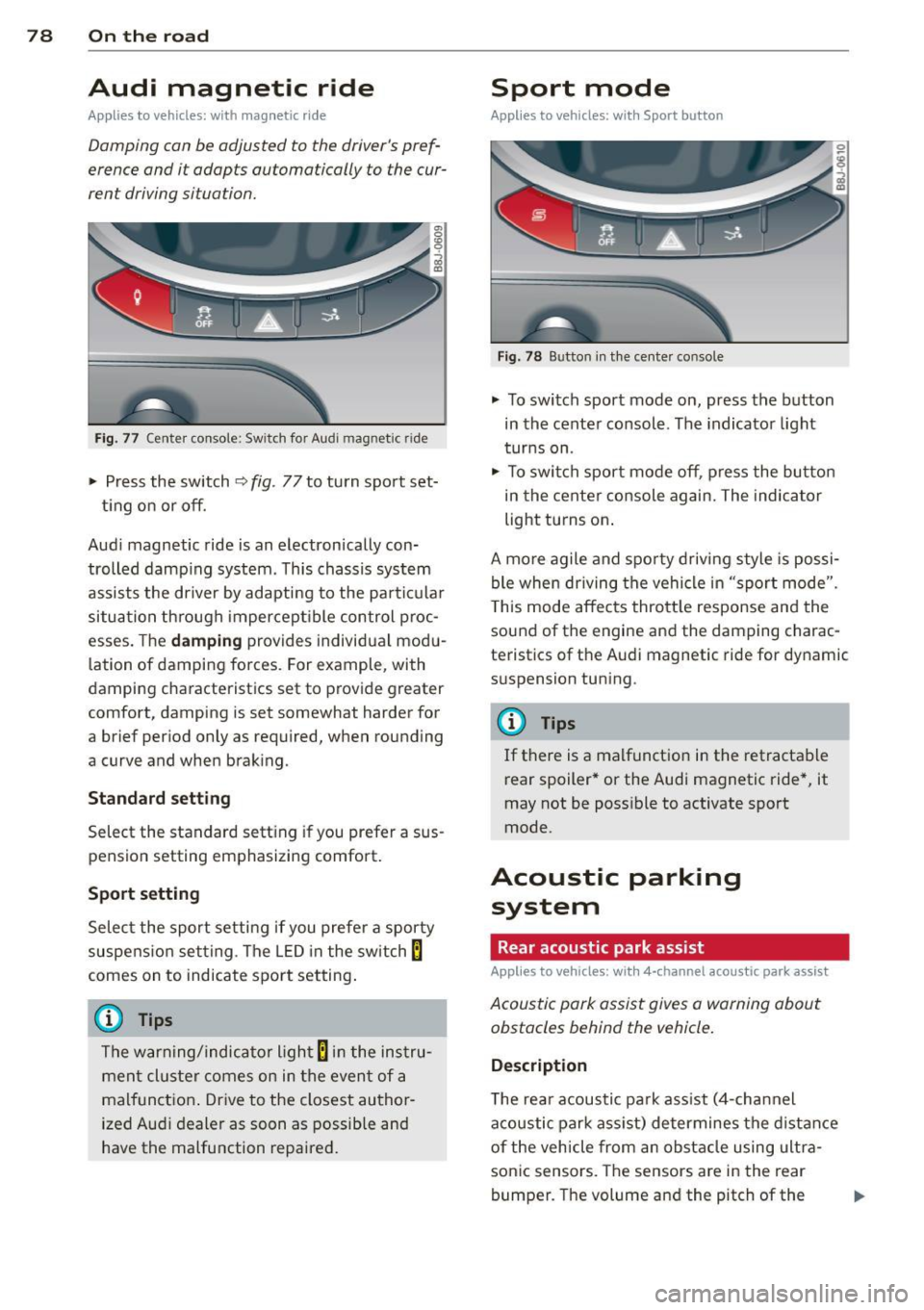
Fig. 77 Cente r console: Switch for Audi magnetic r ide
.,. Press the switch ~ fig . 77 to turn spo rt set-
t ing o n or off.
Aud i magnetic ride is an electron ically con
trolled damp ing system . Th is chassis system
assists the driver by adapting to the par ticular
situatio n th rough imper cep tible con trol p roc
esses. The
damping provides individual mod u
l ation of damping forces. For example, with
dampi ng cha racterist ics set to p rovide greater
comfort, damping is set somewhat harder for
a brief period only as required, when rounding
a curve and when braking.
Standard setting
Select the standard sett ing if you prefer a sus
pension setting emphasizing comfort.
Sport setting
Select the sport setti ng if you prefe r a sporty
suspe nsio n setting . The LED in the sw itch
8
comes on to indicate spo rt setting .
@ Tips
The w arning/indicator light 8 in the in stru
ment cluster comes on in the even t of a
malfunction . Drive to the closest au thor
ized Audi dealer as soon as possible and
have the malfunction repaired.
Sport mode
Applies to vehicles: wit h Sport but ton
F ig . 7 8 Button in th e ce nte r console
.,. To switch sport mode on, press the button
in th e cente r console. The indicator light
t ur ns on .
.,. To swi tch spor t mo de off, press the bu tto n
in the center co nsole again. The indicator
light turns on .
A mo re agile and spo rty d riv in g style is po ssi
ble when driving the vehicle in "sport mode".
T his mode affec ts thrott le response and the
sound of the engine and the damping charac
teristics of the Audi magnetic ride for dynamic
s uspension tuning .
@ Tips
If there is a malfunct ion in the retracta ble
rear spoiler* or the Audi magnetic ride*, it
may not be poss ible to activate sport
mode.
Acoustic parking system
Rear acoustic park assist
Applies to vehicles: wit h 4-channel acoustic park assist
Acous tic park assist gives a warning about
obstacles behind the vehicle.
Description
T he rea r acousti c park ass ist (4-cha nnel
a coustic park ass ist) determines the distance
of the vehicle from an obstacle using ultra
son ic sensors. The sensors are in the rear
bumper. The volume a nd the pitch of the
Page 154 of 262
152 Intelligent technology
Switching ESC off (sport m ode )
In certain situat ions, it m ight make sense to
allow some sl ip. For example :
- Rocking the vehicle to free it when it is stuck
- Driv ing in deep snow or on loose ground
- Driving with snow chains
Press the~ button . The ESC ind icator light
II
turns on and Stabilizati on prog ram off ap
pears in the d isplay. ASR deactivates com
p letely and the stabi lizat ion effects from the
ESC system are limited .
Switc hing on
Press the~ button again. The message Stabi
li zation p rog ram on
appears briefly in the dis
p lay.
A WARNING
Only switch ESC sport mode on when your
driving abilities and the traffic s ituation
permit. Please note that the dr iv ing
wheels can spin and the vehicle can break
away in ESC sport mode, especia lly when
the road is slippe ry.
@ Tips
If the re are faults in the rea r spo ile r sys
tem or in Audi magnet ic r ide, it may not be
possible to a ct ivate ESC spor t mode or
normal mode may a ct ivate aga in a utomat
ically.
n RS: Switching on/off
App lies to vehicles: TI RS Coupe
ESC turns on automatically when you start
the engine.
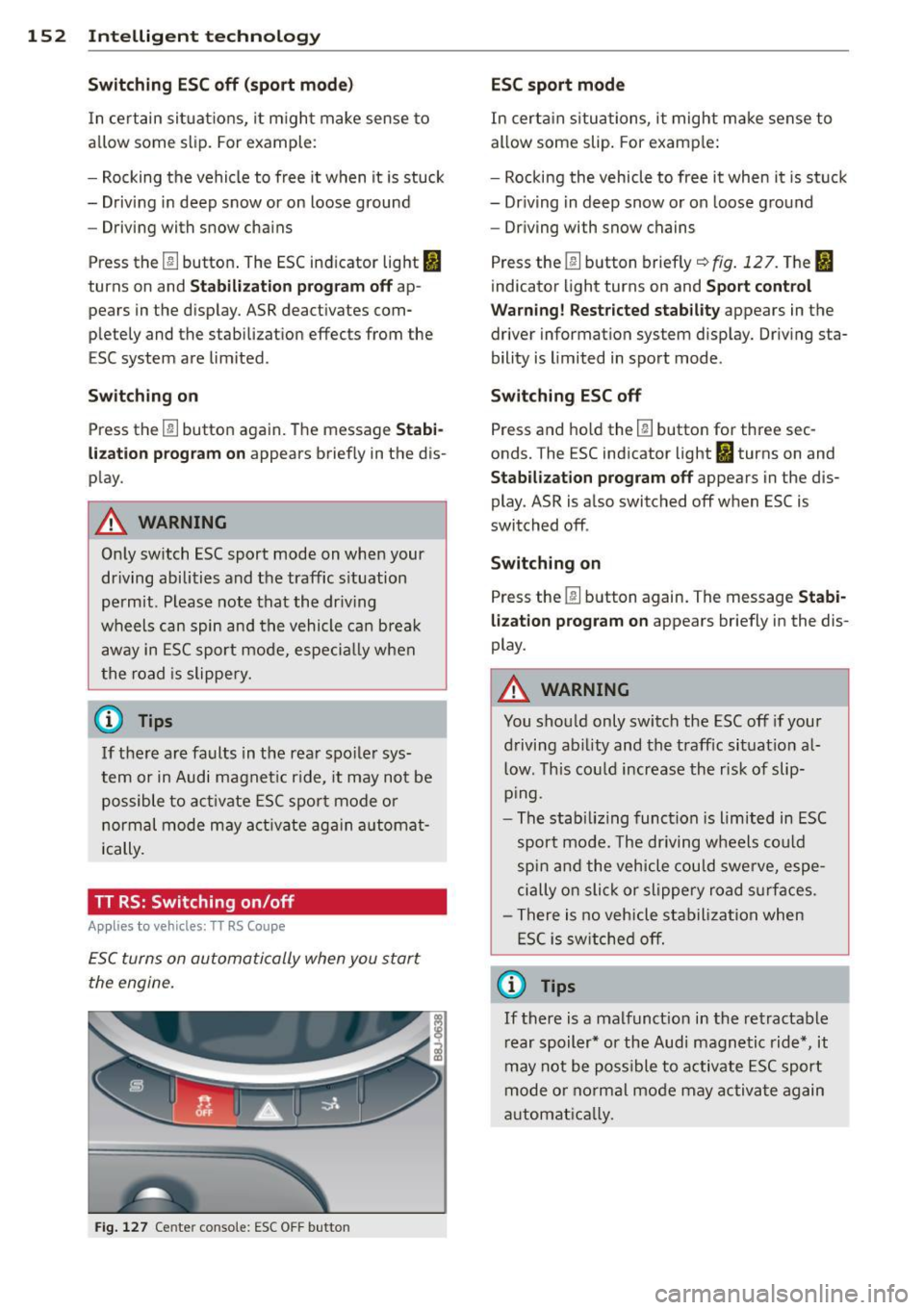
Fig . 12 7 Ce nter console: ESC OFF b utton
ESC sport mode
In certa in situations, i t might make sense to
al low some slip . For examp le:
- Rocking the vehicl e to free it when i t is st uck
- Dr iving in deep snow o r on loose gro und
- Driving with snow chains
Press the~ button briefly ¢
fig. 12 7. Th e fl
indicator light turns on and Spo rt cont rol
Wa rning! Rest rict ed stability
appears in the
driver information system disp lay. Driv ing sta
bility is limited in sport mode.
Switching ESC off
Press and hold the ~ button for three sec
onds. The ESC ind icator light
liJ turns on and
Stabilization program off appears in the dis
play. ASR is also switched
off w hen ESC is
switched
off .
Switching on
Press the~ button again. The message Stabi
lization program on
appears briefly i n the dis
play.
A WARNING
-You should only switch the ESC off i f your
d riving ab ility and the traffic sit uat ion al
l ow . This co uld increase the r isk of slip
p ing.
- The stab ilizing function is limited in ESC
sport mode. The driving wheels could
spin and the vehicle could swerve, espe
cially o n sli ck or slippery road s urf aces.
- There is no veh icle stabilization when
E SC is sw itched
off.
© Tips
If there is a malfunct ion in the re tractable
r ear spoiler* or the Aud i magneti c ride *, it
may not be poss ible to activate ESC sport
mode or no rm al mode may activa te again
a utomat ica lly.
Page 155 of 262
Rear spoiler
Applies to vehicles: with retractable rear spoiler
The rear spoiler improves vehicle handling
and enhances driver control.
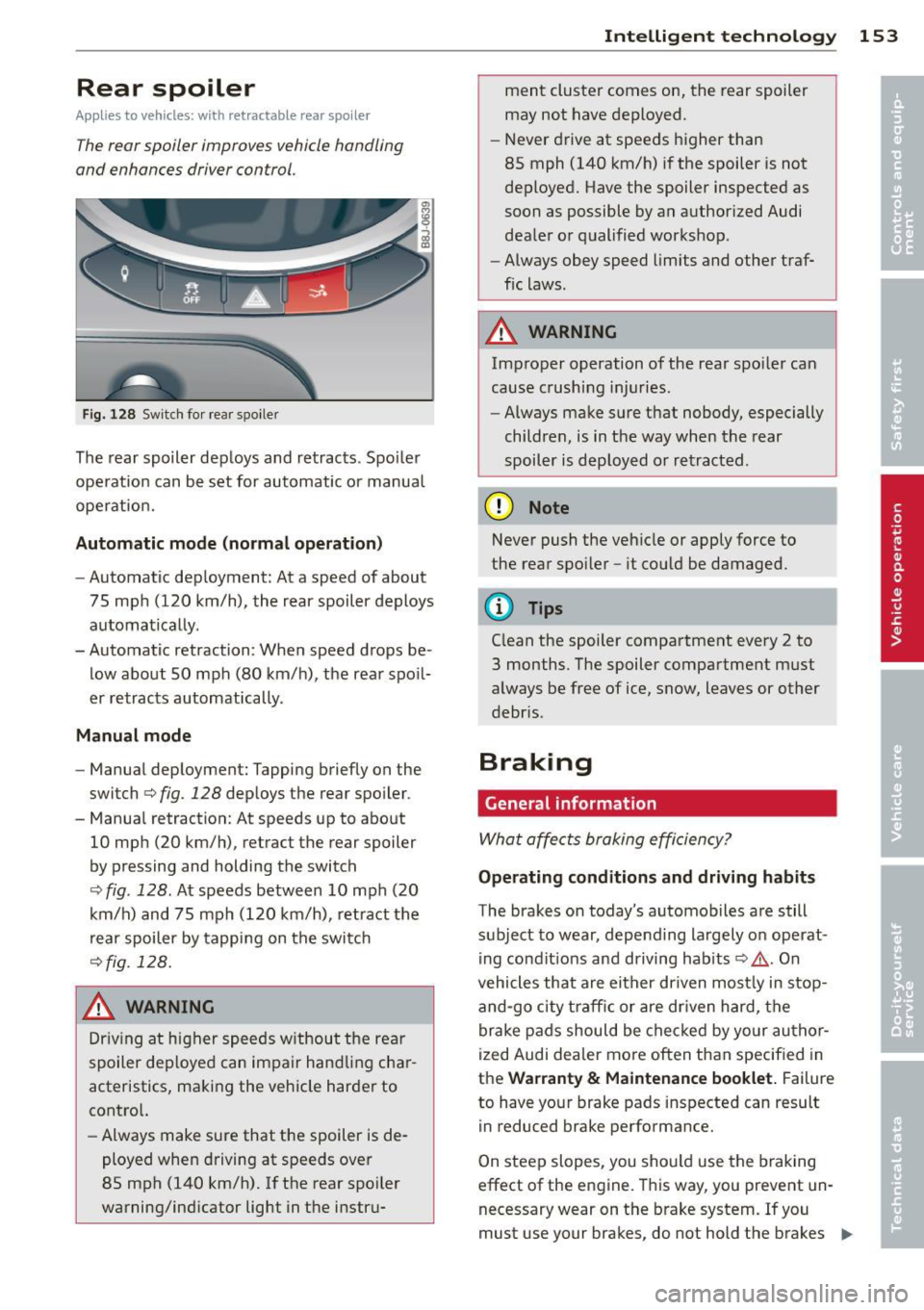
Fig. 128 Switc h for rear spo iler
The rear spoiler deploys and retracts . Spo iler
operation can be set for automatic or manua l
operation.
Automatic m ode (no rmal operat ion )
-Automatic deployment: At a speed of about
75 mph (120 km/h), the rear spoiler deploys
automatically.
-Automat ic retraction: When speed drops be
low about SO mph (80 km/h), the rear spo il
er retracts automatically .
Manu al mode
- Manual deployment: Tapping briefly on the
switch
c:> fig. 128 dep loys the rear spo iler .
- Manual retraction: At speeds up to about 10 mph (20 km/h), retract the rear spoiler
by pressing and holding the switch
c:> fig . 128 . At speeds between 10 mph (20
km/h) and 75 mph (120 km/h) , retract the
rear spoiler by tapping on the switch
c:>fig . 128.
_& WARNING
Dr iv ing at higher speeds w ithout the rear
spoiler dep loyed can impair hand ling cha r
acteristics, making the vehicle harder to
contro l.
- Always make sure that the spoiler is de
ployed when driving at speeds over
85 mph (140 km/h).
If the rear spoiler
warning/ind icator light in the instru-
Intelligen t technolog y 153
ment cluster comes on, the rear spoiler
may not have deployed .
- Never drive at speeds higher than
85 mph (140 km/h) if the spoiler is not
deployed. Have the spoiler inspected as
soon as possible by an authorized Audi
deale r o r qualified workshop .
- Always obey speed limits and other traf
fic laws.
_& WARNING
Improper operation of the rear spoiler can
cause crushing injuries.
- Always make sure that nobody, especially
children, is in the way when the rear
spoiler is deployed or retracted .
(D Note
Never push the vehicle or apply force to
the rear spoi ler -it cou ld be damaged.
{!) Tips
C lean the spoiler compartment every 2 to
3 months. The spoiler compartment must
a lways be free of ice, snow, leaves or other
debr is .
Braking
General information
What affects braking efficiency?
Ope rating cond itions and driving habits
The brakes on today's automobiles a re still
subject to wear, depe nd ing largely on operat
ing condit ions and driving hab its
c:> .&,. . On
vehicles that are either driven most ly in stop
and-go city t raff ic or are dr iven hard, the
brake pads should be checked by yo ur au thor
ized Audi dealer more often than specified in
the
Warr anty & Maintenance booklet. Failure
to have your brake pads inspected can result
in reduced brake performance.
On steep slopes, you should use the braking
effect of the engine. T his way, you prevent un
necessary wear on the brake system . If you
must use your brakes, do not hold the brakes .,.
Page 156 of 262
154 Intellig ent technolog y
down continuously. Pump the brakes at inter
va ls.
Noises may occur when braking depending on
the speed, braking force and outside condi
tions such as temperature and humidity.
Moistu re or road salt
Under certain conditions, for examp le, when
d riving through water or ve ry heavy rain, or
even after washing your vehicle , the bra king
effect can be reduced due to moisture (o r in
freezing conditions ice) on the brake pads. A
few cautious brake applications should dry off
the brake pads or remove any ice coatings.
The effectiveness of the b rakes can be reduced
when the vehicle is driven on a salt -covered
road and the brakes are not used. Likewise,
you clean off accumulated sa lt coating from
brake discs and pads with a few caut ious ap
plications of the brake
q .&. .
Co rrosion
There may be a tendency for dirt to bui ld up
on the brake pads and corrosion to form on
the discs if the car is not driven regularly or
only for short trips with little use of the brakes.
If the brakes are not used frequently, or if cor rosion has formed on the discs, it is advisable
to clean off the pads and discs by braking
f irmly a few times from a moderately high
speed
Q .&. .
Fa ults in th e brak e system
If you should notice a sudden increase in
brake peda l travel, then one of the two brake
circu its may have failed
q .&. .
Low brake flu id le vel
Malfunct ions can occur in the brake system if
the brake fluid level is too low. The brake fluid
leve l is monitored electronically.
B rake boo ste r
The brake booster increases the press ure that
you gene rate w it h the brake pedal. It works
on ly when the engine is running
.Q .&.
Brake lining wear statu s
Brake lining wear may be checked by visual in
spection of the condition of the brake pads
thro ugh the openings in the wheel. If neces
sary, the wheel may be removed for this in
spection
q page 224, What should I be
aware of when changing a tire?.
A WARNING
-- You shou ld perform braking maneuvers
for the purpose of cleaning the brake system only if road conditions permit .
Othe r road use rs must not be put at risk -
you may ca use an accident!
- Before descend ing a steep grade, reduce
speed and sh ift transmission into a lower
gear or lower dr iving range. Do not ride
the brakes or hold the pedal down too
long or too often. This could cause the
brakes to get hot and diminish braking
efficiency.
- Do not "ride the brakes" by rest ing your
foot on the pedal when you do not intend
to brake. This may cause the brakes to
overheat, premature wear and increased
stopping distance .
- Under certain climatic and operat ing
conditions such as passing through wa
ter, dr iving in heavy rain or after washing
the vehicle, the effectiveness of the b rakes can be reduced. In winte r, ice can
accumu late on the bra ke pads, lin ings,
d iscs and drums. Carefully app ly bra kes
for a test . Brakes will dry and ice coat
ings will be cleaned off after a few care
fu l brake applications.
- Driving for an extended period of time on salt-covered roads without using your brakes can a lso affect braking efficiency.
Clean off accumulated salt coating from
brake discs and pads with a few cautious
brake applications .
- If you damage the front spoiler, or if you
install a different spoiler, be sure the a ir
f low to the front brakes is not obstruct-
ed. Otherwise the brake system could
Ill>
Page 157 of 262
overheat reducing the effectiveness of
the ent ire brake system.
- Failure of one brake circuit will impair
the braking capability resulting in an in
creased stopp ing distance. Avoid driv ing
the vehicle and have it towed to the near est Aud i dealer or qualified workshop .
- Never let the vehicle roll to a stop w ith
the engine shut off.
- If the brake booster is not working, for
example when towing your ve hicle, or
because the brake booste r has somehow
been damaged, the brake pedal must be
pressed considerab ly harder to make up
for the lack of booster assistance.
Electro-mechanical
power assist
The electro-mechanical power assist helps
the driver when steering.
The degree of power assist is electronically
matched to vehicle speed.
The power steer ing system ass ists the driver
so that he can stee r the veh icle w ith red uced
phys ica l effort.
Power steering w ill not work if the engine is
off. As a result, the steering wheel w ill be hard
to turn.
& WARNING
If the system develops a prob lem, you
must seek qualified professional assis
tance.
(D Note
-
If there is an electronic malfunct ion, ser
votronic
wi ll sti ll function like a conven
tional power steering system, providing a
constant steering support force that is no
longer proportionate to the vehicle speed.
This is most noticeable when turning the
steer ing wheel at low speeds (for example
when parking), -more effort will be re
quired than usual.
Int ellig ent technolog y 155
-Be aware of the different than usual
steering response and adjust your steer
ing force accordingly.
- Have the problem checked and set right
by an authorized Audi dea ler as soon as
possible.
- If a steering malfunction occurs, this is
signaled with the,~ , or .• indicator
lights and a warn ing tone, see.
(D Tips
- If the power steering system sho uld fail,
or if the engine is not running (for exam
ple, while being towed), you will still be
able to steer the vehicle. However, more
effort will be required to do so.
- If the power steering system is not func
tioning properly, contact your authorized
Audi dealer immediately.
Driving with your
quattro ®
Applies to vehicles : wit h all -w hee l d rive
With oil -wheel drive, oil four wheels ore driv
en.
General information
With a ll-wheel drive, power is distr ibuted to
all four wheels. This happens automatically
depend ing on your driving style and the road
conditions at the time. See also
c::> page 1 SO.
The all-whee l dr ive concept is des igned for
high eng ine power. Your veh icle is except ion
ally powerfu l and has excellent driving charac
teristics both under normal driving conditions
and on snow and ice. Always read and follow
safety precautions
c::> &. .
Winter tires
When dr iving in the winter, your vehicle with
all-wheel drive has an advantage, even with
regular tires. In winter road conditions it may
be advisable to mount winter tires (or all-sea
son tires) for improved driveability and brak
ing: these tires must be mounted on
all fou r
wheels. See also c::> page 211, Winter tires. ..,_
•
•
Page 162 of 262
160 Driving and en vironm ent
Avoid damaging the
vehicle
When you are driving on poor roads, or over
curbs, steep ramps, etc ., make certain that
low-lying parts such as spoilers and exhaust
system parts do not bottom out and get dam
aged.
This is especially true for vehicles with low
slung chassis (sports chassis) and fully loaded
vehicles .
Driving through water
on roads
Note the following to avoid vehicle damage
when driving through water, for example on
flooded roads:
- T he water must not be any highe r tha n the
bottom of the vehi cle body.
- Do no t drive faster than wa lking speed.
_& WARNING
After d riving through water, m ud, slush,
etc., the brakes may be slow to take effect
because o f wet brake ro tors and pads . Dry
the brakes fi rst by braking carefully to re
store the full braking effect.
(]) Note
Vehicle components such as the engine,
transmiss ion, suspension or electrical sys
tem can be severely damaged by driving
through water.
- Check the depth o f the water before driv
ing through it.
- Do not stop the veh icle, dr ive in reverse
or switch the engine
off when driving
through water.
- Keep in mind that oncoming vehicles may c reate waves that raise the water
l evel and make it too deep for your vehi
cle to drive through safely.
- Avoid driving thro ugh salt water because
it can ca use corrosion.
-
Catalytic converter
It is very important that your emission con
trol system (catalytic converter) is function
ing properly to ensure that your vehicle is run
ning in an environmentally sound manner.
.,. Always use lead-free gasoline ¢ page 176,
Fuel supply .
.,. Never run the tank down all the way to
empty .
.,. Never put too much motor o il in your en-
gine ¢
page 185, Adding engine oil 'l::r. .
.,. Never try to push- or tow-sta rt you r vehicle.
The catalyt ic converter is an efficient "clean
u p" dev ice buil t into the exhaust system of
t h e vehi cle. The cata lytic conve rter bu rns
many of t he pollu tan ts in the exha ust gas be
f ore they are re leased into the atmosphere.
T he exclusive use of unleaded fuel is critica lly
important for the life of the catalyt ic convert
er and prope r fu nct ion ing of the engine.
A WARNING
- Do not park or operate the vehicle in
areas where the hot exha ust system may
come in contact with dry g rass, brush,
fue l spill or other material wh ich can
cause a fire.
- Do not app ly additiona l undercoating or
rustproofing on or near the exhaust
manifold, exhaust pipes, catalytic con
verter or heat sh ields. Dur ing driv ing, the
substance used fo r undercoating could
overheat and cause a fire.
(D Note
- Be aware that just one tank filling with
leaded fuel will already ser iously de-
grade the performance of the catalytic
converte r.
- Do not exceed the correct engi ne oil level
¢page 185.
-Do not drive until the fuel tank becomes
completely empty . The engine co uld mis-
fire. Unburned fuel could also get into ..,.
Page 164 of 262
162 Driving and en vironm ent
Reducing unnecessary idling
Even when your car is just idling it burns up
fuel .
.,. Shut the engine off when you are not driv
ing the vehicle.
.,. Do not warm up the vehicle by letting the
engine run at idle .
It makes sense to shut off the engine in traff ic
jams, when waiting for trains to pass at ra il
road crossings, or at traff ic lights that have
l ong wa its on red . Turning the engine off fo r
just 30-40 seconds saves more fue l than is
burned starti ng the eng ine again .
It takes a long time for the engine to warm up
fully when it is running at idle . However , wear
and nox ious em issions are especially high
when the engine is warming up. So you should
drive away as soon as you start the engine and
avoid running at high RPMs whi le the engine
is sti ll warming up.
(D Note
Do not leave engine idling unattended af
ter starting . If warning lights shou ld come
on to indicate improper operation, they
wou ld go unheeded. Extended idling also
produces heat, which cou ld result in over
heating or other damage to the vehicle or
other property .
Regular maintenance
A badly tuned engine unnecessarily wastes a
lot of fuel .
... Have your vehicle serviced at regular inter-
vals.
By having your vehicle regularly serviced by an
Audi dealer helps to ensure that it runs prop
erly and economica lly. The cond it ion of yo ur
vehicle not only affects its safety and ab ility to
hold its value, it also affects
fuel con sump
tion .
Check you r oil ea ch time you fill you r tan k.
The amount o f oi l used is re lated to engine
load and speed.
It i s normal fo r the oil consump tion of a new
engine to reach its lowest value after a certa in
mileage has been d riven.
You must drive your veh icle about 3,000 m iles
(5,000 kilometres) before you can properly
assess oil consumpt ion.
This also app lies to fue l consumption and en
gine o utput.
(D Note
- Have your veh icle ma inta ined properly
and in acco rdance with the service rec
ommendations in your Wa rranty
& Main
t enance boo klet . Lack of p roper ma inte
nance as well as improper use of the ve
hicle will impair the function of the
emission contro l system and cou ld lead
to damage.
- Do not alter or remove any component of
the Emission Control System unless ap
proved
by the manufacturer.
- Do not alter or remove any device, such
as heat sh ie lds, switches, ignit ion w ires,
valves, which are designed to protect
your vehicle's Emission Control System and other important vehicle compo
nents.
Fewer short trips
Fuel consumption will always be relatively
high on short trips .
.,. Try to avoid driv ing short distances w ith a
cold engine .
T he engine and cata lytic converter have to
reach their opt imal
operat ing temperature to
reduce fuel consumpt ion and nox ious emis
s ions effectively .
- Ju st after starting, a cold engine in a mid
size car burns the fue l at a poor rate of 6-8
m iles per gallon (30-40 l/l00km). Half a
m ile down the road, the mileage improves
to 12 MPG (20 l/100 km). It w ill take the
ll>
Page 176 of 262
174 Cleaning and protection
• Once the stain is no longer visib le, use a
soft dry cloth or tissue to soak up the mois
ture.
Do not use leather cleaning products on Al
cantara .
You may use a suitable shampoo fo r remov ing
d ust and dirt.
Dust and grit in the pores and seams can
scratch and damage the surface. If the ca r is
l eft standing i n the sun fo r long periods, the
A lcantara should be protected against direc t
sunlight to prevent it from fading. Slight co lor
variations will deve lop in normal use and are
not an indication of material deterioration.
{[) Note
-Never use chemical solvents (e.g . lighter
fl uid, turpentine), waxes, shoe polis h or
similar products on Alcantara ® surfaces.
- To avoid damage, have stubborn stains removed by a commercial cleaning spe
cia list.
- Do not use br ushes, stiff sponges or sim
ilarly abrasive cleaning aids.
Safety belts
Only well -maintained safety belts work relia
bly when needed .
Heavily soiled safety belts may no t retr act
p roperly.
• Keep be lts clean.
• Fo r cl eaning, use a m ild soap and wate r sol
u tion. Let be lts dry thoro ughly and away
from direct sunlight .
• Do not a llow inertia reel safety be lts to re
tract before they are completely dry .
• Check the condition of your safety belts
reg
ularly.
.&_ WARNING
Damaged safety belts can break in a crash.
1l Use o nly the co rrect cleaning so lu tions. Never use gas
o line or d iese l fue l.
-Anyth ing that might damage your safety
be lts could mean that you and your pas
sengers would not be adequate ly pro
tected in an accident.
- Safety belt performance depends on cor
rect insta llation. Never remove be lts
from the veh icle to clean them .
- Do not use chemical clean ing agents,
b leach or dyes. They have co rrosive prop
erties which wea ken the webb ing.
- When clean ing your safety be lts, inspect
them for damage . If you discover dam
age, see your Audi dealer.
'
- Always read a nd heed all WARNINGS and
the information
<=;> page 164.
Engine compartment
Be especially careful when cleaning the en
gine comportment.
Alway s swit ch off the ign ition before clean
ing the engine <=;>.&, .
Plenum panel
Remove leaves from the plenum panel in front
of the w indshield under the eng ine hood . This
prevents the water drain holes from becoming
blocked, and it prevents debris from enter ing
the vehicle interior t hro ugh the heating and
ventilat ion ducts.
Corrosion protection
T he engine compartment and transmission
have been corrosion -protected at the factory .
Good anti- corrosion treatmen t is very impor
tant, particu larly in the w inter.
If the vehicle
is frequently driven on salt treated roads, the
entire engine compartment and p lenum panel
shou ld be thoroughly cleaned at the end of
winter and retreated to prevent salt damage.
At the same time, the underside of the vehicle
shou ld be washed as well.
If the engine compartment is cleaned at any
time with grease removing solutions
1>, or if ..,.
Page 183 of 262
-Apply the parking brake.
- Move selector lever of automatic trans-
mission to "P" (Park); put manual trans
mission in Neutral.
- Always let the engine cool down . Hot
components will burn skin on contact.
- To reduce the risk of being burned, never
open the hood if you see or hear steam
or coolant escaping from the engine
compartment . Wait until no steam or
coolant can be seen or heard before care
fully opening the hood.
- Keep children away from the engine com
partment .
- Never spill fluids on hot engine compo
nents. They can cause a fire.
- Never touch the radiator fan. The auxili
ary electric fan is temperature controlled
and can switch on suddenly.
- Never open the coolant reservoir cap
when the engine is still warm. The cool
ant system is pressurized and hot cool ant could spray out .
-Protect your face, hands and arm from
steam or hot engine coolant by placing a
thick rag over the cap when you open the
coolant reservoir .
- Do not remove the engine cover under
any circumstances. This increases the
risk of burns.
- If work on the fuel system or the electri
cal system is necessary:
- Always disconnect the battery.
- Never smoke or work near heaters or
open flames. Fluids in the engine com
partment could start a fire.
- Keep an approved fire extinguisher im
mediately available.
- To avoid electrical shock and personal in
jury while the engine is running or being
started, never touch:
- Ignition cables
- Other components of the high voltage
electronic ignition system.
-If you must perform a check or repair
with the engine running:
Checking and filling 181
- First, fully apply the parking brake,
move selector lever of automatic trans
mission to "P" (Park); put manual
transmission in Neutral.
- Always use extreme caution to prevent
clothing, jewelry, or long hair from get
ting caught in the radiator fan, V -belts
or other moving parts, or from contact ing hot parts. Tie back hair before
starting, and wear no clothing that will hang or droop into the engine.
- Minimize exposure to emission and
chemical hazards~,& .
.8, WARNING
California Proposition 65 Warning:
- Engine exhaust, some of its constituents,
and certain vehicle components contain
or emit chemicals known to the State of
California to cause cancer and birth de
fects and reproductive harm. In addition,
certain fluids contained in vehicles and
certain products of component wear con
tain or emit chemicals known to the
State of California to cause cancer and
birth defects or other reproductive harm.
- Battery posts, terminals and related ac
cessories contain lead and lead com
pounds, chemicals known to the State of
California to cause cancer and reproduc
tive harms. Wash hands after handling.
(D Note
When adding fluids, always make sure that
they are poured into the proper container
or filler opening, otherwise serious dam
age to vehicle systems w ill occur.
@ For the sake of the environment
To detect leaks in time, inspect the vehicle
floor pan from underneath regularly. If
you see spots from oil or other veh icle flu
id s, have your vehicle inspected by an au
thorized Audi dealer . •
•