parking brake AUDI TT 2013 Owner´s Manual
[x] Cancel search | Manufacturer: AUDI, Model Year: 2013, Model line: TT, Model: AUDI TT 2013Pages: 262, PDF Size: 65.91 MB
Page 90 of 262
88 Homelink®
Pha se 1:
p rogramming th e ove rhead k eypad
1. Make sure yo ur vehicle is wit hin operating
range of the remote controlled garage
door opener .
2. Set the parking brake¢.&. in General in
formation on page 87 .
3. Tur n the ignition on . Do not start the en
g ine!
4 . Press and hold the two outs ide Home
L ink ® buttons
(D a nd @ for approx i
mately
20 seconds until indicator light @
¢fig . 88 begins to flash . The n re lease
both buttons. Do not hold the buttons for
longer than
30 seconds .
.,. This procedure only needs to be performed
once . It erases the factory-set default codes
and does not have to be repeated to pro
gram add it ional remote controls .
5. Press and hold the Home Link ® button (D ,
® or @ until the indicator light @
starts flashi ng
slowly. Re lease the bu tton.
.,. The system will remain in programming
mode for 5 minutes .
Co to the front of the
vehicle and proceed with phase 2 .
Phase 2:
programming the bumper mounted tran s
m itter
6 . Hold the original remote control at a dis
tance between
0 -6 in . (0 -15 cm) from the
bumper below the appropriate head light
for you r vehicle ¢
fig. 89 (use the shortest
d istance possible).
7 . Aim the remote control just below the
driver sid e head light.
8 . Press and hold the activation button on
the remote contro l.
.,. May be different in Canada.
If so, press and
re-press (cycle) the activation button on your
remote control every two seconds.
9 . The emergency flashers will flash
thre e
tim es
(after about 15-60 seconds) when
the programm ing is successful. Release
the butto n on the remote control.
.,. To program more devices, repeat steps 4 to
9.
10. Press and ho ld the tra ined Homelink ®
button and observe the indicator light @
¢fig. 88.
.,. If the ind icator light is solid/continuous,
programm ing is comp lete and your device
should activate when you press and release
the tra ined Homel ink ® button .
.,. If the ind icator light blinks rapidly fo r
2 sec
onds and is the n a sol id/continuous ligh t,
proceed w ith phase
3 to progr am a roll ing
code device.
Phase 3: rolling code pr ogramming
.,. A second pe rson o n a ladder who ca n safely
reach the garage door opene r motor is rec
ommended .
11. Loca te the "learn" b utton on the ga rage
doo r opener motor ( re fer to the operating
instructions for the opener, as the loca
tion of this button may vary by manufac
turer).
12. Press and release the learn button on the
garage door opener motor .
.,. Not e: once the button is pressed, there are
30 second s in which to in it iate the next
step.
13. On the Homelink ® keypad inside the vehi
cle , fi rm ly press and hold the Homel ink ®
bu tton prev ious ly programmed in phases
1 and 2 for two seconds and release. Re
peat this sequence
twice.
.,. Some vehicles may require the press/hold/
release sequence up to three times to com
plete the trai ning process .
.,. Homelink ® should now activate your rolling
code equipped device .
If the 5 minute time limit is exceeded , the
emergency flash ers will flash one time to in
dicate that the process has been term inated .
In this case, repeat steps 4 through 9.
If the emergency flashers do not flash
three
t imes (after about 15 -60 seconds) , program
ming was not successful. In this case, repeat
steps 4 through 9 .
Remote contro l units for garage door openers
in Canada are set to stop transmitting radio
frequency sig nals afte r two seconds. This t ime ..,.
Page 157 of 262
overheat reducing the effectiveness of
the ent ire brake system.
- Failure of one brake circuit will impair
the braking capability resulting in an in
creased stopp ing distance. Avoid driv ing
the vehicle and have it towed to the near est Aud i dealer or qualified workshop .
- Never let the vehicle roll to a stop w ith
the engine shut off.
- If the brake booster is not working, for
example when towing your ve hicle, or
because the brake booste r has somehow
been damaged, the brake pedal must be
pressed considerab ly harder to make up
for the lack of booster assistance.
Electro-mechanical
power assist
The electro-mechanical power assist helps
the driver when steering.
The degree of power assist is electronically
matched to vehicle speed.
The power steer ing system ass ists the driver
so that he can stee r the veh icle w ith red uced
phys ica l effort.
Power steering w ill not work if the engine is
off. As a result, the steering wheel w ill be hard
to turn.
& WARNING
If the system develops a prob lem, you
must seek qualified professional assis
tance.
(D Note
-
If there is an electronic malfunct ion, ser
votronic
wi ll sti ll function like a conven
tional power steering system, providing a
constant steering support force that is no
longer proportionate to the vehicle speed.
This is most noticeable when turning the
steer ing wheel at low speeds (for example
when parking), -more effort will be re
quired than usual.
Int ellig ent technolog y 155
-Be aware of the different than usual
steering response and adjust your steer
ing force accordingly.
- Have the problem checked and set right
by an authorized Audi dea ler as soon as
possible.
- If a steering malfunction occurs, this is
signaled with the,~ , or .• indicator
lights and a warn ing tone, see.
(D Tips
- If the power steering system sho uld fail,
or if the engine is not running (for exam
ple, while being towed), you will still be
able to steer the vehicle. However, more
effort will be required to do so.
- If the power steering system is not func
tioning properly, contact your authorized
Audi dealer immediately.
Driving with your
quattro ®
Applies to vehicles : wit h all -w hee l d rive
With oil -wheel drive, oil four wheels ore driv
en.
General information
With a ll-wheel drive, power is distr ibuted to
all four wheels. This happens automatically
depend ing on your driving style and the road
conditions at the time. See also
c::> page 1 SO.
The all-whee l dr ive concept is des igned for
high eng ine power. Your veh icle is except ion
ally powerfu l and has excellent driving charac
teristics both under normal driving conditions
and on snow and ice. Always read and follow
safety precautions
c::> &. .
Winter tires
When dr iving in the winter, your vehicle with
all-wheel drive has an advantage, even with
regular tires. In winter road conditions it may
be advisable to mount winter tires (or all-sea
son tires) for improved driveability and brak
ing: these tires must be mounted on
all fou r
wheels. See also c::> page 211, Winter tires. ..,_
•
•
Page 183 of 262
-Apply the parking brake.
- Move selector lever of automatic trans-
mission to "P" (Park); put manual trans
mission in Neutral.
- Always let the engine cool down . Hot
components will burn skin on contact.
- To reduce the risk of being burned, never
open the hood if you see or hear steam
or coolant escaping from the engine
compartment . Wait until no steam or
coolant can be seen or heard before care
fully opening the hood.
- Keep children away from the engine com
partment .
- Never spill fluids on hot engine compo
nents. They can cause a fire.
- Never touch the radiator fan. The auxili
ary electric fan is temperature controlled
and can switch on suddenly.
- Never open the coolant reservoir cap
when the engine is still warm. The cool
ant system is pressurized and hot cool ant could spray out .
-Protect your face, hands and arm from
steam or hot engine coolant by placing a
thick rag over the cap when you open the
coolant reservoir .
- Do not remove the engine cover under
any circumstances. This increases the
risk of burns.
- If work on the fuel system or the electri
cal system is necessary:
- Always disconnect the battery.
- Never smoke or work near heaters or
open flames. Fluids in the engine com
partment could start a fire.
- Keep an approved fire extinguisher im
mediately available.
- To avoid electrical shock and personal in
jury while the engine is running or being
started, never touch:
- Ignition cables
- Other components of the high voltage
electronic ignition system.
-If you must perform a check or repair
with the engine running:
Checking and filling 181
- First, fully apply the parking brake,
move selector lever of automatic trans
mission to "P" (Park); put manual
transmission in Neutral.
- Always use extreme caution to prevent
clothing, jewelry, or long hair from get
ting caught in the radiator fan, V -belts
or other moving parts, or from contact ing hot parts. Tie back hair before
starting, and wear no clothing that will hang or droop into the engine.
- Minimize exposure to emission and
chemical hazards~,& .
.8, WARNING
California Proposition 65 Warning:
- Engine exhaust, some of its constituents,
and certain vehicle components contain
or emit chemicals known to the State of
California to cause cancer and birth de
fects and reproductive harm. In addition,
certain fluids contained in vehicles and
certain products of component wear con
tain or emit chemicals known to the
State of California to cause cancer and
birth defects or other reproductive harm.
- Battery posts, terminals and related ac
cessories contain lead and lead com
pounds, chemicals known to the State of
California to cause cancer and reproduc
tive harms. Wash hands after handling.
(D Note
When adding fluids, always make sure that
they are poured into the proper container
or filler opening, otherwise serious dam
age to vehicle systems w ill occur.
@ For the sake of the environment
To detect leaks in time, inspect the vehicle
floor pan from underneath regularly. If
you see spots from oil or other veh icle flu
id s, have your vehicle inspected by an au
thorized Audi dealer . •
•
Page 223 of 262
The tire sea lant mu st not be us ed :
- for c uts or punctures in the tire which are
l arger than 0.16 inch (4 mm)
q fig. 153 (D
- for damage to the rim@
- if you have been driving with very low ti re
pressures or tires with no air @
Using the
TM S is described in the section
q page 221, Preliminary steps .
TMS can be used at temperatures down to
-4 °F ( -20 °() .
A WARNING
Take the following precautions after re
pairing the tire:
- Do not drive faster than
50 mph (80 km/
h)!
- Avoid full-throttle accelerat ion, heavy
braking and fast cornering .
- The veh icle's road behavior can be affect
ed .
- Tires sealed with
TMS are intended only
for
temporar y, short -term use.
-After using the t ire sealant the tire pres
sure monitoring system may no longer
work prope rly. Drive carefully to the next
professional repair fac il ity.
- TMS must NOT be used,
- for cuts or punctures in the tire which are larger t han 0.16 inch (4 mm)
- for damage to the rim
- if you have been driv ing with very low
tire pressures or t ires with no air
- Seek profess ional assistance if it is not
poss ible to repair the tire with the tire
sealant.
A WARNING
T he tire sealant must not come into con
tact w ith skin, eyes or cloth ing.
- If you get any tire sealant in your eyes or
come into contact with it, r inse the af
fec ted area t ho roughly with cle an wate r.
Find a physician immediately!
- Change any clot hing contaminated with
t ire sea lant immed iate ly.
- Do not inhale the vapo r!
-
What do I d o now ? 221
-If you have swallowed tire sealant, rinse
your mouth thoro ughly right away and
drink plenty of water.
- Do not induce vom it ing! Find a physi
c ian immediately!
- I f you have allergic react ions, find a
phys ician immediately.
- Keep the tire sealant away from children .
(D Note
Do not use commercially available tire
sealants . The e lectr ica l components of the
tire pressu re monitoring system will no
l onge r work properly .
@ For the sake of the env ironment
Used sealant bottles can be dropped off at
a recycling facility.
@ Tips
- If sea lant has run out, allow it to dry.
Then you can peel it off.
- Have the t ire sea lant replaced every 4
years at a dealership.
Preliminary steps
Applies to vehicles: with Tire Mobility System
Some preliminary steps are necessary for tire
repair.
Fig. 154 Lu ggage compartment: Tire Mob ility System
.,.. If you have a flat tire, park the vehicle as far
as poss ib le from moving t raff ic.
.,.. App ly the
parking brake firmly .
.,.. Shift into
1st gear on veh icles with man ual
transmission, or move the
s electo r le ver to
the P po sit io n
on vehicles with automatic
transmiss ion.
Page 256 of 262

254 Index
Park assist . . . . . . . . . . . . . . . . . . . . . . . . . . 78
Park ing ... .. ................ ... 74,82
Parking brake ....................... 73
Park ing brake warn ing ................ 15
Park ing on a decline (downhill) ... .. .... 74
Parking on an incline (uphill) ... ... ... .. 74
Parts rep lacement .................. 245
PASSENGER AIR BAG OFF light . .. ..... 119
Passive safety system . . . . . . . . . . . . . . . . . 90
Pedals .. .... .................. ... .. 95
Phys ica l pr inciples of a frontal coll is ion . 101
Polishing .. .. ............. .. .. .. .. . 167
Pollen filter . . . . . . . . . . . . . . . . . . . . . . . . . 67
Poll utant fi lter .. .. ..... ... .. .. .... .. 67
Powe r locking switch ............ ..... 36
Power locking system . . . . . . . . . . . . . . . . . 34
Conven ience close/open feature ..... .. 40
Lock ing and unlocking the vehicle from
in side ... .. ... .... ...... ... ... .. .. 36
Opening and clos ing the w indows ...... 40
Rear lid/t runk l id ................... 37
Remote cont rol .......... .. .. .... . . 33
Un lock ing and locking veh icle ... .. .. . . 35
Powe r outlets
63
Powe r seats
Ad justment ............. .. .. .. .. .. 56
P ower steering
refer to Electro -mechanica l power as -
sist . . . . . . . . . . . . . . . . . . . . . . . . . 17, 155
Powe r window switches . . . . . . . . . . . . . . . 39
Reactiva ting t he system . .. .. .. .... .. 4 1
Pregnant women Specia l cons iderations when wearing a
safety belt .... .... ...... .. .. .. .. . 105
Programming the Homelink ® universal re
mote contro l . . . . . . . . . . . . . . . . . . . . . . . . 87
Pr ope r occupant sea ting pos it ions .. .... 9 1
Proper safety belt pos it ion ........ .... 105
Prope r seat ing posit ion
Front passenger . . . . . . . . . . . . . . . . . . . . 92
Occupants ......................... 91
Rear passengers . . . . . . . . . . . . . . . . . . . . 93
Q
Qua rtz clock . . . . . . . . . . . . . . . . . . . . . . . . 11 quatt
ro ®
refer to All-whee l drive
Question What happens to unbelted o ccupants?
Why sa fe ty belts? ............. ... .
R
15S
102
100
Radiator fan ...... ............. .... 189
Rain sensor defective . . . . . . . . . . . . . . . . . 21
Reading ligh ts ... .. .. ... ..... ... .. .. . 45
Rea r lid ....... .... .... ........... .. 37
Emergency re lease . . . . . . . . . . . . . . . . . . 38
Rear light defect ive . . . . . . . . . . . . . . . . . . 20
Rea r spo ile r . .. .. .. ... .. ..... ... .. .. 153
Rear v iew m irror ........ ........... .. 47
Rear window defogger . . . . . . . . . . . . . . . . 70
Rea r window s helf . . . . . . . . . . . . . . . . . . . 58
Refuell ing .. .... .. ............. .... 178
Re lease lever for hood . .. ..... ... .. .. 180
Remote contro l . . . . . . . . . . . . . . . . . . 33, 36
Remote contro l garage door opener
(Homelink ®) .. .. .. ............. .. .. . 87
Remote maste r key
U nlocking and locking ... .... ... .. .. . 35
Remote rea r lid re lease . ...... ...... .. 37
Repair ma nuals ..................... 243
Repa irs
Airbag system ... .. ... ..... ... .. .. 122
Rep lacement parts ........... ....... 245
Rep lacing
Wheel rims .... .. ............. .... 207
Rep lacing a fuse ... .. .... .... ... .. .. 228
Replacing light bulbs ........... ... .. 231
Rep lacing tires and wheels ........ .... 208
Rep lac ing windsh ield w iper b la d es . .. .. . 51
Repo rting Sa fety Defects .............. 98
Reset button . . . . . . . . . . . . . . . . . . . . . . . . 12
Resetting remote contro l . . . . . . . . . . . . . . 36
Retractor . . . . . . . . . . . . . . . . . . . . . . . . . . 104
Reverse (Automat ic transm iss ion) .. .... . 81
Rims Cast alloy ..... ....... ........... . 169
Replac ing . .... .. ............. .... 20 7
Stee l rim s ... .. .. ............. .... 169
Page 259 of 262
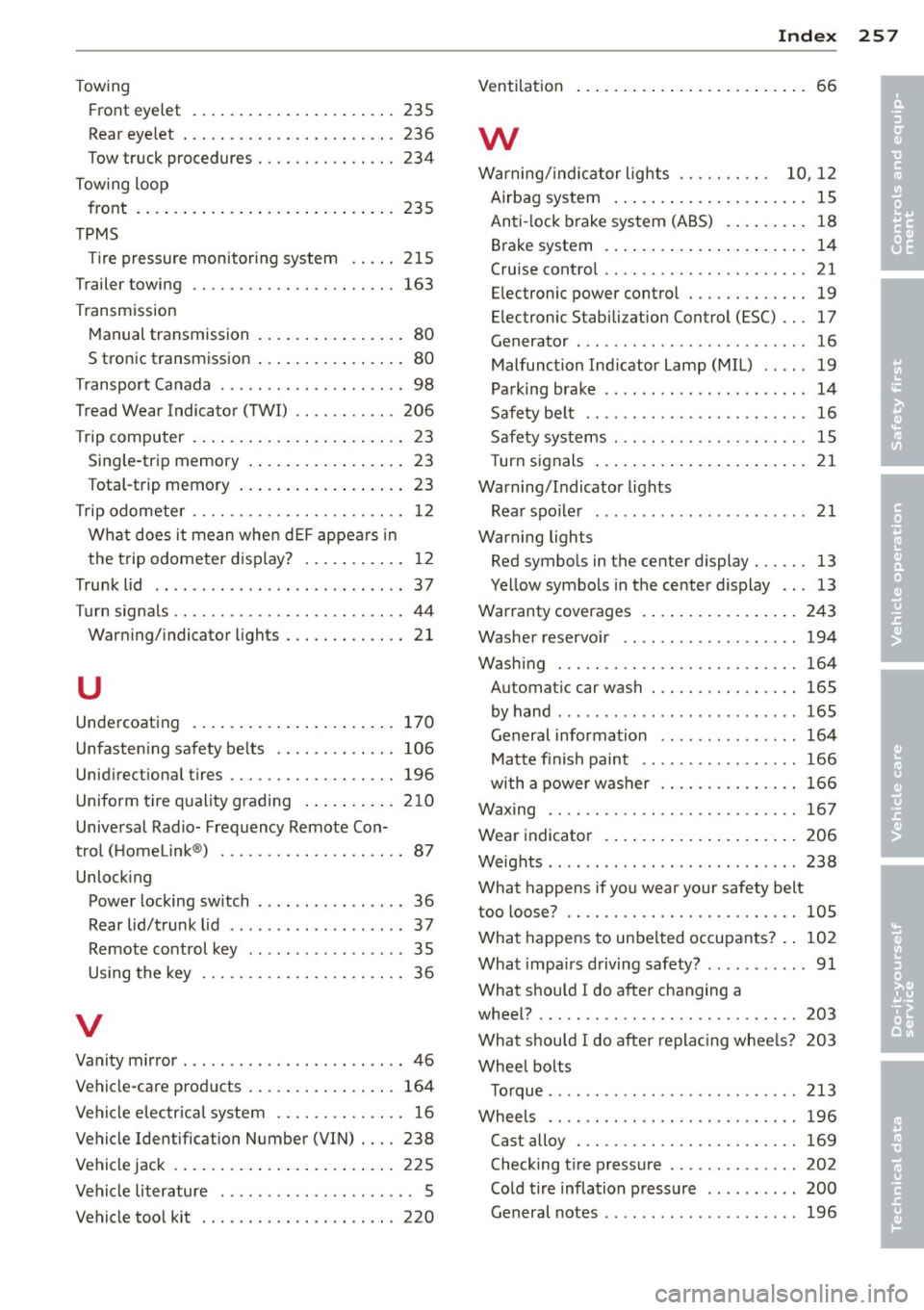
Towing Front eyelet ................ ... ... 235
Rear eyelet ................. ... .. . 236
Tow truck procedures ...... .. .. .. .. . 234
Towing loop front .... .. .. ................ .... 235
TPMS Tire pressure monitoring system .. .. . 215
Trailer towing ............. .... .. .. . 163
Transmission Manual transmission ......... ... .. .. 80
S tronic transmission ......... ... .. .. 80
Transport Canada .......... .. .. .. .. .. 98
Tread Wear Indicator (TWI) .. .. .. .. .. . 206
Trip computer . . . . . . . . . . . . . . . . . . . . . . . 23
Single-trip memory .......... ... .. .. 23
T otal-trip memory . . . . . . . . . . . . . . . . . . 23
Trip odometer ............. .... .. .. .. 12
What does it mean when dEF appears in
the trip odometer display? ....... .. .. 12
Trunk lid . . . . . . . . . . . . . . . . . . . . . . . . . . . 3 7
T urn signals .. .. ........... .. .. .. .... 44
Warning/indicator lights ..... .. .. .. .. 21
u
Undercoating
170
Unfasten ing safety belts .... .. .. .. .. . 106
Unidirectional tires ......... .. .. .. .. . 196
Uniform tire quality grading ....... .. . 210
Universal Radio- Frequency Remote Con-
trol (Homelink ®) . . . . . . . . . . . . . . . . . . . . 87
Unlocking Power locking switch ...... .. .. .. .. .. 36
Rear lid/trunk lid ............ .. .... . 37
Remote control key ....... .. .. .. .. .. 35
Using the key ............ .. .. .. .... 36
V
Vanity mirror . .. .............. ... ... . 46
Vehicle-care products .......... ... .. . 164
Vehicle electrical system .... .. .. .. .. .. 16
Vehicle Identification Number (VIN) . .. . 238
Vehicle jack . ... .............. ... ... 225
Vehicle literature . . . . . . . . . . . . . . . . . . . . . 5
Vehicle tool kit ............ .. .. .. .. . 220
Index 257
Ventilation . . . . . . . . . . . . . . . . . . . . . . . . . 66
w
Warning/indicator lights . . . . . . . . . . 10, 12
Airbag system ... .. ................ 15
Anti-lock brake system (ABS) . . . . . . . . . 18
Brake system . . . . . . . . . . . . . . . . . . . . . . 14
Cruise control .. .. ................. . 21
Electronic power control . . . . . . . . . . . . . 19
Electronic Stabilization Control (ESC) .. . 17
Generator . ....... ................. 16
Malfunction Indicator Lamp (MIL) .. .. . 19
Parking brake .. .... ... .. ..... ..... . 14
Safety be lt .. .. .. .. . .............. . 16
Safety systems . .. .... ........... .. . 15
Turn signals . . . . . . . . . . . . . . . . . . . . . . . 21
Warning/Indicator lights Rear spoiler ...... ................. 21
Warning lights Red symbols in the center display . .. .. . 13
Yellow symbols in the center display .. . 13
Warranty coverages . ................ 243
Washer reservoir .. .... ........... .. 194
Washing ... .. .. .. ................. 164
Automatic car wash . ... ..... ... .. .. 165
by hand ......... .. ............... 165
General information ..... .. .... .... 164
Matte finish paint .... ........... .. 166
with a power washer ........... .... 166
Waxing .... .. .. .. .. . .............. 167
Wear indicator ...... ............... 206
Weights .......... .. ..... .......... 238
What happens if you wear your safety belt
too loose? ...... ...... ............. 105
What happens to unbelted occupants? . . 102
What impairs driving safety? .. .... .... . 91
What should I do after changing a
wheel? ..... .. .. .. ... ............ .. 203
What should I do after replacing wheels? 203
Wheel bolts Torque ...... .. .... .......... ..... 213
Wheels .... .. .. .. ................. 196
Cast alloy . .. .. .. ................. 169
Checking tire pressure ......... .... . 202
Cold tire inflation pressure ......... . 200
General notes . . . . . . . . . . . . . . . . . . . . . 196
•
•