fuel AUDI TT 2013 Owner´s Manual
[x] Cancel search | Manufacturer: AUDI, Model Year: 2013, Model line: TT, Model: AUDI TT 2013Pages: 262, PDF Size: 65.91 MB
Page 163 of 262
the exhaust system and this could cause
the catalytic converter to overheat.
- Do not turn off the ignition while the ve
hicle is moving .
- Do not con tinue to operate yo ur vehicle
under these conditions, as otherwise fuel
can reach the cata lytic converter . This
could result in overheating of the con
verter, requ iring its replacement.
- To assure efficient operation of the Emis
sion Control System:
- Have your veh icle ma inta ined properly
and in acco rdance with the service rec
ommendations in your Wa rranty
&
Ma intenan ce booklet.
- Lac k of proper maintenance as well as
improper use of the vehicle will impa ir
t he funct ion of the emission control
system and cou ld lead to damage.
@ For the sake of the environment
Even when the Emission Contro l System is
operating p roperly, the exhaus t gas can
have a s ulfu r- like exhaust gas smell under
some operating states. This depends on
the s ulfur content o f the fue l being used.
Using a different brand of fuel may help,
or filling the tank w ith lead-free super
grade gasoline .
Operate your vehicle
economically and
minimize pollution
General
Your personal style of driving will determine
the economy of your vehicle, as well as ex
haust and noise levels .
Fuel economy, environmental impact, and
wear on your engine, brakes and t ires largely
depend on three factors :
- your persona l driving style
- operating conditions
- technical lim itations
I f you anticipate w hat you need to do nex t and
d rive economically, you can eas ily cut your
Dri vin g and en vironm ent 161
fuel consumption by 10 -15 percent. Th is sec
tion w ill give yo u some tips on how you can
help the env ironment and your pocketbook .
(D Tips
The cons umption estimates as published
by ENVIRONME NTAL PROTEC TION AGENCY
(EPA) and Transport Canada may not corre
spond to your actual consumption on the road, which will vary depending upon vehi
cle load and speed, road and weather con
dit ions, trip length, etc.
Drive smoothly and keep a lookout
ahead
Vehicles use the most fuel when they are ac
celerating.
Avoid unnecessary accelerat ing and braking .
Vehicles use the most fuel when they are ac
ce lerat ing . If you anticipate what is going to
happe n next, you will need to brake less and,
th us, accele rate less. Let the vehicle coast
whenever possible -for examp le when you see
that the next t raff ic light is red.
Avoid full throttle
Driving at moderate speeds saves fuel and
improves your mileage.
"' Try and keep well below your car's maxi -
mum speed.
Acce lerat ing gently reduces fue l consump
tion, eng ine wear, and does not disturb the
environment.
Fuel consumpt ion, exhaust emiss ions and en
gine noise increase disproportionately at high
speeds. If you drive at approximately three
quarte rs of top speed, fuel consumption w il l
be reduced by one half. Never drive faster
t h an the posted speed limit and weathe r con
ditions perm it.
•
•
Page 164 of 262
162 Driving and en vironm ent
Reducing unnecessary idling
Even when your car is just idling it burns up
fuel .
.,. Shut the engine off when you are not driv
ing the vehicle.
.,. Do not warm up the vehicle by letting the
engine run at idle .
It makes sense to shut off the engine in traff ic
jams, when waiting for trains to pass at ra il
road crossings, or at traff ic lights that have
l ong wa its on red . Turning the engine off fo r
just 30-40 seconds saves more fue l than is
burned starti ng the eng ine again .
It takes a long time for the engine to warm up
fully when it is running at idle . However , wear
and nox ious em issions are especially high
when the engine is warming up. So you should
drive away as soon as you start the engine and
avoid running at high RPMs whi le the engine
is sti ll warming up.
(D Note
Do not leave engine idling unattended af
ter starting . If warning lights shou ld come
on to indicate improper operation, they
wou ld go unheeded. Extended idling also
produces heat, which cou ld result in over
heating or other damage to the vehicle or
other property .
Regular maintenance
A badly tuned engine unnecessarily wastes a
lot of fuel .
... Have your vehicle serviced at regular inter-
vals.
By having your vehicle regularly serviced by an
Audi dealer helps to ensure that it runs prop
erly and economica lly. The cond it ion of yo ur
vehicle not only affects its safety and ab ility to
hold its value, it also affects
fuel con sump
tion .
Check you r oil ea ch time you fill you r tan k.
The amount o f oi l used is re lated to engine
load and speed.
It i s normal fo r the oil consump tion of a new
engine to reach its lowest value after a certa in
mileage has been d riven.
You must drive your veh icle about 3,000 m iles
(5,000 kilometres) before you can properly
assess oil consumpt ion.
This also app lies to fue l consumption and en
gine o utput.
(D Note
- Have your veh icle ma inta ined properly
and in acco rdance with the service rec
ommendations in your Wa rranty
& Main
t enance boo klet . Lack of p roper ma inte
nance as well as improper use of the ve
hicle will impair the function of the
emission contro l system and cou ld lead
to damage.
- Do not alter or remove any component of
the Emission Control System unless ap
proved
by the manufacturer.
- Do not alter or remove any device, such
as heat sh ie lds, switches, ignit ion w ires,
valves, which are designed to protect
your vehicle's Emission Control System and other important vehicle compo
nents.
Fewer short trips
Fuel consumption will always be relatively
high on short trips .
.,. Try to avoid driv ing short distances w ith a
cold engine .
T he engine and cata lytic converter have to
reach their opt imal
operat ing temperature to
reduce fuel consumpt ion and nox ious emis
s ions effectively .
- Ju st after starting, a cold engine in a mid
size car burns the fue l at a poor rate of 6-8
m iles per gallon (30-40 l/l00km). Half a
m ile down the road, the mileage improves
to 12 MPG (20 l/100 km). It w ill take the
ll>
Page 165 of 262
engine no less than two and a half miles
(4 km) of driving to warm up to its proper
operating tempe ratu re and ope rate at an
economic mileage. This explains w hy taking
t h e car for s hort tr ips is a rather wastefu l
convenience .
- The
outs ide temperature is also cr itical in
t hi s regard. Your car consumes more fuel in
the winter than in the summer .
Trailer towing
General information
Your Audi TT Coupe is not designed to tow a
trailer.
Tow ing a tra ile r with you r Audi T T Coupe is not
r eco mmended a nd can cause damage to t he
c a r. Damaged caused by towing a tra iler is not
covered by yo ur Audi War ranty .
Driving and environment 163
•
•
Page 166 of 262
164 Cleaning and protection
Cleaning and
protect ion
General information
Regular core preserves vehicle value .
Any automobile is exposed to industrial
fumes, corrosive road salt, etc. A well cared
for Audi can look like new many years after purchase . Regular and correct care w ill con
tr ibute to maintaining the beauty and value of
your Aud i.
Furth erm ore, goo d car e m ay be a c onditi on
for substantiat ing a warrant y claim shou ld
c orrosion dam age or paint d efe ct s occ ur.
Your author ized Audi dealer has a variety of
d ed ica ted vehicl e-ca re product s and can ad
vise which ones to use for cleaning the exter i
or and inte rior of your vehicle .
Whether you use products recommended by
Aud i or other commercially ava ilable clean ing
agents, please make sure you apply them cor
rectly .
A WARNING
-Cleaning agents may be poisonous. Keep
them out of the reach of children.
- Heed all caut ion labels.
- Always read directions on the container
before using any product . Follow the di
rect ions carefu lly.
- Most chemical cleaners are concentrated
and have to be diluted.
- Use spot removing fluids only in well
ventilated areas.
- Do not use gasoline, kerosene, d iesel
fuel, nail pol ish remover or other volati le
fluids. They may be toxic, flammab le or
hazardous in other ways. Do not wash,
wax or dry the vehicle with the ignit ion
on or the engine running.
- Do not clean the undersides of chassis,
fenders, wheel covers, etc. without pro
tecting your hands and arms. You may
c u t yourself on sharp-edged metal parts . -
Moisture and ice on brakes may impair
brak ing eff ic iency
c::> page 153 , General
information.
Test the brakes carefully
each time you wash the vehicle .
@ For the sake of the environment
Select on ly environ mentally friendly clean
i ng products. Leftover cleaning products
should not d isposed of in the househo ld
waste .
Care of exterior
Washing
Frequent washing protects the vehicle .
The best protection against environmental in
fluences is
frequent washing and waxing . How
often this is required depends on:
- How much the veh icle is used
- Where the veh icle is parked (garage, in the
open under trees, etc.)
- The seasona l and weather conditions
- Environmental infl uences
T he longer b ird droppings, insects, tree resin,
road and indus tria l gr ime, ta r, soot, road salt
and other materials remain on the vehicle paint, the more lasting their destructive ef
fects wi ll be .
High tempera tures, as from expos ure to in
tense sunlight, intensify the corrosive e ffect
particularly when humidity is high as well.
Under certa in ci rc u mstances,
we ekly washing
may be necessary. Unde r othe r cond it ions, a
monthly washing and waxing may be ade
quate.
After the winter, the unders ide of the vehicle
sho uld be thoro ughly washed p re ferab ly in a
pro fessional ca r wash.
A WARNING ~
A lways read and heed all WARNINGS and
the information
c::> page 164.
Page 168 of 262
166 Cleaning and protection
sponges to prevent scratches. It is best
to use soapy water .
- You should remove debris (such as in
sects) from the headlight lenses on a
regular basis, for example when refuel
li ng your vehicle.
@ For the sake of the environment
On ly wash the vehicle in facilit ies specially
designed for that purpose. This w ill reduce
the risk of d irty water contaminated with
oil from entering the sewer system. In
some areas, washing vehicles outs ide of
these facilities is prohib ited.
Washing your vehicle with a power
washer
Cleaning the exterior of your car with a high
pressure power washer is safe as long as you
observe a few simple rules.
• Before using the power washe r, make sure
you have read and understood the WARN
I N GS 9 .&. in General information on
page 1 64.
• Always fo llow the opera ting ins truc tions for
the power washer.
• Make sure that the jet on the spray hose
produces a "fan shaped spray" .
• Do
no t ho ld the spray no zzle too close to
soft materia ls.
Keep a distance from soft materials such as
rubber hoses or insulat ing mater ial as we ll as
sensors and camera lenses.
When clea ning the vehicle wit h a power wash
er
always f o llow the operating instructions .
This applies particularly to the operating pres
sure and the spraying distance. Do not po int
the spray directly at the sea ls around the s ide
windows, a round t he doors, on the rear lid or
on the su nroof* . Likew ise, do not point it di
r e ctly at t ires, r ubber hoses, insul ation mate
rial or sensors. Hold t he sp ray noz zle at least
1.3 ft ( 0.4 m) away from the vehicle.
D o not use a h igh-pressure powe r washer to
r emove snow and i ce. D
o not use a jet which sprays water in a d irect
stream o r one that has a rotating jet .
Water temper ature sho uld n ot ex ceed 140 °F
(6 0 °C).
A WARNING ~ -
N eve r wash t ires wi th a jet that sprays wa
ter i n a direct stream. This could cause in
v is ib le damage to the t ires and weaken
them, even if the spray is from a re lative ly
l ong distance and for a short time. Dam
aged and weakened tires can fail a nd cause
a ccidents and pe rsonal i njury.
([) Note
To avoid damaging your vehicle, a lways
make sure that there is suffic ient d istance
between the spray head and soft materia ls
like rubber hoses, plast ic pa rts and sound
deade ning ma ter ia ls as w ell as s ensors
and camera lenses. Neve r aim t he sp ray
head a t the same point fo r a long time.
This also applies to cleaning headligh ts
and painted bumpers. Remembe r: the
closer the nozzle is to the surface of the
materia l, the greater the stress on the ma
terial.
Caring for vehicles with matte finish
paint
Applies to vehicles: with matte finish paint
Vehicles with ma tte finish paint require spe
cial care due to the characteristics of the
paint.
Wa shing by hand
To avoid damaging the paint when washing,
first remove dust and large par ticles from
your vehicle. Insects, grease spots and fi nger
pri nts are best removed w ith a
special cleaner
for matte finish paint .
Apply the product us ing a microfiber cloth . To
avo id damag ing the pa int surface , do not use
too much pressure . ..,.
Page 169 of 262
Rinse the vehicle thoroughly with water. Clean
the vehicle starting at the top and working to
ward the bottom using a
ne utral shampoo
and a soft m ic ro fi ber cloth . Stop frequently to
rinse the cloth thoroughly.
Clean the wheels and sill panels last. Use a
clean
s p on ge on these areas .
Rinse the vehicle tho roughly aga in and let it
air dry . If there are any water spots, they can
be removed using a
le athe r cloth.
Clean aga in with the s peci al cl ean er for matt e
fini sh p aint
if necessary.
R emoving stubborn dirt
B ird d ropping s or tree sap
are best removed
with p lenty of water and a m icrofiber cloth .
You should r inse
off ga soline residue immedi
ately with plenty of water .
A WARNING
-Wash your veh icle only when the ignition
is switched
off to reduce the risk of a
c rash .
- Always read and heed all WARNINGS and
othe r information
r=;> page 164.
(D Note
-Do not treat vehicle parts painted w ith
matte finish paint using polish ing mate
r ials or hard wax. These products could
cause damage to the appea rance or sur
face that cannot be repaired.
- Never use protective wax.
It can destroy
the matte fin is h effect.
- Do not p lace any st ickers or magnetic
s igns on vehicle parts painted w ith
ma tte finish paint. The pa int co uld be
damaged when the stickers or magnets
are removed .
- To prevent pa int damage, do not wash
the veh icle in direct sunl igh t.
- To prevent damage to the paint su rface,
do no t use insect removal sponges,
r o ugh kitchen sponges or similar items.
- You should remove debris (such as in
sects) from the headl igh t lenses on a
Cleaning and protec tion 167
regu lar bas is, for example when re fuel
ing your vehicle . Only clean the head
lights using a wet cloth or sponge, never
a dry one. Cleaning with soapy water is
recommended.
(D Tips
For more information on special clean ing
products designed for matte f inish paint,
see your Aud i dea ler.
Waxing and Polishing
Wa xing
A good wax coating pro tects the vehicle paint
to a large extent against the environmental
factors listed under
r=;> page 164, Washing and
even against s light scratches.
You can use a liquid car wax to protect your paint as soon as one week after your vehicle
has been delivered.
Even if you regularly use a
wa xing process in
automa tic car washes, we recommend that
you manually apply a coat of wax to g ive the
paint extra protection, part icularly if water no
longer beads on the clean paint .
Protect plastic body parts with car wax in the
same way as the veh icle body .
D uring warm weather dead insects tend to
collect on the front bumper and on the for
ward area of the hood. They are much easier
to remove from pa int that is waxed
often .
Polishing
Polish your vehicle only if the paint has lost its
shine and the g loss cannot be brought back
with wax.
If the polis h used does not contain p reserva
tive compounds, the paint must be waxed af
terwards.
A WARNING
-Always read and heed all WARNINGS and
other information
¢ page 164 .
•
•
Page 178 of 262
176 Fuel supply and filling your fuel tank
Fuel supply and filling
your fuel tank
Gasoline
Fuel supply
Using the right fuel helps keep the environ
ment clean and prevents engine damage .
Fuel recommendation
The fuel recommended for your vehicle is un
lead ed premium
grade gasoline . See also
¢
page 240, Data . Audi recommends using
TOP TIER Detergent Gasoline with a minimum
octane rating of 91 AK I (95 RON). For more
information on TOP TI ER Detergent Gasoline,
p lease go to the officia l website (www.toptier
gas.com).
The recommended gasoline octane rating for
your engine can also be found on a label locat
ed on the inside of the fuel filler flap. This rat
ing may be specified as AKI or RON.
Your veh icle may also be operated using un
l eaded regular gasoline with a minimum oc
tane rating of 87 AKI/91 RON. However, using
87 AKI/91 RON octane fuel wi ll slightly re
duce engine performance.
Use unleaded gasoline only. Unleaded gaso
line is available throughout the USA, Canada ,
and in most European countries . We recom
mend that you do not take your vehicle to
areas or countries where unleaded gasoline
may not be available.
F or more information on refueling your vehi
cle, see¢
page 177.
Octane rating
Octane rating ind icates a gasoline's ability to
resist engine damaging "knock" caused by
premature ign ition and detonation. Therefore,
buying the correct grade of gasoline is very
important to help prevent possible engine
damage and a loss of engine performance.
Gasoline most commonly used in the United
States and Canada has the following octane r
atings that can usually be found on the fi ller
pump:
- Premium Grade: 91 -96 AKI
- Regular Grade: 87 -90 AKI
Explanation of the abbreviations:
AKI = Anti Knock Index= (R+M)/2 = (RON
+MON )/2
RON= Research Octane Number
MON = Motor Octane Number .
(D Note
-Do not use any fuel w ith octane ratings
lower than 87 AKI or 91 RON otherwise
expensive engine damage will occur.
- Do
not use leaded gasoline! The use of
leaded gasoline w ill severely damage
your vehicle's catalytic converter and its
ability to control exhaust emissions.
Blended gasoline
Use of gasoline containing alcohol or
MTBE (methyl tertiary butyl ether)
You may use unleaded gasoline blended with
alcohol or MTBE (commonly referred to as
oxygenates) if the blended mixture meets the
following criteria:
Blend of gasoline methanol (wood alcohol or
methyl alcohol)
-Anti -knoc k index must be 87 A KI or higher.
- Blend must contain no more than 3% meth-
anol.
- Blend must contain more than 2% co-sol-
vents .
Blend of gasoline and ethanol (grain alcohol
or ethyl alcohol)
-Anti -knock index must be 87 AKI or higher.
- Blend must not contain more than 10%
ethanol.
Blend of gasoline and MTBE
-Anti-knock index must be 87 AKI or higher. ll-
Page 179 of 262
-Blend must contain not more than 15%
MTBE.
Seasonally adjusted gasoline
Many gasoline grades are blended to perform
espec ially we ll for winter or summer driving.
During seasonal change-over, we suggest that
you fill up at busy gas stat ions where the sea
sonal adjustment is more likely to be made in
time .
(D Note
-Methanol fuels which do not meet these
requirements may cause corrosion and
damage to plastic and rubber compo
nents in the fuel system .
- Do not use fue ls that fail to meet the
specified criter ia in this chapter.
- If you are unable to determine whether
or not a particular fue l blend meets the
specifications, ask your service station or
its fuel supp lier.
- Do not use fuel for which the contents
cannot be identified.
- Fuel system damage and performance
problems resulting from the use of fuels
different from those specified are not
the responsibility of Audi and are not
covered under the New Vehicle or the Emission Control System Warranties.
- If you experience a loss of fuel economy
or driveability and performance prob l ems due to the use of one of these fuel
blends, we recommend that you switch
to unblended fuel.
Gasoline additives
A major concern among many auto manufac
turers is carbon deposit build- up caused by
the type of gasoline you use.
Although gasoline grades differ from one manufacturer to another , they have certain
things in common. All gasoline grades contain
substances that can cause deposits to collect
on vital engine parts, such as fuel injectors
and intake valves. Although most gasoline brands include additives to keep engine and
Fuel supply and filling your fuel tank 177
fuel systems clean, they are not equally effec
tive .
A udi recommends using TOP TIER Detergent
Gasoline. For more info rmation on TOP TIER
Detergent Gasoline, please go to the official
website (www.toptiergas.com).
After an extended period of using inadeq uate
fuels, built-up carbon deposits can rob yo ur
engine of peak performance.
Q) Note
Damage or malf unct ion due to poor fue l
quality is not covered by the Aud i New Ve
hicle Limited Warranty.
Fuel tank
Fuel filler neck
The fuel filler neck is located on the right rear
side panel behind the fuel fille r flap.
If the unlocking system should fail, you can
still open the flap manually -for detailed in
structions see
¢ page 179.
You can find the fuel tank capacity of your ve hicle in
Technical Data ¢ page 240.
The label on the inside of the fuel fi ller flap
tells you the correct fue l for your vehicle. For
more information about fuel specifications,
see
¢ page 176.
Your vehicle fue l tank has an on -board refue l
li ng vapor recovery system. This feature helps
to prevent fuel vapors from escaping from the
tank and polluting the environment while you refuel your vehicle . In order to fill the tank
properly while protecting the environment,
please fo llow this refueling procedure careful
ly.
_&. WARNING
Under normal operating conditions, never
carry additional fuel containers in your car.
Gas canisters and other containers used to
transport f uel can be dangero us. Such con
tainers, full or empty, may leak and could
cause a fire in a collision. If you must
•
•
Page 180 of 262
1 78 Fuel supply and filling your fuel t ank
transport fue l to use for your lawn mower,
snow blower, etc., be very careful and al
ways observe local and state laws regard
ing the use, transportat ion and storage of
such fuel containers . Make certain the con
tainer meets industry standards (A NSI/
AS TM F852 -86) .
(D Note
Never drive your vehicle unti l the fuel tank
is completely d ry. The irreg ular s upply of
fuel can cause misfir ing. Gasoline cou ld
e nte r into the exhaust system and damage
t he cata lytic conve rter.
Refuelling
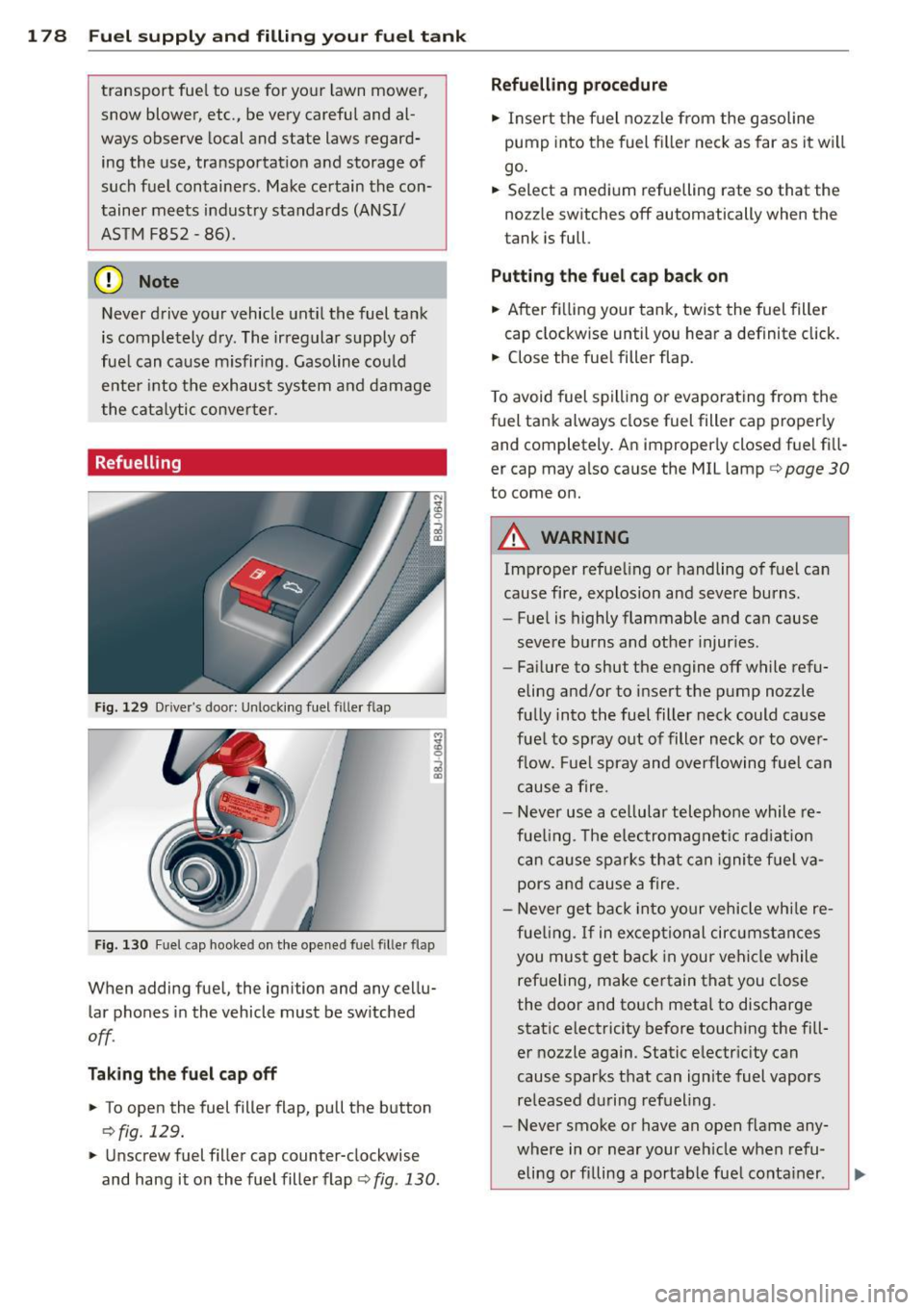
Fi g. 12 9 Drive r's doo r: Un lo cki ng fuel f ille r flap
Fi g. 130 Fu el cap hooke d on the opened fuel filler flap
When adding fue l, the ignition and any ce llu
lar phones in the vehicle must be sw itched
off .
Tak ing the fuel cap off
• To open the fuel filler flap, pull the button
r:> fig. 129.
• Unscrew fuel filler cap counter-clockwise
and hang it o n the fuel filler flap ¢
fig. 130 .
Refuelling procedure
• Insert the f uel no zz le from the gasoline
pump into the fuel fi ller neck as far as it w ill
go .
• Select a med ium refuelling rate so that the
no zz le sw itches off automatically when the
tank i s full.
Putting the fuel cap back on
• After fi lling your tank, twist the fuel filler
cap clockw ise until you hear a definite click.
• Close the fue l filler flap.
T o avoid fuel s pill ing or evaporating from the
fuel tank always close fuel filler cap properly and completely . An improperly closed fuel fi ll
er cap may also cause the MIL lamp¢
page 30
to come on.
A WARNING
Imp roper refue ling or handling of fuel can
cause fire, explosion and severe burns.
- Fue l is highly flammable and can cause
severe burns and other injur ies .
- Fai lure to shut the engine off while refu
eling and/or to insert the pump nozzle
fu lly into the fuel filter neck could cause
fuel to spray out of filler neck or to ove r
f low. Fuel spray and overflowing fuel can
cause a fire.
- Never use a ce llu lar telephone whil e re
fue ling . Th e e lec tromagnet ic radiat io n
can cause spa rks th at can igni te fuel v a
pors an d cause a fire.
- N ever get back in to your vehicle whi le re
fue ling.
If in excep tio nal cir cumstances
you must get back in your vehi cle while
ref ueling, make ce rtain that you close
the door and touch metal to discharge
static electricity be fore touching the fill
er nozzle again . Static e lectr icity can
cause sparks that can ignite fuel vapors
re leased d uring refueling .
- Never smoke or have an open f lame any
where in or near your ve hicle when refu
eling or fi lling a portable fue l conta iner .
Page 181 of 262
-For your safety, we strongly recommend
that you do not trave l w ith a portab le
fuel container in your vehicle. The con
tainer, full or empty may leak and cou ld
cause a fire, especially in a crash.
- If, under except ional circumstances, you
must transpo rt a portable fuel container,
please observe the following:
- Never f ill a portable fue l container
while it is anywhere in or on the vehicle (for examp le, in the luggage compart
ment, or on the tr unk) . Static electric i
ty can bu ild up while f illing and ca n ig
n ite fuel vapors causing a f ire.
- Always place a portable fuel container
on the ground before filling .
-Always keep the fi ller nozzle comp lete
ly inside the portable conta iner before
a nd during filling.
- If filling a portable container made of metal, the filler nozz le must always be
in contact with the containe r. Th is w ill
he lp prevent static electricity from dis
charging and cause a fi re.
- Never sp ill fuel inside the vehicle or
luggage compartment. Fuel vapors are
h ighly flammable.
- Always observe local and state/p rov in
cial laws regard ing the us e, storage
and trans po rt ation of fuel con tainers.
- Make certa in the fuel conta iner meets
in du stry standards (ANSI/ ASTM
F8 52-86).
(D Note
If any fuel has spilled onto the ca r, it
should be remov ed immed iate ly to prevent
damage to the paint.
@ For the sake of the environment
As soon as the correctly operated nozzle sw itches off automatically fo r the fi rs t
time, th e tank is full. Do not try to add
more fue l because fuel may spill ou t. In
a dd ition, the exp ansio n sp ace in the fuel
t ank will be f illed -ca using the fue l to
Fu el suppl y and filli ng your fuel t ank 179
ove rf low w hen it becomes warm and pol
l ute the environment .
a) Tips
- Running y our eng ine wh ile ref ue lli ng
may cause va pors to esca pe or even fuel
to spill out of the tank . This would then
shut o ff th e f ue l nozz le before the tank
is f ull.
- Do not refue l you r vehicle with the ig ni
t ion switched on. The fuel ga uge may
ot herwise not ind icate the correct fue l
level after refuel ling.
Unlocking the fuel filler flap
by hand
You can open the fuel filler flap by hand if the
power locking system should fail .
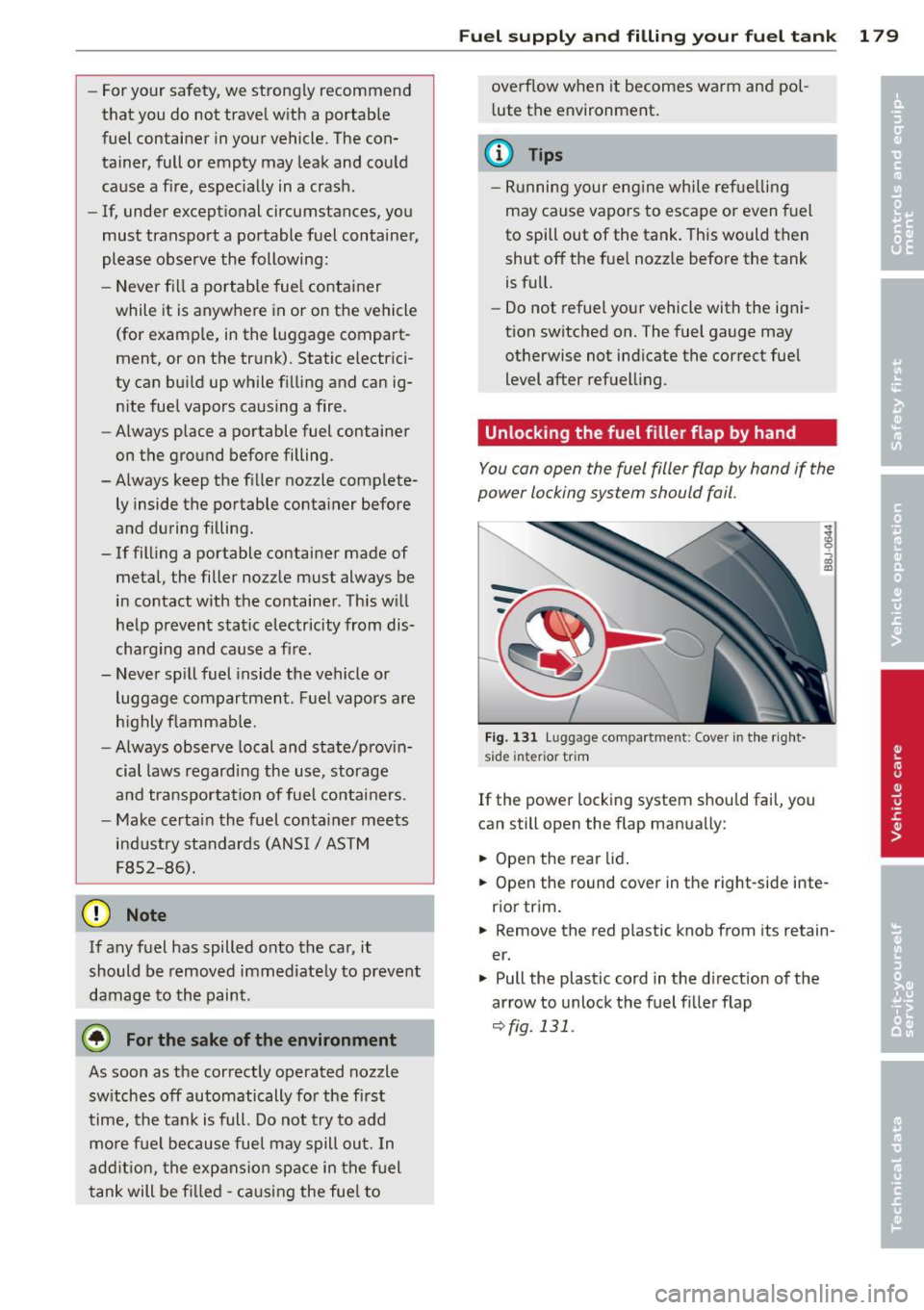
Fig. 1 31 Lu ggage co mpa rtment : Cove r in th e right
side interior trim
If the power locking system shou ld fa il, you
can still open the flap man ua lly:
.. Open the rear lid .
.. Open the round cover in the right-side inte
r ior trim .
.. Remove the red plastic knob from its retain
er.
.. Pull the plastic cord in the d irection of the
arrow to unlock the fuel fi ller flap
~fig. 131 .