stop start AUDI TT 2013 Owner´s Manual
[x] Cancel search | Manufacturer: AUDI, Model Year: 2013, Model line: TT, Model: AUDI TT 2013Pages: 262, PDF Size: 65.91 MB
Page 205 of 262
forget the spare tire. If the press ure in any tire
is too high when the tire is "cold," let air out
of the tire slowly with the edge of the t ire
gauge and keep checking the pressure until
you reach the pressure that is correct for the
load (passengers and luggage) and kind of
driving you plan to do .
If the pressure in any tire is too low, note the
d ifference between the pressure in the cold
tire and the pressure you need and add the a ir
that you need to reach the correct pressure for
the veh icle load (passengers and luggage) for
the tires on your veh icle as listed on the on
your ve hicle and in this manua l and the kind
of dr iving you p lan to do .
Never exce ed the ma ximum inflation pres
s ur e listed on t he tire s idewall for any re a
s on.
Remember that the vehicle manufacturer , not
the t ire manufacturer , determ ines the correct
tire pressure for the tires on your veh icle .
It is important to check the tire pressure when
the t ires a re cold .
- Read the req uired tire press ure from the tire
pressure label located on driver's s ide B-pil
l ar .
- Turn the valve stem cap counter-clockwise
to remove it from the tire valve .
- Place the air pressure ga uge on the valve.
- The tire pressures sho uld on ly be checked
and adjusted when the tires are cold . The
s light ly raised pressures of warm tires must
not be reduced.
- Adjust the tire pressure to the load you are
carrying.
- Re insta ll the va lve stem cap on the valve .
When should I check the tire pressure?
The correct tire pressure is espec ially impo r
tant at high speeds . The pressure sho uld
therefore be checked at least once a month
and a lways befo re starting a journey.
When should I adjust the tire pressures?
Adj ust the tire pressu re to the load you are
carry ing . After changi ng a wheel
or replacing
Tire s an d wheel s 203
whee ls yo u have to adjust the ti re p ressu res
o n all whee ls. In addition, yo u m ust then initi
a lize the new tire pressu res in the t ire pres
s u re monitoring system
Q page 214.
A WARNING
Incorrect tire pressures and/or underinfla
tion can lead sudden tire fa ilure, loss of
control, collision, serio us pe rsonal injury
or even death.
- When the warning symbol
[I] appears in
the instrument cluster, stop and inspect
the t ires.
- Inco rrect tire pressure and/or underinfla
tion can cause increased tire wea r and
can affect the handling of the vehicle and
stopping ability.
- Inco rrect tire pressures and/or underin
flation can a lso lead to sudden t ire fail
ure, including a blowou t and su dden de
flation, ca using loss of veh icle cont ro l.
- Th e drive r is responsi ble for the correc t
tire pressures for all tires on the veh icle.
The applicable pressure values a re locat
ed on a sticke r on the dr iver's side B-pil
lar.
- On ly when all tires on the vehicle are fil
led to the correct pressure, the t ire pres
sure mon itor ing system can work cor
rectly.
- The use of incorrect tire pressu re va lues
can lead to acc idents or other damage.
Therefore it is essential that the driver
observe the spec ified t ire pressure values
for the tires and the correct pressures for
the function of th e ti r e p ressu re monito r
ing system.
- Always inf late tires to the recommended
a nd correct t ire p ress ure before dr iv ing
off.
- Driving with unde rinflated tir es bend
mo re, letting t hem get too hot resulting
in tre ad separation, sudden tire f ailure
and loss of cont rol.
- Exces sive speed and/overloading can
cause he at bu ild- up, sudden tire failure
an d loss of cont rol. •
•
Page 217 of 262
remain continuous ly illuminated . This se
quence will continue upon subsequent vehicle
start-ups as long as the ma lfunction ex ists.
When the malfunct ion indicator is ill uminat
ed, the system may not be able to detect or
signa l low tire pressure as intended. TPMS
malfunct ions may occur for a variety of rea
sons, including the installat ion of replace
ment or alternate tires or wheels on the veh i
cle that prevent the TPMS from funct io ni ng
properly. Always check the TPMS malfunct ion
tellta le afte r replacing one or more t ires or
wheels on your veh icle to ensure that the re
p lacement or a lternate tires and wheels allow
the TPMS to continue to function properly.
Tire pressure indicator appears
Applies to vehicles: with tire pressure monitoring system
The tire pressure indicator in the instrument
cluster informs you if the tire pressure is too
low or if there is a system malfunction.
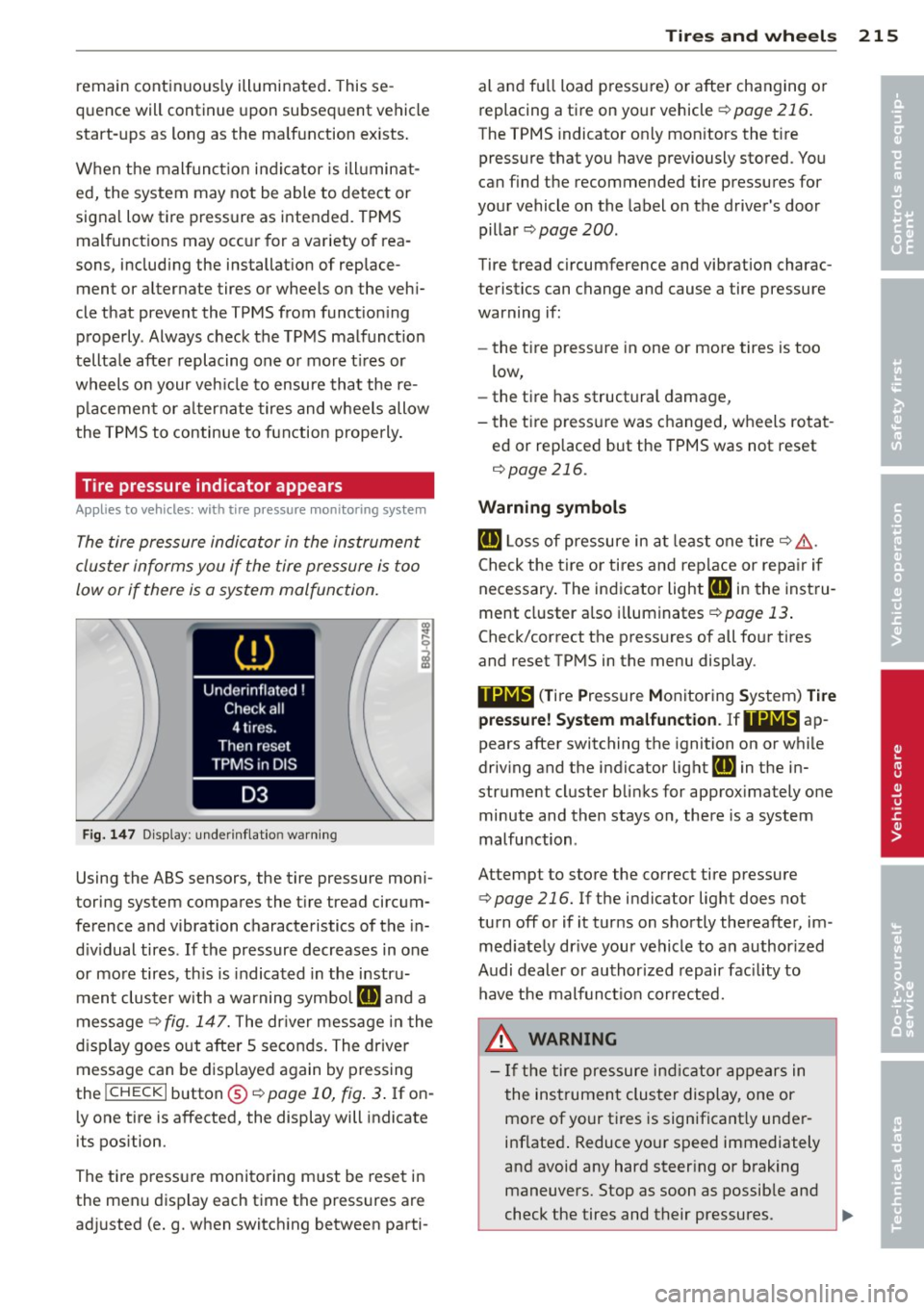
F ig. 1 47 Disp lay : under infla tion warn ing
Using the ABS sensors, the tire pressure moni
toring system compares the t ire tread circum
fe rence and vibration characteristics of the in
d iv idual tires . If the pressure decreases in one
or mo re tires, th is is indicated in the instru
ment clus ter with a warning symbol
RE and a
message
'* fig. 147. The dr iver message in the
d isp lay goes out after 5 seconds. The driver
message can be d isplayed again by pressing
the
! CHECK I button @¢ page 10, fig . 3 . If on
ly one tire is affected, the display will indicate
its pos ition.
The ti re pressure monito ring m ust be reset in
the menu display each time the pressures are
ad justed (e.g. when switching between parti-
Tire s an d wheel s 215
al and fu ll load pressure) or after changing o r
replacing a tire on your vehicle '*
page 216.
The TPMS indicator on ly mon itors the t ire
pressure that you have previously stored . You
can f ind the recommended tire pressures for
your vehicle on the label on the driver's door
pillar ¢
page 200.
Tire tread circumference and vibration charac
teristics can change and cause a tire pressure
warning if:
- the t ire press ure in one or more tires is too
low,
- the tire has structural damage,
- the t ire press ure was changed, wheels rotat -
ed or rep laced but the TPMS was not reset
¢ page 216.
Warning symbo ls
RE L oss of pressure in a t least one tire ¢ ,&..
Check the tire or tires and rep lace or repa ir if
necessary . The indicator light
RE in the inst ru
ment cluster a lso i lluminates
¢ page 13 .
Check/correct the press ures of all four tires
and reset TPMS in the menu display .
Iii;~, (T ire Pressure Monitoring System) Ti re
pre ssure! System malfun ction .
Ifllilff' ap
pears after switching the ignition on or whi le
driv ing and the indicator light
RE in the in
strument cluster blinks for approx imately one
minute and then stays on, there is a system
malfunction .
Attempt to store the correct tire pressure '*
page 216. If the indicator light does not
turn off or if it turns on shortly thereafter, im
med iate ly dr ive your vehicle to a n author ized
Audi dealer or author ized repair fac ility to
have the malfunct io n cor rected.
.8, WARNING
-
- If the tire pressure ind ic a tor ap pears in
the ins trumen t cluster display, one or
more of your tires is significant ly under
inflated . Reduce yo ur speed immediately
and avoid any hard steer ing or braking
maneuvers. Stop as soon as possible and
check the tires and their pressures.
~
•
•
Page 218 of 262
216 Tires and wheels
Inflate the tire pressure to the proper
pressure as indicated on the vehicle's tire
pressure label¢
page 200. Driving on a
significantly under-inflated tire causes
the tire to overheat and can lead to tire
failure. Under-inflation also is likely to
impair the vehicle's handling and stop
ping ability .
- The driver is responsible for maintaining
the correct tire pressures. You must
check the tire pressures regularly.
- Under certain conditions (such as a spor
ty driving style, winter conditions or un
paved roads), the pressure monitor ind i
cator may be delayed.
- Ask your authorized Audi dealer if run
flat tires may be used on your vehicle .
Your vehicle registration becomes invalid
if you use these tires when not permit
ted. Damage to your veh icle or accidents
could also result.
- If you switch between standard and run
flat tires, an authorized Audi dealer or
qualified workshop must reprogram the
control module .
@ Tips
-The tire pressure monitoring system
stops working when there is an ESC/ABS
malfunction.
- Using snow chains may result in a system
malfunction .
- The tire pressure monitoring system on
your Audi was developed using t ires with
the "AO" or "RO" identification on the
tire sidewall ¢
page 207. We recom
mend using these tir es.
Reset tire pressure monitoring system
(Stepl)
Applies to veh icles: w ith tire pressure monitoring system
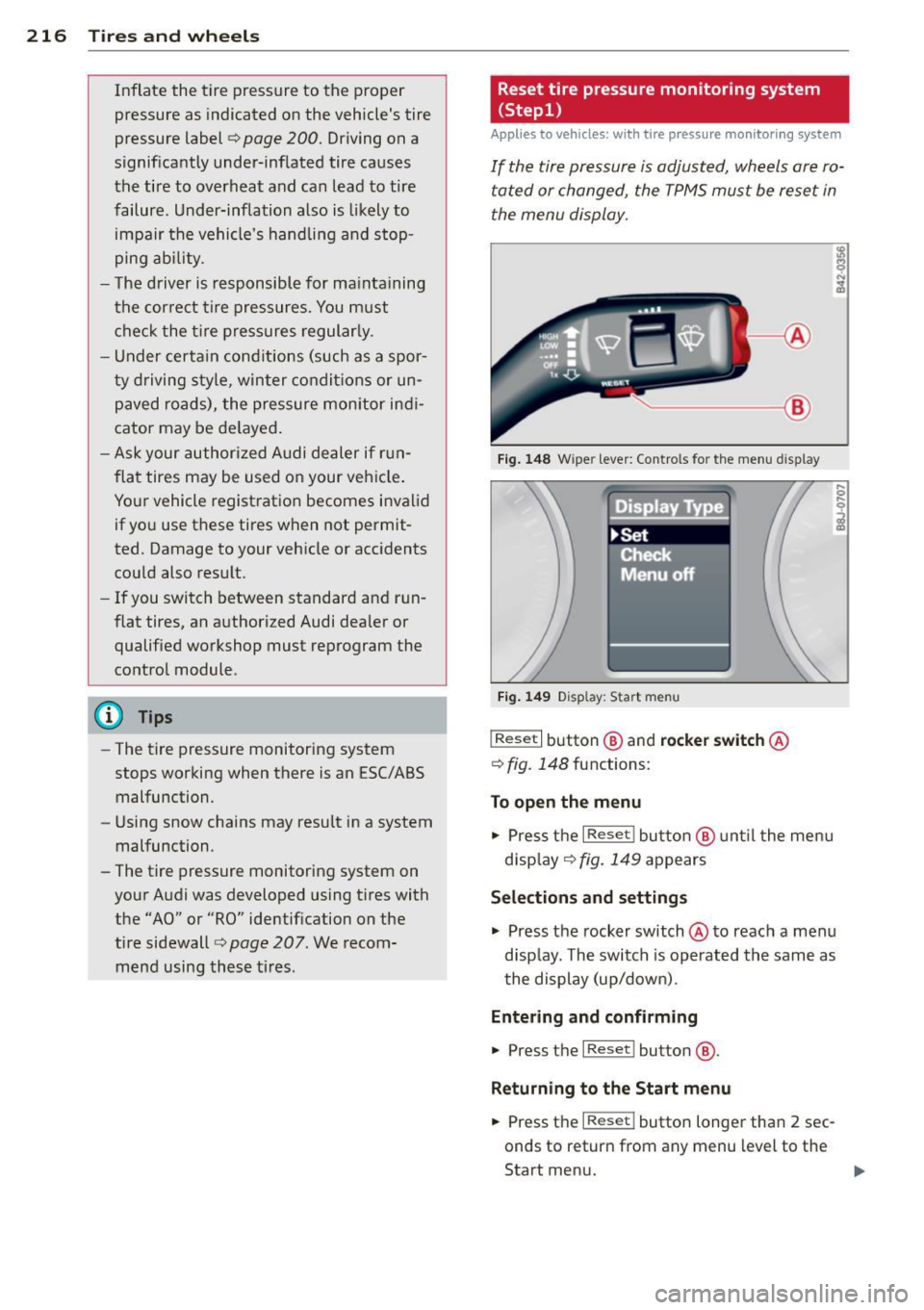
If the tire pressure is adjusted, wheels are ro
tated or changed, the TPMS must be reset in
the menu display.
----- ®
Fig. 148 Wipe r lever: Contro ls fo r the menu d isplay
Fig. 149 Disp lay: S ta rt m enu
I Rese t I button @ and rocker switch @
¢
fig. 148 functions:
To open the menu
" Press the I Reset ! button @ unt il the menu
disp lay
~fig. 149 appears
Selections and settings
" Press the rocker switch @ to reach a menu
disp lay. The switch is operated the same as
the display (up/down) .
Entering and confirming
" Press the I Reset I button @.
Returning to the Start menu
" Press the I Rese t I button longer than 2 sec
onds to return from any menu level to the
Start menu.
Page 225 of 262
~ Drive the vehicle slow ly 10 meters back
ward or forward. This helps to distribute the
sealant better .
~ Remove the empty inflation bott le and
screw the hose ®¢
fig. 155 from the elec
tric pump directly onto the valve.
~ Insert the plug©¢ fig. 155 into the socket
for the cigarette lighter.
~ Switc h on the igni tion.
~ Move the switch @¢ fig. 156 on the e lec
tric a ir pump
ll to posi tion I. After 5 mi
nutes, tire pressure must have reached at
least 1.8 bar.
~ Switch the electric a ir pump off - switch in
position
0 . If the requ ired tire pressure of at
least 1.8 bar has not been reached, it is not
poss ible to make a repa ir with the tire seal
ant. Seek professional ass istance.
Disassembling Tire Mobility System
~ Remove the hose from the valve and pu ll
the plug out of the socket.
~ Screw the dust cap onto the valve.
~ Place the empty sealant bottle back in the
original packag ing and clip it in place under
the floor so that no tire sealant can run out
into the vehicle.
~ Place the elect ric air pump in the luggage
compartment for the time being.
~ Start driving right away so that the sealant
is distributed in the tire.
A WARNING
-Follow the manufacturer's safety instruc
t ions on the deca l for the air pump and
the sealant bott le.
- If a t ire pressure of 1.8 bar cannot be
achieved after pump ing for 5 m inutes,
the tire is too severely damaged. Do not
continue to drive .
- Seek profess ional assistance if it is not
poss ible to repair the tire with the tire
sealant.
l ) The e lectr ic air pump s hould never r un for longer than
6 min utes.
What do I do now? 223
(D Tips
-Do not operate the electric air pump for
more than 6 minutes witho ut stopping,
otherwise it can overheat. When the a ir
pump has coo led down, you can continue
to use it.
- If sealant has escaped, allow it to dry,
then you can peel it off.
Final check
App lies to vehicles: wit h Tire Mobility System
After driving for a short distance, tire
pressure must be checked
~ After d riving for about 10 m inutes, stop
and check the tire pressure.
~ If tire pressure is still at leas t 1.3 bar, in
flate the tire to specified pressure (see driv
ers side B -pillar), drive to the next repair
shop and have the tire and the sealant bot
tle replaced.
~ If tire pressure is less than 1.3 bar, the t ire
is too severely damaged. Do not cont inue to
drive . Seek professional assistance.
A WARNING
If t ire pressure is less than 1.3 bar after
driving for 10 minutes, the tire is too se
ve rely damaged. Do not continue to drive.
Seek professional ass istance .
(D Tips
After a tire repair, have the sealant bottle
replaced at a dealership. This restores full
funct iona lity to the Tire Mobility System.
-
•
•
Page 235 of 262
@ Tips
The discharged battery must be properly
connected to the vehicle's electrical sys
tem.
Use of jumper cables
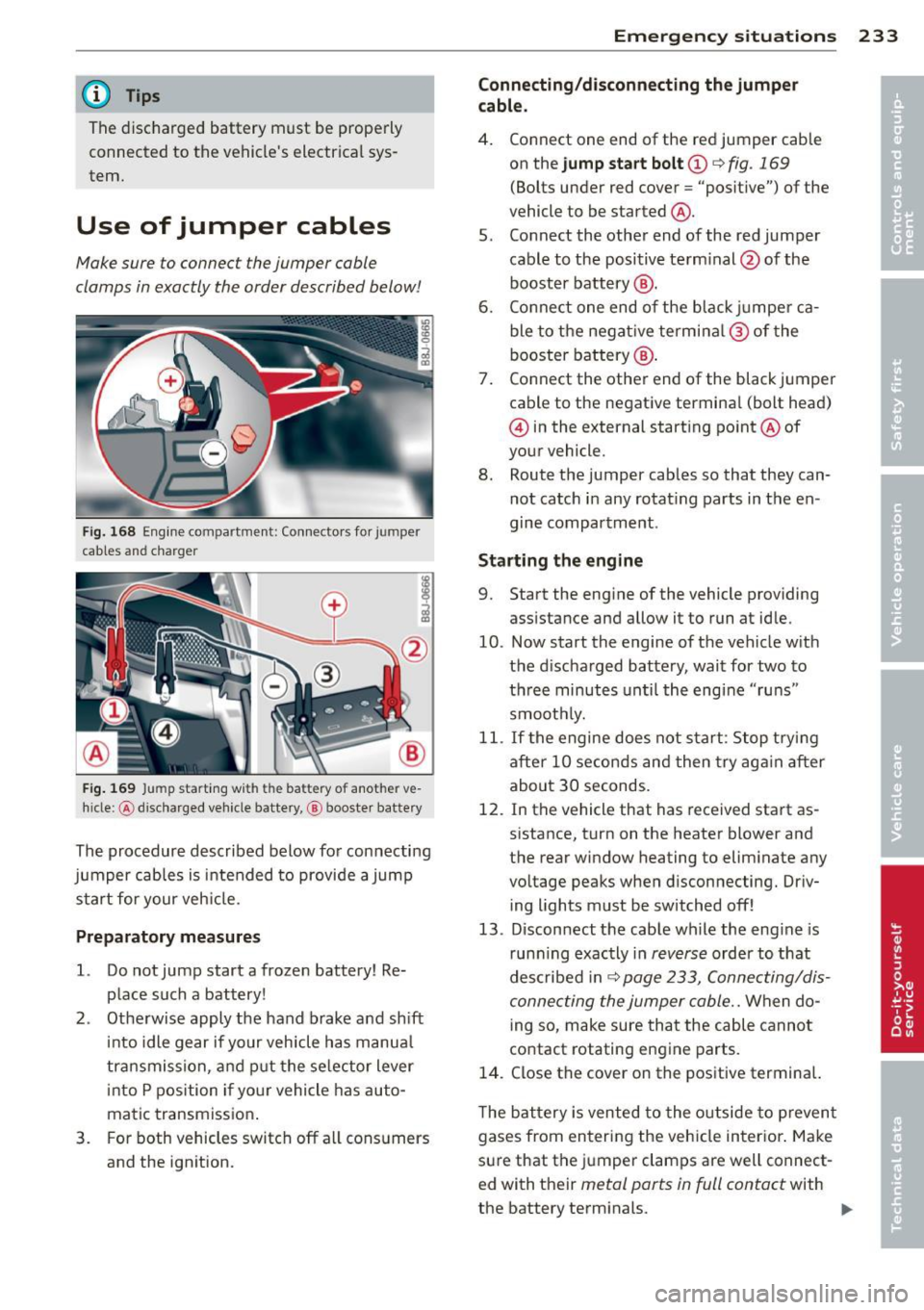
Make sure to connect the jumper coble
clomps in exactly the order described below!
Fi g. 168 Engine compartment: Connecto rs for jumper
cables and charger
Fig. 169 Jump starting with the battery of another ve
h icle: @discharged veh icle batte ry, @ booste r battery
The procedure described below for connecting
jumper cables is intended to provide a jump
start for your veh icle.
Preparatory measures
1. Do not jump start a frozen battery! Re
place such a battery!
2 . Otherwise apply the hand brake and shift
in to idle gear if your veh icle has manua l
transmission , and put the selector lever
into P position if your vehicle has auto
matic transm ission.
3. For both vehicles switch off all consumers
and the ignition.
Emergency situations 233
Connecting/disconnecting the jumper
cable.
4. Connect one end of the red jumper cable
on the
jump start bolt (D c:> fig. 169
(Bolts under red cover= "positive") of the
vehicle to be started @.
5. Connect the other end of the red jumper
cable to the positive term inal @of the
booster battery @.
6. Connect one end of the black jumper ca
ble to the negative terminal@ of the
booster battery @.
7. Connect the other end of the black jumper
cable to the negative terminal (bolt head)
@ in the external starting point @of
your vehicle.
8. Route the jumper cables so that they can not catch in any rotat ing parts in the en
gine compartment .
Starting the engine
9. Start the engine of the vehicle providing
assistance and allow it to run at idle.
10. Now start the engine of the vehicle w ith
the d ischarged battery, wait for two to
three minutes until the engine "runs"
smoot hly.
11. If the engine does not start: Stop trying
after 10 seconds and then try again after
about 30 seconds.
12. In the vehicle that has received start as
s istance, turn on the heater blower and
the rear window heating to eliminate any
voltage peaks when disconnecting. Driv ing lights must be switched off!
13. Disconnect the cable while the eng ine is
running exactly in
reverse order to that
described inc:>
page 233, Connecting/dis
connecting the jumper coble ..
When do
ing so, make sure that the cable cannot
contact rotating engine parts.
14. C lose the cover on the positive terminal.
T he battery is vented to the outside to prevent
gases from entering the vehicle interior . Make
sure that the jumper clamps are well connect
ed with their
metal ports in full contact with
the battery term inals.
Page 252 of 262
250 Index
Distance . . . . . . . . . . . . . . . . . . . . . . . . . . . 23
Driver information system Boost .......................... .. 28
E ng ine oi l tempe ratu re d isplay .. .. .... 26
Engine oil temperatu re indicator ...... 28
Menu button . . . . . . . . . . . . . . . . . . . . . . 25
Menu display . . . . . . . . . . . . . . . . . . . . . . 24
Open door or front lid warning . . . . . . . . 22
Outside temperature display .. .. .. .. . . 22
Red symbols ................. ...... 13
Service interval display ...... .. .. .. .. 28
Setting .. .. ... .... ...... ... ... .. .. 26
Sound system display . . . . . . . . . . . . . . . 22
Trip computer. . . . . . . . . . . . . . . . . . . . . . 23
ye llow symbo ls ......... .. .. .. .. .. .. 13
Driver seat
refer to Seat ing pos ition . ........ .. .. 91
Driving Run-flat tires . ........... .... .... . 218
Driving safely . . . . . . . . . . . . . . . . . . . . . . . 90
Driving through water ........ .. .. ... 160
Duplicate key .............. ... .... .. 32
Dust filter . ... .............. .. .. .. .. 67
E
Efficiency program . . . . . . . . . . . . . . . . . . . 26
Fuel economy messages ..... .. .. .... 27
Memory levels . . . . . . . . . . . . . . . . . . . . . 23
Other equipment ........... .. .. .. .. 27
Elapsed time . . . . . . . . . . . . . . . . . . . . . . . . 23
Electro-mechanical power assist . . . 17, 155
E lectronic diffe rent ial lock (EDL) .. .. ... 150
Warn ing/ indicator lights ....... .. .... 18
Electronic immobilizer . . . . . . . . . . . . 12, 33
Electronic power control EPC warning/indicator light . ..... .. .. 19
E lect ronic speed limiter . . . . . . . . . . . . . . . 31
Electronic Stability Control (ESC) Warning/indicator lights ..... .. .. .. . . 17
Electronic Stabilization Control (ESC) . .. 150
E mergency flasher . . . . . . . . . . . . . . . . . . . 45
Warn ing/ indicator l ights ... .... .... .. 21
Emergency locking ............. .... .. 37
Emergency operation
Rear lid . . . . . . . . . . . . . . . . . . . . . . . . . . . 38
E mergency starting ........ .... ..... 232 Emergency towing
.............. .... 234
Energy management . ............ ... 156
Battery power ................ .... 157
Driver notification ............. .. .. 157
Engine Checking and filling locations .... .. .. 182
Coolant . .. ... ... .. .......... ... .. 187
Hood . .... .. .. .. ............. .. .. 180
Starting . . . . . . . . . . . . . . . . . . . . . . 71, 72
Starting with jumper cables ... .. .. .. 232
Stopping .. .... .. .. .............. .. 73
Engine compartment ......... ... .. .. 182
Safety instructions ... .......... .. .. 180
Working in the eng ine compartment 180
Engine coolant system Malfunction ..... ... ........... ... . 16
Radiator fan . .. .. ..... ..... ... .. .. 189
Temperature gauge ....... ..... .. .. . 11
Engine cooling system ........... .... 187
Adding coolant ................ .... 188
Checking the engine coolant level ..... 187
Engine data ..... .. ................ . 240
Engine hood
Closing . .. .. .. .. ............... .. 180
How to release the hood .......... .. 180
Engine oil ...... .. .. ..... ... ... .. .. 182
Adding . ...... .. .. ..... ... ... .. .. 185
Additives .. .. .. .. .. ... ........ .... 185
Changi ng ... .. .. ............. .. .. 186
Checking the engine oil leve l ..... .... 185
Indications and conditions requiring ex-
tra checking ..... ................ . 185
Oil consumption . ................. . 184
Oil grades . ................... .... 182
Recommended oil check intervals . .. .. 185
Specification and viscosity . ...... .. .. 182
Temperature display ........ ... .. .. . 26
Engine oil level .... ................ .. 19
Engine oil pressu re (ma lfunction) .... .. . 16
Engine oil sensor defective . . . . . . . . . . . . 19
Engine oil temperature indicator ........ 28
Engine speed limitation . ......... .. .. . 19
Environment Break-in period .................... 159
Catalytic converter ....... ...... .. .. 160
Dispos ing of your veh icle battery . . . . . 191
Driving at high speeds . ...... ... .. .. 161
Page 258 of 262
256 Index
------------------------------------
Starting on hills
H ill hold ass ist . ....... ... .. .. .... ..
74
Starti ng the eng ine . . . . . . . . . . . . . . 7 1, 7 2
Wha t should I do if the eng ine does no t
s ta rt? . . . . . . . . . . . . . . . . . . . . . . . . . . . .
7 2
Steel wheels ........... .... ... .. ... 169
St ee ring
refer to Ele ct ro -me chanic al power as -
s is t . . . . . . . . . . . . . . . . . . . . . . . . .
17, 155
Steer ing column
A dj usting . .... .. ..... ... .. .. .... ..
7 1
Lock ing the st eering . . . . . . . . . . . . . . . . 7 1
Steps fo r de termining co rrect load lim it . 205
Stopp ing the eng ine . . . . . . . . . . . . . . . . . . 73
Sto rage ..... ... .. ..... ... .. .. .... .. 64
Compartment in the front seats ... .. . . 64
Cup holde r . . . . . . . . . . . . . . . . . . . . . . . . 62
Glove compartment . . . . . . . . . . . . . . . . . 64
Storage compartment
E xpanding . . . . . . . . . . . . . . . . . . . . . . . .
59
S tron ic .... ........... ........ ... .. 80
Dr iving Notes . . . . . . . . . . . . . . . . . . . . . . 8 2
Eme rgency program .. .... .. .. .... .. 85
Emergency release . . . . . . . . . . . . . . . . . . 86
K ick -down . . . . . . . . . . . . . . . . . . . . . . . . . 85
Launch Con tro l Program ... .. .... .. . . 85
Selector leve r lock ..... ... .. .. .... .. 81
Selector lever pos it ions . . . . . . . . . . . . . . 80
Tiptronic . . . . . . . . . . . . . . . . . . . . . . . . . . 84
T iptronic controls on t he steering wheel 84
Sun v isors .... .. .. ..... ... .. .. .... .. 4 6
Sw itches
E me rgency flasher . . . . . . . . . . . . . . . . . .
4 5
Symbo ls
Red symbols in the center d isp lay .. ....
13
Yellow symbols in the center d isp lay ... 13
also refer to War ning/Ind icator lights .. 12
T
Tachometer .. .......... ........ ... .. 10
Tank flap
Un lock ing the fue l fille r flap by hand ..
17 9
Tec hni cal mo difi cat ions . .. .. .. .. .... . 24 6
Temper ature ........... ........ ... .. 67
Temperature display
Engin e oi l ... .. .. ..... ... .. .. .... ..
26
Teth er anchors . . . . . . . . . . . . . . . . . . . . . 147
Tether st rap ...... ................ . 147
The first 1,000 miles (1,500 km) and afte r-
wards .. .... .. .. .. ...... ....... ....
159
T ie-downs . . . . . . . . . . . . . . . . . . . . . . 59, 97
T ighte ning whee l bo lts ... ........... . 224
Tips for the envi ronment
S aving fuel .. .. .. .... ... ... .. ..... .
62
Tire mob ility system ...... ....... .... 22 0
Tire pressure ........... ........... . 202
Tire p ressure mo nitor ing system ... .. .. 214
Loss of a ir pres sure ..... ..... .. .... 215
Malfun ction . .. .. .... ... ... ... .. .. 215
Rese tting tire press ures ...... .. 216,217
Tire repa ir k it ... .. .. .... .... ... .. .. 220
T ires .......... .................... 196
Rep lac ing . .. .. . .. ... ... ... .. ... .. 2 0 7
run-fl at ... .. .. .. ... .. ..... ... .... 2 17
Serv ice life .... .. ... .. ..... ... .. .. 2 06
speed ra ting lette r code ..... .... . .. 2 08
Ti re manufact uri ng date ..... ... .. .. 208
T ir e specifications ...... ....... .... 208
Tread dep th . .. .. .... ... ... .. ..... 206
Uniform tire quali ty grad ing . .... .... 210
Winter tires ..... ................ . 211
Tires/Wheels
Low aspect rat io ti res .. ... ... ... .. ..
2 13
Ti re mob ility sy stem ... .. ... ... .. .. 220
Ti re pressure moni toring system . .. .. 214
Tire repair kit .. ............ ....... 2 20
T ires and vehicle load limits .... ... .. .. 204
T ires and wheels
Checking t ire p ress ure . ... ... ... .. ..
2 02
Co ld tire infla tion press ure ... ... .... 200
Dimens ions . ..... .. ... ..... ... .. .. 2 07
Gen eral notes . . . . . . . . . . . . . . . . . . . . . 196
G lossary of tir e and loading t erm inolo-
gy ....... .... .. ...... ... ... .....
197
New tires and wheels .. ... ... ... .. .. 207
Replac ing ... .. .. ... .. ..... ..... .. 208
S now cha ins . .. ............ ....... 212
Tires and veh icle load limits ......... 204
Whee l bolts . .. .. ... .. ..... ... .. .. 2 13
Winter tires . .. .. .... ... ... ... .. .. 2 11
Tire service life .. .. ... .. ..... ..... .. 206
Too l kit . ... .... .. ... .. ..... .... . .. 220
To uch -u p pa int .. .. .... ... ... ... .. .. 168