tow AUDI TT 2013 Owner´s Manual
[x] Cancel search | Manufacturer: AUDI, Model Year: 2013, Model line: TT, Model: AUDI TT 2013Pages: 262, PDF Size: 65.91 MB
Page 157 of 262
overheat reducing the effectiveness of
the ent ire brake system.
- Failure of one brake circuit will impair
the braking capability resulting in an in
creased stopp ing distance. Avoid driv ing
the vehicle and have it towed to the near est Aud i dealer or qualified workshop .
- Never let the vehicle roll to a stop w ith
the engine shut off.
- If the brake booster is not working, for
example when towing your ve hicle, or
because the brake booste r has somehow
been damaged, the brake pedal must be
pressed considerab ly harder to make up
for the lack of booster assistance.
Electro-mechanical
power assist
The electro-mechanical power assist helps
the driver when steering.
The degree of power assist is electronically
matched to vehicle speed.
The power steer ing system ass ists the driver
so that he can stee r the veh icle w ith red uced
phys ica l effort.
Power steering w ill not work if the engine is
off. As a result, the steering wheel w ill be hard
to turn.
& WARNING
If the system develops a prob lem, you
must seek qualified professional assis
tance.
(D Note
-
If there is an electronic malfunct ion, ser
votronic
wi ll sti ll function like a conven
tional power steering system, providing a
constant steering support force that is no
longer proportionate to the vehicle speed.
This is most noticeable when turning the
steer ing wheel at low speeds (for example
when parking), -more effort will be re
quired than usual.
Int ellig ent technolog y 155
-Be aware of the different than usual
steering response and adjust your steer
ing force accordingly.
- Have the problem checked and set right
by an authorized Audi dea ler as soon as
possible.
- If a steering malfunction occurs, this is
signaled with the,~ , or .• indicator
lights and a warn ing tone, see.
(D Tips
- If the power steering system sho uld fail,
or if the engine is not running (for exam
ple, while being towed), you will still be
able to steer the vehicle. However, more
effort will be required to do so.
- If the power steering system is not func
tioning properly, contact your authorized
Audi dealer immediately.
Driving with your
quattro ®
Applies to vehicles : wit h all -w hee l d rive
With oil -wheel drive, oil four wheels ore driv
en.
General information
With a ll-wheel drive, power is distr ibuted to
all four wheels. This happens automatically
depend ing on your driving style and the road
conditions at the time. See also
c::> page 1 SO.
The all-whee l dr ive concept is des igned for
high eng ine power. Your veh icle is except ion
ally powerfu l and has excellent driving charac
teristics both under normal driving conditions
and on snow and ice. Always read and follow
safety precautions
c::> &. .
Winter tires
When dr iving in the winter, your vehicle with
all-wheel drive has an advantage, even with
regular tires. In winter road conditions it may
be advisable to mount winter tires (or all-sea
son tires) for improved driveability and brak
ing: these tires must be mounted on
all fou r
wheels. See also c::> page 211, Winter tires. ..,_
•
•
Page 162 of 262
160 Driving and en vironm ent
Avoid damaging the
vehicle
When you are driving on poor roads, or over
curbs, steep ramps, etc ., make certain that
low-lying parts such as spoilers and exhaust
system parts do not bottom out and get dam
aged.
This is especially true for vehicles with low
slung chassis (sports chassis) and fully loaded
vehicles .
Driving through water
on roads
Note the following to avoid vehicle damage
when driving through water, for example on
flooded roads:
- T he water must not be any highe r tha n the
bottom of the vehi cle body.
- Do no t drive faster than wa lking speed.
_& WARNING
After d riving through water, m ud, slush,
etc., the brakes may be slow to take effect
because o f wet brake ro tors and pads . Dry
the brakes fi rst by braking carefully to re
store the full braking effect.
(]) Note
Vehicle components such as the engine,
transmiss ion, suspension or electrical sys
tem can be severely damaged by driving
through water.
- Check the depth o f the water before driv
ing through it.
- Do not stop the veh icle, dr ive in reverse
or switch the engine
off when driving
through water.
- Keep in mind that oncoming vehicles may c reate waves that raise the water
l evel and make it too deep for your vehi
cle to drive through safely.
- Avoid driving thro ugh salt water because
it can ca use corrosion.
-
Catalytic converter
It is very important that your emission con
trol system (catalytic converter) is function
ing properly to ensure that your vehicle is run
ning in an environmentally sound manner.
.,. Always use lead-free gasoline ¢ page 176,
Fuel supply .
.,. Never run the tank down all the way to
empty .
.,. Never put too much motor o il in your en-
gine ¢
page 185, Adding engine oil 'l::r. .
.,. Never try to push- or tow-sta rt you r vehicle.
The catalyt ic converter is an efficient "clean
u p" dev ice buil t into the exhaust system of
t h e vehi cle. The cata lytic conve rter bu rns
many of t he pollu tan ts in the exha ust gas be
f ore they are re leased into the atmosphere.
T he exclusive use of unleaded fuel is critica lly
important for the life of the catalyt ic convert
er and prope r fu nct ion ing of the engine.
A WARNING
- Do not park or operate the vehicle in
areas where the hot exha ust system may
come in contact with dry g rass, brush,
fue l spill or other material wh ich can
cause a fire.
- Do not app ly additiona l undercoating or
rustproofing on or near the exhaust
manifold, exhaust pipes, catalytic con
verter or heat sh ields. Dur ing driv ing, the
substance used fo r undercoating could
overheat and cause a fire.
(D Note
- Be aware that just one tank filling with
leaded fuel will already ser iously de-
grade the performance of the catalytic
converte r.
- Do not exceed the correct engi ne oil level
¢page 185.
-Do not drive until the fuel tank becomes
completely empty . The engine co uld mis-
fire. Unburned fuel could also get into ..,.
Page 165 of 262
engine no less than two and a half miles
(4 km) of driving to warm up to its proper
operating tempe ratu re and ope rate at an
economic mileage. This explains w hy taking
t h e car for s hort tr ips is a rather wastefu l
convenience .
- The
outs ide temperature is also cr itical in
t hi s regard. Your car consumes more fuel in
the winter than in the summer .
Trailer towing
General information
Your Audi TT Coupe is not designed to tow a
trailer.
Tow ing a tra ile r with you r Audi T T Coupe is not
r eco mmended a nd can cause damage to t he
c a r. Damaged caused by towing a tra iler is not
covered by yo ur Audi War ranty .
Driving and environment 163
•
•
Page 171 of 262
~ Wipe the windows dry with a clean piece of
cloth or kitchen paper towel.
The best way to remove snow from windows
and mirrors is to use a brush. Use a non-abra
sive
plastic ice scraper -better still, a spray
deicer -to remove
ice from windows and mir
rors.
The windows must not be cleaned with insect
remover or wax since these can interfere with
the function of the windshield wiper blades
(chatter).
Oil, grease or silicone residue can be removed
with
glass cleaner or silicone remover. How
ever, wax residue requires the use of a special
ly formulated solvent. Please contact your
Audi dealer for advice on safe products for
wax removal.
Windows should also be cleaned on the inside
at regular intervals.
Never dry windows with the same chamois
that you use to dry painted surfaces. Wax resi
due on the chamois can impair vision through
the windows.
A WARNING
-The windshield must not be treated with
water-repellent materials. They can in
crease glare under poor visibility condi
tions such as wetness, darkness, or when
the sun is low on the horizon. In addi
tion, they can cause the windshield wip
ers to chatter.
- Always read and heed all WARNINGS and
other information
¢page 164.
(D Note
-Never use warm or hot water to remove
snow and ice from windows and mirrors.
This could cause the glass to crack.
- To prevent damage to the wires of the
rear defogger, do not place any adhesive
stickers on the inside of the rear window
over the wires.
- To help prevent dirt from scratching the
window, always scrape in a forward di-
Cleaning and protection 169
rection -pushing the scraper away from
you -never back and forth.
· Steel wheels
Applies to vehicles : with steel wheels
The wheels also have to be cleaned.
~ Always include the hub caps and wheel rims
when washing your vehicle to remove road
dirt, salt sprays and brake dust.
If necessary, use a commercial wheel cleaner
to remove accumulated brake dust.
The wheel rims are easier to keep clean if they
are regu larly coated with liquid wax.
Paint scratches should be touched up as soon
as possible to prevent corrosion
¢ page 168,
Touch-up paint.
A WARNING
-Moisture and ice on brakes may affect
braking efficiency -
¢ page 153, General
information.
Test the brakes carefully af
ter each vehicle wash.
- Always read and heed all WARNINGS and
the information
¢page 164.
Cast (light) alloy wheels
Applies to vehicles: with Cast alloy wheels
Cast (light) alloy wheels require special care.
~ Wash the wheels with a sponge or hose
brush every other week.
~ For deep cleaning afterwards, use only a
dedicated
acid-free cast alloy wheel cleaner .
~ Rub a coat of liquid wax onto the rims every
three month. Be sure to reach and treat all
parts of the rim.
To preserve the decorative appearance of the
cast alloy wheels, some special care is neces sary. In addition to road dirt and salt, brake
dust is also corrosiv e. If left on for too long,
brake dust can cause pitting.
Use only special
acid-free cleaners formulated
for alloy rims. Safe products are available at
your Audi dealer. Never leave the cleaner on .,..
•
•
Page 175 of 262
creme will nourish and moisturize the
l eather, helping it to b reathe and stay
supple . It also helps to b uild up a protec
tive coat ing on the surface.
- Clean the leather every 2 -3 months,
and clean any areas that get soiled.
- Remove fresh marks made by ba llpoint
pens, ink, lipstick, shoe polish, etc . as
soon as possib le.
- Preserve the color of the leather as need
ed by using a special colored leather care
creme to touch up areas of uneven color.
Cleaning and caring for leather
upholstery and trim
App lies to vehicles: with natural leather
Natural leather requires special care and at
tention .
Normal cleaning
~ Clean soiled areas wit h a slightly moistened
cotton or woolen cloth.
Mor e stubborn dirt
~ More stubbo rn dirt can be removed using a
cloth saturated with a mi ld soap so lution (2
tablespoons mi ld liquid soap) .
~ Never allow the soap solution to saturate
the leather, and make certa in that no water
soaks into the seams .
~ Wipe off the soap solution with a soft, dry
cloth .
Cleaning sp ots
~ Remove fresh w ater -b ased spots (such as
coffee, tea, ju ices, blood) w ith an absorbent
cloth or paper towel.
~ Remove fresh gr ea se or oil -ba sed spot s
(such as butter, mayonnaise, chocolate) with
an absorbent cloth or paper towe l, or use
the cleane r from the leathe r care kit if the
spot has not yet pene trated in to the surface
of the leather .
~ Use an oil/grease dissolving spray , if oil /
grea se spots h ave d ried on.
~ Remove specific kinds of spots (ballpoint
pen, felt marker, fingernail polish, water-
Cleaning and protec tion 173
based paint, shoe po lish, etc.) with a spot
remover specifically formu lated for leather .
Le ather car e
~ Every half yea r use an approved leather care
product (available from your Audi dea ler) to
care for the leathe r.
~ App ly the product very sparingly .
~ Wipe it off with a damp cloth.
If you have any questions abou t cleaning and
caring for the leather in your vehicle, it is best
to contact your authorized Audi dea ler, who
will be g lad to help you and tell you abo ut our
full range of leather care products, such as:
- Leather cleaning and care kit
- Cremes to care fo r colored lea ther
- Spot removers for ballpoint pens, shoe pol-
ish, etc.
- Oil/grease d issolving spray
- New and upcom ing products.
A WARNING
Always read and heed all WARNINGS and
the information r=) page 164.
Q) Note
- Never use chemical so lve nts (e.g. lighter
fluid, tu rpentine), waxes, shoe polish or
simi lar products on the leather surfaces
in yo ur Audi .
- To avoid damage, have stubborn sta ins
removed by a comme rcial clean ing spe
cialist.
Cleaning Alcantara ® (synthetic suede)
Applies to vehicles: with Alcantara upholstery
Removing dust and dirt
~ Moisten a cloth, squeeze out excess water
and wipe down the seat surfaces.
Removing stains
~ Moisten a cloth with lukewarm water or
w ith diluted
ethyl (rubbing ) alcohol.
~ Dab at the stain . Start at the outs ide and
work inwards . •
•
Page 207 of 262
Determining correct load limit
Use the example below to cal
culate the total weight of the
passengers and luggage or oth
er things that you plan to trans
port so that you can make sure
that your vehicle will not be overloaded.
Steps for Determining
Correct Load Limit
1. Locate the statement "THE
COMBINED WEIGHT OF OC
CUPANTS AND CARGO
SHOULD NEVER EXCEED XXX KG OR XXX LBS"on your vehi
cle's placard (tire inflation pressure label)
¢ page 200,
fig . 142 .
2. Determine the combined
weight of the driver and pas sengers that will be riding in
your vehicle .
3 . Subtract the combined
weight of the driver and pas sengers from
"XXX" kilo
grams or
"XXX" pounds
shown on the sticker
¢ page 200 , fig. 142.
4. The resulting figure equals
the available amount of car
go and luggage load capaci
ty. For example, if the
"XXX"
amount equals 1400 lbs.
Tires and wheels
and there will be five 150 lbs. passengers in your vehi
cle, the amount of available
cargo and luggage load ca pacity is 650 lbs. (1400-7 50
(5
X 150) = 650 lbs.)
5 . Determine the combined
weight of luggage and cargo
being loaded on the vehicle .
That weight may not safely exceed the available cargo
and luggage load capacity
calculated in Step
4.
6. If your vehicle will be towing
a trailer, load from your trail
er will be transferred to your
vehicle. Consult this manual
to determine how this reduces the available cargo
and luggage load capacity of
your vehicle.
,... Check the tire sidewall
(¢ page 207, fig. 146) to de
termine the designated load rating for a specific tire.
205
•
•
'
Page 222 of 262
220 What do I do now?
What do I do now?
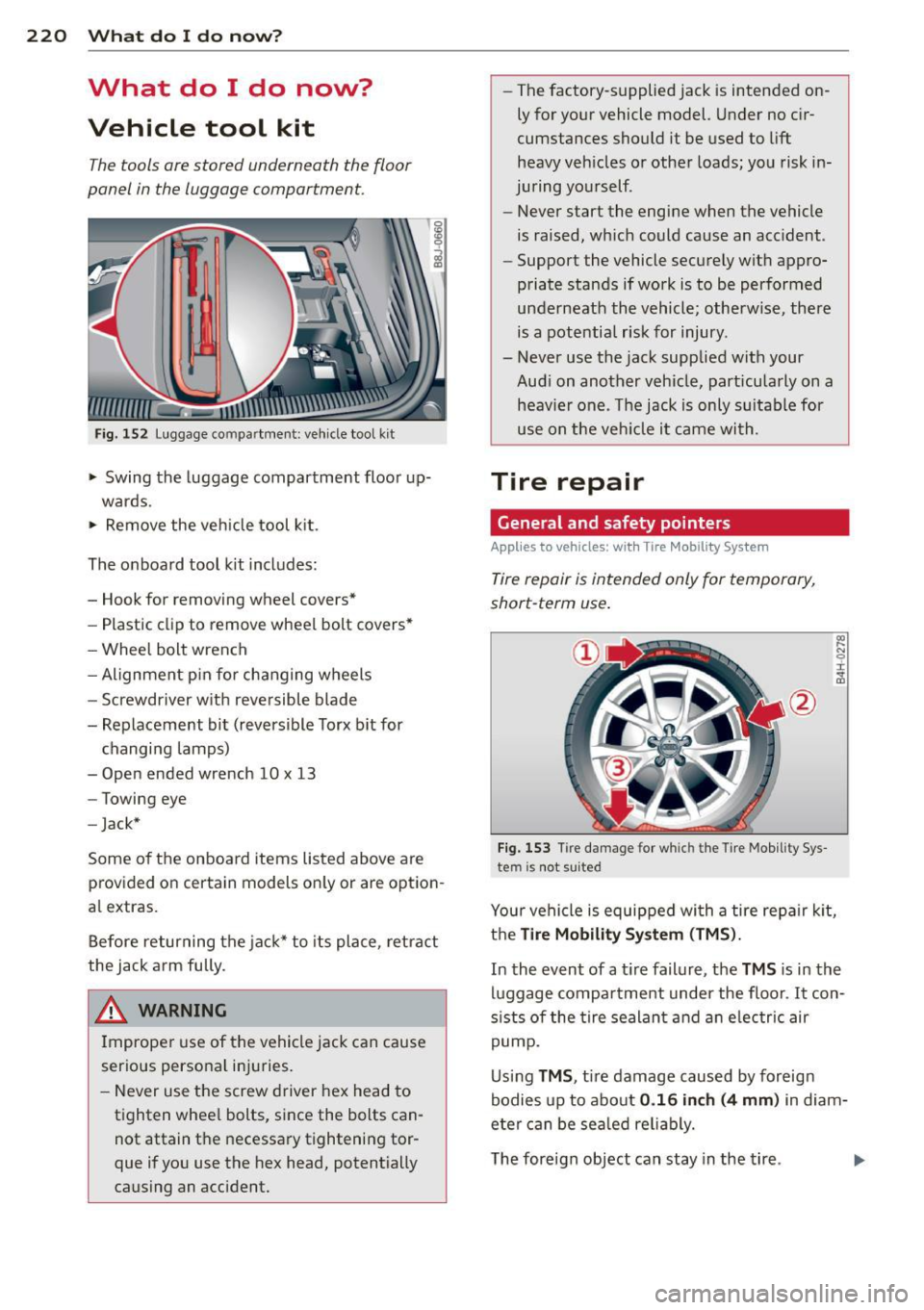
Vehicle tool kit
The tools ore stored underneath the floor
panel in the luggage comportment.
Fig. 152 Luggage compartment: vehicle tool kit
• Swing the luggage compartment floor up-
wards.
• Remove the veh icle tool kit .
The on board tool kit includes:
- Hook for removing wheel covers*
- Plastic clip to
remove wheel bolt covers*
-Wheel bolt wrench
- Alignment pin for changing wheels
- Screwdr iver w ith reversible blade
- Replacement bit (reversible Torx b it for
changing lamps)
- Open ended wrench 10 x 13
- Towing eye
- Jack *
Some of the on board items listed above are provided on certain models on ly or are opt ion
al extras.
Before returning the jack* to its place, retract
the jack arm fully.
_& WARNING
Improper use of the vehicle jack can cause
serious personal injuries.
- Never use the screw driver hex head to
tighten wheel bolts, since the bolts can not attain the necessary tightening tor
que if you use the hex head, potentially causing an accident. -
The factory-supplied jack is intended on
ly for your vehicle model. Under no cir
cumstances should it be used to
lift
heavy veh icles or other loads; you risk in
juring yourself .
- Never start the engine when the vehicle
is raised, which could cause an accident.
- Support the vehicle securely with appro
priate stands if work is to be performed
underneath the vehicle; otherwise, there is a potentia l risk for injury.
- Never use the jack supplied with your
Aud i on another vehicle, part icularly on a
heav ier one . T he jack is only s uitable for
use on the vehicle it came with.
Tire repair
General and safety pointers
Applies to vehicles: wit h Tire Mobility Sys tem
Tire repair is intended only for temporary,
short-term use .
Fig. 153 Tire damage for whic h the Tir e Mob ility Sys
tem is not suited
Your vehicle is equipped with a tire repa ir kit,
the
Tire Mobility System (TMS).
In the event of a tire failure, the TMS is in the
luggage compartment under the floor.
It con
s ists of the tire sealant and an electric air
pump .
Using
TMS , tir e damage caused by foreign
bodies up to about
0.16 inch (4 mm) in diam
eter can be sealed reliably.
The foreign object can stay in the tire .
Page 234 of 262
232 Emergency situations
Emergency situations
General
This chapter is intended for trained emer
gency crews and working personnel who
have the necessary tools and equ ipment to
perform these ope rations.
Starting by pushing or
towing
Q;) Note
Vehicle s with an automati c transmission
cannot be started by pushing or towing .
Starting with jumper
cables
If necessary, the engine can be started by
connecting it to the battery of another vehi
cle.
If the engine should fail to start because of a
discha rged or wea k batte ry, the battery can be
connected to the battery o f
another vehicle,
using a
pair of jumper cables to start the en
g ine .
Jumper cables
Use only jumper cab les of sufficiently
large cross section to safely carry the starter
cur rent. Refer to the manufacturer's specifica
ti ons.
Use on ly jumper cables which have
insulated
termina l clamps and are properly marked for
d istinction :
plus(+) cable in most cases colo red red
minu s(-) cable
in most cases colo red black .
_& WARNING
Batterie s contain elec trici ty, a cid, and ga s.
Any of th ese c an cause ve ry seri ous or f ata l
inju ry . Follow the instructions below fo r
safe han dling of your ve hicle's battery.
- Alw ays s hield yo ur eyes and avoid lean
ing over the batte ry w henever possib le . -
A discharged battery can a lready freeze
at temperatures just be low 32 °F (0 °C).
Before connect ing a jumper cab le, the
frozen battery must be thawed com
p letely, othe rwise it cou ld explode .
- Do not allow batte ry acid to contact eyes
or skin . Fl ush any contacted a rea wi th
water immediat ely .
- Imp roper use of a booster battery to
s tart a vehicle may cause an explosion.
- Vehicle batter ies generate explosive gas
es . Keep sparks, flame and lighted ciga
rettes away from ba tte ries .
- Do not try to jump start a ny ve hicle w ith
a low ac id leve l in the battery .
- The vo ltage of the booster batte ry m ust
a lso have a 12-Vo lt rat ing . The capacity
(A h) of the booster batte ry should not b e
lowe r than that of the discharged bat
tery . U se o f batt erie s of d iffe ren t voltage
or subs tanti ally diffe ren t "Ah" rat ing
may c ause an exp losion and person al in
ju ry .
- N ever ch arge a fr ozen bat te ry. Gas t rap
ped in the ice may ca use an ex plosion .
- N ever ch arge o r use a batt ery th at has
been fro zen. T he battery case may have
be weakened.
- Us e of batt erie s of di ffere nt vo lta ge or
substan tially differen t ca pa city (Ah) rat
i ng may cause an exp losion and injury.
T he capac ity (Ah) of the booster battery
should not be lower than that of the dis
charged batte ry.
- Before you check anything in the engine
compartment, always read and heed a ll
W ARNI NGS
c::;,page 174, Engine com
partment .
@ Note
-App lying a hig her voltage booster ba t
tery will cause expens ive damage to se n
sitive electronic components, such as
cont ro l units , relays, rad io, etc.
- There must be no electrical contact be
twee n the vehicles as otherwise current
cou ld already start to flow as soo n as th e
posi tive (+) term inals are connect ed. ""
Page 236 of 262
234 Emergency sit uat ions
_& WARNING
To avo id serious per sonal injury and dam
age to the vehicle, heed all warnings and
instructions of the jumper cable manufac
turer. If in doubt, call for road serv ice.
- Jumper cables must be long enough so
that the vehicles do not touch.
- When connecting jumper cables, make
surethattheycannotgetca ughtinany
moving parts in the eng ine compart
ment.
- Before you check anything in the engine
compartment, always read and heed all
WARNINGS
c::> page 174, Engine com
partment.
(D Note
Improper hook-up of jumper cables can ru
in the generator.
- Always connect POSITIVE( +) to POSI
TIVE(+), and NEGATIVE(-) to NEGATIVE ( - ) ground post of the battery manager
control unit.
- Check that all screw plugs on the battery
ce lls are screwed in firmly. If not, tighten
plugs prior to connecting clamp on nega
tive battery terminal.
- Please note that the procedure for con
nect ing a jumper cable as described
above applies spec ifically to the case of
you r vehicle be ing jump started. When
you are giving a jump star t to a nothe r ve
hicle, do
not connect the negat ive (-) ca
ble to the negat ive (-) term inal on the
discharged battery @. Instea d, secure ly
connect the negative (-) cable to either a
solid metal component that is firmly
bo lted to the engine block or to the en
gine block itself. If the battery that is be i ng charged does not vent to the outside,
escap ing batte ry gas cou ld ign ite and ex
plode!
-
Emergency towing
with commercial tow
truck
General hints
Your Audi requires special handling for tow
ing.
T he following information is to be used by
commercial tow truck operators who know
how to operate their equipment safely.
- Ne ver tow your Audi , towing will cau se
damage to the engine and tr an smi ssion .
- Ne ver wrap th e safet y chain s or winch ca
ble s ar ound the brak e lines.
- To prevent unne ces sary damage , your Audi
must be tran sp o rt ed with a car carrier
(flatbed truck ).
- To load th e vehi cle on t o the flat bed , u se
the t owing loop found in the vehicle tool s
and attach to the front o r rear anchorage
c::> page 235 and c::> page 236.
A WARNING
--A vehicle being towed is not safe for pas
sengers. Never allow anyone to ride in a
vehicle be ing towed, for any reason.
Page 237 of 262
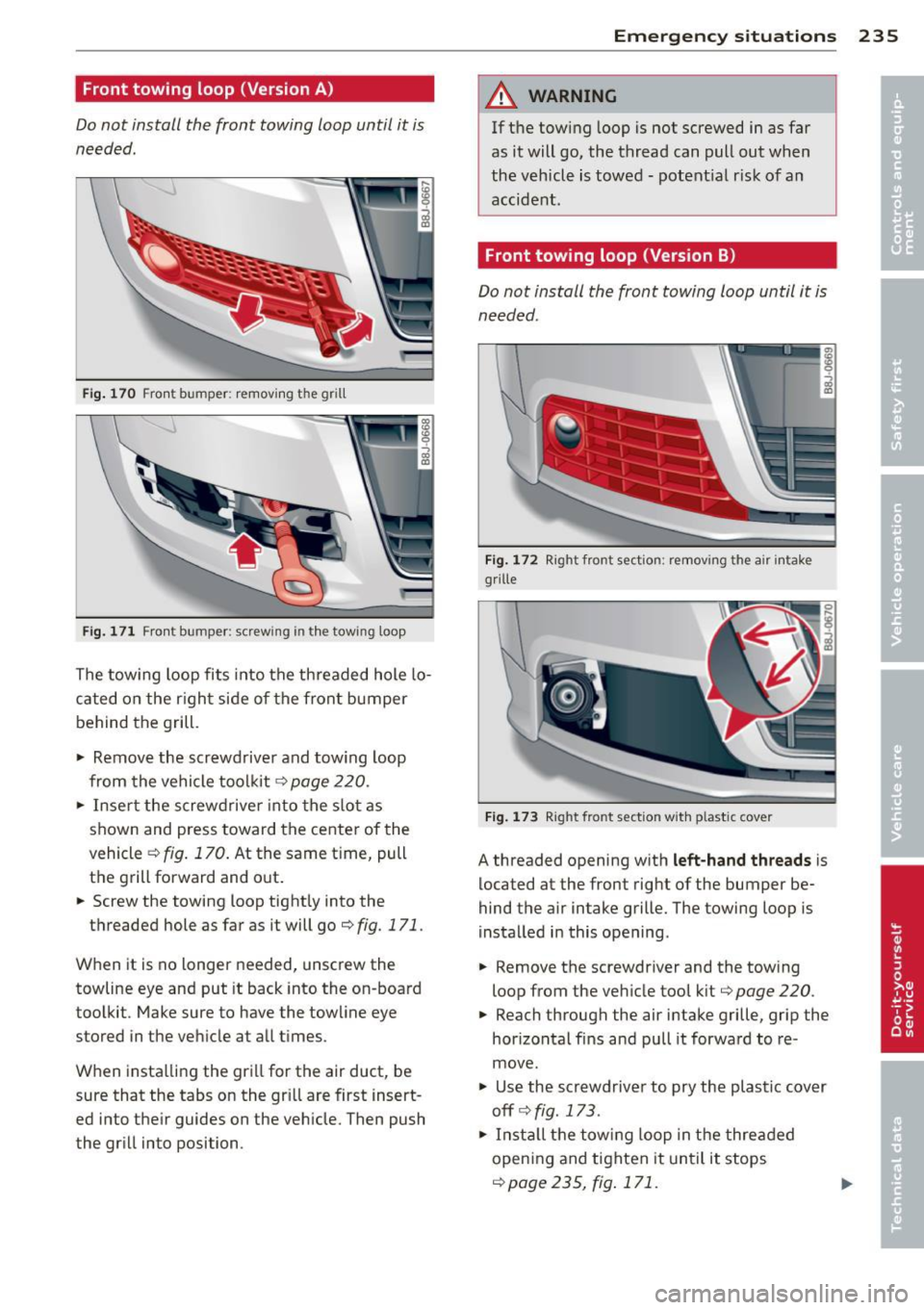
Front towing loop (Version A)
Do not install the front towing loop until it is
needed.
Fig. 170 Front bumper : removing t he grill
Fi g. 171 Fron t bumper: screwing in the towing loop
The tow ing loop fits into the th readed hole lo
cated on the r igh t side of the fron t bumper
behind the grill.
"' Remove the s cre wd river and tow ing loop
from the vehicle tool kit ¢
page 220.
"' Inse rt the screwdrive r into the s lot as
shown and press toward the center of the
vehicle
r!.> fig. 170 . At the same time, pull
the grill forward and out.
"' Screw the towing loop tightly into the
threaded hole as far as it will go¢
fig. 171 .
When it is no longer needed, unscrew the
towline eye and put it back into the on-board
toolkit. Make sure to have the towline eye
stored in the vehicle at all times.
When insta lling the grill for the air duct, be
sure that the tabs on the gr ill are first insert
ed into their guides on the vehicle. Then push
the grill into position.
Emergenc y situ ation s 235
A WARNING
If the tow ing loop is not screwed in as far
as it will go, the thread can pull out when
the vehicle is towed -potent ia l risk of an
accide nt.
Front towing loop (Version B)
Do not install the front towing loop until it is
needed.
F ig . 17 2 Righ t fro nt sectio n: remov ing the air inta ke
g ri lle
Fig . 17 3 Righ t front section w it h plastic cover
A threaded opening w ith left-hand th reads is
located at the front right of the bumper be·
hind the air intake grille. The towing loop is
i nstalled in this opening .
"' Remove the screwdriver and the tow ing
loop from the vehicle too l kit¢
page 220.
"' Reach through the air intake grille, grip the
hor izonta l fins and pull it forward to re ·
move .
"' Use the screwdrive r to pry the plastic cover
off r!.>fig. 173.
"' Inst all th e tow ing loop in the threaded
open ing and tighten it unt il it stops
r!.> page 235, fig . 171 . ~