warning light AUDI TT COUPE 2009 Owners Manual
[x] Cancel search | Manufacturer: AUDI, Model Year: 2009, Model line: TT COUPE, Model: AUDI TT COUPE 2009Pages: 316, PDF Size: 71.16 MB
Page 227 of 316

Checking and filling -
---------------------=----"=---------
reduce corrosion protection. The resu lting corrosion can cause a
loss of coolant and serious engine damage.
• Do not add any type of radiator leak sealant to your vehicle's
engine coolant. Adding radiator repair fluid may adverse ly affect the
function and performance of your cooling system and cou ld result
in damage not covered by your New Vehicle Limited Warranty. •
Checking the engine coolant level
The engine coolant level can be checked with a quick
gla nce .
Fig . 142 Engine
co mp artm ent : coo lan t
e xpa nsion t ank
Before you check anything in the engine compartment,
always read and heed all WARNINGS=> & in "Working in
the engine compa rtment" on
page 217.
- Switch the ignition of f.
- Read the coo lant l eve l at the coo lant exp ansio n tank
==> fig. 142. With a col d e ngine, it must b e above the
"min" mar k. Wit h a hot engine, it can be a little above t he
indicated range.
The location of the coolant expansion tank can be seen in the
engine compartment i llustration. To obtain an accurate reading, the engine must be switched off.
The expansion tank in your vehic
le is equipped with an e lectric
coolant level sensor.
When the coolant leve l is too low, the warning light in the Auto
Check System =>
page 34 will blink un til you add coolant and the
level has been restored to normal. Even though there is an e lectric
coo la n t level sensor, we still recommend you check the coolant level
from time to time .
Coolant loss
Coolant loss may indicate a leak in the cooling system . In the event
of coo lant loss, the co oling sys tem shou ld be i nspected immedi
ate ly by your authorized Audi dealer . It is not enough merely to add
coo lant .
In a
sealed system , losses can occur only if the boiling point of the
coolant is exceeded as a result of overheating .
0 Note
Do not add any type of radiator leak sea lant to your vehicle's engine
coolant. Adding rad iator repair fluid may adversely affect the func
tion and performance of your coo ling system and could resu lt in
damage not covered by your New Vehic le Limited Warra nty. •
Adding coo lant
Be very careful when adding engine coolant.
Before you check anything in the engine compartment,
always read and heed all WARNINGS==> & in "Working in
the engine compartment" on
page 217 .
-Turn off the engin e.
- Let the engine cool down.
Vehic le care I I irechnical data
Page 228 of 316
-~_C_ h_e _c _ k_ i_n ...:::g::;...._ a_n_ d_ f_ i_ll _in -'g:::;.._ ___________________________________________ _
-Pla ce a t hick ra g o ver the coola nt e xpansion tank
=>
page 225, fi g. 142 an d carefully tw ist the c ap counter
cl ockw ise=> &.
- Add coo lan t.
- Twist the cap on again
tightly .
Replacement engine coolant must conform to exact specifications
=>
page 224, "C oolant" . Even in an emerge ncy, if coo lant add it ive
G 12+ +, G 12+ or G12 is not availab le, do
not use a different additive.
Use p lain water instead until you ca n get the c orrec t addit ive and
can restore the correct ratio. This should be done as soon as possible.
If you have lost a considerable amount o f coo lant, then you should
add co ld antifreeze and cold water only when the engine is cold.
A lways use
new e ngine c oolan t when refil ling .
Do not fill coolant above the "MAX" mark. Excess coolant will be
forced ou t through the pressure relief va lve in the cap when the
engine becomes hot.
& WARNING
• The cooling sy stem is under pre ssure and can get very hot .
Reduce the risk of scalding from hot coolant by following these
s teps.
- Turn off the engine and allo w it to cool down .
- Protect your face, hands and arms from esc aping fluid and
steam by covering the cap with a large , thick rag .
- Turn the cap slo wly and very carefully in a counter -clockwise
dire ction while applying light , downward pressure on the top
of the cap .
- To avoid being burned, do not spill antifreeze or coolant on
the e xhaust system or hot engine parts . Under certain condi
tions, the ethylene glycol in engine coolant can catch fire .
& WARNING (continued )
• Antifreeze is poi sonous. Always store antifreeze in its original
container and well out of the re ach of children .
• If you drain the coolant , it must be caught and safely stored in
a proper container clearly marked "poison ".
0 Note
• Coo lant po llutes the environment and could cause an engine
fire. Excess coolant will be forced out through the pressure re lief
va lve in the cap when the engine becomes hot.
• If , in an eme rgency, o nly wa te r can be added, the correct rat io
between water and antifreeze=>
page 224 must be restored as soon
as possib le .
ffi For the sake of the environment
Drained coolant should not be reused. Always dispose of used
coo lant whi le observ ing all environmen tal regulat io n s. •
Radiator fan
The radi ator f an s witches on au tomati cally by itself.
T he e lectric radiator fan is control led bythe rmoswitches that switch
on and off depending on coolant and engine compartment temper
atures.
An auxiliary electric radiator fan* switches on and off depending on
coo la nt tempe rature a nd other veh ic le operati on cond itio ns.
After you switch the engine off, the aux iliary fan can continue
running for up to 10 m inutes -even with the ignition off. It can even
sw itch o n again later by itself=> & , if
• the temperature of the engine coo lant rises due to the heat
b ui ld-up fro m the eng ine in the eng ine co m partment, or
Page 229 of 316

_____________________________________________ C_h_ e_ c _ k_in --= g'-a _ n_d _ f_il _li _n -=g =-- ____.•
• the engine compartment heats up because the vehicle is parked
in intense sunlight.
& WARNING
• To reduce the risk of personal injury never touch the radiator
fan.
• The auxiliary electric fan is temperature controlled and can
switch on suddenly even when the engine is not running .
• The auxiliary radiator fan switches on automatically when the
engine coolant reaches a certain temperature and will continue to
run until the coolant temperature drops. •
Brake fluid
Checking brake fluid level
The brake fluid level can be checked with a quick glance.
Fig. 143 Engine
compartment: brake
fluid reservoir
Before you check anything in the engine compartment,
always read and heed all WARNINGS=> & in "Working in
the engine compartment" on
page 217.
-Read the brake fluid level from the brake fluid reservoir
=> fig. 143. The brake fluid level must be between the
"MIN" and "MAX" markings.
The brake fluid reservoir is located behind the rear partition of the
engine compartment on the left side~ page 218.
The fluid level may drop slightly after some time due to the auto
matic adjustment of the brake pads. This is not cause for alarm.
If the brake fluid level falls considerably below the "MIN" mark, the
brake warning/indicator light (U.S. models:
BRAKE, Canadian models:
(Cf))) will come on~ page 19 and~ page 33. Do not continue to
operate the vehicle. The complete brake system should be thor
oughly checked by an authorized Audi dealer or other qualified
facility and the cause corrected. If the brake fluid level is too low, the
brake warning/indicator light will illuminate. Contact an authorized
Audi dealer
immediately. •
Changing brake fluid
Have the brake fluid changed by an experienced techni
cian.
Brake fluid absorbs moisture from the air. If the water content in the
brake fluid is too high, corrosion in the brake system may result
after a period of time . The boiling point of the brake fluid will also
decrease considerably and decrease braking performance.
Therefore, the brake fluid must be changed
every two years. Always
use new brake fluid which conforms to Federal Motor Vehicle Stan
dard "FMVSS 116 DOT 4".
The brake fluid reservoir can be difficult to reach, therefore, we
recommend that you have the brake fluid changed by your autho
rized
Audi dealer. Your dealer has the correct tools, the right brake
fluid and the know-how to do this for you.
~
Vehic le care I I irechnical data
Page 230 of 316

-~_C_ h_e _c _ k_ i_n ...:::g::;...._ a_n_d _ f_ i_ll _in -'g:::;.._ ___________________________________________ _
& WARNING
• Bra ke fluid i s poiso nou s. It must be stor ed only in the clo se d
original container out of the rea ch of children!
• Bra ke failure can re sult from old or inappropri ate br ake fluid .
Ob serve the se pre cauti ons:
- Use o nly br ake fluid th at m eets S AE spe cific ation
J 1703 and
co nform s to Fed era l Mo tor Vehic le Standard 11 6. Alway s check
w ith your authori zed Aud i de aler to mak e sure y ou are usi ng
the correc t brake fluid. The corre ct type of brake flu id i s also
indica ted on the br ake fl uid re se rvoi r.
- The brake fluid mu st be new . Heavy u se of the brake s can
ca use a vapor lock if th e bra ke fluid is left in the system too
long. Thi s can seriou sly affect the effic iency of the brake s as
w ell as y our safet y. T his c ould re s u lt in an a ccident .
0 Note
Brake fluid wil l damage the paint of your vehicle .
~ For the sake of the environment
Because of the problem of proper disposal of brake fluid as well as
the special tools required and the necessary expertise, we recom
mend that you have the brake fluid changed by your authorized Audi
dea ler. •
Battery
General information
Your vehicle is equipped with a specia l battery, an AGM battery. This
ba ttery is loca ted in the luggage compar tment and must be
replaced with an original equipment battery. Under normal oper
ating conditions, the battery is
ma inten anc e-free .
Have the battery checked when you take your vehicle in for service .
You a re well advised to replace a battery that is o lder than 5 years .
Disconn ecting th e batt ery te rmin als
Some vehicle functions (power w indow regulators, for example) are
lost if the battery terminals are disconnected. These functions have
to be relearned after the battery terminals are connected again. To prevent this, the battery should only be disconnected from the
vehic le electrical sys tem when abso lutely necessary for repairs .
Vehi cles not dri ven for lo ng p eriods
If you are going to let your vehic le stand for a long time and n ot
drive it, you should remember there are e lectrica l components
whic h are still functioning and they will draw energy from the
battery and drain it, for example, the engine immobilizer. To prevent
t his, you can eithe r charge the batte ry occasionally to keep it in
good working condition or you can disconnect the negative cable
on the battery.
W int er op erati on
During the winter months, batte ry capacity tends to decrease as
temperatures drop . This is because more power is also consumed
whi le starting, and the headlights, rear window defogger, etc ., are
used more often.
Avoid unnecessary power consumption, particularly in city traffic or
when trave ling o nly short distances . Let your authorized Audi dealer
check the capacity of the vehicle battery before winter sets in
~ page 232. A we ll charged battery will not only preven t starting
problems when the weather is cold, but will also last longer.
Repla cing batter y
The new battery must hav e the same capacity, voltage ( 12 volts),
amperage, construction and p lug sea ling, as the orig inal battery .
Specifications are listed on the battery housing. Batteries specia lly
developed by Aud i fulfill the main tenance, output, and safe ty
requirements. ...,
Page 232 of 316
-L~C~ h~ e~c ~k ~in ~ g~a~ n~d !._~ fi~ll ~in ~ g~ ------------------------------------------
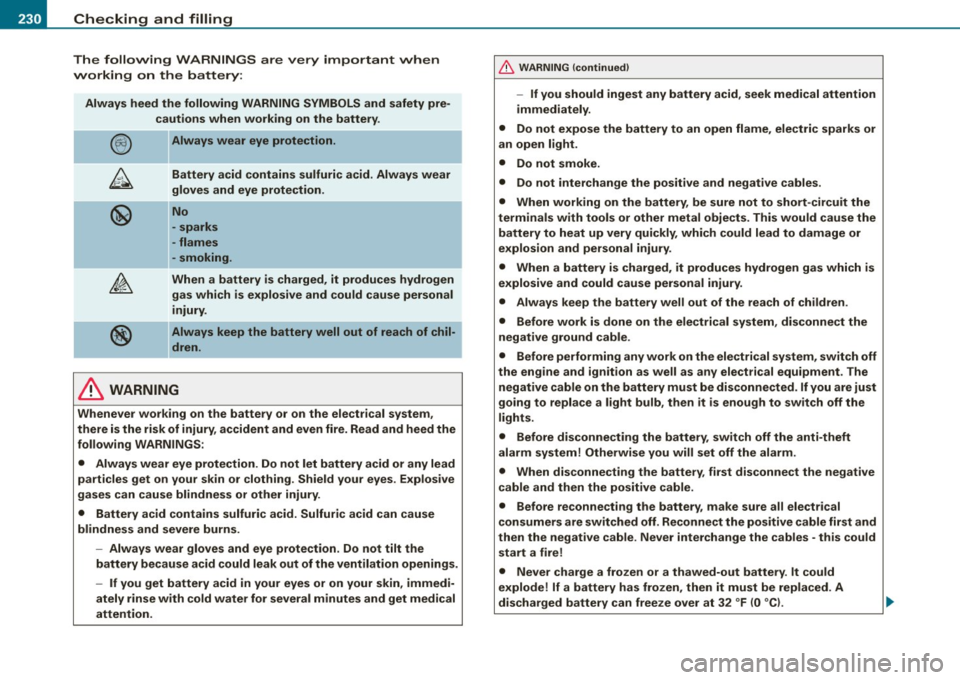
The following WARNINGS are very important when
working on the battery:
Always heed the following WARNING SYMBOLS and safety pre
cautions when work ing on the battery .
@
®
Always wear eye protection .
Battery acid contains sulfuric acid. Always wear
gloves and eye protection .
No
· sparks
- flames
· smoking .
When a battery is charged , it produces hydrogen
gas which is explosive and could cause personal
injury .
Always keep the battery well out of reach of chil
dren .
& WARNING
Whenever working on the battery or on the electrical system,
there is the risk of injury , accident and even fire. Read and heed the
following
WARNINGS :
• Always wear eye protection. Do not let battery acid or any lead
particles get on your skin or clothing . Shield your eyes . Explosive
gases can cause blindness or other injury.
• Battery acid contains sulfuric acid. Sulfuric acid can cause
blindness and severe burns.
-Always wear gloves and eye protection . Do not tilt the
battery because acid could leak out of the ventilation openings .
- If you get battery acid in your eyes or on your skin, immedi
ately rinse with cold water for several minutes and get medi cal
attention .
& WARNING (continued)
- If you should ingest any battery acid , seek medical attention
immed iately.
• Do not expose the battery to an open flame , electric sparks or
an open light.
• Do not smoke.
• Do not interchange the positive and negative cables.
• When working on the battery, be sure not to short -circuit the
terminals with tools or other metal objects. This would cause the
battery to heat up very quickly , which could lead to damage or
explosion and personal injury.
• When a battery is charged , it produces hydrogen gas which is
explosive and could cause personal injury.
• Always keep the battery well out of the reach of children .
• Before work is done on the electrical system, disconnect the
negative ground cable .
• Before performing any work on the electrical system , switch off
the engine and ignit ion as well as any electri cal equipment . The
negative cable on the battery must be disconnected . If you are just
going to replace a light bulb , then it is enough to switch off the
lights.
• Before disconnecting the battery , switch off the anti-theft
alarm system! Otherwise you will set off the alarm.
• When disconnecting the battery, first disconnect the negative
cable and then the positive cable.
• Before reconnecting the battery , make sure all electrical
consumers are switched off. Reconnect the positive cable first and
then the negative cable . Never interchange the cables • this could
start a fire!
• Never charge a frozen or a thawed-out battery . It could
explode! If a battery has frozen , then it must be replaced. A
discharged battery can freeze over at 32 °F (0 °Cl. ..,_
Page 235 of 316

Checking and filling -
------------- --------=----" =---------
& WARNING !continued )
• To reduce the danger of explosio n, never connect or di sconnect
c h arger cable s whi le the charger i s operating .
• Fast charging a battery i s dang erou s and should only be
atte mpt ed by a competent techni cian with the proper equipment .
• Battery acid that may spill during charging should be washed
off with a solut ion of w arm wat er and bak ing soda to ne utrali ze
the acid .
0 Note
Never use a fast charger as a boos ter to start the engine . This wil l
seriously damage sensitive electronic components, such as control
units, re lays, radio, etc ., as well as the battery charger .
[ i ] Tips
The vehicle battery must not be charged with a standard small
charger that plugs into the cigarette lighter or out let .•
Windshield /headlight washer
conta iner
Fi g. 14 7 Fend er, left:
Wind shi eld washer
flui d re ser voir
T h e w asher fluid container is mark ed wit h the symbol O on
its cap.
Before you c heck anything in the e ngine compartment,
always read and heed all WARNINGS~ & in "Workin g
in t he engi ne compartment" on
page 217.
Lift the fi ller cap to ngue to add washe r fluid . You can fill
t h e container to the top.
Press the cap bac k on to the fi ller neck after fi lling the
container .
You can find the reservoir ca pac ity in the tab le in => page 291.
To prevent lime residue fr om bui lding up on the spray jets, use
dis tilled water when refilling . Always add a g lass cleaner solut ion
(with frost pro tection in the winter).
0 Note
Do not mix eng ine coolant antifreeze or any other additives to fil l up
the windshield washer reservo ir. •
Vehic le care I I Technical data
Page 243 of 316
__________________________________________________ T_ ir_e_ s_ a_ n_d _ w_ h_ e_ e_l_s __ _
•
& WARNING (continued)
• Incorrect tire pressures and/or underinflation cause increased
tire wear and can affect the handling of the vehicle.
• Incorrect tire pressures and/or underinflation can also lead to
sudden tire failure, including a blowout and sudden deflation,
causing loss of vehicle control. •
Checking tire pressure
The correct tire pressure for the tires originally installed
on your vehicle is listed on the tire pressure label located
on driver's side 8-pillar.
The recommended tire pressures are on the tire pressure label and
in the table=>
page 238, "Cold tire inflation pressure". This means
that the pressure must be checked and adjusted when the tire has
not been driven for more than a couple of miles (kilometers) at low
speeds during the previous three hours. Air in the tires expands
when the tire heats up as a result of internal friction as it flexes in
use. The tire pressure is higher when the tire has warmed up than
when it is "cold."
It is the inflation pressure in a "cold" tire that counts. Therefore, you
should never let air out of a warm tire to match "Cold tire inflation
pressure" recommendations =>
page 238. The tires would then be
underinflated and could fail suddenly.
The tire pressure label on your Audi lists the recommended cold tire
inflation pressures for the new, original equipment tires that were
on your vehicle at the time it was manufactured . For the location of
the label =>
page 238, fig. 148.
Most tires lose air naturally over time. They can also lose some air if
you drive over a pothole or hit a curb while parking. It is usually not
possible to see whether the radial tires used today are underinflated
just by looking at them. Therefore,
be sure to check tire pressures at least once a month and
always before going on a long trip. Make sure to take the number of
people and the amount of luggage into account when adjusting tire
pressure for a trip -even one that you would not consider to be
"long." See=>
page 242, "Tires and vehicle load limits" for more
important information.
Always use an accurate tire pressure gauge when checking and adjusting inflation pressures . Check all of the tires and be sure not
to forget the spare tire. If the pressure in any tire is too high when
the tire is "cold," let air out of the tire slowly with the edge of the tire
gauge and keep checking the pressure until you reach the pressure
that is correct for the load (passengers and luggage) and kind of driving you plan to do.
If the pressure in any tire is too low, note the difference between the
pressure in the cold tire and the pressure you need and add the air
that you need to reach the correct pressure for the vehicle load
(passengers and luggage) for the tires on your vehicle as listed on
the on your vehicle and in this manual and the kind of driving you
plan to do.
Never exceed the maximum inflation pressure listed on the tire
sidewall for any reason.
Remember that the vehicle manufacturer, not the tire manufacturer,
determines the correct tire pressure for the tires on your vehicle.
It is important to check the tire pressure when the tires are cold.
• Read the required tire pressure from the tire pressure label
located on driver's side 8-pillar.
• Turn the valve stem cap counter -clockwise to remove it from the
tire valve.
• Place the air pressure gauge on the valve.
• The tire pressures should only be checked and adjusted when
the tires are cold. The slightly raised pressures of warm tires must
not be reduced.
• Adjust the tire pressure to the load you are carrying.
• Reinstall the valve stem cap on the valve.
Vehicle care I t •
Page 256 of 316
-~_T_ ir_e_ s_ a_ n_d _ w_ h_ e_e _l_s _________________________________________________ _
than the size indicated on the vehicle placard or tire inflation pres
sure label, you should determine the proper tire inflation pressure
for those tires.)
As an added safety feature, your vehicle has been equipped with a
tire pressure monitoring system* (TPMS) that illuminates a low tire
pressure telltale when one or more of your tires is significantly
under-inflated. Accord ingly, when the low tire pressure te lltale illu
minates, you should stop and check your tires as soon as possible,
and inflate them to the proper pressure. Driving on a significantly
under -inflated tire causes the tire to overheat and can lead to tire
failure . Under -inflation also reduces fuel efficiency and tire tread
life, and may affect the vehic le's handling and stopping ability.
Please note that the TPMS is not a substitute for proper tire mainte
nance, and it is the driver's responsibi lity to maintain correct tire
pressure, even if under -inflation has not reached the level to trigger
il lumination of the TPMS low tire pressure te lltale.
Your vehicle has also been equipped with a TPMS ma lfunction indi
cator to indicate when the system is not operating properly . The
TPMS malfunction indicator is combined with the low tire pressure
telltale. When the system detects a malfunction, the tellta le wi ll
flash for approximately one minute and then remain continuously illuminated. This sequence wil l continue upon subsequent vehicle
start -ups as long as the malfunction exists .
When the ma lfunction indicator is illuminated, the system may not
be able to detec t or signal low tire pressure as intended. TPMS
malfunctions may occur for a variety of reasons, including the
installat ion of replacement or a lternate tires or wheels on the
vehicle that prevent the TPMS from functioning properly . A lways
check the TPMS malfunction tellta le after replacing one or more
tires or whee ls on your vehicle to ensure that the rep lacement or
a lternate tires and wheels al low the TPMS to continue to function
proper ly .•
Ap plies to vehi cles : w it h tire pr ess ure monit oring sy ste m
Introduction
The tire pressure monitoring system* monitors air pres
sure in all four road wheels while the vehicle is moving.
As soon as the tire pressure monitoring system* senses a signifi
cant loss of air pressure in one or several tires, text messages and
yel low symbols appear in the instrument cluster disp lay to alert the
driver. The ) warning light in the instrument cluster comes on
when the tire is significantly underinflated
:::> page 17 .
The warning light Cl' also i lluminates in the case of a system
malfunction.
Be aware that tire pressure is a lso dependent on the temperature of
the tire. For every 18
°F (10 °C) increase in tire temperature, tire pres
sure increases by about 1.5 psi (0 .1 bar). The tire warms up while the
vehic le is moving and tire pressure rises. So you should adjust tire
pressure only when they are
cold, when the temperatu re of the t ires
is roughly the same as the ambient air temperature .
I n order to keep the tire pressure monitoring system * properly ca li
brated, tire pressure on all four tires shou ld be checked at regu lar
intervals, adjusted if necessary and saved in the proper setting
(recommended pressure)
:::> page 256 .
The tire pressure is shown on the label located on the driver's side
B -pillar (visible when the door is open) .
& WARNING
• When the tire pr essure monito ring system * wa rning light i s lit ,
on e or more of your t ires is s ignific antl y under -infl ated . You should
s top and ch eck your tire s as soon as possible , and inflat e th em to
the p rope r pr ess ure as indi cated on th e vehi cle' s tire pre ssure
lab el
:::> pag e 23 8. Driv ing on a sig nific antly under -inflated t ire
ca uses the ti re to overhe at and can le ad to tir e fai lure . Unde r-infl a
tio n also is likel y to imp air the vehi cle 's handlin g and stopping
a bility . .,
Page 257 of 316

Tires and wheels -
----------------
•
& WARNING (continued)
• Do not adjust tire pressure when tire temperature is excessive.
This could lead to serious tire damage and even cause the tire to
burst, with the additional danger of an accident.
tread life.
[ i] Tips
• Each tire should be checked monthly when the temperature of
the tires is about the same as ambient air temperature and set to the
recommended inflation pressure as specified on the tire pressure
label =>
page 238.
• The factory supplied spare wheel is equipped with a sensor for
the tire pressure monitoring system *. As long as the spare wheel is
not mounted, the tire pressure of this tire will not be monitored.
• The tire pressure monitoring system * helps the driver to keep an
eye on tire pressures. But the driver still has the responsibility for
maintaining the correct tire pressure.
• Tire pressure must only be adjusted when the temperature of the
tires is about the same as ambient air temperature.
• When tires are replaced, the sensors and valves should not be
exchanged . The valve core, nut, valve sealing and seal washer
(replacement kit) needs to be replaced. If necessary, the valve and
the wheel electronics have to be replaced.
• If you should put different wheels and tires on your vehicle (e.g.
winter wheels and tires), you must be certain that the wheels and
tires are compatible with the tire pressure monitoring system*.
Otherwise the system will register a malfunction and a fault
message will be displayed. For more information, contact your Audi
dealer. •
Adjust the tire pressure and store the pressure in the tire pres
sure monitoring system* to the load you are carrying.
• For Declaration of Compliance to United States FCC and Industry
Canada regulations =>
page 296. •
Applies to vehicles : with tire pressu re mon itoring system
Significant loss of air pressure }
The yellow symbol appears in the event of a significant
loss of air pressure.
Fig. 153 Display:
yellow symbol with message
If the I warning light in the instrument cluster comes on
and then the(•' symbol appears in the display ~ fig. 153,
pressure in at least one tire is too low.
- Stop driving as soon as possible without endangering
yourself and other drivers on the road.
Inspect all tires.
- Change the tire if necessary ~
page 268.
The, warning light in the instrument cluster comes on when the
tire is significantly underinflated .
In addition, the tire symbol
J appears in the display together with
the message Please check tire pressure=> fig. 153. .._
Vehicle care
I t •
Page 259 of 316

________________________________________________ T_ i _r_e _s_ a_n_ d_ w_ h_ e_e _ l_s __ !II
•
• The tire pressure monitoring system * helps the driver to keep an
eye on tire pressures. But the driver still has the responsibi lity for
maintaining the correct tire pressure .•
Applies to vehicles: with tire pressure mon itorin g system
Wheel change
If a wheel is changed, the wheels that were exchanged
have to be re-programmed .
- Turn on the ignition.
- Press the button~
page 256, fig. 154 for approximately 5
seconds. You will hear a beep and the symbol in the button flas hes three times.
Programming is necessary :
• after the tires have been rotated on the vehicle, or the spare tire
is used,
• if tires with new wheel sensors are used .
A ll pressure warning indicators in the display will be canceled. The
system malfunction error message wil l not disappear until the
vehicle is underway . With pressing the button~
page 256, fig. 154,
the re -programming of the new sensors and storing of ac tua l pres
sures starts. This learning phase can take up to 10 minutes driving
time .
During the learning process the tire pressure monitoring system* is
not avai lable. •
Applies to veh ic les: with tir e pressure monitoring system
Malfunctions •
A malfunction can have various causes.
F ig . 155 Display:
S yst e m m alfun ctio n
If the .J., warning light in the instrument cluster flashes for approxi
mately one minute and then remains continuously illuminated and
additional ly the T ~~ fig. 155 symbol appears in the display, the
tire pressure mon itoring system* is not available. This can have
various causes.
• If the message appears at the end of the lear ning process, the
system cannot recognize the wheels installed on the vehicle. This
can be because one or more wheels without a wheel sensor were
insta lled.
• A wheel sensor or other component may have failed .
• During initialization the system has detected more than 4 wheels
on the vehicle, for example whi le driving next to another car with a
tire pressure monitoring system*.
• A whee l change was made but the button
~ page 256 , fig. 154
was not pressed.
• Audi replacement parts were not used.
• I f snow chains are being used, system function can be compro
mised due to the shielding properties of the chains .
• The tire pressu re monitoring system* may not be available
because of a radio malfunction .
Vehicle care I t •