warning light AUDI TT COUPE 2009 Repair Manual
[x] Cancel search | Manufacturer: AUDI, Model Year: 2009, Model line: TT COUPE, Model: AUDI TT COUPE 2009Pages: 316, PDF Size: 71.16 MB
Page 151 of 316

__________________________________________________ A_ i_ r _b _a...; g::- s_ y=--- s_t _e _m __ lllll
& W ARNING (continued )
seating position and have the airbag system inspected by your
Audi dealer .
• A tight tether or other str ap on a rearward-fac ing child restr aint
attached to the front pas senger seat can put too much pressure
on the weight-sensing mat in the seat and reg ister more weight
than i s actually on the seat. The heavier weight registered can
make the system work as though an adult were on the seat and
deploy the Advanced Airbag when it must be suppressed causing
s erious or even fatal injury to the child .
• If, in exceptional circumstance s, you mu st in stall a forward
fac ing child restra int on the front passenger seat , always move the
seat into its rearmost position in the seat 's fore and aft ad just
ment range , as far away from the airbag a s possible . The backrest
must be adjusted to an upright position . Make sure that the
PASSENGER AIR BAG OFF light comes on and stay s on all the time
whenever the ignition is switched on .
& WARNING
• If the PASSENGER AIR BAG OFF light does not go out when an
adult is sitting on the front passenger seat after taking the steps
described above, make sure the adult is properly seated and
restrained at one of the rear seating positions .
• Have the airbag system inspected by your Audi dealer before
transporting anyone on the front passenger seat .
[ i ] Tips
If the weight -sensing mat in the front passenger seat detects an
e mp ty seat, the fro nt air b ag on the pa ssenge r sid e will be t urned
off, and PASSENGER AIR BAG OFF will stay on.•
Controls and equip ment Safety first
Vehicle operation
Repair, care and disposal of the airbags
Parts of the airbag system are insta lled at many different places on
your Au di. In sta ll in g, re moving, ser vic in g or re pair in g a part in an
area of the vehicle can damage a part of an a irbag system and
pre ven t that system fro m wo rki ng p rope rly in a co llision .
There are some important things you have to know to make sure
that the effectiveness of the system will not be impai red an d that
d iscarded components do not cause inju ry or po llute t he e nv iron
ment .
& WARNING
Improper care , servicing and repair procedures can increase the
risk of personal injury and death by preventing an airbag from
deploying when needed or deploying an airbag unexpectedly:
• Never cover , obstruct , or change the steering wheel horn pad
or airbag cover or the instrument panel or modify them in any way .
• Never attach any obje cts su ch as cup holders or telephone
mountings to the surfaces covering the airbag units.
• For cleaning the horn pad or instrument panel, use only a soft ,
dry cloth or one moi stened with plain water . Solvents or cleaners
c ould damage the airbag cover or change the stiffness or strength
of the material so that the airbag cannot deploy and protect prop
erly .
• Never repair , adjust , or change any parts of the airbag system.
• All work on the steering wheel , instrument panel , front seats or
electrical system (including the installation of audio equipment ,
c ellular telephones and CB radios , etc .I must be performed by a
qualified technician who has the training and special equipment
necessary .
• For any work on the airbag system , we strongly recommend
that you see your authorized Audi dealer or qualified workshop .
• Never modify the front bumper or parts of the vehicle body .
Vehicle care Do-it-yourself service Technical data
Page 152 of 316

-L~A:::..:,: ir:....: b:!..::: a~g L.:: s:1y :...:s::..: t~ e:.: m:...:...:.. ________________________________________________ _
& WARN ING (continued )
• Always make sure that the side airbag can inflate without inter
fe rence :
- Never install seat covers or replacement upholstery over the
front seatback s that have not been spe cifically approved by
Audi.
- Never use additional seat cushions that cover the areas
where the side airbags inflate .
- Damage to the original seat covers or to the seam
in the area
of the side airbag module must always be repaired immedi
ately by an authorized Audi dealer .
• The airbag system can be activated only once. After an airbag
ha s inflated , it must be replaced by an authorized Audi de aler or
qualified technician who has the technical information , training
and special equipment necessary .
• The airbag system can be deployed only once. After an airbag
has been deployed , it must be repla ced with new repla cement
parts designed and approved especially for your Audi model
version . Replacement of complete airbag systems or airbag
components must be performed by qualified workshops only .
Make sure that any airbag service action is entered in your Audi
Warranty
& Maintenance booklet under AIRBAG REPLACEMENT
RECORD .
• For safety reasons in severe accidents , the alternator and
starter are separated from the vehicle battery with a pyrotechn ic
circuit interrupter.
-Work on the pyrotechni c circuit interrupter must only be
performed by a qualified dealer -risk of an accident!
- If the vehi cle or the circuit inte rrupter is scrapped , all appli
cable safety precautions must be followed. •
Other things that can affect Advanced Airbag
performance
Changing the vehic le 's suspens ion system can change the way that
th e Adva nced Air bag Syste m performs in a c rash. Fo r example,
using tire -ri m co mbinations not approved by Audi, lowering the
veh ic le, c hang in g the st if f ness o f th e suspe nsio n, incl uding th e
spr ings, suspension struts, shock absorbers etc. can change the
f o rces t hat a re m easured by the a irba g se nsors and se nt to the elec
tronic control unit. Some suspension changes can, for example,
i ncrease the fo rce level s meas ure d by the senso rs and make the
a irbag system dep loy in crashes in which it wou ld not d ep loy if the
changes ha d no t been made . O th er ki nds of changes may red uce
th e force levels measured by the sensors and preve nt the airbag
fro m deploying w hen it sh ould.
Th e senso rs in th e sa fety belt buc kle fo r the dr iver a nd fro nt
passenger seat te ll the e lectronic control modu le if the safety belt is
l a tc h ed or not. If th e sa fe ty belt is being use d, th e front airbag wi ll
deploy at a slightly higher rate of vehic le dece leration than if the
sa fe ty be lt is n ot b ein g use d. Th ere fore, i n a partic ula r co llisi on, i t is
possible that an airbag wi ll not deploy at a seating position where
th e sa fe ty be lt is bei ng us ed bu t wi ll infl ate at the position w here the
safety be lt is not being used. It is important that nothi ng interfere
with the safety belt buc kles so that the sensors can send the co rrect
i nformatio n about safety belt use to t he electronic control unit.
& WARNING
Changing the vehicle's suspension including use of unapproved
tire -rim combinations can change Advanced Airbag performance
and increase the risk of serious personal injury in a crash.
• Never install suspension components that do not have the
same pe rformance characteristics as the components originally
installed on your vehicle.
• Never use tire -rim combinations that have not been approved
by Audi. ..
Page 154 of 316
__ .....:::A::.::..:. ir..:b ::..:a::. 9:2...: s:::L y..::s :.:t ..::e :.:m.:..:... ________________________________________________ _
is why you should always wear your safety belt, not just because the
law requires you to do so~
page 125, "General notes".
The safety belt buckle for the driver and front seat passenger have switches that tell the airbag control module if the safety belt is
being used or not . If the safety belt is being used, the knee airbag
will deploy at a slightly higher rate of deceleration than if the belt is
not be ing used. Therefore, in a part icular collision, it is possible that
an airbag will not deploy at a seating position where the safety belt
is being used but will inflate a t the position where the safety belt is
not being used .
Remember too, airbags wi ll deploy only once and only in certain
kinds o f accidents -your safety belts are a lways there to offer
protection in those accidents in which airbags are not supposed to
deploy or when they have already deployed, for example when your
vehic le strikes or is struck by another after the first collision .
This is just one of the reasons why an airbag is not a substitute for
the safety be lt . The airbag system works most effectively when used
with the safety bel ts. Therefore, always wear your safety belts
correctly .
It is important to remember that while the supplemental airbag
system is des igned to reduce the likelihood of serious injuries, other
injuries, for example, swelling, bruising, and minor abrasions can
a lso be associated with airbags.
Th e kn ee a irbag s ystem b asica lly con sist s of:
• The electronic control module
• Two inflatable airbags (airbag and gas generator!, one for the
driver and one for the front passenger
• The airbag indicator light in the instrument panel
T he kn ee airb ag sys te m will not depl oy:
• when the ignition is turned off
• in front -end col lisions when the deceleration measured by the
control unit is too low
• in side collisions •
in rear-end collisions
• in rollovers
• in the event of a system malfunction (warning/indicator light illu
m inated)~
page 18 .
& WARNING
• Safet y belt s a nd th e airbag sy stem can onl y pr ovi de prote ction
when o ccupants are in the prop er seating posit ion ~
pag e 144.
• If the airbag i nd ica to r light com es whe n the vehi cle is being
used , have the sy ste m in spected imm ediat ely by y our authori zed
Audi deale r. The a irbag ma y not work p roperly when the v ehicl e
acceler ation in a sid e co llision i s high enou gh to deploy th e airbag.
S ee als o~
pag e 18. •
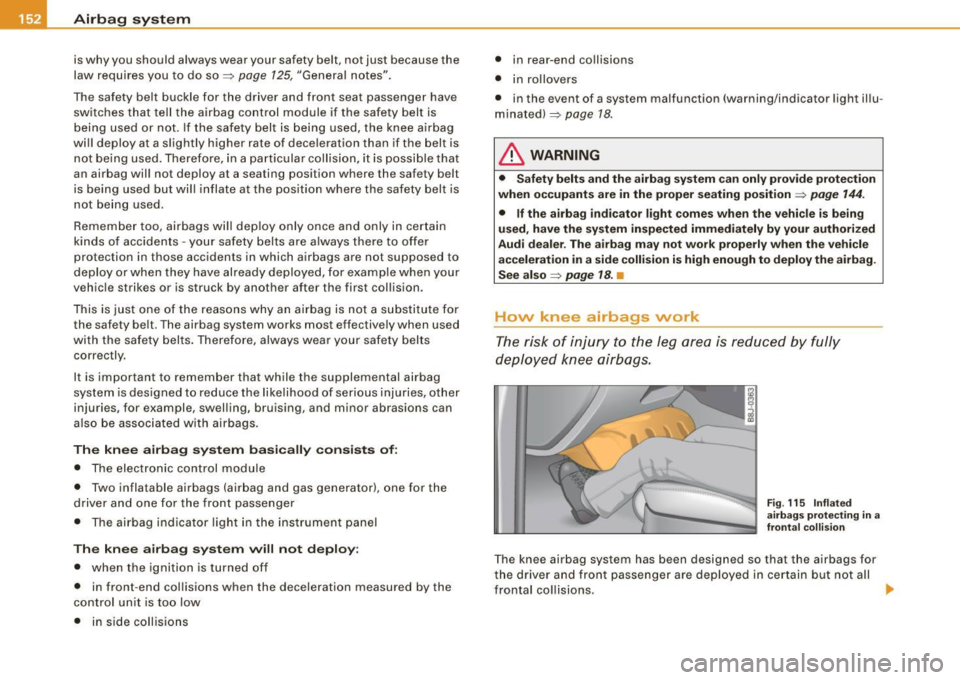
How knee airbags work
The risk of injury to the leg area is re duced by fully
deployed knee airbags.
Fig . 115 Inf lat ed
a ir bags pro tec ting in a
fr ontal co llision
The knee airbag system has been designed so that the airbags for
the driver and fron t passenger are deployed in certain but not all
frontal co llisions. .,.
Page 156 of 316

___ A_ ir_b _a_ g;:::;_ s--:.. y_s _t _e _m _________________________________________________ _
Side airbags
Description of side airbags
The airbag system can provide supplemental protection
to properly restrained front seat occupants.
Fig. 1 16 S ide a irbag
l oca tion i n the drive r's
seat
The side airbags are located in the sides of the front seat backrests
~ fig. 116 facing the doors. They are identified by the word
"AIRBAG".
Th e s ide a irba g sys te m bas ica lly consis ts o f:
• the e lectronic control module and external side impact sensors
• the two side airbags located in the sides of the front backrests
• the airbag warning light in the instrument cluster .
The airbag system is monitored electronica lly to make certain that
it is functioning properly at all times . Each time you turn on the igni
tion, the airbag system indicator light will come on for a few
seconds (self diagnostics).
The side airbag system supplements the safety belts and can help
to reduce the risk of injury to the driver's and front passenger's
upper torso on the side of the vehicle that is struck in a side colli
sion . The airbag deploys only in side impacts and only when the
vehic le acceleration registered by the control unit is high enough. If
this rate is below the reference value programmed into the control unit, the side airbags will not be
triggered, even though the car may
be badly damaged as a result of the collision. It is not possible to
define an airbag triggering range that wi ll cover every possible
angle of impact, since the circumstances will vary considerab ly
between one collision and another . Important factors include, for
example, the nature (hard or soft) of the impacting object, the angle
of impact, vehicle speed, etc.~
page 155, "Important safety
instructions on the side airbag system" .
Aside from their normal safety function, safety belts work to he lp
keep the driver or front passenger in position in the event of a side
collision so that the side airbags can provide protection.
The airbag system is
not a subs titute for your safety belt. Rather, it
is part of the overall occupant restraint system in your vehicle .
Always remember that the side airbag system can only help to protect you if you are wearing your safety belt and wearing it prop
erly. This is another reason why you should always wear your safety
belts, not just because the law requires you to do so~
page 125,
"General notes" .
It is important to remember that while the supplemental side airbag
system is designed to reduce the likelihood of serious injuries, other
injuries, for example, swel ling, bruis ing , and minor abrasions can
also be associated with deployed side airbags . Remember too, side
airbags will deploy only once and only in certain kinds of accidents
- your safety belts are a lways there to offer protection.
Vehicle damage, repair costs or even the lack of vehicle damage are not necessarily an indication of over-sensitive or failed airbag acti
va tion . In some collisions, both front and side airbags may inflate .
Remember too, that airbags will deploy only once and only in
certain kinds of col lisions -your safety belts are a lways there to
offer protection in those accidents in which airbags are not
supposed to deploy or when they have already deployed .
The s ide a irba g sy stem wi ll not deploy :
• whe n the ignition is turned off
• in side collisions when the acceleration measured by the sensor
is too low
~
Page 157 of 316
• in front -end collisions
• i n rea r-en d col lis ions
• in ro llovers.
In som e types o f acci dents th e fron t air bags a nd s ide airbags m ay
be trigge red together.
& WARNING
• Safety belts and the airbag system will only provide protect ion
when occupants are in the proper seating position
=> page 155 .
• If the a irbag indicator light comes on when the vehicle is being
used, have the system inspected immediately by your authorized
Audi dealer . The a irbag may not work properly when the vehicle
acceleration in a side collision is high enough to a ctivate the
airbag .•
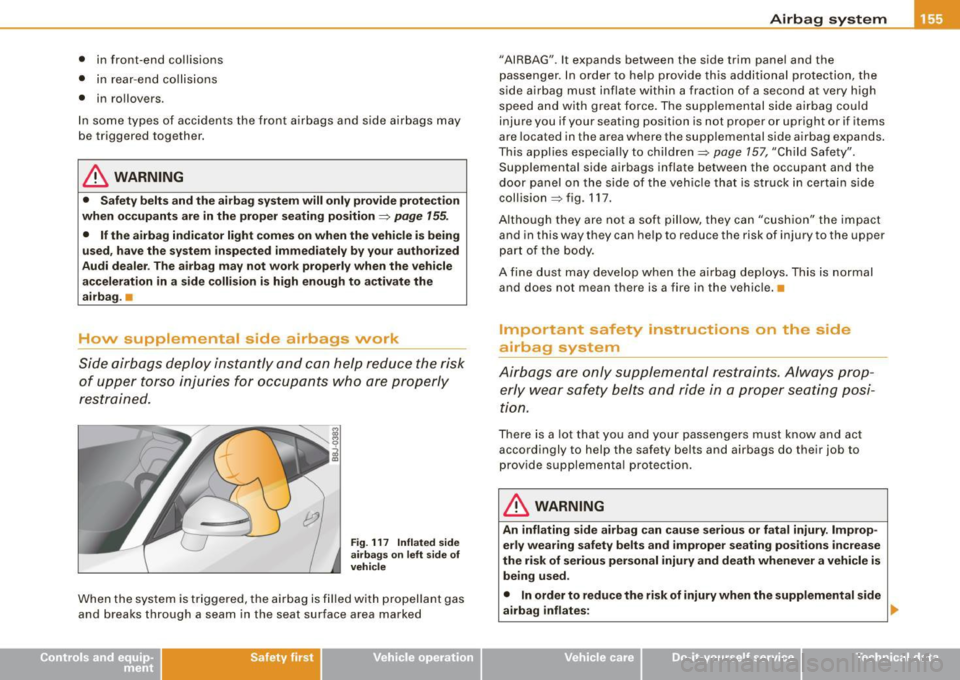
How supplemental side airbags work
Side air bags deploy inst ant ly a nd con help reduce the risk
of u pper torso injuries for oc cupants wh o ore p roperly
restrained.
Fig . 117 Inflated side
a irba gs on left side of
vehic le
When the sys tem is triggered, the airbag is fille d with prop ellant gas
and br eaks through a seam in the seat sur face area marked
Safety first
Airbag system
"AIR BAG". It expands between the side trim pane l and the
passe nger. In o rder to hel p provide this a dditional protecti on, the
s ide a irbag must inflate w ithin a fraction of a second at very high
speed a nd w ith grea t force. T he suppleme ntal side ai rbag could
injure you if your seating position is not proper or upright or if items
are located in the a rea where the s upp lemental si de air bag expands .
This applies especial ly to child ren=>
page 157, "Ch ild Sa fe ty".
Sup plemental side airbags inflate between the o ccupant and the
d o or pa nel on the side of the vehicle tha t is str uck in certa in side
collision => fig . 117.
A lthough they a re not a s oft pillow, they ca n "cu shi on" the i mpact
and in this way they can help to reduce the risk of injury to the upper
par t of the bo dy.
A fin e dust may d evelop whe n the ai rbag deploys. T his is no rmal
and does not mean there is a fire in the vehic le .•
rmportant safety instructions on the side
airbag system
Ai rb ags o re on ly supplementa l restrai nts. A lwa ys p rop
e rly wea r safety belts and ride i n a prope r seatin g posi
ti on .
Ther e is a lo t th at you and your passenge rs m ust know a nd act
accordingly to help the safety belts and airbags do their job to
p rovide s upple men ta l pr otec tion .
& WARNING
An inflating side airbag can cause serious or fatal injury . Improp
erly wearing safety belts and improper seating positions increase
the risk of serious personal injury and death whenever a vehicle is being used.
• In order to reduce the risk of injury when the supplemental side
airbag inflates : .,
Vehicle care
I I irechnical data
Page 158 of 316

-Airbag system ----=---'---------------------------------------------
& WARNING (continued)
- Always sit in an upright position and never lean against the
area where the supplemental side airbag is located.
- Never let a child or anyone else rest their head against the
side trim panel in the area where the supplemental side airbag
inflates .
- Always make sure that safety belts are worn correctly,
- Do not let anyone sitting in the front seat put their hand or any other parts of their body out of the window.
• Always make sure that the side airbag can inflate without inter
ference.
- Never install seat covers or replacement upholstery over the front seat backs that have not been specifically approved by
Audi.
- Never use additional seat cushions that cover the areas
where the side airbags deploy .
- Damage to the original seat covers or to the seam in the area
of the side airbag module must always be repaired immedi
ately by an authorized Audi dealer.
• Objects between you and the airbag can increase the risk of
injury in an accident by interfering with the way the airbag unfolds
or by being pushed into you as the airbag inflates .
- Never place or attach accessories or other objects (such as
cup holders , telephone brackets, or even large, bulky objects)
on the doors , over or near the area marked "AIRBAG" on the
seat backrests .
- Such objects and accessories can become dangerous projec
tiles and cause injury when the supplemental side airbag
deploys.
- Never carry any objects or pets in the deployment space
between them and the airbags or allow children or other
passengers to travel in this position.
& WARNING (continued)
• Always use the built-in coat hooks only for lightweight
clothing. Never leave any heavy or sharp -edged objects in the
pockets that may interfere with side airbag deployment and can
cause personal injury in an accident .
• Always prevent the side airbags from being damaged by heavy
objects knocking against or hitting the sides of the seatbacks.
• The airbag system can only be triggered once.
If the airbag has
been triggered, the system must be replaced by an authorized
Audi dealership .
• Damage (cracks , deep scratches etc.I to the original seat covers
or to the seam in the area of the side airbag module must always
be repaired immediately by an authorized Audi dealer .
• If children are seated improperly, their risk of injury increases
in the case of an accident~
page 157, "Child Safety ".
• Never attempt to modify any components of the airbag system
in any way .
• In a side collision , side airbags will not function properly if
sensors cannot correctly measure increasing air pressure inside
the doors when air escapes through larger , unclosed openings in
the door panel.
- Never drive with interior door trim panels removed.
-Never drive when parts have been removed from the inside
door panel and the openings they leave have not been properly
closed .
- Never drive when loudspeakers in the doors have been
removed unless the speaker holes have been properly closed.
- Always make certain that openings are covered or filled if
additional speakers or other equipment is installed in the
inside door panels .
- Always have work on the doors done by an authorized Audi
dealer or qualified workshop . •
Page 160 of 316

-Child Safety -------=---------------------------------------
& WAR NIN G (co ntinued )
• Alw ays in sta ll re ar-facin g child safety s eats on the r ear seat .
• If you m us t in sta ll a rear ward f acing child saf ety s eat on th e
fr ont pa ssenger seat in exceptional circum stan ces and the
PA SSEN GER AIR BAG OFF light do es not come on and sta y on ,
immediately in sta ll the re ar-facing child safety s eat in a rear
s eating po sit ion and ha ve th e airb ag s ystem insp ected immedi
atel y by your Audi dea ler .
& WARNING
If, in exceptional circum stance s, you mu st in sta ll a forward -f a cing
c hild re str ain t on th e fr ont p assenger's s eat:
• Always mak e sure the forward -fac ing seat ha s been de signed
a nd ce rt ified by it s m anufa cturer for u se on a fr ont se at w ith a
pa ssenger front and side airbag.
• Always follow the m anufacturer's instru ctions provided w ith
the child safety seat or carr ier.
• Alwa ys mo ve the pa ssenger seat into it s rea rmost positi on in
the seat' s fore and aft adju stment range , as far aw ay from the
ai rbag as possib le bef ore installing the ch ild r estr aint . The ba ck
re st mu st b e adjusted to an upright po sition.
• Alway s m ake sure that the PASSENGER AIR BAG OFF l ight
c om es on and sta y s on all the time whenever the ignition is
s w it c hed on . •
Advanced front airbag system and children
Your vehicle is equipped with an "Advanced Airbag System" in
complia nce with United States Federa l Motor Vehicle Safety Stan
dard (FMVSS) 208 as applicable at the time your vehicle was manu
factu red. T
he Advanced Airbag system in your vehicle has been certified to
meet the " low -risk" requirements for 3 and 6 year -old chi ldren on
the passenger side and smal l adults on the driver side . The low risk
deployment criteria are intended to reduce the risk of injury through
interaction with the airbag that can occur, for example, by being too
close to the steering wheel and instrument panel when the airbag
inflates. In addition, the system has been certified to comply with
the "suppression" requirements of the Safety Standard, to turn off
the front airbag for infants up to 12 months who are restrained on
the front passenger seat in child restraints that are listed in the
S tandard.
Even though your vehicle is equipped with an Advanced Airbag
system, all ch ildren, especially those 12 years and younger, should
always ride in the back seat properly restrained for their age and
size . The airbag on the passenger side makes the front seat a poten
tially dangerous p lace for a child to ride. The front seat is not the
safest p lace for a child in a forward -facing child safety seat. It can be
a very dangerous p lace for an infant or a larger ch ild in a rearward
facing seat. •
Advanced Airbags and the weight-sensing
mat in the front seat
The Advanced Airbag System in your vehicle detects the presence
of an infant or child in a chi ld restraint on the front passenger seat
using the weight -sensing mat in the seat cushion and the sensor
below the safety belt latch on the front passenger seat that
measures the tension on the safety belt.
The weight -sensing mat measures total weight of the chi ld and the
child safety seat and a child blanket on the front passenger seat . The
weight on the front passenger seat is related to the design of the
child restraint and its "footprint", the size and shape of the bottom
of the child restraint as it sits on the seat . The weight of a child
restraint and its "footprint" vary for different kinds of child ..,.
Page 161 of 316

-----------------------------------------~C::_! h~ i~ ld ~ S~a !_!f ~e _!;tY L _lffl!III
restraints and for the different models of the same kind of child
restraint offered by child restraint manufacturers.
The weight ranges for the individual types, makes and models of
child restraints that the NHTSA has specified in the Safety Standard
together with the weight ranges of typ ical infants and typical 1 year
old child have been stored in the control unit of the Advanced
Airbag System. When a child restraint is being used on the front
passenger seat with a typical 1 year -old child, the Advanced Airbag
System compares the weight measured by the weight sensing mat
with the information stored in the electronic control unit.
The electronic control unit also registers the tension on the front
passenger safety belt. The tension on the safety belt for the front
passenger seat will be different for an adult who is properly using
the safety belt as compared to the tension on the belt when it is
used to attach a child restraint to the seat. The sensor below the
latch for the safety belt for the front seat passenger measures the
tension on the belt . The input from this sensor is then used with the
weight to "decide" , whether there is a child restraint with a typical 1
year-old child on the front passenger seat and whether or not the airbag must be turned off.•
Child restraints and Advanced Airbags
Regardless of the child restraint that you use, make sure that it has
been certified to meet United States Federal Motor Vehicle Safety
Standards and has been certified by its manufacturer for use with
an airbag. Always be sure that the chi ld restraint is properly
installed at one of the rear seating positions. If in exceptiona l
circumstances you must use it on the front passenger seat, carefully
read all of the information on child safety and Advanced Airbags
and heed a ll of the applicable WARNINGS. Make certain that the
child restraint is correctly recognized by the weight -sensing mat
inside the front passenger seat, that the front passenger airbag is
turned off and that the airbag status is always correctly signaled by
th e
PASSENGER AIR BAG OFF light .
Controls and equip
ment Safety first Vehicle operation
Many
types and models of child restraints have been available over
the years, new mode ls are introduced regularly incorporating new
and improved designs and older mode ls are taken out of produc
tion. Child restraints are not standardized . Child restraints of the
same type typically have different weights and sizes and different
'footprints,' the size and shape of the bottom of the chi ld restraint
that sits on the seat, when they are installed on a vehicle sea t. These
differences make it virtual ly impossible to certify comp liance with
the requirements for advanced airbags with each and every child
restraint that has ever been sold in the past or will be sold over the
course of the usefu l life of your vehic le.
For this reason, the United States National Highway Traffic Safety
Administration has pub lished a list of specific type, makes and
models of child restraints that must be used to certify compliance
of the Advanced Airbag System in your vehicle with the suppression
requirements of Federal Motor Vehicle Safety Standard 208. These
child restraints are:
A. Car beds, manufactured on or after September 1,
2004:
• Cosco Dream Ride 02-719
B. Rear facing child restraint systems, manufactured
on or after September 1, 2004:
(When the restraint system comes equipped with a removable base,
compliance has to be certified with or without the base) .
• Britax Handle with Care 191
• Century Assura 4553
• Century Smart Fit 4543
• Cosco Arriva 02727
• Evenflo Discovery Adjust Right 212
• Evenflo First Choice 204
• Graco lnfant8457
Vehicle care Do-it-yourself service Technical data
Page 162 of 316
___ C_ h_ il_ d _S_ a_fe _ ty ______________________________________________ _
C. Forward-facing convertible child restraint systems,
manufactured on or after September 1, 2004:
• Britax Roundabout 161
• Britax Expressway
• Century Encore 4612
• Century STE 1000 4416
• Cosco Olympian 02803
• Cosco Touriva 02519
• Evenflo Horizon V 425
• Evenflo Medallion 254
• Safety First Comfort Ride 22-400
& WARNING
To reduce the risk of serious injury, make sure that the PASSENGER
AIR BAG OFF light comes on and stays on whenever a child
restraint is installed on the front passenger seat and the ignition
is switched on.
• Take the child restraint off the front passenger seat and install
it properly at one of the rear seat positions if the PASSENGER AIR
BAG OFF light does not stay on.
• Have the airbag system inspected by your authorized Audi
dealer immediately.
[ i] Tips
The child seats listed in categories A to C have been tested by Audi
only for the Advanced Airbag function. •
Important safety instructions for using child
safety seats
Correct use of child safety seats substantially reduces the
risk of injury in an accident!
As the driver, you are responsible for the safety of every
body in the vehicle, especially children:
- Always use the right child safety seat for each child and
always use it properly ::::> page 162.
- Always carefully follow the child safety seat manufac
turer's instructions on how to route the safety belt prop
erly through the child safety seat.
- When using the vehicle safety belt to install a child safety
seat, you must first activate the convertible locking
retractor on the safety belt to prevent the child safety
seat from moving ::::> page
168.
- Push the child safety seat down with your full weight to
get the safety belt really tight so that the seat cannot
move forward or sideways more than one inch (2.5 cm).
- If a strap or tether is being used to tie the child safety
seat to the front passenger seat, make sure that it is not
so tight that it causes the weight-sensing mat to
measure more weight than is actually on the seat.
Always remember: Even though your vehicle is equipped with an
Advanced Airbag system, all children, especially those 12 years and
younger, should always ride in the back seat properly restrained for
their age and size. _,,
Page 164 of 316
___ C_h_ i_ld _ S_ a_ f_ e_ t-= y'------------------------------------------------
& WARNING (continued)
-Always move the front passenger seat into the rearmost
position of the passenger seat's fore and aft adjustment range,
and as far away from the airbag as possible before installing
the child restraint.
- Always make sure that nothing prevents the front
passenger's seat from being moved to the rearmost position in
its fore and aft adjustment range .
- Always make sure that the backrest is in the upright posi
tion.
• Always buckle the child safety seat firmly in place even if a
child is not sitting in it. A loose child safety seat can fly around
during a sudden stop or in a collision.
• Always read and heed all WARNINGS whenever using a child
restrained in a vehicle is being used=>
page 125, "Safety belts",
=>
page 135, "Airbag system" and=> page 157, "Child Safety".
& WARNING
To reduce the risk of serious injury, make sure that the PASSENGER
AIR BAG OFF light comes on and stays on whenever a child
restraint is installed on the front passenger seat and the ignition
is switched on.
• Take the child restraint off the front passenger seat and install
it properly at one of the rear seat positions if the PASSENGER AIR
BAG OFF light does not stay on.
• Have the airbag system inspected by your authorized Audi
dealer immediately. •
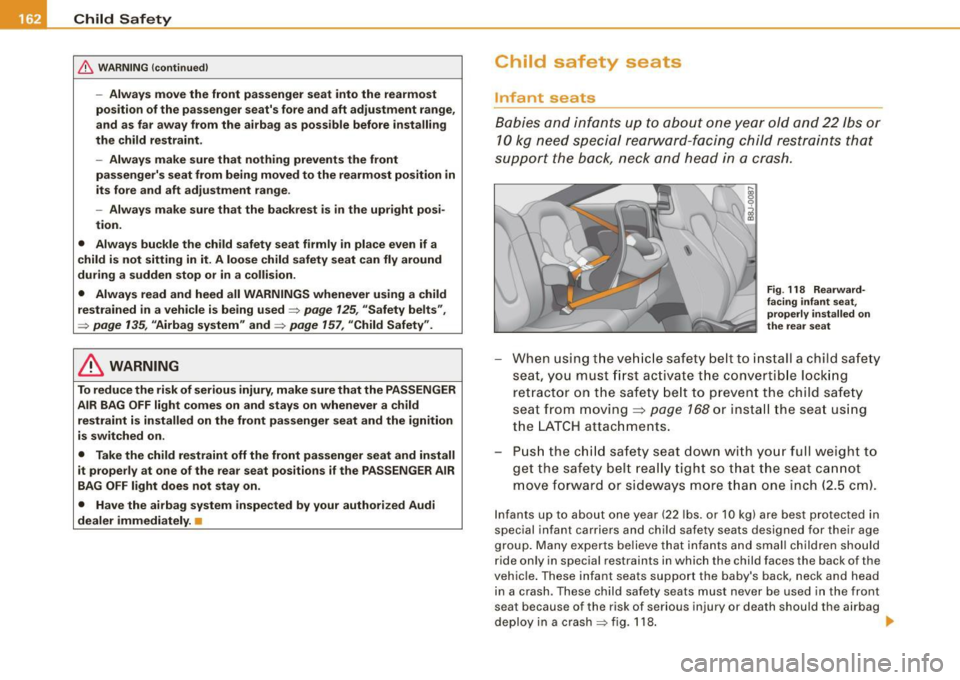
Child safety seats
Infant seats
Babies and infants up to about one year old and 22 lbs or
10 kg need special rearward-facing child restraints that
support the back, neck and head in a crash.
Fig . 118 Rearward
facing infant seat,
properly installed on
the rear seat
-When using the vehicle safety belt to install a child safety
seat, you must first activate the convertible locking
retractor on the safety belt to prevent the child safety
seat from moving~
page 168 or install the seat using
the LATCH attachments.
- Push the child safety seat down with your full weight to
get the safety belt really tight so that the seat cannot
move forward or sideways more than one inch (2.5 cm).
Infants up to about one year (22 lbs. or 10 kg) are best protected in
special infant carriers and child safety seats designed for their age
group. Many experts believe that infants and small children should
ride only in special restraints in which the child faces the back of the
vehicle. These infant seats support the baby's back, neck and head
in a crash . These child safety seats must never be used in the front
seat because of the risk of serious injury or death should the airbag
deploy in a crash=> fig. 118. ..