air condition AUDI TT COUPE 2009 Owner's Manual
[x] Cancel search | Manufacturer: AUDI, Model Year: 2009, Model line: TT COUPE, Model: AUDI TT COUPE 2009Pages: 316, PDF Size: 71.16 MB
Page 230 of 316

-~_C_ h_e _c _ k_ i_n ...:::g::;...._ a_n_d _ f_ i_ll _in -'g:::;.._ ___________________________________________ _
& WARNING
• Bra ke fluid i s poiso nou s. It must be stor ed only in the clo se d
original container out of the rea ch of children!
• Bra ke failure can re sult from old or inappropri ate br ake fluid .
Ob serve the se pre cauti ons:
- Use o nly br ake fluid th at m eets S AE spe cific ation
J 1703 and
co nform s to Fed era l Mo tor Vehic le Standard 11 6. Alway s check
w ith your authori zed Aud i de aler to mak e sure y ou are usi ng
the correc t brake fluid. The corre ct type of brake flu id i s also
indica ted on the br ake fl uid re se rvoi r.
- The brake fluid mu st be new . Heavy u se of the brake s can
ca use a vapor lock if th e bra ke fluid is left in the system too
long. Thi s can seriou sly affect the effic iency of the brake s as
w ell as y our safet y. T his c ould re s u lt in an a ccident .
0 Note
Brake fluid wil l damage the paint of your vehicle .
~ For the sake of the environment
Because of the problem of proper disposal of brake fluid as well as
the special tools required and the necessary expertise, we recom
mend that you have the brake fluid changed by your authorized Audi
dea ler. •
Battery
General information
Your vehicle is equipped with a specia l battery, an AGM battery. This
ba ttery is loca ted in the luggage compar tment and must be
replaced with an original equipment battery. Under normal oper
ating conditions, the battery is
ma inten anc e-free .
Have the battery checked when you take your vehicle in for service .
You a re well advised to replace a battery that is o lder than 5 years .
Disconn ecting th e batt ery te rmin als
Some vehicle functions (power w indow regulators, for example) are
lost if the battery terminals are disconnected. These functions have
to be relearned after the battery terminals are connected again. To prevent this, the battery should only be disconnected from the
vehic le electrical sys tem when abso lutely necessary for repairs .
Vehi cles not dri ven for lo ng p eriods
If you are going to let your vehic le stand for a long time and n ot
drive it, you should remember there are e lectrica l components
whic h are still functioning and they will draw energy from the
battery and drain it, for example, the engine immobilizer. To prevent
t his, you can eithe r charge the batte ry occasionally to keep it in
good working condition or you can disconnect the negative cable
on the battery.
W int er op erati on
During the winter months, batte ry capacity tends to decrease as
temperatures drop . This is because more power is also consumed
whi le starting, and the headlights, rear window defogger, etc ., are
used more often.
Avoid unnecessary power consumption, particularly in city traffic or
when trave ling o nly short distances . Let your authorized Audi dealer
check the capacity of the vehicle battery before winter sets in
~ page 232. A we ll charged battery will not only preven t starting
problems when the weather is cold, but will also last longer.
Repla cing batter y
The new battery must hav e the same capacity, voltage ( 12 volts),
amperage, construction and p lug sea ling, as the orig inal battery .
Specifications are listed on the battery housing. Batteries specia lly
developed by Aud i fulfill the main tenance, output, and safe ty
requirements. ...,
Page 241 of 316
________________________________________________ T_ i _r_e _s_ a_n_ d_ w_ h_ e_e _ l_s __ l'III
•
If yo u w is h to impr ove com fort when operat ing the vehi cle at
nor mal load (up t o 2 occupant s), you c an adju st tire pres sur es to
th ose spe cified f or norm al v ehi cle lo ad . B efo re op era tin g the vehicle
at maximum load , you mu st in crease the tire pre ssure s to tho se
s pe cifi ed for m aximum vehi cle lo ad =>
& .
Bear in mind that the tire pressure mon itor ing syst em * can only
monitor the tire pressures you have stored. The system does not
recogni ze th e load cond ition o f you r vehicle .
T he effec tiveness of the tire pressu re monitoring system * will be
impaired if you store no rmal load pressures bu t then operate the
vehicle at its maximum load=>& . See the
illustra tion=>
page 238, fig . 148 for the location of the label
on driver's side 8 -pillar (co lor of the actual label and exact location
on the vehic le wi ll vary slightly).
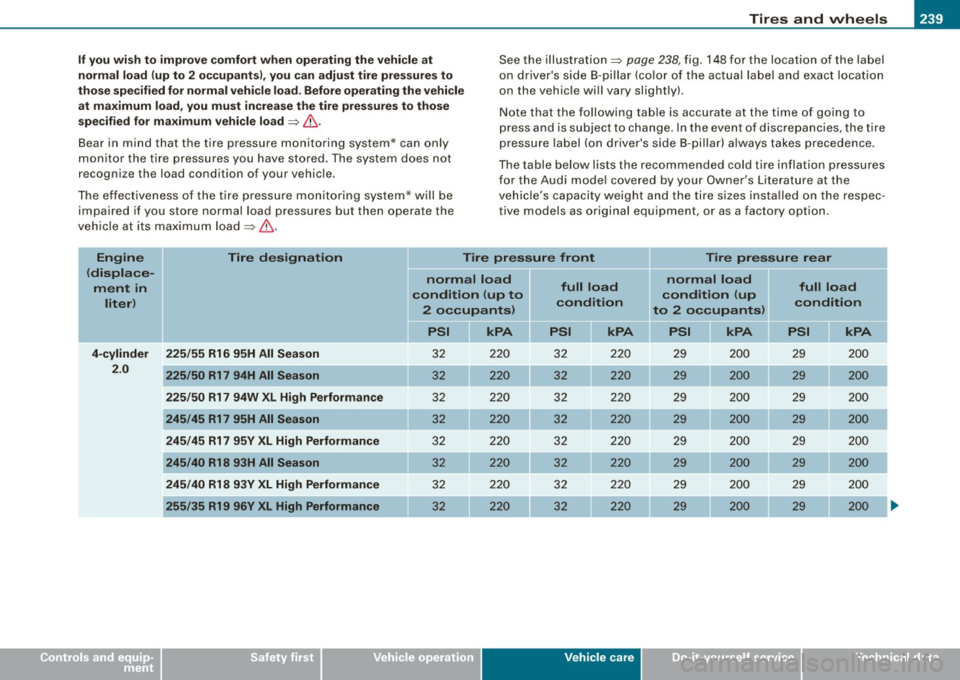
Note that the following tab le is accurate at the time of going to
press and is subject to change . In the event of discrepancies, the t ire
pressure label (on dr iver's side 8 -pillar) always takes precedence .
The table below lists the recommended cold tire i nflation pressures
for the Audi mode l covered by your Owner 's Litera ture at the
vehicle's capacity weight and the tire sizes insta lled on the respec
tive models as original equipment , or as a factory option .
Engine
(displ ace
m ent in
liter ) Tir
e design ation Tire pr es sur e front Tire press ure re ar
4 -c ylinder
2 .0 225
/55 R16 95H All Se ason
225 /50 R17 94H All S eason
2 2 5/5 0 R17 94W XL High Perf orma nce
245 /45 R17 95H All Sea son
2 45 /45 R17 95 V XL High Perform ance
245 /40 R18 93H All Se ason
245 /40 R18 93V XL High P erformance
255 /35 R19 96V XL High Perform ance
normal lo ad
conditi on (up to
2 occup ant s)
PSI kPA
32 220
32 220
32 220
32 220
32 220
32 220
32 220
32 220
full load
c ondition
PSI kPA
32 220
32 220
32 220
32 220
32 220
32 220
32 220
32 2 20
Vehicle care
n o rm al l oa d
full load
co ndition (up
condition
to 2 o ccupant s)
PSI kPA PSI kPA
29 200 29 200
29 200 29 200
29 200 29 200
29 200 29 200
29 200 29 200
29 200 29 200
29 200 29 200
29 200 29 200
I t •
Page 248 of 316
___ T_ i_ r_e _s_ a_ n_ d_ w_ h_ e_ e _ ls _________________________________________________ _
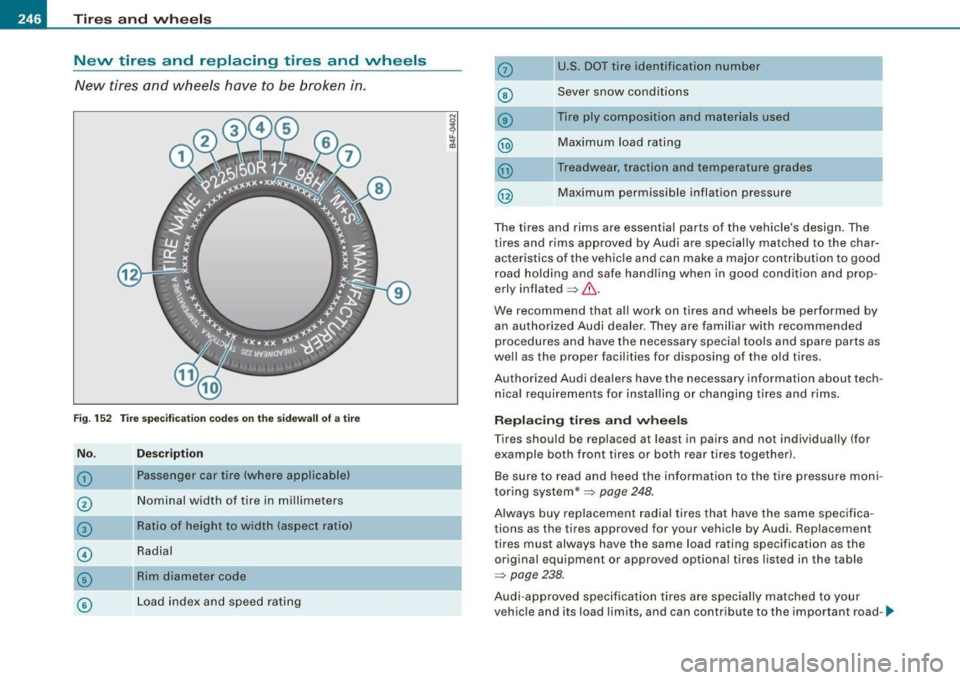
New tires and replacing tires and wheels
New tires and wheels have to be broken in.
F ig . 1 52 Tir e spec ifi cati on co des o n the sid ewa ll of a t ire
No . Desc ription
G)
®
©
©
©
©
Passenger car tire (where a pplicable)
Nominal width of tire in mi llimeters
Ratio of he ight to width (aspect ratio)
Radial
Rim diameter code
Load index and speed rating
0
©
©
@
@
U.S. DOT tire identification number
Sever snow conditions
Tire ply composition and materials used
Maximum load rating
Treadwear, traction and temperature grades
@ Maximum permissible inflation pressure
The tires and rims are essential parts of the vehicle's design. The
tires and rims approved by Audi are special ly matched to the char
acteristics of the vehicle and can make a major contribution to good
road ho lding and safe hand ling when in good cond ition and prop
erly inflated
~ & .
We recommend that all work on tires and wheels be performed by
an authorized Audi dealer . They are familiar with recommended
procedures and have the necessary special too ls and spare parts as
well as the proper facilities for disposing of the old tires.
Authorized Audi dea lers have the necessary information about tech
n ical requirements for insta lling or changing tires and rims .
Replacing tires and wheel s
Tires should be replaced at least in pairs and not individual ly (for
example both front tires or both rear tires together) .
Be sure to read and heed the information to the tire pressure moni
toring system *~ page
248 .
Always buy replacement radial tires tha t have the same specifica
tions as the tires approved for your vehicle by Audi . Replacement
tires must always have the same load rating specification as the
original equipment or approved optiona l tires listed in the table
~ page 238.
Audi -app roved specification tires are specially ma tched to your
vehic le and its load limits, and can contribute to the important road-~
Page 250 of 316

-~_T_ ir_e_ s_ a_ n_d _ w_ h_ e_e _l_s _________________________________________________ _
ture. For example, the numbers 2209 mean that the tire was
produced in the 22th week of 2009. The other numbers are
marketing codes that may or may not be used by the tire manufac
turer. This information is used to contact consumers if a tire defect
requires a recall.
Tire ply composition and materials used
The number of plies indicates the number of layers of rubber-coated
fabric in the tire. In general, the greater the number of plies, the
more weight a tire can support. Tire manufacturers also must indi
cate the materials in the tire, which include steel, nylon, polyester,
and others .
Maximum Load Rating
This number indicates the maximum load in kilograms and pounds
that can be carried by the tire.
Tire quality grading for treadwear, traction, and
temperature resistance
Tread wear, traction and temperature grades => page 249.
Maximum Permissible Inflation Pressure
This number is the greatest amount of air pressure that should ever
be put in the tire under normal driving conditions.
Replacing tires or rims on vehicles equipped with tire
pressure monitoring system*
The wheels on your vehicle are equipped with a sensor which
constantly monitors the air pressure inside the tire, and then trans
mits this information to the tire pressure monitoring system *. If you
are going to replace the wheel rims on your vehicle, make sure the
new rims also have these sensors . The sensors must be compatible
with the tire pressure monitoring system * on your vehicle.
If the sensors are to be installed on different rims , the seal, washer ,
and valve cap for each sensor must be replaced.
If you install rims, which do not have the sensors, or have sensors
which are not compatible, then the tire pressure monitoring system* will not work properly.
In this case, the tire pressure moni
toring system * would not be able to monitor the tire pressure or
warn you if it is necessary .
• The battery inside of the tire pressure sensor has a limited
service life.
• Always drive with the valve stem caps securely mounted. We
recommend using factory installed valve stem caps. Ask your autho
rized Audi dealer to replace lost valve stem caps.
The installation of replacement tires with steel cord body plies in
the tire sidewall may cause malfunction of the tire pressure moni
toring system*, and is not recommended (cord material information
in molded on the tire sidewall) .
Always check your tire pressure monitoring system* indicator after
replacing one or more tires on your vehicle. If the tire pressure
monitoring system* indicator flashes, or is on, your system is not
working properly. Your replacement tire might be incompatible with
your tire pressure monitoring sys tem* , or some component o f the
tire pressure monitoring system* may be damaged.
& WARNING
• Using incorrect or unmatched tires and/ or wheels or improper
tire and wheel combinations can lead to loss of control, collision
and serious personal injury.
• Always use tires, rims and wheel bolts that meet the specifica
tions of original factory-installed tires or other combinations that
have been specifically approved by the vehicle manufacturer .
• Tires age even if they are not being used and can fail suddenly,
especially at high speeds. Tires that are more than 6 years old can
only be used in an emergency and then with special care and at
lower speeds.
• Never mount used tires on your vehicle if you are not sure of
their "previous history." Old used tires may have been damaged
even though the damage cannot be seen that can lead to sudden
tire failure and loss of vehicle control. .,_
Page 252 of 316
-~_T_ ir_e_ s_ a_ n_d _ w_ h_ e_e _l_s _________________________________________________ _
Quality grades can be found where applicable on the tire side wall
between tread shoulder and maximum section width
=> page 246,
fig. 152.
For example: Tread wear 200, Traction AA, Temperature A.
All passenger car tires must conform to Federal Safety Require
ments in addition to these grades .
Tread wear
The tread wear grade is a comparative rating based on the wear rate
of the tire when tested under controlled conditions on a specified
government test course .
For example, a tire graded 150 would wear one and one half (1 1/2)
times as well on the government course as a tire graded 100 .
The relative performance of tires depends upon the actual condi
tions of their use, however, and may depart significantly from the
norm due to variations in driving habits, service practices and differ
ences in road characteristics and climate.
Traction
The traction grades, from highest to lowest, are AA, A, Band C .
Those grades represent the tire's ability to stop on wet pavement as
measured under controlled conditions on specified government
test surfaces of asphalt and concrete. A tire marked C may have
poor traction performance
=> &.
Temperature
The temperature grades are A (the highest), B, and C, representing
the tire's resistance to the generation of heat and its ability to dissi
pate heat when tested under controlled conditions on a specified
indoor laboratory test wheel.
Sustained high temperature can cause the material of the tire to
degenerate and reduce tire life, and excessive temperature can lead
to sudden tire failure=>& .
The grade C corresponds to a level of performance which all
passenger car tires must meet under the Federal Motor Vehicle Safety
Standard No. 109. Grades Band A represent higher levels of
performance on the laboratory test wheel than the minimum
required by law.
& WARNING
The traction grade assigned to this tire is based on straight-ahead
braking traction tests, and does not include acceleration,
cornering, hydroplaning or peak traction characteristics.
& WARNING
The temperature grade for this tire is established for a tire that is
properly inflated and not overloaded. Excessive speed, underinfla
tion, or excessive loading, either separately or in combination, can
cause heat buildup and possible tire failure. •
Winter tires
Winter tires can improve vehicle handling on snow and
ice. At temperatures below 45 °F (7 °C) we recommend
changing to winter tires.
In some heavy snow areas, local governments may require true
winter or "snow" tires, those with very deeply cut tread. These tires
should only be used in pairs and be installed on all four wheels.
Make sure you purchase snow tires that are the same size and
construction type as the other tires on your vehicle.
I f your vehicle is equipped with all-wheel drive *, this will improv e
traction during winter driving, even with the standard tires.
However, we strongly recommend that you always equip all four
wheels on your vehicle with correctly fitted winter tires or all-season
tires, when winter road conditions are expected. This also improves
the vehicle's braking performance and reduces stopping distances.
Summer tires provide less grip on ice and snow.
Page 255 of 316
Tires a nd wh eels -
----------------
•
possible with a torque wrench -preferably by an authori zed Audi
dea ler or qua lified workshop. •
Low aspect ratio tires
Your Audi is factory-equipped with low aspect ratio tires. These t ires
have been thorough ly tested and been selected specifically for your
model for their superb performance , road feel and hand ling under
a variety of driving conditions . Ask your authorized Audi dealer for
more deta ils.
The low aspect rat io of these t ires is indicated by a numera l of
5 5 or
les s
in the tire's si ze designation. The numeral represents the ratio
of the tire's sidewa ll height in relation to its tread wid th expressed
in perc entage. Conv entiona l tires have a h eight/width ratio of 60 or
more .
The p erform an ce of lo w-aspe ct-r a tio tire s is pa rti cula rly sen siti ve to
improp er inflation pre ssure . It i s ther efore important that low
a spect ratio tir es are inflat ed to the sp ec ified pre ssure and th at the
i nflation pr es su re is regularl y checked and mainta ined . Tire pr es
s ure s should be che cked at le ast once a month and alw ay s before a
long tr ip :::;, page
247, "Checking tire pressure".
What you can d o to av oid tire and rim d amage
Low aspect ratio tires can be damaged more easi ly by impact with
potholes, curbs, gul lies or r idges on the road, particularly i f the t ire
is underinflated.
In order to min imize the occurrence of impact damage to the tires
of your vehicle , we recommend that you observe the following
precautions:
• Always maintain recommended inflat ion pressures . Check your
tire pressure every 2 ,000 miles (3,000 km) and add air if necessary.
• Drive carefully on roads with potholes , deep gullies or ridges.
The impact from driving through or over such obstacles can
damage your t ires. Impact with a curb may also cause damage to
your tires . •
After any impact , immediately inspect your tires or have them
inspected by the neares t authorized Audi dea ler . Replace a
damaged tire as soon as possib le.
• Inspec t you r tires every 2,000 miles (3,000 km) for damage and
wear . Damage is not always easy to see. Damage can lead to loss of
air and underin flation, which cou ld eventua lly cause tire fai lure. If
you be lieve that a tire may have been damaged , replace the tire as
soon as possible .
• These tires may wear more quickly than others.
• Please also remember that, while these tires de liver responsive
handling, they may ride less comfortably and make more noise than
other choices.
R edu ced p erform an ce in w int er/c old sea son
c ondition s
All tires are designed for c ertain purposes . The low aspect ratio,
ultra h igh performance tires origina lly instal led o n your vehic le are
intended for maximum dry and wet road performance and hand ling.
They are no t sui table for cold, snowy or icy weather conditions . If
you drive under those circumstances , you should equip your vehic le
with al l- season or winte r ti res, which offer better tract ion under
those conditions . We suggest you use the recommended snow or
all -season tires specified for your vehicle, or their equiva lent.
Refer to:::;,
page 250 for more de tai led information regarding winter
tires. •
Tire pressure monitoring system
Applies to vehi cles : with tire p ressu re mon itori ng sy stem
General notes ....J
Each t ire, including the spare (if p rovided), should be checked
month ly when co ld and inflated to the inflation pressure recom
mended by the vehicle manufacturer on the vehicle placa rd or tire
inf la tion pressure label. ( If your vehicle has tires of a different s ize _,.
Vehicle care I t •
Page 258 of 316
___ T_ i_ r_e _s_ a_ n_ d_ w_ h_ e_ e _ ls _________________________________________________ _
After a few seconds, the message disappears again. If you would
like to show the message again, press the Set/Check button
=>
page 72 , fig. 2@ .
[ i) Tips
• In the case of an intentional loss of air pressure, for example,
when re -adjusting tire pressure, this has to be stored again after
wards=>
page 256.
• Tire pressure must only be adjusted when the temperature of the
tires is about the same as ambient air tempera ture.
• The yellow symbol disappears, when the tire pressure is
correc ted and the new pressure is stored in the system=>
page 256.
• After changing a wheel or replacing a wheel with the spare tire
you have to adjust the tire pressures on all wheels. In addition , you
must then initialize the new tire pressures in the tire pressure moni
toring system*=>
page 257. •
Ap plies to vehicles: w ith tir e pressure monitor in g system
Storing tire pressures
Correct storage of specified pressure is the basic require
ment for reliable tire pressure monitoring.
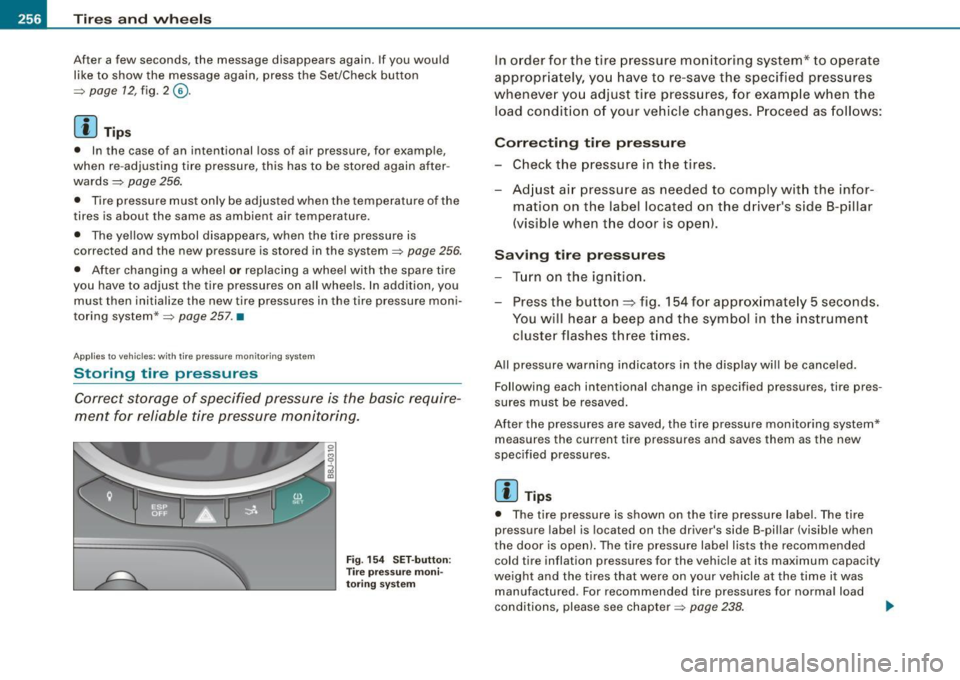
Fig. 154 SET-button :
Tire pressure moni
toring system
In order for the tire pressure monitoring system* to operate
appropriately, you have to re-save the specified pressures
whenever you adjust tire pressures, for example when the
load condition of your vehicle changes . Proceed as follows:
Correcting tire pressure
Check the pressure in the tires.
Adjust air pressure as needed to comply with the infor mation on the label located on the driver's side B -pillar
(vis ible when the door is open).
Saving tire pressures
Turn on the ignition.
Press the button=> fig. 154 for app roximately 5 seconds.
You will hear a beep and the symbol in the instrument
cluster flashes three times.
All pressure warning indicators in the display will be canceled.
Following each intentional change in specified pressures, tire pres
sures must be resaved.
After the pressures are saved, the tire pressure monitoring system* measures the current tire pressures and saves them as the new
specified pressures.
[ i J Tips
• The tire pressure is shown on the tire pressure label. The tire
pressure label is located on the driver's side B-pillar (visible when
the door is open). The tire pressure label lists the recommended cold tire inflation pressures for the vehicle at its maximum capacity
weight and the tires that were on your vehicle at the time it was
manufactured . For recommended tire pressures for normal load
conditions, please see chapter
=> page 238. .,_
Page 261 of 316
________________________________________________ T_ ir_e _s_ a_n_ d_ w_ h _e_e_ l_s __ lfll
•
& WARNING (continued)
• Never drive with run-flat tires if heat build-up causes the tire to
give off smoke .
• Never drive with run-flat tires if the vehicle shakes or vibrates
severely.
• Never drive with a run-flat tire that develops sidewall cracks or
other damage while in use .
0 Note
Run-flat tires have specia l characteristics and requirements, that are
very different from conventional tires. Run-flat tires require special
rims for run-flat use and cannot be used on conventional wheel
rims.
[ i] Tips
• I f you are not able to continue driving with run -flat tires, please
seek professional assistance.
• Please contact your authorized Audi dealer or Audi of America,
Inc . if you have questions about tires and rims. •
Applies to vehic les: with Run-flat t ires
Driving with run-flat tires
Handling characteristics change when tire pressure is
low.
Driving on tires with low tire pressure changes the way a
vehicle handles, particularly when cornering and braking.
The handling characteristics of run-flat tires do not seem to
change a lot even when driving on low pressure or in the
run-flat mode. Nevertheless you must still take special
precautions when operating a vehicle on run-flat tires when
tire pressure is low or the tire(s) is flat: The
Electronic Stabilization Program (ESP) must be
switched on.
- Never drive faster than 50 mph (80 km/h)~
&-
Plan ahead when driving and anticipate what you will
have to do considering traffic and road conditions up
ahead.
- Accelerate carefully.
- Avoid unnecessary and sudden steering and braking
maneuvers.
Reduce your speed in plenty of time before intersections,
curves and other places where you may have to react
quickly.
Please see:=> page 258, "When it is not possible to continue driving,
even with run -flat tires?"
Handling characteristics change when driving with
low air pressure or with flat tires even with special run
flat tires
A low pressure or flat front tire affects vehicle handling characteris
tics by pulling the vehicle slightly to the side where the tire is
mounted and reduces braking performance.
A low pressure or flat rear tire also affects driving characteristics by
pulling to the side where the tire is mounted and also reduces
braking performance. The effect on vehicle handling is most notice
able when driving around curves.
& WARNING
Changed vehicle handling characteristics when driving in the run
flat mode can cause loss of vehicle control, a crash and serious personal injury. .,,,
Vehicle care
I t •
Page 296 of 316

___ C_ o_n_ s_ u_m _ e_ r_ ln_ f_ o _r _m _ a_ t_ i_o _n ______________________________________________ _
reliability. For detailed vehicle maintenance consult your Warranty &
Maintenance book let.
Und er di ffi cult ope rating cond ition s, for example at extremely low
outside temperatures, in very dusty regions, etc ., some service work
should be performed between the intervals specified. This app lies
particularly to:
• oil changes, and
• cleaning or replacing the air filter.
sion standards are maintained, thus minimizing adverse effects on
the environment. •
Important considerations for you and your
vehicle
The increasing use of electronics, sophisticated fuel injection and
emission control systems, and the general ly increasing technical
complexity of today's automobi les, have steadi ly reduced the scope
of maintenance and repa irs which can be carried out by vehicle
owners.
Al so, sa fety a nd e nvironment al concerns p lace very strict
limi ts on the na ture of repairs a nd adjustments to engine and trans
mission parts which an owner can perform.
Maintenance, adjustments and repairs usually require special tools,
testing dev ices and other equipment ava ilable to specially trained
workshop personnel in order to assure proper performance, reli
abil ity and safety of the vehicle and its many systems.
Improper maintenance, adjustments and repairs can impair the
ope ration and re liability of your vehic le and even void your vehic le
warranty. Therefore, proof of servicing in accordance with the main
tenance schedu le may be a condition for upholding a pos sible
warranty claim made within the warranty period. Above all, operational safety can be adversely affected, creating
unnecessary r isks for you and your passengers .
If in doubt about any servicing, have it done by your authorized Audi
dea ler or any other properly equipped and qualified workshop. We
strongly urge you to give your authorized Audi dealer the opportu
nity to perform all scheduled maintenance and necessary repairs.
Your dealer has the fac ilities, origina l parts and trained spec ial ists
to keep your vehicle running proper ly.
P e rforming limited maint enance your self
The following pages describe a lim ited number of procedures which
can be performed on your vehicle wi th ordinary too ls, should the
need arise and trained personnel be unavai lab le. Before performing
any of these procedures, a lways thoroughly read all of the appli
cable text and carefu lly follow the instructions given. Always rigor
ously observe the
WARNINGS provide d.
Before you che ck anything in th e eng ine compartment , always read
and heed all WARNINGS~
& and~ & in "Working in the engine
compartment" on
page 217.
& WARNING
• Serio us per sonal injur y may oc cur a s a re sult of improperly
performed maintenan ce , adjustment s or repair s.
• Alway s be e xtremely careful when working on the vehi cle .
Alway s follow commonly accepted s afety pra ctice s and general
c ommon sen se . Ne ver ri sk p ers onal injury .
• Do not attempt any of the maintenan ce , check s or repair s
de scr ibed on the follo wing page s if you are not full y familia r with
the se or other procedure s with respect t o the vehicle , or are uncer
tain ho w to pr oceed .
• Do not do any work without the proper tool s and equ ipment .
Ha ve the ne cessa ry work done by your authorized Audi deale r or
another properly equipped and qu alified work shop .
~
Page 302 of 316
___ A---" lp_ h_ a_b_ e_ t_ i_ c _ a_ l_ in_ d_ e_x ______________________________________________ _
A
A/C operation
Climate control ............ ....... 89
ABS See Anti -Lock Brake System . . . . . . . . 187
Accessories . . . . . . . . . . . . . . . . . . . . . . . . 295
Acoustic park assist rear . . . . . . . . . . . . . . . . . . . . . . . . . . . . . 95
Acoustic parking system .. .... ... .... . 95
Adaptive Light defective . . . . . . . . . . . . . . . . . . . . . . . . 37
Adaptive light . . . . . . . . . . . . . . . . . . . . . . . 54
Adding Engine coolant .. ... .... .... .... . 225
Engine oil ....................... 222
Windshield washer fluid . . . . . . . . . . 233
Additiona l accessories .. ........ .... . 295
Additives Engine oil ... ..... .... ... ... ... .. 222
Adjustable steering column .... .... ... 91
Adjusting front seats . ...... .... .... .. 69
Adjusting steering column ...... .. ... . 91
Adjusting the seats .... .... .... .... .. 71
Advanced Airbag System
Children ........................ 158
Components .. .... .... ......... . 142 Air distribution
Climate control ..... .. .... .... .... 87
Air recirculation mode Climate control ...... .... ... .. .... 88
Airbag Warning/indicator lights ......... .. 18
Airbag system .................. 135, 155
Care ............................ 149
Child restraints .... .... .... .... .. 159
Components (front airbags) .. ...... 142
Danger of fitting a chi ld safety seat on the
front passenger seat . . . . . . . . . . . . 137
Disposa I . . . . . . . . . . . . . . . . . . . . . . . . 149
Front airbags . . . . . . . . . . . . . . . . . . . . 139
How do the front airbags work? . . . . 144
How many airbags does my vehicle have?
142
Important safety instructions on the knee
airbag system . . . . . . . . . . . . . . . . . . 153
Important things to know . ... .. ... 135
Indicator light ....... .... ... .. ... 146
Knee airbags .... .... .... ... .... . 151
Monitoring . . . . . . . . . . . . . . . . . . . . . . 146
PASSENGER AIR BAG OFF light ... .. 147
Repairs . . . . . . . . . . . . . . . . . . . . . . . . . 149
Side airbags ... ...... ....... ..... 154
When must the system be inspected? ...
146 Anti-free
ze
See Engine coolant system ...... .. 224
Anti -glare inside day-night mirror .... .. 64
Anti-Lock Brake System .............. 187
Anti- lock brake system
Warning/indicator lights ............ 20
Anti -Slip Regulation System (ASR)
How the system works . . . . . . . . . . . . 184
Anti-theft systems Anti-Theft A larm System ...... ..... 47
Electronic immobilizer . .... .... .... 40
Ashtray ................... .......... 81
ASR How the Anti -S lip Regu lation System
works ... .... .... .... ... .... ... 184
Asterisk What does it mean when something is
marked with an asterisk? . .... ...... 6
Audi magnetic ride ......... .... ... 16, 98
Description ....................... 98
Indicator light ...... ..... ..... ... . 16
Audi Service Repair Manuals and Literature . 293
Auto Safety Hotline ... ..... .. ... ..... 123
Automatic belt retractor 129
Automatic car wash
See Washing .. ........ .... ...... 199
Front airbags ....... .... .... .... .
140 All Wheel Drive
......... ....... ..... 189 Automatic headlight control ........... 52
How the components work together 143 Alloy wheels ... .. ...... .... ... .. ... 204 Automatic headlights
Monitoring .. .... .... .... ... .... . 146 All-whee l drive defective .
.... ... .... .... .... ..... 37
Weight -sensing mat . ... .. .... .... 158 Winter tires ..................... 250 Automatic Transmission
air conditioning Alternator Automatic Transmission
.......... 103
Temperature . . . . . . . . . . . . . . . . . . . . . 86 See Generator . . . . . . . . . . . . . . . . . . . . 18