fuel AUDI TT COUPE 2009 Owner's Manual
[x] Cancel search | Manufacturer: AUDI, Model Year: 2009, Model line: TT COUPE, Model: AUDI TT COUPE 2009Pages: 316, PDF Size: 71.16 MB
Page 194 of 316
___ D_ r_ iv _i_ n-' g"'""'- a_ n_d_ e_ n _ v_i_r _ o _n_ m_ e_ n_t _____________________________________________ _
- Lack of proper maintenance as well as improper use of the
vehicle will impair the function of the emission con trol system
and could lead to damage.
exhaust gas can have a su lfur -like exhaust gas smell under some
operating states . This depends on the su lfur content of the fuel
being used. Using a different brand of fuel may he lp, or filling the
tank with lead-free super grade gasoline. •
Avoid damaging the vehicle
When you are driving on poor roads, or over curbs, steep ramps,
etc., make certain that low-lying parts such as spoilers and exhaust
system parts do not bottom out and get damaged.
This is especially true for vehicles with low-slung chassis (sports
chassis) and fully loaded vehicles. •
Operate your vehicle economically
and minimize pollution
General
Your personal style of driving will determine the economy
of your vehicle, as well as exhaust and noise levels.
Fuel economy, environmental impact, and wear on your engine,
brakes and t ires largely depend on three factors:
• your personal driving style
• operating condit ions
• technical limitations If
you anticipate what you need to do next and drive economically,
you can easily cut your fuel consumption by 10-15 percent . This
section will give you some tips on how you can he lp the environ
ment and your pocketbook .
[ i ] Tips
The consumption estimates as published by ENVIRONMENTAL
PROTECTION AGENCY (EPA) and Transport Canada may not corre
spond to your actua l consumption on the road, which will vary
depend ing upon vehicle load and speed, road and weather condi
tions, trip length, etc. •
Drive smoothly and keep a lookout ahead
Vehicles use the most fuel when they are accelerating.
Avoid unnecessary accelerating and braking.
Vehicles use the most fue l when they are accelerating . If you antici
pate what is going to happen next, you will need to brake less and,
thus, accelerate less. Let the vehicle coast whenever possible -for
example when you see that the next traffic light is red. •
Avoid full throttle
Driving at moderate speeds saves fuel and improves your
mileage.
- Try and keep well below your car's maximum speed.
Acce lerating gently reduces fuel consumption, engine wear, and
does not disturb the environment.
Fuel consumption, exhaust emissions and engine noise increase
disproportionately at high speeds. If you drive at approximately
three quarters of top speed, fuel consumption wil l be reduced by
9J,,
Page 195 of 316

one half. Never drive faster than the posted speed limit and weather
conditi ons permit. •
Reducing unnecessary Idling
Even when your car is just idling it burns up fuel.
- Shut the eng ine off when you are not driving the vehicle .
- Do not warm up the vehicle by letting the eng ine run at
idle.
I t makes sense to shut off the engine in traffic jams, when waiting
for trains to pass at railroad crossings, or at traffic lights that have long waits on red. Turning the engine off for just 30 -40 seconds
saves more fue l than is burned s tarting the engine again .
It takes a long time for the engine to warm up fully when it is
running at idle . However, wear and noxious emissions a re especial ly
high when the engine is warming up . So you should drive away as
soon as you start the engine and avoid running at high RPMs whi le
the engine is stil l warming up .
0 Note
Do not leave engine idling unattended after starting . If warning
lights should come on to indicate improper operation, they would
go unheeded. Extended idl ing also produces heat, wh ich cou ld
result in overheating or other damage to the vehicle or other
property .•
Regular maintenance
A badly tuned en gine unnecessarily wastes a lot of fuel.
- Have your v ehicl e serv ice d at reg ular intervals.
Controls and equip
ment Safety first Vehicle operation
Dri
ving and environm ent
By having your vehicle regularly serviced by an Audi dea ler helps to
ensure that i t runs properly and economically . The conditio n of your
vehic le not only affects its safety and abi lity to hold its va lue, it also
affects
fuel consumption .
Check your oil each time you fill your tank.
The amount of oil used is related to engine load and speed .
I t is normal for the oi l consumption of a new eng ine to reach its
lowest va lue after a certain mi leage has been driven.
You must drive your vehicle about 3,000 miles (5,000 kilometres) be fore you can proper ly assess o il consumpt ion.
This also applies to fuel consumption and engine output .
0 Note
• Have your vehicle maintained properly and in accordance with
t he service recommendations in you r Warranty
& Maintenance
booklet. Lack of proper ma intenance as well as improper use of the
vehicle wi ll impair the function of the emission control system and
cou ld lead to da mage.
• Do not alter or remove any component of the Emission Contro l
System unless approved by the manufacturer .
• Do no t al te r or remove any device, such as heat shields,
switches, ignition wires, valves, which are designed to protect your
veh ic le' s Emission Contr ol System and o ther i mportant vehicle
components. •
Fewer short trips
Fu el con su mp tion wi ll alwa ys be rel atively high on shor t
tri ps.
- Try to avo id driving short dista nce s wi th a cold engine.
Vehicle care Do-it-yourself service Technical data
Page 196 of 316
___ D_ r_iv _ in_... g"'- a_ n_ d_ e_ n_ v_i_r _ o _n_ m __ e_n _ t _______________________________________________ _
The engine and catalytic converter have to reach their optimal oper
ating temperature
to reduce fuel consumption and noxious emis
sions effectively.
• Just after starting, a cold engine in a mid -size car burns the fuel
at a poor rate of 6-8 miles per gallon (30-40 l/100kml. Half a mile
down the road, the mileage improves to 12 MPG (20 1/100 kml. It will
take the engine no less than
two and a half miles (4 km) of driving to
warm up to its proper operating temperature and operate at an
economic mileage. This explains why taking the car for short trips is
a rather wasteful convenience.
• The
outside temperature is also critical in this regard. Your car
consumes more fuel in the winter than in the summer.
Trailer towing
General information
Your Audi TT Coupe is not designed to tow a trailer.
Towing a trailer with your Audi TT Coupe is not recommended and
can cause damage to the car. Damaged caused by towing a trailer is
not covered by your Audi Warranty. •
Page 200 of 316
___ C _l_e _a _ n_ in_g ~_ a_n _ d ___ p ___ r_ o _t _e _c_ t_ i_o _ n _____________________________________________ _
Cleaning and protection
General information
Regular care preserves vehicle value.
Any automobile is exposed to industrial fumes, corrosive road salt,
muddy dog feet, etc . A wel l cared for Audi can look like new many
years after purchase. Regu lar and correct ca re will contribute to
maintaining the beauty and value of your Audi.
Furthermore, good care may be a conditi on for substantiating a
war ranty claim should co rros ion d amage or p aint defec ts occur .
Your authorized Audi dealer has a variety of dedi cated vehicle- care
product s
and can advise whic h ones to use for cleaning the exterior
and interior of your vehicle.
Whether you use p roducts recommended by Audi or other commer
cially availab le cleaning agents , please make sure you apply them
correctly.
& WARNING
• Cleaning agents may be poisonous . Keep them out of the reach
of ch ildren .
• Heed all caution label s.
• Alway s read directions on the contai ner before u sing any
produ ct. Follow the di rection s carefull y.
• Most chemical cleaner s are concentrated and have to be
d iluted .
• Use s pot removing fluids only in well ventilated area s.
• Do not us e gasoline , ker osene , die sel fuel , nail polish rem over
or oth er volatile fluid s. They may be toxi c, flammable or ha zardous
in other way s. Do n ot w ash, wa x or dry the vehicle w it h the igni
tion on or the engine running.
& WA RNIN G (conti nued)
• Do not clean the under side s of chassis , fe nder s, wheel cove rs,
etc . without protecting your hands and arm s. You may cut yourself
on sha rp -edg ed metal part s.
• Moisture and ice on brakes may impair braking eff iciency
=> page 186 , "General info rm ation ". Test the brake s carefully each
time you wa sh the vehicle.
~ For the sake of the environment
Se lect only environmenta lly friend ly c leaning products . Leftover
clean ing products should not disposed of in the household waste. •
Care of exterior
Washing
Frequent washing protects the vehicle.
Th e best protection against envi ronmental influences is frequent
washing and waxing .
H ow often t his is required depends on:
• H ow much the vehic le is used
• Where the vehicle is pa rked (garage, in the open under t rees,
etc.)
• The seasonal and weather conditions
• Environmental influences
T he longer bird droppings, insects, tree resin, road a nd industrial
grime, tar, soot, road salt and other materials remain on the vehicle
p aint, the more lasting their dest ructive effects will be . _,,,
Page 211 of 316

_______________________________________________ C_l_e _a_ n_ in _____ g ___ a_n_ d ___ p_r _o _t_ e_ c_ t _i _o _ n __ lfll
•
0 Note
• Never use chemical solvents (e.g. lighter fluid, turpentine),
waxes, shoe polish or similar products on Alcantara® surfaces.
• To avoid damage, have stubborn stains removed by a commer
cial cleaning specialist.
• Do not use brushes, stiff sponges or similarly abrasive cleaning
aids. •
Safety belts
Only well-maintained safety belts work reliably when
needed.
Heavily soiled safety belts may not retract properly.
- Keep belts clean.
-For cleaning, use a mild soap and water solution. Let
belts dry thoroughly and away from direct sunlight.
- Do not allow inertia reel safety belts to retract before
they are completely dry.
- Check the condition of your safety belts
regularly.
& WARNING
Damaged safety belts can break in a crash .
• Anything that might damage your safety belts could mean that
you and your passengers would not be adequately protected in an
accident.
• Safety belt performance depends on correct installation. Never
remove belts from the vehicle to clean them .
• Do not use chemical cleaning agents, bleach or dyes. They have
corrosive properties which weaken the webbing.
& WARNING (continued)
• When cleaning your safety belts, inspect them for damage. If
you discover damage, see your Audi dealer .
• Always read and heed all WARNINGS and the information
~ page 198. a
Engine compartment
Be especially careful when cleaning the engine compart
ment.
Always switch off the ignition before cleaning the engine ~ &
Plenum panel
Remove leaves from the plenum panel in front of the windshield
under the engine hood. This prevents the water drain holes from
becoming blocked, and it prevents debris from entering the vehicle
interior through the heating and ventilation ducts.
Corrosion protection
The engine compartment and transmission have been corrosion protected at the factory.
Good anti-corrosion treatment is very important, particularly in the
winter. If the vehicle is frequently driven on salt treated roads, the
entire engine compartment and plenum panel should be thor
oughly cleaned at the end of winter and retreated to prevent salt
damage. At the same time, the underside of the vehicle should be
washed as well.
I f the engine compartment is cleaned at any time with grease
removing solutions
21 , or if you have the engine washed, the anti
corrosion treatment is almost always removed as well. It is therefore
essential to have a long-lasting corrosion protection reapplied to all
~
21 Use only the correct cleaning solutions. Never use gasoline or diesel fuel.
Vehicle care I t •
Page 213 of 316
Fue l supply and fillin g you r fu el tank 1111 ___________ ...:._:......:,_______;::;...a,__ __
•
Fuel supply and filling your fuel tank
Gasoline
Fuel supply
Using the right fuel helps keep the environment clean and
prevents engine damage.
Fuel r ecomm end ati on
The fuel recommended for your vehic le is unl eade d prem ium grade
gaso line . See also ~
page 291, "Data". Audi recommends using TOP
T IER Detergent Gasoline with a minimum octane rating of 91 AKI (95
RON). For more information on TOP TIER Detergent Gaso line, please
go to the official website (www.toptiergas .com).
The recommended gasoline octane rating for your engine can also be found on a label located on the inside of the fuel fille r flap. This
rating may be specified as AK I or RON .
Your vehic le may also be operated us ing unleaded regular gasoline
with a minimum octane rating of 87 AKl/91 RON . However, using 87
AKl/9 1 RON octane fuel will slightly reduce engine performance.
Use unle ad ed ga so line only . Unleaded gaso line is avai lable
throughout the USA, Canada, and in most European countries. We
recommend that you do not take your vehicle to areas or countr ies
where un leaded gasoline may not be available .
For more information on refueling your vehicle, see~
page 212 .
Octane ra tin g
Octane rating indicates a gaso line's ability to resist engine
damaging "knock" caused by premature ignition and detonation.
Therefore, buying the correct grade of gaso line is very important to
help prevent possible engine damage and a loss of engine perfor
mance. Gasoline most common
ly used in the United States and Canada has
the following octane ratings that can usua lly be found on the filler
pump:
• Premium Grade : 91 -96 AKI
• Regular Grade: 87 -90 AKI
Explanation of the abbreviations:
AKI = Anti Knock Index= (R +M)/2 = (RON +MON)/2
RON = Research Octane Number
MON
= M otor Octane Number .
0 Note
• Do not use any fue l with octane ratings lower than 87 AKI or 91
RON otherwise expensive engine damage will occur .
• Do
not use leaded gasoline! The use of leaded gasoline will
severe ly damage your vehicle's catalytic converter and its abi lity to
control exhaust emissions. •
Blended gasoline
Use of g aso line containing alco hol or M TB E ( meth yl
t er tiary butyl e ther )
You may use unleaded gasoline blended with alcohol or MTBE
(commonly referred to as oxygenates) if the blended mixture meets
the follow ing criteria:
Bl end of g asoline m eth anol (wood al coho l or methyl alc oh ol)
• Anti-knock index must be 87 AKI or higher .
• Blend must contain no more than 3% methanol.
• Blend must contain more than 2% co-solvents.
Vehicle care I t •
Page 214 of 316

-Fuel supply and filling your fuel tank
-----=--=----:.------=-=---------------
Blend of gasoline and ethanol
(grain alcohol or ethyl alcohol}
• Anti-knock index must be 87 AKI or higher.
• Blend must not contain more than
10% ethanol.
Blend of gasoline and MTBE
• Anti-knock index must be 87 AKI or higher.
• Blend must contain not more than
15% MTBE.
Seasonally adjusted gasoline
Many gasoline grades are blended to perform especially well for
winter or summer driving. During seasonal change -over, we suggest
that you fill up at busy gas stations where the seasonal adjustment
is more likely to be made in time.
0 Note
• Methanol fuels which do not meet these requirements may
cause corrosion and damage to plastic and rubber components in
the fuel system.
• Do not use fuels that fail to meet the specified criteria in this
chapter.
• If you are unable to determine whether or not a particular fuel
blend meets the specifications, ask your service station or its fuel
supplier.
• Do not use fuel for which the contents cannot be identified.
• Fuel system damage and performance problems resulting from
the use of fuels different from those specified are not the responsi
bility of Audi and are not covered under the New Vehicle or the
Emission Control System Warranties.
• If you experience a loss of fuel economy or driveability and
performance problems due to the use of one of these fuel blends,
we recommend that you switch to unblended fuel. •
Gasoline additives
A major concern among many auto manufacturers is carbon
deposit build-up caused by the type of gasoline you use.
Although gasoline grades differ from one manufacturer to another,
they have certain things in common. All gasoline grades contain
substances that can cause deposits to collect on vital engine parts,
such as fuel injectors and intake valves. Although most gasoline
brands include additives to keep engine and fuel systems clean,
they are not equally effective.
Audi recommends using TOP TIER Detergent Gasoline. For more
information on TOP TIER Detergent Gasoline, please go to the offi
cial website (www.toptiergas.com).
After an extended period of using inadequate fuels, built-up carbon
deposits can rob your engine of peak performance.
(D Note
Damage or malfunction due to poor fuel quality is not covered by
the Audi New Vehicle Limited Warranty. •
Fuel tank
Fuel filler neck
The fuel filler neck is located on the right rear side panel behind the
fuel filler flap.
If the unlocking system should fail, you can still open the flap manu
ally -for detailed instructions see=>
page 215.
You can find the fuel tank capacity of your vehicle in Technical Data
=> page 291. .,_
Page 215 of 316
Fuel supply and filling your fuel tank -------------=-=--=-------=:a....:.--------J
The labe l on the inside of the fuel filler flap tel ls you the correct fuel
fo r your vehicle . For mo re information about fuel specifications, see
~ page 271.
Your vehicle fuel tank has an on -board refuelling vapor recovery
sys tem. Th is feature helps to prevent fue l vapors from escapin g
from the tank and polluting the environment wh ile you refue l your
veh ic le . I n order to fill the tank properly while protecti ng the envi
ronment, please follow this refuel ing procedure carefully .
& WARNING
Under normal operating conditions , never carry additional fuel
c ontainers in your car . Ga s canister s and other containers used to
transport fuel can be dangerous . Such conta iners , full or empty,
may leak and could cause a fire in a collision . If you mu st transport
fuel to use for your lawn mower , snow blower , etc. , be very c areful
and always ob serve local and state laws regarding the u se , tran s
port ation and storage of su ch fuel containers . Make certain the
c ontainer meets industry standard s (ANSI/ASTM F852 · 86 1.
0 Note
Neve r drive yo ur vehicle un til the fue l tank is comp le tely d ry. The
irregular supp ly of fuel can cause misfiring . Gasoline could enter
int o t he exhaus t system and damage the cataly tic conver ter. •
Refuelling
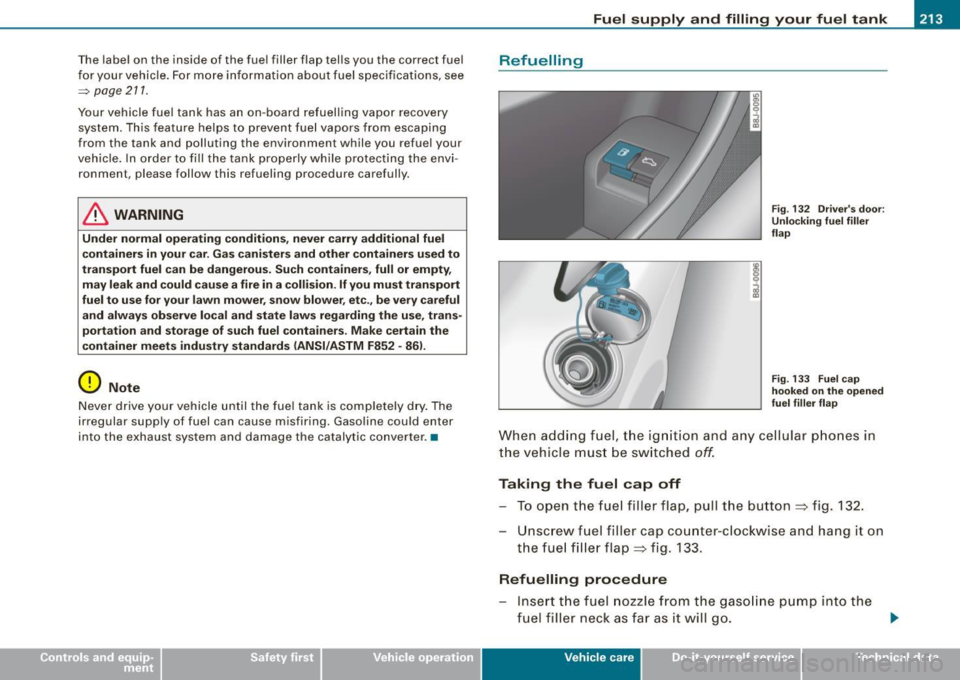
Fig . 13 2 Dri ver 's do or :
Unlo cking fuel filler
flap
Fi g. 133 Fuel c ap
ho oke d on th e opened
fu el fi ller flap
Wh en ad din g fu el, th e i gni tion and any cellul ar ph ones in
t h e v ehicl e mus t be sw itch ed
off.
Taking the fuel cap off
To o pen t he fue l fille r flap, pull the button=> fig. 132.
Unsc rew fuel filler c ap cou nter-c lockwise an d hang it on
t h e fue l fi ller flap => fig. 133 .
Refuelling procedure
Insert th e fuel nozzle from the ga solin e p ump into the
f u el fill er n eck as far as i t will go. ..,.
Vehicle care I I irechnical data
Page 216 of 316
Fuel supply and filling your fuel tank
-Select a medium refuelling rate so that the nozzle
switches off automatically when the tank is full.
Putting the fuel cap back on
-After filling your tank, twist the fuel filler cap clockwise
until you hear a defin ite click.
Close the fuel filler flap.
To avoid fuel spilling or evaporating from the fuel tank always close
fuel filler cap properly and completely. An improperly closed fuel
filler cap may also cause the MIL lamp=> page
24 to come on.
& WARNING
Improper refueling or handling of fuel can cause fire, explosion
and severe burns.
• Fuel is highly flammable and can cause severe burns and other
injuries.
• Failure to shut the engine off while refueling and/or to insert
the pump nozzle fully into the fuel filler neck could cause fuel to
spray out of filler neck or to overflow. Fuel spray and overflowing
fuel can cause a fire.
• Never use a cellular telephone while refueling. The electromag
netic radiation can cause sparks that can ignite fuel vapors and
cause a fire.
• Never get back into your vehicle while refueling. If in excep
tional circumstances you must get back in your vehicle while refu eling, make certain that you close the door and touch metal to
discharge static electricity before touching the filler nozzle again.
Static electricity can cause sparks that can ignite fuel vapors
released during refueling.
• Never smoke or have an open flame anywhere in or near your
vehicle when refueling or filling a portable fuel container.
& WARNING (continued)
• For your safety, we strongly recommend that you do not travel
with a portable fuel container in your vehicle. The container, full or
empty may leak and could cause a fire, especially in a crash .
• If, under exceptional circumstances, you must transport a
portable fuel container, please observe the following:
-Never fill a portable fuel container while it is anywhere in or
on the vehicle (for example, in the luggage compartment, or on
the trunk). Static electricity can build up while filling and can ignite fuel vapors causing a fire.
- Always place a portable fuel container on the ground before
filling.
- Always keep the filler nozzle completely inside the portable
container before and during filling.
- If filling a portable container made of metal, the filler nozzle
must always be in contact with the container. This will help
prevent static electricity from discharging and cause a fire.
- Never spill fuel inside the vehicle or luggage compartment.
Fuel vapors are highly flammable.
- Always observe local and state/provincial laws regarding the
use, storage and transportation of fuel containers
- Make certain the fuel container meets industry standards
(ANSI / ASTM F852-86).
Q) Note
If any fuel has spilled onto the car, it should be removed immedi
ately to prevent damage to the paint.
W For the sake of the environment
As soon as the correctly operated nozzle switches off automatically
for the first time, the tank is full . Do not try to add more fuel becaus e
fuel may spill out. In addition, the expansion space in the fuel tank .,,_
Page 217 of 316
Fuel supply and filling your fuel tank -------------=-=--=-------=:a....:.--------J
will be filled -causing the fuel to overflow when it becomes warm
and pollute the environment.
[ i J Tips
• Running your engine while refuelling may cause vapors to
escape or even fuel to spill out of the tank. This would then shut off
the fuel nozzle before the tank is full.
• Do not refuel your vehicle with the ignition switched on . The fuel
gauge may otherwise not indicate the correct fuel level after
refuelling. •
Unlocking the fuel filler flap by hand
You can open the fuel filler flap by hand if the power
locking system should fail.
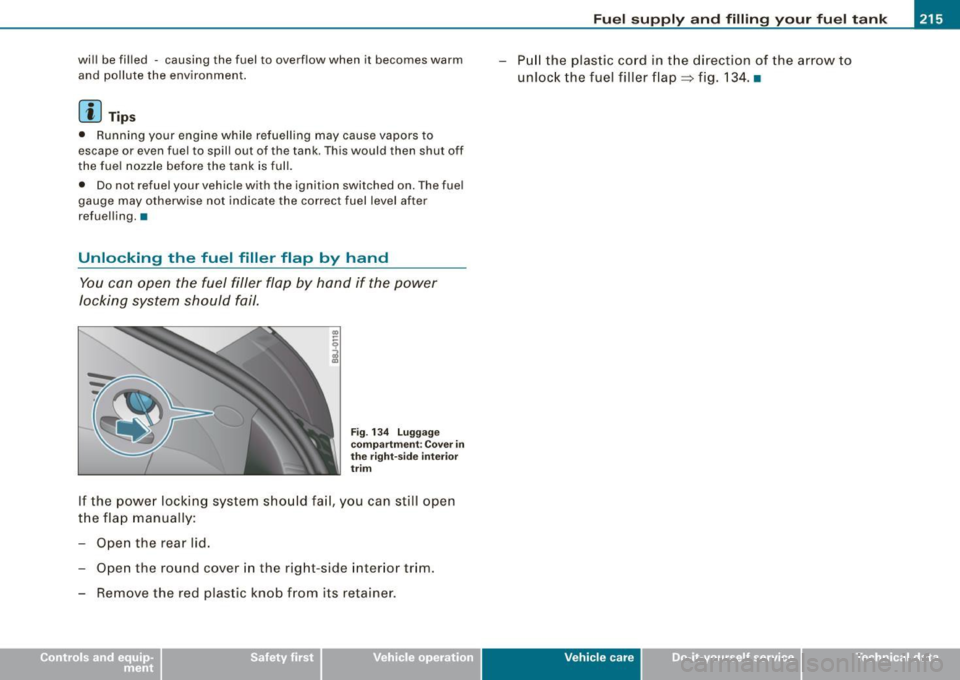
Fig . 134 Luggage
compartment : Cover in
the right-side interior
trim
If the power locking system should fail, you can still open
the flap manually:
- Open the rear lid.
- Open the round cover in the right-side interior trim.
- Remove the red plastic knob from its retainer. -
Pull the plastic cord in the direction of the arrow to
unlock the fuel filler flap=> fig. 134. •
Vehicle care I I irechnical data