fuel AUDI TT COUPE 2009 User Guide
[x] Cancel search | Manufacturer: AUDI, Model Year: 2009, Model line: TT COUPE, Model: AUDI TT COUPE 2009Pages: 316, PDF Size: 71.16 MB
Page 29 of 316

Sele cting the fun ctions
- Push in the uppe r (lower) protrusion on the function
se lector switch
@ =>page 26, fig. 12. The functions for
the trip compu ter are d isp layed in succession on the
respective memory levels.
R ese ttin g the function to z ero
- Push the [Reset ] button ® for at least two seconds .
You can reset the fo llowing values to zero using the [R eset] button:
• driving time
• distance
• average fuel mileage
• average speed
The trip computer only opera tes when the ignition is on . When you
turn on the ignit ion, the function that was in use when you last
turned the ignition off will be displayed.
[ i ] T ip s
• You can also set the va lues for the functions to zero in the menu
display (R es et) ~
page 27 .
• All stored values wil l be lost if the vehic le battery is
disconnected .•
Con tro ls and eq uip
ment
Menu display
Introduction Dri
ver in form ati on syst em
Fig . 13 W ip er leve r:
Co ntrols for the men u
di sp la y
Fig . 14 Di spl ay: Star t
menu
Some functions in your vehicle can be set, activated, and controlled
by Men us (e.g. Acoustic park assist*) . With these menus you can
also select the informa tion shown in the driver information system ,
which operates only with the ignition switched on . Operation is
controlled by the
I Res et I button and the rocker switch on the wiper
lever~fig .13 . .,_.
Vehicle care
I I Technical data
Page 30 of 316
Driver inf ormation sy ste m
The Sta rt m enu shows you the different disp lay types:
Se t
Check
M enu off
Each display type in the Start menu contains a submenu with addi
tional options.
S et
Ch eck
Clock ~ page29
Lighting* ~ page 53~ page 55
Computer ~ page29
Acoustic park assist* ~ page95
Speed alarm (speed ~ page 37
warning)
Language (6 languages)
~ page29
Units (distance, fuel con -~ page29
sumption, temperature)
Wiper (service position)
~ page 62
Window ~ page 49
Doors (Auto-lock) ~ page 41
Service
Chassis number* ~ page23
~ page288
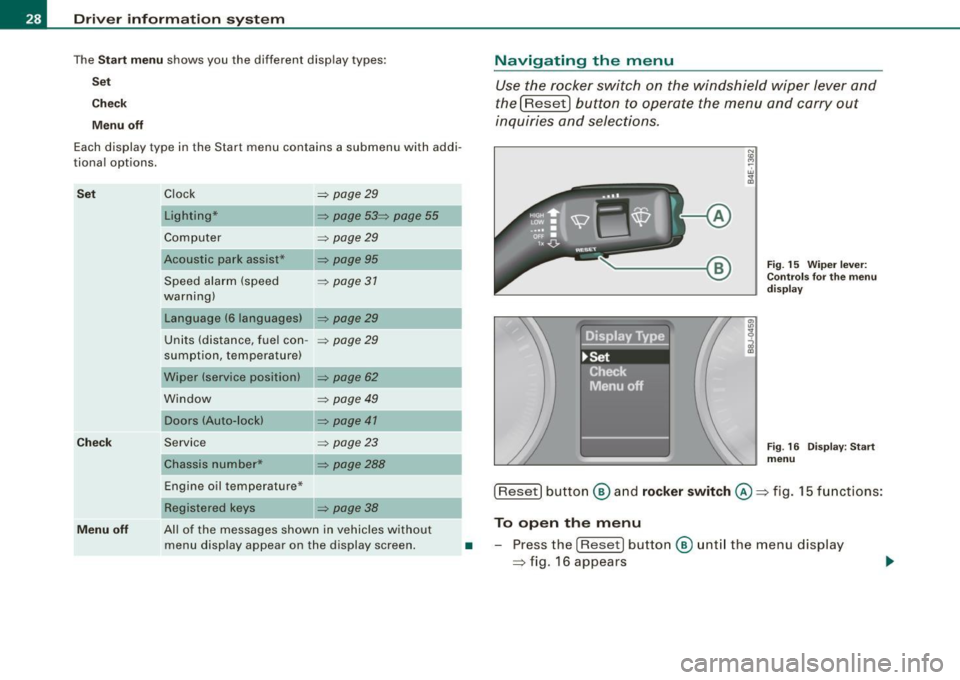
Navigating the menu
Use the rocker switch on the windshield wiper lever and
the[Reset) button to operate the menu and carry out
inquiries and selec tions.
-A
N
"' cc
Fig . 15 Wiper leve r:
Con trols fo r th e m enu
d is pla y
Fig . 16 Disp lay: Start
menu
Engine oil temperature* ___ __, [Reset] button ® an d rock er swit ch @ => fig. 15 functions:
Menu off
Registered keys ~ page 38
All of the messages shown in vehicles without
menu display appear on the display screen. To open the menu
• -Press the [Reset ) button ® unt il the menu display
=> fig. 16 appears
Page 34 of 316
Driver inf orm atio n syst em
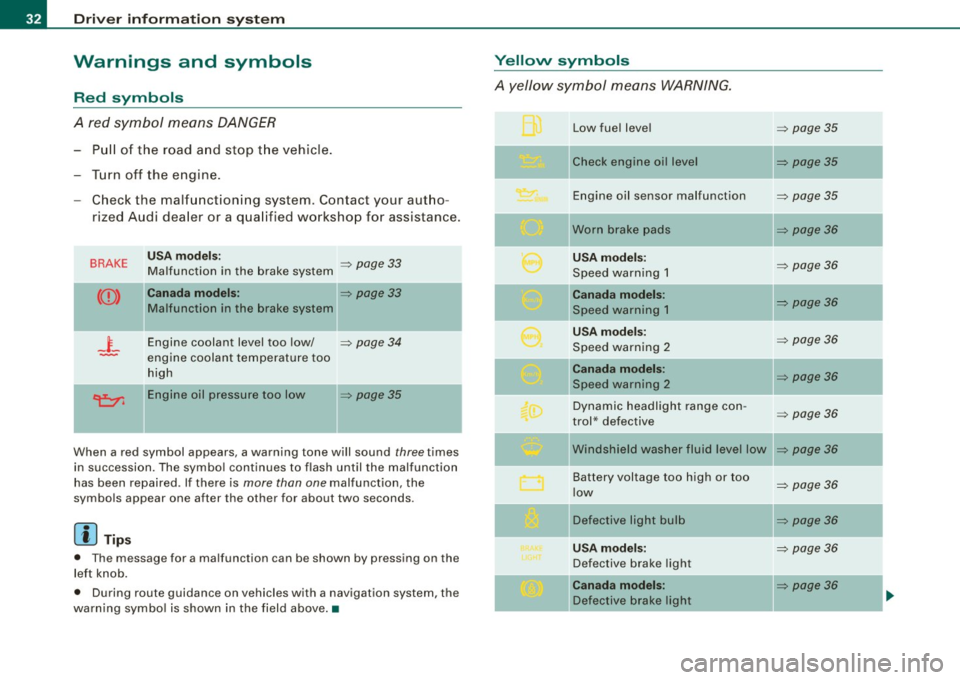
Warnings and symbols
Red symbols
A red symbol means DANGER
- Pull of the road a nd stop t he vehicle .
- Turn off the engine.
- Check the malfunctioning system. Contact your autho -
rized Audi dea ler or a qua lified workshop for assistance .
BRAKE
-
USA models:
Malfunction in the brake system => page 33
Ca
nada m odels : => page 33
Malfunction in the brake system
Engine coolant level too low/
=> page 34
engine coolant temperature too
high
Engine oil pressure too low
=> page 35
When a red symbol appears, a warning tone will sound three times
in succession. The symbol continues to flash until the malfunction
has been repaired . If there is
more than one malfunction, the
symbols appear one after the other for about two seconds.
[ i ) Tip s
• The message for a malfunction can be shown by pressing on the
left knob.
• During route guidance on vehicles with a navigation system, the
warning symbo l is shown in the field above .•
Yellow symbols
A yellow symbol means WARNING .
Low fuel level => page 35
l!check engine oi l level => page35
-
Engine oil sensor malfunction => page 35
-
IIWorn brake pads => page36
USA model s: => page 36 Speed warning 1
IIC an ada model s:
Speed warning 1 => page36
--
USA mod els: => page 36 Speed warning 2
C anad a m od els: => page 36 Speed warning 2
Dynamic headlight range con -
=> page 36 trol* defective
Winds hield washer fluid level low
=> page36
Battery voltage too high or too => page 36 low
Defective light bulb
=> page 36
U SA mod els: => page 36
Defective brake light
C an ada m od els: => page36
Defective brake light
Page 37 of 316
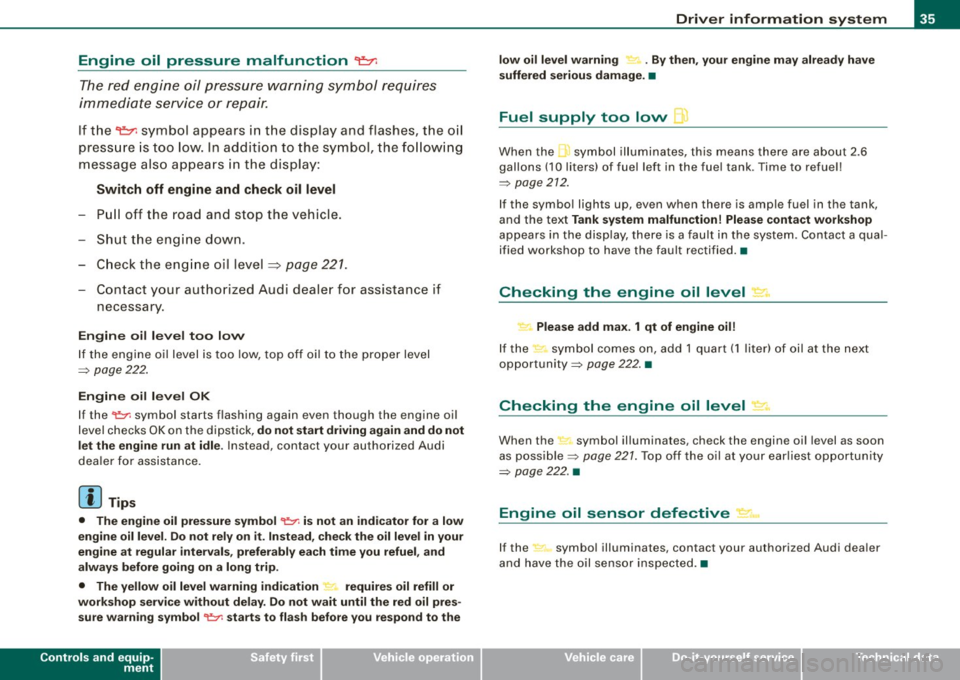
Engine oil pressure malfunction 9=;r;
The red engine oil pressure warning symbol requires
immediate service or repair.
If the ~ symbol appears in the display and flashes, the oil
pressure is too low. In addition to the symbol, the following
message also appears in the display:
Switch off engine and check oil level
- Pull off the road and stop the vehicle .
- Shut the engine down.
- Check the engine oil level~
page 221.
-Contact your authorized Audi dealer for assistance if
necessary .
Engine oil level too low
If the engine oil level is too low, top off oil to the proper level
=>
page 222.
Engine oil level OK
If the ~ symbol starts flashing again ev en though the engine oil
level checks OK on the dipstick,
do not start driving again and do not
let the engine run at idle .
Instead, contact your authorized Audi
dealer for assistance .
[ i J Tips
• The engine oil pressure symbol ~ is not an indicator for a low
engine oil level. Do not rely on it. Instead, check the oil level in your
engine at regular intervals, preferably each time you refuel, and
always before going on a long trip.
• The yellow oil level warning indication _ requires oil refill or
workshop service without delay. Do not wait until the red oil pres sure warning symbol
~ starts to flash before you respond to the
Controls and equip
ment
Driver information system
low oil level warning = . By then, your engine may already have
suffered serious damage. •
Fuel supply too low Jl
When the L symbol illuminates, this means there are about 2.6
gallons
(10 liters) of fuel left in the fuel tank . Time to refuel!
=>
page 212.
If the symbol lights up , even when there is ample fuel in the tank,
and the text
Tank system malfunction! Please contact workshop
appears in the display, there is a fault in the system. Contact a qual
ified workshop to have the fault rectified. •
Checking the engine oil level .d'" ..
Please add max. 1 qt of engine oil!
If the symbol comes on, add 1 quart (1 liter) of oil at the next
opportunity=>
page 222. •
Checking the engine oil level -1.
When the _ symbol illuminates, check the engine oil level as soon
as possible =>
page 221. Top off the oil at your earliest opportunity
=>
page 222. •
Engine oil sensor defective • ...
If the symbol illuminates, contact your authorized Audi dealer
and have the oil sensor inspected. •
I • •
Page 81 of 316
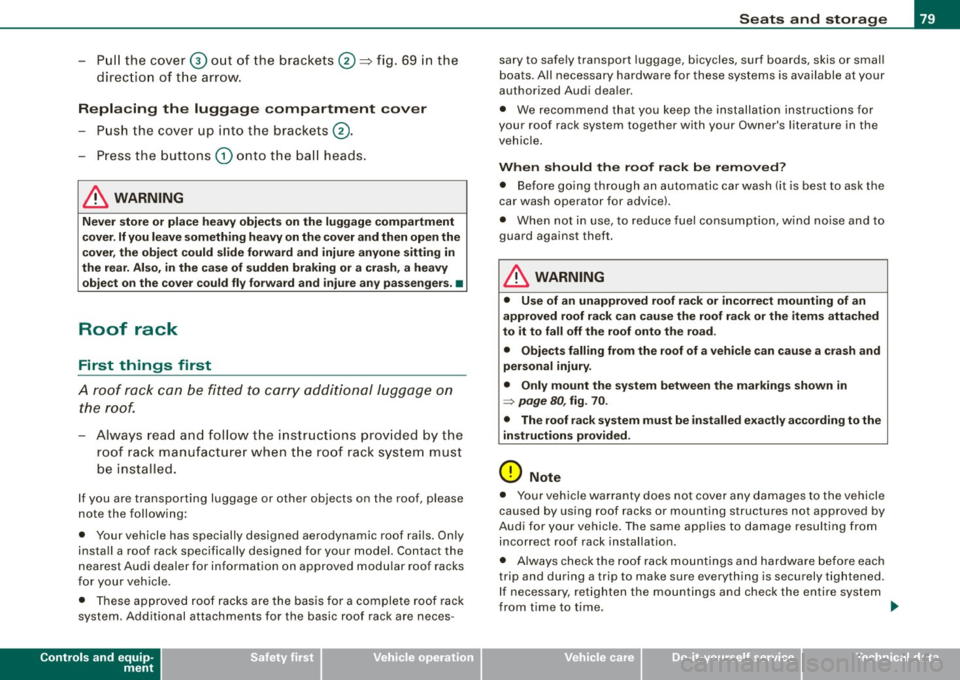
-Pull the cover© out of the brackets 0 => fig. 69 in the
direction of the arrow.
Replacing the luggage compartment cover
-Push the cover up into the brackets 0-
- Press the buttons G) onto the ball heads.
& WARNING
Never store or place heavy objects on the luggage compartment
cover. If you leave something heavy on the cover and then open the
cover, the object could slide forward and injure anyone sitting in
the rear. Also, in the case of sudden braking or a crash, a heavy
object on the cover could fly forward and injure any passengers. •
Roof rack
First things first
A roof rack can be fitted to carry additional luggage on
the roof.
-Always read and follow the instructions provided by the
roof rack manufacturer when the roof rack system must
be installed.
If you are transporting luggage or other objects on the roof, please
note the following:
• Your vehicle has specially designed aerodynamic roof rails . Only
install a roof rack specifically designed for your model. Contact the
nearest Audi dealer for information on approved modular roof racks
for your vehicle.
• These approved roof racks are the basis for a complete roof rack
system. Additional attachments for the basic roof rack are neces-
Controls and equip
ment
Seats and storage
sary to safely transport luggage, bicycles, surf boards, skis or small
boats. All necessary hardware for these systems is available at your
authorized Audi dealer.
• We recommend that you keep the installation instructions for
your roof rack system together with your Owner's literature in the
vehicle.
When should the roof rack be removed?
• Before going through an automatic car wash (it is best to ask the
car wash operator for advice).
• When not in use , to reduce fuel consumption, wind noise and to
guard against theft.
& WARNING
• Use of an unapproved roof rack or incorrect mounting of an
approved roof rack can cause the roof rack or the items attached
to it to fall off the roof onto the road.
• Objects falling from the roof of a vehicle can cause a crash and
personal injury.
• Only mount the system between the markings shown in
~ page 80, fig. 70.
• The roof rack system must be installed exactly according to the
instructions provided.
0 Note
• Your vehicle warranty does not cover any damages to the vehicle
caused by using roof racks or mounting structures not approved by
Audi for your vehicle. The same applies to damage resulting from
incorrect roof rack installation .
• Always check the roof rack mountings and hardware before each
trip and during a trip to make sure everything is securely tightened.
If necessary, retighten the mountings and check the entire system
from time to time . .,,
I • •
Page 83 of 316
<£> For the sake of the environment
Sometimes it may be easier to leave a roof rack installed even
though you are not using it . Due to the increased air resistance your
vehicle wi ll unnecessarily use more fuel. Remove the roo f rack if you
are not going to use it. •
Cup holder
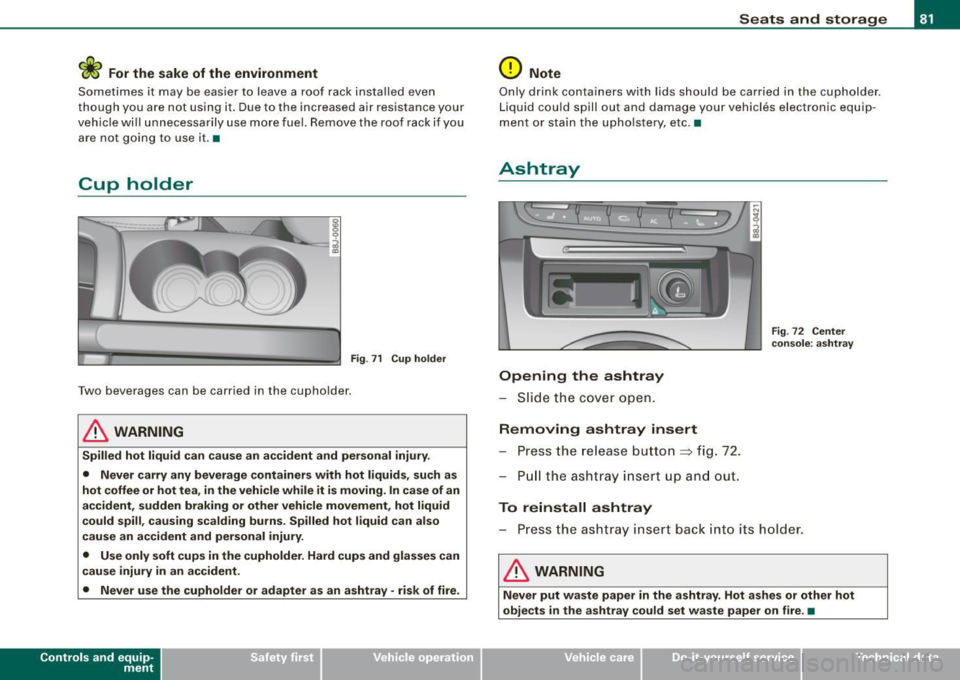
Fig. 71 C up hol der
Two beverages can be carried in the cupholder .
& WARNING
Spilled hot liq uid ca n cause an a ccident and perso nal injury .
• Never carry any beverage container s with hot liquids , such a s
hot coffee or hot tea , in the vehicle while it i s moving . In case of an
accident , sudden braking o r other vehicle movement , hot liquid
c ould spill , cau sing scald ing burns . Spilled hot liquid c an also
c au se an accident and per sonal injury.
• Use only soft cups in the cupholder . Hard cups and gla sses c an
c au se injury in an accident .
• Never use the cupholder or adapter as an ashtray · risk of fire .
Con tro ls and eq uip
ment
Seats and storag e
0 Note
Only drink containers with lids should be carried in the cupholder.
Liquid cou ld spill out and damage your vehicles electronic equip
ment or stain the upho lstery, etc. •
Ashtray
Opening the ashtray
- Slid e the cove r open.
Removing ashtray insert Press the re lease butto n
~ fig. 72.
P ull the ashtra y insert up and out .
To reinstall ashtray
F ig . 72 C enter
co nsole : a sht ray
- Press the ashtray insert back into its holder.
& WARNING
Nev er put w aste paper in the a shtr ay . Hot ashes or other hot
obje cts in the ashtr ay could set w aste paper on fire . •
Vehicle care I I irechnical data
Page 91 of 316
& WARNING
You shou ld not u se t he re circ ulati on mod e for an exte nd ed p eriod
si nce no fre sh air i s drawn in , and with the air conditioning
sw itc hed off the windows ca n fog up -thi s inc re a ses the r isk of an
acc ident !•
A/C operation [A C)
Switching on A /C
- Press the (AC) button~ page 85, fig. 76 .
Switching A /C off
- Press the (AC) button again.
T he cooling system is switched on during A/C operation -the
heating and ventilation system is controlled auto matica lly.
[ i J Tips
I f the LED in the switch stays on after A/C operation has been
switched off( = switching the A/C off), there is a fau lt in an air condi
tioning component. P lease consult an authorized Audi dealer when
there is an operat ing prob lem. •
Using the climate controls economically
E conomical use of the climate c ontrols helps to save fuel.
When climate control is working in cooling mode, engine
performance is reduced and fuel consumption is affected.
To keep the t ime the air cond itioning is on as s hort as
poss ible, you s hould do the following:
Controls and equip
ment
W arm and cold
- If you would like to save fuel, swit ch the air conditioning
off .
- If you open the windows while driving, switch the air
conditioning off .
- If the veh icle is extremely hot due to the heat of the sun,
briefly open doors and windows.
'£> For th e sake of th e environm ent
When you save fuel, you reduce emissions from the vehicle. •
Rear window defogger [ffiJ
The rear window defogger clears the rear window of
condensati on.
- Press the QuJ bu tton~ page 85, fig. 76 to turn the rear
window defogger on and off.
The rear window defogger works on ly when the engine is running.
The indicator light in the button illuminates when the rear window defogger is turned on.
The rear window defogger is switched off automatica lly after 10 to
20 minutes, depending on the outside temperature .
At very low outside temperatures, the rear window defogger can be switched on continuously by pushing the
Qiil button for more than 2
seconds. This remains stored until the ignition is switched off. A
rear window defogger that was switched on also remains stored for
15 minutes after the ignition is switched off.
If the engine is restarted within these 15 minutes, the rear window
defogger is activated for 10 to 20 minutes, depending on outside
temperature . With a vehicle that is parked for a short time, the rear
window defogger does not need to be manually activated again. .,,_
I • •
Page 97 of 316

-Wit h a manual transm issi on, engage 1st gea r, or with a n
a utomatic transmission place the se lector lever in P
=> & .
- Remove the ignition key from the ignit io n lock.
Wha t el se you should do wh en parking yo ur v ehi cle on
a n incli ne or d ecline
Turn the steering whee l so that if the vehicle shou ld start to rol l, it
wi ll roll into the curb.
I f you are park ing on a
decline (the front of you r ve hicle facing
downhill) , turn the front wheels to the right so that they poin t
toward the curb .
If you are park ing on an in cline (the font of your vehicle facing
uphill!, turn the front whe els to the left so that they point
away from
the curb .
& WARNING
This is how you can reduce the ri sk of injury when le avi ng your
vehicle .
• Never p ark the vehi cle w here it can come
in cont act w ith dry
gra ss, s pilled fuel or any other flammable mater ial s.
• Never allow anyone -espe cially small ch ildren -to remain
in the
vehicle when it is locked . Locked doors make it more difficult for
re scu ers to ac ce ss the pa ssenger compartment in the e vent of an
emergency . Danger to life!
• Never lea ve childr en un super vis ed in the vehicle . Children
c ould release the parking brake or move the gearsh ift l ever out of
gear . The vehicle could start to r oll away a nd cau se an a ccident .
• No matter what the season i s, the temperature
in a parked
v ehi cle can reach dangerou s level s. •
Controls and equip
ment
On th e road
Acoustic parking system
Applies to veh ic les : wit h 4 -ch anne l a cou stic park ass is t
Rear acoustic park assist
Acoustic park assist gives a warning a bout o bstacles
behind the vehicle.
Description
The rear acoustic park assist (4 -channel acoustic park assist) deter
mines the d istance of the vehic le from an obstac le using u ltrasonic
sensors. The sensors are in the rear bumper. The volume and the
pitch of the chimes can be adjusted through the menu display
=> page 27.
The range at which the sensors start to m easure is about :
To the side
Center rear
Acti v atio n
2 feet (0 .60 m)
5 feet (1.60 ml
The pa rking assist is activated when rever se ge ar is engaged . A brief
tone confirms that the system is activated .
Backing up
Distance warning when backing up starts when an obstacle is
detec ted in the range of the park ass ist system . As the distance
decreases, the time interval between the aud ible tones becomes
shorter .
When the distance is less than 1 foot (0.30 m) , the tone becomes
continuous . At this point you should stop backing up.
Please note that low objects a lready signalled by a warning can
disappear from the sys tem's detection range and wil l not continue
t o be signa lled . ..,
I • •
Page 192 of 316
___ D_ r _i_v _i_n ""'g "'- a_ n_ d _ e_ n_v_ i_ r _o _n_ m_ e_ n_t ___________________________________________ _
Driving and environment
The first 1,000 miles ( 1 ,500 km) and
afterwards
New engine
The engine needs to be run-in during the first 1,000 miles
(1,500 km).
For the first 600 miles (1,000 kilometres):
Do not use full throttle.
- Do not drive faster than 3/4 of the top speed marked on
the speedometer.
- Avoid high engine speeds .
From 600 to 1,000 miles (1,000 to 1,500
kilometres):
- Speeds can gradually be increased to the max imum
permissible road or engine speed.
During and after break-in period
- Do not rev the engine up to high speeds when it is cold.
This applies whether the transmission is in N (Neutral) or
1n gear.
After the break-in period
- Do not exceed maximum engine speed under any
circumstances.
- Upshift into the next higher gear before reaching the red
area at the end of the tachometer scale=> page 12.
During the first few hours of driving, the engine's internal friction is
higher than later when all the moving parts have been broken in.
How well this break-in process is done depends to a considerable
extent on the way the vehicle is driven during the first 1,000 miles
(1,500 kilometres).
0 Note
Extremely high engine speeds are automatically reduced. However,
these RPM-limits were programmed for an engine well run-in, not a
new engine.
~ For the sake of the environment
Do not drive with unnecessarily high engine speeds - upshifting
early saves fuel, reduces noise and protects the environment .•
New tires
If your vehicle is running on new tires, drive particularly
careful for the first 350 miles (500 kilometres) after fitting.
& WARNING
New tires tend to be slippery and must also be "broken-in". Be
sure to remember this during the first 350 miles (500 kilometres).
Brake gently. Avoid following closely behind other vehicles or
other situations that might require sudden, hard braking.
:I
Page 193 of 316

New brake pads
Remember that new brake pads do not have a full braking
effec t during the first 250 miles (400 kilometres) after they
are installed.
New brake pads have to be "burnished in" before they have optima l
grab=> &.
During the break -in period, you should avoid putting severe loads
on the brakes. Severe loads include, for example, sudden hard
braking, in particular at very high speeds or, for example, on moun
tain passes.
& WARNING
U ntil the y develop the m axim um "b ite " fo r be st stoppi ng p owe r,
th e s urfaces on new br ake p ads re quir e some " brea king -in " during
th e ini tia l 100 to 150 miles 1 150 to 200 k ilom etres) of nor ma l c ity
driving . You can comp ensa te fo r thi s by press ing the brak e ped al
more fi rml y. T his appl ie s w henev e r ne w pad s a re in sta lled . •
Catalytic converter
It is very important that your emission control system
(catalytic converter) is fu nctioning properly to ensure that
y o ur vehicle is running in an environmentally s ound
manner.
- Always use lead-free gasoline~ page 211, "Fuel supply".
- Never run the tank down a ll the way to empty.
- Never put too much motor o il in your engine~
page 222,
"Adding engine oi l 'l=:;r\11
•
- Neve r try to push -or tow -s tart your ve hicle.
Controls and equip
ment Safety first Vehicle operation
Dri
ving and environm ent
The catalytic converter is an efficient "clean-up" device built into the
exhaust system of the vehicle . The cataly tic converter burns many
of the pollutants in the exhaust gas before they are re leased into the
atmosphere.
The exclusive use of un leaded fuel is critica lly important for the l ife
of the catalytic converter and proper functioning of the engine.
& WARNING
• Do not park or oper ate th e ve hi cle in are a s whe re the hot
exha ust sys te m may c ome in conta ct wi th dr y grass, bru sh , fu el
s pill or other mat eri al which can cau se a fi re.
• Do not app ly a dditi onal u nder co at ing or ru stpr oofing on or
near the exhau st m anifold , exh au st pipe s, cata ly tic convert er or
he at shi elds. During dri ving, the s ubstance use d f or und ercoa ting
c ould ov erheat an d ca u se a fire.
0 Note
• Be aware that just one tank fi lling with
le ad ed fuel wi ll a lready
seriously degrade the performance of the catalytic converter.
• Do not exceed the correct engine oil level =>
page 222.
• Do not drive until the fuel tank becomes completely empty. The
engine could misfire . Unburned fuel could a lso get into the exhaust
system and this could cause the catalytic converter to overheat .
• Do not turn off the igni tion wh ile the vehicle is moving.
• Do not continue to operate your vehicle under these conditions,
as otherwise fue l can reach the cata lytic converter. This could resu lt
in overheating of the converter, requiring its replacement .
• To assure efficient operation of the Emiss ion Control System:
- Have your vehicle maintained properly and in accordance with
the service recommendations in your Warranty
& Maintenance
booklet.
Vehicle care Do-it-yourself service Technical data