oil AUDI TT COUPE 2009 Owner's Guide
[x] Cancel search | Manufacturer: AUDI, Model Year: 2009, Model line: TT COUPE, Model: AUDI TT COUPE 2009Pages: 316, PDF Size: 71.16 MB
Page 226 of 316

-~_C_ h_e _c _ k_ i_n ...:::g::;...._ a_n_ d_ f_ i_ll _in -'g:::;.._ ___________________________________________ _
& WARN ING (c o ntinued )
• Continuou s contact with used en gine oil i s harmful to your
sk in. Alway s prote ct your skin b y wa shi ng oil off thoroughly with
soap and water .
0 Note
Never mix oil additives with your engine oil. These additives can
damage your engine and adversely affect you r Audi Limited New
Vehicle Warranty.
<£> For the sake of the environment
• Before changing your oil, first make sure you know where you
can proper ly dispose of t he used oil.
• Always dispose of used engine oil properly . Do not dump it on
garden soil, wooded areas, into open strea ms or down sewage
drains .
• Recycle used eng ine oi l by taking it to a used eng ine oi l collec
tion facility in your area, or contact a service station. •
Engine cooling system
Coolant
The e ngine coolant perfor ms tw o functions: i t kee ps the
en gine from overheatin g and i t pro tects the engi ne from
freezing in the winter.
The cooling system is sea led and general ly requires litt le attention.
The coo ling sys tem has been f illed at the factory with a permanen t
coo lant which does not need to be changed. The coolant consists of
a mixture of water and the ma nufacturer 's glyc ol- basedco olan t
additive
G12++ antifreeze w ith anti corrosion additives (50% for USA models; 60% for Canadian mode
ls) . T his mixture both assures the
n ecessary fros t pr otection a nd protects metal co mpo nents in the
engine's cooling system from corrosion and scaling. It also raises
t he boil ing point of the coolant .
Do not reduce the concentration of the coo lant in the su mmer by
adding plain water.
The proportion of coolant additive mu st be at
lea st 50 % but not more than 60 %
to maintai n antifreeze pro tection
and cooling efficiency. If the coolant frost protection is too low, the
coo la nt co uld free ze and damage the vehic le heating and engine
coo ling system .
For year-round driving, antifree ze is added at the factory for temper
atures down to:
• - 31 °F ( -35 °C) USA
• -40 °F ( -40 °C) Canada.
You can mix the
G 12+ + coolant additive with other additives (G12+
or G12). Always check w ith your authorized Audi dealer.
& WARNING
Before you check anything in the engine compartment, alway s
read and heed all WARNINGS
~ & in "Working in the engine
compartment " on
page 217.
0 Note
• Before winter sets in, have the coolant checked to see if the
coo lant additive in your vehicle is suff icient to meet the c limate
co nd itions . This is e special ly impor tant i f you live in a region where
the winter is extremely cold. If necessary, increase the proportion of coo lant additive t o 60%.
• When adding coolant additive to your cooling system,
r emem ber:
- We recommend using on ly coolant additive
G 12+ + (check the
l abel) for your veh ic le . Th is coolant additive is available at autho -
rized Audi dealers. Other types of antifreeze can significantly ._
Page 227 of 316

Checking and filling -
---------------------=----"=---------
reduce corrosion protection. The resu lting corrosion can cause a
loss of coolant and serious engine damage.
• Do not add any type of radiator leak sealant to your vehicle's
engine coolant. Adding radiator repair fluid may adverse ly affect the
function and performance of your cooling system and cou ld result
in damage not covered by your New Vehicle Limited Warranty. •
Checking the engine coolant level
The engine coolant level can be checked with a quick
gla nce .
Fig . 142 Engine
co mp artm ent : coo lan t
e xpa nsion t ank
Before you check anything in the engine compartment,
always read and heed all WARNINGS=> & in "Working in
the engine compa rtment" on
page 217.
- Switch the ignition of f.
- Read the coo lant l eve l at the coo lant exp ansio n tank
==> fig. 142. With a col d e ngine, it must b e above the
"min" mar k. Wit h a hot engine, it can be a little above t he
indicated range.
The location of the coolant expansion tank can be seen in the
engine compartment i llustration. To obtain an accurate reading, the engine must be switched off.
The expansion tank in your vehic
le is equipped with an e lectric
coolant level sensor.
When the coolant leve l is too low, the warning light in the Auto
Check System =>
page 34 will blink un til you add coolant and the
level has been restored to normal. Even though there is an e lectric
coo la n t level sensor, we still recommend you check the coolant level
from time to time .
Coolant loss
Coolant loss may indicate a leak in the cooling system . In the event
of coo lant loss, the co oling sys tem shou ld be i nspected immedi
ate ly by your authorized Audi dealer . It is not enough merely to add
coo lant .
In a
sealed system , losses can occur only if the boiling point of the
coolant is exceeded as a result of overheating .
0 Note
Do not add any type of radiator leak sea lant to your vehicle's engine
coolant. Adding rad iator repair fluid may adversely affect the func
tion and performance of your coo ling system and could resu lt in
damage not covered by your New Vehic le Limited Warra nty. •
Adding coo lant
Be very careful when adding engine coolant.
Before you check anything in the engine compartment,
always read and heed all WARNINGS==> & in "Working in
the engine compartment" on
page 217 .
-Turn off the engin e.
- Let the engine cool down.
Vehic le care I I irechnical data
Page 229 of 316

_____________________________________________ C_h_ e_ c _ k_in --= g'-a _ n_d _ f_il _li _n -=g =-- ____.•
• the engine compartment heats up because the vehicle is parked
in intense sunlight.
& WARNING
• To reduce the risk of personal injury never touch the radiator
fan.
• The auxiliary electric fan is temperature controlled and can
switch on suddenly even when the engine is not running .
• The auxiliary radiator fan switches on automatically when the
engine coolant reaches a certain temperature and will continue to
run until the coolant temperature drops. •
Brake fluid
Checking brake fluid level
The brake fluid level can be checked with a quick glance.
Fig. 143 Engine
compartment: brake
fluid reservoir
Before you check anything in the engine compartment,
always read and heed all WARNINGS=> & in "Working in
the engine compartment" on
page 217.
-Read the brake fluid level from the brake fluid reservoir
=> fig. 143. The brake fluid level must be between the
"MIN" and "MAX" markings.
The brake fluid reservoir is located behind the rear partition of the
engine compartment on the left side~ page 218.
The fluid level may drop slightly after some time due to the auto
matic adjustment of the brake pads. This is not cause for alarm.
If the brake fluid level falls considerably below the "MIN" mark, the
brake warning/indicator light (U.S. models:
BRAKE, Canadian models:
(Cf))) will come on~ page 19 and~ page 33. Do not continue to
operate the vehicle. The complete brake system should be thor
oughly checked by an authorized Audi dealer or other qualified
facility and the cause corrected. If the brake fluid level is too low, the
brake warning/indicator light will illuminate. Contact an authorized
Audi dealer
immediately. •
Changing brake fluid
Have the brake fluid changed by an experienced techni
cian.
Brake fluid absorbs moisture from the air. If the water content in the
brake fluid is too high, corrosion in the brake system may result
after a period of time . The boiling point of the brake fluid will also
decrease considerably and decrease braking performance.
Therefore, the brake fluid must be changed
every two years. Always
use new brake fluid which conforms to Federal Motor Vehicle Stan
dard "FMVSS 116 DOT 4".
The brake fluid reservoir can be difficult to reach, therefore, we
recommend that you have the brake fluid changed by your autho
rized
Audi dealer. Your dealer has the correct tools, the right brake
fluid and the know-how to do this for you.
~
Vehic le care I I irechnical data
Page 245 of 316
______________________________________________ T_ ir_e _s_ a_n_ d_ w_ h_ e_ e_ls __ __
•
technically referred to as the vehicle's Gross Vehi cle We ight Rating
("GVWR") .
T he "GVWR" includes the weight of the bas ic veh icle, al l factory
insta lled accessor ies, a full tank of fue l, oil, coolant and other f luids
p lus ma ximum load. The maxim um load includes the number o f
passengers that the vehicle is intended to carry ("seating capacity")
w it h an assu med weight o f 15 0 l bs (68 kg) for eac h passe nger at a
designated seating position and the total weight of any luggage in
th e veh ic le .
T he
Gross Axle Weight Rating ("GAWR"l is the maximum load that
can be applied a t each of the vehic le's two axles .
The Gross Ve hicle W eig ht Rati ng and the Gross A xle Weigh t Rating
a re l isted on the safety compliance sticker labe l located on the
dr iver's s ide B -p il lar . Y o ur Aud i has 4 seat ing positions, 2 in the fron t
and 2 in the rear for total seating capacity of 4. Each seating posit ion
has a sa fet y b elt
=> page 125, "Safe ty be lts" .
T he fact t hat the re is an uppe r lim it to your ve hicle's G ross V ehic le
Weight Rati ng means tha t the total we igh t of w hateve r is bei ng
ca rried in the vehicle is lim it e d. T he m ore pass engers in t he veh ic le
or passengers who are heavier than the standard weights assumed
mean that less we igh t ca n be ca rried as lu ggage .
T he tire pressure labe l o n you r Audi also lists the max imum
c o m bined weig ht of all of t he oc cupan ts a nd lu ggage or other ca rgo
t h at the ve hicle can carry. For the locat ion of the label
=> page 238,
fig . 14 8.
& WARNING
Overloading a vehicle can cause loss of vehicle control, a crash or
other accident , serious personal injury , and even death .
• Carrying more weight than your vehicle was designed to carry
will prevent the vehicle from handling properly and increase the
risk of the loss of vehicle control.
• The brakes on a vehicle that has been overloaded may not be
able to stop the vehicle within a safe distance.
& WARNING (continued )
• Tires on a vehicle that has been overloaded can fail suddenly,
including a blowout and sudden deflation , causing loss of control
and a crash .•
Determining correct load limit
Use the example below to calculate the
total weight of the passengers and
luggage or other things that you plan to
transport so that you can make sure that
your vehicle will not be overloaded.
Steps for Determining Correct
Load Limit
1 . Locate the statement "THE COMBINED
WEIGHT OF OCCUPANTS AND CARGO SHOULD NEVER EXCEED XXX KG OR XXX
LBS "on your vehicle 's placard (tire infla
tion pressure label)~
page 238, fig. 148.
2. Determine the combined weight of the driver and passengers that will be riding
in your vehicle. ..,
Vehicle care I t •
Page 247 of 316
________________________________________________ T_ i _r_e _s_ a_n_ d_ w_ h_ e_e _ l_s __ _
•
make, th ere w ill be six to ei ght of them evenly placed around the
t ire. Ma rks o n th e tir e s idewall (f or e xam ple "TWI " or oth er symbo ls)
indicate the positions of t he tread wear indicators . Worn tires must
be re placed. Diffe re nt fig ure s may a ppl y in other countr ies=>& .
Tire pressure
Inc orr ect t ire p ressure causes prema ture wea r and ca n cause
sudden tire blow -out. For this reason, tire pressure must be checked
at leas t on ce a mont h=>
pag e 24 1.
Dri ving style
Dr ivi ng fa st aro und curves, heavy accele ration a nd hard bra king
increase tire wea r.
Rotating tires for more even wear
F or all four tires on your vehicle to have the same service life, we
r ec om men d that t he fr ont a nd rear ti res are rota ted acco rd ing to the
tire manufacturer 's suggested tire ro tation interva ls. Please
r eme mber the fo llo wi ng:
• Ti re rotation interva ls may differ from the vehicle servic e int er
va ls ou tlined in y our Wa rranty
& M ain te n ance Booklet .
• T he longer one tire is used in one location on the vehicle, the
mo re it wears a t ce rtai n poi nts ; th erefore, we recom men d th at you
follow t he tire manufac turer's su ggested t ire rotation interv als .
• Vehi cles w ith front -w hee l d rive ex per ience more trea d wea r on
the front wheels compared to all -wheel drive (quattro®l .
• Ple as e rota te tires as shown=>
page 244, fi g. 15 1.
• Extra care must be ta ken when rotating direction -specific tires
=>
p age 2 73 .
Wheel balancing
The w heels on new vehic les are balanced. However, various situa
tions du ring everyday dr iving can cause them to become unbal
anc ed, resu lt in g in v ibrat io ns y ou can usual ly fe e l throu gh th e
steering whee l. U
nba lanc ed wheels must be r eba lanced to avoid excessive wear on
ste erin g, sus pen sion and tire s. A wh ee l mu st als o b e re b ala nce d
when a new tire is insta lled.
Incorrect wheel alignment
I ncorrect wheel alignment can cause excess ive tire wear, impairing
t he sa fety of the v ehicle. If t ire s s how e xcess ive wear, hav e t he
whee l a lignment chec ked by an authoriz ed Aud i d eal er o r qua lif ied
wo rk shop.
All Wheel Drive
V eh icles w ith q uattro ® must alwa ys ha ve tire s of the same siz e,
construction and t read t ype . For detai ls see=>
page 189 .
& WARNING
Sudden tire failure can lead to loss of control , a crash and serious
personal injury!
• Never drive a vehicle when the tread on any tire is worn down
to the wear indicators.
• Worn tires are a safety hazard , they do not grip well on wet
roads and increase your risk of "hydroplaning" and loss of control.
• Always keep chemicals that can cause tire damage , such as
grease , oil , gasoline and brake fluid away from tires .
• Tires age even if they are not being used and can fail suddenly,
espe cially at high speeds . Tires that are more than 6 years old can
only be used in an emergency and then with special care and at
lower speeds .
• Never mount used tires on your vehicle if you are not sure of
their "previous history ." Old used tires may have been damaged
even though the damage cannot be seen that can lead to sudden
tire failure and loss of vehicle control. •
Vehicle care
I t •
Page 254 of 316
-Tires and wheels
P'tr:1-------------------
Remove wheel center covers and trim discs befor e putting snow
ch ain s on y our ve hic le ~
(D. For sa fe ty rea sons c over ca ps m us t
th en be fitted over the wheel bo lts. These ar e avai lable from autho
rized Audi deale rs.
& WARNING
Using the wrong snow chains for your vehicle or installing them
incorrectly can increase the risk of loss of control leading to
serious personal injury.
• Snow chains are available in different sizes . Always make sure
to follow the instructions provided by the snow chain manufac
turer .
• When driving with snow chains never drive faster than the
speed permitted for your spec ific snow chains.
• Always observe local regulations.
0 Note
• Remove s now c hains befo re driv ing on roads no t cove re d w it h
snow to avoid damag ing tires and wearing the snow chains down
un nece ss aril y.
• Snow chains, whic h come into direct contact with the wheel rim,
can scratch or da mag e it. There fo re , m ake sure t hat th e s now ch ai ns
a re s uitably covered. Check the position of the snow chains after
dr ivin g a few yar ds a nd correct if ne cessary . Fo ll ow the in struc tions
from t he snow cha in manufacturer when do ing so.
[ i ] Tips
Where snow chains are mandatory on certain roads, this normal ly
a ls o ap plies to vehicle s w ith All W hee l Dr ive.•
Wheel bolts
W heel bo lts mu st a lways be ti ghte ned to t he corr ect
t o rq ue .
The design of wheel bolts is matched to the facto ry instal led rims . If
diff eren t rim s are fitt ed, t he cor rect w heel bol ts with the r ig ht le ngth
and correctly shaped bolt heads must be used. This ensures that
w hee ls a re fitted securely and t hat t he brake sys te m funct io ns
correctly.
In cer tain ci rc u ms tances, yo u may no t use whee l b olt s fro m a
different vehicle -even if it is the same model~
page 295.
& WARNING
Improperly tightened or maintained wheel bolts can become loose
causing loss of control, a collision and serious personal injury .
• Always keep the wheel bolts and the threads in the wheel hubs
clean so the wheel bolts can turn easily and be properly tightened .
• Never grease or oil the wheel bolts and the threads in the wheel
hubs. They can become loose while driving if greased or oiled,
even if tightened to the specified torque.
• Only use wheel bolts that belong to the rim be ing installed.
• Never use different wheels bolts on your vehicle.
• Always maintain the correct tightening torque for the wheel
bolts to reduce the risk of a wheel loss .
If the tightening torque of
the wheel bolts is too low , they can loosen and come out when the
vehicle is moving. If the tightening torque is too high, the wheel
bolts and threads can be damaged and the wheel can become
loose .
0 Note
The specified torq ue for the wheel bolts is 9 0 ft lb (120 Nm) with a
t o lerance of± 7,4 f t lb (± 10 N m). To rque w hee l bo lt s d ia g ona lly .
After chang ing a wheel, the torque must be checked as soon as
~
Page 277 of 316
Fuses and bulbs -
------------------
The various electrical circuits are protected by fuses. The fuses are
clustered in a centralized unit. The unit is located behind the face
panel at the end of the instrument panel.
Two spare fuses and a sticker identifying the fuses are located on
the inside of the fuse box cover.
You are well advised to keep a supply of spare fuses in your vehicle.
Fuses with the proper ampere ratings are available at your autho
rized Audi dealer.
& WARNING
Never replace a fuse with one that has a higher amperage rating .
• A fuse with a too high amperage could damage the electrical
part and cause a fire.
0 Note
• On no account should fuses be repaired (e.g. patched up with tin
foil or wire) as this may cause serious damage elsewhere in the elec
trical circuit or cause fire.
• If a fuse blows repeatedly, do not keep replacing it. Instead, have
the cause for the repeated short circuit or overload tracked and
fixed. •
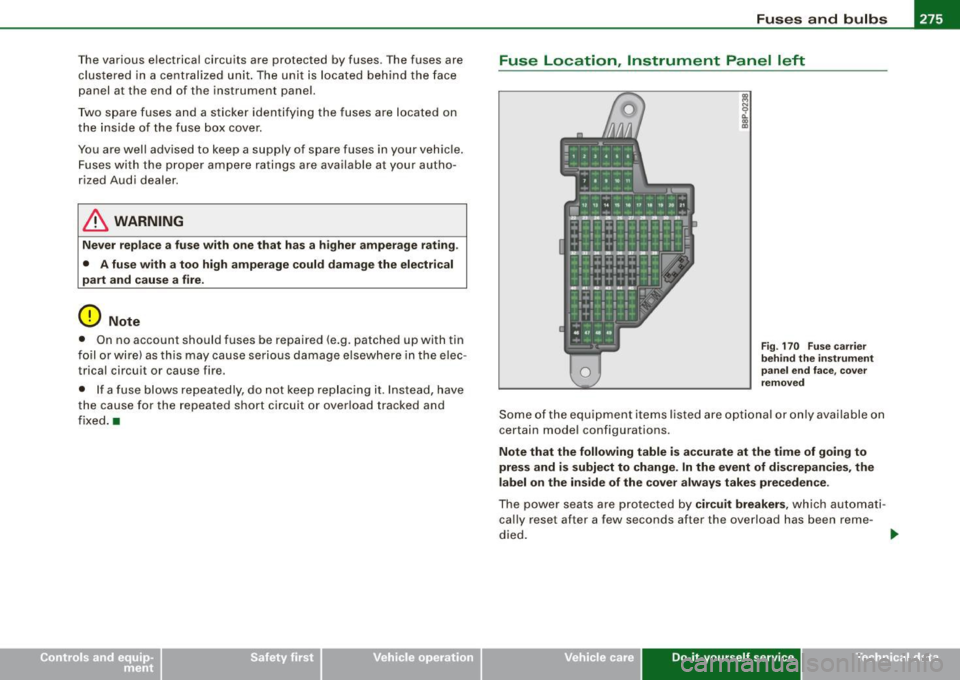
Fuse Location , Instrument Panel left
Fig . 170 Fuse carrier
behind the instrument
panelendface,cover
removed
Some of the equipment items listed are optional or only available on
certain model configurations.
Note that the following table is accurate at the time of going to
press and is subject to change. In the event of discrepancies, the
label on the inside of the cover always takes precedence.
The power seats are protected by circuit breakers, which automati
cally reset after a few seconds after the overload has been reme-
died. .,_
Vehicle care Do-it-yourself service irechnical data
Page 278 of 316

ffl.___F_ u_ s _ e_s _ a_n _ d_ b_ u_lb _ s _______________________________________________ _
Equipment No.
II Equipment
Amps I
Engine relay, fuel tank control unit, Airbag Off 16 A/C system (control unit) 10
1 light, light switch (switch illumination), diagnos-10
tic connector
17 Tire pressure monitoring system (control unit) 5
18 Not used
2 ABS, ASR, ESP, brake light switch 5
19
Not used
3 AFS headlight (left) 5 20
Not used
Oil level sensor (extended maintenance interval)
(WIVl, tire pressure monitoring system, switch
21 Fuel injectors (gasoline engine) 10
4 for Electronic Stability Program (ESP), AFS head-5 22 Wind deflector (Roadster) 30
lights (control unit), A/C system (pressure sen-23 Horn 20 llsorl, backup light switch
Automatic headlight range control, AFS head -
24 Transmission (control unit) 15
5
light (right)/ manual headlight range control, 5/10 25 Heater rear window Coupe/heated rear window 30/20
halogen headlights Roadster
Control unit for CAN data transfer (gateway),
26 Driver's side power window 30
6 electromechanical steering, automatic transmis-5 27 Passenger's side power window 30
sion shift gate
28 Not used
Acoustic Park Assist, automatic dipping interior
rear view mirror, garage door opener, heatable
29 Washer pump 15
7
windshield washer nozzles, washer pump, wind 5
30 Cigarette lighter 20
deflector relay (Roadster)
31 Starter 40
8
Haldex clutch 5 32 Steering column module 5
9
Control unit Audi magnetic ride 5 33
Instrument cluster 5
Airbag control unit 5 34 Radio navigation system, radio 15
1 1 Mass airflow sensor, crankcase heating 5/10
35
Audio amplifier 30
Door control unit (central locking driver/passen-12 10
36 Engine (control unit) 10 gerl
13 Diagnostic connector 10 37 CAN (Gateway) 5
Rain sensor, automatic transmission shift gate 5 38 Not used
15 Roof light (interior lighting) 5 39 Not
used
Page 279 of 316

_______________________________________________ F_ u_ s_ e_s _ a_ n_d _ b_u_ l_ b _s_--J _
No. Equipm ent Amps
40 Not used
41 Not used
42 Not used
43 Not us ed
44 Not use d
45 Not used
Not used
47 SDARS tuner, cell phone package, TV tune r 5
48 VDA interface
5
49 Not us ed
Fuse location , left side of engine
compartment
"' ~ M 9 -, ., m
F ig . 17 1 Illus tration o f
fu se h old er on l eft s ide
of engin e compart-
m en t: fuses (wi thout
fu se cov er)
Some of the equipment items listed a re optiona l or on ly avai lable on
ce rtain model co nfigurations .
Not e th at the foll owing t able is acc urate at th e tim e of goin g to
pr es s and i s subject to chang e. In the even t of di scr epanc ies, the
lab el on the insi de of th e cove r alwa ys takes pre ced en ce .
•
No . Equipm ent
Fuse h old er (bl ack)
1 Not used
2 Not used
3 Not used
4 Not used
5
II Anti-theft warning system (sensor), anti-theft
warning system (ho rn)
6 Headlamp washer system
7 Electric fue
l pumps (supplyl/volume control
valve
8 Windshield wipers
9 Heated seats (driver and passenger)
10 Lumbar support (driver and passenger
)
1 1 Not used
12 Ventilation b
lower
Fus e holder (brown )
1
2
3
4
5
6
7 Fuel pump (6-cylinderl
02 sensors (6-cylinderl Mass airflow sensor (6 -cy linder)
02 sensors (6-cylin derl
Relay coil relay volum e con tro l valve 14-cylin-
der)
Secondary air pump valve (6 -cylinderl , 02 sen
so rs ( 4-cylinderl
Positioning valves pre-wired engine harness
Vehicle care Do-it-yourself service
Amps
5
30
15/10 30
25 1 0
40 15
10
5
10
5
1 0
10
-
irechnical data
Page 280 of 316
.,,___F_ u_ s _ e_s _ a_n _ d_ b_ u_lb _ s _______________________________________________ _
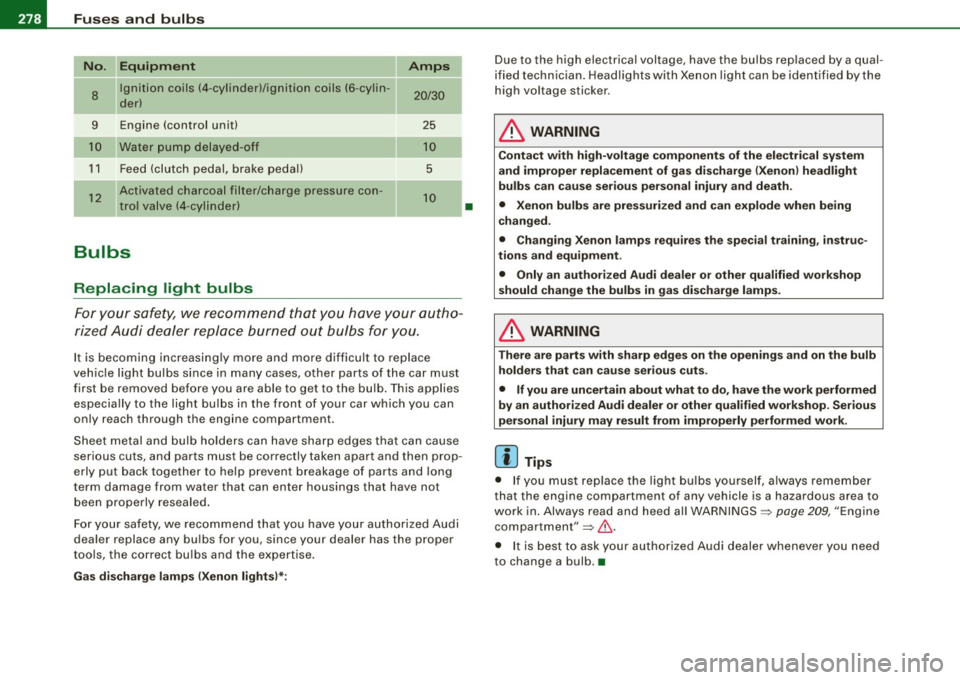
No. Equipment Amps
8 Ignition coils (4
-cylinderl/ignition coils (6-cylin -
20/30
der)
9 Engine (control unitl 25
Water pump delayed-off 10
1 1 Feed (clutch pedal, brake pedal) 5
12
Activated charcoal filter/charge pressure con-10 trol valve (4-cylinder)
-' -
Bulbs
Replacing light bulbs
For your safety, we recommend that you have your autho
rized Audi dealer replace burned out bulbs for you.
It is becoming increasingly more and more difficult to replace
vehicle light bulbs since in many cases , other parts of the car must
first be removed before you are able to get to the bulb. This applies
especially to the light bulbs in the front of your car which you can
only reach through the engine compartment.
Sheet metal and bulb holders can have sharp edges that can cause
serious cuts, and parts must be correctly taken apart and then prop
erly put back together to help prevent breakage of parts and long
term damage from water that can enter housings that have not been properly resealed.
For your safety , we recommend that you have your authorized Audi
dealer replace any bulbs for you, since your dealer has the proper
tools, the correct bulbs and the expertise.
Gas discharge lamps (Xenon lights)*:
•
Due to the high electrical voltage, have the bulbs replaced by a qual
ified technician. Headlights with Xenon light can be identified by the
high voltage sticker .
& WARNING
Contact with high-voltage components of the electrical system
and improper replacement of gas discharge (Xenon) headlight
bulbs can cause serious personal injury and death .
• Xenon bulbs are pressurized and can explode when being
changed.
• Changing Xenon lamps requires the special training, instruc
tions and equipment .
• Only an authorized Audi dealer or other qualified workshop
should change the bulbs in gas discharge lamps.
& WARNING
There are parts with sharp edges on the openings and on the bulb holders that can cause serious cuts .
• If you are uncertain about what to do, have the work performed
by an authorized Audi dealer or other qualified workshop. Serious
personal injury may result from improperly performed work.
[ i] Tips
• If you must replace the light bulbs yourself, always remember
that the engine compartment of any vehicle is a hazardous area to
work in. Always read and heed all WARNINGS=>
page 209, "Engine
compartment"=>
/A .
• It is best to ask your authorized Audi dealer whenever you need
to change a bulb .•