brake AUDI TT COUPE 2009 Workshop Manual
[x] Cancel search | Manufacturer: AUDI, Model Year: 2009, Model line: TT COUPE, Model: AUDI TT COUPE 2009Pages: 316, PDF Size: 71.16 MB
Page 247 of 316
________________________________________________ T_ i _r_e _s_ a_n_ d_ w_ h_ e_e _ l_s __ _
•
make, th ere w ill be six to ei ght of them evenly placed around the
t ire. Ma rks o n th e tir e s idewall (f or e xam ple "TWI " or oth er symbo ls)
indicate the positions of t he tread wear indicators . Worn tires must
be re placed. Diffe re nt fig ure s may a ppl y in other countr ies=>& .
Tire pressure
Inc orr ect t ire p ressure causes prema ture wea r and ca n cause
sudden tire blow -out. For this reason, tire pressure must be checked
at leas t on ce a mont h=>
pag e 24 1.
Dri ving style
Dr ivi ng fa st aro und curves, heavy accele ration a nd hard bra king
increase tire wea r.
Rotating tires for more even wear
F or all four tires on your vehicle to have the same service life, we
r ec om men d that t he fr ont a nd rear ti res are rota ted acco rd ing to the
tire manufacturer 's suggested tire ro tation interva ls. Please
r eme mber the fo llo wi ng:
• Ti re rotation interva ls may differ from the vehicle servic e int er
va ls ou tlined in y our Wa rranty
& M ain te n ance Booklet .
• T he longer one tire is used in one location on the vehicle, the
mo re it wears a t ce rtai n poi nts ; th erefore, we recom men d th at you
follow t he tire manufac turer's su ggested t ire rotation interv als .
• Vehi cles w ith front -w hee l d rive ex per ience more trea d wea r on
the front wheels compared to all -wheel drive (quattro®l .
• Ple as e rota te tires as shown=>
page 244, fi g. 15 1.
• Extra care must be ta ken when rotating direction -specific tires
=>
p age 2 73 .
Wheel balancing
The w heels on new vehic les are balanced. However, various situa
tions du ring everyday dr iving can cause them to become unbal
anc ed, resu lt in g in v ibrat io ns y ou can usual ly fe e l throu gh th e
steering whee l. U
nba lanc ed wheels must be r eba lanced to avoid excessive wear on
ste erin g, sus pen sion and tire s. A wh ee l mu st als o b e re b ala nce d
when a new tire is insta lled.
Incorrect wheel alignment
I ncorrect wheel alignment can cause excess ive tire wear, impairing
t he sa fety of the v ehicle. If t ire s s how e xcess ive wear, hav e t he
whee l a lignment chec ked by an authoriz ed Aud i d eal er o r qua lif ied
wo rk shop.
All Wheel Drive
V eh icles w ith q uattro ® must alwa ys ha ve tire s of the same siz e,
construction and t read t ype . For detai ls see=>
page 189 .
& WARNING
Sudden tire failure can lead to loss of control , a crash and serious
personal injury!
• Never drive a vehicle when the tread on any tire is worn down
to the wear indicators.
• Worn tires are a safety hazard , they do not grip well on wet
roads and increase your risk of "hydroplaning" and loss of control.
• Always keep chemicals that can cause tire damage , such as
grease , oil , gasoline and brake fluid away from tires .
• Tires age even if they are not being used and can fail suddenly,
espe cially at high speeds . Tires that are more than 6 years old can
only be used in an emergency and then with special care and at
lower speeds .
• Never mount used tires on your vehicle if you are not sure of
their "previous history ." Old used tires may have been damaged
even though the damage cannot be seen that can lead to sudden
tire failure and loss of vehicle control. •
Vehicle care
I t •
Page 251 of 316

________________________________________________ T.:......... ir--=e :....:s:......: a--=n..:.. d.::..:..... w..:....:.... h :....:..:e:....:e:..: 1-=s :...__IJlll
•
& W ARNING (continu ed )
• All four wheels must be fitted with radial tire s of the same type ,
s ize (rolling cir cumference ) and the same tread pattern . Driv ing
with different t ires redu ces vehicle h andling and can lead to a loss
of contro l.
• If the spare tire is not the same a s the tires that are mounted
on the vehicle -for e xample with winter tires -only use the spare
tire for a short period of time and dr ive with extra c are . Refit the
norm al road wheel as soon as safely possible .
• Never drive faster than the maximum speed for which the tires
on your vehicle are rated because tires that are driven faster than
their rated speed can fail suddenly .
• Overloading tires cause heat build-up , sudden tire failure ,
including a blowout and sudden deflation and loss of control.
• Temperature grades apply to t ires that are properly inflated and
not over or underinflated .
• For te chnical reasons it is not always possible to use wheels
from other vehicles -in some cases not even wheels from the
same vehicle model.
• If you install wheel trim discs on the vehicle wheels , make sure
that the air flow to the brakes is not blo cked . Redu ced airflow to
the brakes can them to overheat , in creasing stopp ing distances
and causing a collision .
• Run flat tires may only be u sed on vehicle s that were equipped
with them at the fa ctory . The vehicle must have a chassis de signed
for run flat tires and a factory -installed tire pressure monitoring
system* that indicates a loss of tire pressure. In correct use of run
flat tires can lead to vehicle damage or accidents . Check w ith an
autho riz ed Audi dealer or tire specialist to see if your vehicle can
be equipped with run flat tires . If run flat tires are used, they must
be installed on all four wheel s. Mixing tire types is not permitted .
0 Note
• For techn ica l reaso ns, it is not genera lly poss ib le to use t he
whee l rims from other vehicles. This can hold true fo r wheels of the
same vehicle type .
• I f the s pare t ire is d ifferent from the tires that you have mounted
on your vehicle ( fo r example win te r ti res or wide p rofile tires), then
use the spa re tire for a short period of time on ly and drive with extra
care. Replace t he flat tir e w ith the tire matching the others o n your
vehic le as soon as possib le.
• If you s hould put different whee ls a nd tires on your ve hic le (e.g.
winter wheels and tires), you must be certain that the whee ls and
t ires are co mpa tibl e w ith the tire pressure mon itor in g syste m*.
Otherwise the system w ill reg ister a malfunction and a fault
m essage w ill be d isplayed . For more info rma tion, co ntact your Aud i
dea ler.
0 Note
• When installing new tires, be careful not to damage the va lves or
tire p ressu re m on itoring system senso rs* .
• N ever drive without the valve stem cap. The valves could get
da mage d.
• I f the sensors must be replaced, then the valve must also be
r eplaced at the same time.
ci> For the sake of the environment
Dis p ose o f old tir es in acco rdance with the local requ ireme nts .•
Uniform tire quality grading
• Tread wear
• Traction AA A B C
• Temperature A B C
Vehicle care
I t •
Page 254 of 316
-Tires and wheels
P'tr:1-------------------
Remove wheel center covers and trim discs befor e putting snow
ch ain s on y our ve hic le ~
(D. For sa fe ty rea sons c over ca ps m us t
th en be fitted over the wheel bo lts. These ar e avai lable from autho
rized Audi deale rs.
& WARNING
Using the wrong snow chains for your vehicle or installing them
incorrectly can increase the risk of loss of control leading to
serious personal injury.
• Snow chains are available in different sizes . Always make sure
to follow the instructions provided by the snow chain manufac
turer .
• When driving with snow chains never drive faster than the
speed permitted for your spec ific snow chains.
• Always observe local regulations.
0 Note
• Remove s now c hains befo re driv ing on roads no t cove re d w it h
snow to avoid damag ing tires and wearing the snow chains down
un nece ss aril y.
• Snow chains, whic h come into direct contact with the wheel rim,
can scratch or da mag e it. There fo re , m ake sure t hat th e s now ch ai ns
a re s uitably covered. Check the position of the snow chains after
dr ivin g a few yar ds a nd correct if ne cessary . Fo ll ow the in struc tions
from t he snow cha in manufacturer when do ing so.
[ i ] Tips
Where snow chains are mandatory on certain roads, this normal ly
a ls o ap plies to vehicle s w ith All W hee l Dr ive.•
Wheel bolts
W heel bo lts mu st a lways be ti ghte ned to t he corr ect
t o rq ue .
The design of wheel bolts is matched to the facto ry instal led rims . If
diff eren t rim s are fitt ed, t he cor rect w heel bol ts with the r ig ht le ngth
and correctly shaped bolt heads must be used. This ensures that
w hee ls a re fitted securely and t hat t he brake sys te m funct io ns
correctly.
In cer tain ci rc u ms tances, yo u may no t use whee l b olt s fro m a
different vehicle -even if it is the same model~
page 295.
& WARNING
Improperly tightened or maintained wheel bolts can become loose
causing loss of control, a collision and serious personal injury .
• Always keep the wheel bolts and the threads in the wheel hubs
clean so the wheel bolts can turn easily and be properly tightened .
• Never grease or oil the wheel bolts and the threads in the wheel
hubs. They can become loose while driving if greased or oiled,
even if tightened to the specified torque.
• Only use wheel bolts that belong to the rim be ing installed.
• Never use different wheels bolts on your vehicle.
• Always maintain the correct tightening torque for the wheel
bolts to reduce the risk of a wheel loss .
If the tightening torque of
the wheel bolts is too low , they can loosen and come out when the
vehicle is moving. If the tightening torque is too high, the wheel
bolts and threads can be damaged and the wheel can become
loose .
0 Note
The specified torq ue for the wheel bolts is 9 0 ft lb (120 Nm) with a
t o lerance of± 7,4 f t lb (± 10 N m). To rque w hee l bo lt s d ia g ona lly .
After chang ing a wheel, the torque must be checked as soon as
~
Page 260 of 316

-~_T_ ir_e_ s_ a_ n_d _ w_ h_ e_e _l_s _________________________________________________ _
• Transmitters with the same frequency , such as radio head
phones in the vehic le or radio equipment, can cause a temporary
disruption of the system through excessive electromagnetic fields .
• Elimina te the interference if possible/if you can and then
proceed as follows : Turn off the engine for 20 minutes . T hen drive
another
1 0 min. If the warning light comes on aga in, you should
contact your authorized Audi dealer immediately to have the problem corrected .
• Do not use commercially avai lable tire sea lants. Otherwise, the
e lectrical componen ts of the tire pressure monitoring system* wil l
no longer work properly and the sensor for the tire pressure moni
toring system * will have to be replaced by a qualified workshop .•
Run-flat tires
Ap plies to ve hic les : w it h R un -f la t tires
Introduction
Run-flat tires help keep you moving if a tire goes flat.
Re inforced sidewalls give the tires run -flat capability if t ire pressure
is lost .
We recommend that run -flat tires only be mounted on vehicles that
were origina lly equipped with these special tires at the factory and
have a Tire Pressure Monitoring System.
Run-flat tire s can be identified by the letter s "RSC" on the tire side
wa ll.
If you do change the tires on you r vehicle from normal to run -flat
tires , you must buy the special rims required for run -flat tires, and
the Tire Pressure Mon itoring System must be reprogrammed by an
authorized Audi dea ler or other qual ified workshop.
What do run -fl at tires do ?
These specia l tires have run-flat capabilities that help keep you
moving if a tire loses pressure and goes flat. Under favorab le condi -tions tires can be driven
a
t lea st 30 mile s (50 km ), but you must not
drive
fa ster than 50 mph (80 km/h )=> page 259, "Driving with run
flat tires".
The Tire Pressure Monitoring System constant ly checks the air pres
sure in the tires. If the run-flat system is active (shown in the center
display), you must inspect the affected t ire or t ires and then decide
whether to cont inue dr iving. Be sure to fol low these tips
=> page 259, "Driving with run -flat tir es" .
When it is n ot po ssible to c ontinue dri ving, ev en with
run-flat tir es?
• I f the Electronic Stabi lization Program (ESP) is not work ing o r
keeps coming on.
• I f the Tire Pressure Monitoring System does not work.
• I f the tire has been severely damaged, in a crash, for example .
T he t read can separate from a damaged tire as the wheel turns , and
hit parts of the vehicle, such as the fuel tank filler neck, fuel lines or
brake lines.
• Do not con tin ue d riving if severe vibra tion occurs or if the tire
starts to smoke because the tire is running hot.
• Do not conti nue drivi ng if da mage to the tire, such as cracks in
the sidewal l, appears .
& WARNING
Improper use of run -fl at tires can cause ve hic le da mage th at can
le ad to los s of vehicle control , a crash and seriou s personal injury .
• Run-flat t ires can only be used w ith spe cial rims .
• Run -fl at tires must always be monitored with a properly
programmed Tire Pre ssure Monitoring Sy stem.
• Alway s inspect a tire that ha s lo st air to make sure it i s safe to
drive with the tire in the run -flat mode .
• Never dr ive with run -fl at tire s th at have been dam aged in a
colli sion.
Page 268 of 316
1111...__W_ h_ a _ t_d_ o_ l _d _o_ n_ o_ vv_ ? ______________________________________________ _
[ i J Tips
• If sealant has run out, allow it to dry. Then you can peel it off .
• Have the tire sealant replaced every 4 years at a d ealership. •
Applie s to ve hicles: with T ire Mob ilit y Sy stem
Preliminary steps
Some preliminary steps ore necessary for tire repair.
Fig . 158 Tire Mobility
System under luggage
compartment floor
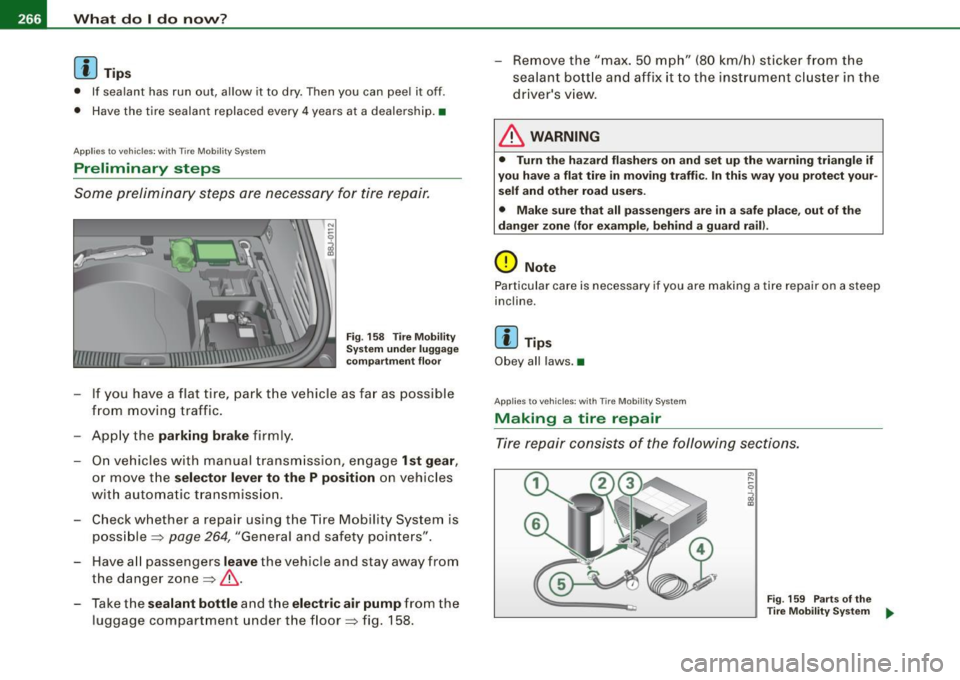
- If you have a flat tire, park the vehicle as far as possible
from moving t raffic.
- Apply the
parking brake firmly.
- On vehicles w ith manual transmission, engage
1st gear,
or move the selector lever to the P position on vehicles
w ith automat ic transmission.
- Check whether a repair using the Tire Mob ility System is
possible ~
page 264, "General and safety po inters".
Have all passengers
leave the vehicle and stay away from
the danger zone~& .
- Take the
sealant bottle and the electric air pump from the
luggage compartment under the floor~ fig. 158. - Remove the "max. 50 mph"
(80 km/h) sticker from the
sealant bottle and affix it to the instrument cluster in the
driver's view.
& WARNING
• Turn the hazard flashers on and set up the warning triangle if
you have a flat tire in moving traffic. In this way you protect your
self and other road users.
• Make sure that all passengers are in a safe place, out of the
danger zone (for example, behind a guard raill.
(D Note
Particular care is necessary if you are making a tire repair on a steep
inc line .
[ i J Tips
Obey all laws. •
App lies to ve hicles: w ith T ire Mob ility System
Mak ing a tire repa ir
Tire repair consists of the following sections.
Fig. 159 Parts of the
Tire Mobility System ..
Page 278 of 316

ffl.___F_ u_ s _ e_s _ a_n _ d_ b_ u_lb _ s _______________________________________________ _
Equipment No.
II Equipment
Amps I
Engine relay, fuel tank control unit, Airbag Off 16 A/C system (control unit) 10
1 light, light switch (switch illumination), diagnos-10
tic connector
17 Tire pressure monitoring system (control unit) 5
18 Not used
2 ABS, ASR, ESP, brake light switch 5
19
Not used
3 AFS headlight (left) 5 20
Not used
Oil level sensor (extended maintenance interval)
(WIVl, tire pressure monitoring system, switch
21 Fuel injectors (gasoline engine) 10
4 for Electronic Stability Program (ESP), AFS head-5 22 Wind deflector (Roadster) 30
lights (control unit), A/C system (pressure sen-23 Horn 20 llsorl, backup light switch
Automatic headlight range control, AFS head -
24 Transmission (control unit) 15
5
light (right)/ manual headlight range control, 5/10 25 Heater rear window Coupe/heated rear window 30/20
halogen headlights Roadster
Control unit for CAN data transfer (gateway),
26 Driver's side power window 30
6 electromechanical steering, automatic transmis-5 27 Passenger's side power window 30
sion shift gate
28 Not used
Acoustic Park Assist, automatic dipping interior
rear view mirror, garage door opener, heatable
29 Washer pump 15
7
windshield washer nozzles, washer pump, wind 5
30 Cigarette lighter 20
deflector relay (Roadster)
31 Starter 40
8
Haldex clutch 5 32 Steering column module 5
9
Control unit Audi magnetic ride 5 33
Instrument cluster 5
Airbag control unit 5 34 Radio navigation system, radio 15
1 1 Mass airflow sensor, crankcase heating 5/10
35
Audio amplifier 30
Door control unit (central locking driver/passen-12 10
36 Engine (control unit) 10 gerl
13 Diagnostic connector 10 37 CAN (Gateway) 5
Rain sensor, automatic transmission shift gate 5 38 Not used
15 Roof light (interior lighting) 5 39 Not
used
Page 280 of 316
.,,___F_ u_ s _ e_s _ a_n _ d_ b_ u_lb _ s _______________________________________________ _
No. Equipment Amps
8 Ignition coils (4
-cylinderl/ignition coils (6-cylin -
20/30
der)
9 Engine (control unitl 25
Water pump delayed-off 10
1 1 Feed (clutch pedal, brake pedal) 5
12
Activated charcoal filter/charge pressure con-10 trol valve (4-cylinder)
-' -
Bulbs
Replacing light bulbs
For your safety, we recommend that you have your autho
rized Audi dealer replace burned out bulbs for you.
It is becoming increasingly more and more difficult to replace
vehicle light bulbs since in many cases , other parts of the car must
first be removed before you are able to get to the bulb. This applies
especially to the light bulbs in the front of your car which you can
only reach through the engine compartment.
Sheet metal and bulb holders can have sharp edges that can cause
serious cuts, and parts must be correctly taken apart and then prop
erly put back together to help prevent breakage of parts and long
term damage from water that can enter housings that have not been properly resealed.
For your safety , we recommend that you have your authorized Audi
dealer replace any bulbs for you, since your dealer has the proper
tools, the correct bulbs and the expertise.
Gas discharge lamps (Xenon lights)*:
•
Due to the high electrical voltage, have the bulbs replaced by a qual
ified technician. Headlights with Xenon light can be identified by the
high voltage sticker .
& WARNING
Contact with high-voltage components of the electrical system
and improper replacement of gas discharge (Xenon) headlight
bulbs can cause serious personal injury and death .
• Xenon bulbs are pressurized and can explode when being
changed.
• Changing Xenon lamps requires the special training, instruc
tions and equipment .
• Only an authorized Audi dealer or other qualified workshop
should change the bulbs in gas discharge lamps.
& WARNING
There are parts with sharp edges on the openings and on the bulb holders that can cause serious cuts .
• If you are uncertain about what to do, have the work performed
by an authorized Audi dealer or other qualified workshop. Serious
personal injury may result from improperly performed work.
[ i] Tips
• If you must replace the light bulbs yourself, always remember
that the engine compartment of any vehicle is a hazardous area to
work in. Always read and heed all WARNINGS=>
page 209, "Engine
compartment"=>
/A .
• It is best to ask your authorized Audi dealer whenever you need
to change a bulb .•
Page 282 of 316

IIII...__E_ m _ e _r.;:g '-e_ n_ c-=y _ s_ i_t _u _a _t_ i_o _n_ s _______________________________________________ _
& WARNING (continued)
• Before you check anything in the engine compartment, always
read and heed all WARNINGS=>
page 209, "Engine compartment".
0 Note
• Applying a highe r voltage booste r battery will cause expensive
damage to sens itiv e electron ic components, such as control units,
relays , radio, etc.
• There must be no electrical contact between the vehicles as
otherwise current could already start to flow as soon as the positive
( + ) terminals are connected .
[ i ] Tips
The d ischarged battery must b e properly connected to the vehicle's
electrical system. •
Use of jumper cables
Make sure to connect the jumper cable clamps in exactly
the order described below!
Fig. 172 For jump
starting or charging
the battery, there is a
jump start connection
on the left side of the
engine compartment . Fig
. 173 Jump start
using the battery in
another vehicle: A -
Discharge, B- Female
socket
The procedure described below for connecting jumper
cables is intended to provide a jump start for your vehicle.
Preparatory measures
1. Do not jump start a frozen battery! Replace such a
battery!
2. Otherwise apply the hand brake and sh ift into idle gear if
your vehicle has manual transmission, and put the selector lever into P posit ion if your vehicle has auto
matic transmission.
3. For both vehicles switch off all consumers and the igni
tion.
Connecting/disconnecting the jumper cable.
4. Connect one end of the red jumper cable on the jump
start bolt G) => fig. 173 (Bolts under red cover= "posi
tive") of the vehicle to be started
@.
5. Connect the other end of the red jumper cable to the
positive terminal @ of the booster battery @.
6. Connect one end of the black jumper cable to the nega -
tive terminal @ of the booster battery @. _,,,
Page 284 of 316
IIIII...__E_ m _ e _r.;:g '-e_ n_ c-=y _ s_ i_t _u _a _t_ i_o _n_ s _______________________________________________ _
Emergency towing with commercial
tow truck
General hints
Your Audi requires special handling for towing.
The following information is to be used by commercial tow truck
operators who know how to operate their equipment safely.
• Never tow your Audi, towing will cause damage to the engine
and transmission.
• Never wrap the safety chains or winch cables around the brake
lines.
• To prevent unnecessary damage , your Audi must be transported
with a car carrier (flatbed truck).
• To load the vehicle on to the flat bed, use the towing loop found
in the vehicle tools and attach to the front or rear anchorage
~ page 282 and~ page 283.
& WARNING
A vehicle being towed is not safe for passengers. Never allow
anyone to ride in a vehicle being towed, for any reason. •
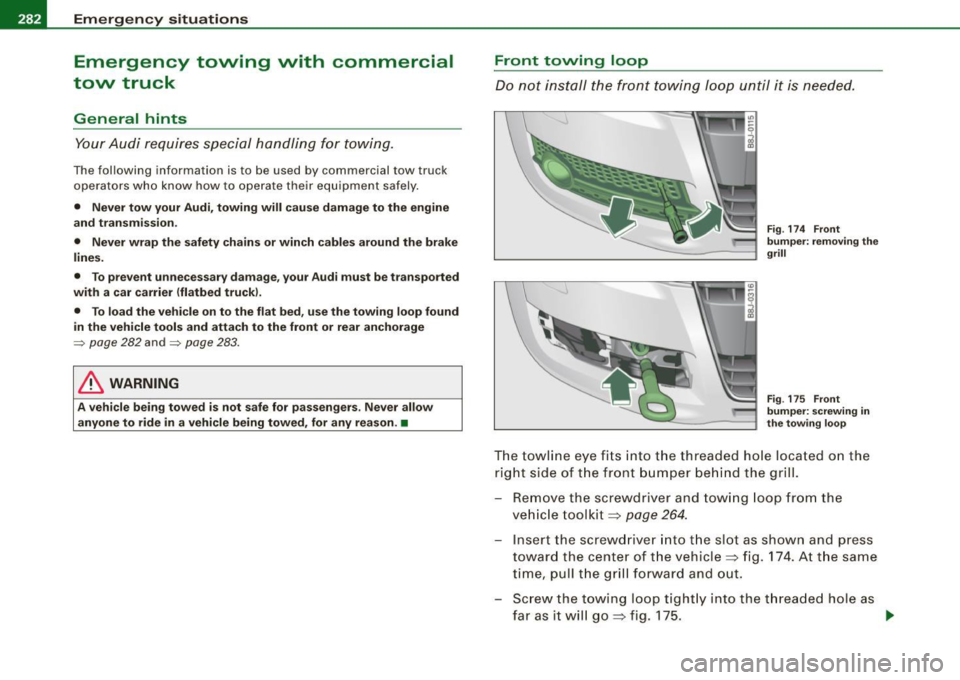
Front towing loop
Do not install the front towing loop until it is needed.
Fig. 174 Front
bumper: removing the
grill
Fig . 175 Front
bumper: screwing in
the towing loop
The towline eye fits into the threaded hole located on the
right side of the front bumper behind the grill.
- Remove the screwdriver and towing loop from the
vehicle toolkit =>
page 264.
-Insert the screwdriver into the slot as shown and press
toward the center of the vehicle=> fig. 174. At the same
time, pull the grill forward and out.
- Screw the towing loop tightly into the threaded hole as
far as it will go=> fig. 175. ..,
Page 297 of 316
__________________________________________________ C_o_ n _ s_u_ m_ e ___ r_l_ n _f_ o_ r _m...:....:.. a:.;..:. ti .... o:.. n ........ _lllll
& WARNING (continued)
• The engine compartment of any motor vehicle is a potentially
hazardous area. Never reach into the area around or touch the
radiator fan. It is temperature controlled and can switch on
suddenly -even when the engine is off and the ignition key has
been removed. The radiator fan switches on automatically when
the coolant reaches a certain temperature and will continue to run
until the coolant temperature drops .
• Always remove the ignition key before anyone gets under the
vehicle.
• Always support your vehicle with safety stands if it is neces
sary to work underneath the vehicle. The jack supplied with the
vehicle is not adequate for this purpose and could collapse
causing serious personal injury.
• If you must work underneath the vehicle with the wheels on
the ground, always make sure the vehicle is on level ground, that
the wheels are always securely blocked and that the engine
cannot be started .
• Always make sure the transmission selector lever (automatic
transmission) is in "P" (Park position) (automatic transmission) or
Neutral (manual transmission) and the hand brake is firmly
applied.
<£> For the sake of the environment
• Changing the engine settings will adversely affect emission
levels. This is detrimental to the environment and increases fuel
consumption .
• Always observe environmental regulations when disposing of
old engine oil, used brake fluid, dirty engine coolant, spent batteries
or worn out tires.
• Undeployed airbag modules and pretensioners might be classi
fied as Perchlorate Material -special handling may apply, see
www.dtsc.ca.gov/hazardouswaste/perchlorate . When the vehicle or
parts of the restraint system including airbag modules safety belts
Controls and equip ment Safety first Vehicle operation with pretensioners are scrapped, all applicable laws and regula
tions must be observed. Your authorized Audi dealer is familiar with
these requirements and we recommend that you have your dealer
perform this service for you. •
Additional accessories,
modifications and parts replacement
Additional accessories and parts
replacement
Always consult an authorized Audi dealer before
purchasing accessories.
Your vehicle incorporates the latest safety design features ensuring
a high standard of active and passive safety.
This safety could be compromised by non -approved changes to the
vehicle. For this reason, if parts have to be replaced, please observe
the following points when installing additional accessories:
Approved Audi accessories and genuine Audi parts are available
from authorized Audi dealers .
These dealers also have the necessary facilities, tools and trained specialists to install the parts and accessories properly .
& WARNING
Using the wrong spare parts or using non-approved accessories
can cause serious personal injury.
• Use only accessories expressly approved by Audi and genuine
Audi spare parts
• These parts and accessories have been specially designed to
be used on your vehicle.
• Never install accessories such as telephone cradles or
beverage holders on airbag covers or within the airbag deploy-
Vehicle care Do-it-yourself service Tec hn ica l da ta