lock AUDI TT COUPE 2009 Repair Manual
[x] Cancel search | Manufacturer: AUDI, Model Year: 2009, Model line: TT COUPE, Model: AUDI TT COUPE 2009Pages: 316, PDF Size: 71.16 MB
Page 215 of 316
Fuel supply and filling your fuel tank -------------=-=--=-------=:a....:.--------J
The labe l on the inside of the fuel filler flap tel ls you the correct fuel
fo r your vehicle . For mo re information about fuel specifications, see
~ page 271.
Your vehicle fuel tank has an on -board refuelling vapor recovery
sys tem. Th is feature helps to prevent fue l vapors from escapin g
from the tank and polluting the environment wh ile you refue l your
veh ic le . I n order to fill the tank properly while protecti ng the envi
ronment, please follow this refuel ing procedure carefully .
& WARNING
Under normal operating conditions , never carry additional fuel
c ontainers in your car . Ga s canister s and other containers used to
transport fuel can be dangerous . Such conta iners , full or empty,
may leak and could cause a fire in a collision . If you mu st transport
fuel to use for your lawn mower , snow blower , etc. , be very c areful
and always ob serve local and state laws regarding the u se , tran s
port ation and storage of su ch fuel containers . Make certain the
c ontainer meets industry standard s (ANSI/ASTM F852 · 86 1.
0 Note
Neve r drive yo ur vehicle un til the fue l tank is comp le tely d ry. The
irregular supp ly of fuel can cause misfiring . Gasoline could enter
int o t he exhaus t system and damage the cataly tic conver ter. •
Refuelling
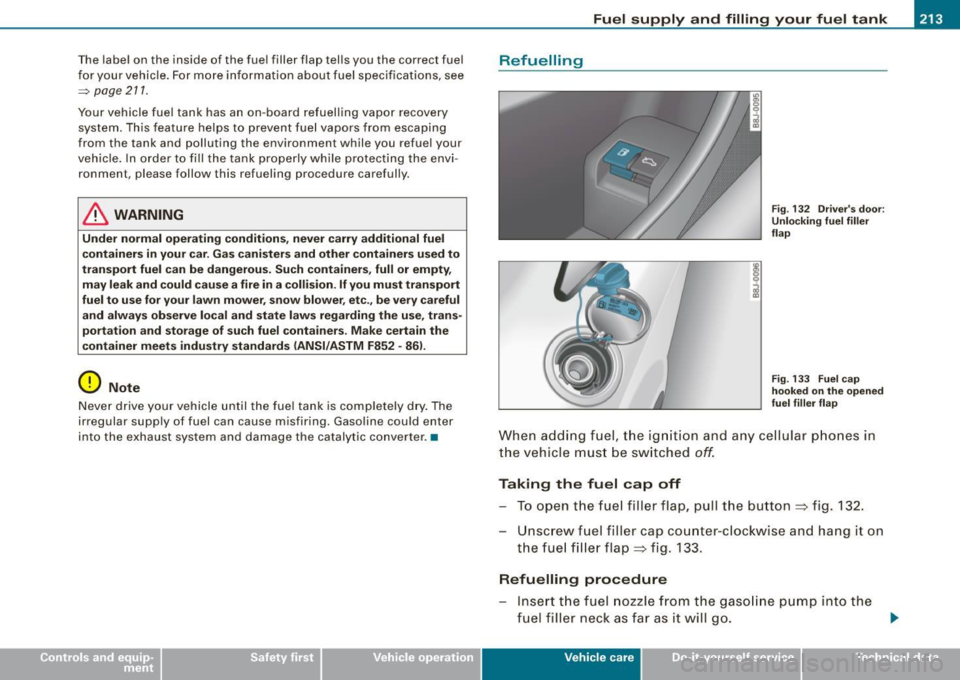
Fig . 13 2 Dri ver 's do or :
Unlo cking fuel filler
flap
Fi g. 133 Fuel c ap
ho oke d on th e opened
fu el fi ller flap
Wh en ad din g fu el, th e i gni tion and any cellul ar ph ones in
t h e v ehicl e mus t be sw itch ed
off.
Taking the fuel cap off
To o pen t he fue l fille r flap, pull the button=> fig. 132.
Unsc rew fuel filler c ap cou nter-c lockwise an d hang it on
t h e fue l fi ller flap => fig. 133 .
Refuelling procedure
Insert th e fuel nozzle from the ga solin e p ump into the
f u el fill er n eck as far as i t will go. ..,.
Vehicle care I I irechnical data
Page 216 of 316
Fuel supply and filling your fuel tank
-Select a medium refuelling rate so that the nozzle
switches off automatically when the tank is full.
Putting the fuel cap back on
-After filling your tank, twist the fuel filler cap clockwise
until you hear a defin ite click.
Close the fuel filler flap.
To avoid fuel spilling or evaporating from the fuel tank always close
fuel filler cap properly and completely. An improperly closed fuel
filler cap may also cause the MIL lamp=> page
24 to come on.
& WARNING
Improper refueling or handling of fuel can cause fire, explosion
and severe burns.
• Fuel is highly flammable and can cause severe burns and other
injuries.
• Failure to shut the engine off while refueling and/or to insert
the pump nozzle fully into the fuel filler neck could cause fuel to
spray out of filler neck or to overflow. Fuel spray and overflowing
fuel can cause a fire.
• Never use a cellular telephone while refueling. The electromag
netic radiation can cause sparks that can ignite fuel vapors and
cause a fire.
• Never get back into your vehicle while refueling. If in excep
tional circumstances you must get back in your vehicle while refu eling, make certain that you close the door and touch metal to
discharge static electricity before touching the filler nozzle again.
Static electricity can cause sparks that can ignite fuel vapors
released during refueling.
• Never smoke or have an open flame anywhere in or near your
vehicle when refueling or filling a portable fuel container.
& WARNING (continued)
• For your safety, we strongly recommend that you do not travel
with a portable fuel container in your vehicle. The container, full or
empty may leak and could cause a fire, especially in a crash .
• If, under exceptional circumstances, you must transport a
portable fuel container, please observe the following:
-Never fill a portable fuel container while it is anywhere in or
on the vehicle (for example, in the luggage compartment, or on
the trunk). Static electricity can build up while filling and can ignite fuel vapors causing a fire.
- Always place a portable fuel container on the ground before
filling.
- Always keep the filler nozzle completely inside the portable
container before and during filling.
- If filling a portable container made of metal, the filler nozzle
must always be in contact with the container. This will help
prevent static electricity from discharging and cause a fire.
- Never spill fuel inside the vehicle or luggage compartment.
Fuel vapors are highly flammable.
- Always observe local and state/provincial laws regarding the
use, storage and transportation of fuel containers
- Make certain the fuel container meets industry standards
(ANSI / ASTM F852-86).
Q) Note
If any fuel has spilled onto the car, it should be removed immedi
ately to prevent damage to the paint.
W For the sake of the environment
As soon as the correctly operated nozzle switches off automatically
for the first time, the tank is full . Do not try to add more fuel becaus e
fuel may spill out. In addition, the expansion space in the fuel tank .,,_
Page 217 of 316
Fuel supply and filling your fuel tank -------------=-=--=-------=:a....:.--------J
will be filled -causing the fuel to overflow when it becomes warm
and pollute the environment.
[ i J Tips
• Running your engine while refuelling may cause vapors to
escape or even fuel to spill out of the tank. This would then shut off
the fuel nozzle before the tank is full.
• Do not refuel your vehicle with the ignition switched on . The fuel
gauge may otherwise not indicate the correct fuel level after
refuelling. •
Unlocking the fuel filler flap by hand
You can open the fuel filler flap by hand if the power
locking system should fail.
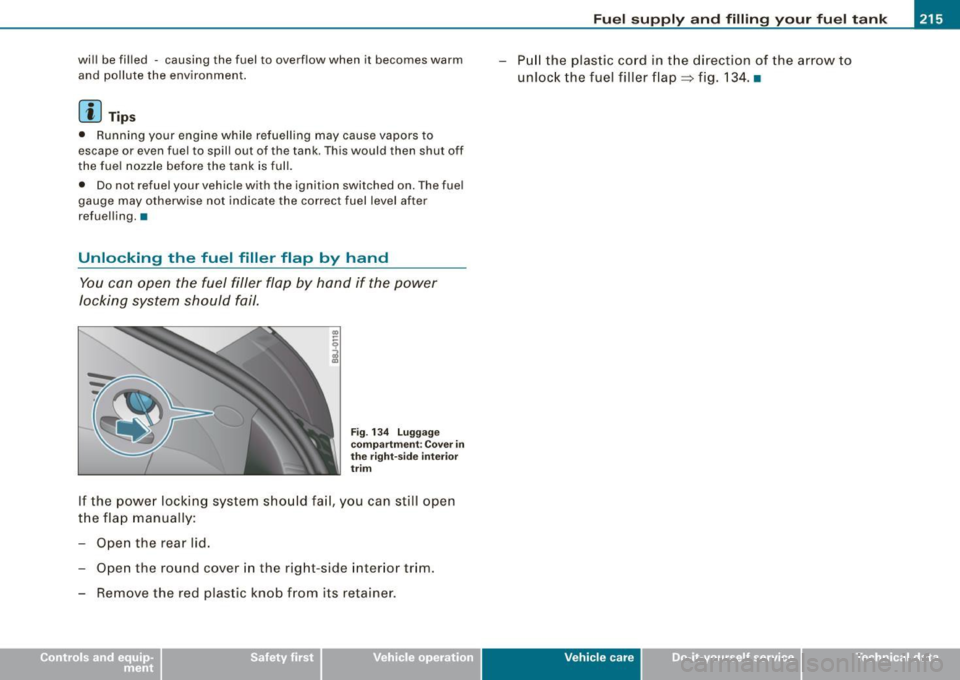
Fig . 134 Luggage
compartment : Cover in
the right-side interior
trim
If the power locking system should fail, you can still open
the flap manually:
- Open the rear lid.
- Open the round cover in the right-side interior trim.
- Remove the red plastic knob from its retainer. -
Pull the plastic cord in the direction of the arrow to
unlock the fuel filler flap=> fig. 134. •
Vehicle care I I irechnical data
Page 219 of 316

___________________________________________ C_ h_e _c_ k_ i_n _g _ a_n _d_ f_il _li _n _g __ fflllll
•
Closing the engine hood
- Pull the hood down until the pressure from the struts is
reduced .
- Let the hood
drop down and latch in place. Do not try to
push it shut;
it may fail to engage => &.
& WARNING
A hood that is not completely latched could fly up and block your
view while driving.
• When you close the engine hood, check it to make sure the
safety catch has properly engaged. The hood should be flush with
the surrounding vehicle body parts.
• If you notice while driving that the hood is not secured prop
erly, stop at once and close it. •
Working in the engine compartment
Be especially careful whenever you work in the engine
compartment!
Whenever you must perform any work in the engine compartment,
for example checking and filling the different fluids, there is a risk of injury, burns and accidents. To prevent personal injury always
observe the following WARNINGS. The engine compartment of any
vehicle is a hazardous area!
~ &
& WARNING
To help avoid injury, before you check anything under the hood :
• Switch off the engine.
• Remove the ignition key.
• Apply the parking brake .
& WARNING (continued)
• Move selector lever of automatic transmission to "P" (Park);
put manual transmission in Neutral .
• Always let the engine cool down. Hot components will burn
skin on contact.
• To reduce the risk of being burned, never open the hood if you
see or hear steam or coolant escaping from the engine compart
ment. Wait until no steam or coolant can be seen or heard before
carefully opening the hood .
• Keep children away from the engine compartment.
• Never spill fluids on hot engine components . They can cause a
fire.
• Never touch the radiator fan. The auxiliary electric fan is
temperature controlled and can switch on suddenly.
• Never open the coolant reservoir cap when the engine is still
warm. The coolant system is pressurized and hot coolant could
spray out.
• Protect your face, hands and arm from steam or hot engine
coolant by placing a thick rag over the cap when you open the
coolant reservoir.
• If work on the fuel system or the electrical system is necessary:
- Always disconnect the battery.
- Never smoke or work near heaters or open flames. Fluids in
the engine compartment could start a fire .
- Keep an approved fire extinguisher immediately available.
• To avoid electrical shock and personal injury while the engine
is running or being started, never touch :
- Ignition cables
- Other components of the high voltage electronic ignition
system.
• If you must perform a check or repair with the engine running: ..,
Vehicle care
I t •
Page 228 of 316
-~_C_ h_e _c _ k_ i_n ...:::g::;...._ a_n_ d_ f_ i_ll _in -'g:::;.._ ___________________________________________ _
-Pla ce a t hick ra g o ver the coola nt e xpansion tank
=>
page 225, fi g. 142 an d carefully tw ist the c ap counter
cl ockw ise=> &.
- Add coo lan t.
- Twist the cap on again
tightly .
Replacement engine coolant must conform to exact specifications
=>
page 224, "C oolant" . Even in an emerge ncy, if coo lant add it ive
G 12+ +, G 12+ or G12 is not availab le, do
not use a different additive.
Use p lain water instead until you ca n get the c orrec t addit ive and
can restore the correct ratio. This should be done as soon as possible.
If you have lost a considerable amount o f coo lant, then you should
add co ld antifreeze and cold water only when the engine is cold.
A lways use
new e ngine c oolan t when refil ling .
Do not fill coolant above the "MAX" mark. Excess coolant will be
forced ou t through the pressure relief va lve in the cap when the
engine becomes hot.
& WARNING
• The cooling sy stem is under pre ssure and can get very hot .
Reduce the risk of scalding from hot coolant by following these
s teps.
- Turn off the engine and allo w it to cool down .
- Protect your face, hands and arms from esc aping fluid and
steam by covering the cap with a large , thick rag .
- Turn the cap slo wly and very carefully in a counter -clockwise
dire ction while applying light , downward pressure on the top
of the cap .
- To avoid being burned, do not spill antifreeze or coolant on
the e xhaust system or hot engine parts . Under certain condi
tions, the ethylene glycol in engine coolant can catch fire .
& WARNING (continued )
• Antifreeze is poi sonous. Always store antifreeze in its original
container and well out of the re ach of children .
• If you drain the coolant , it must be caught and safely stored in
a proper container clearly marked "poison ".
0 Note
• Coo lant po llutes the environment and could cause an engine
fire. Excess coolant will be forced out through the pressure re lief
va lve in the cap when the engine becomes hot.
• If , in an eme rgency, o nly wa te r can be added, the correct rat io
between water and antifreeze=>
page 224 must be restored as soon
as possib le .
ffi For the sake of the environment
Drained coolant should not be reused. Always dispose of used
coo lant whi le observ ing all environmen tal regulat io n s. •
Radiator fan
The radi ator f an s witches on au tomati cally by itself.
T he e lectric radiator fan is control led bythe rmoswitches that switch
on and off depending on coolant and engine compartment temper
atures.
An auxiliary electric radiator fan* switches on and off depending on
coo la nt tempe rature a nd other veh ic le operati on cond itio ns.
After you switch the engine off, the aux iliary fan can continue
running for up to 10 m inutes -even with the ignition off. It can even
sw itch o n again later by itself=> & , if
• the temperature of the engine coo lant rises due to the heat
b ui ld-up fro m the eng ine in the eng ine co m partment, or
Page 230 of 316

-~_C_ h_e _c _ k_ i_n ...:::g::;...._ a_n_d _ f_ i_ll _in -'g:::;.._ ___________________________________________ _
& WARNING
• Bra ke fluid i s poiso nou s. It must be stor ed only in the clo se d
original container out of the rea ch of children!
• Bra ke failure can re sult from old or inappropri ate br ake fluid .
Ob serve the se pre cauti ons:
- Use o nly br ake fluid th at m eets S AE spe cific ation
J 1703 and
co nform s to Fed era l Mo tor Vehic le Standard 11 6. Alway s check
w ith your authori zed Aud i de aler to mak e sure y ou are usi ng
the correc t brake fluid. The corre ct type of brake flu id i s also
indica ted on the br ake fl uid re se rvoi r.
- The brake fluid mu st be new . Heavy u se of the brake s can
ca use a vapor lock if th e bra ke fluid is left in the system too
long. Thi s can seriou sly affect the effic iency of the brake s as
w ell as y our safet y. T his c ould re s u lt in an a ccident .
0 Note
Brake fluid wil l damage the paint of your vehicle .
~ For the sake of the environment
Because of the problem of proper disposal of brake fluid as well as
the special tools required and the necessary expertise, we recom
mend that you have the brake fluid changed by your authorized Audi
dea ler. •
Battery
General information
Your vehicle is equipped with a specia l battery, an AGM battery. This
ba ttery is loca ted in the luggage compar tment and must be
replaced with an original equipment battery. Under normal oper
ating conditions, the battery is
ma inten anc e-free .
Have the battery checked when you take your vehicle in for service .
You a re well advised to replace a battery that is o lder than 5 years .
Disconn ecting th e batt ery te rmin als
Some vehicle functions (power w indow regulators, for example) are
lost if the battery terminals are disconnected. These functions have
to be relearned after the battery terminals are connected again. To prevent this, the battery should only be disconnected from the
vehic le electrical sys tem when abso lutely necessary for repairs .
Vehi cles not dri ven for lo ng p eriods
If you are going to let your vehic le stand for a long time and n ot
drive it, you should remember there are e lectrica l components
whic h are still functioning and they will draw energy from the
battery and drain it, for example, the engine immobilizer. To prevent
t his, you can eithe r charge the batte ry occasionally to keep it in
good working condition or you can disconnect the negative cable
on the battery.
W int er op erati on
During the winter months, batte ry capacity tends to decrease as
temperatures drop . This is because more power is also consumed
whi le starting, and the headlights, rear window defogger, etc ., are
used more often.
Avoid unnecessary power consumption, particularly in city traffic or
when trave ling o nly short distances . Let your authorized Audi dealer
check the capacity of the vehicle battery before winter sets in
~ page 232. A we ll charged battery will not only preven t starting
problems when the weather is cold, but will also last longer.
Repla cing batter y
The new battery must hav e the same capacity, voltage ( 12 volts),
amperage, construction and p lug sea ling, as the orig inal battery .
Specifications are listed on the battery housing. Batteries specia lly
developed by Aud i fulfill the main tenance, output, and safe ty
requirements. ...,
Page 243 of 316
__________________________________________________ T_ ir_e_ s_ a_ n_d _ w_ h_ e_ e_l_s __ _
•
& WARNING (continued)
• Incorrect tire pressures and/or underinflation cause increased
tire wear and can affect the handling of the vehicle.
• Incorrect tire pressures and/or underinflation can also lead to
sudden tire failure, including a blowout and sudden deflation,
causing loss of vehicle control. •
Checking tire pressure
The correct tire pressure for the tires originally installed
on your vehicle is listed on the tire pressure label located
on driver's side 8-pillar.
The recommended tire pressures are on the tire pressure label and
in the table=>
page 238, "Cold tire inflation pressure". This means
that the pressure must be checked and adjusted when the tire has
not been driven for more than a couple of miles (kilometers) at low
speeds during the previous three hours. Air in the tires expands
when the tire heats up as a result of internal friction as it flexes in
use. The tire pressure is higher when the tire has warmed up than
when it is "cold."
It is the inflation pressure in a "cold" tire that counts. Therefore, you
should never let air out of a warm tire to match "Cold tire inflation
pressure" recommendations =>
page 238. The tires would then be
underinflated and could fail suddenly.
The tire pressure label on your Audi lists the recommended cold tire
inflation pressures for the new, original equipment tires that were
on your vehicle at the time it was manufactured . For the location of
the label =>
page 238, fig. 148.
Most tires lose air naturally over time. They can also lose some air if
you drive over a pothole or hit a curb while parking. It is usually not
possible to see whether the radial tires used today are underinflated
just by looking at them. Therefore,
be sure to check tire pressures at least once a month and
always before going on a long trip. Make sure to take the number of
people and the amount of luggage into account when adjusting tire
pressure for a trip -even one that you would not consider to be
"long." See=>
page 242, "Tires and vehicle load limits" for more
important information.
Always use an accurate tire pressure gauge when checking and adjusting inflation pressures . Check all of the tires and be sure not
to forget the spare tire. If the pressure in any tire is too high when
the tire is "cold," let air out of the tire slowly with the edge of the tire
gauge and keep checking the pressure until you reach the pressure
that is correct for the load (passengers and luggage) and kind of driving you plan to do.
If the pressure in any tire is too low, note the difference between the
pressure in the cold tire and the pressure you need and add the air
that you need to reach the correct pressure for the vehicle load
(passengers and luggage) for the tires on your vehicle as listed on
the on your vehicle and in this manual and the kind of driving you
plan to do.
Never exceed the maximum inflation pressure listed on the tire
sidewall for any reason.
Remember that the vehicle manufacturer, not the tire manufacturer,
determines the correct tire pressure for the tires on your vehicle.
It is important to check the tire pressure when the tires are cold.
• Read the required tire pressure from the tire pressure label
located on driver's side 8-pillar.
• Turn the valve stem cap counter -clockwise to remove it from the
tire valve.
• Place the air pressure gauge on the valve.
• The tire pressures should only be checked and adjusted when
the tires are cold. The slightly raised pressures of warm tires must
not be reduced.
• Adjust the tire pressure to the load you are carrying.
• Reinstall the valve stem cap on the valve.
Vehicle care I t •
Page 253 of 316
Tires and wheels -
----------------
•
Winter tires (snow tires) must a lways be fitted o n all four whee ls.
C om patible ti re p ressu re monito rin g sen so rs must be instal led on
a ll four wint er tires for the tire pr essure mon itor ing system* to func
tion proper ly =>
page 24 8.
As k you r auth orize d Aud i deal er or qua lifie d wo rksho p for per mitte d
winter tire sizes . Use only radial winter tires.
W in te r t ires lose the ir effec tive ness when the t read i s w or n do wn to
a depth of 0. 157 inch (4 mm).
On ly dr ive with w inter tires under winter conditions. Summer tires
h and le be tter when the re is no s now o r ice o n the roads and t he
temperature is above 45 °F (7 °C).
I f yo u have a flat t ire, see n otes on spa re w heel =>
page 246 .
Please a lwa ys reme mbe r tha t w inte r tires may h ave a lowe r speed
rating than the tires origi nally instal led on you r vehic le at t he time
i t was manu fac tur ed. P leas e se e=>
page 247, "S pee d rati ng (lett er
code)" for a list ing of the speed rating lette r codes and the
m axi mu m speed at w hich th e tire s ca n be dr ive n.
T he speed rating letter code(=>
page 237) is on the side wa ll of the
t ir e =>
page 246.
& WARNING
Winter tires have maximum speed limits that may be lower than
your vehicle's maximum speed . Always know the maximum speed
before driving off . Never drive faster than the speed permitted for
your specific winter tires . This will cause damage to the tires
leading to an accident and serious personal injury to you and your
passengers .
& WARNING
Driving faster than the maximum speed for which the winter tires
on your vehicle were designed can cause tire failure including a
blowout and sudden deflation , loss of control , crashes and serious
& WARNING (continued )
personal injuries . Have worn or damaged tires replaced immed i
ately.
• Winter tires have maximum speed rating that may be lower
than your vehicle' s maximum speed.
• Never drive faster than the speed for which the winter or other
tires installed on your vehicle are rated .
& WARNING
Always adjust your driving to the road and traffi c conditions .
Never let the good acceleration of the winter tires and all -wheel
drive tempt you into taking extra risks. Always remember :
• When braking, an all -wheel drive vehicle handles in the same
way as a front drive vehicle .
• Drive carefully and reduce your speed on icy and slippery roads,
even winter tires cannot help under black ice conditions .
ci' For the sake of the environment
Use summer tires when weather conditions permit. They are
q ui ete r, d o not wear as quickl y a nd re duc e fu el cons ump tion. •
Snow chains
Sno w chains may be fitted o nly to t he fro nt whe els, a nd o nly to
certain tire sizes . Ask your authorized Audi dealer on which tire
s iz es sn ow c hain s ca n be use d.
I f you are going to use snow chains, then you must install them on
the front wheels at least .
The s now chains must have l ow- pro file links a nd must n ot be thick er
than 0.53 inc h (13.5 mm), including the lock . .,_
Vehicle care I t •
Page 266 of 316
-L~W~h~a~t:_:d~o~I ~d~o~n~o~vv~? __________________________________________ _
What do I do now?
Vehicle tool kit
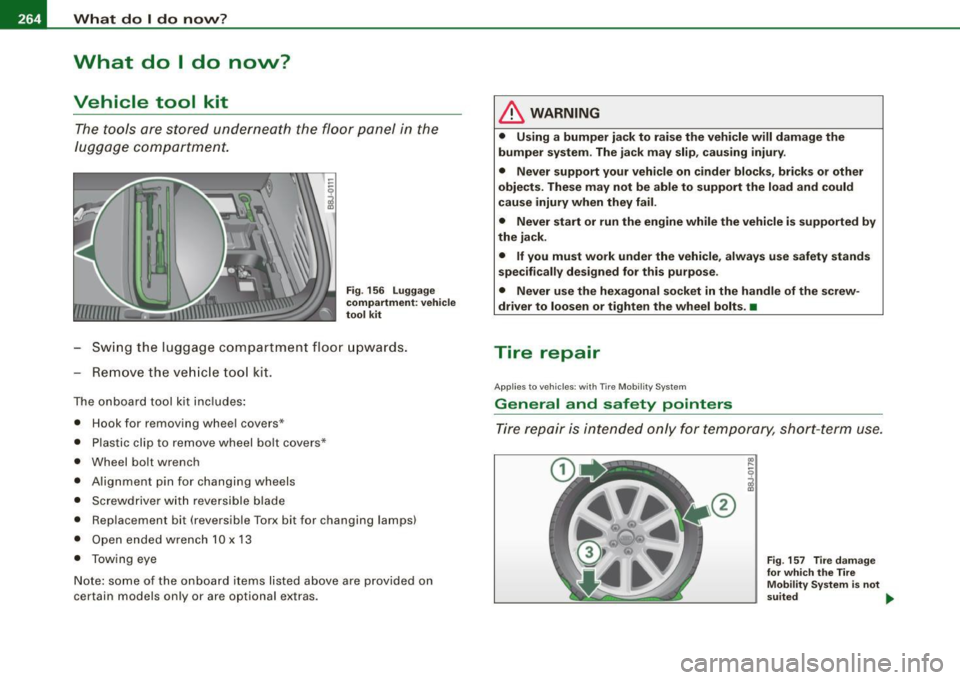
The tools are stored underneath the floor panel in the
luggage compartment.
-5
i
Fig. 156 Luggage
compartment: vehicle
tool kit
Swing the luggage compartment floor upwards.
- Remove the vehicle tool kit.
The onboard tool kit includes:
• Hook for removing wheel covers*
• Plastic clip to remove wheel bolt covers*
• Wheel bolt wrench
• Alignment pin for changing wheels
• Screwdriver with reversible blade
• Replacement bit (reversible Torx bit for changing lamps)
• Open ended wrench 10 x 13
• Towing eye
Note: some of the on board items listed above are provided on
certain models only or are optional extras.
& WARNING
• Using a bumper jack to raise the vehicle will damage the
bumper system. The jack may slip, causing injury .
• Never support your vehicle on cinder blocks, bricks or other
objects. These may not be able to support the load and could
cause injury when they fail.
• Never start or run the engine while the vehicle is supported by
the jack.
• If you must work under the vehicle, always use safety stands
specifically designed for this purpose .
• Never use the hexagonal socket in the handle of the screw
driver to loosen or tighten the wheel bolts . •
Tire repair
Appl ies to vehicles: with T ire Mob ili ty System
Gen eral and safety pointers
Tire repair is intended only for temporary, short-term use.
®
Fig. 157 Tire damage
for which the Tire
Mobility System is not
suited ...
Page 272 of 316
1111...__W_ h_ a _ t_d_ o_ l _d _o_ n_ o_ vv_ ? ______________________________________________ _
Loosening and tightening the wheel bolts
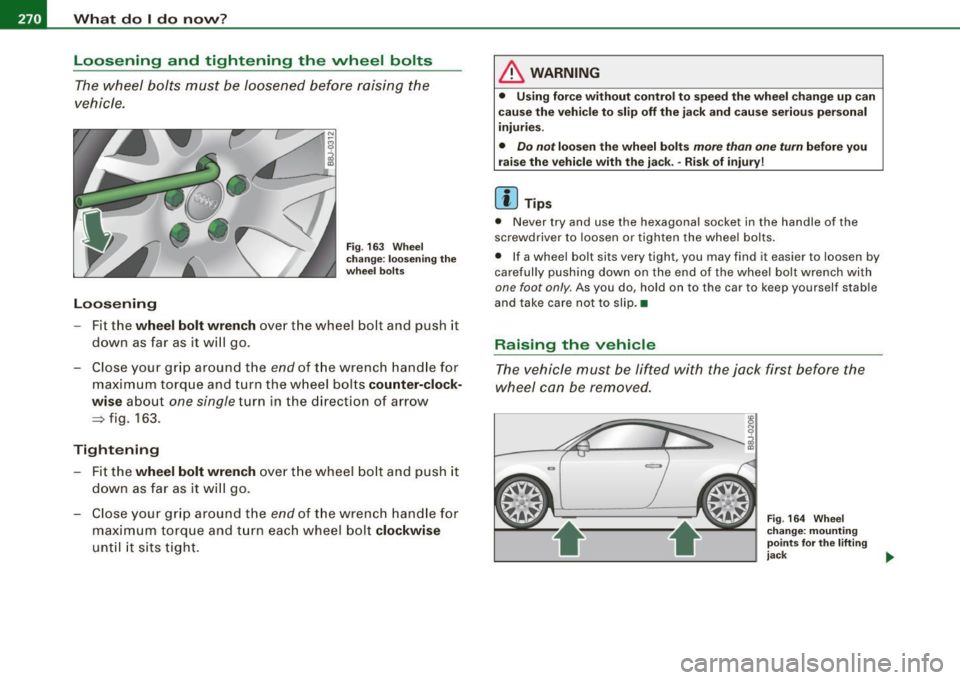
The wheel bolts must be loosened before raising the
vehicle.
Loosening
Fig . 163 Wheel
change: loosening the
wheel bolts
- Fit the wheel bolt wrench over the wheel bolt and push it
down as far as it will go .
- Close your grip around the
end of the wrench handle for
maximum torque and turn the wheel bolts
counter-clock
wise
about one single turn in the direction of arrow
~ fig. 163.
Tightening
Fit the wheel bolt wrench over the wheel bolt and push it
down as far as it will go.
- Close your grip around the
end of the wrench handle for
maximum torque and turn each wheel bolt
clockwise
until it sits tight.
& WARNING
• Using force without control to speed the wheel change up can
cause the vehicle to slip off the jack and cause serious personal
injuries.
• Do not loosen the wheel bolts more than one turn before you
raise the vehicle with the jack. -Risk of injury!
[ i] Tips
• Never try and use the hexagonal socket in the handle of the
screwdriver to loosen or tighten the wheel bolts.
• If a wheel bolt sits very tight, you may find it easier to loosen by
carefully pushing down on the end of the wheel bolt wrench with
one foot only . As you do, hold on to the car to keep yourself stable
and take care not to slip.•
Raising the vehicle
The vehicle must be lifted with the jack first before the
wheel can be removed.
Fig. 164 Wheel
change: mounting
points
for the lifting
jack ..