light AUDI TT COUPE 2014 Owners Manual
[x] Cancel search | Manufacturer: AUDI, Model Year: 2014, Model line: TT COUPE, Model: AUDI TT COUPE 2014Pages: 284, PDF Size: 34.42 MB
Page 227 of 284
Downloaded from www.Manualslib.com manuals search engine 0
N
co
....
\D Lfl
N
Lfl
.... Coolant
addi-Frost protec-
tive tion
Countries with min. 40 %,
min. -25 °C
warm climate max. 45 %
Countries with min.
50 %,
max. -40 °C
cold climate max.
60 %
CD CAUTION
- Have your qualified workshop check the
cooling system before the winter season to
make sure that the anti-freeze concentra
tion is adequate for the conditions to be ex
pected. This applies particularly if you drive
into a colder climate zone.
- To prevent damage to the engine, do not
use a different type of anti-freeze additive if
the approved type of additive is not availa
ble. In this case use only water and bring
the coolant concentration back up to the
correct level as soon as possible by putting
in the specified additive.
- Always top up with fresh, unused coolant.
- Radiator sealants must not be added to the
coolant.
Topping up coolant
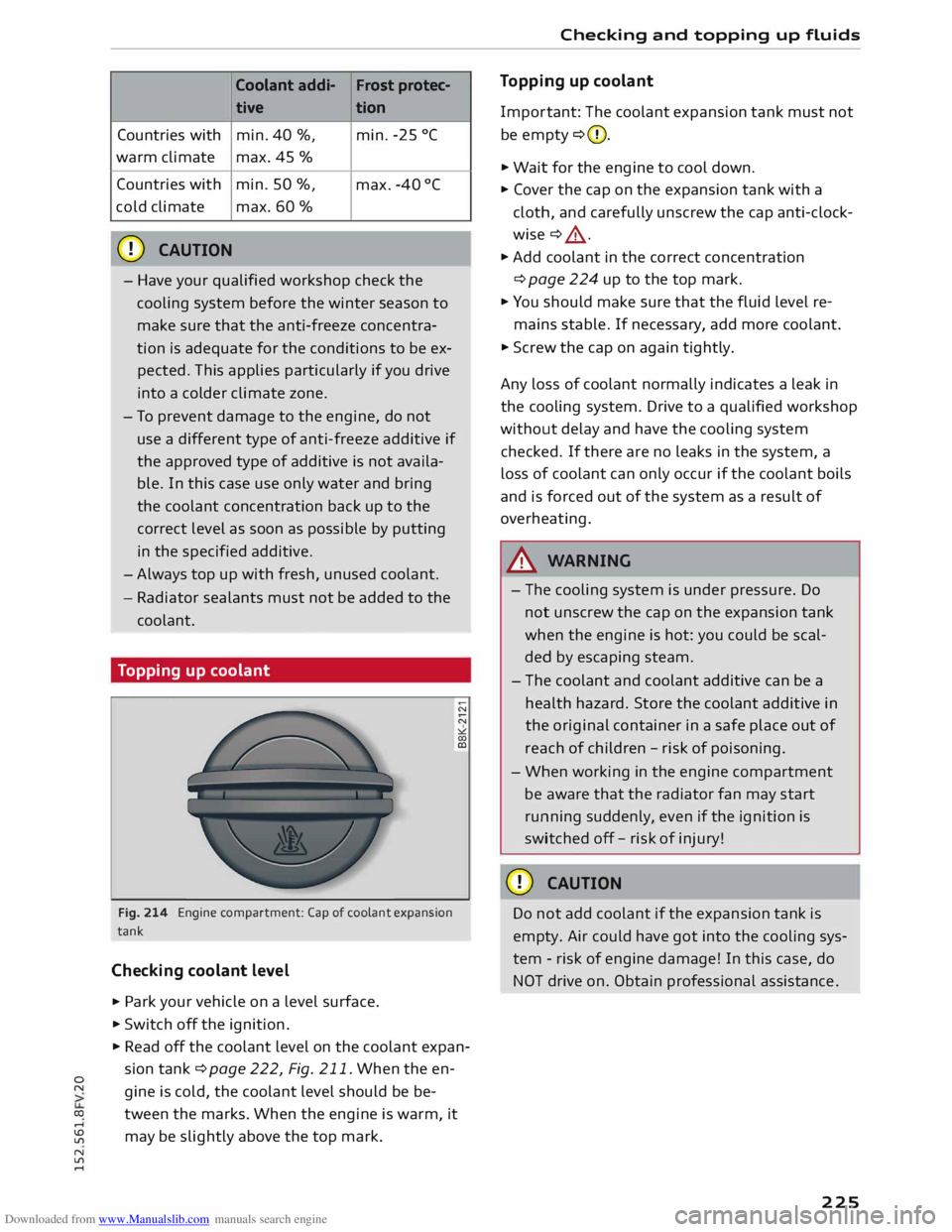
Fig. 214 Engine compartment: Cap of coolant expansion
tank
Checking coolant level
.. Park
your vehicle on a level surface .
.. Switch off the ignition .
.. Read off the coolant level on the coolant expan
sion tank ¢ page 222, Fig. 211. When the en
gine is cold, the coolant level should be be
tween the marks. When the engine is warm, it
may be slightly above the top mark. Checking
and topping up fluids
Topping up coolant
Impor tant: The coolant expansion tank must not
be empty ¢(D.
.. Wait for the engine to cool down.
.. Cover the cap on the expansion tank with a
cloth, and carefully unscrew the cap anti-clock
wise ¢ .&_ .
.. Add coolant in the correct concentration
¢ page 224 up to the top mark.
.. You should make sure that the fluid level re-
mains stable. If necessary, add more coolant.
.. Screw the cap on again tightly.
Any loss of coolant normally indicates a leak in
the cooling system. Drive to a qualified workshop
without delay and have the cooling system
checked. If there are no leaks in the system, a
loss of coolant can only occur if the coolant boils
and is forced out of the system as a result of
overheating.
A WARNING
- The cooling system is under pressure. Do
not unscrew the cap on the expansion tank
when the engine is hot: you could be scal
ded by escaping steam.
- The coolant and coolant additive can be a
health hazard. Store the coolant additive in
the original container in a safe place out of
reach of children -risk of poisoning.
- When working in the engine compartment
be aware that the radiator fan may start
running suddenly, even if the ignition is
switched off-risk of injury!
CD CAUTION
Do not add coolant if the expansion tank is
empty. Air could have got into the cooling sys
tem -risk of engine damage! In this case, do
NOT drive on. Obtain professional assistance .
225
Page 228 of 284
Downloaded from www.Manualslib.com manuals search engine Checking
and topping up fluids
Brake fluid
&
8cm DOT 4 0
0
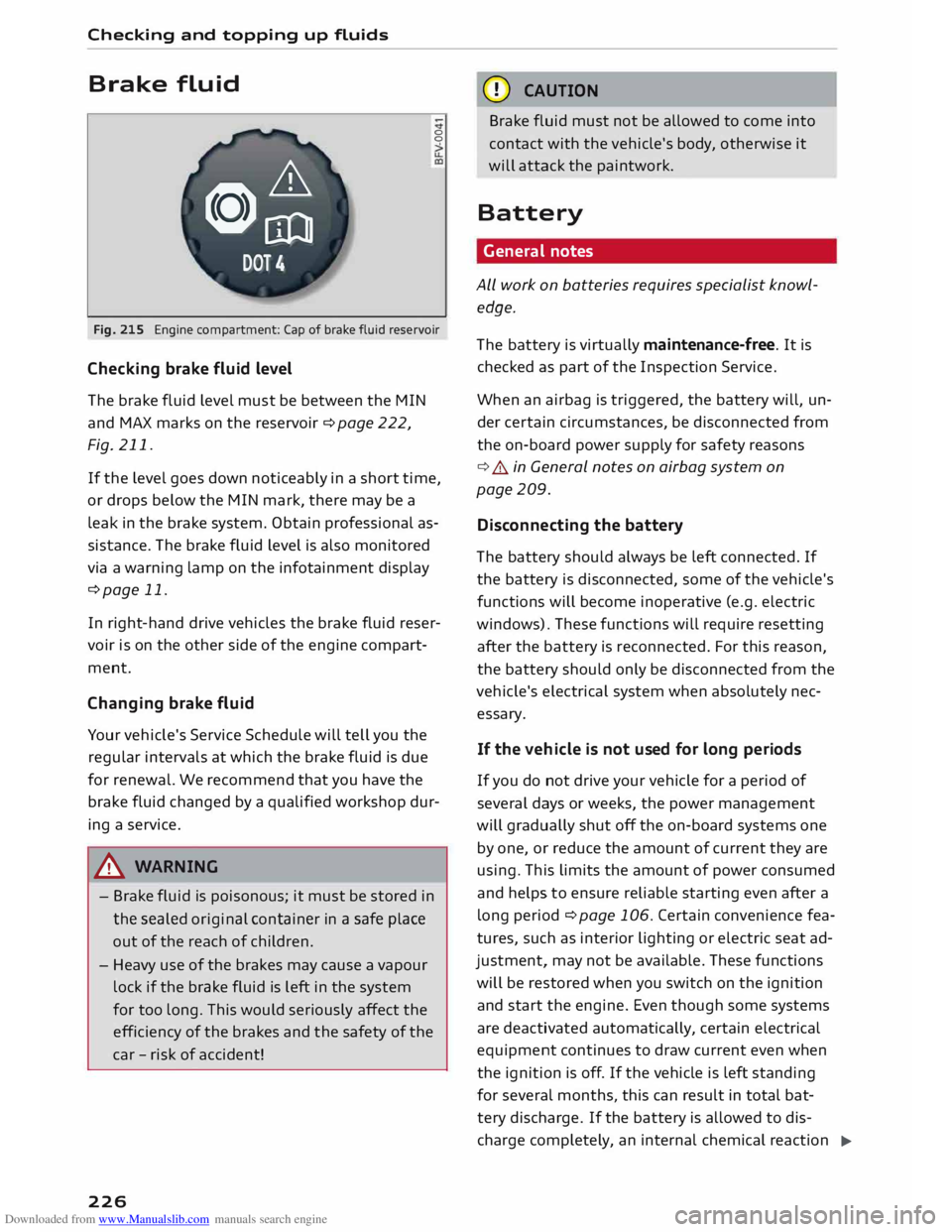
Fig. 215 Engine compartment: Cap of brake fluid reservoir
Checking brake fluid level
The brake fluid Level must be between the MIN
and MAX marks on the reservoir ¢ page 222,
Fig. 211.
If the Level goes down noticeably in a short time,
or drops below the MIN mark, there may be a
Leak in the brake system. Obtain professional as
sistance. The brake fluid Level is also monitored
via a warning Lamp on the infotainment display
¢page 11.
In right-hand drive vehicles the brake fluid reser
voir is on the other side of the engine compart
ment.
Changing brake fluid
Your vehicle's Service Schedule will tell you the
regular intervals at which the brake fluid is due
for renewal. We recommend that you have the
brake fluid changed by a qualified workshop dur
ing a service.
A WARNING
- Brake fluid is poisonous; it must be stored in
the sealed original container in a safe place
out of the reach of children.
- Heavy use of the brakes may cause a vapour
Lock if the brake fluid is left in the system
for too Long. This would seriously affect the
efficiency of the brakes and the safety of the
car -risk of accident!
226 CD
CAUTION
Brake fluid must not be allowed to come into
contact with the vehicle's body, otherwise it
will attack the paintwork.
Battery General notes
ALL work on batteries requires specialist knowl
edge.
The battery is virtually maintenance-free. It is
checked as part of the Inspection Service.
When an airbag is triggered, the battery will, un
der certain circumstances, be disconnected from
the on-board power supply for safety reasons
¢ .&.. in General notes on airbag system on
page 209.
Disconnecting the battery
The battery should always be Left connected. If
the battery is disconnected, some of the vehicle's
functions will become inoperative (e.g. electric
windows). These functions will require resetting
after the battery is reconnected. For this reason,
the battery should only be disconnected from the
vehicle's electrical system when absolutely nec
essary.
If the vehi cle is not used for long periods
If you do not drive your vehicle for a period of
several days or weeks, the power management
will gradually shut off the on-board systems one
by one, or reduce the amount of current they are
using. This Limits the amount of power consumed
and helps to ensure reliable starting even after a
Long period ¢ page 106. Certain convenience fea
tures, such as interior Lighting or electric seat ad
justment, may not be available. These functions
will be restored when you switch on the ignition
and start the engine. Even though some systems
are deactivated automatically, certain electrical
equipment continues to draw current even when
the ignition is off. If the vehicle is Left standing
for several months, this can result in total bat-
tery discharge. If the battery is allowed to dis
charge completely, an internal chemical reaction
..,_
Page 229 of 284
Downloaded from www.Manualslib.com manuals search engine 0
N
co
....
\D Lfl
N
Lfl
.... destroys
the battery. To avoid this, the battery
should be recharged at least once a month
¢ page 228. Do not disconnect the battery; oth
erwise the anti-theft alarm system* will be out of
operation.
Winter conditions The battery is drained more in cold weather,
which means that the starting power is reduced.
For this reason, have the battery checked and
charged if necessary before the start of winter.
A WARNING
-
-All work on batteries requires specialist
knowledge. For queries regarding the vehi
cle battery please seek the assistance of a
qualified workshop -risk of chemical
burns / risk of explosion!
- The battery must not be opened. Do not at
tempt to make any changes to the electro
lyte level of the battery. Otherwise, there is
a risk that a mixture of oxygen and hydrog en
gas can accumulate and cause an explosion.
Important safety warnings for handling a
car battery
All work on batteries requires specialist knowl
edge.
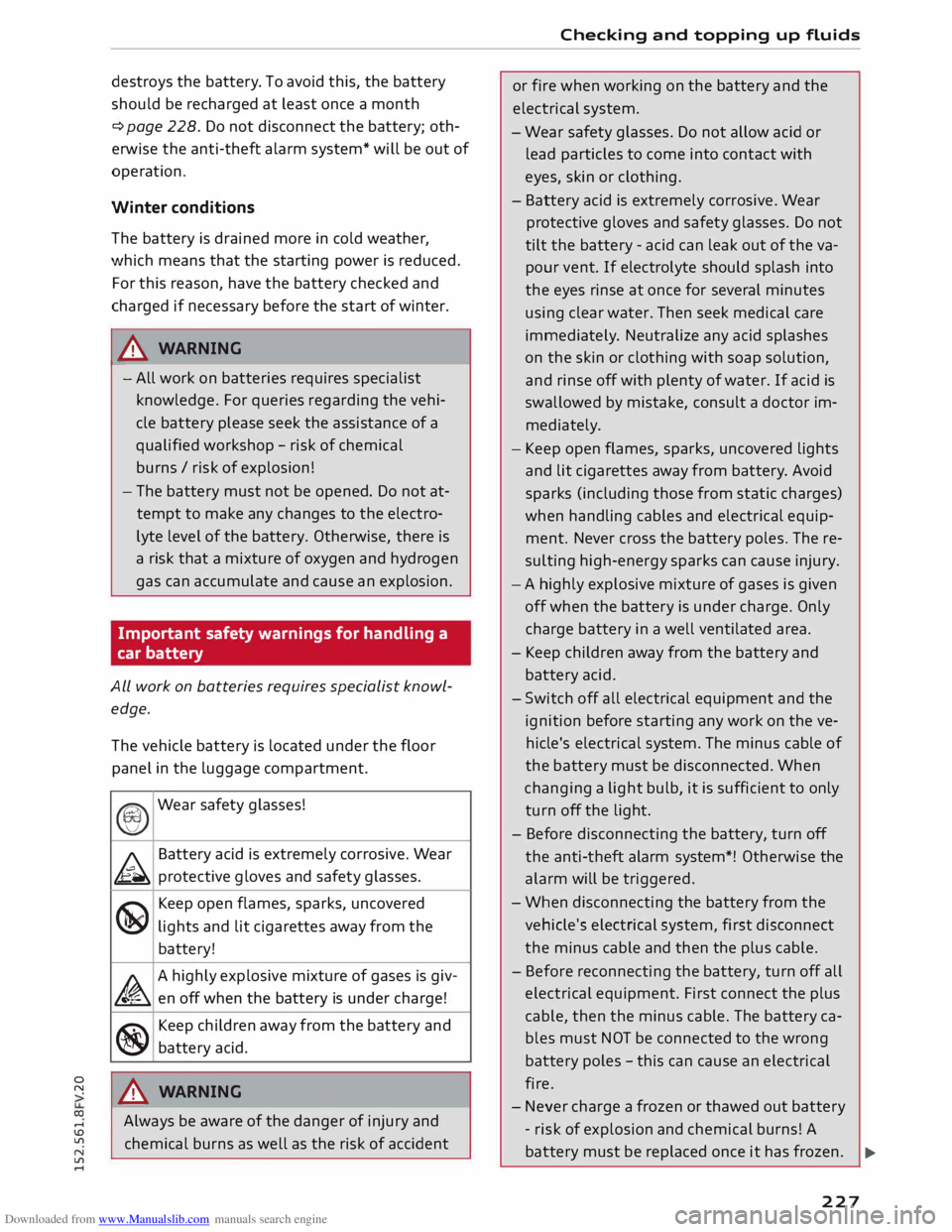
The vehicle battery is located under the floor
panel in the luggage compartment.
® Wear
safety glasses!
A Battery
acid is extremely corrosive. Wear
protective gloves and safety glasses.
@ Keep
open flames, sparks, uncovered
lights and lit cigarettes away from the
battery!
� A
highly explosive mixture of gases is giv-
en off when the battery is under charge!
® Keep
children away from the battery and
battery acid.
A WARNING
Always be aware of the danger of injury and
chemical burns as well as the risk of accident Checking
and topping up fluids
or fire when working on the battery and the
electrical system.
- Wear safety glasses. Do not allow acid or
lead particles to come into contact with
eyes, skin or clothing.
- Battery acid is extremely corrosive. Wear
protective gloves and safety glasses. Do not
tilt the battery -acid can leak out of the va
pour vent. If electrolyte should splash into
the eyes rinse at once for several minutes
using clear water. Then seek medical care
immediately. Neutralize any acid splashes
on the skin or clothing with soap solution,
and rinse off with plenty of water. If acid is
swallowed by mistake, consult a doctor im
mediately.
- Keep open flames, sparks, uncovered lights
and lit cigarettes away from battery. Avoid
sparks (including those from static charges)
when handling cables and electrical equip
ment. Never cross the battery poles. The re
sulting high-energy sparks can cause injury.
-A highly explosive mixture of gases is given
off when the battery is under charge. Only
charge battery in a well ventilated area.
- Keep children away from the battery and
battery acid.
- Switch off all electrical equipment and the
ignition before starting any work on the ve
hicle's electrical system. The minus cable of
the battery must be disconnected. When
changing a light bulb, it is sufficient to only
turn off the light.
- Before disconnecting the battery, turn off
the anti-theft alarm system*! Otherwise the
alarm will be triggered.
- When disconnecting the battery from the
vehicle's electrical system, first disconnect
the minus cable and then the plus cable.
- Before reconnecting the battery, turn off all
electrical equipment. First connect the plus
cable, then the minus cable. The battery ca
bles must NOT be connected to the wrong
battery poles -this can cause an electrical
fire.
- Never charge a frozen or thawed out battery
- risk of explosion and chemical burns! A
battery must be replaced once it has frozen.
..,..
227
Page 230 of 284
Downloaded from www.Manualslib.com manuals search engine Checking
and topping up fluids
When it is discharged the battery can freeze
at temperatures around 0°
(.
- Make sure that the vapour hose is always at
tached to the battery.
- Never use a damaged battery -risk of explo
sion! Replace a damaged battery immedi
ately.
- Never disconnect the car's battery with the
engine running or with the ignition turned
on, otherwise the electrical system or elec
trical components will be damaged.
- Do not expose the battery to direct sunlight
over a Long period of time, as the intense ul
traviolet radiation can affect the battery
housing.
- If the car is Left standing for Long periods,
protect the battery from frost. The battery
will be destroyed if it is allowed to freeze
¢page 228.
- When the doors are opened the windows
are automatically lowered by approximately
10 mm. This function is not available if the
battery is disconnected, and the door seal
and window may be damaged as a result.
Charging the battery
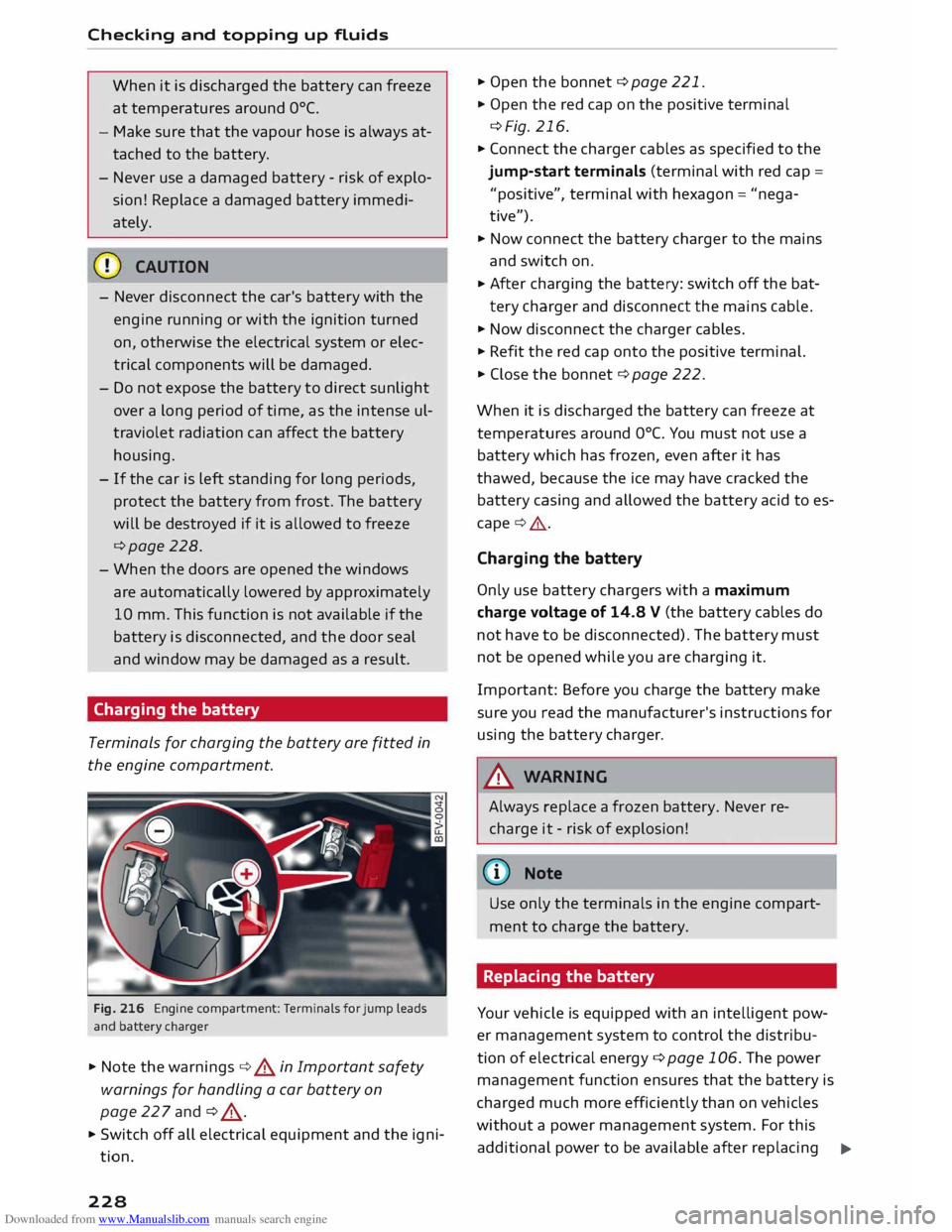
Terminals for charging the battery are fitted in
the engine compartment.
Fig. 216 Engine compartment: Terminals for jump leads
and battery charger
... Note the warnings ¢.&. in Important safety
warnings for handling a car battery on
page 227 and r=;, ,&..
... Switch off all electrical equipment and the igni
tion.
228 ...
Open the bonnet ¢page 221.
... Open the red cap on the positive terminal
¢Fig. 216.
... Connect the charger cables as specified to the
jump-start terminals (terminal with red cap=
"positive", terminal with hexagon = "nega
tive").
... Now connect the battery charger to the mains
and switch on .
... After
charging the battery: switch off the bat-
tery charger and disconnect the mains cable.
... Now disconnect the charger cables.
... Refit the red cap onto the positive terminal.
... Close the bonnet r=;,page 222.
When it is discharged the battery can freeze at
temperatures around 0°
C. You must not use a
battery which has frozen, even after it has
thawed, because the ice may have cracked the
battery casing and allowed the battery acid to es
cape r=;,.&..
Charging the battery
Only use battery chargers with a maximum
charge voltage of 14.8 V (the battery cables do
not have to be disconnected). The battery must
not be opened while you are charging it.
Important: Before you charge the battery make
sure you read the manufacturer's instructions for
using the battery charger.
.&_ WARNING
Always replace a frozen battery. Never re
charge it -risk of explosion!
{D Note
Use only the terminals in the engine compart
ment to charge the battery.
Replacing the battery
Your vehicle is equipped with an intelligent pow-
er management system to control the distribu-
tion of electrical energy r=;, page 106. The power
management function ensures that the battery is
charged much more efficiently than on vehicles
without a power management system. For this
additional power to be available after replacing
.,.
Page 231 of 284
Downloaded from www.Manualslib.com manuals search engine 0
N
co
....
\D L/'l
N
L/'l
.... the
battery, we recommend that the replacement
battery used is of the same make and type as the
original-equipment battery. After changing the
battery, the power management system must be
initialised by a qualified workshop to ensure that
the replacement battery is charged to an opti
mum level.
A replacement battery must have the same ca
pacity, voltage (12 V) and current rating. It must
also have the same dimensions as the original,
factory-fitted battery and have sealed caps. The
battery must comply with the standards
TL 825 06 (dated April 2008 or later) and
VW 7 50 73 (April 2010 or later).
Since the battery is difficult to access, we recom
mend having it replaced by an Audi dealer or
qualified workshop.
CD CAUTION
- Your vehicle is equipped with a special deep
cycle battery (e.g. AGM type). The on-board
electronic systems may develop problems if
you fit a different type of battery. For this
reason, if you need to replace the vehicle
battery, make sure that the specifications of
the new battery match the original exactly.
- Make sure that the vent hose is always at
tached to the original opening on the side of
the battery. Gases or battery acid can other
wise escape and possibly cause damage.
- The battery holder and clamps must always
be correctly secured.
- Before starting any work on the battery, al
ways observe the warnings listed under
¢ page 227, Important safety warnings for
handling a car battery.
@ For the sake of the environment
"S Batteries contain toxic substances including
sulphuric acid and lead. They must be dis
posed of appropriately and must not be put
together with ordinary household waste.
Make sure the battery removed from the vehi
cle cannot tip over. Otherwise, sulphuric acid
could escape. Checking
and topping up fluids
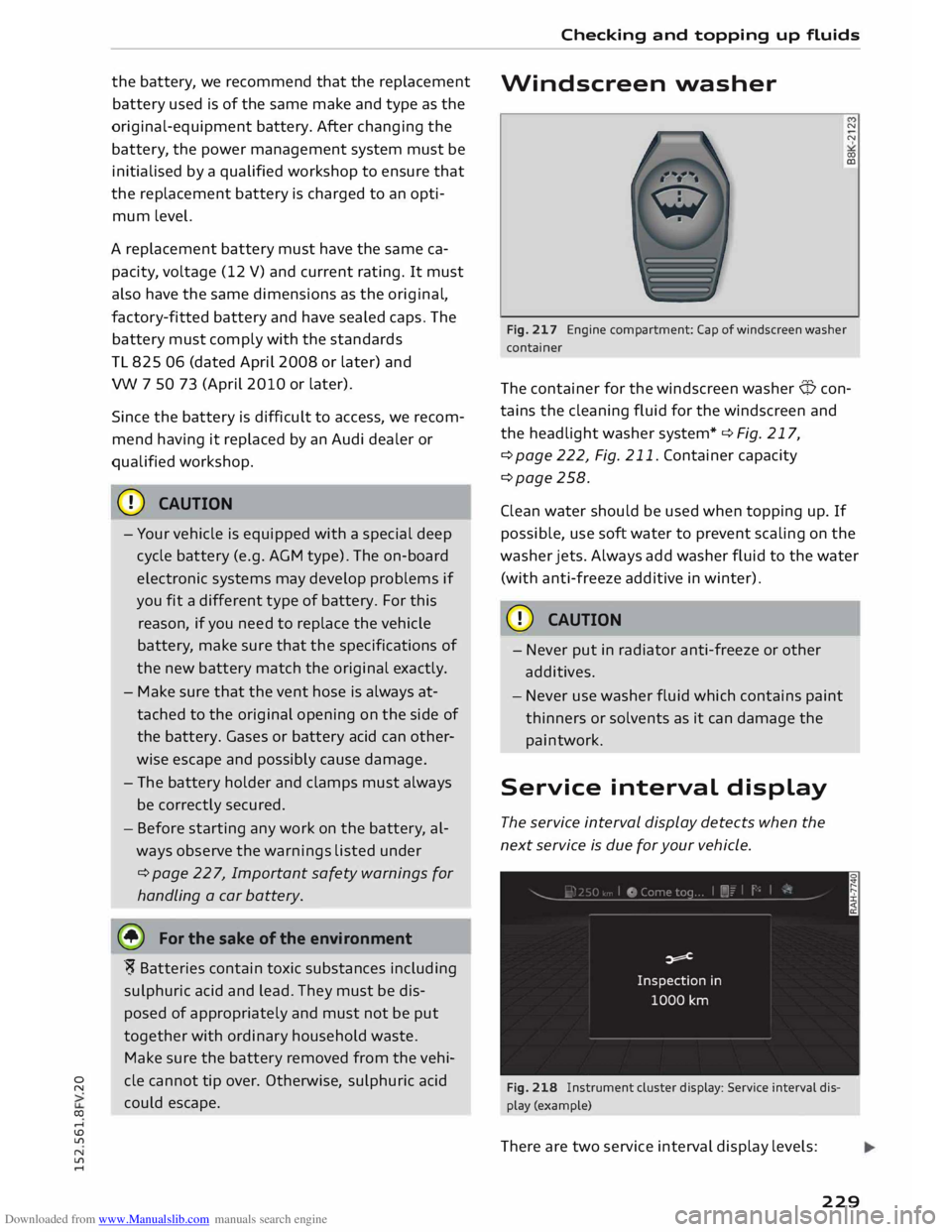
Windscreen washer
N
N
co
al
Fig. 217 Engine compartment: Cap of windscreen washer
container
The container for the windscreen washer Q con
tains the cleaning fluid for the windscreen and
the headlight washer system* ¢ Fig. 217,
¢page 222, Fig. 211. Container capacity
¢page 258.
Clean water should be used when topping up. If
possible, use soft water to prevent scaling on the
washer jets. Always add washer fluid to the water
(with anti-freeze additive in winter).
CD CAUTION
- Never put in radiator anti-freeze or other
additives.
- Never use washer fluid which contains paint
thinners or solvents as it can damage the
paintwork.
Service interval display
The service interval display detects when the
next service is due for your vehicle.
Fig. 218 Instrument cluster display: Service interval dis
play (example)
There are two service interval display levels:
229
Page 235 of 284
Downloaded from www.Manualslib.com manuals search engine 0
N
co
,-j
\D L/'l
N
L/'l
,-j A
WARNING
Insufficient tread depth or different tread
depths on different wheels reduce safety. This
is particularly evident in vehicle handling,
when there is a risk of aquaplaning in deep
puddles of water and when driving through
corners. Braking is also adversely affected -
risk of accident!
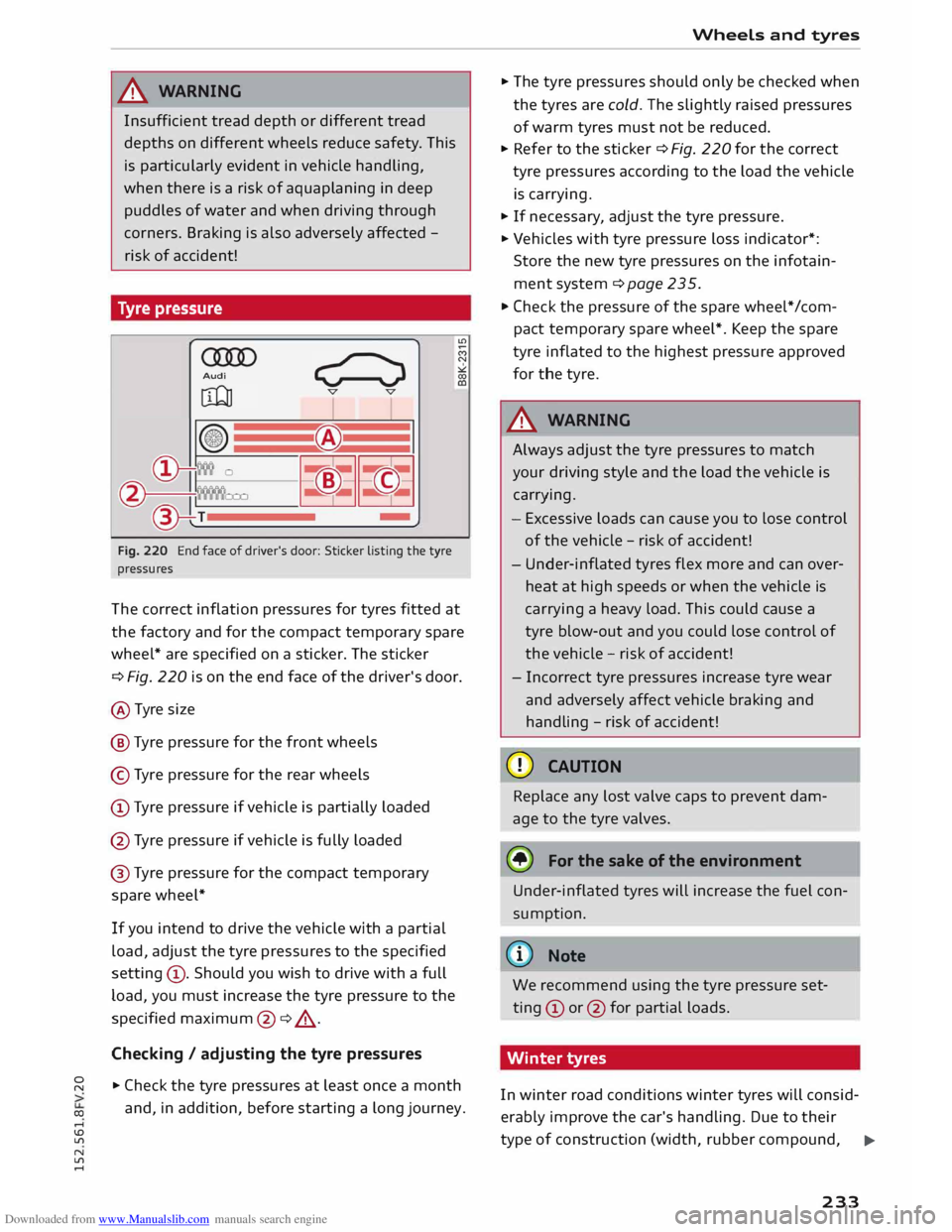
Tyre pressure
Audi V V
Fig. 220 End face of driver's door: Sticker listing the tyre
pressures
The correct inflation pressures for tyres fitted at
the factory and for the compact temporary spare
wheel* are specified on a sticker. The sticker
¢ Fig. 220 is on the end face of the driver's door.
@ Tyre size
@ Tyre pressure for the front wheels
© Tyre pressure for the rear wheels
(D Tyre pressure if vehicle is partially loaded
@ Tyre pressure if vehicle is fully loaded
@ Tyre pressure for the compact temporary
spare wheel*
If you intend to drive the vehicle with a partial
load, adjust the tyre pressures to the specified
setting (D. Should you wish to drive with a full
load, you must increase the tyre pressure to the
specified maximum @
¢.&,.
.
Checking / adjusting the tyre pressures
.. Check
the tyre pressures at least once a month
and, in addition, before starting a long journey. Wheels
and tyres
.. The tyre pressures should only be checked when
the tyres are cold. The slightly raised pressures
of warm tyres must not be reduced.
.. Refer to the sticker ¢ Fig. 220 for the correct
tyre pressures according to the load the vehicle
is carrying.
.. If necessary , adjust the tyre pressure.
.. Vehicles with tyre pressure loss indicator*:
Store the new tyre pressures on the infotain
ment system ¢ page 235 .
.. Check the pressure of the spare wheel* /com
pact temporary spare wheel*. Keep the spare
tyre inflated to the highest pressure approved
for the tyre.
A WARNING
Always adjust the tyre pressures to match
your driving style and the load the vehicle is
carrying.
- Excessive loads can cause you to lose control
of the vehicle -risk of accident!
- Under-inflated tyres flex more and can over
heat at high speeds or when the vehicle is
carrying a heavy load. This could cause a
tyre blow-out and you could lose control of
the vehicle -risk of accident!
- Incorrect tyre pressures increase tyre wear
and adversely affect vehicle braking and
handling -risk of accident!
CD CAUTION
Replace any lost valve caps to prevent dam
age to the tyre valves.
@ For the sake of the environment
Under-inflated tyres will increase the fuel con
sumption.
@ Note
We recommend using the tyre pressure set
ting (Dor@ for partial loads.
Winter tyres
In winter road conditions winter tyres will consid
erably improve the car's handling. Due to their
type of construction (width, rubber compound,
IJII>
233
Page 238 of 284
Downloaded from www.Manualslib.com manuals search engine Care
of vehicle and cleaning
Care of vehicle and
cleaning
General notes
Regular and careful care helps to maintain the
value of the vehicle. This may also be one of the
requirements for upholding any warranty claims
in the event of corrosion or paint defects.
The required car care products are available from
Audi dealers or specialist retailers. Please follow
the instructions for use on the packaging.
A WARNING
- Cleaning products and other materials used
for car care can damage health if misused.
- Car care products can contain toxic substan
ces and must always be kept in a safe place
out of reach of children.
®, For the sake of the environment
- Please choose care products that are not
harmful to the environment.
- Surplus cleaning materials should not be
disposed of together with ordinary house
hold waste.
Washing the vehicle
The longer residues are allowed to remain on the
vehicle, the more damage they can do to the
paintwork. High temperatures (for instance in di
rect sunlight) further intensify the damage.
Before washing, soak heavy dirt with plenty of
water.
Stubborn dirt, such as bird droppings or resinous
tree sap, is best removed with plenty of water
and a micro-fibre cloth.
After the period when salt is put on the roads,
have the underside of the vehicle washed thor
oughly.
High-pressure cleaners
When cleaning the vehicle with a high-pressure
cleaner, always follow the operating instructions
for the equipment. This applies particularly to
236 the
operating pressure and the spraying distance.
Do not point the spray jet directly at the seals on
the windows, doors, bonnet or boot lid, or at the
tyres, rubber hoses, insulating material or sen
sors*. Maintain a distance of at least 40 cm.
Do not use a high-pressure cleaner to remove
snow and ice.
Never use high-pressure cleaners with a round-jet
nozzle or "dirt blasters".
The water must not be hotter than 60 °C.
Automatic car washes
Spray the vehicle with water before washing.
Ensure that the windows are closed and that the
windscreen wipers are switched off. Follow the
car wash operator's rules and recommendations,
especially if any accessories are attached to your
vehicle.
If possible use a brush less car wash.
Washing by hand
Clean the car with a soft sponge or brush, start
ing on the roof and working down. Use solvent
free cleaning agents.
Washing matt-painted vehicles by hand
To avoid damaging the paintwork when washing
the car, first remove any dust, sand and grit. In
sects, grease stains and fingerprints are best re
moved using a special cleaning agent for matt
painted surfaces.
Apply the product with a micro-fibre cloth. Do
not apply too much pressure to avoid damaging
the paintwork.
Rinse the car thoroughly with water. Then clean
the car with a neutral shampoo and a soft micro
fibre cloth.
Rinse the car with lots of water again and then
let it dry in the air. Remove any water stains with
a chamois.
A WARNING
-
- Follow the rules and recommendations of
the car wash operator and do not wash the
�
Page 239 of 284
Downloaded from www.Manualslib.com manuals search engine 0
N
co
....
\D L/'l
N
L/'l
.... vehicle
with the ignition switched on - risk
of accident!
- To avoid cutting yourself on sharp metal
parts, always wear suitable protection when
cleaning the underside of the car or inside
the wheel arches.
- After the car has been washed, the full brak
ing effect can be delayed by moisture (or in
winter by ice) on the discs and brake pads -
risk of accident! The brakes should be dried
by pressing the pedal to restore full braking
effect.
CD CAUTION
- Before washing the vehicle in an automatic
car wash, please make sure to retract the
exterior mirrors and, if necessary, retract
the automatic rear spoiler* to prevent dam
age. Always use the electrical power control
to fold the mirrors in/out on vehicles with
electrically retractable exterior mirrors*.
Notes on cleaning and care
For cleaning and care of individual components
on the vehicle, please refer to the tables below.
These are recommendations only. If you have
Cleaning the exterior
Component Situation Care
of vehicle and cleaning
- Do not wash the vehicle in direct sunlight -
otherwise the paint can be damaged.
- Do not use insect sponges or abrasive
household sponges, etc. -they can damage
the surfaces.
- Matt-painted vehicle parts:
- Do not use polish or wax -otherwise the
paintwork can be damaged.
- Never use car-wash programmes that in
clude wax coatings. This could spoil the
matt finish.
- Do not attach any stickers or magnet la
bels to matt-painted parts as these could
damage the paintwork when they are re
moved.
@ For
the sake of the environment
The car should only be washed in special wash
bays. This prevents oily water from getting in
to the public drains.
special questions or certain components are not
listed, please ask your qualified workshop. Please
also refer to the notes ¢ &. .
Remedy
Wiper blades Di
rt/deposits
¢page43
Headlights/ Di rt/deposits Soft
sponge with mild detergent a
>
rear lights
Sensors Dirt/deposits
Soft
cloth with solvent-free cleaning agent
Snow/ice Small brush/solvent-free de-icer spray
Wheels Road
salt Water
Brake dust
Acid-free cleaning agent
Tailpipes Road
salt Water; suitable stainless steel cleaning product if necessa-
ry
Ornamental trim/ Dirt/deposits
Mild detergent a
>
; suitable stainless steel cleaning product
mouldings if necessary
237
Page 241 of 284
Downloaded from www.Manualslib.com manuals search engine 0
N
co
....
\D Lfl
N
Lfl
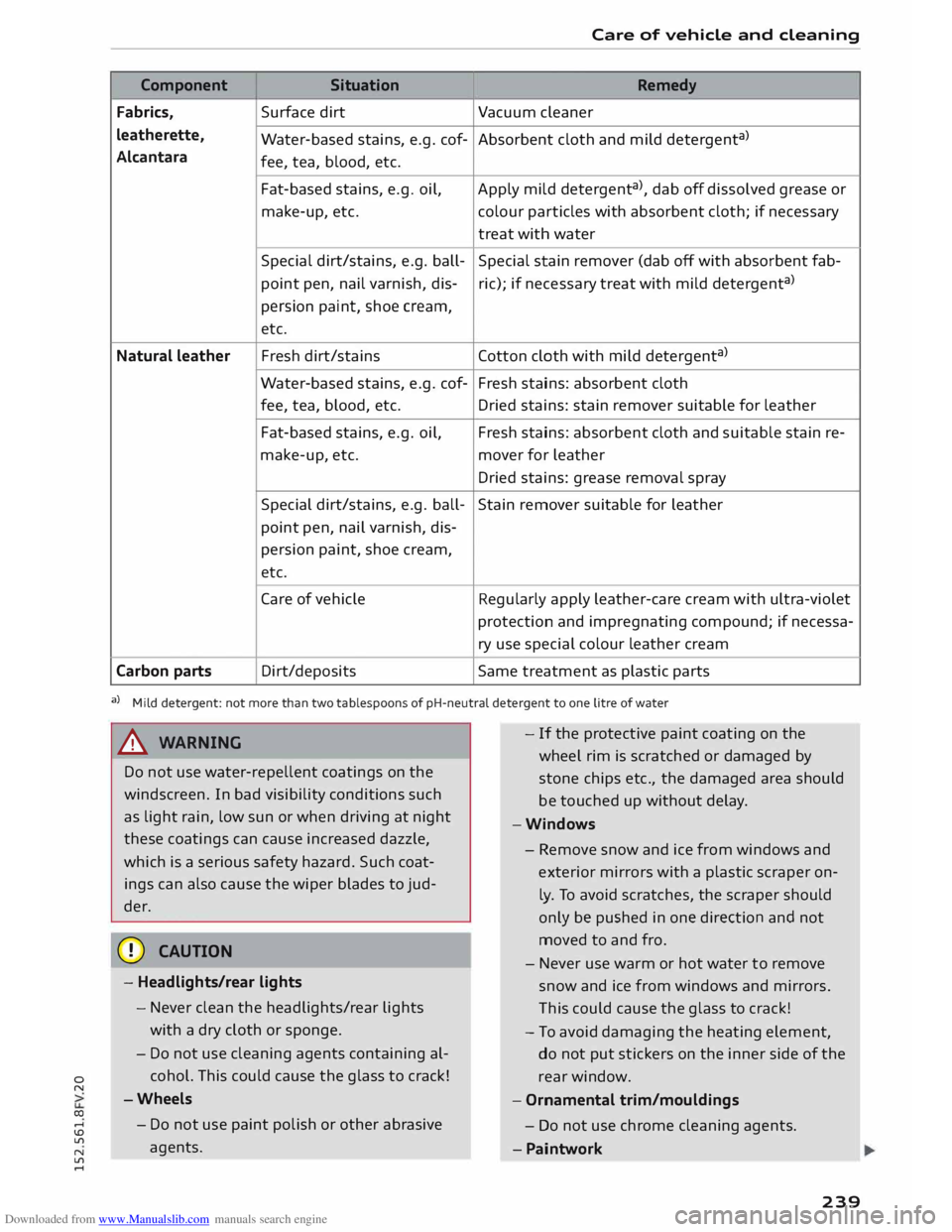
.... Care
of vehicle and cleaning
Component Situation
Remedy
Fabrics, Surface
dirt
Vacuum cleaner
leatherette, Water-based stains, e.g. cof- Absorbent cloth and mild detergent a
)
Alcantara fee, tea, blood, etc.
Fat-based stains, e.g. oil,
Apply mild detergent a
), dab off dissolved grease or
make-up, etc. colour
particles with absorbent cloth; if necessary
treat with water
Special dirt/stains, e.g. ball- Special stain remover (dab off with absorbent fab-
point pen, nail varnish, dis-ric);
if necessary treat with mild detergent a
)
persion paint, shoe cream,
etc.
Natural leather Fresh
dirt/stains Cotton cloth with mild detergent a
)
Water-based stains, e.g. cof- Fresh stains: absorbent cloth
fee, tea, blood, etc.
Dried stains: stain remover suitable for leather
Fat-based stains, e.g. oil, Fresh stains: absorbent cloth and suitable stain re-
make-up, etc. mover for leather
Dried stains: grease removal spray
Special dirt/stains, e.g. ball-
Stain remover suitable for leather
point pen, nail varnish, dis-
persion paint, shoe cream,
etc.
Care of vehicle Regularly apply leather-care cream with ultra-violet
protection and impregnating compound; if necessa-
ry use special colour leather cream
Carbon parts Dirt/deposits
Same treatment as plastic parts
a) Mild detergent: not more than two tablespoons of pH-neutral detergent to one litre of water
A WARNING
Do not use water-repellent coatings on the
windscreen. In bad visibility conditions such
as light rain, low sun or when driving at night
these coatings can cause increased dazzle,
which is a serious safety hazard. Such coat
ings can also cause the wiper blades to jud
der.
CD CAUTION
- Headlights/rear lights
- Never clean the headlights/rear lights
with a dry cloth or sponge.
- Do not use cleaning agents containing al
cohol. This could cause the glass to crack!
-Wheels
- Do not use paint polish or other abrasive
agents. -
If the protective paint coating on the
wheel rim is scratched or damaged by
stone chips etc., the damaged area should
be touched up without delay.
-Windows
- Remove snow and ice from windows and
exterior mirrors with a
plastic
scraper on
ly. To avoid scratches, the scraper should
only be pushed in one direction and not
moved to and fro.
- Never use warm or hot water to remove
snow and ice from windows and mirrors.
Th is could cause the glass to crack!
- To avoid damaging the heating element,
do not put stickers on the inner side of the
rear window.
- Ornamental trim/mouldings
- Do not use chrome cleaning agents .
- Paintwork
239
Page 242 of 284
Downloaded from www.Manualslib.com manuals search engine Care
of vehicle and cleaning
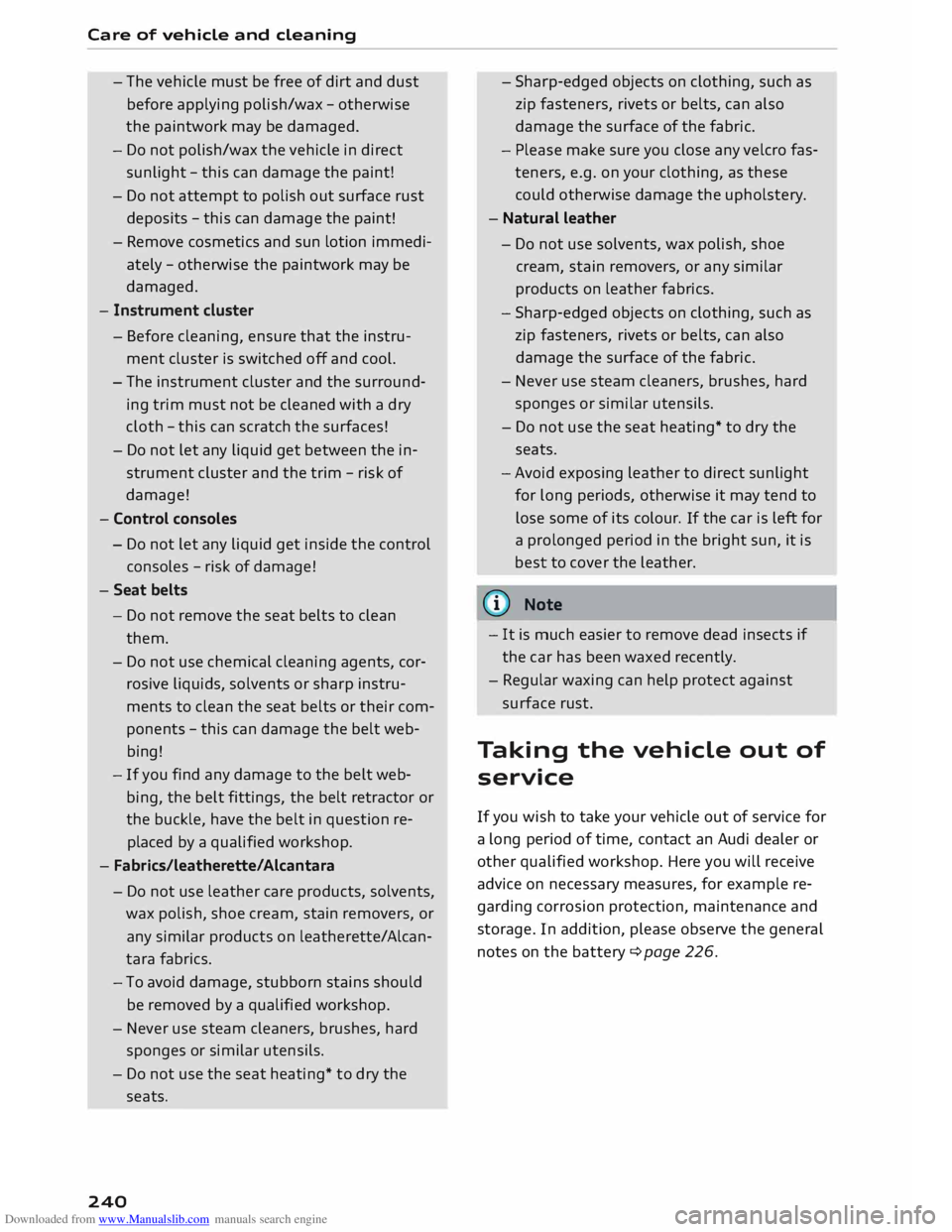
- The vehicle must be free of dirt and dust
before applying polish/wax -otherwise
the paintwork may be damaged.
- Do not polish/wax the vehicle in direct
sunlight -this can damage the paint!
- Do not attempt to polish out surface rust
deposits -this can damage the paint!
- Remove cosmetics and sun lotion immedi
ately -otherwise the paintwork may be
damaged.
- Instrument cluster
- Before cleaning, ensure that the instru-
ment cluster is switched off and cool.
- The instrument cluster and the surround
ing trim must not be cleaned with a dry
cloth -this can scratch the surfaces!
- Do not let any liquid get between the in
strument cluster and the trim -risk of
damage!
- Control consoles
- Do not let any liquid get inside the control
consoles -risk of damage!
- Seat belts
- Do not remove the seat belts to clean
them.
- Do not use chemical cleaning agents, cor
rosive liquids, solvents or sharp instru
ments to clean the seat belts or their com
ponents -this can damage the belt web
bing!
- If you find any damage to the belt web
bing, the belt fittings, the belt retractor or
the buckle, have the belt in question re
placed by a qualified workshop.
- Fabrics/leatherette/Alcantara
- Do not use leather care products, solvents,
wax polish, shoe cream, stain removers, or
any similar products on leatherette/Alcan
tara fabrics.
- To avoid damage, stubborn stains should
be removed by a qualified workshop.
- Never use steam cleaners, brushes, hard
sponges or similar utensils.
- Do not use the seat heating* to dry the
seats.
240 -
Sharp-edged objects on clothing, such as
zip fasteners, rivets or belts, can also
damage the surface of the fabric.
- Please make sure you close any velcro fas
teners, e.g. on your clothing, as these
could otherwise damage the upholstery.
- Natural leather
- Do not use solvents, wax polish, shoe
cream, stain removers, or any similar
products on leather fabrics.
- Sharp-edged objects on clothing, such as
zip fasteners, rivets or belts, can also
damage the surface of the fabric.
- Never use steam cleaners, brushes, hard
sponges or similar utensils.
- Do not use the seat heating* to dry the
seats.
- Avoid exposing leather to direct sunlight
for long periods, otherwise it may tend to
lose some of its colour. If the car is left for
a prolonged period in the bright sun, it is
best to cover the leather.
@ Note
- It is much easier to remove dead insects if
the car has been waxed recently.
- Regular waxing can help protect against
surface rust.
Taking the vehicle out of
service
If you wish to take your vehicle out of service for
a long period of time, contact an Audi dealer or
other qualified workshop. Here you will receive
advice on necessary measures, for example re
garding corrosion protection, maintenance and
storage. In addition, please observe the general
notes on the battery � page 226.