light AUDI TT COUPE 2014 Owners Manual
[x] Cancel search | Manufacturer: AUDI, Model Year: 2014, Model line: TT COUPE, Model: AUDI TT COUPE 2014Pages: 284, PDF Size: 34.42 MB
Page 243 of 284
Downloaded from www.Manualslib.com manuals search engine 0
N
co
,-j
\D L/'l
N
L/'l
,-j Mobility
General notes
... If your vehicle experiences technical problems,
stop the car well away from moving traffic. If
you have a flat tyre, you should park the car on
a level surface. Be particularly careful if you are
on a slope .
... Apply the parking brake .
... Switch the hazard warning lights on .
... Place the warning triangle in a visible location
¢page 241.
... Instruct all passengers to leave the car when it
is safe to do so. They should wait in a safe place
(for instance behind the roadside crash barrier).
A WARNING
You should note the procedure described
above for your own safety and that of other
road users.
Equipment Warning triangle
Applies to vehicles: with warning triangle
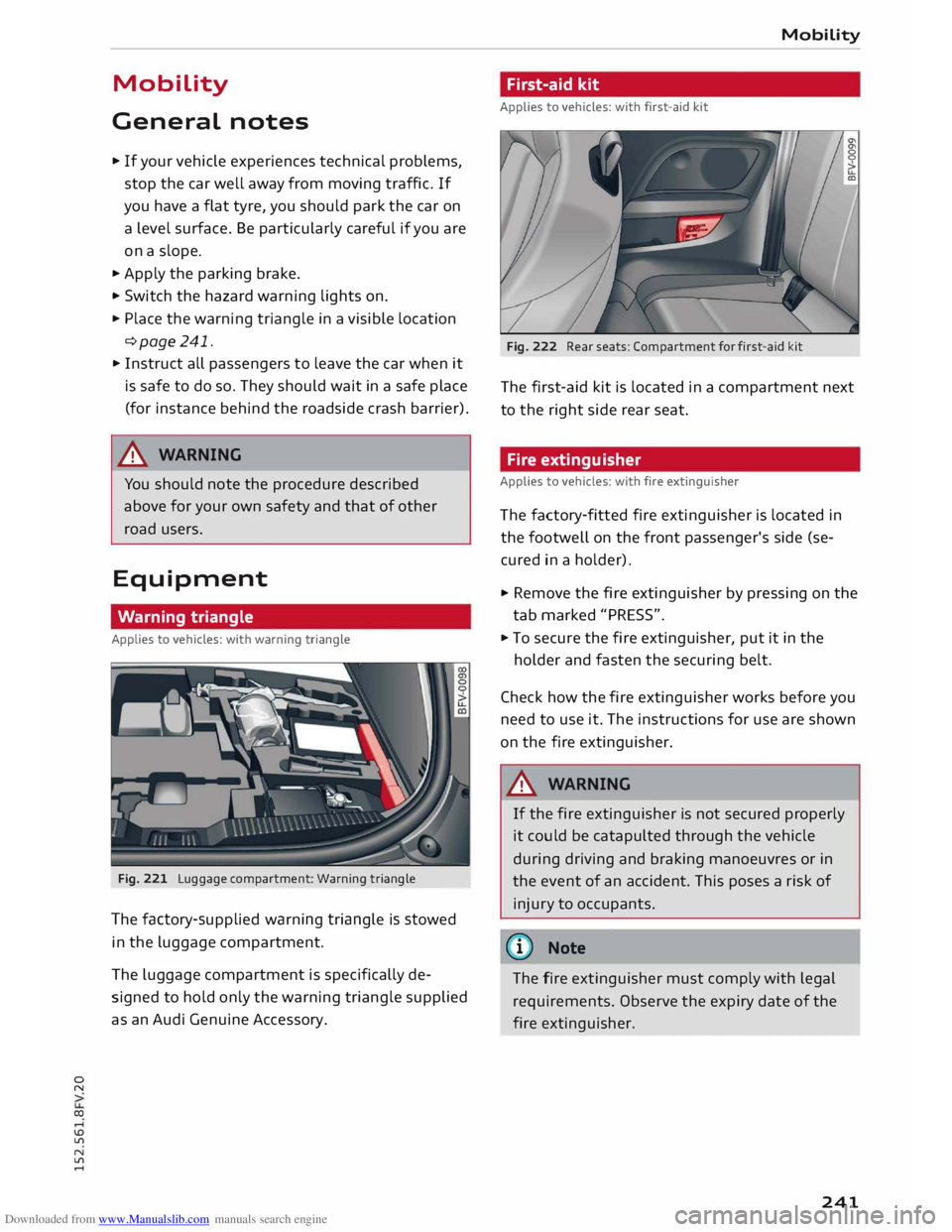
Fig. 221 Luggage compartment: Warning triangle
The factory-supplied warning triangle is stowed
in the luggage compartment.
The luggage compartment is specifically de
signed to hold only the warning triangle supplied
as an Audi Genuine Accessory. Mobility
First-aid kit
Applies to vehicles: with first-aid kit
Fig. 222 Rear seats: Compartment for first-aid kit
The first-aid kit is located in a compartment next
to the right side rear seat.
Fire extinguisher
Applies to vehicles: with fire extinguisher
The factory-fitted fire extinguisher is located in
the footwell on the front passenger's side (se
cured in a holder).
... Remove the fire extinguisher by pressing on the
tab marked "PRESS".
... To secure the fire extinguisher, put it in the
holder and fasten the securing belt.
Check how the fire extinguisher works before you
need to use it. The instructions for use are shown
on the fire extinguisher.
A WARNING
If the fire extinguisher is not secured properly
it could be catapulted through the vehicle
during driving and braking manoeuvres or in
the event of an accident. This poses a risk of
injur y to occupants.
� Note
The fire extinguisher must comply with legal
requirements. Observe the expiry date of the
fire extinguisher.
241
Page 247 of 284
Downloaded from www.Manualslib.com manuals search engine 0
N
co
,-j
\D L/'l
N
L/'l
,-j �
Note
Note the code number of the anti-theft wheel
bolt and keep it in a safe place -not in your
vehicle. If you need a replacement adapter,
give the code number to your Audi dealer.
Loosening the wheel bolts
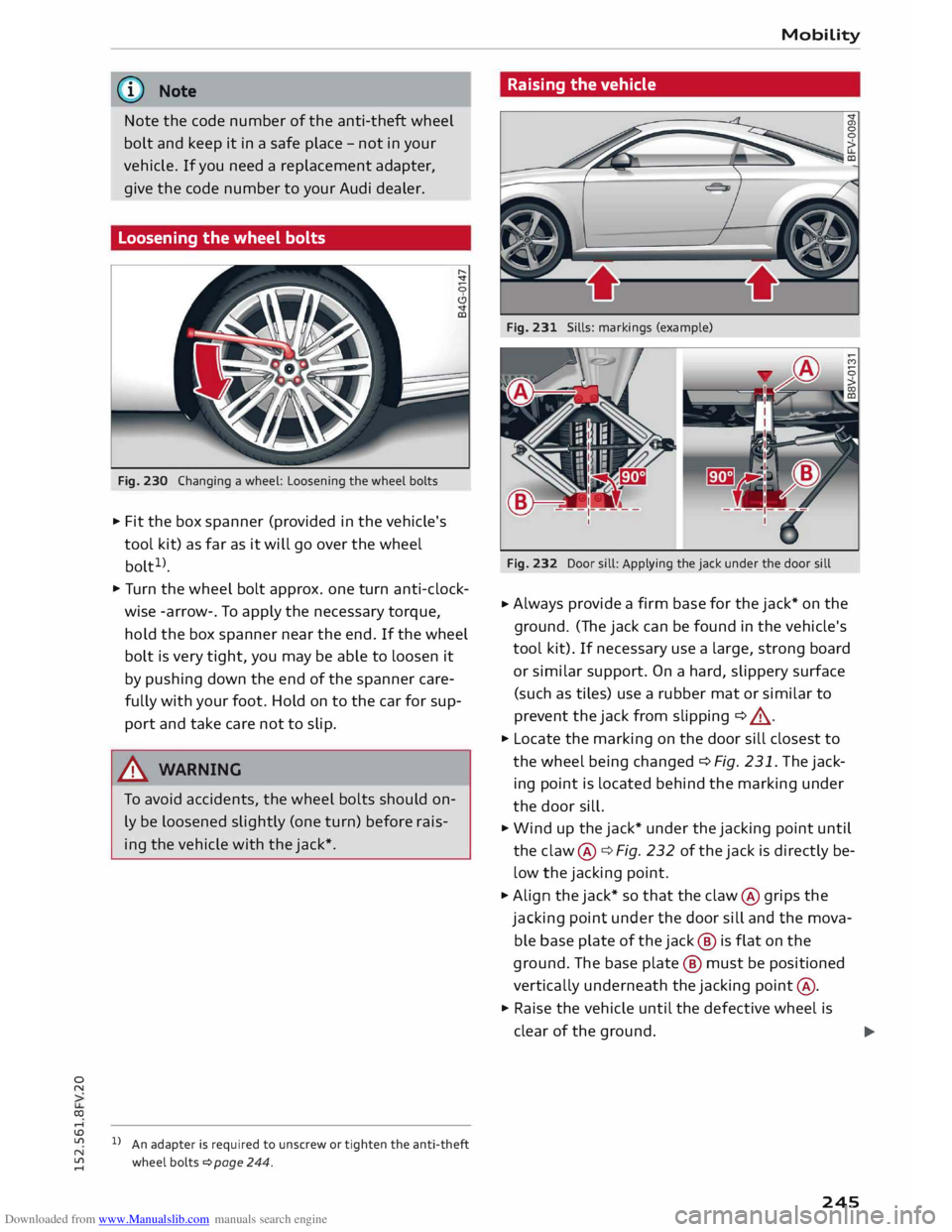
Fig. 230 Changing a wheel: Loosening the wheel bolts
.,. Fit the box spanner (provided in the vehicle's
tool kit) as far as it will go over the wheel
bolt 1
>.
.,. Turn the wheel bolt approx. one turn anti-clock
wise -arrow-. To apply the necessary torque,
hold the box spanner near the end. If the wheel
bolt is very tight, you may be able to loosen it
by pushing down the end of the spanner care
fully with your foot. Hold on to the car for sup
port and take care not to slip.
.&_ WARNING
To avoid accidents, the wheel bolts should on
ly be loosened slightly (one turn) before rais
ing the vehicle with the jack*.
l l
An adapter is required to unscrew or tighten the anti-theft
wheel bolts � page 244. Mobility
Raising the vehicle
Fig. 231 Sills: markings (example)
Fig. 232 Door sill: Applying the jack under the door sill
.,. Always
provide a firm base for the jack* on the
ground. (The jack can be found in the vehicle's
tool kit). If necessary use a large, strong board
or similar support. On a hard, slippery surface
(such as tiles) use a rubber mat or similar to
prevent the jack from slipping ¢ ,,&.
.,. Locate the marking on the door sill closest to
the wheel being changed ¢ Fig. 231. The jack
ing point is located behind the marking under
the door sill.
.,. Wind up the jack* under the jacking point until
the claw @¢ Fig. 232 of the jack is directly be
low the jacking point .
.,. Align the jack* so that the claw @ grips the
jacking point under the door sill and the mova
ble base plate of the jack @ is flat on the
ground. The base plate @ must be positioned
vertically underneath the jacking point@ .
.,. Raise the vehicle until the defective wheel is
clear of the ground.
.,.
245
Page 248 of 284

Downloaded from www.Manualslib.com manuals search engine Mobility
.&_ WARNING
- Make sure the jack* is stable. If the ground
underneath the jack* is slippery or soft, the
jack can slip or sink in -risk of injury!
- Use only the jack* supplied with your vehicle
to raise the vehicle. If you use a jack from a
different vehicle, your vehicle may slip off
the jack -risk of injury!
- Apply the jack* only at the jacking points Lo
cated behind the markings on the door sill
and align it properly. Otherwise there is a
risk of injury since the jack* can slip off sud
denly if it is not properly engaged.
- The height of the parked vehicle can change
as a result of variations in Loading.
- Never start the engine when the vehicle is
on the jack -risk of accident!
- If work has to be done under the vehicle, en
sure that it is safely supported on suitable
stands -risk of injury!
CD CAUTION
The vehicle must not be lifted up on its sills.
Only apply the jack* at the jacking points Loca
ted behind the markings on the door sill. Oth
erwise your vehicle could be damaged.
Taking off/ putting on the wheel
Fig. 233 Wheel: Hexagonal socket for turning wheel bolts
246 Fig.
234 Wheel: Mounting pin in wheel bolt hole nearest
to the top
Taking off the wheel
... Using the hexagonal socket in the screwdriver
handle {provided in the vehicle's tool kit), un
screw the top wheel bolt and place it on a clean
surface ¢ Fig. 233.
... Screw in the mounting pin (provided in the ve
hicle's tool kit) by hand in place of the wheel
bolt¢ Fig. 234.
.,. Then unscrew the other wheel bolts .
.,. Take off the wheel ¢(D
. The mounting pin
stays where it is.
Putting on the wheel
When putting on a tyre with directional tread
pattern, refer to ¢ page 247.
.,. Put on the wheel, using the mounting pin to
guide it into place ¢(D
.
.,. Screw in the wheel bolts and tighten them
lightly using the hexagonal socket .
... Then unscrew the mounting pin and tighten the
remaining wheel bolt lightly .
... Carefully lower the car with the jack* .
.,. Tighten the wheel bolts in diagonal sequence
with the box spanner.
The wheel bolts should be clean and turn easily.
Before putting on the wheel, inspect the condi
tion of the wheel and hub mounting surfaces.
These surfaces must be clean before mounting
the wheel.
.&_ WARNING
Do not use the hexagonal socket in the screw-
driver handle to tighten the wheel bolts. It is ..,.
Page 251 of 284
Downloaded from www.Manualslib.com manuals search engine N
....
Lfl
N
Lfl
.... Starting
the engine
The jump leads must be connected in the correct
sequence.
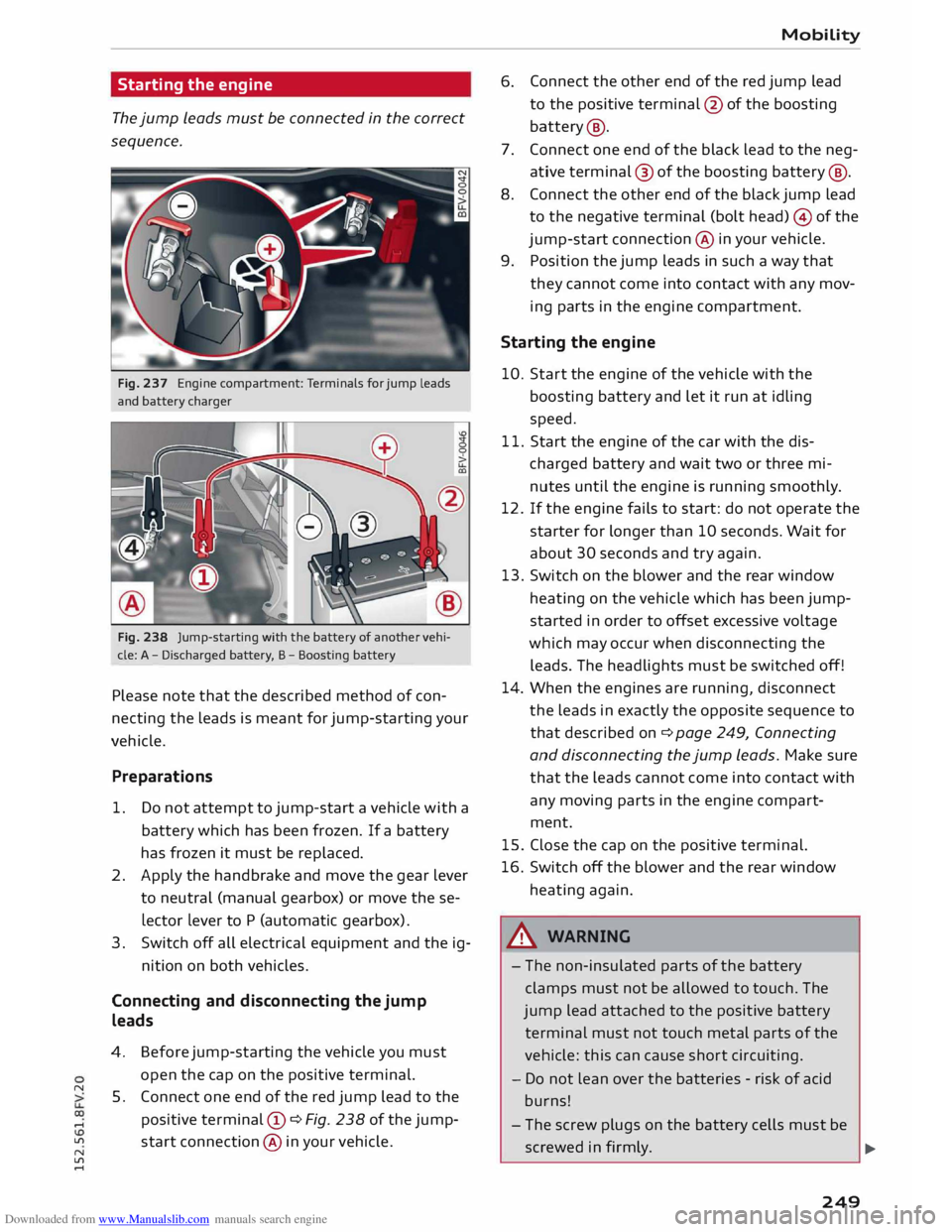
Fig. 237 Engine compartment: Terminals for jump leads
and battery charger
Fig. 238 Jump-starting with the battery of another vehi
cle: A -Discharged battery, B -Boosting battery
Please note that the described method of con
necting the leads is meant for jump-starting your
vehicle.
Preparations
1. Do not attempt to jump-start a vehicle with a
battery which has been frozen. If a battery
has frozen it must be replaced.
2. Apply the handbrake and move the gear lever
to neutral (manual gearbox) or move these
lector Lever to P (automatic gearbox).
3. Switch off all electrical equipment and the ig-
nition on both vehicles.
Connecting and disconnecting the jump
leads
4.
5. Before
jump-starting the vehicle you must
open the cap on the positive terminal.
Connect one end of the red jump lead to the
positive terminal (!) ¢Fig. 238 ofthejump
start connection @ in your vehicle. Mobility
6. Connect
the other end of the red jump lead
to the positive terminal @ofthe boosting
battery @.
7. Connect one end of the black lead to the neg
ative terminal@ of the boosting [email protected] the other end of the black jump lead
to the negative terminal (bolt head) © of the
jump-start connection@ in your vehicle.
9.
Position the jump leads in such a way that
they cannot come into contact with any mov
ing parts in the engine compartment.
Starting the engine
10. Start the engine of the vehicle with the
boosting battery and let it run at idling
speed.
11. Start the engine of the car with the dis
charged battery and wait two or three mi
nutes until the engine is running smoothly.
12. If the engine fails to start: do not operate the
starter for longer than 10 seconds. Wait for
about 30 seconds and try again.
13. Switch
on the blower and the rear window
heating on the vehicle which has been jump
started in order to offset excessive voltage
which may occur when disconnecting the
leads. The headlights must be switched off!
14. When the engines are running, disconnect
the leads in exactly the opposite sequence to
that described on¢ page 249, Connecting
and disconnecting the jump leads. Make sure
that the leads cannot come into contact with
any moving parts in the engine compart
ment.
15. Close the cap on the positive terminal.
16. Switch off the blower and the rear window
heating again.
_& WARNING
- The non-insulated parts of the battery
clamps must not be allowed to touch. The
jump lead attached to the positive battery
terminal must not touch metal parts of the
vehicle: this can cause short circuiting.
- Do not lean over the batteries -risk of acid
burns!
- The screw plugs on the battery cells must be
screwed in firmly.
.,..
249
Page 252 of 284
Downloaded from www.Manualslib.com manuals search engine Mobility
- Keep sparks, flame and lighted cigarettes
away from batteries: the gases given off can
cause an explosion.
- If jump-starting another vehicle, position
the jump Leads in such a way that they can
not come into contact with any moving
parts in the engine compartment of the oth
er vehicle.
CD CAUTION
Please note that the above method of con
necting the Leads is intended for jump-start
ing your vehicle. If jump-starting another ve
hicle, you should not connect the negative
lead (-) to the negative terminal of the dis
charged battery, but directly to the engine
block or a solid metal part bolted to the en
gin e block. If the battery of the other vehicle
does not have a gas vent, there is a risk that a
mixture of oxygen and hydrogen gas can accu
mulate and cause an explosion.
@ Note
- The battery is vented to the outside to pre
vent gases entering the vehicle's interior.
- Connect the battery clamps so they have
good metal-to-metal contact with the bat
tery terminals.
Tow-starting / towing
away
General notes
Some experience is required to tow or tow-start a
vehicle, especially when using a tow-rope. Both
drivers should be familiar with the technique re
quired for towing. Inexperienced drivers should
not attempt to tow-start or tow away another ve
hicle.
Do not pull too hard with the towing vehicle and
take care to avoid jerking the tow-rope. When
towing off-road, there is always a risk that the
anchorage points may be overloaded.
Tow-bar / tow-rope
It is easier and safer to tow the vehicle with a
tow-bar. You should only use a tow-rope if you do
250 not
have a tow-bar. It is advisable to use a tow
rope made of elastic synthetic fibre or similarly
elastic material.
Notes on towing vehicles
The vehicle can be towed with a tow-bar or tow
rope. When the engine is not running, the gear
box will not be adequately Lubricated if the fol
lowing speed/distance restrictions are not ob
served:
- The vehicle must not be towed faster than
SO km/h.
- The vehicle must not be towed further than
50km.
Additi onal notes on towing by breakdown
truck
If one of the axles has to be raised in order to tow
the vehicle, please refer to the following table to
determine the appropriate axle for your gearbox/
drive combination:
Front-wheel IFour-wheel
drive drive
Manual Front
or rear Front or rear
gearbox axle
axle
Automatic gearbox Front
axle Front axle
Four-wheel drive: If the vehicle is to be towed
with one of the axles raised, the ignition must be
switched off; otherwise the drive train can be
damaged.
Notes on tow-starting
Automatic gearbox: For technical reasons, your
vehicle must not be tow-started.
Manual gearbox: As a general rule, tow-starting
is not recommended. If the engine will not start,
it is best to try starting it using the battery of an
other vehicle ¢ page 248 before attempting to
tow start. If this is not possible, you can try to
push-star t or tow-start the vehicle ¢ page 251,
Tow-starting. ...,
Page 253 of 284
Downloaded from www.Manualslib.com manuals search engine 0
N
co
....
\D U'l ,&.
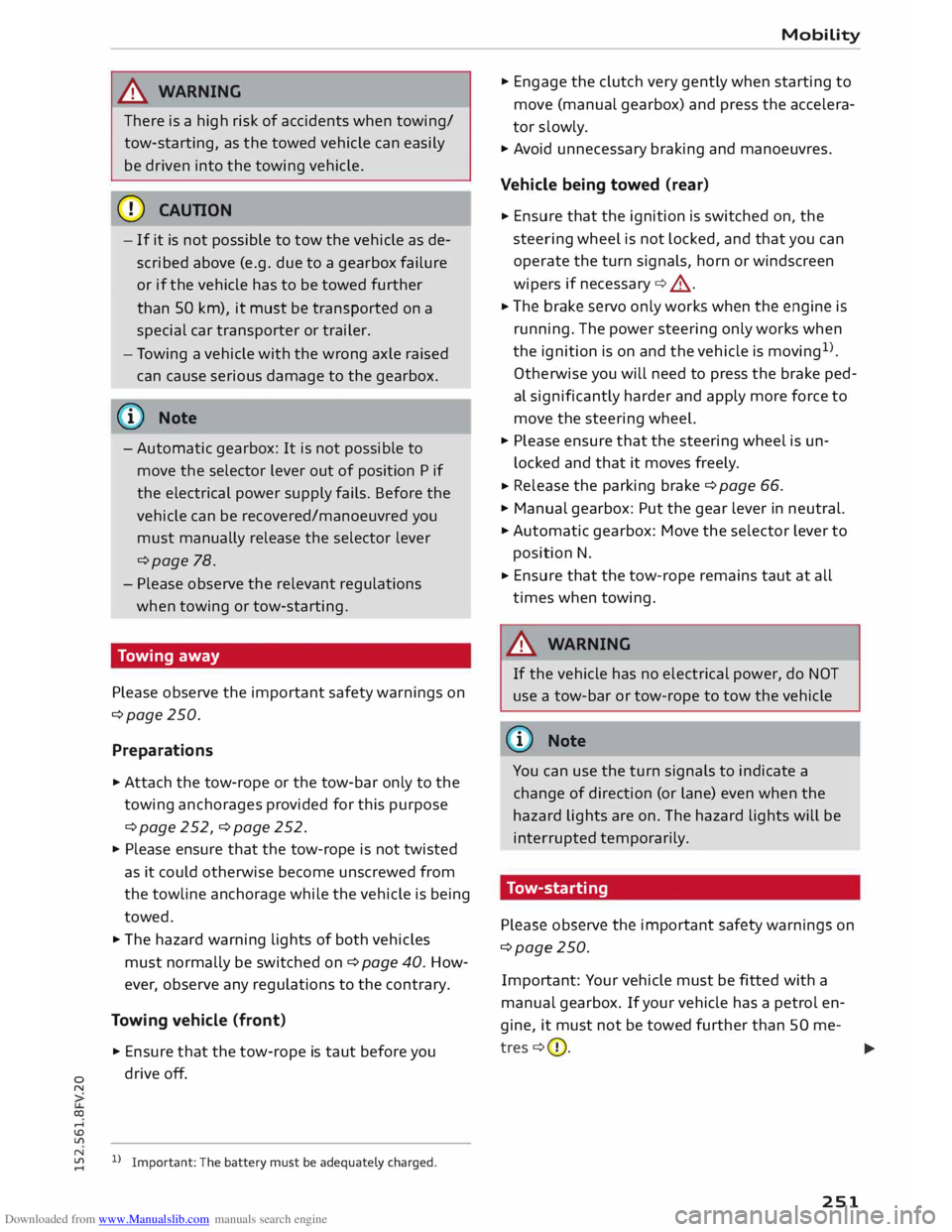
WARNING
There is a high risk of accidents when towing/
tow-starting, as the towed vehicle can easily
be driven into the towing vehicle.
CD CAUTION
- If it is not possible to tow the vehicle as de
scribed above (e.g. due to a gearbox failure
or if the vehicle has to be towed further
than 50 km), it must be transported on a
special car transporter or trailer.
- To wing a vehicle with the wrong axle raised
can cause serious damage to the gearbox.
@ Note
- Automatic gearbox: It is not possible to
move the selector lever out of position P if
the electrical power supply fails. Before the
vehicle can be recovered/manoeuvred you
must manually release the selector lever
¢page 78.
- Please observe the relevant regulations
when towing or tow-starting.
Towing away
Please observe the important safety warnings on
¢page 250.
Preparations
.. Attach the tow-rope or the tow-bar only to the
towing anchorages provided for this purpose
¢page 252, ¢page 252.
.. Please ensure that the tow-rope is not twisted
as it could otherwise become unscrewed from
the towline anchorage while the vehicle is being
towed.
.. The hazard warning lights of both vehicles
must normally be switched on ¢ page 40. How
ever, observe any regulations to the contrary.
Towing vehicle (front)
.. Ensure that the tow-rope is taut before you
drive off.
N
� l
l
Important: The battery must be adequately charged. Mobility
.. Engage the clutch very gently when starting to
move (manual gearbox) and press the accelera
tor slowly.
.. Avoid unnecessary braking and manoeuvres.
Vehicle being towed (rear)
.. Ensure
that the ignition is switched on, the
steering wheel is not locked, and that you can
operate the turn signals, horn or windscreen
wipers if
necessary ¢,& .
.. The
brake servo only works when the engine is
running. The power steering only works when
the ignition is on and the vehicle is moving 1
).
Otherwise you will need to press the brake ped
al significantly harder and apply more force to
move the steering wheel.
.. Please ensure that the steering wheel is un-
locked and that it moves freely.
.. Release
the parking brake ¢page 66.
.. Manual gearbox: Put the gear lever in neutral.
.. Automatic gearbox: Move the selector lever to
position N.
.. Ensure
that the tow-rope remains taut at all
times when towing.
,&. WARNING
If the vehicle has no electrical power, do NOT
use a tow-bar or tow-rope to tow the vehicle
@ Note
You can use the turn signals to indicate a
change of direction (or lane) even when the
hazard lights are on. The hazard lights will be
interrupted temporarily .
Tow-starting
Please observe the important safety warnings on
¢page 250.
Important: Your vehicle must be fitted with a
manual gearbox. If your vehicle has a petrol en
gine, it must not be towed further than SO me-
tres ¢(D.
.,.
251
Page 256 of 284
Downloaded from www.Manualslib.com manuals search engine Fuses
and bulbs
Fuses and bulbs
Fuses Fuses in vehic le interior
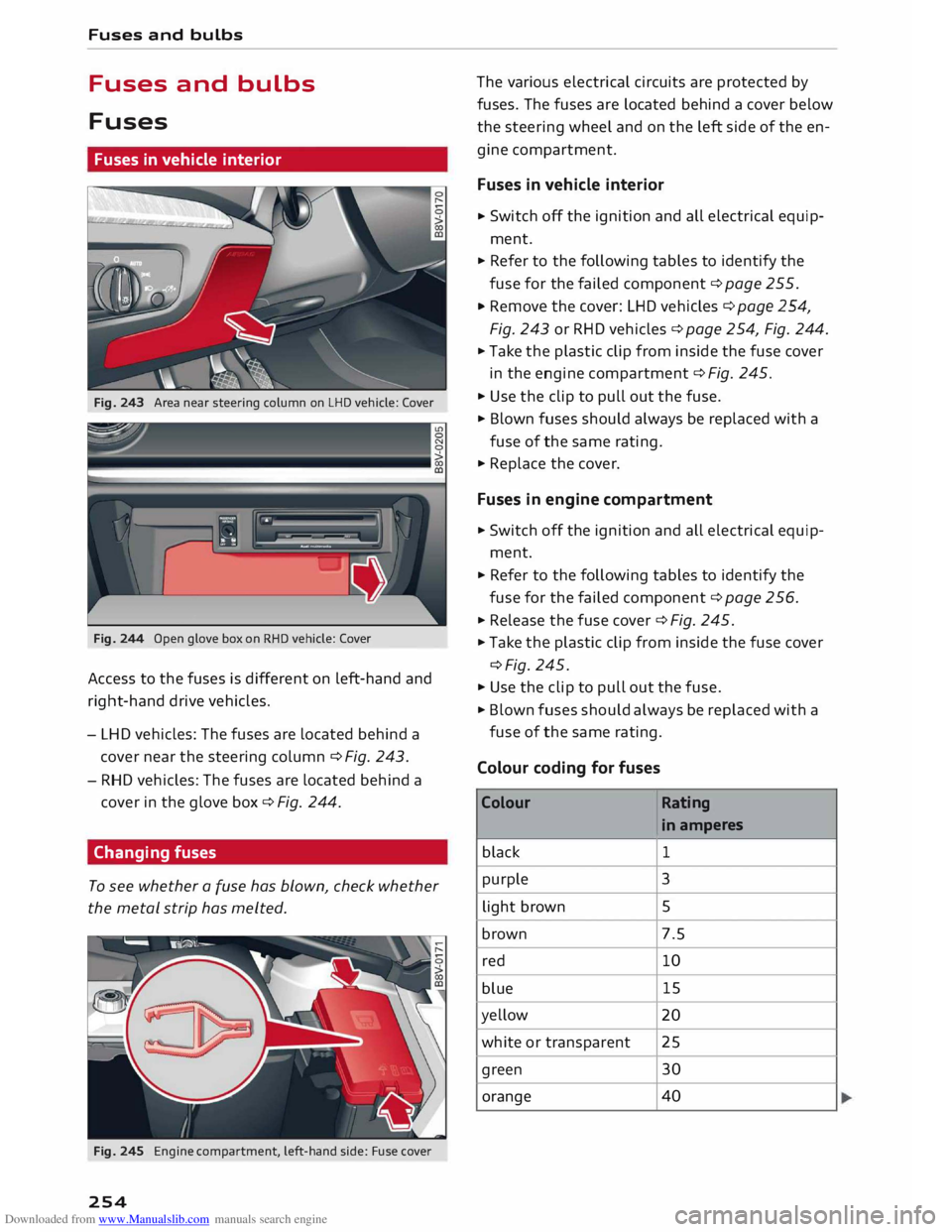
Fig. 243 Area near steering column on LHD vehicle: Cover
Fig. 244 Open glove box on RHO vehicle: Cover
Access to the fuses is different on left-hand and
right-hand drive vehicles.
- LHD vehicles: The fuses are located behind a
cover near the steering column ¢Fig. 243.
- RHD vehicles: The fuses are located behind a
cover in the glove box¢ Fig. 244.
Changing fuses
To see whether a fuse has blown, check whether
the metal strip has melted.
Fig. 245 Engine compartment, left-hand side: Fuse cover
254 The
various electrical circuits are protected by
fuses. The fuses are located behind a cover below
the steering wheel and on the left side of the en
gine compartment.
Fuses in vehicle interior
.. Switch
off the ignition and all electrical equip
ment .
.. Refer to the following tables to identify the
fuse for the failed component ¢ page 255 .
.. Remove the cover: LHD vehicles c:> page 254,
Fig. 243 or RHD vehicles ¢ page 254, Fig. 244 .
.. Take the plastic clip from inside the fuse cover
in the engine compartment ¢ Fig. 245 .
.. Use the clip to pull out the fuse.
.. Blown fuses should always be replaced with a
fuse of the same rating .
.. Replace the cover.
Fuses in engine compartment
.. Switch off the ignition and all electrical equip
ment .
.. Refer to the following tables to identify the
fuse for the failed component ¢ page 256 .
.. Release the fuse cover ¢ Fig. 245.
.. Take the plastic clip from inside the fuse cover
¢Fig. 245.
.. Use the clip to pull out the fuse.
.. Blown fuses should always be replaced with a
fuse of the same rating.
Colour coding for fuses
Colour Rating
in amperes
black 1
purple 3
light brown 5
brown 7.5
red 10
blue 15
yellow 20
white or transparent 25
green 30
orange 40
Page 257 of 284
Downloaded from www.Manualslib.com manuals search engine 0
N
co
....
\D L/'l
N
L/'l
.... ,&.
WARNING
Never attempt to repair a fuse or replace a
blown fuse by fitting a fuse with a higher am
pere rating. This could damage the electrical
system -risk of fire!
CD CAUTION
If a newly replaced fuse blows again after a
short time, the electrical system must be
checked by a qualified workshop as soon as
possible.
@ Note
- Unassigned fuse locations are not shown in
the tables below.
- Some of the items of equipment listed in
the tables below are only fitted on certain
models or are optional extras.
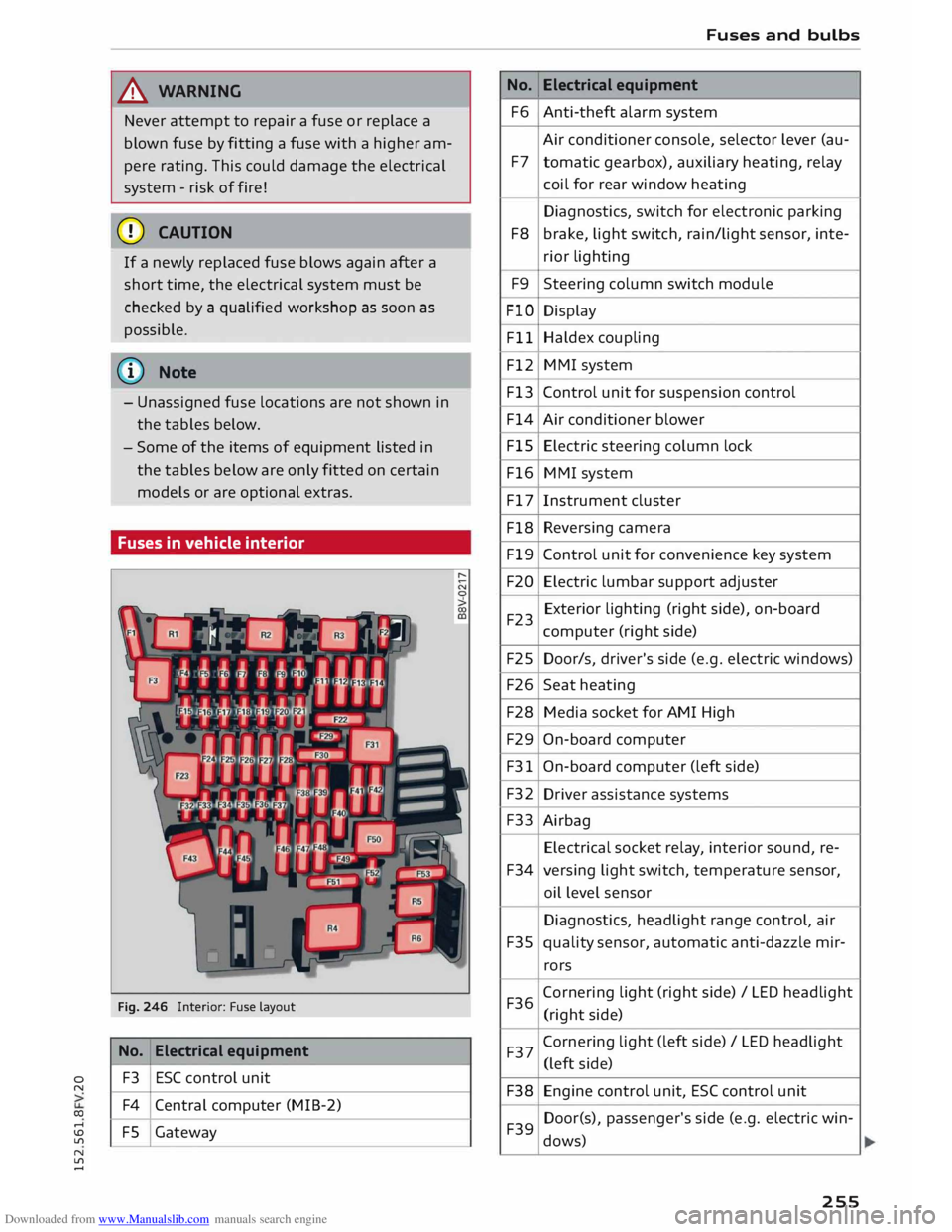
Fuses in vehicle interior
Fig. 246 Interior: Fuse layout
No. Electrical
equipment
F3 ESC
control unit
F4 Central computer (MIB-2)
FS Gateway No.
F6
F7
F8 F9
FlO Fll
F12
F13
F14
FlS
F16
F17
F18
Fl9
F20
F23
F25
F26
F28
F29
F31
F32 F33
F34
F35
F36 F37
F38 F39 Fuses
and bulbs
Electrical equipment
Anti-theft alarm system
Air conditioner console, selector lever (au-
tomatic gearbox), auxiliary heating, relay
coil for rear window heating
Diagnostics, switch for electronic parking
brake, light switch, rain/light sensor, inte-
rior lighting
Steering column switch module
Display
Haldex coupling
MMI system
Control unit for suspension control
Air conditioner blower
Electric steering column lock
MMI system
Instrument cluster
Reversing camera
Control unit for convenience key system
Electric lumbar support adjuster
Exterior lighting (right side), on-board
computer (right side)
Door/s, driver's side (e.g. electric windows)
Seat heating
Media socket for AMI High
On-board computer
On-board computer (left side)
Driver assistance systems
Airbag Electrical socket relay, interior sound, re-
versing light switch, temperature sensor,
oil level sensor
Diagnostics, headlight range control, air
quality sensor, automatic anti-dazzle mir-
rors
Corn ering light (right side)/ LED headlight
(right side)
Cornering light (left side) / LED headlight
(left side)
Engine control unit, ESC control unit
Door(s), passenger's side (e.g. electric win-
dows)
255
Page 258 of 284
Downloaded from www.Manualslib.com manuals search engine Fuses
and bulbs
No. Electrical
equipment
F40 Cigarette lighter, electrical sockets
F41 SCR relay and delivery unit
F42 Central locking system
F43 On-board computer
F45 Electrically
adjustable seat (driver's side)
F49 Starter, clutch sensor
FSO ESC
valves
F53 Rear window heating
Th e seats with electric adjustment* are protected
by circuit breakers. These reset automatically af
ter a few seconds when the overload has been
corrected.
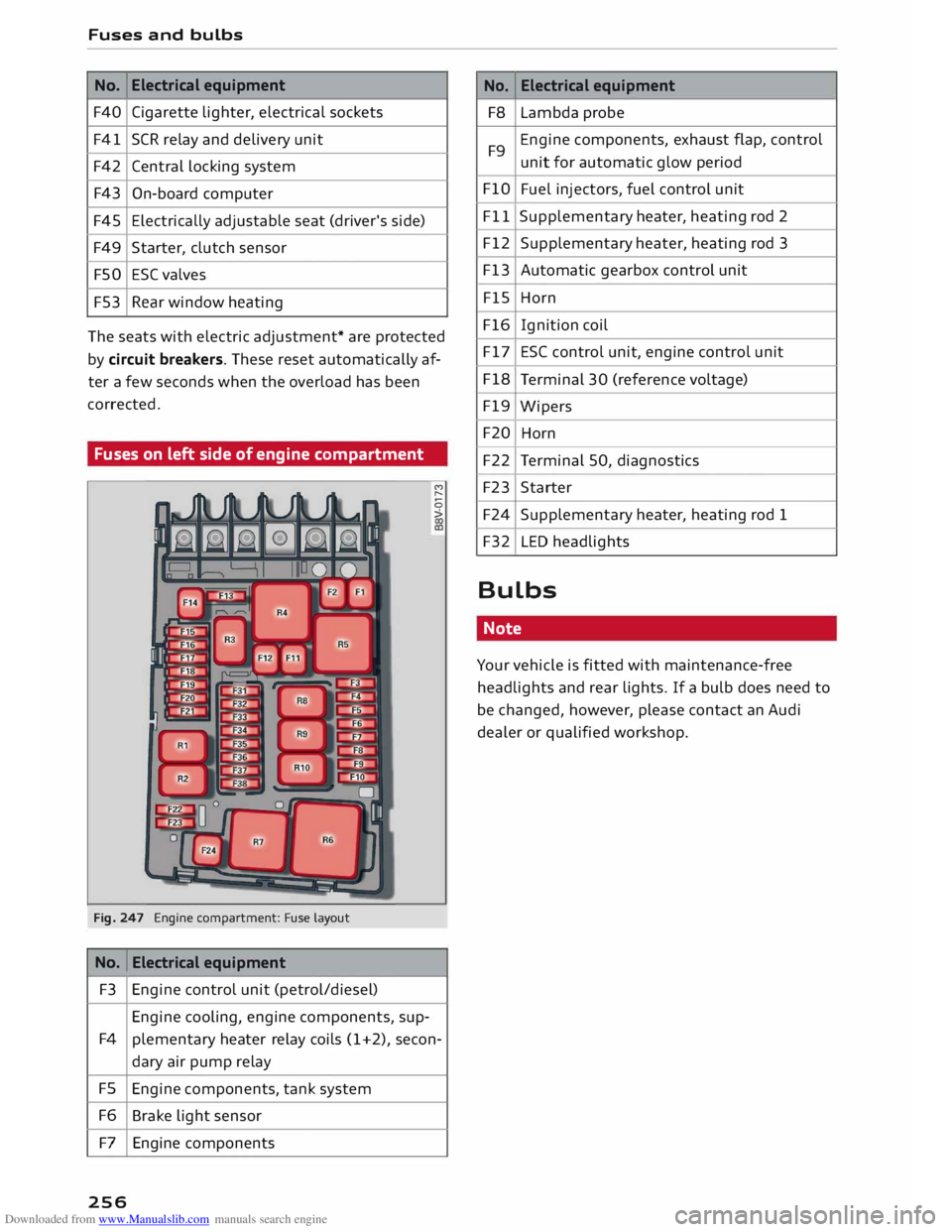
Fuses on left side of engine compartment
Fig. 247 Engine compartment: Fuse la
yout
No. Electrical
equipment
F3 Engine control unit (petrol/diesel)
Engine cooling, engine components, sup-M
,...,
0
>
F4 plementary heater relay coils (1+2), secon-
dary air pump relay
FS Engine components, tank system
F6 Brake light sensor
F7 Engine components
256 No.
Electrical
equipment
F8 Lambda probe
F9 Engine
components, exhaust flap, control
unit for automatic glow period
FlO Fuel injectors, fuel control unit
Fll Supplementary
heater, heating rod 2
F12 Supplementary heater, heating rod 3
F13 Automatic gearbox control unit
FlS Horn
F16 Ignition coil
F17 ESC control unit, engine control unit
F18 Terminal 30 (reference voltage)
F19 Wipers
F20 Horn
F22 Terminal 50, diagnostics
F23 Starter
F24 Supplementary heater, heating rod 1
F32 LED headlights
Bulbs Note
Your vehicle is fitted with maintenance-free
headlights and rear lights. If a bulb does need to
be changed, however, please contact an Audi
dealer or qualified workshop.
Page 260 of 284
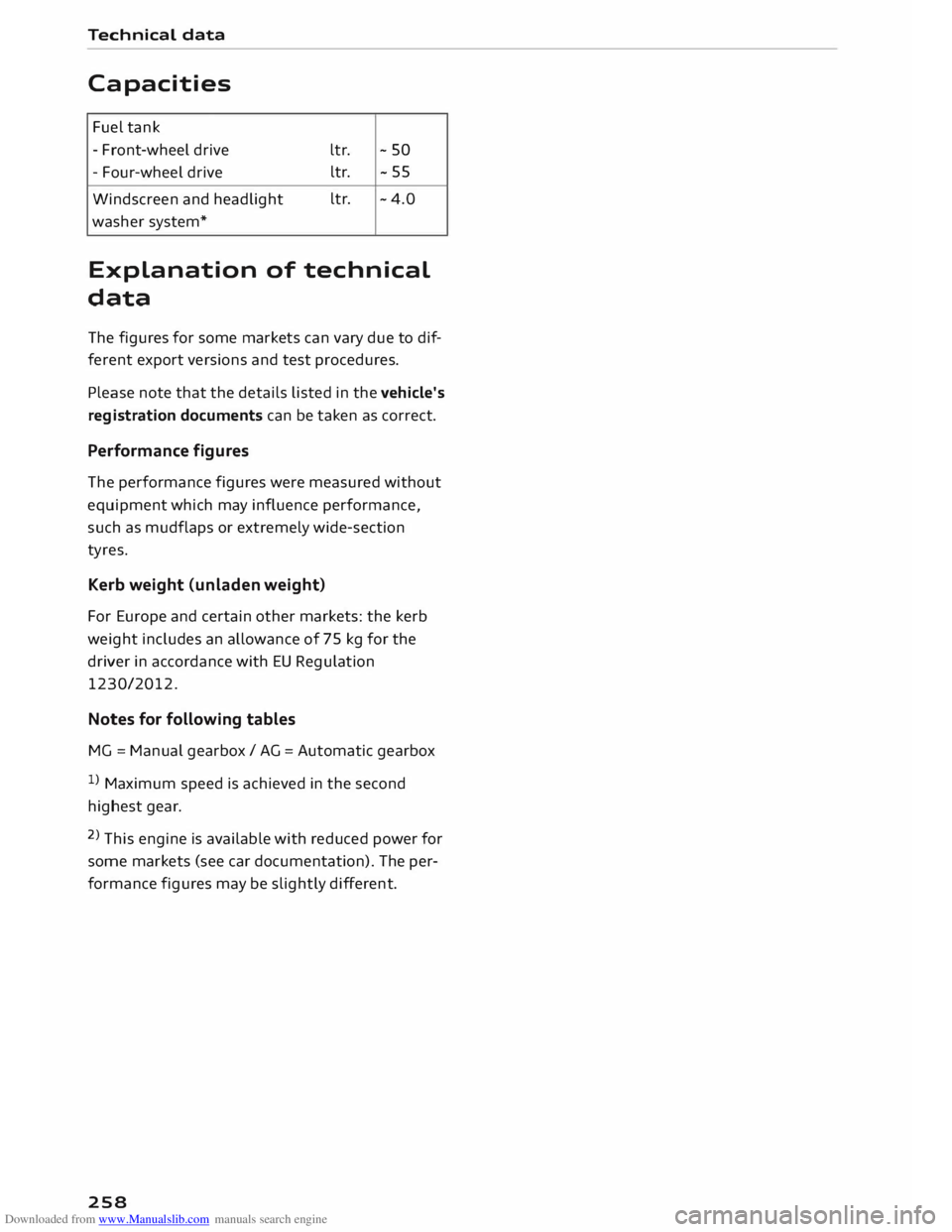
Downloaded from www.Manualslib.com manuals search engine Technical
data
Capacities Fuel tank
- Front-wheel drive ltr. - so
- Four-wheel drive ltr. -
55
Windscreen and headlight ltr.
-4.0
washer system*
Explanation of technical
data
The figures for some markets can vary due to dif
ferent export versions and test procedures.
Please note that the
details
listed in the vehicle's
registration documents can be taken as correct.
Performance figures
The performance figures were measured without
equipment which may influence performance,
such as mudflaps or extremely wide-section
tyres.
Kerb weight (unladen weight)
For Europe and certain other markets: the kerb
weight includes an allowance of 75 kg for the
driver in accordance with EU Regulation
1230/2012.
Notes for following tables
MG = Manual gearbox I AG = Automatic gearbox
l) Maximum speed is achieved in the second
highest gear.
2 ) This engine is available with reduced power for
some markets (see car documentation). The per
formance figures may be slightly different.
258