ESP AUDI TT COUPE 2014 Workshop Manual
[x] Cancel search | Manufacturer: AUDI, Model Year: 2014, Model line: TT COUPE, Model: AUDI TT COUPE 2014Pages: 284, PDF Size: 34.42 MB
Page 204 of 284
Downloaded from www.Manualslib.com manuals search engine Safe
driving
Fastening rings
Unsecured loads are a hazard to all vehicle occu
pants.
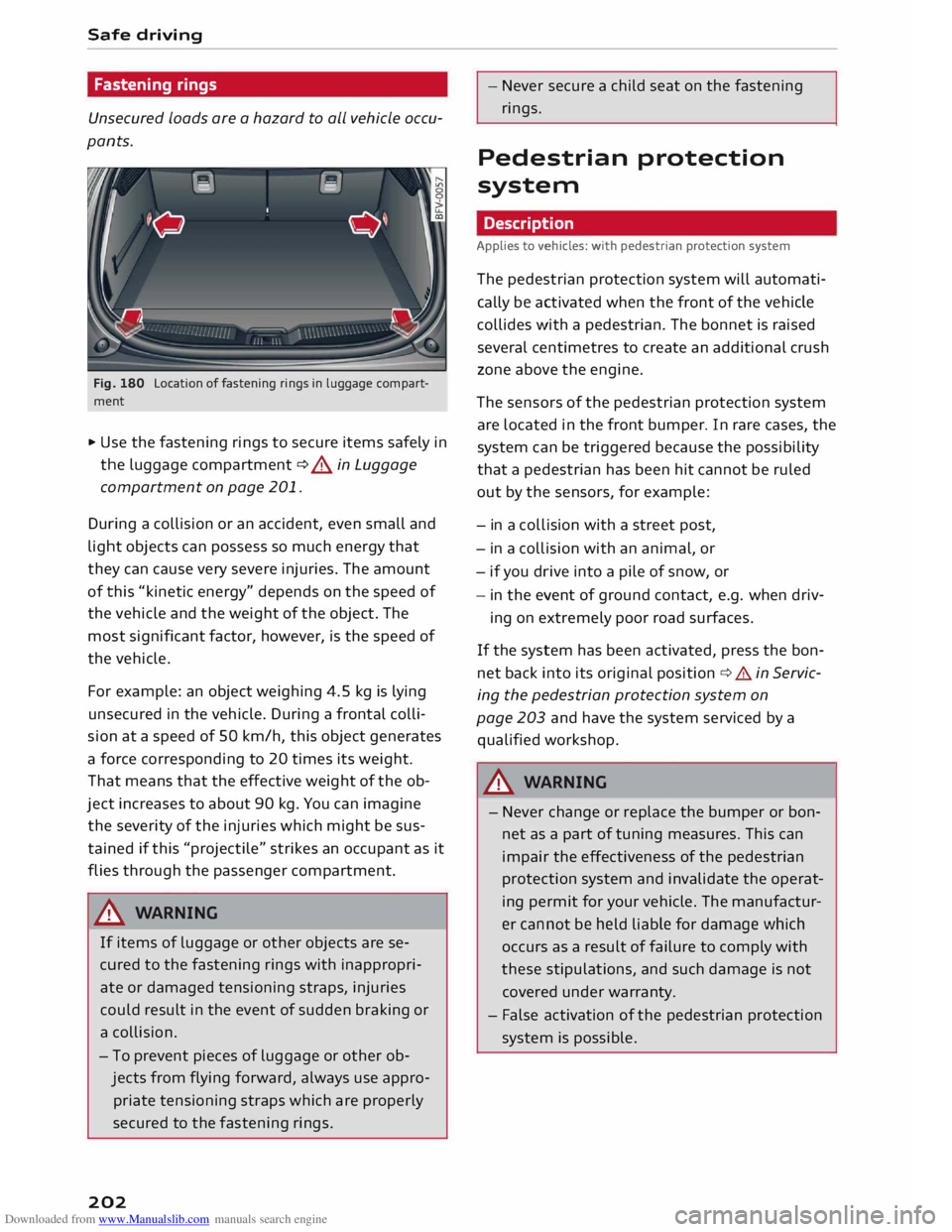
Fig. 180 Location of fastening rings in luggage compart
ment
.,. Use the fastening rings to secure items safely in
the luggage compartment ¢ A in Luggage
compartment on page 201.
During a collision or an accident, even small and
light objects can possess so much energy that
they can cause very severe injuries. The amount
of this "kinetic energy" depends on the speed of
the vehicle and the weight of the object. The
most significant factor, however, is the speed of
the vehicle.
For example: an object weighing 4.5 kg is lying
unsecured in the vehicle. During a frontal colli
sion at a speed of SO km/h, this object generates
a force corresponding to 20 times its weight.
That means that the effective weight of the ob
ject increases to about 90 kg. You can imagine
the severity of the injuries which might be sus
tained if this "projectile" strikes an occupant as it
flies through the passenger compartment.
A WARNING
If items of luggage or other objects are se
cured to the fastening rings with inappropri
ate or damaged tensioning straps, injuries
could result in the event of sudden braking or
a collision.
- To prevent pieces of luggage or other ob
jects from flying forward, always use appro
priate tensioning straps which are properly
secured to the fastening rings.
202 -
Never secure a child seat on the fastening
rings.
Pedestrian protection
system
Description
Applies to vehicles: with pedestrian protection system
The pedestrian protection system will automati
cally be activated when the front of the vehicle
collides with a pedestrian. The bonnet is raised
several centimetres to create an additional crush
zone above the engine.
The sensors of the pedestrian protection system
are located in the front bumper. In rare cases, the
system can be triggered because the possibility
that a pedestrian has been hit cannot be ruled
out by the sensors, for example:
- in a coll ision with a street post,
- in a collision with an animal, or
- if you drive into a pile of snow, or
- in the event of ground contact, e.g. when driv-
ing on extremely poor road surfaces.
If the system has been activated, press the bon
net back into its original position¢&. in Servic
ing the pedestrian protection system on
page 203 and have the system serviced by a
qualified workshop.
.&_ WARNING
- Never change or replace the bumper or bon
net as a part of tuning measures. This can
impair the effectiveness of the pedestrian
protection system and invalidate the operat
ing permit for your vehicle. The manufactur
er cannot be held liable for damage which
occurs as a result of failure to comply with
these stipulations, and such damage is not
covered under warranty.
- False activation of the pedestrian protection
system is possible.
Page 206 of 284
Downloaded from www.Manualslib.com manuals search engine Seat
belts
Seat belts
Why is it so important to
use seat belts?
Seat belts provide effective protection
The common belief that passengers can brace
their weight with their hands in a minor collision
is false.
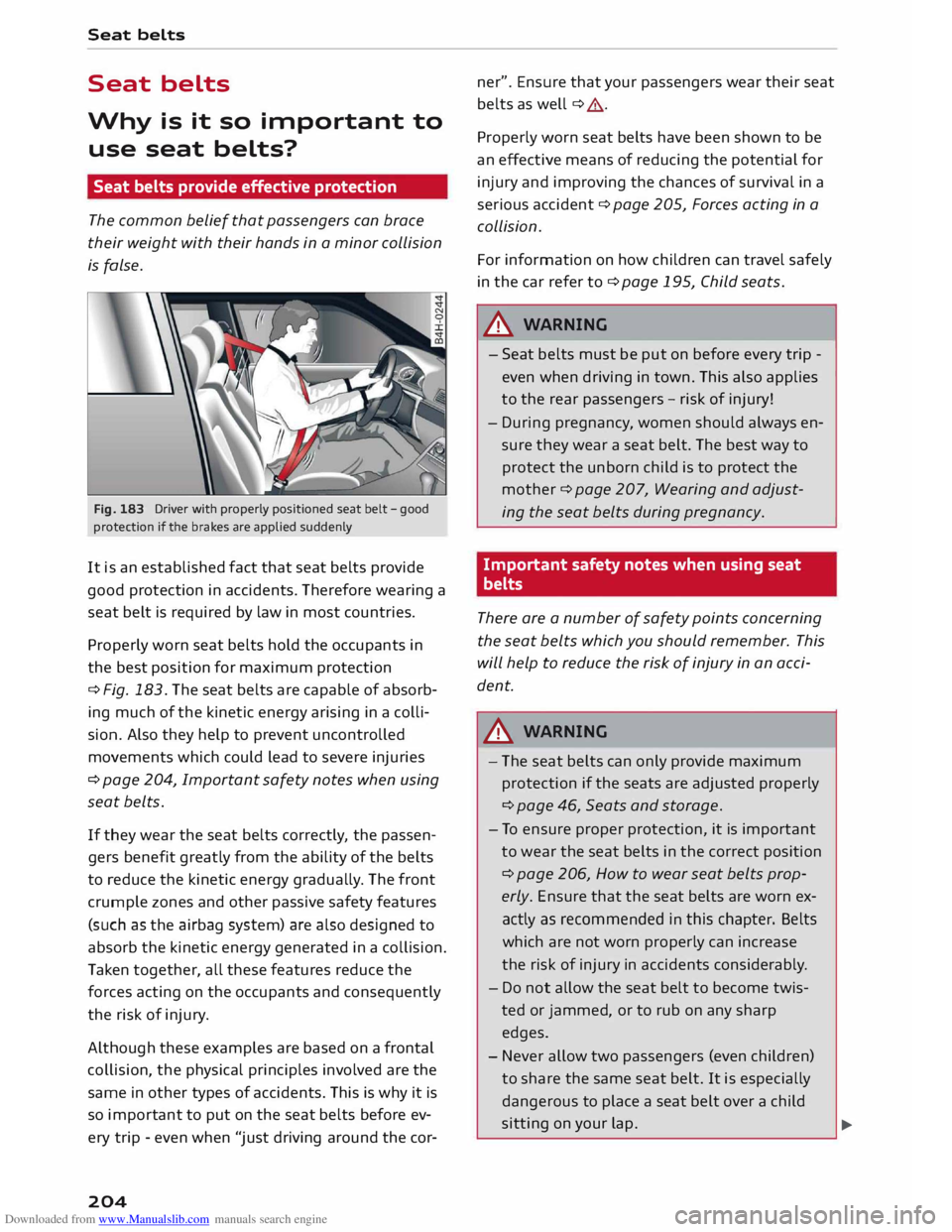
Fig. 183 Driver with properly positioned seat belt -good
protection if the brakes are applied suddenly
It is an established fact that seat belts provide
good protection in accidents. Therefore wearing a
seat belt is required by law in most countries.
Properly worn seat belts hold the occupants in
the best position for maximum protection
¢ Fig. 183. The seat belts are capable of absorb
ing much of the kinetic energy arising in a colli
sion. Also they help to prevent uncontrolled
movements which could lead to severe injuries
¢ page 204, Important safety notes when using
seat belts.
If they wear the seat belts correctly, the passen
gers benefit greatly from the ability of the belts
to reduce the kinetic energy gradually. The front
crumple zones and other passive safety features
(such as the airbag system) are also designed to
absorb the kinetic energy generated in a collision.
Taken together, all these features reduce the
forces acting on the occupants and consequently
the risk of injury.
Although these examples are based on a frontal
collision, the physical principles involved are the
same in other types of accidents. This is why it is
so import ant to put on the seat belts before ev
ery trip -even when "just driving around the cor-
204 ner".
Ensure that your passengers wear their seat
belts as well ¢ ,&.
Properly worn seat belts have been shown to be
an effective means of reducing the potential for
injury and improving the chances of survival in a
serious accident ¢ page 205, Forces acting in a
collision.
For information on how children can travel safely
in the car refer to¢ page 195, Child seats .
.lD.. WARNING
- Seat belts must be put on before every trip -
even when driving in town. This also applies
to the rear passengers -risk of injury!
- During pregnancy, women should always en
sure they wear a seat belt. The best way to
protect the unborn child is to protect the
mother ¢ page 207, Wearing and adjust
ing the seat belts during pregnancy.
Important safety notes when using seat
belts
There are a number of safety points concerning
the seat belts which you should remember. This
will help to reduce the risk of injury in an acci
dent.
.lD.. WARNING
- The seat belts can only provide maximum
protection if the seats are adjusted properly
¢page 46, Seats and storage.
- To ensure proper protection, it is important
to wear the seat belts in the correct position
¢ page 206, How to wear seat belts prop
erly. Ensure that the seat belts are worn ex
actly as recommended in this chapter. Belts
which are not worn properly can increase
the risk of injury in accidents considerably.
- Do not allow the seat belt to become twis
ted or jammed, or to rub on any sharp
edges.
- Never allow two passengers (even children)
to share the same seat belt. It is especially
dangerous to place a seat belt over a child
sitting on your lap.
�
Page 210 of 284
Downloaded from www.Manualslib.com manuals search engine Seat
belts
_& WARNING
During pregnancy, women should especially
make sure to wear the lap portion of the seat
belt as low as possible across the hips so that
there is no pressure on the stomach.
Taking off the seat belts
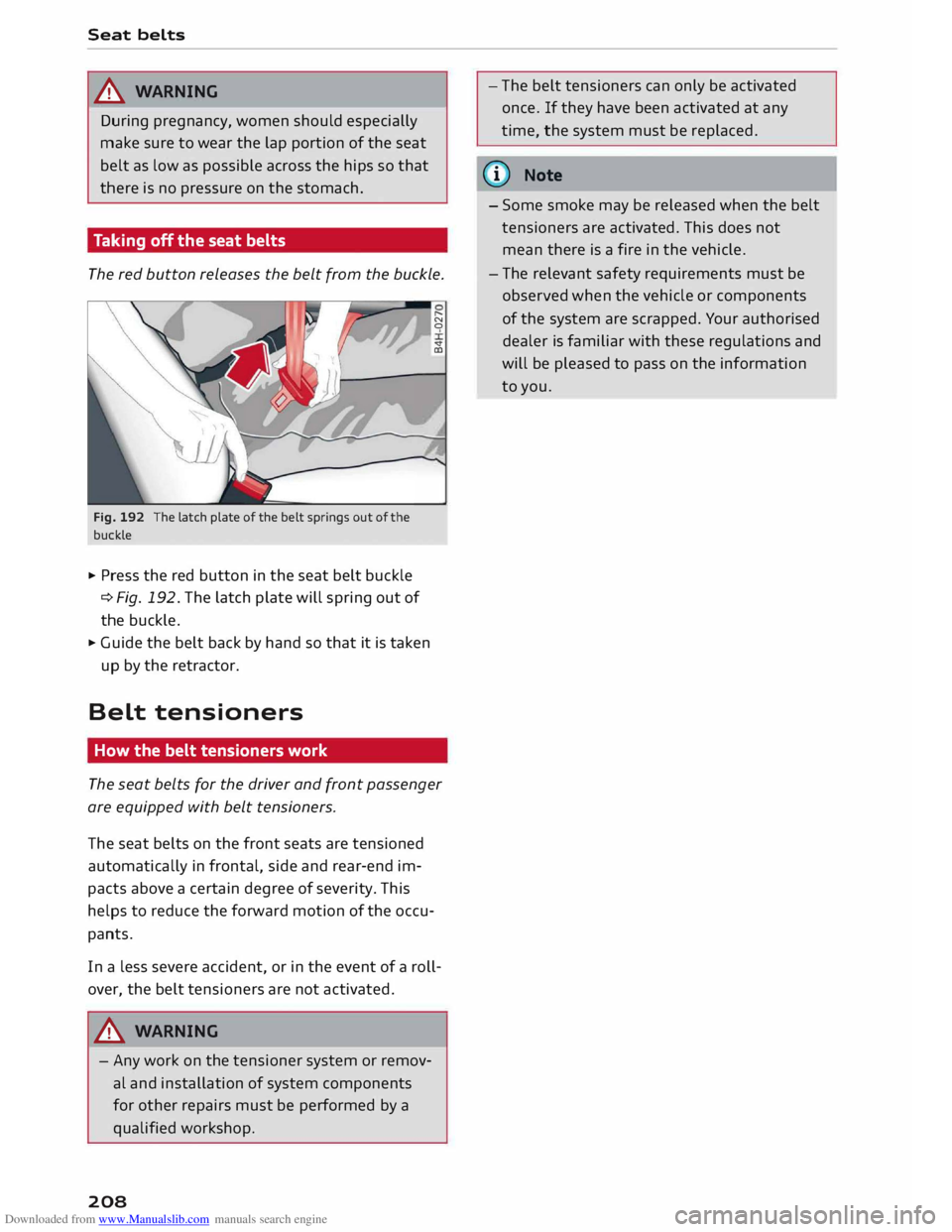
The red button releases the belt from the buckle.
Fig. 192 The latch plate of the belt springs out of the
buckle
• Press the red button in the seat belt buckle
¢ Fig. 192. The latch plate will spring out of
the buckle.
• Guide the belt back by hand so that it is taken
up by the retractor.
Belt tensioners
How the belt tensioners work ,...
N
0
'
The seat belts for the driver and front passenger
are equipped with belt tensioners.
The seat belts on the front seats are tensioned
automatically in frontal, side and rear-end im
pacts above a certain degree of severity. This
helps to reduce the forward motion of the occu
pants.
In a less severe accident, or in the event of a roll
over, the belt tensioners are not activated.
_& WARNING
- Any work on the tensioner system or remov
al and installation of system components
for other repairs must be performed by a
qualified workshop.
208 -
The belt tensioners can only be activated
once. If they have been activated at any
time, the system must be replaced.
({D Note
- Some smoke may be released when the belt
tensioners are activated. This does not
mean there is a fire in the vehicle.
- The relevant safety requirements must be
observed when the vehicle or components
of the system are scrapped. Your authorised
dealer is familiar with these regulations and
will be pleased to pass on the information
to you.
Page 212 of 284
Downloaded from www.Manualslib.com manuals search engine Airbag
system
- For safety reasons, the alternator and the
starter are both disconnected from the bat
tery via a pyrotechnic circuit breaker in se
vere accidents.
-Any repairs to the pyrotechnic circuit
breaker must always be performed by a
qualified workshop - risk of accident!
- The relevant safety requirements must be
observed when the vehicle or the circuit
breaker are scrapped.
When are the airbags triggered?
One or more airbag systems are triggered in se
vere collisions, depending on the circumstances.
The airbag system is not triggered in minor colli
sions, or in rear collisions, or if the car overturns.
In these situations, the occupants are protected
by wearing the seat belts.
Factors determining the triggering response
It is not possible to define the exact triggering
response of the airbag system in all possible sit
uations, since the circumstances in different
types of accident will vary considerably. Impor
tant factors include, for example, the nature
(ha rd or soft) of the object which the car hits, the
angle of impact, vehicle speed and so on.
Whether the airbags are triggered depends pri
marily on the vehicle deceleration rate resulting
from the collision. By processing the signals from
the sensors located in the vehicle, the electronic
control unit is immediately able to evaluate the
severity of the collision and activate the restraint
systems accordingly. If the deceleration rate is
below the predefined reference value in the con
trol unit the airbags will not be triggered, even
though the accident may cause extensive damage
to the car.
([J) Note
The airbag releases a fine dust when it in
flates. This is quite normal and does not
mean there is a fire in the vehicle.
l l
Not available in all export vehicles.
210 Front
airbags
Important notes on front passenger's
airbag
A AIRBAG
�� � t4 (ill
c::::::=J
®
CJO
00
\1 '� ,�(]
-� ,Y
.;::p
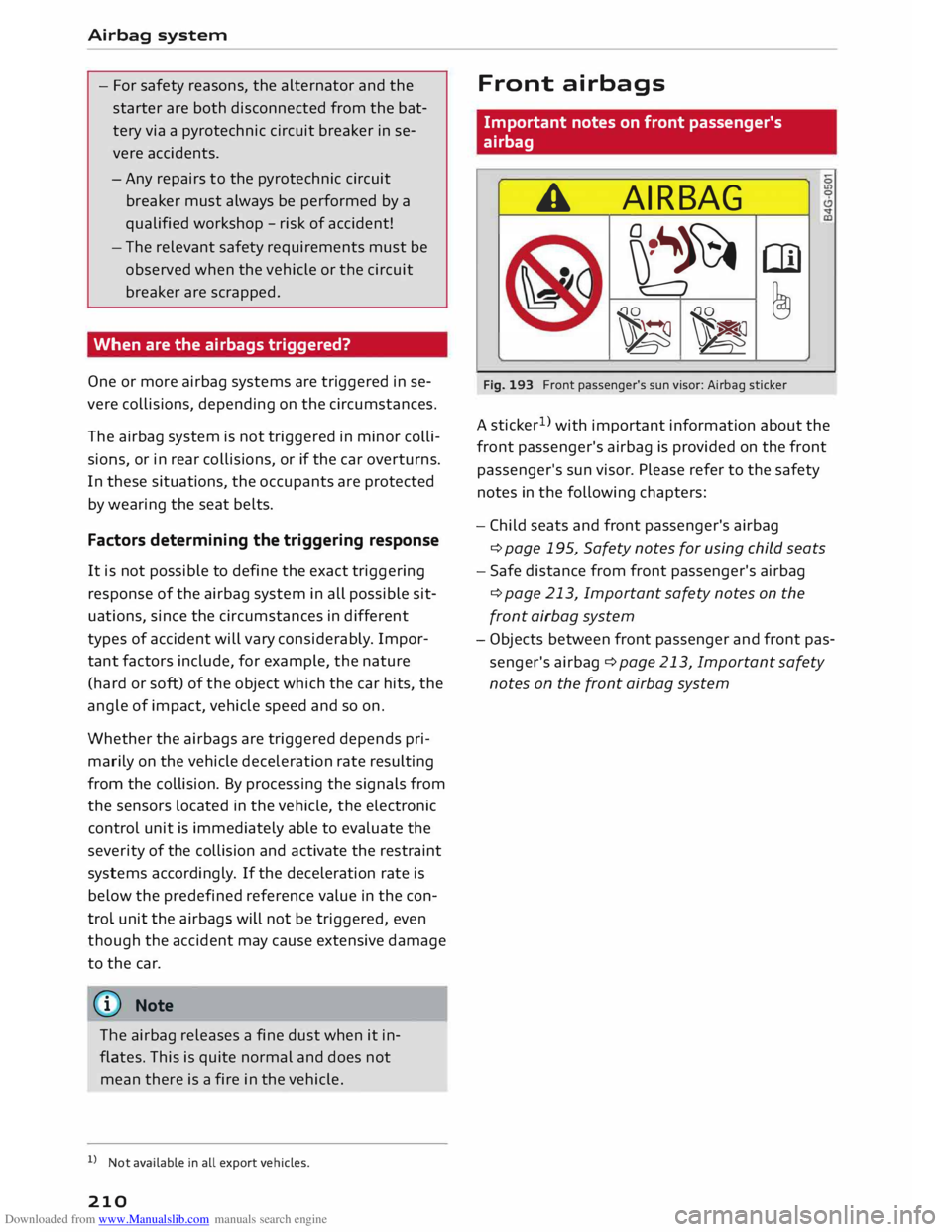
Fig. 193 Front passenger's sun visor: Airbag sticker
A sticker 1
>
with important information about the
front passenger's airbag is provided on the front
passenger's sun visor. Please refer to the safety
notes in the following chapters:
- Child seats and front passenger's airbag
¢ page 195, Safety notes for using child seats
- Safe distance from front passenger's airbag
¢ page 213, Important safety notes on the
front airbag system
- Objects between front passenger and front pas
senger's airbag c:::>page 213, Important safety
notes on the front airbag system
Page 213 of 284
Downloaded from www.Manualslib.com manuals search engine Deactivating
the front passenger's airbag
Applies to vehicles: with key-operated switch for front pas
senger's airbag
If an airbag has been deactivated, it should be
reactivated as soon as possible so that it can
continue to give the required protection.
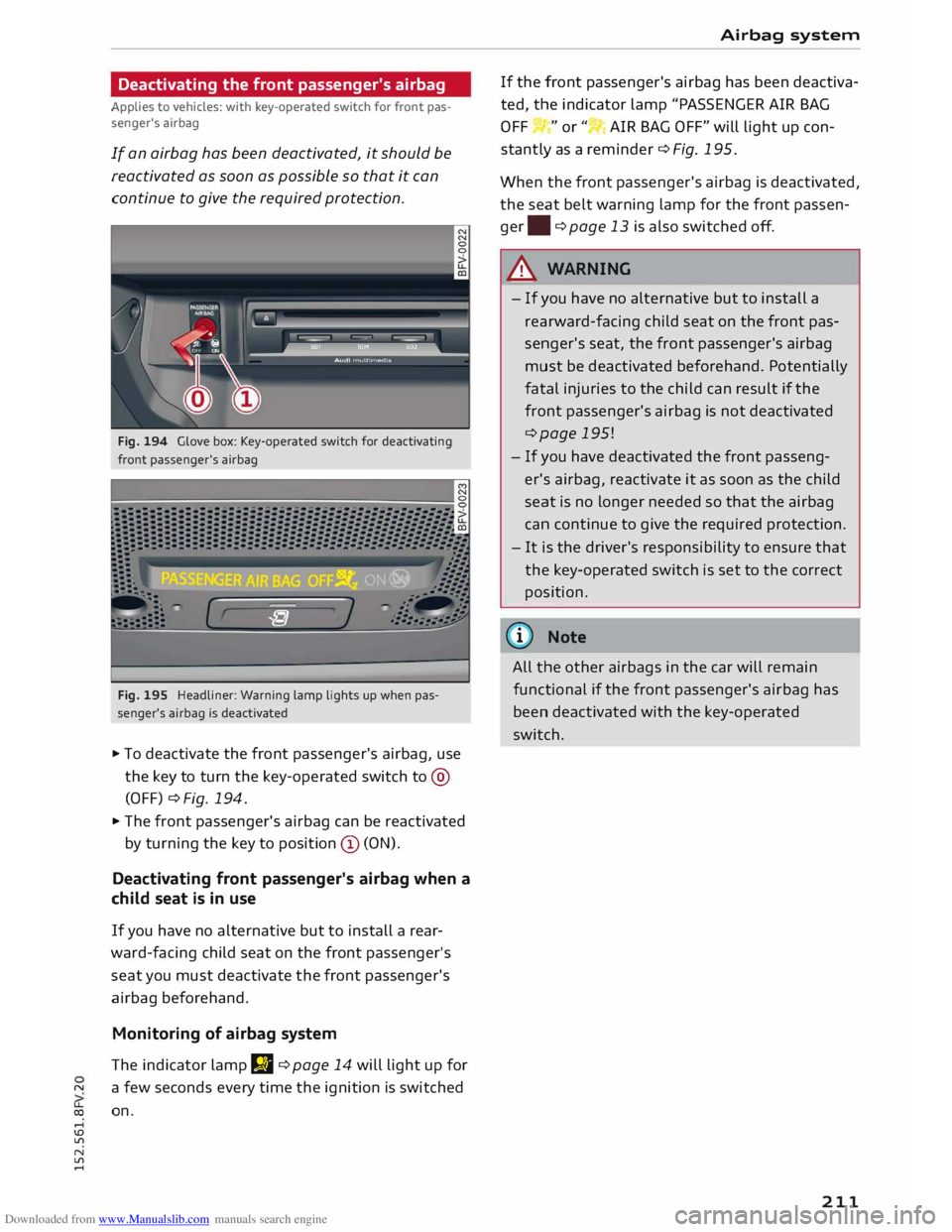
Fig. 194 Glove box: Key-operated switch for deactivating
front passenger's airbag
Fig. 195 Headliner: Warning lamp lights up when pas
senger's airbag is deactivated
... To deactivate the front passenger's airbag, use
the key to turn the key-operated switch to@
(OFF) ¢ Fig. 194 .
... The front passenger's airbag can be reactivated
by turning the key to position (D (ON).
Deactivating front passenger's airbag when a
child seat is in use
If you have no alternative but to install a rear
ward-facing child seat on the front passenger's
seat you must deactivate the front passenger's
airbag beforehand.
Monitoring of airbag system
The indicator lamp JJI ¢ page 14 will light up for
"' a few seconds every time the ignition is switched
� on.
,-1
\D U'l
N
U'l
,-1 Airbag
system
If the front passenger's airbag has been deactiva
ted, the indicator lamp "PASSENGER AIR BAG
OFF "or" AIR BAG OFF" will light up con
stantly as a reminder ¢Fig. 195.
When the front passenger's airbag is deactivated,
the seat belt warning lamp for the front passen
ger. ¢ page 13 is also switched off.
A WARNING
- If you have no alternative but to install a
rearw ard-facing child seat on the front pas
senger's seat, the front passenger's airbag
must be deactivated beforehand. Potentially
fatal injuries to the child can result if the
front passenger's airbag is not deactivated
¢page 195!
- If you have deactivated the front passeng
er's airbag, reactivate it as soon as the child
seat is no longer needed so that the airbag
can continue to give the required protection.
- It is the driver's responsibility to ensure that
the key-operated switch is set to the correct
position.
((J) Note
All the
other
airbags in the car will remain
functional if the front passenger's airbag has
been deactivated with the key-operated
switch .
211
Page 223 of 284
Downloaded from www.Manualslib.com manuals search engine 0
N
co
....
\D L/'l
N
L/'l
.... -
Never spill fluids on a hot engine. These flu
ids can cause a fire (e.g. radiator anti
freeze).
- Take care not to cause short circuits in the
electrical system, especially when working
on the battery.
- When working in the engine compartment
be aware that the radiator fan may start
running suddenly, even if the ignition is
switched off-risk of injury!
- Do not unscrew the cap on the expansion
tank when the engine is hot. The cooling
system is under pressure.
- Protect face, hands and arms by covering
the cap with a large, thick rag to protect
against escaping coolant and steam.
- Never remove the engine cover panel -risk
of burns!
- If any tests have to be performed with the
engine running, there is an extra safety risk
from the rotating parts, such as the drive
belts, alternator and radiator fan, etc., and
from the high-voltage ignition system.
- Vehicles with automatic gearbox: Never
open the throttle inadvertently (for instance
by hand from the engine compartment) if a
gear is engaged while the vehicle is station
ary with the engine running. The vehicle
could otherwise start moving immediately
and possibly cause an accident.
- Observe the following additional warnings if
work on the fuel system or the electrical
system is necessary:
- Always disconnect the battery.
- Do not smoke.
- Never work near naked flames.
- Always keep an approved fire extinguisher
immediately available.
CD CAUTION
When topping up fluids make sure the correct
fluid is put into the correct filler opening. This
can otherwise cause serious malfunctions or
engine damage. Checking
and topping up fluids
® For the sake of the environment
Inspect the ground underneath your vehicle
regularly so that any leaks are detected at an
early stage. If you find spots of oil or other
fluids, have your vehicle inspected in the
workshop.
{D) Note
On right-hand drive vehicles* some of the
containers/ reservoirs mentioned below are
located on the other side of the engine com
partment.
Opening the bonnet
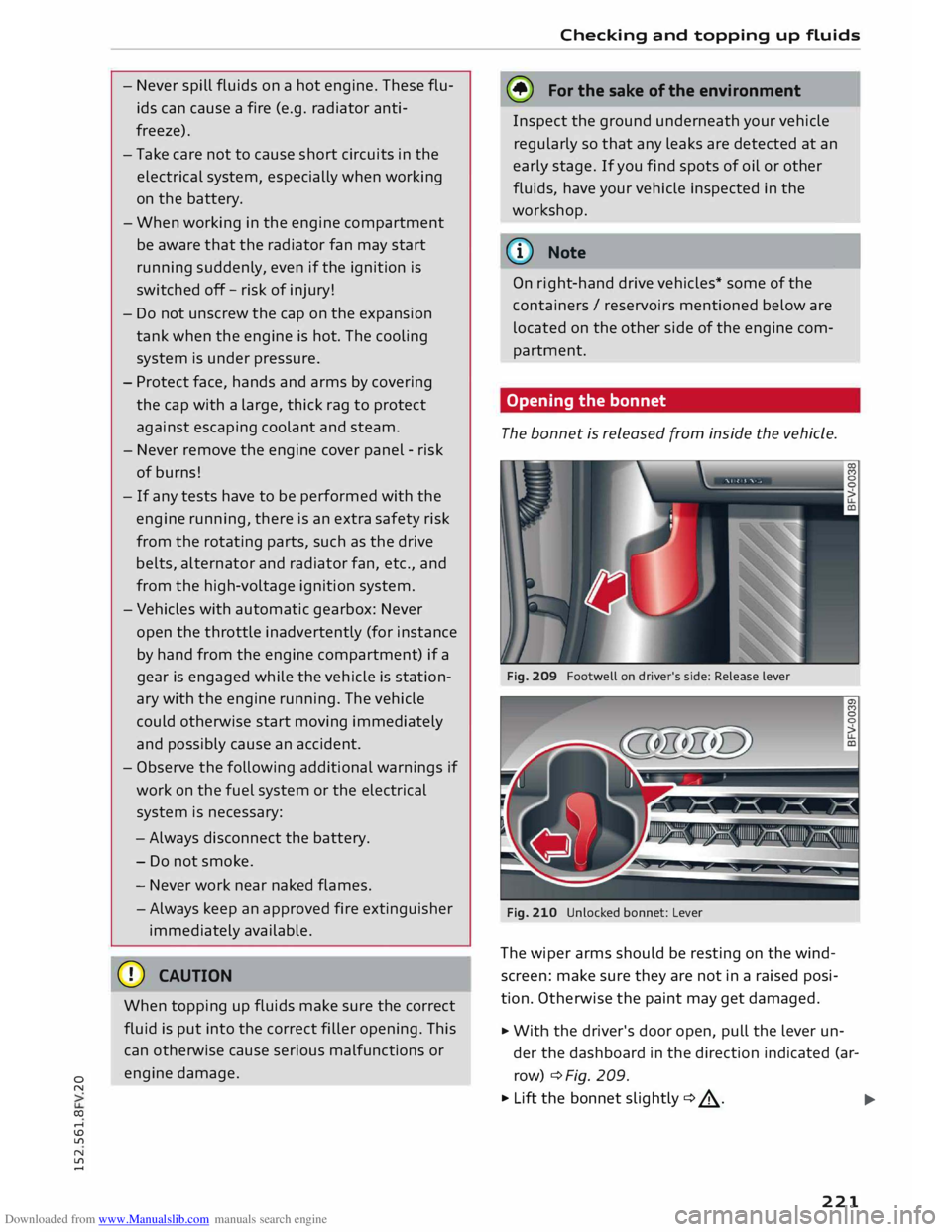
The bonnet is released from inside the vehicle.
Fig. 209 Footwell on driver's side: Release lever
Fig. 210 Unlocked bonnet: Lever
The wiper arms should be resting on the wind
screen: make sure they are not in a raised posi
tion. Otherwise the paint may get damaged.
� With the driver's door open, pull the lever un
der the dashboard in the direction indicated (ar
row) ¢ Fig. 209.
� Lift the bonnet slightly¢.&_.
11111>
221
Page 232 of 284
Downloaded from www.Manualslib.com manuals search engine Checking
and topping up fluids
- Inspection or oil change reminder: After acer
tain mileage, a service reminder will appear on
the infotainment display each time the ignition
is switched on/off¢ Fig. 218. The distance or
time remaining will be shown briefly.
- Inspection or oil change due: When your vehi
cle is due for an inspection, oil change or both,
the corresponding reminder Inspection due!,
Oil change due! or Oil change and inspection
due! will appear briefly after you switch the ig
nition on/off.
Checking the service intervals
You can look up the distance and time remaining
until the next oil change and next service inspec
tion. Select the following on the infotainment
system: I MENU I button > Car > left control button
> Se rvicing & checks > Service intervals. You can
not check the service interval for the first 500 km
or so after resetting the display or when your ve
hicle is new.
CD CAUTION
- Keeping to the correct service intervals is
most important for the service life and re
sidual value of the vehicle (and especially
for the life of the engine). Services must al
ways be carried out promptly, even if the
mileage is low.
- The time until the next oil change is not
counted down if the battery is disconnec
ted. If your vehicle is out of service for an
extended period, please refer to the Service
Schedule for details of the next service
date.
230
Page 233 of 284
Downloaded from www.Manualslib.com manuals search engine 0
N
co
....
\D L/'l
N
L/'l
.... Wheels
and tyres
Wheels General notes
... Inspect the tyres regularly for damage (cuts,
cracks or blisters, etc.). Remove any foreign
bodies embedded in the treads.
... If you have to drive over a kerb or similar obsta
cle, drive very slowly and as near as possible at
a right angle to the kerb.
... Damaged rims or tyres must be replaced imme
diately.
... Keep grease, oil and fuel off the tyres.
... Mark
the wheels before taking them off so that
they rotate in the same direction when refitted.
... When removed, the wheels should be stored
flat in a cool, dry and preferably dark place.
CD CAUTION
- Please note that summer and winter tyres
are optimised for the prevailing road condi
tions at different times of year. We recom
mend that you use winter tyres during the
winter months. At low temperatures, sum
mer tyres lose their elasticity and grip, and
braking performance also suffers as a re
sult. Cracks can form in the tread block on
summer tyres if they are used at very cold
temperatures, and this can cause perma
nent damage to the tyres. An increase in
rolling noise and tyre imbalance may result
from this damage.
- Machined, polished or chrome-plated rims
must not be used in winter conditions. The
process used to manufacture these types of
wheel rim does not provide adequate sur
face protection against corrosion, and the
rims can be permanently damaged by road
salt or similar.
New wheels or tyres
It is best to have all servicing of wheels and tyres
performed by a qualified workshop, since they
have the necessary special tools and replacement
parts and trained personnel. Wheels
and tyres
... New tyres do not yet give maximum grip. When
driving with new tyres, drive at moderate
speeds and be especially careful during the first
500 km.
... All four wheels must be fitted with tyres of the
same type, size (rolling circumference) and
preferably the same tread pattern.
... Tyres should be replaced in pairs and not indi
vidually (i.e. both front tyres or both rear tyres
together).
... We recommend the use of Audi Genuine Tyres.
If you wish to use other tyres, please note that
the actual size can differ from the nominal size
marked on the tyre ¢.&_
.
... If you wish to purchase a different combination
of rims and tyres than the ones fitted on the ve
hicle during production, it is advisable to con
sult a qualified workshop beforehand ¢.&_
.
On vehicles with four-wheel drive, all four wheels
must always be fitted with tyres of the same
type, make and tread pattern, as otherwise the
driveline can be damaged by variations in the
wheel speeds. For the same reason, only use a
spare wheel* which has the same rolling circum
ference as the normal road wheels.
If the spare wheel* is not the same type as the
tyres fitted on the car (for example if the car has
winter tyres or wide-section tyres) you should on
ly use the spare wheel* if a puncture occurs, and
then only for a short period of time. In this case,
please drive with extra care. Refit a normal road
wheel as soon as possible.
Manufacturing date
The manufacturing date is indicated on the tyre
sidewall (possibly only on the inner side of the
wheel):
DOT ... 2214 ...
means, for example, that the tyre was produced
in the 22nd week of 2014.
Audi Genuine Tyres
Audi Genuine Tyres with the marking "AO" or
"RO" are specially matched to your Audi. When
used properly, these tyres meet the highest
standards in safety and handling. Your specialist
retailer will be glad to provide more information . ..,..
231
Page 237 of 284
Downloaded from www.Manualslib.com manuals search engine 0
N
co
....
\D Lfl
N
Lfl
.... lamp
[Bl and a message on the infotainment dis
play. If only one tyre is affected, the display will
indicate its position.
Each time you change a tyre, change the wheels
round or change the tyre pressures on your vehi
cle (e.g. when switching from partial load to full
load and vice-versa), you must store the new tyre
pressures on the infotainment system
¢ page 235. Monitoring of the tyre pressures is
based on the tyre pressures you have stored. The
inflation pressures recommended for your vehicle
are given on the tyre pressure sticker
¢ page 233, Fig. 220.
The rolling circumference and vibration can
change and cause a tyre pressure warning if:
- The inflation pressure in one or more tyres is
too low.
- The tyre has suffered structural damage.
- The wheels were changed or the tyre pressures
were changed and the new tyre pressures were
not stored ¢ page 235.
- You are driving with the temporary spare
wheel*.
Indicator lamps
RI]- Loss of pressure on one or more tyres¢ A.
Check and change or repair the tyre(s). Check and
adjust the inflation pressures of all four tyres
again and store the new tyre pressures on the in
fotainment system¢ page 235.
ffim (Tyre Pressure Monitoring System) Tyre
pressure: fault. See owner's manual -If� ap
pears and the indicator lamp [Bl in the instru
ment cluster display flashes for approx. one mi
nute and then remains lit after you have switched
on the ignition or while you are driving, there is a
fault in the system. Try to store the correct tyre
pressures ¢ page 235. If the indicator lamp
does not go out or if it comes on again after a
short time, drive to a qualified workshop without
delay and have the fault rectified.
&_ WARNING
- If the tyre pressure loss indicator appears
on the display, slow down immediately and
avoid any severe braking or steering ma- Wheels
and tyres
noe uvres. As soon as you can do so safely,
stop and check the tyres and the tyre pres
sures.
- It is the driver's responsibility to ensure that
the tyre pressures are correct. For this rea
son you must check the tyre pressures regu
larly.
- Under certain conditions (e.g. driving at
high speeds, on ice and snow or on poor
road surfaces) the tyre pressure loss indica
tor may not appear immediately.
- Run-flat tyres* may only be used on vehicles
which were originally equipped with this
type of tyre.
- If a malfunction occurs in the ESC system,
the tyre pressure loss indicator may also be
out of action.
- When driving with snow chains, a system
malfunction can occur.
- The tyre pressure loss indicator on your Audi
is specially matched to tyres with the mark
ing "AO" or "RO" ¢ page 231. We recom
mend that you use these tyres.
Storing tyre pressure settings
Applies to vehicles: with tyre pressure loss indicator
When you change a tyre or the tyre pressure on
your vehicle, you must confirm the change on the
infotainment system.
� Before storing the new tyre pressures, check
that the current pressures on all four wheels
correspond to the specified values and adapt
the pressures to the current load ¢ page 232.
� Switch on the ignition.
� Select the
following on the infotainment sys
tem: I MENU I button >Car> left control button
> Servicing & checks > Tyre pressure loss indi
cator.
@ Note
Do not store the tyre pressures if you are driv
ing with snow chains. Otherwise, a system
malfunction may occur .
235
Page 238 of 284
Downloaded from www.Manualslib.com manuals search engine Care
of vehicle and cleaning
Care of vehicle and
cleaning
General notes
Regular and careful care helps to maintain the
value of the vehicle. This may also be one of the
requirements for upholding any warranty claims
in the event of corrosion or paint defects.
The required car care products are available from
Audi dealers or specialist retailers. Please follow
the instructions for use on the packaging.
A WARNING
- Cleaning products and other materials used
for car care can damage health if misused.
- Car care products can contain toxic substan
ces and must always be kept in a safe place
out of reach of children.
®, For the sake of the environment
- Please choose care products that are not
harmful to the environment.
- Surplus cleaning materials should not be
disposed of together with ordinary house
hold waste.
Washing the vehicle
The longer residues are allowed to remain on the
vehicle, the more damage they can do to the
paintwork. High temperatures (for instance in di
rect sunlight) further intensify the damage.
Before washing, soak heavy dirt with plenty of
water.
Stubborn dirt, such as bird droppings or resinous
tree sap, is best removed with plenty of water
and a micro-fibre cloth.
After the period when salt is put on the roads,
have the underside of the vehicle washed thor
oughly.
High-pressure cleaners
When cleaning the vehicle with a high-pressure
cleaner, always follow the operating instructions
for the equipment. This applies particularly to
236 the
operating pressure and the spraying distance.
Do not point the spray jet directly at the seals on
the windows, doors, bonnet or boot lid, or at the
tyres, rubber hoses, insulating material or sen
sors*. Maintain a distance of at least 40 cm.
Do not use a high-pressure cleaner to remove
snow and ice.
Never use high-pressure cleaners with a round-jet
nozzle or "dirt blasters".
The water must not be hotter than 60 °C.
Automatic car washes
Spray the vehicle with water before washing.
Ensure that the windows are closed and that the
windscreen wipers are switched off. Follow the
car wash operator's rules and recommendations,
especially if any accessories are attached to your
vehicle.
If possible use a brush less car wash.
Washing by hand
Clean the car with a soft sponge or brush, start
ing on the roof and working down. Use solvent
free cleaning agents.
Washing matt-painted vehicles by hand
To avoid damaging the paintwork when washing
the car, first remove any dust, sand and grit. In
sects, grease stains and fingerprints are best re
moved using a special cleaning agent for matt
painted surfaces.
Apply the product with a micro-fibre cloth. Do
not apply too much pressure to avoid damaging
the paintwork.
Rinse the car thoroughly with water. Then clean
the car with a neutral shampoo and a soft micro
fibre cloth.
Rinse the car with lots of water again and then
let it dry in the air. Remove any water stains with
a chamois.
A WARNING
-
- Follow the rules and recommendations of
the car wash operator and do not wash the
�