warning AUDI TT COUPE 2016 Owners Manual
[x] Cancel search | Manufacturer: AUDI, Model Year: 2016, Model line: TT COUPE, Model: AUDI TT COUPE 2016Pages: 322, PDF Size: 52.86 MB
Page 282 of 322
Downloaded from www.Manualslib.com manuals search engine Emergency assistance
car to keep your balance and take care not
to slip.
Raising the vehicle
The vehicle must be li~ed w ith the jock first be
fore the wheel can be removed.
-fi·--
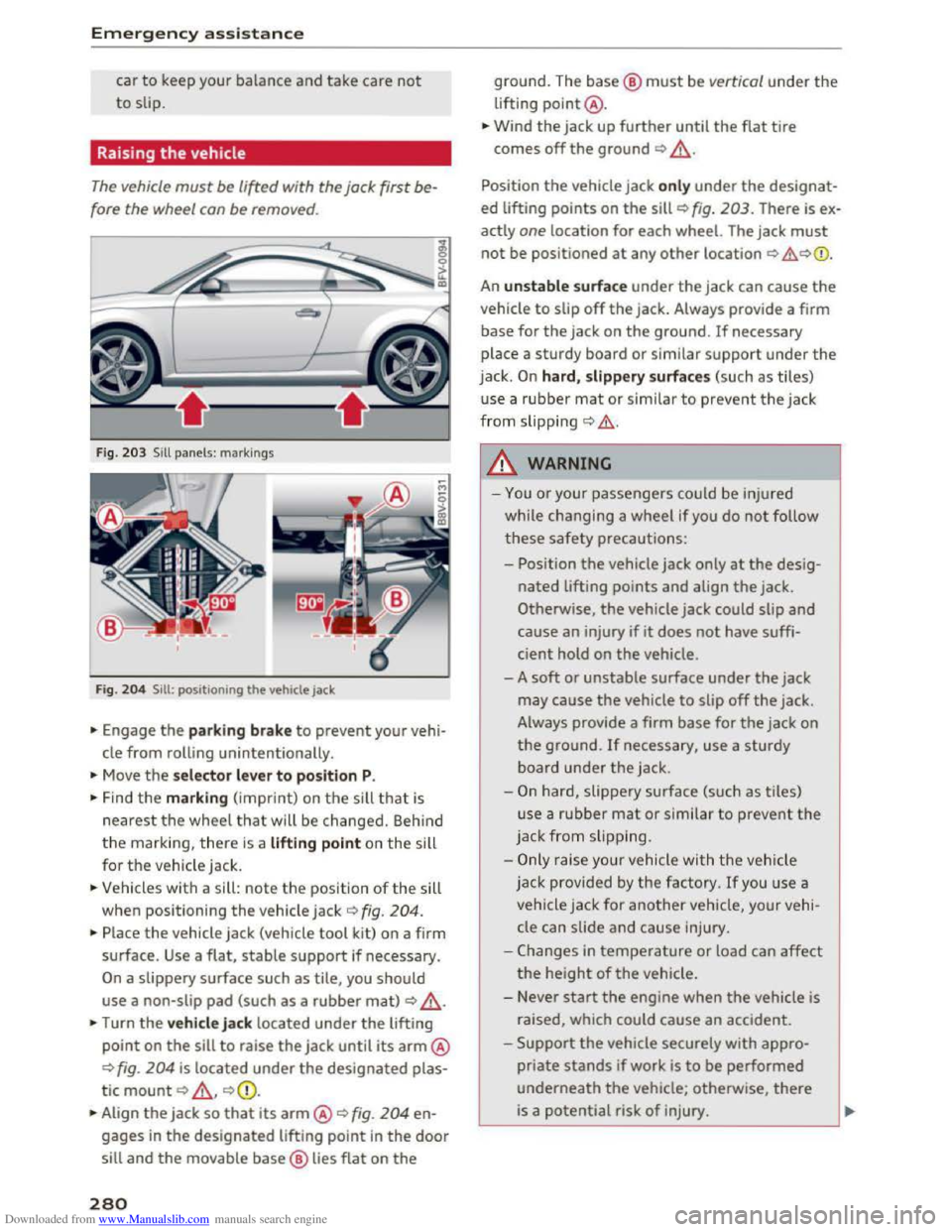
Fig. 203 Sill panels: markings
Fig.
204 Sill : po sitioning th e ve hicl e jack
... Engage the parking brake to prevent your vehi
cle from rolling unintentionally.
... Move the selector lever to position P.
... Find the marking (imprint) on the sill that is
nearest the wheel that will be changed. Behind
the marking, there is a lifting point on the sill
for
the vehicle jack.
... Vehicles with a sill: note the position of the sill
when positioning
the vehicle jack o fig. 204.
... Place the vehicle jack (vehicle tool kit) on a firm
surface.
Use a flat, stable support if necessary.
On a slippery surface such as tile, you should
use a non-slip pad (such as a rubber mat) o _&.
... Turn the vehicle jack located under the lifting
point on the sill to raise the jack until its arm@
c:> fig. 204 is located under the designated plas
tic
mount c:> _&, c:>Q).
... Align the jack so that its arm@o fig. 204 en
gages in the designated lifting point in the door
sill and the movable base@ lies flat on the
280
ground. The base@ must be vertical under the
lifting point@ .
... Wind the jack up further until the flat tire
comes off the ground c:> _&.
Position the vehicle jack only under the designat
ed lifting points on the sill c:> fig. 203. There is ex
actly
one location for each wheel. The jack must
not be positioned at any other location c:> .&,c:>Q).
An unstable surface under the jack can cause the
vehicle to slip off the jack. Always provide a firm
base for the jack on the ground. If necessary
place a
sturdy board or similar support under the
jack. On hard, slippery surfaces (such as tiles)
u
se a rubber mat or similar to prevent the jack
from slipping c:> .&..
A WARNING
- I
-You or your passengers could be injured
while changing a
wheel if you do not follow
these safety precautions:
- Position
the vehicle jack only at the desig
nated lifting points and align the jack.
Otherwise,
the vehicle jack could slip and
cause an injury if it does not have suffi
cient hold on the vehicle.
- A
soft or unstable surface under the jack
may cause the vehicle to slip off the jack .
Always provide a firm
base for the jack on
the ground. If necessary, use a sturdy
board under the jack .
-
On hard, slippery surface (such as tiles)
use a
rubber mat or similar to prevent the
jack
from s lipp ing.
-
Only rais e your vehicle with the vehicle
jack provided by
the factory. If you use a
vehicle jack for
another vehicle, your vehi
cle can slide
and cause injury .
- Changes
in temperature or load can affect
the height of the vehicle.
- Never
start the engine when the vehicle is
raised, which could
cause an accident .
-
Support the vehicle securely with appro
priate stands if work is to be performed
underneath the vehicle; otherwise, there
is a potential risk of injury.
Page 284 of 322
Downloaded from www.Manualslib.com manuals search engine Emergency assistance
-When mounting tires with unidirectional
tread design
make su re the tread pattern is
pointed the r ight way¢ page 282.
- The wheel bolts should be clean and easy to
turn .
Check for dirt and corros ion on th e
mating surfaces of both
the wheel and the
hub. Remove all dirt from these surfaces be
fore remounting t h e wheel.
Tires with unidirectional tread design
Tires with unidirectional tread design must be
mounted with their tread pattern pointed in the
right direction.
Using a spare tire with a tread pattern
intended for use in a specific direction
When using a spare tire with a tread pattern in
tended for use in a spec ific direction, please note
the following:
- The direct ion of
rotation is marked by an arrow
o n
the side of the tire.
-If the spare tire has to be installed in the incor
rect direction, use the spare tire only tempora
rily since the tire will not be able to achieve its
optimum performance charact
eristics wit h re
gard to aqu aplaning, noise and wear.
-
We r ecommend that you pay particular atten
tion to this fact during wet weathe r and that
you ad just your speed to match road condi
tions.
- Replace
the flat tire with a new one and have it
i ns talle d on
your ve hicl e as soon as possibl e to
resto re the han dling adv antages of a unidire c
tio nal tire.
Notes on wheel changing
Please read the info rmation ¢ page 257 if you
are goi
ng to use a spare tire which is different
from
the tires on your vehicle.
Afte r you change a tire:
-Check the tire pressure on the spare immedi
ately after installation.
-
Have the wheel bolt tightening torque
checked with a torque wrench as
soon as pos-
282
sible by your authorized Audi dealer or a
qualified service station.
- With
steel and alloy wheel rims, the wheel
bolts are correctly tightened at a torque of
90 ft lb (120 Nm).
- If you notice
that the wheel bolts are corroded
and difficult
to turn while changing a tire,
they should be replaced before you check the
tightening torque.
- Replace
the flat tire with a new one and have
it installed on your vehicle as soon as
possi
ble. Remount the wheel cover .
Until then, drive with extra care and at reduced
speeds.
8_ WARNING
- I f you are going to equip your vehicle with
tires or rims which differ from those which
were factory insta
lled, then be sure to read
t he informa tion
¢ page 257.
-Always make sure the damaged wheel or
eve n a flat tire and
the jack and tool kit are
pro per ly sec ure d
in the lu ggage compart
men t and are not loose in the passeng er
com partme nt.
- In an accident or sudde n maneuver they
could fly forw ard, in juri ng anyo ne in the v e
hicle.
-
Always s to re damaged whe el, jack and tools
s ecure ly i n t he luggage co m part ment.
Oth
erwi se, in an accid ent or sudde n m aneu ve r
t hey co
uld fly f orw ard , cau sing inju ry to pa s
sengers in the vehicle.
-
Page 287 of 322
Downloaded from www.Manualslib.com manuals search engine ...... N
~ ()()
......
"' "' ......
"' ....
Fuses and bulbs
Electrical fuses
Replacing fuses
A fuse
that has blown will have metal strips that
have burned through.
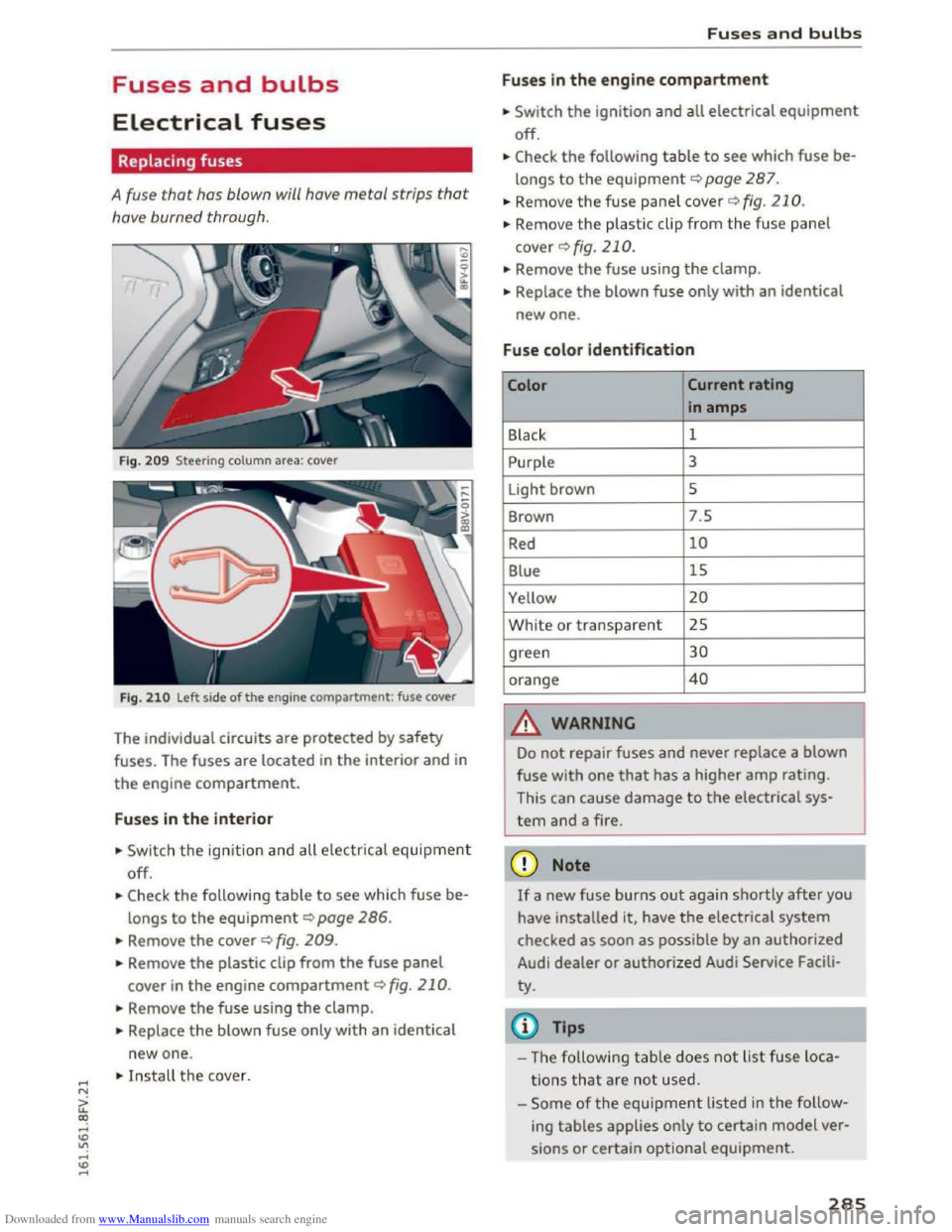
Fig. 209 Steering column area: cover
Fig.
210 Left side of the engine compartment: fuse cover
The individual circuits are protected by safety
fuses. The fuses are located in the interior and in
the engine compartment.
Fuse s in the interior
... Switch the ign ition and all electrical equipment
off .
... Check the following table to see which fuse be
longs to the equipment Q page 286.
• Remove the cover Q fig. 209.
• Remove the plastic clip from the fuse panel
cover in the engine compartment Q fig. 210.
• Remove the fuse using the clamp.
• Replace the blown fuse only with an identical
new one.
•Install the cover.
Fuses and bulbs
Fus es i n the engine compartment
... Switch the ignition and all electrical equipment
off .
... Check the following table to see which fuse be
longs to the equipment Qpage 287.
• Remove the fuse panel cover C)fig . 210.
• Remove the plastic clip from the fuse panel
coverQfig. 210.
• Remove the fuse using the clamp.
• Replace the blown fuse only with an identical
new one.
Fuse colo r identification
Color Current
rati
ng
in amps
Black 1
Purple 3
Light brown 5
Brown
7.5
Red 10
Blue 15
Yellow 20
White or transparent 25
green 30
orange 40
.&. WARNING
1-"="
Do not repair fuses and never replace a blown
fuse with one that has a higher amp rating.
This
can cause damage to the electrical sys
tem and a fire .
CD Note
If a new fuse burns out again shortly after you
have
installed it, have the electrical system
checked as soon as possible by an authorized
Audi dealer or authorized Audi Service Facili
ty.
@ Tips
-The following table does not list fuse loca
tions that are not used .
-
Some of the equipment listed in the follow
ing tables applies only to certain model ver
sions or certain optional equipment .
285
Page 290 of 322
Downloaded from www.Manualslib.com manuals search engine Emergency situations
Emergency situations
General
This chapter is intended for trained emergency
crews and working personnel who have the nec
essary tools and equipment to perform these
operations.
Starting by pushing or
towing
CD Note
Vehicles with an automatic transmission can
not be started by pushing or towi ng.
Starting with jumper
cables
If necessary, the engine con be started by con
necting it to the battery of another vehicle.
If the engine should fail to start because of a dis
charged or weak battery, the battery can be con
nected to the battery of another vehicle, using a
pair of jumper cables to start the engine.
Jumper cables
Use only jumper cables of sufficiently large cross
section to carry the starter current safely. Refer
to the manufacturer's specifications.
Use only jumper cables with insulated terminal
clamps which are distinctly marked:
plus(+) cable in most cases co lored red
minus(-) cable in most cases colored black.
A WARNING _,
Batteries contain electricity, acid, and gas.
Any of these can cause very serious or fatal in·
jury. Follow the instructions below for safe
handling of your vehicle's battery.
-Always shield your eyes and avoid leaning
over
the battery whenever possible.
- A discharged
battery can freeze at tempera
tures just below 32 °F (0 °C). Before con
necting a jumper cable, you must thaw the
288
frozen battery completely, otherwise it
could explode.
-
Do not allow battery acid to contact eyes or
skin. Flush any contacted area with water
immediately.
-
Improper use of a booster battery to start a
vehicle may
cause an explosion.
- Vehicle
batteries generate explosive gases.
Keep sparks, flame and lighted cigarettes
away from batteries.
-Do not try to jump start any vehicle with a
low acid level
in the battery.
-The voltage of th e booster battery must also
have a 12-volt rating. The capacity (Ah) of
the booster battery should not be lower
than that of the discharged battery. Use of
batteries of different voltage or substantial
ly different "Ah" rating may cause an exp lo
sion and personal injury.
- Never
charge a frozen battery. Gas trapped
in the ice may cause an explosion.
- Never
charge or use a battery that has been
frozen. The battery case may have be weak
ened.
-Use of batteries of different voltage or sub
stantially different capacity (Ah) rating may
cause an explosion and injury. The capacity
(Ah)
of the booster battery should not be
lower than that of the discharged battery.
- Before you check anything in the engine
compartment, always read and heed all
WARNINGS
~page 236.
CD Note
- Applying a higher voltage booster battery
will cause expensive damage to sensitive
electronic
components, such as control
units, relays, radio, etc.
-There must be no electrical contact between
the vehicles as otherwise current could al
ready start to flow as soon as the positive
( +
)terminals are connected.
Tips
T he discharged battery must be properly con-
nected to the vehicle's electrical system. ~
Page 291 of 322
Downloaded from www.Manualslib.com manuals search engine ..... N
G: CX)
.....
"' U"I
.....
"' .....
When jump starting or charging the battery,
never connect the negative ground cable to
the battery negative post because the battery
manager system must be able to detect the
battery's state of charge. Always connect the
negative ground cable to the negative ground
post of the battery manager control unit.
Use of jumper cables
Make sure to connect the jumper cable clamps in
exactly the order described below!
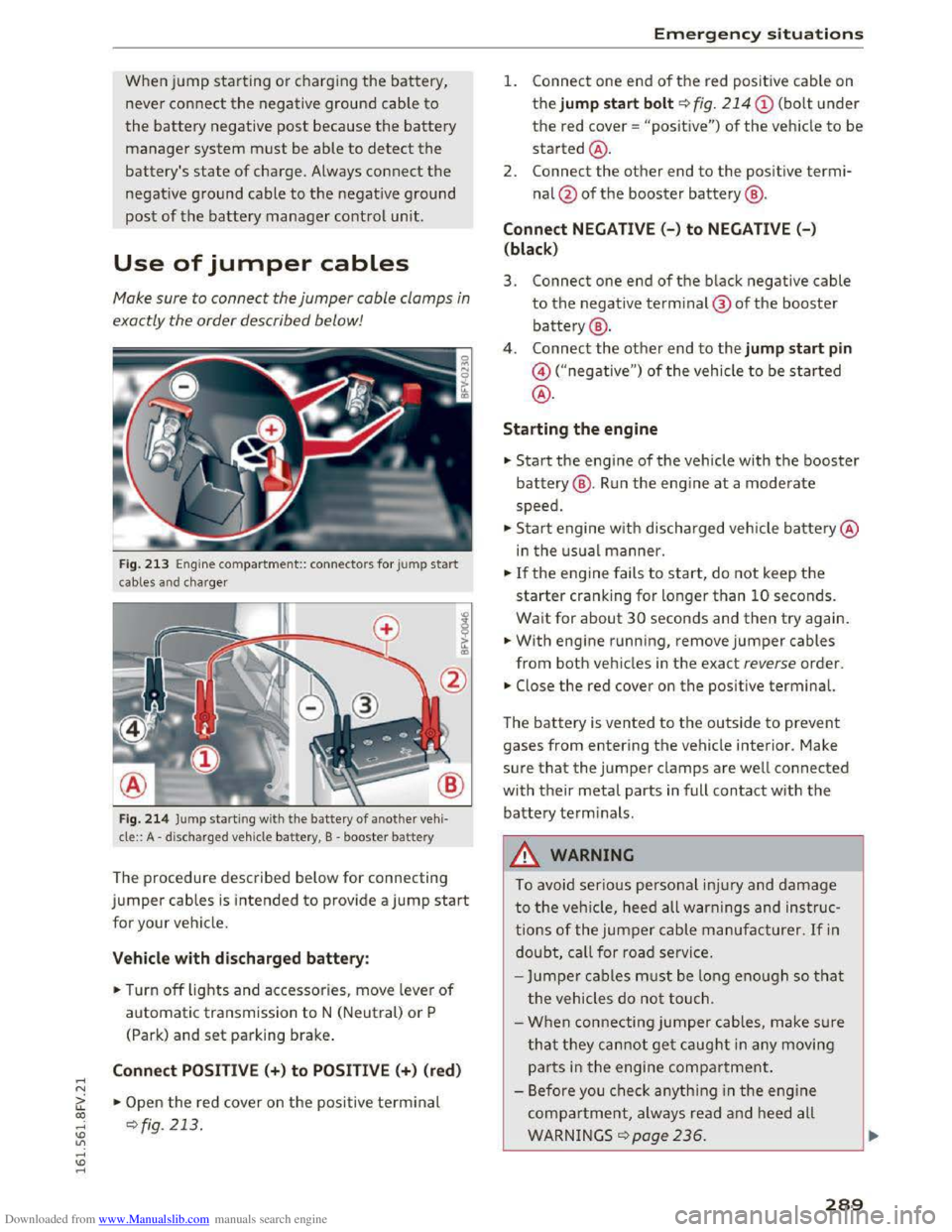
Fig. 213 Engine compa rtment:: connecto rs for jump start
cables and cha rger
Fig.
214 Jump starti ng with the battery of another vehi·
cle:: A -discharged vehicle battery, B -booster battery
The procedure described below for connecting
jumper cables is intended to provide a jump start
for your vehicle.
Vehicle with discharged battery:
.. Turn off lights and accessories, move lever of
automatic transmission to N (Neutral) or P
(Park)
and set parking brake.
Connect POSITIVE (+) to POSITIVE(+) (red)
.,.. Open the red cover on the positive terminal
~fig. 213 .
Emergency situations
1. Connect one end of the red positive cable on
the jump start bolt~ fig. 214
the red cover = "positive") of the veh icle to be
started@ .
2.
Connect the other end to the positi ve termi
nal@of the booster battery@ .
Connect NEGATIVE(-) to NEGATIVE (- )
(black)
3. Connect one end of the black negative cable
to the negative terminal@ of the booster
battery@ .
4 .
Connect the other end to the jump start pin
@("negative") of the vehicle to be started
@.
Starting the engine
.. Start the engine of the vehicle with the booster
battery@. Run the engine at a moderate
speed .
.,.. Start engine w ith discharged vehicle battery@
in the usual manner.
.,.. If the engine fails to start, do not keep the
starter cranking for longer than 10 seconds.
Wait for about 30 seconds and then try again .
.. With engine running, remove jumper cables
from both vehicles in the exact reverse order .
.. Close the red cover on the positive terminal.
The battery is vented to the outside to prevent
gases from entering the vehicle interior. Make
sure that the jumper clamps are well connected
with their metal parts in full contact with the
battery terminals .
.&. WARNING
t-==
To avoid serious personal injury and damage
to the vehicle, heed all warnings and instruc
tions of the jumper cable manufacturer. If in
doubt, call for road service.
-
Jumper cables must be long enough so that
the vehicles do not touch.
-
When connecting jumper cables, make s u re
that they cannot get caught in any moving
parts in the engine compartment.
- Before you check anything in the engine
compartment, always read and heed all
WARNINGS q page 236.
289
Page 292 of 322
Downloaded from www.Manualslib.com manuals search engine Emergency situations
CD Note
Improper hook-up of jumper cables can ruin
the generator.
- Always
connect P O SITIVE( +) to POSITIVE
(+),and N EGATIVE( -) to NEGATIVE( -)
ground post of the battery manager control
u
nit.
-
Check that a ll screw p lugs on the battery
cells are screwed in firmly . If not, tighten
plugs p rior to connecting clamp on negative
b at
tery te rminal.
- Pl
ease note that the procedure fo r con nect
i ng a
jumper cable as describ ed above ap
plies specifica lly
to the case of yo ur vehicle
being
jump started . When you are giv ing a
ju
mp start to another vehicle , d o not con
n e
ct the negative(-) c a ble to the negative
(-) terminal o n the dis ch a rged battery @
¢ fig . 214. Instead , securely connect the
negative(-) cable to either a solid metal
component that is fir m ly bolted to the en
gine block or
to the engine bloc k itself. If
the battery that is bei ng cha rged does not
vent to the outside, escaping battery gas
could ignite and exp lode!
Towing with a tow truck
General hints
Your Audi requires special handling for towing .
The follow ing information is to be used by com
mercia l
tow truck operators who know how to op
erate their equipment sa fe ly .
- Never tow your Audi. Towing will cause dam
age to the engine and transmission.
- Never wrap
the safety chains or winch cables
around
the brake lines.
-
To prevent unnecessary damage, your Audi
must be transported with a flat bed truck.
-
To load the vehicle on to the flat bed, use the
towing loop found in the vehicle tools and at
tach
to the front or rear anchorage
¢page 290 and ¢page 291.
290
A WARNING
A veh icle being towed is not safe for passen
gers . Neve r allow anyone to ride in a vehicle
be ing
towed, fo r any reason.
Front towing loop
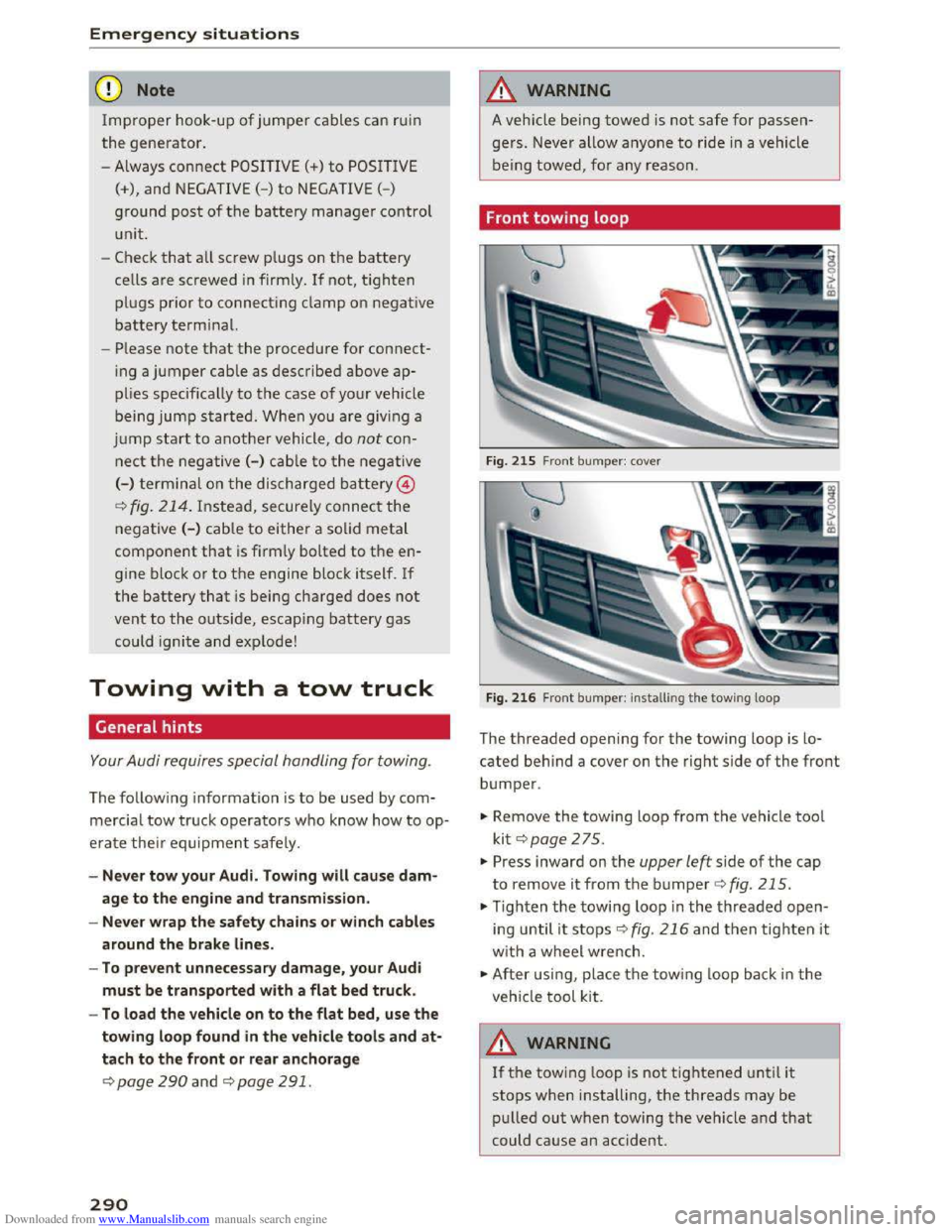
Fig. 215 Front bum per: co ver
Fig. 2 16 Front bum per: install ing the to win g loop
The threaded opening for the towing loop is lo
cated behind a cove r on the rig ht side of the front
bumper.
.. Remove the towing loop from the vehicle tool
kit¢ page 275.
.. Press inward on the upper Left side of the cap
to remove it from the b umper¢ fig. 215.
.,. T ighten the towing loop in the threaded o pen
ing
until i t s tops¢ fig. 216 a nd then tighten it
w it h a
wheel w re nch.
.,. After using, place the towing loop back in the
veh icle tool kit.
A WARNING
If t h e t ow ing loop is not tightened until it
stops when installing, the threads may be
pu lled out when towing the vehicle and that
could cause an accident.
Page 293 of 322
Downloaded from www.Manualslib.com manuals search engine ..... N
G: CX)
.....
"' U"I
.....
"' .....
Rear towing loop
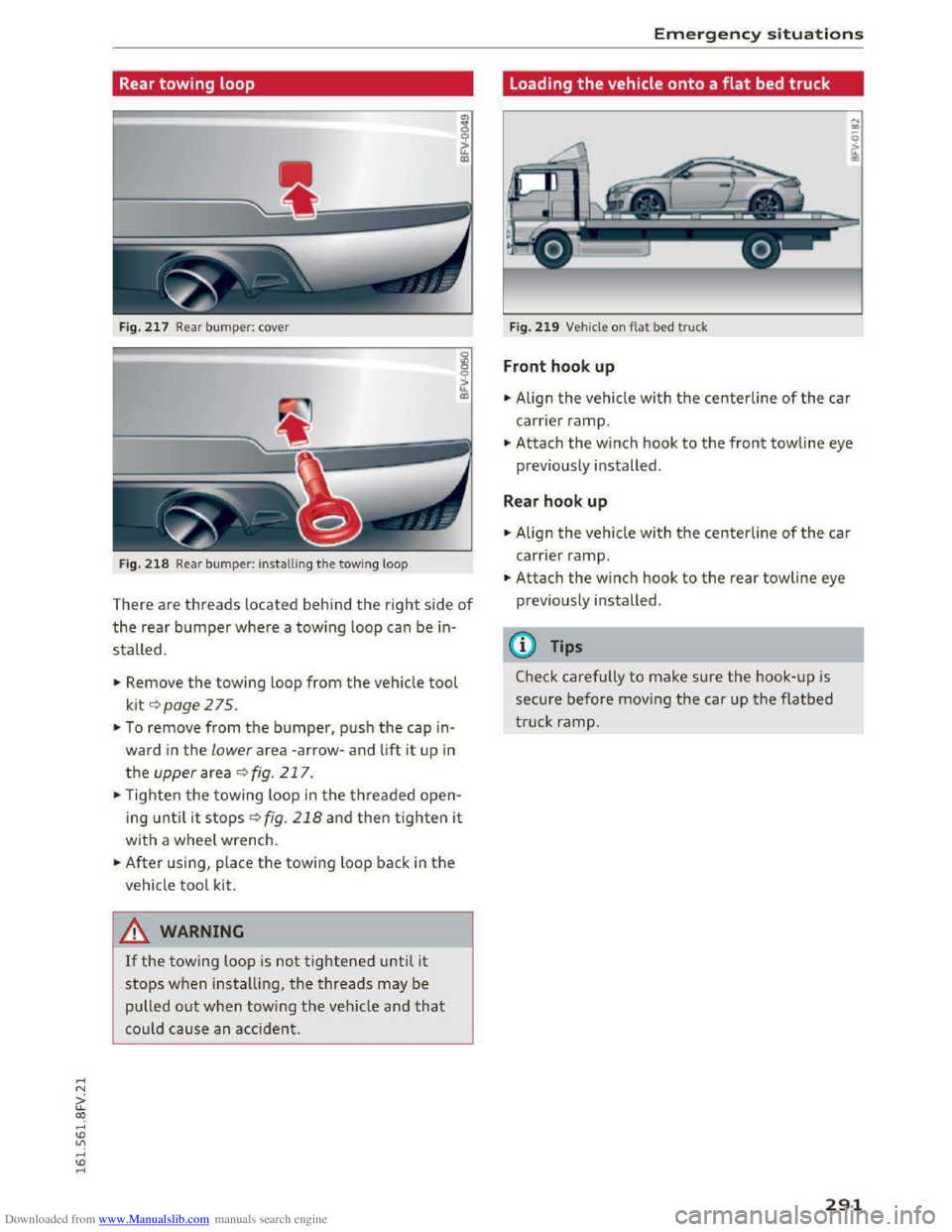
Fig. 217 Rea r bumper: cove r
Fig.
218 Rea r bumper: installing the towing loop
There are threads located behind the right side of
the rear bumper where a towing loop can be in
stalled.
... Remove the towing loop from the vehicle tool
kit¢poge275.
... To remove from the bumper, push the cap in
ward in the lower area -arrow-and lift it up in
the upper area ¢ fig. 217 .
... Tighten the towing loop in the threaded open
ing until it stops ¢fig. 218 and then tighten it
with a wheel wrench .
... After using, place the towing loop back in the
vehicle tool kit .
.&. WARNING
If the towing loop is not tightened until it
stops when installing, the threads may be
pulled
out when towi ng the veh icle and that
could cause an accident .
-
Emergency situations
Loading the vehicle onto a flat bed truck
Fig. 219 Vehicle on flat bed tru ck
Front hook up
... Align the vehicle with the centerline of the car
carrier ramp.
N 00
~ ...
"'Attach the winch hook to the front towline eye
previously installed.
Rear hook up
"'Align the vehicle with the centerline of the car
carrier ramp.
"'Attach the winch hook to the rear towline eye
previously installed.
@Tips
Check carefully to make sure the hook-up is
secure before moving the car up the flatbed
truck ramp .
291
Page 294 of 322
Downloaded from www.Manualslib.com manuals search engine Emergency situations
Raising the vehicle
Lifting with workshop hoist and with floor
jack
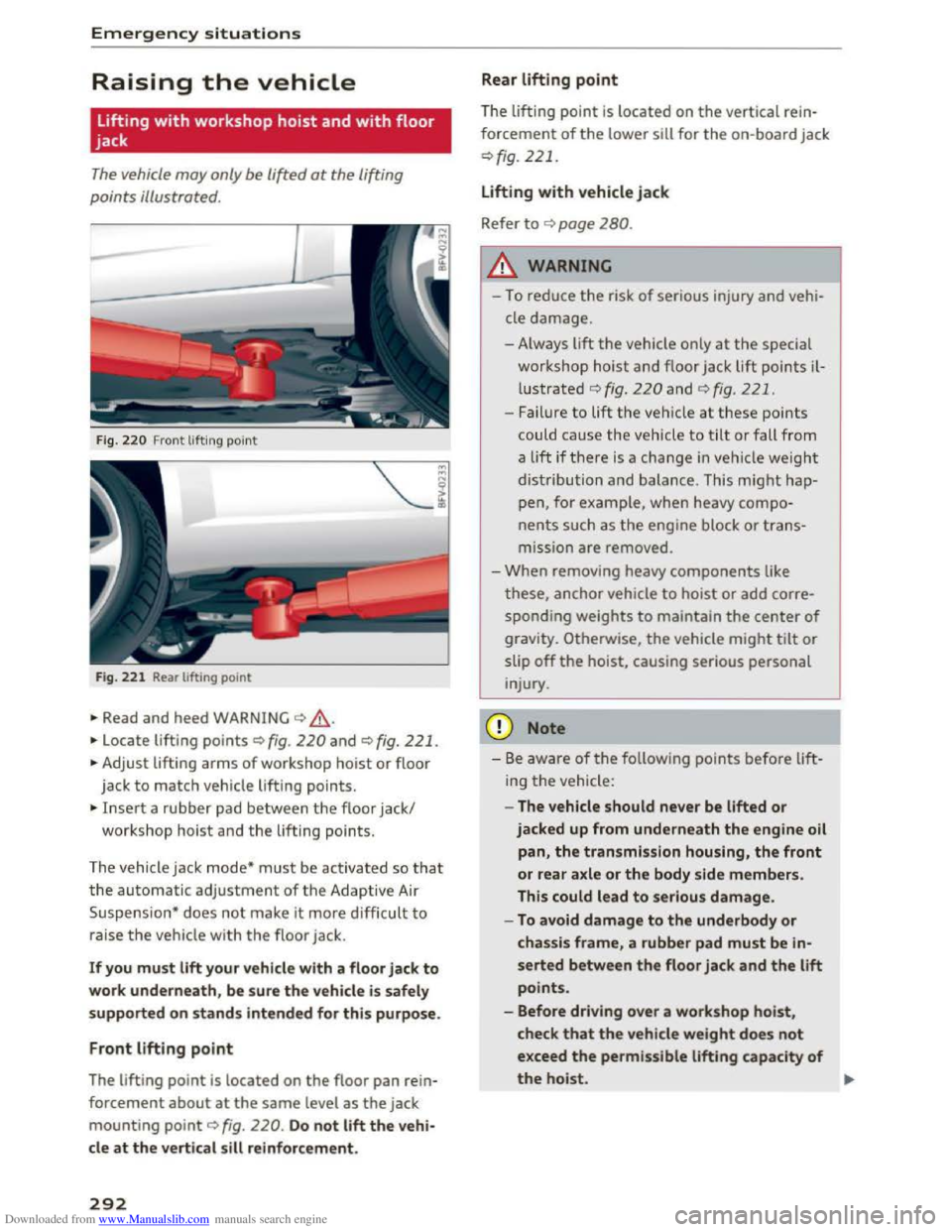
The vehicle may only be li~ed at the lifting
points illustrated.
Fig. 220 Front lifting point
Fig.
221 Rear lifting point
.,. Read and heed WARNING¢_&,
.,. locate lifting points ¢ fig. 220 and¢ fig. 221.
.,. Adjust lifting arms of workshop hoist or floor
jack
to match vehicle lifting points.
.,. Insert a rubber pad between the floor jack/
workshop hoist and the lifting points.
The vehicle jack mode*
must be activated so that
the automatic adjustment of the Adaptive Air
Suspension*
does not make it more d ifficult to
raise the vehicle with the floor jack.
If you must lift your vehicle with a f loor jack to
work underneath, be s ure the ve hicle is safely
s
upported on stands i ntended for this purpos e .
Front lifting point
The lifting point is located on the floor pan rein
forcement about at the same level as the jack
mounting point¢ fig. 220. Do not lift the vehi
cle at the vertical sill reinfor cement.
292
Rear lifting point
The lifting point is located on the vertical rein
forcement of the lower sill for the on-board jack
¢fig. 221.
Lifting with vehicle jack
Refer
to¢ page 280 .
..&. WARNING
-To reduce the r isk of serious injury and vehi
cle damage.
-Always lift the vehicle only at the special
workshop
hoist and floor jack lift points il
lustrated ¢fig. 220 and ¢fig. 221.
-Failure to lift the vehicle at these points
could cause
the vehicle to tilt or f all from
a lift ifthere is a change in vehicle weigh t
distribution
and balance. This might hap
pen, for example, when heavy compo
nents such as the engine block or trans
mission are removed.
-
When removing heavy components like
these, anchor vehicle to hoist or add corre
sponding weights to maintain the center of
gravity. Otherwise, the vehicle might tilt or
slip off the hoist, causing serious personal
injury .
CD Note
-Be aware of the following points before lift
ing the vehicle:
- The vehicle
should never be lifted or
jacked up from underneath the engine oil
pan, the transmission housing, the front
or rear axle or the body side members.
This could lead to serious damage.
-To avoid damage to the underbody or
chassis frame, a rubber pad must be in
serted between the floor jack and the lift
points.
- Before driving over a work shop hoist,
check that the vehicle weight does not
exceed the permissible lifting capacity of
the hoist. ..,.
Page 297 of 322
Downloaded from www.Manualslib.com manuals search engine scope of maintenance and repairs which can be
carried
out by vehicle owners. Also, safety and
e n viro n
mental concerns place very strict limits
on the nature of repairs and adjustments to en
gine and transmission parts which an owner can
perform.
Maintenance,
adjustments and repairs usually re
quire special tools, testing devices and other
equipment available to specially trained work
shop personnel in order to assure proper per
formance, reliability and safety of the vehicle and
its many systems.
Improper maintenance, adjustments and repairs
can impair the operation and reliability of your
vehicle and even void your vehicle warranty.
Therefore, proof of servicing in accordance w ith
the maintenance schedule may be a condition for
upholding a possible
warranty claim made within
the warranty period.
Above all,
operational safety can be adversely af
fected, creating unnecessary risks for you and
your passengers.
If in doubt about any ser vicing, have it done by
your authorized Audi dealer or any other properly
equipped and qualified workshop. We strongly
urge you to give your authorized Audi dealer the
opportunity to perform all scheduled main te
nance
and necessary repairs. Your dealer has the
facilities, original parts and trained specialists to
keep your vehicle running properly.
Performing limited maintenance yourself
The follow ing pages describe a limited number of
procedures which can be performed on your vehi
cle with ordinary
tools, should the need arise and
trained personnel be unavailable. Before per
forming any of these procedures, always thor
oughly read all of the applicable text and careful
ly follow the instructions given. Always rigorously
observe the WARNINGS provided .
Before you check anything in the e ngine com
partment , always read and heed all WARNINGS
..... c::> &. and c::> &. in Working in the engine compart-N
c;: ment on page 236.
co ..... U)
"' ..... U) .....
"'
Consumer information
A WARNING
-Serious personal injury may occur as a result
of improperly performed maintenance, ad
justments or repairs.
-Always be extremely careful when working
on
the vehicle. Always follow commonly ac
cepted safety practices and general com
mon sense. Never risk personal injury.
-
Do not attempt any of the maintenance,
checks or repairs described on the following
pages if you are not fully familiar with these
or other procedures with respect to the ve
hicle,
or are uncertain how to proceed.
-
Do not do any wor k without the proper tools
and equipment. H ave the necessary work
done by your authorized Audi dealer or an
other properly equipped and qualified work
shop.
-The engine compartment of any motor vehi
cle is a
potentially hazardous area. Never
reach into the area around or touch the radi
ator fan. It is temperature controlled and
can switch on suddenly -even when the en
gine is off. The
radiator fan switches on au
tomatically when th e coolant reaches a cer
tain temperature and will continue to run
until the coolant temperature drops.
- Always switch off the ignition before anyone
gets under the vehicle.
- Always
support your vehicle with safety
stands if it is necessary to work underneath
the vehicle. The jack supplied with the vehi
cle is
not adequate for this purpose and
could collapse causing serious personal in
jury.
-
If you must work underneath the vehicle
with
the wheels on the ground, always make
sure the vehicle is on level ground, that the
wheels are always securely blocked and that
the engine cannot be started.
-Always make sure the transmission selector
lever (automatic transmission) is in P (Park
position) and the pa rk brake is applied. .,..
295
Page 298 of 322
Downloaded from www.Manualslib.com manuals search engine Consumer information
@ For the sake of the environment
-Changing the engine settings will adversely
affect emission leve ls.
This is detrimental to
the environment and increases fuel con
sumption.
- A lways observe environmental regulations
when disposing
of old engine oil, used brake
fluid, dirty engine coolant, spent batteries
or worn out tires.
- Undeployed airbag modules and pretension
ers might be classified as
Perchlorate Mate
rial -special handl i
ng may apply, see
www.dtsc .ca. gov/hazard ouswaste/ perch l
o
rate. When th e vehicle or parts of th e re
strain t sys tem including
airb ag modu les
sa fety belts with prete ns ione rs a re scrap
ped, all applicab le laws and regulat ions
must be observed. Your authorized Audi
dealer is familia r with these requirements
and we recommend
that you have your deal
er perform this service for you.
Accessories and
technical changes
Additional accessories and parts
replacement
Always consult on authorized Audi dealer before
purchasing accessories.
Your vehicle incorporates the latest safety design
features ensuring a high standard
of active and
passive safety.
This safety could be comp romised by non -ap
proved changes
to the vehicle . For this reason, if
parts have to be replaced, please observe
the fol
lowing points when insta lling addit ional accesso
ries:
Approved
Audi accessories and genuine Audi
parts are available from author ized Audi dealers.
T hese dealers also have the necessary facilities,
too ls and trained specia
lists to install the parts
and accessories properly.
296
A WARNING
1-
Using the wrong spare parts or using non-ap-
proved accessories
can cause damage to the
vehicle and serio us personal in jury.
-
Use on ly accesso ries expressly approved by
Audi a nd gen uine Audi spare parts
- These parts and accessor ies have been spe
cially designed
to be used on your vehicle.
- Never install accessor i
es such as telephone
cradles
or beverage holders on airbag covers
or within the airbag deployment zones. Do
ing so will increase th e risk of injury if air
bags are triggered
in an accident!
- Before you check anythi ng in
the eng ine
compa
rtment, always read and heed all
WARNINGS Qpoge 236.
CD Note
-If items other than genu ine Audi spare
parts, add-on equipment and accessory
i t ems are used or if repair work
is not per
formed a
ccording to specified methods, this
c an resul t
in severe damage to yo ur vehi
cle's engine and body (such as cor ro sion)
and adve rsely
affect your vehicle's warranty.
- I f emergen cy repai rs mus t be per formed
elsew here, have
the vehicle examined by an
authorized Au
di dealer as soon as possib le .
- T he manufac ture r ca nnot be held liable for
damage
which occu rs d ue to fail ure to com
ply with
these stipulations.
Technical Modifications
Our guidelines must be complied with when tech
nical modifications ore mode .
Always consult an authorized Audi de aler before
sta rt ing work on any modifica tions.
This will help ensure tha t vehicle
function, per
fo rmance and safety are not impaired
Q .&..
Attempting to work on electronic components
and
the softwa re used with th em can cause mal
funct io ns. Because
of the way elect ronic compo
nen ts a re
int erconnected with each other, such
malfunc tions can also h
ave an adverse affect on
other systems tha t are not directl y involved. This .,..