roof AUDI TT COUPE 2016 User Guide
[x] Cancel search | Manufacturer: AUDI, Model Year: 2016, Model line: TT COUPE, Model: AUDI TT COUPE 2016Pages: 322, PDF Size: 52.86 MB
Page 221 of 322

Downloaded from www.Manualslib.com manuals search engine ..... N
G: CX)
.....
"' U"I
.....
"' .....
-Never place objects on the seat (such as a
laptop, CD player, electronic games device,
power inverter or seat heater for child
seats). These may influence the electrical
capacitance measured by the capacitive pas
senger detection system and can also fly
around in an accident and cause serious per
sonal injury .
- Always
read and heed all WARNINGS when
ever using a child restrained in a veh icle is
being
used r:'.> page 180, Safety belts,
r:'.>page 188, Airbag system and
r:'.>page 212, Important information.
Convertible child safety seats
Properly used convertible child safety seats con
help protect toddlers and children over age one
who weigh between
20 and 40 lbs (9 and 18 kg)
in a crash.
Fig. 167 Schematic overv iew : installat io n of the attach
m
ents applicab le to a LATCH seat
Fig. 168 Sche matic overview: i nstallat io n of t he sea t using
the vehicle 's safety belt syste m
•When using the vehicle safety belt to install a
child
safety seat, you must first activate the
convertible locking retractor on the safety belt
to prevent the child safety seat from moving
Child safety
r:'.>poge 223 or install the seat using the LATCH
attachments.
•Push the child safety seat down with your full
weight to get the safety belt really tight so that
the seat cannot move forward or sideways
more than 1 in (2 .5 cm) r:'.>page 223.
"' If the child safety seat is equipped with a tether
strap, attach it to the tether anchors
r:'.> page 228.
"'Secure unused safety belts on the rear seat
r:'.> page 217.
A toddler or child is usually too large for an in
fant restraint if it is more than one year old and
weighs more than 20 lbs (9 kg).
Toddlers
and children who are older than one
year up to about 4 years old and weigh more than
20 lbs (9 kg) up to 40 lbs (18 kg) must always be
properly
restrained in a child safety seat certified
for
their size and weight r:'.> fig. 167 and
r:'.> fig. 168.
The airbag on the passenger side makes the front
seat a potentially dangerous place for a child to
ride . The front seat is not the safest place for a
child
in a forward -facing child safety seat. It is a
v e
ry dangerous place for an infant or a larger
child in a rearward-facing seat.
_&WARNING
f-=-
Not using a child safety seat, using the wrong
child
safety seat or improperly i nstalling a
child
restraint increases the risk of serious
personal i njury and death in a collision or oth
er emergency situation.
-
Children on the front seat of any car, even
with Advanced Airbags, can be seriously in
jured or even killed when an airbag inflates.
A child in a rearward-facing child safety seat
installed on the front passenger seat will be
seriously injured and can be killed if the
front airbag inflates -even with an Ad
vanced Airbag System.
- The inflating airbag will hit
the child safety
seat or infant carrier with great force and
will smash the child safety seat and child
against the backrest, center arm rest, door
or roof.
219
Page 224 of 322
Downloaded from www.Manualslib.com manuals search engine Child safety
.&_ WARNING
Not using a booster seat, using the booster
seat improperly, incorrectly installing a boos
ter seat or using the vehicle safety belt im
properly increases the risk of serious personal
injury and death in a collision or other emer
gency situation. To help reduce the risk of se
rious personal injury and/or death:
-The shoulder belt must lie as close to the
center of the child's collar bone as possible
and must lie flat and snug on the upper
body. It must never lie across the throat or
neck. The lap belt must lie across the pelvis
and never across the stomach or abdomen.
Make sure that the belt lies flat and snug.
Pull on the belt to tighten if necessary.
- Failure
to properly route safety belts over a
ch i
ld's body will cause severe injuries in an
accident or other emergency situation
qpage 180.
-The rear side of the child safety seat should
be positioned as close as possible to the
backrest on the vehicle seat.
-Children on the front seat of any car, even
with Advanced Airbags, can be seriously in
jured or even killed when an airbag inflates.
- Never
let a child stand or kneel on any seat,
for example the front seat.
-Never let a child ride in the cargo area of
your vehicle .
- Always
remember that a child leaning for
ward, sitting sideways or out of position in
any way
during an accident can be struck by
a deploying airbag. This will
result in seriou s
personal injury or death.
-If you must install a booster seat on the
front passenger seat because of exceptional
circumstances the PASSENGER AIR BAG
OFF light must come on and stay on, when
ever the ignition is switched on.
-If the PASSENGER AIR BAG OFF light does
not come on and stay on, perform the
checks described q page 199, Monitoring
the Advanced Airbag System.
-Take the child restraint off the front passen
ger seat and install it properly at one of the
rear seat positions if the PASSENGER AIR
222
BAG OFF light does not stay on whenever
the ignition is switched on.
- Always
read and heed all WARNINGS when
ever using a child restrained in a vehicle is
being
used q page 180, Safety belts,
q page 188, Airbag system and
q page 212, Important information.
Booster seats on the rear seat
Children who are about 7 years and older, who
weigh more than SS lbs (2S kg) and are not taller
than 4 ft 9 in (S7 in/1.4S m) are best protected
when properly restrained on the rear seat.
Due to limited rear seat head clearance chi ld ren
4 ft 3 in (Sl in/1.30 m) and taller must not use
booster seats on the rear seat of your Audi TT
Coupe. The rear seat of your Audi TT Coupe has
been specially designed to permit children who
are between 4 ft 3 in (Sl in/1.30 m) and 4 ft 9 in
(S7 in/1.4S m) tall (about 7 to 12 years old) to
use the available three -point lap and shoulder
safety belts.
.&. WARNING
lo= ----The rear seat area is too small to safely
transport passengers taller than 4 ft 9 in
(S7 in/1.4S m).
-
Persons taller than 4 ft 9 in (S7 in/1.4S m)
as well as children in booster seats who are
too close to the rear window and roof can
suffer severe head and neck injuries when
the rear lid is closed or in a crash.
- The
minimum clearance between the pas
sengers' heads and the rear window must
never -under any circumstances -be less
than l in(2.S cm.) when the passengers sits
fully upright.
- Always make sure that the rear seat passen
gers cannot be struck when the rear lid is
closed.
Booster seats on the front seat
Children aged about 7 years and older and weigh
ing more than SS lbs (2S kg) who are between
4 ft 3 in (Sl in/1.30 m) and 4 ft 9 in (S7 in/
l.4S m) tall may in exceptional circumstances ~
Page 225 of 322
Downloaded from www.Manualslib.com manuals search engine ride on the front passenger's seat. Children less
than 4 ft 9 in (57 in/1.45 m) tall must sit on a
certified booster seat and properly wear the veh i
cle's three-point lap and shoulder safety belt.
Always
securely latch the passenger seat at the
very rear of its fore and aft adjustment range.
The backrest must be adjusted to an upright po
sition .
A WARNING
If you must install a booster seat child re
straint on the front passenger seat:
-Make sure the booster seat has been de
signed and certified by its manufacturer for
use on a front seat with a passenger front
and side airbag.
- Always follow
the manufacturer's instruc
t i
ons prov ided with the booster seat.
-Always move the passenger seat to the very
rear of its fore and aft adjustment range, as
far away from the airbag as possible .
- Always
make sure that the passenger seat is
securely latched in place before installing
the booster seat. The backrest must be ad
justed to an uprig ht position.
-If the passenger seat cannot be securely
latched in the very rear of its fore and aft
adjustment range, then the passenger front
airbag must be turned off with the ON I OFF
switch.
Securing child seats
Securing a child safety seat using a safety
belt
Safety belts for the rear seats and the front pas
senger can be Locked with the convertible Locking
retractor to properly secure child safety seats.
The safety belts emergency locking retractors for
the rear seats safety belts and for the front pas
senger's seat safety belt have a convertible lock
i ng
retractor for child restraints. The safety belt
must be locked so that belt webbing cannot un
reel. The
retractor can be activated to lock the
safety belt and prevent the safety belt webbing
from loosening up during normal driving. A child
safety seat can only be properly installed when
Child safety
the safety belt is locked so that the chi ld and
child safety seat will stay in place .
Always
remember : Even though your veh icle is
equipped with an Advanced Airbag system, all
children, especia lly those 12 years and younger,
should a lways ride in the back seat properly re
strained for their age and size.
A WARNING
Improperly installed child safety seats in
crease the risk of serious personal injury and
death in a collision.
-
- Always make sure that the safety be lt re
tractor is locked when installing a child
safety seat. An unlocked safety belt retrac
tor cannot hold the child safety seat in place
du ring
normal d riving or in a c rash.
-Always buckle the child safety seat firmly in
place even if a ch ild is not sitting in it. A
loose child
safety seat can fly around during
a
sudden stop or in a co llision.
- Always
make sure that the rear seat back
rest is secu rely latched whenever the rear
safety belt is being used to secure a child re
straint.
-
If the backrest is not secu rely latched, the
chi ld and t he child restraint will be thrown
forward together with the backrest and will
strike parts of the vehicle interior. The child
can
be seriously injured or killed.
- Never
install rear-facing child safety seats
or infant carriers on the front passenger
seat. A child w ill be seriously injured and
can be killed when the passenger a irbag in
f lates.
- The inflating airbag will hit the ch ild safety
seat or infant carrier with great force and
will smash the child safety seat and child
against the backrest, center armrest, door
or roof.
-Always install rear-fac ing ch ild safety seats
or infant carriers on the rear seat.
- Forward-facing child
safety seats or infant
carriers installed on the front passenger's
seat may interfere with the deployment of
the airbag and ca use serious injury to the
child.
223
Page 226 of 322
Downloaded from www.Manualslib.com manuals search engine Child safety
-It is safer to install a forward-facing child
safety seat on the rear seat.
-Always read and heed all WARNINGS when
ever using a child restrained in a vehicle is
being used c'.) page 212. Special precautions
apply when installing a child safety seat on
the front passenger seat c'.) page 189, Child
restraints on the front seot -some impor
tant things to know.
..&_WARNING
....
Always take special precautions if you must
install a forward or rearward-facing child re
straint on the front passenger's seat in excep
tional situations:
- W
henever a forward or rearwa rd-facing
chi ld r
estraint is installed on the front pas
senger seat, the PASSENGER AIR BAG OFF
ligh t must come on and stay on whenever
the ignition is switched on.
-
If the PASSENGER AIR BAG OFF light does
not come on and stay on, perform the
checks described c'.) page 199, Monitoring
the Advanced Airbag System.
-Take the child restraint off the front passen
ger seat and install it properly at one of the
rear seat positions if the PASSENGER AIR
BAG OFF light does not stay on whenever
the ignition is switched on.
-
Improper installation of child restraints can
reduce their effectiveness or even prevent
them from providing any protection.
-An improperly installed child restraint can
interfere with the airbag as it deploys and
seriously injure
or even kill the child .
-Always carefu lly follow the manufacturer's
instructions prov ided with the child safety
seat or carrier.
- After checking
to make sure that the child
restraint is properly installed, make certain
that the child restraint is correctly recog
nized by the capacitive passenger detection
system in the front passenger seat and that
the PASSENGER AIR BAG OFF light signals
the correct front passenger frontal airbag
status.
224
-
..&. WARNING
Forward-facing child restraints:
-Always make sure the forward-facing seat
has been designed and certified by its man
ufacturer for use on a front seat with a pas
senger front and side airbag.
- Never
put the forward-facing child restraint
up, against or very near the instrument pan
el.
-Always move the passenger seat into its
rearmost position in the seat's fore and aft
adjustment range, as far away from the air
bag as possible before installing the for
ward-facing child restraint. The backrest
m ust be adjusted to an upr ight position.
- M ake
sure that the PASSENGER AIR BAG
OFF light comes on and stays on all the time
whenever the ign ition is switched on.
..&_WARNING
Rearward-facing child restraints:
-A ch ild in a rearward-facing child safety seat
installed on the front passenger seat will be
seriously injured
and can be killed if the
front airbag inflates -even with an Ad
vanced Airbag System.
-The inflating airbag will hit the child safety
seat or infant carrier with great force and
will smash the child safety seat and child
against the backrest, center armrest, door
or roof.
-Always be especia lly careful if you must in
stall a rearward facing child safety seat on
the front passenger seat in exceptiona l cir
cumstances.
- Make
sure that the PASSENGER AIR BAG
OFF light comes on and stays on all the time
whenever the ignition is switched on.
-If the PASSENGER AIR BAG OFF light does
not come on and stay on, immediately in
stall the rear-facing child safety seat in a
rear seating position and have the airbag
system inspected by your Audi dealer.
Page 237 of 322
Downloaded from www.Manualslib.com manuals search engine ..... N
G: CX)
.....
"' U"I
.....
"' .....
.. Guide the reserve canister filler tube into the
funnel and start the emergency fueling.
.. Remove the funnel after refueling and close the
fuel filler door so that it latches shut.
CD Note
Remove any overflowing fuel from the ve hicle
paint immediately.
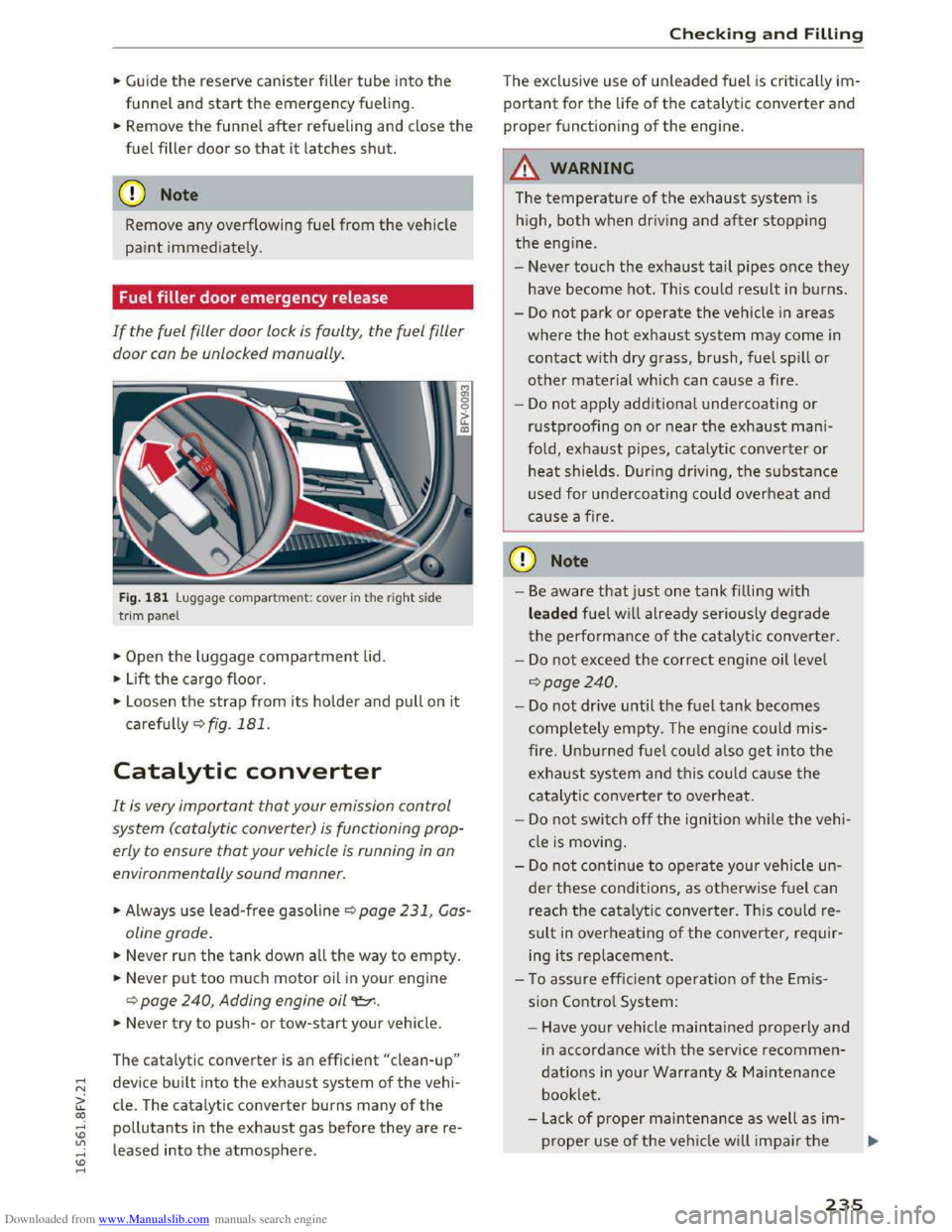
Fuel filler door emergency release
If the fuel filler door lock is faulty, the fuel filler
door con be unlocked manually.
Fig. 181 L uggage compa rtment: cover in t he r ight side
t
rim panel
.,.. Open the luggage compartment lid.
.. L ift the cargo floor .
"'
"' 0 0
it IIl
.,.. Loosen the strap from its holde r and pull on it
carefu lly Qfig. 181.
Catalytic converter
It is very important that your emission control
system (catalytic converter) is functioning prop
erly to ensure
that your vehicle is running in on
environmentally sound manner.
.,.. Always use lead-free gasoline Q page 231, Gas
oline grade .
.. Never run the tank down all the way to empty.
.. Never put too m uch motor oil in your engine
Q page 240, Adding engine oil "t::r..
.. Never try to push-or tow-start your vehicle.
The
catal ytic converter is an efficient "clean-up"
device built into the exhaust system of the vehi
cle. The catalytic
converter burns many of the
pollutants in the exhaust gas before they are re
leased into
the atmosphere .
Checking and Filling
The exclusive use of unleaded fuel is critically im
portant for the life of the catalytic converter and
proper functioning of the engine.
A WARNING
f= - I
The temperature of the exhaust system is
high, both when driving and after stopping
the engine.
- Never
touch the exhaust tail pipes once they
have become hot. This could result in burns.
-Do not park or operate the vehicle in a reas
where the hot exhaust system may come in
contact with dry grass, brush, fuel spill or
other material which can cause a fire .
-
Do not appl y additional undercoating or
r ustproofing on or near the exhaust mani
fold, exhau
st pipes, catalytic converter or
heat shields. During driving, the substance
used for un dercoating could overheat and
cause a fire.
CD Note
-Be aware that just one tank filli ng with
leaded fuel w ill already seriously degrade
the performance of th e c atalytic converter .
-
Do not exceed the correct engine oil leve l
Qpoge240 .
-Do not drive until the fuel tank becomes
completely empty. The engi ne could mis
fire. Unbu r
ned fuel coul d also get into the
exhaust system and this could cause the
ca ta lyt ic co nver ter to overheat.
-Do not swi tch off the ignition whil e the vehi
cl e is moving .
-
Do not continue to operate your vehi cle un
der these condi tions, as o therwise fuel c a n
reach the catalytic converter. This could re
sult in over heating of the converter, requir
ing
its replacement .
- T o assu re
effic ient operatio n of the E mis
sion Contro l System:
-Have your vehicle maintained properly and
in accordance wi th the service recommen
dations in yo ur Warranty & Main tenance
bookle t.
- L ack
of proper maintenance as well as im-
p r
oper use of the veh icle w ill impair the .,..
235
Page 256 of 322
Downloaded from www.Manualslib.com manuals search engine Wheels
(c) Vehicle capacity weight, and
(d) Production options weig ht
Maximum (permissible)
inflation pressure
means the maximum cold infla
tion pressure to which a tire may
be inflated. Also called "maxi
mum inflation pressure."
Normal occupant weight
means 150 lbs (68 kg) times the
number of occupants seated in
the vehicle up to the total seating
capacity of your vehicle .
Occupant distribution
means distribution of occupants
in a vehicle.
Outer diameter
means the overall diameter of an
inflated new tire.
Overall width
means the linear distance be
tween the exteriors of the side
walls of an inflated tire, including
elevations due to labeling, deco
rations, or protective bands or
ribs .
Ply
means a layer of rubber-coated
parallel cords.
254
Production options weight
means the combined weight of
those installed regular production
options weighing over 5 lbs (2.3
kg) in excess of those standard
items which they replace, not pre
viously
considered in curb weight
or accessory weight, including
heavy
duty brakes, ride levelers,
roof rack, heavy duty battery, and
special trim.
Radial ply tire
means a pneumatic tire in which
the ply cords that extend to the
beads are la id at substantially 90
degrees to the centerline of the
tread.
Recommended inflation
pressure
see¢ page 253, Cold tire infla
tion pressure.
Reinforced tire
means a tire designed to operate
at higher loads and at higher in
flation pressures than the corre
sponding standard tire. Rein
forced tires may be identified as
"XL", "xl", "EXTRA LOAD", or "RF"
on the sidewall. ...
Page 297 of 322
Downloaded from www.Manualslib.com manuals search engine scope of maintenance and repairs which can be
carried
out by vehicle owners. Also, safety and
e n viro n
mental concerns place very strict limits
on the nature of repairs and adjustments to en
gine and transmission parts which an owner can
perform.
Maintenance,
adjustments and repairs usually re
quire special tools, testing devices and other
equipment available to specially trained work
shop personnel in order to assure proper per
formance, reliability and safety of the vehicle and
its many systems.
Improper maintenance, adjustments and repairs
can impair the operation and reliability of your
vehicle and even void your vehicle warranty.
Therefore, proof of servicing in accordance w ith
the maintenance schedule may be a condition for
upholding a possible
warranty claim made within
the warranty period.
Above all,
operational safety can be adversely af
fected, creating unnecessary risks for you and
your passengers.
If in doubt about any ser vicing, have it done by
your authorized Audi dealer or any other properly
equipped and qualified workshop. We strongly
urge you to give your authorized Audi dealer the
opportunity to perform all scheduled main te
nance
and necessary repairs. Your dealer has the
facilities, original parts and trained specialists to
keep your vehicle running properly.
Performing limited maintenance yourself
The follow ing pages describe a limited number of
procedures which can be performed on your vehi
cle with ordinary
tools, should the need arise and
trained personnel be unavailable. Before per
forming any of these procedures, always thor
oughly read all of the applicable text and careful
ly follow the instructions given. Always rigorously
observe the WARNINGS provided .
Before you check anything in the e ngine com
partment , always read and heed all WARNINGS
..... c::> &. and c::> &. in Working in the engine compart-N
c;: ment on page 236.
co ..... U)
"' ..... U) .....
"'
Consumer information
A WARNING
-Serious personal injury may occur as a result
of improperly performed maintenance, ad
justments or repairs.
-Always be extremely careful when working
on
the vehicle. Always follow commonly ac
cepted safety practices and general com
mon sense. Never risk personal injury.
-
Do not attempt any of the maintenance,
checks or repairs described on the following
pages if you are not fully familiar with these
or other procedures with respect to the ve
hicle,
or are uncertain how to proceed.
-
Do not do any wor k without the proper tools
and equipment. H ave the necessary work
done by your authorized Audi dealer or an
other properly equipped and qualified work
shop.
-The engine compartment of any motor vehi
cle is a
potentially hazardous area. Never
reach into the area around or touch the radi
ator fan. It is temperature controlled and
can switch on suddenly -even when the en
gine is off. The
radiator fan switches on au
tomatically when th e coolant reaches a cer
tain temperature and will continue to run
until the coolant temperature drops.
- Always switch off the ignition before anyone
gets under the vehicle.
- Always
support your vehicle with safety
stands if it is necessary to work underneath
the vehicle. The jack supplied with the vehi
cle is
not adequate for this purpose and
could collapse causing serious personal in
jury.
-
If you must work underneath the vehicle
with
the wheels on the ground, always make
sure the vehicle is on level ground, that the
wheels are always securely blocked and that
the engine cannot be started.
-Always make sure the transmission selector
lever (automatic transmission) is in P (Park
position) and the pa rk brake is applied. .,..
295
Page 308 of 322
Downloaded from www.Manualslib.com manuals search engine Index
Emergency release
Selector
Lever . . . . . . . . . . . . . . . . . . . . . . . . 71
Emergency starting . . . . . . . . . . . . . . . . . . .
288
E nergy management . . . . . . . . . . . . . . . . . . . 92
Engine
Coolant . . . . . . . . . . . . . . . . . . . . . . . . . . . . 242
Starting . . . . . . . . . . . . . . . . . . . . . . . . . 58, 60
Starting with jumper cables . . . . . . . . . . . 288
Stopping . . . . . . . . . . . . . . . . . . . . . . . . . . . . 59
Engine compartment
Closing the hood . . . . . . . . . . . . . . . . . . . . 237
Opening the hood . . . . . . . . . . . . . . . . . . . 237
Overview . . . . . . . . . . . . . . . . . . . . . . . . . . . 238
Safety precautions . . . . . . . . . . . . . . . . . . . 236
Engine control (indicator light) . . . . . . . . . . . 15
Engine coolant . . . . . . . . . . . . . . . . . . . . . . . 242
Radiator fan . . . . . . . . . . . . . . . . . . . . . . . . 243
E ngine
oil . . . . . . . . . . . . . . . . . . . . . . . . . . . 239
adding . . . . . . . . . . . . . . . . . . . . . . . . . . . . 240
Changing . . . . . . . . . . . . . . . . . . . . . . . . . . 241
Checking
the oil level . . . . . . . . . . . . . . . . . 240
Consumption . . . . . . . . . . . . . . . . . . . . . . . 240
Indicator light . . . . . . . . . . . . . . . . . . . . . . . 13
Oil consumption . . . . . . . . . . . . . . . . . . . . . 239
Specification and viscos ity . . . . . . . . . . . . . 239
Engine speed limitation (indicator light) . . . 15
Entering a destination . . . . . . . . . . . . . . . . . 131
Geocoordinates . . . . . . . . . . . . . . . . . . . . .
135
Last destination . . . . . . . . . . . . . . . . . . . . . 132
Stopover . . . . . . . . . . . . . . . . . . . . . . . . . . . 135
Voice recognition system . . . . . . . . . . . . . 107
Entering destination
Point
of interest . . . . . . . . . . . . . . . . . . . . . 134
Entering letters (speller) . . . . . . . . . . . . . . . . 99
Entering numbers/symbols (speller) . . . . . . . 99
Entertainment volume . . . . . . . . . . . . . . . . . 169
Environment
Catalytic converter . . . . . . . . . . . . . . . . . . .
235
Disposing of your vehicle battery . . . . . . . 248
Proper disposal of drained brake fluid . . . 244
Proper disposal of drained engine oil . . . . 241
Unleaded gasoline . . . . . . . . . . . . . . . . . . . 231
What should I do with an old battery? . . . 248
Exporting/importing (contacts)..... .. .. . 118
Exterior lighting . . . . . . . . . . . . . . . . . . . . . . . 36
306
Exterior mirrors
Adjusting . . . . . . . . . . . . . . . . . . . . . . . . . . .
39
Dimming ........ .. .................. 40
Heating . . . . . . . . . . . . . . . . . . . . . . . . . . . . . 39
Exterior temperature display . . . . . . . . . . . . . 19
External speech dialog system . . . . . . . . . . 109
F
Facebook (Audi connect) 124
Factory settings . . . . . . . . . . . . . . . . . . . . . . 166
Fader (sound) . . . . . . . . . . . . . . . . . . . . . . . . 169
Fastening
Booster seats . . . . . . . . . . . . . . . . . . . . . . . 221
Convertible child safety seats . . . . . . . . . .
219
Infant seats . . . . . . . . . . . . . . . . . . . . . . . . 218
Fast forwarding/rewinding (audio/video
file) . . . . . . . . . . . . . . . . . . . . . . . . . . . . . . . . 159
Fast forwarding (audio/video file) . . . . . . . . 159
Fast route . . . . . . . . . . . . . . . . . . . . . . . . . . . 138
Favorite
Editing
Storing
Favorites
137
137
Media . . . . . . . . . . . . . . . . . . . . . . . . . . . . . 161
Navigation . . . . . . . . . . . . . . . . . . . . . . . . . 133
Telephone......... ................. 114
File formats (med ia drives) . . . . . . . . . . . . . 157
Flight information (Audi connect) . . . . . . . . 123
Floormats ........ .. ................. 175
Fog lights/rear fog light(s) . . . . . . . . . . . . . . 36
Folding
the rear seats. . . . . . . . . . . . . . . . . . . SO
Foot pedals . . . . . . . . . . . . . . . . . . . . . . . . . . 175
Footwell lighting . . . . . . . . . . . . . . . . . . . . . . 38
For
the sake of the environment
Environmentally-friendly driving . . . . . . . . 57
Fueling . . . . . . . . . . . . . . . . . . . . . . . . . . . . 233
Leaks......... .. .. .. .. ............. 237
Roof rack ....... .. .. ................ 49
Free text search . . . . . . . . . . . . . . . . . . . . . . 102
Directory...... .. .. ................. 117
Media . . . . . . . . . . . . . . . . . . . . . . . . . . . . . 161
Navigation . . . . . . . . . . . . . . . . . . . . . . . . .
132
Frequency band . . . . . . . . . . . . . . . . . . 145, 146
Front airbags
Description . . . . . . . . . . . . . . . . . . . . . . . . .
192
How they work . . . . . . . . . . . . . . . . . . . . . . 197
Page 314 of 322
Downloaded from www.Manualslib.com manuals search engine Index
Proper seating position
Front passenger . . . . . . . . . . . . . . . . . . . . . 173
Occupants .. .. ..
................. .. . 172
Rear passengers..................... 174
Protecting 272
Q
quattro (all wheel drive) . . . . . . . . . . . . . . . . . 91
Question
What happens to unbelted occupants? . . 182
R
Radiator fan 243
Radio . . . . . . . . . . . . . . . . . . . . . . . . . . . . . . . 145
Additional station information . . . . . . . . . 146
Free text search . . . . . . . . . . . . . . . . . . . . . 145
Frequency band . . . . . . . . . . . . . . . . . . . . . 146
Menu...... .. ...................... 146
MMI control panel . . . . . . . . . . . . . . . . . . . 145
Presets . . . . . . . . . . . . . . . . . . . . . . . . . . . .
147
Program guide . . . . . . . . . . . . . . . . . . . . . . 146
Radio text . . . . . . . . . . . . . . . . . . . . . . . . . . 146
Scan . . . . . . . . . . . . . . . . . . . . . . . . . . . . . . 146
Station list . . . . . . . . . . . . . . . . . . . . . . . . . 145
Troubleshooting. . . . . . . . . . . . . . . . . . . . . 148
Updating stations (station list) . . . . . . . . . 145
Voice recognition system . . . . . . . . . . . . . 108
Radio setti ngs
Additional station information . . . . . . . . . 147
Rain/light sensor
Headlights . . . . . . . . . . . . . . . . . . . . . . . . . .
36
Indicator light . . . . . . . . . . . . . . . . . . . . . . . 17
Intermittent (windshield wipers) . . . . . . . . 41
Raising the vehicle . . . . . . . . . . . . . . . . . . . . 292
Range (fuel level) . . . . . . . . . . . . . . . . . . . . . . 23
Reading aloud
Possible commands . . . . . . . . . . . . . . . . . .
105
Reading lights . . . . . . . . . . . . . . . . . . . . . . . . . 38
Rear lid
refer to Luggage compartment lid . . . . . . . 30
Rear spoiler .. .. .. ............... .. .. .. 91
Rearview camera
refer to Parking systems . . . . . . . . . . . . 83, 84
Rearview mirror dimming . . . . . . . . . . . . . . . 40
Rear window defogger . . . . . . . . . . . . . . . . . . 54
Recirculation mode (climate control system) 53
312
Recuperation . . . . . . . . . . . . . . . . . . . . . . . . . 23
Redial . . . . . . . . . . . . . . . . . . . . . . . . . . . . . .
119
Refueling . . . . . . . . . . . . . . . . . . . . . . . . . . . . 232
Remote control
refer to Remote control key . . . . . . . . . . . . 2S
Remote control key . . . . . . . . . . . . . . . . . . . . 25
LED . . . . . . . . . . . . . . . . . . . . . . . . . . . . . . . . 27
Personaliz ing . . . . . . . . . . . . . . . . . . . . . . . .
25
Replacing the battery . . . . . . . . . . . . . . . . . 2 7
unlocking/locking . . . . . . . . . . . . . . . . . . . . 27
Repair manuals . . . . . . . . . . . . . . . . . . . . . . .
294
Repairs
Airbag system . . . . . . . . . . . . . . . . . . . . . .
202
Replacement key . . . . . . . . . . . . . . . . . . . . . . 25
Replacing windshield
wiper blades . . . . . . . . 42
Reporting Safety Defects . . . . . . . . . . . . . . . 178
Rerouting ...... .. .. .. ........... 137, 142
Reset button (trip odometer) . . . . . . . . . . . . 23
Resetting
the trip odometer . . . . . . . . . . . . . 23
Reset (restart) . . . . . . . . . . . . . . . . . . . . . . .
170
Restart (reset) . . . . . . . . . . . . . . . . . . . . . . . 170
Retract
New brake pads . . . . . . . . . . . . . . . . . . . . . .
89
Retractor . . . . . . . . . . . . . . . . . . . . . . . . . . . . 184
Reverse (automatic transmission) . . . . . . . . . 64
Rewinding (audio/video file) . . . . . . . . . . . . 159
Right control button . . . . . . . . . . . . . . . . . . . . 21
Rims
.......... .. .. ................. 264
Ringtone settings ................. 119, 169
Road noise compensation (SDVC) . . . . . . . . 169
Roaming
refer to Data connection . . . . . . . . . . . . . . 127
Roof rack . . . . . . . . . . . . . . . . . . . . . . . . . . . . . 49
Roof load . . . . . . . . . . . . . . . . . . . . . . . . . . . 49
Route criteria . . . . . . . . . . . . . . . . . . . . . . . . 13 7
Route guidance
refer to Navigation . . . . . . . . . . . . . . . . . . . 132
Route information . . . . . . . . . . . . . . . . . . . . 141
Route
list . . . . . . . . . . . . . . . . . . . . . . . . . . . . 140
s
Safe driving ......... ................. 171
Safe driving habits ... .. .. .
............ 171