fuel AUDI TT COUPE 2016 Owner's Manual
[x] Cancel search | Manufacturer: AUDI, Model Year: 2016, Model line: TT COUPE, Model: AUDI TT COUPE 2016Pages: 322, PDF Size: 52.86 MB
Page 236 of 322
Downloaded from www.Manualslib.com manuals search engine Checking and Filling
explos ive and increases the risk of serious
injury or death.
- Follow legal requirements when using,
storing and transporting fuel containers.
-Make sure the fuel container conforms to
industry standards (ANSI/ASTM F852-86).
CD Note
- Remove any overflowing fuel from the vehi
cle
paint immediately.
- Never drive
until the fuel tank is completely
empty. The irregular supply of fuel that re
sults from that can cause engine misfires.
Uncombusted
fuel will enter the exha ust
system and increase the risk of damage to
the catalytic converter.
@ For the sake of the environment
If the fuel nozzle is used correctly, it will indi
cate that the tank is full the first time it
switches off automatically. Do not try to add
more fuel, because it can spill over. Also, the
expansion space in the tank will fill, which can
result in fuel spilling out when it becomes
warm and polluting the environment.
Tips
If adverse weather conditions cause the fuel
filler door to freeze shut, press on the center
of the filler door with the heel of your hand
and then try opening it again.
(0 Tips
-If the engine is running while fueling, va
pors
can escape or the fuel can spill over.
Because
of this, the fuel nozzle switches off
before the tank is full.
-
Do not fuel the vehicle when the ignition is
switched on. Otherwise, the fuel gauge may
not show the correct level after fueling the
vehicle.
- Your vehicle
is equipped with a misfueling
guard.
It allows the vehicle to be fueled on
ly with the correct fuel pump nozzle.
- A worn
or damaged nozzle or a nozzle that
is too small may not be able to open the
diesel misfueling protector. If this is the
234
case, try turning the nozzle before inserting
it in the fuel filler neck, use a different fuel
pump or see an authorized Audi dealer or
authorized Audi Service Facility for assis
tance.
-The misfueling guard does not open when
adding fuel from a fuel container. When re
fueling with a reserve canister, you
must
use the funnel stored in the luggage com
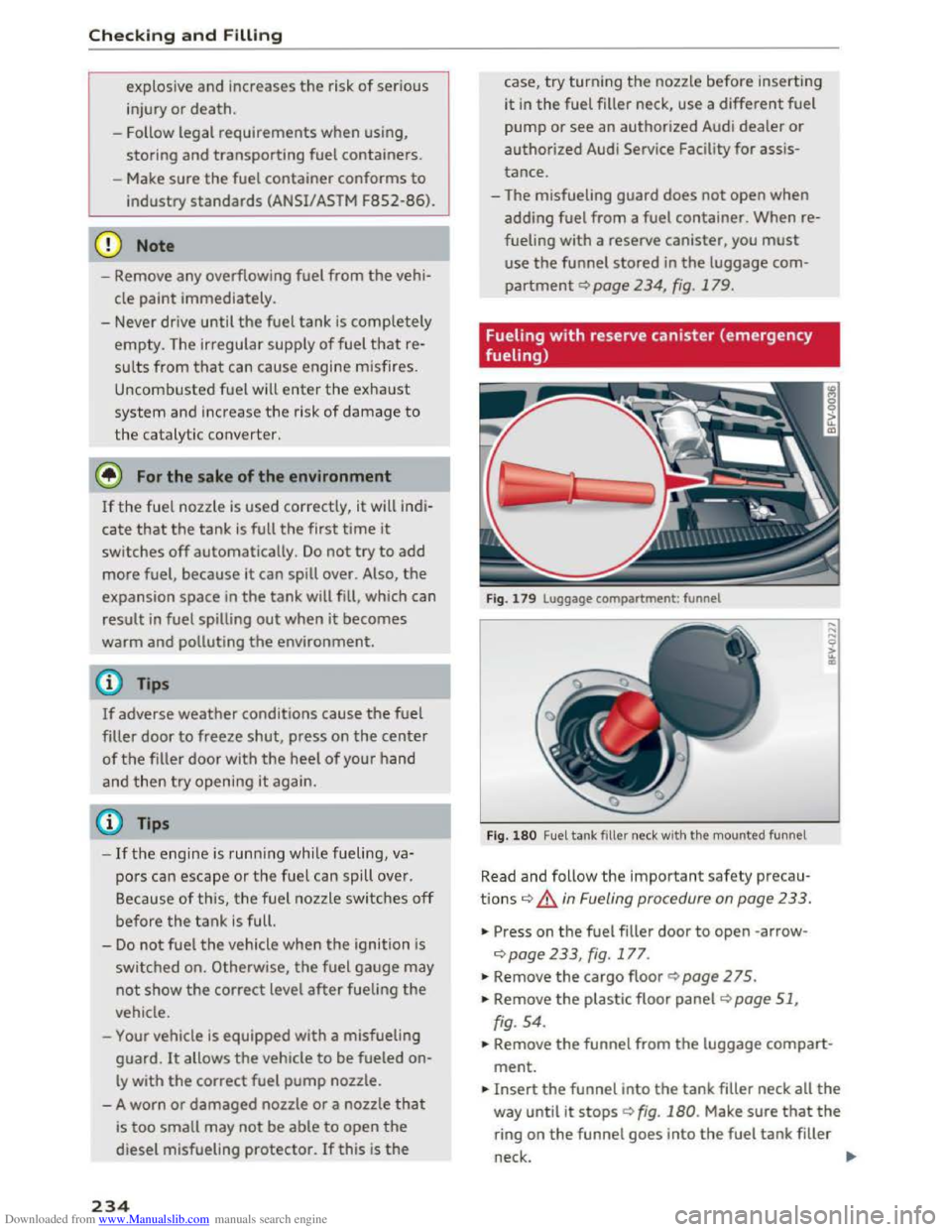
partment qpoge 234, fig. 179.
Fueling with reserve canister (emergency
fueling)
F ig . 179 Luggage compartment: funnel
Fig .
180 Fuel tank filler neck with the mou nted funnel
Read and follow the important safety precau
tions c:) ,&. in Fueling procedure on page 233.
"'Press on the fuel filler door to open -arrow-
q page 233, fig. 177.
"' Remove the cargo floor q page 2 75.
"'Remove the plastic floor panel qpage 51,
fig.
54.
"' Remove the funnel from the luggage compart
ment.
"' Insert the funnel into the tank filler neck all the
way until it stops q fig. 180. Make sure that the
ring on the funnel goes into the fuel tank filler
neck.
1111>
Page 237 of 322
Downloaded from www.Manualslib.com manuals search engine ..... N
G: CX)
.....
"' U"I
.....
"' .....
.. Guide the reserve canister filler tube into the
funnel and start the emergency fueling.
.. Remove the funnel after refueling and close the
fuel filler door so that it latches shut.
CD Note
Remove any overflowing fuel from the ve hicle
paint immediately.
Fuel filler door emergency release
If the fuel filler door lock is faulty, the fuel filler
door con be unlocked manually.
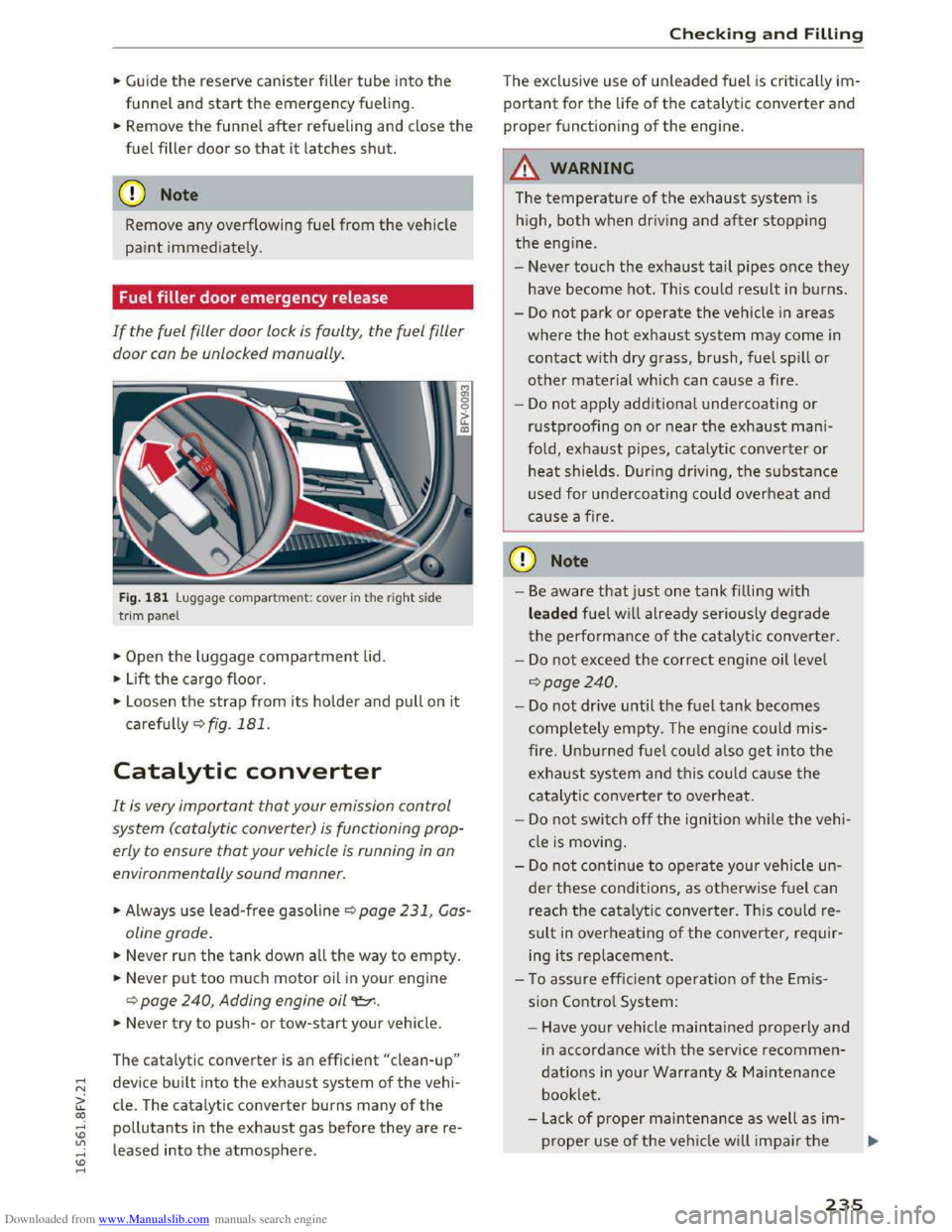
Fig. 181 L uggage compa rtment: cover in t he r ight side
t
rim panel
.,.. Open the luggage compartment lid.
.. L ift the cargo floor .
"'
"' 0 0
it IIl
.,.. Loosen the strap from its holde r and pull on it
carefu lly Qfig. 181.
Catalytic converter
It is very important that your emission control
system (catalytic converter) is functioning prop
erly to ensure
that your vehicle is running in on
environmentally sound manner.
.,.. Always use lead-free gasoline Q page 231, Gas
oline grade .
.. Never run the tank down all the way to empty.
.. Never put too m uch motor oil in your engine
Q page 240, Adding engine oil "t::r..
.. Never try to push-or tow-start your vehicle.
The
catal ytic converter is an efficient "clean-up"
device built into the exhaust system of the vehi
cle. The catalytic
converter burns many of the
pollutants in the exhaust gas before they are re
leased into
the atmosphere .
Checking and Filling
The exclusive use of unleaded fuel is critically im
portant for the life of the catalytic converter and
proper functioning of the engine.
A WARNING
f= - I
The temperature of the exhaust system is
high, both when driving and after stopping
the engine.
- Never
touch the exhaust tail pipes once they
have become hot. This could result in burns.
-Do not park or operate the vehicle in a reas
where the hot exhaust system may come in
contact with dry grass, brush, fuel spill or
other material which can cause a fire .
-
Do not appl y additional undercoating or
r ustproofing on or near the exhaust mani
fold, exhau
st pipes, catalytic converter or
heat shields. During driving, the substance
used for un dercoating could overheat and
cause a fire.
CD Note
-Be aware that just one tank filli ng with
leaded fuel w ill already seriously degrade
the performance of th e c atalytic converter .
-
Do not exceed the correct engine oil leve l
Qpoge240 .
-Do not drive until the fuel tank becomes
completely empty. The engi ne could mis
fire. Unbu r
ned fuel coul d also get into the
exhaust system and this could cause the
ca ta lyt ic co nver ter to overheat.
-Do not swi tch off the ignition whil e the vehi
cl e is moving .
-
Do not continue to operate your vehi cle un
der these condi tions, as o therwise fuel c a n
reach the catalytic converter. This could re
sult in over heating of the converter, requir
ing
its replacement .
- T o assu re
effic ient operatio n of the E mis
sion Contro l System:
-Have your vehicle maintained properly and
in accordance wi th the service recommen
dations in yo ur Warranty & Main tenance
bookle t.
- L ack
of proper maintenance as well as im-
p r
oper use of the veh icle w ill impair the .,..
235
Page 238 of 322
Downloaded from www.Manualslib.com manuals search engine Checking and Filling
function of the emission control system
and could lead to damage.
@ For the sake of the environment
Even when the Emission Control System is op
erating properly, the exhaust gas can have a
sulfur-like
exhaust gas smell under some op
erating states. This depends on the sulfur
content of the fuel being used. Using a differ
ent brand of fuel may help, or filling the tank
with lead-free super grade gasoline.
Engine compartment
Working in the engine compartment
Special care is required if you are working in the
engine compartment
For work in the engine compartment such as
checking and filling fluids, there is a risk of in
jury, scald ing , accidents, and burns. For this
reason, follow all the following listed warnings
and general safety precautions. The engine
compartment is a dangerous area. ~ & .
I'
A WARNING
-Turn the engine off.
-switch the ignition off.
-
Set the parking brake.
-
Place the selector lever in the P position.
- Let
the engine cool down.
- Never
open the hood when you see that
steam or coolant drips from the engine
compartment-there is a danger of burns!
Wait unti l no steam or coolant flows out.
- Keep children away from the engine com
partment.
- Never spill fluids on a hot engine. These flu
ids (such
as the freeze protection contained
in the coolant) can catch fire.
- Avoid
short circuits in the electrical system,
especially the battery.
-When working in the engine compartment,
remember that the radiator fan can switch
on even
if the ignition is switched off, which
increases
the risk of personal injury.
236
- Never open the cap on the coolant expan
sion
tank when the engine is warm. The
cooling
system is under pressure.
-To protect your face, hands, and arms from
hot steam or coolant, cover the cap with a
large cloth when opening.
-Do not remove the engine cover under any
circumstances. This increases the risk of
burns.
-
If tests need to be performed with the en
gine running, there is additional danger due
to moving components (such as the ribbed
belt, alternator and radiator fan) and from
the high voltage ignition system.
-Do not under any circumstances give gas in
advertently (for example, by hand from the
engine compartment) if the vehicle is sta
tionary but the engine is running and a gear
is engaged. Otherwise the veh icle will start
to move immediately and could result in a
crash.
-
Pay attention to the following warnings list
ed when work on the fuel system or on the
electrical equipment is required.
- Always
disconnect the vehicle battery
from the vehicle electrical system.
-Do not smoke.
-Never work near open flames.
-Always have a working fire extinguisher
nearby
- To reduce
the risk of electric shock and in
jury, never
touch the follow ing components
when t he engine is running or is being start
ed:
- Ignition cable
-
Other components in the electronic high
voltage ignition system
-If you must check or perform work on the
engine while it is running:
-
Set the parking brake and place the selec
tor lever in the P (park) position first.
- Always
proceed with extreme caution so
that clothing, jewelry or long hair do not
become caught in the radiator fan, fan
belt or other moving components or do
not come into contact with hot compo-
nents. Tie back long hair before beginning .,..
Page 241 of 322
Downloaded from www.Manualslib.com manuals search engine Engine oil
Engine oil specifications
The engine oil used must conform to exact speci
fications.
The ser vice interva l disp lay in the instrument
cluster of your vehicle will inform you when it is
time for an oil change . We recommend that you
have your
oil changed by an authorized Audi Serv
ice Advisor.
If you have to top off the oil between oil changes,
use the Audi oil quality standard specified in the
table.
Audi oil quality standard
G
asoline VW S02 00 or
engin e vw S0400
Using the proper engine oil is important for the
functionality and service life of the engine. Your
engine was factory-filled
with a high-quality oil
which
can usually be used throughout the entire
year.
CD Note
Your Limited New Vehicle Warranty does not
cover damage or malfunctions due to failure
to follow recommended maintenance and use
requirements as set forth in the Audi Owner's
Manual and Warranty
& Maintenance booklet.
-
Use only a high quality engine oil that ex-
pressly complies
with the Audi oil quality
standard specified for your vehicle's engine.
Using any other oil can cause serious engine
damage.
-
Do not mix any lubricants or other additives
into the engine oil. Doing so can cause en
gine damage.
Tips
If you need to add oil and there is none availa
ble
that meets the Audi oil quality standard
your engi
ne requires, you may add a tota l of
no more than O.S qt/l of a high-quality "syn
thetic" oil that meets the following spec ifica
tions.
Checking and F illing
-ACEA A3 or API SM with a viscosity grade of
SAE OW-30, SAE SW-30 or SAE SW-40.
-For more information about engine oil that
has been approved for your vehicle, please
contact either your
authorized Audi dealer
or Audi Customer
Relations at
1 (800) 822-2834 o r visit our web site at
www .audiusa .com or www.audicanada .ca.
Engine oil consumption
The engine in your vehicle depends on an ade
quate
amount of oil to lubricate and cool all of
its moving parts.
In order to provide effective lubrication and cool
i ng
of internal engine components, all internal
combustion engines consume a certa in amount
of oil. Oil consumption varies from engine to en
gine and may change significantly over
the life of
the engine. Typically, engines with a specified
break-in period
(see~ page 56) consume more
oil during the break-in period than they consume
after oil consumption has stabilized.
Under normal cond it ions, the rate of oil con
s u
mption depends on th e qu ality and viscos ity of
the oil, the RPM (revolutions per minute) at
which the engine is operated, the ambient tem
perature and road conditions. Further factors are
the amount of oil dilution from water condensa
tion or fuel residue and the oxidation level of the
oil. As any engine is subject to wear as mileage
builds
up, the oil consumption may increase over
t ime
until replacement of worn components may
become necessary.
With all these variab les coming into play, no
standard rate
of oil consumption can be estab
lished
or specified. There is no alternative to reg
ular and frequent checking of the oil level, see
Note .
If the yellow engine oil level warning symbol II
in the instrument cluster lights up, you should
check
the oil level as soon as possible
~page 240. Top off the oil at your earliest con-
venience
Q page 240. ..,..
239
Page 242 of 322
Downloaded from www.Manualslib.com manuals search engine Checking and Filling
.&. WARNING
Before you check anything in the engine com
partment, always read and heed all WARN
INGS¢ page 236.
CD Note
Driving with an insufficient oil level is likely to
cause severe damage to the engine.
{!) Tips
-The oil pressure warning display. is not
an indicator of the oil level. Do not rely on
it. Instead, check the oil level in your en
gine at regular intervals, preferably each
time you refuel , and always before going
on a long trip.
-If you have the impression your engi ne con
sumes excessive amounts of oil, we recom
mend that you consult an authorized Audi
dealer to have the cause of your concern
properly diagnosed. Keep
in mind that the
accurate measurement of oil consumption
requires great care and may take some
time. An authorized Audi dealer has instruc
tions about how to measure oil consump
tion accurately.
Checking the engine oil level
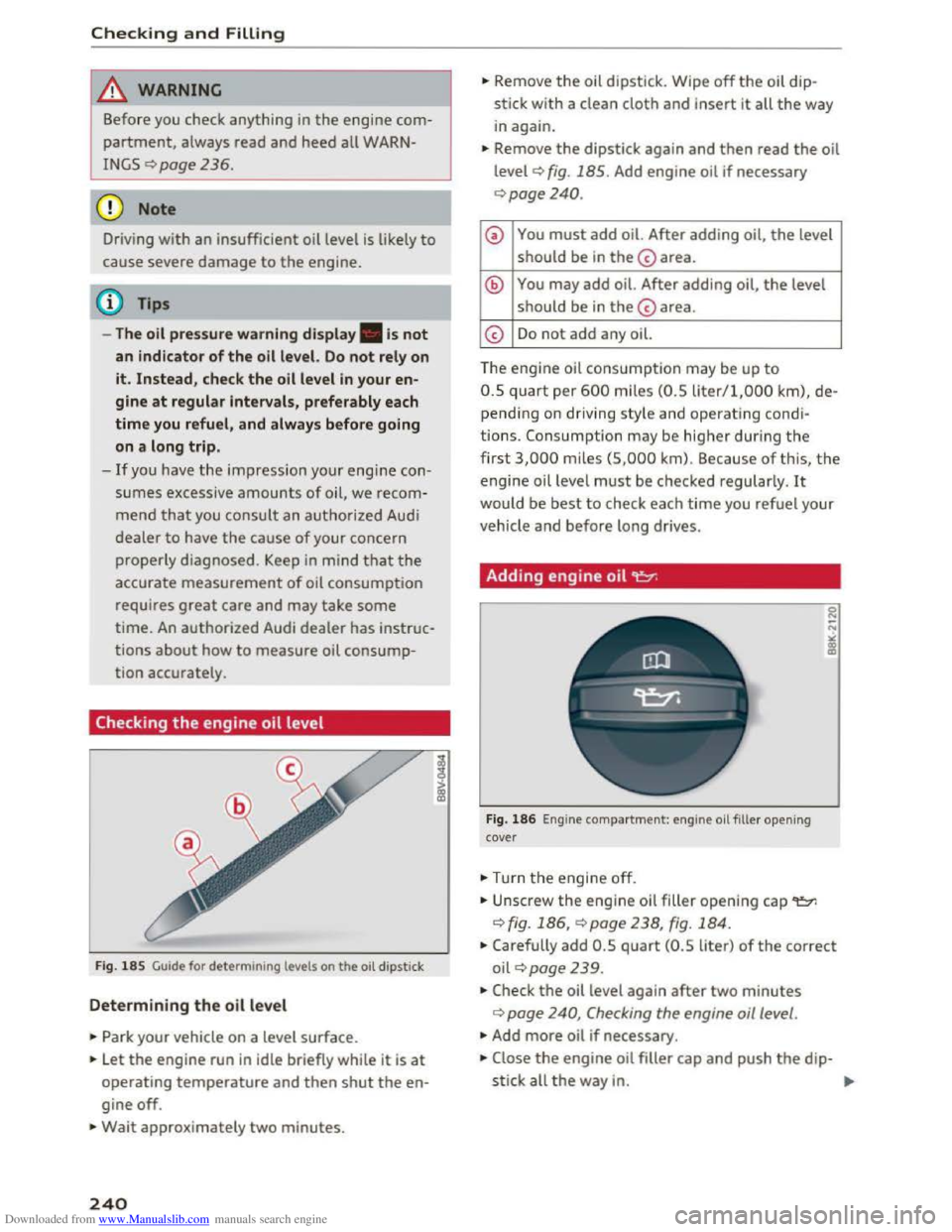
Fig. 185 Guide for determining levels on the oil dipstick
Determining the oil level
.. Park your vehicle on a level surface.
.. Let the engine run in idle briefly while it is at
operating temperature and then shut the en
gine off .
.. Wait approximately two minutes.
240
.. Remove the oil dipstick. Wipe off the oil dip
stick with a clean cloth and insert it all the way
in again.
.. Remove the dipstick again and then read the oil
level¢ fig. 185. Add engine oil if necessary
¢page240.
0 You must add oil. After adding oil, the level
should be
in the@area.
@ You may add oil. After adding oil, the level
should be
in the@area.
@
Do not add any oil.
The engine o
il consumption may be up to
0.5 quart per 600 m iles (0.5 liter/1,000 km), de
p ending on driving style and operating cond i
tions. Consumption may be higher during the
first 3,000 miles (S,000 km). Because of this, the
engine oil level must be checked regularly. It
would be best to check each time you refue l your
vehicle
and before long drives.
Adding engine oil 't:::?:
Fig. 186 Engine compartment: engine oil filler opening
cove r
•Turn th e engine off .
.. Unscrew the eng ine oil filler opening cap~
q fig. 186, ¢page 238, fig. 184 .
0 N
-N
" ~
.. Carefully add 0.5 quart (0.5 liter) of the correct
oil¢ page 239.
•Check the oil level again after two minutes
¢page 240, Checking the engine oil level.
•Add more oil if necessary .
.. Close the engine oil filler cap and push the dip-
stick all
the way in. IJI>
Page 252 of 322
Downloaded from www.Manualslib.com manuals search engine Wheels
Wheels
Wheels and Tires
General information
.,.Check your tires regularly for
damage (punctures, cuts, cracks
and bulges). Remove foreign ob
jects from the tire tread.
.,. If driving over curbs or similar
obstacles, drive slowly and ap
proach the curb at an angle.
.,.Have faulty tires or rims re
placed
immediately.
.,.Protect your tires from oil,
grease and fuel.
.,.Mark tires before removing
them so that the same running
direction can
be maintained if
they are reinstalled .
... Lay tires flat when storing and
store them in a cool, dry location
with
as little exposure to light as
possible.
CD Note
-Please note that summer and
winter tires are designed for
the conditions that are typical
in those seasons. Audi recom
mends using winter tires dur
ing the winter months. Low
temperatures significantly de
crease the elasticity of summ
er tires, which affects traction
250
and braking ability. If summer
tires are used in very cold
temperatures, cracks can form
on the tread bars, resulting in
permanent tire damage that
can cause loud driving noise
and unbalanced tires.
-Burnished, polished or
chromed rims must not be
used in winter driving condi
tions. The surface of the rims
does not have sufficient corro
sion
protection for this and
could be permanently dam
aged by road salt or similar
substances.
Tire designations
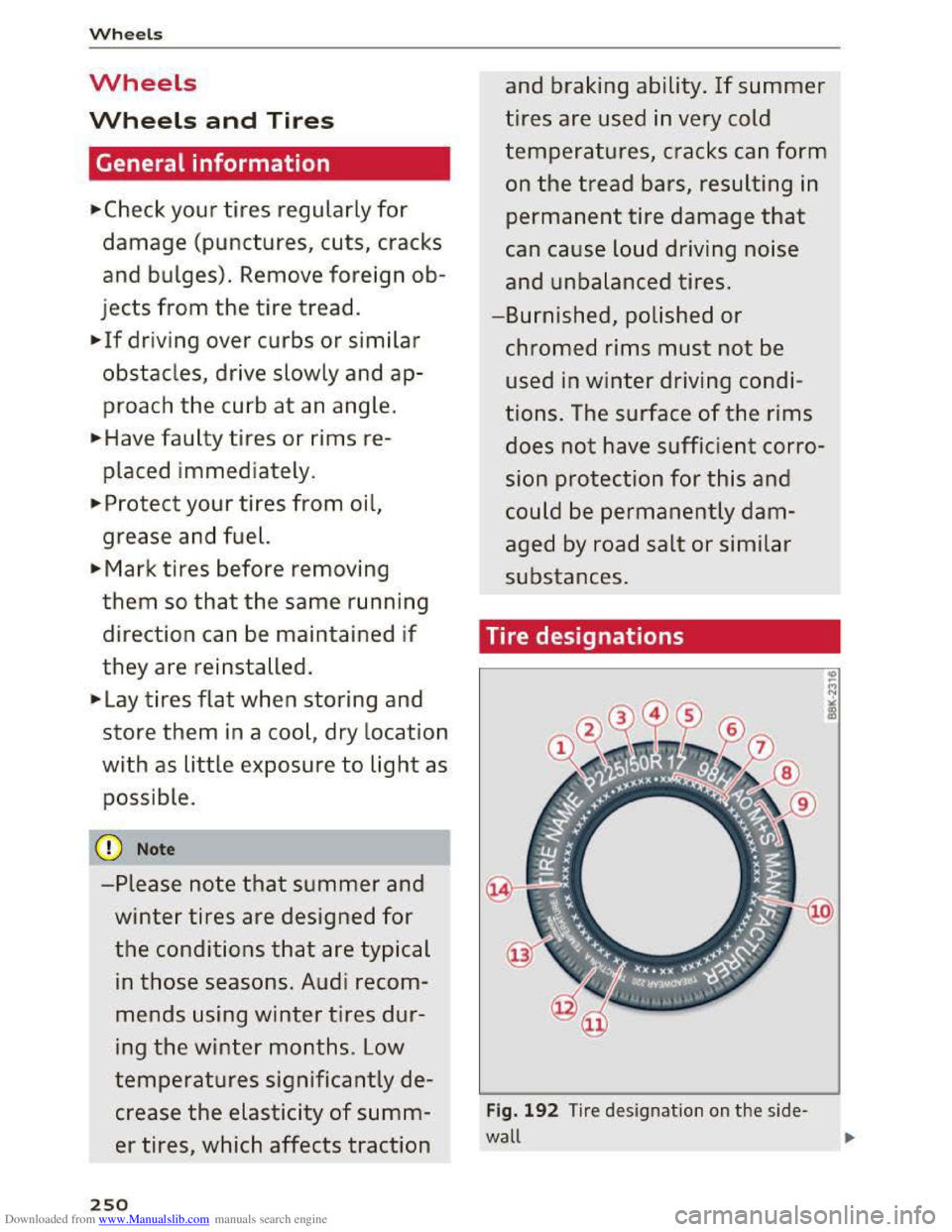
Fig. 192 Tire designation on the side
wall
Page 255 of 322

Downloaded from www.Manualslib.com manuals search engine reinforced by ply cords and that is
shaped to fit the rim.
Bead separation
means a breakdown of the bond
between components in the bead.
Cord
means the strands forming the
plies in the tire.
Cold tire inflation pressure
means the tire pressure recom
mended by the vehicle manufac
turer for a tire of a designated
size that has not been driven for
more than a couple of miles (kilo
meters) at low speeds in the
three hour period before the tire
pressure is measured or adjusted.
Curb weight
means the weight of a motor ve
hic le
with standard equipment in
c l
uding the maximum capacity of
fuel, oil, and coolant, air condi
tioning and additional weight of
optional equipment.
Extra load ti re
means a tire designed to operate
at higher loads and at higher in
flation pressures than the corre
sponding standard tire. Extra load
tires may be identified as "XL ",
Wheels
"xl" "EXTRA LOAD" or "RF" on , ,
the sidewall.
Gross Axle Weight Rating
("GAWR")
means the load-carrying capacity
of a single axle system, measured
at the tire-ground interfaces.
Gross Vehicle Weight Rating
(" GVWR ")
means the maximum total loaded
weight of the vehic le.
Groove
means the space between two ad
jacent tread ribs.
Load rating (code)
means the maxim um load that a
tire is rated to carry for a g iven in
flation pressure. You may not find
this information on all tires be
ca use it is not required by law.
Maximum load rating
means the load rating for a tire at
the maximum permissible infla
tion pressure for that tire.
Ma ximum loaded vehicle
weight
means the sum of:
(a)
Curb weight
(b) Accessory weight
253
Page 263 of 322
Downloaded from www.Manualslib.com manuals search engine the risk of an accident. Read
and follow
the important safe
ty precautions
inc:::> page 262,
Tires and vehicle Load Limits.
-The tire must flex more if the
tire pressure is too Low or if
the vehicle speed or Load are
too high. This heats the tire up
too much . This increases
the
risk of an accident because it
can cause the tire to burst and
result
in Loss of vehicle con
trol.
- Incorrect tire pressure
in
creases tire wear and has a
negative effect on driving and
Tire pressure table
Please note that the information
contained
in the following table
was correct at the time of print
ing , and
the information is sub
ject to change. If there are differ
ences between this information
and
the tire pressures specified
on
the Label on the driver's side B
pillar, always follow the specifica
tion on
the B-pillar Label
~page 260, fig. 194.
Wheels
braking behavior, which in
creases the risk of an accident.
CD Note
Replace Lost valve caps to re
duce
the risk of damage to the
tire valves.
Tire pressure
that is too Low in
creases fuel consumption.
(0 Tips
Audi recommends using the
tire pressure specified for a
normal
Load c:::> table on
page
262 or for a full Load
when the vehicle is partially
loaded.
Make sure
that the tire designa
tion on your tire matches
the des
ignation on
the tire pressure Label
and the tire pressure table.
The following
table Lists recom
mended tire pressures
in cold
tires according
to the Load and
the size of the tires installed . ...
261
Page 264 of 322
Downloaded from www.Manualslib.com manuals search engine Wheels
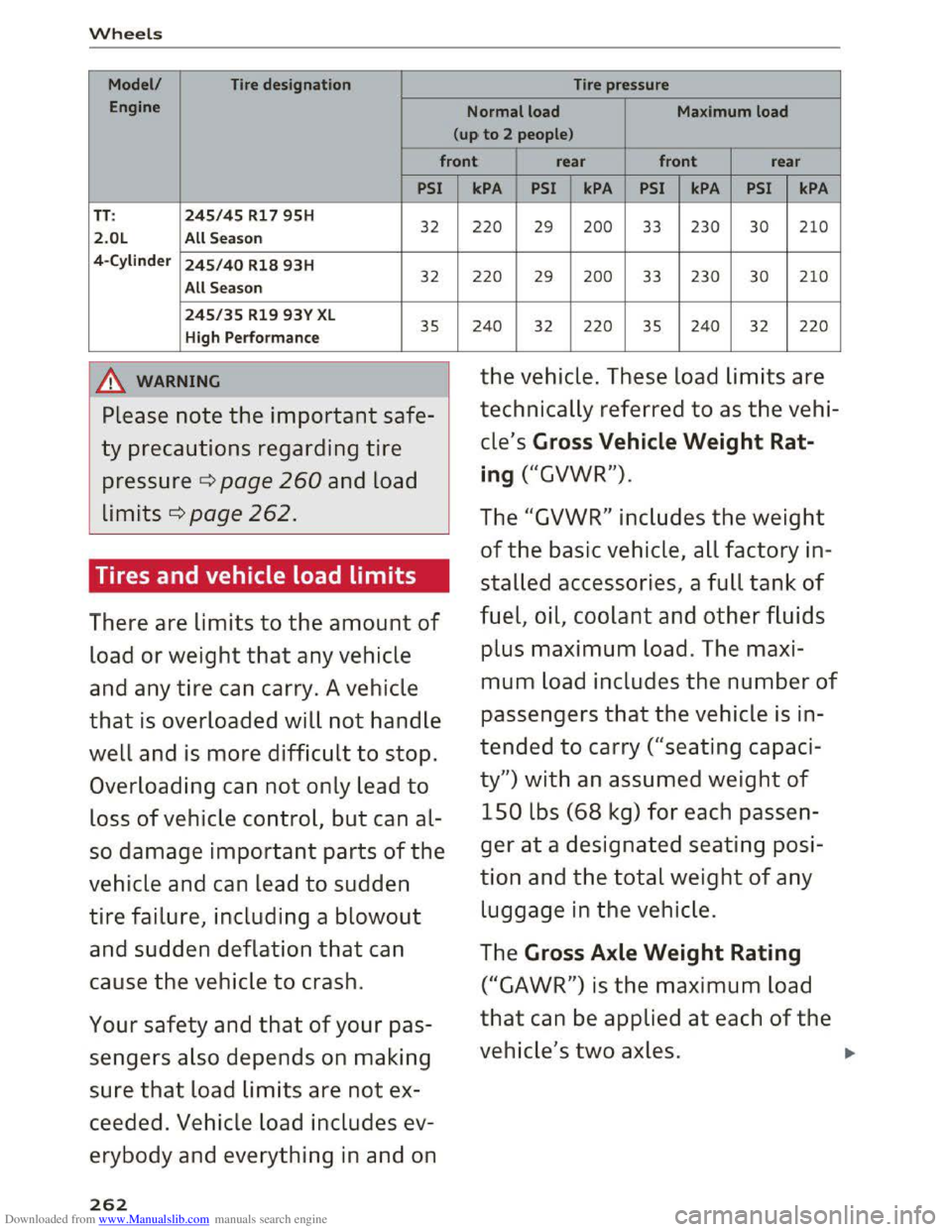
Model/ Tire designation Tire pressure
Engine Normal load Maximum load
(up to 2 people)
front rear front rear
PSI
TT: 245/45 R17 95H
2.0L All Season 32
4-Cylinder 245/40 R18 93H
All
Season 32
245/35 R19 93Y XL
High Performance 35
A WARNING
Please
note the important safe
ty precautions regarding tire
pressure¢ page 260 and load
limits
¢page 262.
Tires and vehicle load limits
There are limits to the amount of
load or weight that any vehicle
and any tire can carry. A vehicle
that is overloaded will not handle
well and
is more difficult to stop.
Overloading can
not only lead to
loss of vehicle control, but can al
so
damage important parts of the
vehicle and can lead to sudden
tire failure, including a blowout
and sudden deflation
that can
cause
the vehicle to crash.
Your safety and
that of your pas
sengers also depends on making
sure that load limits are not ex
ceeded. Vehicle load includes ev
erybody and everything
in and on
262
kPA PSI kPA PSI kPA PSI kPA
220 29 200 33 230 30 210
220 29 200 33 230 30 210
240 32 220 35 240 32 220
the vehicle. These load limits are
technically referred
to as the vehi
cle's Gross Vehicle
Weight Rat
ing
("GVWR").
The "GVWR" includes the weight
of the basic vehicle, all factory in
stalled accessories, a full tank of
fuel, oil, coolant and other fluids
plus maximum load. The maxi
mum load includes
the number of
passengers that the vehicle is in
tended to carry ("seating capaci
ty") with an assumed weight of
150 lbs (68 kg) for each passen
ger
at a designated seating posi
tion and
the total weight of any
luggage
in the vehicle.
The Gross Axle
Weight Rating
("GAWR") is the maximum load
that can be applied at each of the
vehicle's two axles.
Page 267 of 322
Downloaded from www.Manualslib.com manuals search engine ~Only use winter tires that are approved for your
vehicle.
~Please note that the maximum permitted
speed may be lower with winter tires q ,&.. An
authorized Audi dealer or authorized Audi Serv
ice Facility
can inform you about the maximum
permitted speed for your tires.
~Check the tire pressure after installing wheels
qpage260.
The effectiveness of winter tires is reduced great
ly when
the tread is worn down to a depth of
0.157 in (4 mm). The characteristics of winter
tires also decrease greatly as the tire ages, re
gardless
of the remaining tread.
A WARNING
1-=---Never drive faster than the maximum per-
mitted speed for your tires. This could cause
the tires to heat up too much. This increases
the risk
of an accident because it can cause
the
tire to burst.
- Always
adapt your driving to the road and
traffic conditions. Drive carefully and reduce
your speed on icy or slippery roads.
Even
winter tires can lose traction on black ice.
@ For the sake of the environment
Reinstall summer tires at the appropriate
time, because they provide better handling
when roads are free
of snow and ice. Summer
tires cause
Less road noise, tire wear and fuel
consumption.
(j) Tips
You can also use all season tires instead of
winter tires. Please note that in some coun
tries where
winter tires are required, only
winter tires with the & symbol may be per
mitted.
Snow chains
Snow chains not only improve the driving in win
ter road conditions, but also the braking.
~Only install snow chains on the front wheels.
This applies also
to vehicles with all wheel
drive*.
Wheels
~Check and correct the seating of the snow
chains
after driving a few feet, if necessary. Fol
low
the instructions from the manufacturer.
~Note the maximum speed of 30 mph (50 km/
h). Note the Local regulations.
Use of snow chains is only permitted with certain
rim/tire combinations due to technical reasons.
Check with an authori zed Audi dealer or author
ized Audi Service Facility
to see if you may use
snow chains .
You must remove the snow chains on roads with
out snow . Otherwise, you could impair driving
ability and damage the tires.
A WARNING
Using incorrect snow chains or installing snow
chains incorrectly
can result in loss of vehicle
control, which increases
the risk of an acci
dent.
CD Note
- Snow chains can damage the rims/wheel
covers* if the chains come into direct con·
tact with them. Remove the wheel covers*
first. Use coated snow chains.
-
Using snow chains that add more than 0.53
in (0.53 in) of height can severely damage
the wheel housings and
other vehicle com
ponents.
(D Tips
When using snow chains, it may be useful to
switch on sport mode ~page 88.
Low aspect ratio tires
Your Audi is factory-equipped with low aspect ra
tio tires. These tires have been thoroughly tested
and been selected specifically
for your model for
their superb performance, road feel and handling
under a variety
of driving conditions. Ask your au
thorized Audi dealer
for more details .
The
Low aspect ratio of these tires is indicated by
a numeral
of SS or less in the tire's size designa
tion. The numeral represents the ratio of the
tire's sidewall height in relation to its tread width..,.
265