steering wheel AUDI TT COUPE 2016 Owner's Guide
[x] Cancel search | Manufacturer: AUDI, Model Year: 2016, Model line: TT COUPE, Model: AUDI TT COUPE 2016Pages: 322, PDF Size: 52.86 MB
Page 200 of 322
Downloaded from www.Manualslib.com manuals search engine Airbag sy ste m
When an airbag deploys, fine dust is released.
This is normal and is not caused by a fire in the
vehicle. This dust is made up mostly of a powder
used to lubricate the airbags as they deploy. It
could irritate skin.
It is important to remember that while the sup
plemental airbag system is designed to reduce
the likelihood of serious injuries, other injuries,
for example swelling , bruising and minor abra
sions, can also happen when airbags inflate. Air
bags do not protect the arms or the lower parts
of the body. Front airbags supplement the three
point safety belts only in some frontal collisions
in which the vehicle deceleration is high enough
to deploy the airbags.
Front airbag s will not deploy:
-ifthe ignit ion is switched off when a crash oc-
curs,
-in side collisions,
-
in rear-end collisions,
-
in rollovers,
-
when the crash deceleration measured by the
airbag system is less than the minimum thresh
old needed for airbag deployment as registered
by the electronic control unit.
The front passenge r airbag will also not
deploy:
-when the front passenger seat is not occupied,
-
when the electrical capacitance measured by
the capacitive passenger detection system for
the front passenger seat indicates that the pas
senger side frontal airbag must be switc hed off
by the electronic control unit (the PASSENGER
AIR
BAG OFF light Q page 200 and how they
work comes on and stays on).
A WARNING
Sitting in the wrong position can increase the
risk of serious injury in crashes.
-To reduce the risk of injury when the airbags
inflate, the driver and passengers must al
ways
sit in an upright position, must not
lean against or place any part of their body
too close to the area where the airbags are
located.
198
-Occupants who are unbelted, out of position
or too close to the airbag can be seriously
injured
by an airbag as it unfolds with great
force in the blink of an eye Q page 189.
A WARNING
A child in a rearward-facing child seat instal
led
on the front passenger seat will be seri
ously injured
and can be killed if the front air
bag inflates -even with an Advanced Airbag
System.
-The inflating airbag will hit the child seat or
infant carrier with great force and will
smash the child seat and child against the
backrest, center armrest, door or roof.
- Always install rear-facing
child seats on the
rear seat.
- If you must install a rearward facing child
seat on the front passenger seat because of
exceptional circumstances and the PASSEN
GER AIR BAG OFF light does not come on
and stay on, immediately install the rear
facing child seat in a rear seating position
and have the airbag system inspected by
your Audi dealer.
A WARNING
Objects between you and the airbag will in
crease the risk of injury in a crash by interfer
ing with the way the airbag unfolds or by be
ing pushed into you as the airbag inflates.
- Never hold
things in your hands or on your
lap when the vehicle is in use.
-
-Never transport items on or in the area of
the front passenger seat. Objects could
move in
to the area of the front airbags dur
ing braking or other sudden maneuver and
become dangerous projectiles that can
cause serious personal injury if the airbags
inflate.
- Never place
or attach accessories or other
objects (such as cup holders, telephone
brackets, large, heavy or bulky objects) on
the doors, over or near the area marked
"AIRBAG" on the steering wheel, instru
ment panel, seat backrests or between
Page 205 of 322
Downloaded from www.Manualslib.com manuals search engine system will not be impaired and that discarded
components do not cause injury or pollute the
environment.
A WARNING
Improper care, servicing and repair proce
dures can increase the risk of personal injury
and death by preventing an airbag from de
ploying when needed or deploying an airbag
unexpectedly:
- 1
-Never cover, obstruct, or change the steer
ing wheel horn pad or airbag cover or the in
strument panel or modify them in any way.
- Never
attach any objects such as cup holders
or telephone mountings to the surfaces cov
ering
the airbag units.
- For cleaning
the horn pad or instrument
panel, use only a soft, dry cloth or one mois
tened with plain water. Solvents or cleaners
could damage the airbag cover or change
the stiffness or strength of the material so
that the airbag cannot deploy and protect
properly.
- Never repair,
adjust, or change any parts of
the airbag system.
-All work on the steering wheel, instrument
panel, front seats or electrical system (in
cluding
the installation of audio equipment,
cellular telephones and CB radios, etc.)
must be performed by a qualified technician
who has the training and special equipment
necessary.
- For any work on
the airbag system, we
strongly recommend that you see your au
thorized Audi dealer or qualified workshop.
- Never modify
the front bumper or parts of
the vehicle body.
- Always
make sure that the side airbag can
inflate without interference:
- Never install
seat covers or replacement
upholstery over the front seatbacks that
have not been specifically approved by
Audi.
- Never
use additional seat cushions that
cover the areas where the side airbags in
flate.
Airbag system
-Damage to the original seat covers or to
the seam in the area of the side airbag
module must always be repaired immedi
ately by an authorized Audi dealer.
-The airbag system can deploy only once. Af
ter an airbag has been deployed, it must be
replaced with new replacement parts de
signed and approved especially for your
Audi
model version. Replacement of com
plete airbag systems or airbag components
must be performed by qualified workshops
only. Make sure that any airbag service ac
tion is
entered in your Audi Warranty &
Maintenance booklet under AIRBAG RE
PLACEMENT RECORD.
-For safety reasons in severe accidents, the
alternator and starter are separated from
the vehicle battery with a pyrotechnic circuit
interrupter.
-Work on the pyrotechnic circuit interrupt
er must only be performed by a qualified
technicians who have
the experience, in
formation and special tools necessary to
perform the work safely.
-
If the vehicle or the circuit interrupter is
scrapped, all applicable safety precautions
must be followed.
@ For the sake of the environment
Undeployed airbag modules and pretension
ers might be classified as Perchlorate Materi
al -special handling may apply, see
www.dtsc.ca.gov/hazardouswaste/perchlo
rate. When the vehicle or parts of the re
straint system including airbag modules and
safety belts with pretensioners are scrapped,
all applicable laws and regulations must be
observed. Your authorized Audi dealer is fa
miliar
with these requirements and we recom
mend that you have your dealer perform this
service for you.
Other things that can affect Advanced
Airbag performance
Changing the vehicle's suspension system can
change the way that the Advanced Airbag System
performs in a crash. For example, using tire-rim ..,.
203
Page 206 of 322
Downloaded from www.Manualslib.com manuals search engine Airbag system
combinations not approved by Audi, lowering the
vehicle, changing the stiffness of the suspension,
including the springs, suspension struts, shock
absorbers etc. can change the forces that are
measured by the airbag sensors and sent to the
electronic control unit. Some suspension changes
can, for example, increase the force levels meas
ured by the sensors and make the airbag system
deploy in crashes in which it would not deploy if
the changes had not been made. Other kinds of
changes may reduce the force levels measured by
the sensors and prevent the airbag from deploy
ing when it should.
_&. WARNING
Changing the vehicle's suspension including
use
of unapproved tire-rim combinations can
change Advanced Airbag performance and in
crease the risk of serious personal injury in a
crash.
-Never install suspension components that
do not have the same performance charac
teristics as the components originally instal
led on your vehicle.
- Never use tire-rim
combinations that have
not been approved by Audi.
Knee airbags
Description of knee airbags
The knee airbag system can provide supplemen
tal protection to properly restrained front
seat
occupants.
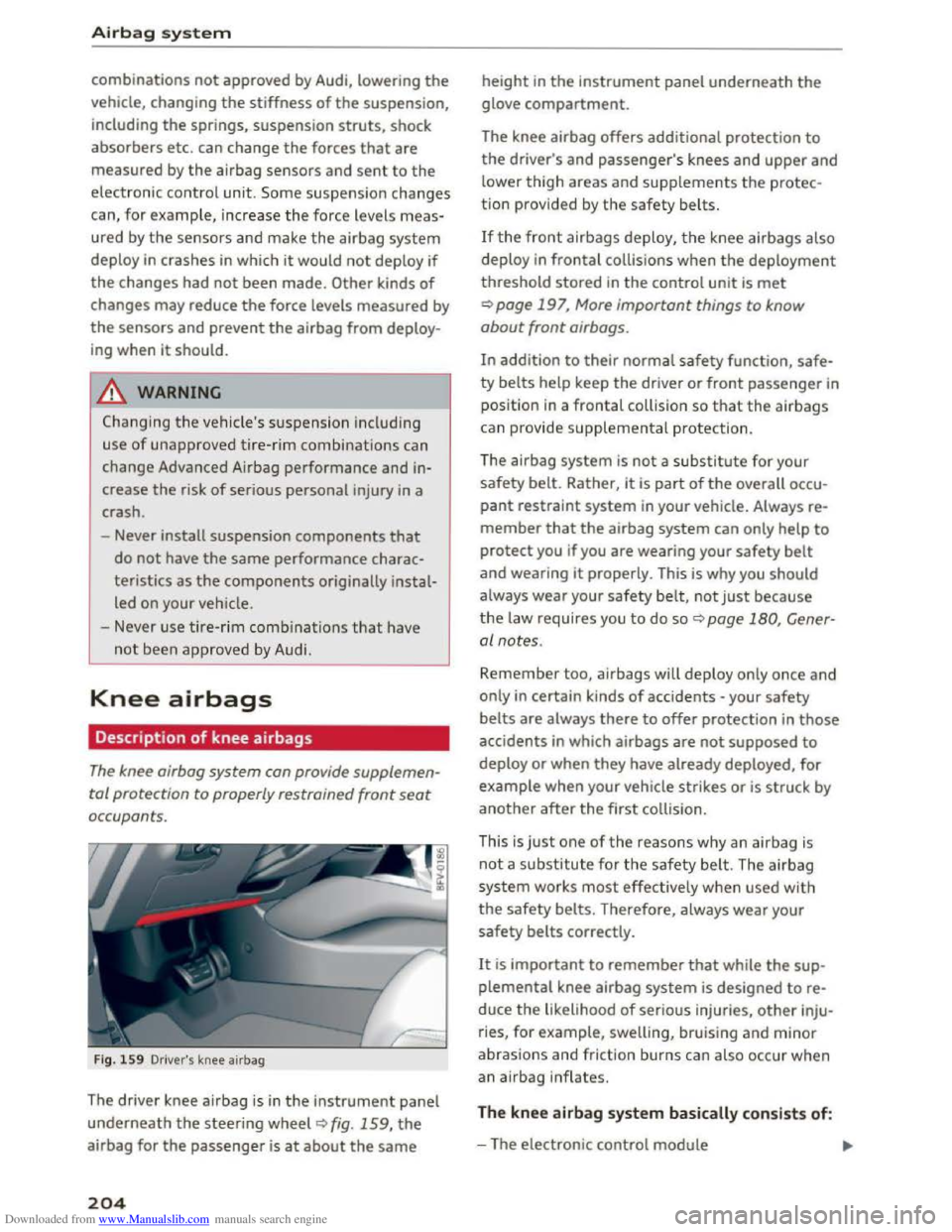
Fig. 159 Driver's knee airbag
The driver knee airbag is in the instrument panel
underneath the steering wheel Q fig. 159, the
airbag for the passenger is at about the same
204
height in the instrument panel underneath the
glove compartment.
The knee airbag offers additional protection to
the driver's and passenger's knees and upper and
lower thigh areas and supplements the protec
tion provided by the safety belts.
If the front airbags deploy, the knee airbags also
deploy
in frontal collisions when the deployment
threshold stored in the control unit is met
Qpage 197, More important things to know
about front airbags.
In addition to their normal safety function, safe
ty belts help keep the driver or front passenger in
position in a frontal collision so that the airbags
can provide
supplemental protection.
The airbag system is not a substitute for your
safety belt. Rather, it is part of the overall occu
pant restraint system in your vehicle. Always re
member that the airbag system can only help to
protect you if you are wearing your safety belt
and wearing it properly. This is why you should
always wear your safety belt, not just be ca use
t h e law requires you
to do so~ page 180, Gener
al notes .
Remember too, airbags will deploy only once and
only in certain kinds of accidents -your safety
belts are always there to offer protection in those
accidents in which airbags are not supposed to
deploy or when they have already deployed, for
example when your vehicle strikes or is struck by
another after the first collision.
This
is just one of the reasons why an airbag is
not a substitute for the safety belt. The airbag
system works most effectively when used with
the safety belts. Therefore, always wear your
safety belts correctly.
It is important to remember that while the sup
plemental knee airbag system is designed to re
duce the likelihood of serious injuries, other inju
ries, for example, swelling, bruising and minor
abrasions and friction burns can also occur when
an airbag inflates.
The knee airbag system basically consists of:
-The electronic control module .,.
Page 208 of 322
Downloaded from www.Manualslib.com manuals search engine Airbag system
-at least 10 in (25 cm) between the chest
and the steering wheel/instrument panel.
-
at least 4 in (10 cm) between the knees
and the lower part of the instrument pan
el.
- The risk
of personal injury increases if you
lean forward
or to the side, or if the seat is
improperly positioned and you are not wear
ing your safety belt. The risk increases even
more should the airbag deploy.
- Always
make sure that the knee airbag can
inflate without interference. Objects be
tween you and the airbag can increase the
risk of injury in an accident by interfering
with
the way the airbag deploys or by being
pushed into you as the airbag deploys.
- Never
let anybody, especially children or
animals ride in the footwell in front of the
passenger seat. If the airbag deploys, this
can result in serious or fatal injuries.
- Never carry
objects of any kind in the foot
well area in front of the driver's or pas
senger's seat. Bulky objects (shopping
bags, for example) can interfere with or
prevent proper deployment of the airbag.
Small objects can be thrown through the
vehicle if the airbag deploys and injure you
or your passengers.
-Make sure there are no cracks, deep scratch
es or other damage in the area of the instru
ment panel where the knee airbags are lo
cated.
-If children are incorrectly seated, their risk
of injury increases in a collision
~page 212, Child safety.
206
Side airbags
Description of side airbags
The airbag system can provide supplemental
protection to properly restrained front
seat occu
pants .
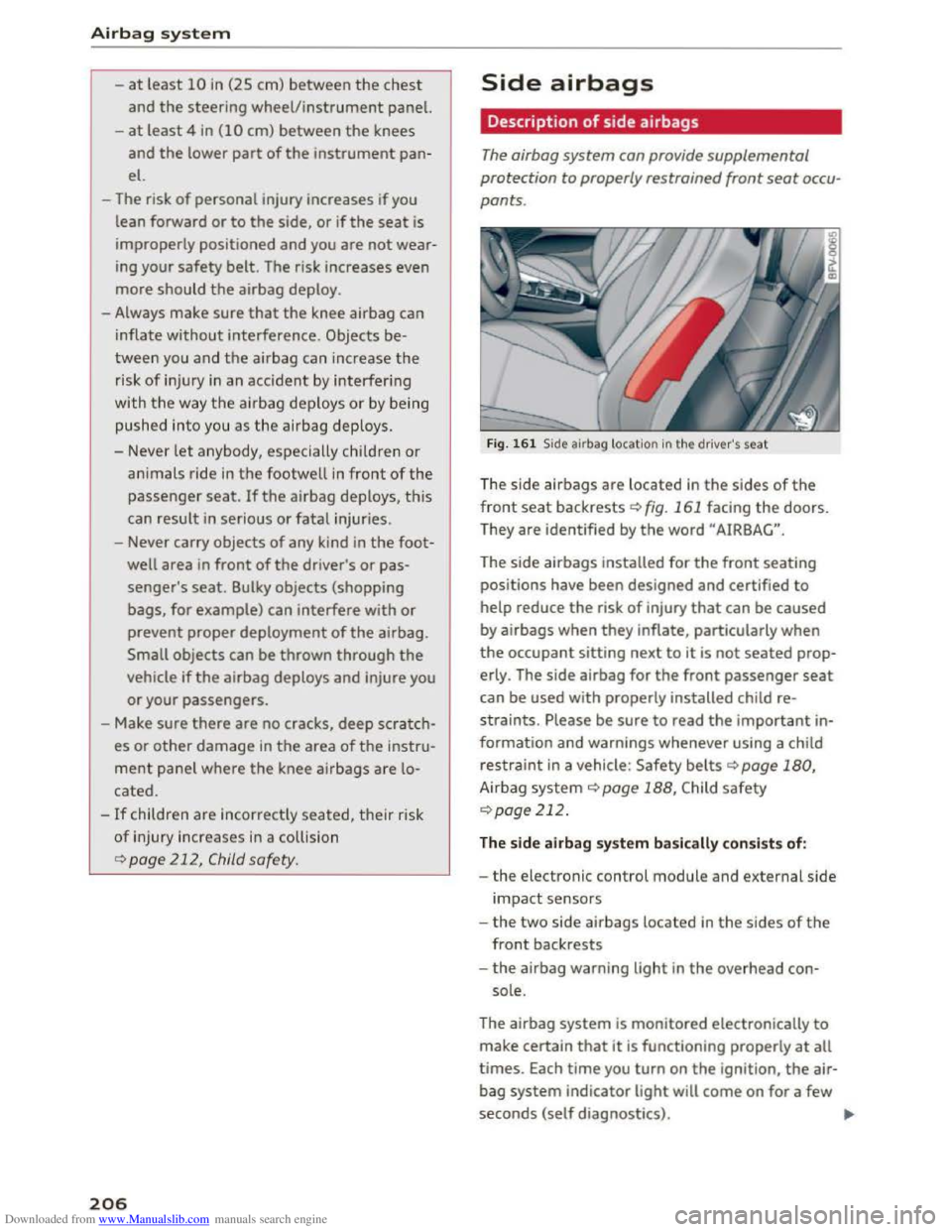
Fig . 161 Side airbag location in the driver's seat
The side airbags are located in the sides of the
front seat backrests Q fig. 161 facing the doors.
They
are identified by the word "AIRBAG".
The side airbags installed for the front seating
positions have been designed and certified to
help reduce the risk of injury that can be caused
by airbags when they inflate, particularly when
the occupant sitting next to it is not seated prop
erly. The
side airbag for the front passenger seat
can be used with properly installed child re
straints. Please be sure to read the important in
formation and warnings whenever using a child
restraint in a vehicle: Safety belts Q page 180,
Airbag system Q page 188, Child safety
¢page 212.
The side airbag syste m b asica lly consist s o f:
-
the electronic control module and external side
impact sensors
-the two side airbags Located in the sides of the
front backrests
-the airbag warning light in the overhead con
sole.
The airbag system is monitored electronically to
make certain that it is functioning properly at all
times. Each time you turn on the ignition, the air
bag system indicator light will come on for a few
seconds (self diagnostics). Iii>
Page 216 of 322
Downloaded from www.Manualslib.com manuals search engine Child safety
208 as applicable at the time your vehicle was
manufactured.
The Advanced Airbag system in your vehicle has
been certified to meet the "low-risk" require
ments for 3-and 6-year old children on the pas
senger side and small adults on the driver side.
The low risk deployment criteria are intended to
reduce the risk of injury through interaction with
the airbag that can occur, for example, by being
too close to the steering wheel and instrument
panel when the airbag inflates. In addition, the
system has been certified to comply with the
"suppression" requirements of the Safety Stand
ard, to turn off the front airbag for infants up to
12 months who are restrained on the front pas
senger seat in child restraints that are listed in
the Standard.
Even though your vehicle is equipped with an Ad
vanced Airbag
system, all children, especially
those 12 years and younger, should always ride
in the back seat properly restrained for their age
and size. The airbag on the passenger side makes
the front seat a potentially dangerous place for a
child
to ride. The front seat is not the safest place
for a child
in a forward-facing child safety seat. It
can be a very dangerous place for an infant or a
larger child in a rearward-facing seat.
The vehicle's Advanced Airbag System has a ca
pacitive
passenger detection system in the front
passenger seat cushion that can detect the pres
ence of a baby or a child in a ch ild restraint sys
tem on this seat.
The capacitiv e passenger detection system regis
ters the changes that resul t in an electrical field
when a ch ild , a child restraint, and a baby blanket
are on the front passenger seat. The change in
the measured capacitance due to the presence of
a child, a child restraint, and a baby blanket on
the front passenger seat is related to the child
restraint system resting on the seat. The meas
ured capacitance of a child restraint system var
ies
depending on the type of system and specific
make and model.
The electrical capacitance of the various types,
makes, and models of child restraints specified
by
the U.S.National Highway Traffic Safety Ad-
214
ministration (NHTSA) in the relevant safety
standard are stored in the Advanced Airbag Sys
tem control unit together with the capacitances
typical of infants and a 1-year old child. When a
child
restraint is used on the front passenger
seat with a typical 1 year-old infant, the Ad
vanced Airbag
System compares the capacitance
measured by the capacitive passenger detection
system with the data stored in the electronic con
trol unit.
Child restraints and Advanced front airbag
system
Regardless of the child restraint that you use,
make sure that it has been certified to meet Unit
ed States Federal Motor Vehicle Safety Standards
and ha s been certified by its manufacture r for
use with a n airbag. Always be sur e that the child
restraint is properly installed at one of the rear
seating positions. If in exceptional circumstances
you must use it on the front passenger seat, care
fully
read all of the information on child safety
and Advanced Airbags and heed all of the appli
cable WARNINGS. Make certain that the child
and child restraint are correctly recognized by the
capacitive passenger detection system in the
front passenger seat, that the front passenger
airbag is turned off, and that the airbag status is
always correctly si
gnaled by the PASSENGER AI R
BAG OFF light.
Many types and models of child restraints have
been available over the years, new models are in
troduced regularly incorporating new and im
proved
designs a nd older models are taken out of
production. Child restraints are not standardized .
Child
restraints of the same type typically have
different weights and sizes and different "foot
pr ints", the size and shape of the bottom of the
child restraint that sits on the seat, when they
are installed on a vehicle seat. These differences
make it virtually impossible to certify compliance
with the requirements for advanced airbags with
each
and every child restraint that has ever been
sold in the past or will be sold over the course of
the useful life of your vehicle.
For
this reason, the United States Nat ional High
way Traffic
Safety Administration has published a ..,_
Page 261 of 322
Downloaded from www.Manualslib.com manuals search engine ..... N
ii ~
-Have the wheels rebalanced if an
imbalance is causing noticeable
vibration in the steering wheel.
If you do not, the tires and other
vehicle components could wear
more quickly.
Treadwear indicator
Original equipment tires contain
treadwear indicators in the tread
pattern, which are bars that are
1/16 in (1.6 mm) high and are
spaced evenly around the tire per
pendicular to the running direc
tion¢ fig. 193. The letters "TWI"
or triangles on the tire sidewall
indicate the location of the tread
wea r indicators.
The tires have reached the mini
mum tread depth l) when they
have worn down to the tread wear
indicators. Replace the tires with
new ones ¢ .&.
Wheel rotation
Rotating the wheels regularly is
recommended to ensure the tires
wear evenly. To rotate wheels, in
stall the wheels from the rear
axle on the front ax le and vice
versa. This will allow the tires to
~ l) Obey any applicable regulations in your
:0 country . .....
Wheels
have approximately the same
length of service life.
F
or unidirectional tires, make
sure the tires are installed accord
ing to the running direction indi
cated on the tire sidewall
¢ page 282.
Hidden damage
Damage to tires and rims can of
ten occur in locations that are
hidden. Unusual vibrations in the
vehicle or pulling to one side may
indicate that there is tire damage.
Reduce your speed immediately.
Check
the tires for damage. If no
damage is visible from the out
side, drive slowly and carefully to
the nearest authorized Audi deal
er or authorized Audi Service Fa
cility
to have the vehicle inspect
ed.
.&. WARNING
Tread that has worn too low or
different tread depths on the
tires can reduce driving safety.
This can especially have a nega
tive effect on handling, on the
risk aquaplaning when driving
through water, when driving ..
259
Page 270 of 322
Downloaded from www.Manualslib.com manuals search engine Wheels
installation of replacement or alternate tires or
wheels on the vehicle that prevent the TPM S
from functioning properly. Always check the
TPMS malfunction telltale after replacing one or
more ti
res or whee ls on your veh icle to ensure
that the replacement or alternate tires and
wheels
allow the TPMS to conti nue to functi on
p roper ly .
If the Tire Pressure Monitoring System
indicator appears
The tire pressure indicator in the instrument
cluster informs you if the tire pressure is too low
or
if there is a system malfunction.
Using the ABS sensors, th e tire p ressure monitor
i n g
system compares the tire tread circumfer
ence and vibra tion char
acteristi cs of the individ u
al tires.
If the pressure changes in one or more
tires,
this i s indicated in the Infotainment system
d isp lay
with an ind icator light RI and a message .
If only one tire is affected , the location of that
tire will be ind icated.
The tire pressures must be stored in the Infotain
ment system again each time the pressu res
change (switching between partial and full load
pressure) or
after changing or replacing a tire on
your veh icle ¢ page 269. The tire pressure moni
toring system only monitors the tire pressure you
have stored. Refe r
to the tire pressure label for
the recommended tire pressure for your veh icl e
¢page260, fig.195.
Tire tread circumference and vibration character
istics
can change and cause a tire pressure warn
i n g if:
-
the tire p ressure in one or more tires is too low.
-
the tire has structural damage .
-
the tire was replaced or the tire pressure was
changed and
it was not stored¢ page 269.
-the spare tire* is installed .
Indicator lights
RI-Loss of pressure in at l east one tire ¢,&.
Check
t h e tires and rep lace or r epair if necessary.
Check/correct
the p ressures of all four tires and
store
the pressure again in the Infotainment sys
tem ¢ page 269.
268
ffim (T ire Pressure Mon itoring System) Tire
pressure: malfunction!
See owner's manual -if
m appears after switching on the ignition or
while driving and then the RI indicator light in
the instrument cluster also starts to blink for
about one minute and then stays on permanent
ly, there
is a system malfunction . T ry to store the
cor rect tire p ressures ¢ page 269. If the indica
tor light does turn off or turns on again after a
sho
rt per iod of time, d rive to an authori zed Aud i
dealer or
authorized Audi Servi ce Facility immedi
ate ly
to have the ma lfunction corrected .
.&. WARNING
-If the tire pressure indicator appears in the
display, reduce your speed immediately and
avoid any hard steering or brak ing maneu
vers.
Stop as soon as poss ible and check the
tires and
their pressure .
- The driver is responsible
for maintain ing the
correct tire pressures . You must check the
tire pressures regularly .
-
Under certain condit ions (such as a sporty
driving style, wi
nter condit ions or unpaved
roads), the pressure
monitor indica tor may
be delayed.
-
Do not use run-flat tires on your vehicle . Us
ing them when not perm itted can lead to
veh icle damage or accidents.
(D Tips
- The tire pressure monitoring system can al
so stop working when there
is an ESC mal
func tion.
-
Usi ng snow chains may result in a system
ma lfunction .
- The
tires wit h the identification "AO" or
"RO" ¢ page 2 5 7 have been matched with
your Audi tire pressu re monitor ing system .
We rec om mend that you use these tires.
Page 303 of 322
Downloaded from www.Manualslib.com manuals search engine ...... N
G'. CX)
...... ID VI ...... ID ......
A
A/C (climate control system) . . . . . . . . . . . . . 53
Accessing media . . . . . . . . . . . . . . . . . . . . . .
159
Accessories . . . . . . . . . . . . . . . . . . . . . . . . . . 296
Active lane assist .
. . . . . . . . . . . . . . . . . . . . . 74
Activating vibration warning . . . . . . . . . . . . 76
Adjusting steering
time . . . . . . . . . . . . . . . . 76
Indicator light . . . . . . . . . . . . . . . . . . . . . . . 75
Messages . . . . . . . . . . . . . . . . . . . . . . . . . . . 75
switching on and
off . . . . . . . . . . . . . . . . . . 7S
Adaptive dampers . . . . . . . . . . . . . . . . . . . . . . 80
Adaptive light (indicator light) . . . . . . . . . . . 17
Adjusting air
distribution (Climate control sys-
tem) . . . . . . . . . . . . . . . . . . . . . . . . . . . . . . . . S3
Adjusting the air vents . . . . . . . . . . . . . . . . . . 54
Adjusting the center console lighting . . . . . . 39
Adjusting the sound (tone) . . . . . . . . . . . . . 169
Adjusting the temperature (climate control
system) . . . . . . . . . . . . . . . . . . . . . . . . . . . . . . 53
Adjusting
the volume
Multifunction steering wheel
Advanced Airbag
System
21,22, 104
Children ...........................
Components ....................... .
Front airbags
...................... .
How
the components work together ... .
Airbag
............................. .
Indicator light ...................... .
Airbag system
....................... .
Advanced Airbag-System
............. .
Care ..............................
Child restraints .....................
Components (front airbags) .......... .
Danger
of fitting a child safety seat on the
front passenger seat ................ .
Disposal
.......................... .
Front airbags
...................... .
How do
the front airbags work? ....... .
How many airbags does
my vehicle have?
Important information ...............
213
19S
193
197
188
15
207
192
202
214
195
189
202
192
197
195
188
Important safety instructions on the knee
airbag system . . . . . . . . . . . . . . . . . . . . . . .
205
Knee airbags . . . . . . . . . . . . . . . . . . . . . . . . 204
Monitoring . . . . . . . . . . . . . . . . . . . . . . . . . 199
PASSENGER AIR BAG OFF light . . . . . . . . . 200
Repairs . . . . . . . . . . . . . . . . . . . . . . . . . . . . 202
Safety instructions . . . . . . . . . . . . . . . . . . . 202
Index
Side airbags . . . . . . . . . . . . . . . . . . . . . . . . 206
Side curtain airbags . . . . . . . . . . . . . . . . . . 209
Warning/Indicator lights . . . . . . . . . . . . . 199
When must the system be inspected? . . . 199
Alarm system
refer to Anti-theft alarm system . . . . . . 25, 30
Alignment pin (tire changing) . . . . . . . . . . . 275
All season tires . . . . . . . . . . . . . . . . . . . . . . . 264
All weather lights . . . . . . . . . . . . . . . . . . . . . . 36
All wheel drive . . . . . . . . . . . . . . . . . . . . . . . . 91
Ambient lighting . . . . . . . . . . . . . . . . . . . . . . 38
AMI
refer to Audi music interface . . . . . . . . . . . 155
Announcements (settings)
refer to Voice guidance . . . . . . . . . . . . . . . 138
Anti-freeze
Windshield washer system . . . . . . . . . . . .
248
Anti-lock braking system (ABS) . . . . . . . . . . . 87
Anti-slip regulation . . . . . . . . . . . . . . . . . . . . 87
Anti-theft alarm system . . . . . . . . . . . . . . . . . 30
Ashtray ............................. . 47
162 Aspect (video) ............. . ..........
Audi connect . . . . . . . . . . . . . . . . . . . . . . . . . 121
Activating . . . . . . . . . . . . . . . . . . . . . . . . . . 121
Configuring . . . . . . . . . . . . . . . . . . . . . . . . 126
Connecting . . . . . . . . . . . . . . . . . . . . . . . . . 121
Connection settings . . . . . . . . . . . . . . . . . . 167
Data connection . . . . . . . . . . . . . . . . . . . . . 127
Data protection . . . . . . . . . . . . . . . . . . . . . 129
Functions
. ......................... 123
Navigation . . . . . . . . . . . . . . . . . . . . . 123, 134
Notes ............................. 128
Options . . . . . . . . . . . . . . . . . . . . . . . . . . . . 125
Preview . . . . . . . . . . . . . . . . . . . . . . . . . . . . 123
Requirements. . . . . . . . . . . . . . . . . . . . . . .
121
Services . . . . . . . . . . . . . . . . . . . . . . . . . . . 123
Audi connect services
Media . . . . . . . . . . . . . . . . . . . . . . . . . . . . .
12S
Navigation . . . . . . . . . . . . . . . . . . . . . . . . . 12S
Telephone . . . . . . . . . . . . . . . . . . . . . . . . . . 12S
Audi music interface . . . . . . . . . . . . . . . ....
Audi music stream
refer to Wi-Fi audio player ........... .
Audio files
. . . . . . . . . . . . . . . . . . . . . . . . . . .
Audio player
Bluetooth audio player
.............. .
Wi-Fi audio player
.................. .
15S
1S3
159
152
153
301
Page 304 of 322
Downloaded from www.Manualslib.com manuals search engine Index
Audio track . . . . . . . . . . . . . . . . . . . . . . . . . . 162
Audi phone
box.................... .. . 111
Audi Service Repair Manuals and Literature 294
Audi virtual cockpit (instrument cluster) . . . . 8
AUTO
Automatic climate control system . . . . . . . 53
Automatic headlights . . . . . . . . . . . . . . . . .
36
Auto Lock (centra l locking) . . . . . . . . . . . . . . 25
Automatic
belt retractor . . . . . . . . . . . . . . . 184
Automatic climate control system
refer to Climate control system (automatic) .53
Automatic key . . . . . . . . . . . . . . . . . . . . . . . . . 25
Automatic post-collision brak ing system . . .
87
Automatic transmission . . . . . . . . . . . . . . . . . 64
Driving tips . . . . . . . . . . . . . . . . . . . . . . . . . . 66
Emergency mode . . . . . . . . . . . . . . . . . . . . . 70
Hill descent control . . . . . . . . . . . . . . . . . . . 68
Kick-down . . . . . . . . . . . . . . . . . . . . . . . . . . . 69
Launch Control-Program . . . . . . . . . . . . . . . 69
malfunction . . . . . . . . . . . . . . . . . . . . . . . . . 65
Selector lever emergency release . . . . . . . . 71
Selector lever lock . . . . . . . . . . . . . . . . . . . . 65
Selector lever positions . . . . . . . . . . . . . . . .
64
Shifting manually . . . . . . . . . . . . . . . . . . . . 68
Steering wheel with shift paddles. . . . . . . . 68
tiptronic . . . . . . . . . . . . . . . . . . . . . . . . . . . . 68
Automatic wipe/wash system . . . . . . . . . . . . 41
Automatic zoom . . . . . . . . . . . . . . . . . . . . . . 141
Auto Safety Hotline . . . . . . . . . . . . . . . . . . . 178
AUX input . . . . . . . . . . . . . . . . . . . . . . . . . . . 155
Average consumption . . . . . . . . . . . . . . . . . . . 23
Average speed . . . . . . . . . . . . . . . . . . . . . . . . 23
Avoid damaging
the vehicle . . . . . . . . . . . . . . 56
B
Balance (sound) . . . . . . . . . . . . . . . . . . . . . . 169
Bass (sound) . . . . . . . . . . . . . . . . . . . . . . . . . 169
Battery . . . . . . . . . . . . . . . . . . . . . . . . . . . . . 245
Charge level . . . . . . . . . . . . . . . . . . . . . . . . . 92
Charging . . . . . . . . . . . . . . . . . . . . . . . . 13, 247
Disconnecting/connecting . . . . . . . . . . . . . 245
Energy management . . . . . . . . . . . . . . . . . . 92
Important warnings . . . . . . . . . . . . . . . . . 245
Indicator light . . . . . . . . . . . . . . . . . . . . . . . 13
Jump starting . . . . . . . . . . . . . . . . . . . . . . .
288
Location . . . . . . . . . . . . . . . . . . . . . . . . . . . 245
302
Not running for long periods of time . . . . 245
Replacing the battery . . . . . . . . . . . . . . . . 248
Winter operat ion . . . . . . . . . . . . . . . . . . . . 245
Working on the battery . . . . . . . . . . . . . . . 24S
Befo re
driv ing . . . . . . . . . . . . . . . . . . . . . . . . 171
Better route . . . . . . . . . . . . . . . . . . . . . . . . . 143
Blended gasoline . . . . . . . . . . . . . . . . . . . . . 231
B locked route . . . . . . . . . . . . . . . . . . . . . . . .
138
Blocking roads . . . . . . . . . . . . . . . . . . . . . . . 13 7
B lower (climate
control system) . . . . . . . . . . 53
Bluetooth Audio player . . . . . . . . . . . . . . . . . . . . . . . .
152
Connect ing a cell phone . . . . . . . . . . . . . . 110
Device search . . . . . . . . . . . . . . . . . . . . . . . 119
Settings . . . . . . . . . . . . . . . . . . . . . . . . . . . 119
Booster seats . . . . . . . . . . . . . . . . . . . . . . . . 221
Brake
fluid
Changing the brake fluid . . . . . . . . . . . . . . 244
Checking the brake fluid level . . . . . . . . . . 244
Brakes . . . . . . . . . . . . . . . . . . . . . . . . . . . . . . . 89
Brake assist system . . . . . . . . . . . . . . . . . . . 87
Brake booster . . . . . . . . . . . . . . . . . . . . . . . . 89
New brake pads . . . . . . . . . . . . . . . . . . . . . . 89
Parking brake . . . . . . . . . . . . . . . . . . . . . . . . 61
Brake system
Brake
fluid . . . . . . . . . . . . . . . . . . . . . . . . . 244
Brake fluid specifications for refill and re
placement . . . . . . . . . . . . . . . . . . . . . . . . .
244
Fluid reservoir . . . . . . . . . . . . . . . . . . . . . . 244
Worn brake pads symbol . . . . . . . . . . . . . . . lS
Braking
Brake assist . . . . . . . . . . . . . . . . . . . . . . . . .
87
Emergency braking function . . . . . . . . . . . . 62
Indicator light . . . . . . . . . . . . . . . . . . . . . . . 11
Break-in period
Tires . . . . . . . . . . . . . . . . . . . . . . . . . . . . . . . 56
Break-in security feature . . . . . . . . . . . . . . . .
25
Breaking in
New tires . . . . . . . . . . . . . . . . . . . . . . . . . . 257
Browser
refer to Media center . . . . . . . . . . . . . . . . . 160
Bulb failure (indicator light) . . . . . . . . . . . . . 16
Bulb replacement . . . . . . . . . . . . . . . . . . . . . 287
Buttons
Multifunction steering wheel . . . . . . . . 20, 22
Page 306 of 322
Downloaded from www.Manualslib.com manuals search engine Index
Climate control system (automatic)
Adjusting air vents . . . . . . . . . . . . . . . . . . . . 53
Adjusting
the air vents. . . . . . . . . . . . . . . . . 54
Adjusting the temperature . . . . . . . . . . . . . 53
Air
distribution, air vents . . . . . . . . . . . . . . . 53
AUTO (automatic mode) . . . . . . . . . . . . . . . 53
Blower . . . . . . . . . . . . . . . . . . . . . . . . . . . . . 53
Controls . . . . . . . . . . . . . . . . . . . . . . . . . . . . 53
Defrosting
the windows . . . . . . . . . . . . . . . 54
Drive select . . . . . . . . . . . . . . . . . . . . . . . . . . 80
Rear window defogger . . . . . . . . . . . . . . . . . 54
Recirculation mode . . . . . . . . . . . . . . . . . . . 53
Climate control system (manual)
Adjusting
the air vents . . . . . . . . . . . . . . . . . 54
Closing
Hood . . . . . . . . . . . . . . . . . . . . . . . . . . . . . . 237
W indows . . . . . . . . . . . . . . . . . . . . . . . . . . . 32
Closing/opening by remote
control . . . . . . . . . . . . . . . . . . . . 27
with the central locking switch . . . . . . . . . . 29
with the convenience key . . . . . . . . . . . . . . . 28
Closing and opening
With the door lock . . . . . . . . . . . . . . . . . . . . 30
Cockpit (overview) . . . . . . . . . . . . . . . . . . . . . . 6
Coming home . . . . . . . . . . . . . . . . . . . . . . . . . 38
Command (voice recognition system) . . . . . 104
Compartments . . . . . . . . . . . . . . . . . . . . . . . . 48
Compass in the mirror . . . . . . . . . . . . . . . . . . 42
Compliance . . . . . . . . . . . . . . . . . . . . . . . . . . 297
Connection manager . . . . . . . . . . . . . . . . . . 167
Audi MMI connect app . . . . . . . . . . . . . . . . 167
Bluetooth settings . . . . . . . . . . . . . . . . . . . 168
Data connection . . . . . . . . . . . . . . . . . . . . . 167
Network settings . . . . . . . . . . . . . . . . . . . . 168
Importing/exporting . . . . . . . . . . . . . . . . . 118
Navigating . . . . . . . . . . . . . . . . . . . . . . . . . 133
Searching . . . . . . . . . . . . . . . . . . . . . . . . . . 117
Sending as text message . . . . . . . . . . . . . . 118
Contacting NHTSA . . . . . . . . . . . . . . . . . . . . 178
Control knob with joystick function . . . . . . . . 98
Controls
Multifunction steering wheel . . . . . . . . . . . 20
Convenience key
Indicator light . . . . . . . . . . . . . . . . . . . . . . . 60
Stopping the engine (START ENGINE STOP
button) . . . . . . . . . . . . . . . . . . . . . . . . . . . . . 59
unlocking/locking . . . . . . . . . . . . . . . . . . . . 28
Convenience opening/closing
Convertible child safety seats
Convertib le locking retractor 32
219
Activating . . . . . . . . . . . . . . . . . . . . . . . . . . 225
Deactivating . . . . . . . . . . . . . . . . . . . . . . . . 225
Using to secure a child safety seat . . . . . . 225
Cooling mode (climate control system) . . . . 53
Cooling system
Adding coolant . . . . . . . . . . . . . . . . . . . . . .
242
Coolant level checking . . . . . . . . . . . . . . . . 242
Coolant temperature indicator . . . . . . . . . . . 8
Indicator light . . . . . . . . . . . . . . . . . . . . . . . 12
Cornering light . . . . . . . . . . . . . . . . . . . . . . . . 80
Crash data recorder (EDR) . . . . . . . . . . . . . . . 94
Cruise control system
Changing speed . . . . . . . . . . . . . . . . . . . . . . 73
Preselecting speed . . . . . . . . . . . . . . . . . . . . 73
Switching
off . . . . . . . . . . . . . . . . . . . . . . . . 73
switching on . . . . . . . . . . . . . . . . . . . . . . . . .
72
C up ho lders . . . . . . . . . . . . . . . . . . . . . . . . . . . 48
C urrent consumpt ion 23
Online settings . . . . . . . . . . . . . . . . . . . . . . 168
Options . . . . . . . . . . . . . . . . . . . . . . . . . . . .
168 D
SIM PIN settings . . . . . . . . . . . . . . . . . . . . 168
Connections
refer to Media drives . . . . . . . . . . . . . . . . . 149
Consumer information . . . . . . . . . . . . . . . . . 294
Consumer Information . . . . . . . . . . . . . . . . . 178
Consumption (fuel) . . . . . . . . . . . . . . . . . . . . 23
Contact
Deleting . . . . . . . . . . . . . . . . . . . . . . . . . . . 119
Displaying . . . . . . . . . . . . . . . . . . . . . . . . . . 118
Editing . . . . . . . . . . . . . . . . . . . . . . . . . . . . 118
Favorites . . . . . . . . . . . . . . . . . . . . . . . . . . . 114
304
Data connection
Configuring . . . . . . . . . . . . . . . . . . . . . . . .
127
Data usage . . . . . . . . . . . . . . . . . . . . . . . . . 168
Data encryption
Data protection 166
Audi connect . . . . . . . . . . . . . . . . . . . . . . . 129
Media drives . . . . . . . . . . . . . . . . . . . . . . . . 149
Data recorder . . . . . . . . . . . . . . . . . . . . . . . . . 94
Date . . . . . . . . . . . . . . . . . . . . . . . . . . . . . 23, 166
daylight saving time . . . . . . . . . . . . . . . . . . . 166