service AUDI TT COUPE 2016 Repair Manual
[x] Cancel search | Manufacturer: AUDI, Model Year: 2016, Model line: TT COUPE, Model: AUDI TT COUPE 2016Pages: 322, PDF Size: 52.86 MB
Page 189 of 322
Downloaded from www.Manualslib.com manuals search engine ...... N
G'. CX)
..... ID IJ' ..... ID .....
-The relevant safety requirements must be
observed when the vehicle or components
of the system are scrapped. A qualified
dealership is familiar with these regulations
and will be pleased to pass on the informa
tion
to you.
-
Be sure to observe all safety, environmental
and other regulations if the vehicle or indi
vidual
parts of the system, particularly the
safety belt or airbag, are to be disposed. We
recommend you have your authorized Audi
dealer perform this service for you.
Service and disposal of safety belt preten
sioner
The safety be lt pretensioners are parts of the
safety belts on your Audi. Installing, removing,
servicing
or repairing of belt pretensioners can
damage the safety belt system and prevent it
from working correctly in a collision .
There
are some important things you have to
know to make sure that the effectiveness of the
system will not be impaired and that discarded
components do not cause injury or pollute the
environment.
A WARNING
-
Improper care, servicing and repair proce
dures can increase the risk of personal injury
and
death by preventing a safety belt preten
sioner from activating when needed or acti
vating it unexpectedly:
-
The belt pretensioner system can be activat
ed only once.
If belt pretensioners have
been activated, the system must be re
placed.
- Never repair, adjust,
or change any parts of
the safety belt system.
-Safety belt systems including safety belt
pretensioners cannot be repaired. Special
procedures are required for removal, instal
lation and disposal of this system.
-For any work on the safety belt system, we
strongly recommend that you see your au
thorized Audi dealer or qualified technician
who has an Audi approved repair manual,
training and special equipment necessary .
Safety belts
@ For the sake of the environment
Undeployed air bag modules and pretension
ers might be classified as Perchlorate Materi
al -special handling may apply, see
www.dtsc.ca.gov/hazardouswaste/perchlo
rate. When the vehicle or parts of the re
straint system including airbag modules safe
ty belts with pretensioners are scrapped, all
applicable laws and
regulations must be ob
served. Your authorized Audi dealer is familiar
with
these requirements and we recommend
that you have your dealer perform this service
for you.
187
Page 205 of 322
Downloaded from www.Manualslib.com manuals search engine system will not be impaired and that discarded
components do not cause injury or pollute the
environment.
A WARNING
Improper care, servicing and repair proce
dures can increase the risk of personal injury
and death by preventing an airbag from de
ploying when needed or deploying an airbag
unexpectedly:
- 1
-Never cover, obstruct, or change the steer
ing wheel horn pad or airbag cover or the in
strument panel or modify them in any way.
- Never
attach any objects such as cup holders
or telephone mountings to the surfaces cov
ering
the airbag units.
- For cleaning
the horn pad or instrument
panel, use only a soft, dry cloth or one mois
tened with plain water. Solvents or cleaners
could damage the airbag cover or change
the stiffness or strength of the material so
that the airbag cannot deploy and protect
properly.
- Never repair,
adjust, or change any parts of
the airbag system.
-All work on the steering wheel, instrument
panel, front seats or electrical system (in
cluding
the installation of audio equipment,
cellular telephones and CB radios, etc.)
must be performed by a qualified technician
who has the training and special equipment
necessary.
- For any work on
the airbag system, we
strongly recommend that you see your au
thorized Audi dealer or qualified workshop.
- Never modify
the front bumper or parts of
the vehicle body.
- Always
make sure that the side airbag can
inflate without interference:
- Never install
seat covers or replacement
upholstery over the front seatbacks that
have not been specifically approved by
Audi.
- Never
use additional seat cushions that
cover the areas where the side airbags in
flate.
Airbag system
-Damage to the original seat covers or to
the seam in the area of the side airbag
module must always be repaired immedi
ately by an authorized Audi dealer.
-The airbag system can deploy only once. Af
ter an airbag has been deployed, it must be
replaced with new replacement parts de
signed and approved especially for your
Audi
model version. Replacement of com
plete airbag systems or airbag components
must be performed by qualified workshops
only. Make sure that any airbag service ac
tion is
entered in your Audi Warranty &
Maintenance booklet under AIRBAG RE
PLACEMENT RECORD.
-For safety reasons in severe accidents, the
alternator and starter are separated from
the vehicle battery with a pyrotechnic circuit
interrupter.
-Work on the pyrotechnic circuit interrupt
er must only be performed by a qualified
technicians who have
the experience, in
formation and special tools necessary to
perform the work safely.
-
If the vehicle or the circuit interrupter is
scrapped, all applicable safety precautions
must be followed.
@ For the sake of the environment
Undeployed airbag modules and pretension
ers might be classified as Perchlorate Materi
al -special handling may apply, see
www.dtsc.ca.gov/hazardouswaste/perchlo
rate. When the vehicle or parts of the re
straint system including airbag modules and
safety belts with pretensioners are scrapped,
all applicable laws and regulations must be
observed. Your authorized Audi dealer is fa
miliar
with these requirements and we recom
mend that you have your dealer perform this
service for you.
Other things that can affect Advanced
Airbag performance
Changing the vehicle's suspension system can
change the way that the Advanced Airbag System
performs in a crash. For example, using tire-rim ..,.
203
Page 234 of 322
Downloaded from www.Manualslib.com manuals search engine Checking and Filling
-If you a re unable to determine whether or
not a particular fuel blend
meets the speci
fications, ask your service station or its fuel
supplier.
-
Do not use fuel for which the contents can
not be identified.
- Fuel system damage and performance prob
lems resulting from
the use of fuels differ
ent from those specified are not the respon
sibility of
Audi and are not covered under
the New Vehicle or the Emission Control
System Warranties.
- If you experience a loss of fuel economy or
driveability and performance problems due
to
the use of one of these fuel blends, we
recommend
that you switch to unblended
fuel.
Gasoline additives
A major concern among many auto manufactur
ers
is carbon deposit build-up caused by the type
of gasoline
you use .
Although gasoline grades differ from one manu
facturer
to another, they have certain things in
common. All gasoline grades contain substances
that can cause deposits to collect on vital engine
parts, such as fuel injectors and intake valves.
Al
though most gasoline brands include additives to
keep engine and fuel systems clean, they are not
equally effective .
Audi recommends using TOP TIER Detergent Gas
oline.
For more information on TOP TIER Deter
gent Gasoline, please go to the official website
(www.toptiergas .com).
After an extended period
of using inadequate
fuels, carbon deposit build-ups can rob your en
gine of peak performance.
CD Note
Damage or malfunction due to poor fuel qual
ity
is not covered by the Audi New Vehicle
Limited Warranty.
232
Refueling
Fuel filler neck
The fuel filler neck is located on the right rear
side panel behind
the fuel filler flap.
If the power locking system should fail, you can
still open
the flap manually -for detailed instruc
tions see
~page 235.
You can find the fuel tank capacity of your vehicle
in ~page 299.
The label on the inside of the fuel filler flap tells
you
the correct fuel for your vehicle. For more in
formation about fuel specifications, see
~page 231.
Your vehicle fuel tank has an on board refuelling
vapor recovery system. This feature helps to pre
vent fuel vapors from escaping from
the tank and
polluting
the environment while you refuel your
vehicle .
In order to fill the tank properly while
protecting
the environment, please follow this
refueling procedure carefully.
.&. WARNING
Under normal operating conditions, never car
ry additional fuel containers in your car. Gas
canisters and other containers used to trans
port fuel can be dangerous. Such containers,
full or empty, may leak and could cause a fire
in a collision. If you must transport fuel to
use for your lawn mower, snow blower, etc.,
be very careful and always observe local and
state laws regarding the use, transportation
and storage of such fuel containers.
Make cer
tain the container
meets industry standards
(ANSI/ASTM F8S2 -86).
{[) Note
Never drive your vehicle until the fuel tank is
completely empty. The irregular supply
of
fuel can cause misfiring. Gasoline could enter
the exhaust system and damage the catalytic
converter.
Page 236 of 322
Downloaded from www.Manualslib.com manuals search engine Checking and Filling
explos ive and increases the risk of serious
injury or death.
- Follow legal requirements when using,
storing and transporting fuel containers.
-Make sure the fuel container conforms to
industry standards (ANSI/ASTM F852-86).
CD Note
- Remove any overflowing fuel from the vehi
cle
paint immediately.
- Never drive
until the fuel tank is completely
empty. The irregular supply of fuel that re
sults from that can cause engine misfires.
Uncombusted
fuel will enter the exha ust
system and increase the risk of damage to
the catalytic converter.
@ For the sake of the environment
If the fuel nozzle is used correctly, it will indi
cate that the tank is full the first time it
switches off automatically. Do not try to add
more fuel, because it can spill over. Also, the
expansion space in the tank will fill, which can
result in fuel spilling out when it becomes
warm and polluting the environment.
Tips
If adverse weather conditions cause the fuel
filler door to freeze shut, press on the center
of the filler door with the heel of your hand
and then try opening it again.
(0 Tips
-If the engine is running while fueling, va
pors
can escape or the fuel can spill over.
Because
of this, the fuel nozzle switches off
before the tank is full.
-
Do not fuel the vehicle when the ignition is
switched on. Otherwise, the fuel gauge may
not show the correct level after fueling the
vehicle.
- Your vehicle
is equipped with a misfueling
guard.
It allows the vehicle to be fueled on
ly with the correct fuel pump nozzle.
- A worn
or damaged nozzle or a nozzle that
is too small may not be able to open the
diesel misfueling protector. If this is the
234
case, try turning the nozzle before inserting
it in the fuel filler neck, use a different fuel
pump or see an authorized Audi dealer or
authorized Audi Service Facility for assis
tance.
-The misfueling guard does not open when
adding fuel from a fuel container. When re
fueling with a reserve canister, you
must
use the funnel stored in the luggage com
partment qpoge 234, fig. 179.
Fueling with reserve canister (emergency
fueling)
F ig . 179 Luggage compartment: funnel
Fig .
180 Fuel tank filler neck with the mou nted funnel
Read and follow the important safety precau
tions c:) ,&. in Fueling procedure on page 233.
"'Press on the fuel filler door to open -arrow-
q page 233, fig. 177.
"' Remove the cargo floor q page 2 75.
"'Remove the plastic floor panel qpage 51,
fig.
54.
"' Remove the funnel from the luggage compart
ment.
"' Insert the funnel into the tank filler neck all the
way until it stops q fig. 180. Make sure that the
ring on the funnel goes into the fuel tank filler
neck.
1111>
Page 237 of 322
Downloaded from www.Manualslib.com manuals search engine ..... N
G: CX)
.....
"' U"I
.....
"' .....
.. Guide the reserve canister filler tube into the
funnel and start the emergency fueling.
.. Remove the funnel after refueling and close the
fuel filler door so that it latches shut.
CD Note
Remove any overflowing fuel from the ve hicle
paint immediately.
Fuel filler door emergency release
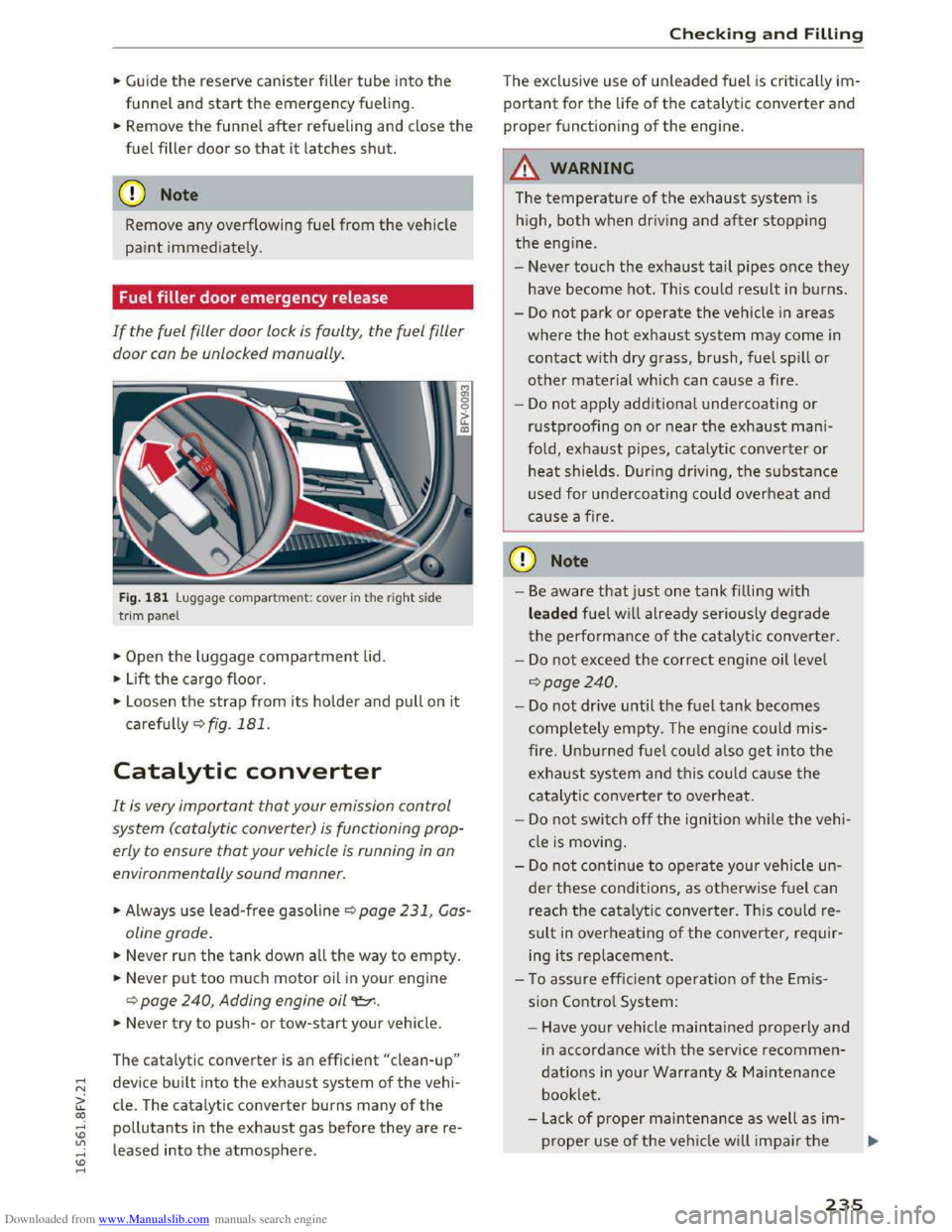
If the fuel filler door lock is faulty, the fuel filler
door con be unlocked manually.
Fig. 181 L uggage compa rtment: cover in t he r ight side
t
rim panel
.,.. Open the luggage compartment lid.
.. L ift the cargo floor .
"'
"' 0 0
it IIl
.,.. Loosen the strap from its holde r and pull on it
carefu lly Qfig. 181.
Catalytic converter
It is very important that your emission control
system (catalytic converter) is functioning prop
erly to ensure
that your vehicle is running in on
environmentally sound manner.
.,.. Always use lead-free gasoline Q page 231, Gas
oline grade .
.. Never run the tank down all the way to empty.
.. Never put too m uch motor oil in your engine
Q page 240, Adding engine oil "t::r..
.. Never try to push-or tow-start your vehicle.
The
catal ytic converter is an efficient "clean-up"
device built into the exhaust system of the vehi
cle. The catalytic
converter burns many of the
pollutants in the exhaust gas before they are re
leased into
the atmosphere .
Checking and Filling
The exclusive use of unleaded fuel is critically im
portant for the life of the catalytic converter and
proper functioning of the engine.
A WARNING
f= - I
The temperature of the exhaust system is
high, both when driving and after stopping
the engine.
- Never
touch the exhaust tail pipes once they
have become hot. This could result in burns.
-Do not park or operate the vehicle in a reas
where the hot exhaust system may come in
contact with dry grass, brush, fuel spill or
other material which can cause a fire .
-
Do not appl y additional undercoating or
r ustproofing on or near the exhaust mani
fold, exhau
st pipes, catalytic converter or
heat shields. During driving, the substance
used for un dercoating could overheat and
cause a fire.
CD Note
-Be aware that just one tank filli ng with
leaded fuel w ill already seriously degrade
the performance of th e c atalytic converter .
-
Do not exceed the correct engine oil leve l
Qpoge240 .
-Do not drive until the fuel tank becomes
completely empty. The engi ne could mis
fire. Unbu r
ned fuel coul d also get into the
exhaust system and this could cause the
ca ta lyt ic co nver ter to overheat.
-Do not swi tch off the ignition whil e the vehi
cl e is moving .
-
Do not continue to operate your vehi cle un
der these condi tions, as o therwise fuel c a n
reach the catalytic converter. This could re
sult in over heating of the converter, requir
ing
its replacement .
- T o assu re
effic ient operatio n of the E mis
sion Contro l System:
-Have your vehicle maintained properly and
in accordance wi th the service recommen
dations in yo ur Warranty & Main tenance
bookle t.
- L ack
of proper maintenance as well as im-
p r
oper use of the veh icle w ill impair the .,..
235
Page 239 of 322
Downloaded from www.Manualslib.com manuals search engine work and do not wear clothing that can
hang down into the engine.
-Limit your exposure to exhaust and chemi
cals to as short a time as possible c::> &..
/Jj._ WARNING
California Proposition 65 Warning:
- Engine
exhaust, some of its constituents,
and certain vehicle components contain or
emit chemicals known to the State of Cali
fornia to cause cancer and birth defects and
reproductive harm. In addition, certain flu
ids
contained in vehicles and certain prod
ucts of component wear contain or emit
chemicals known to the State of California
to cause cancer and birth defects or other
reproductive harm.
-Battery posts, terminals and related acces
sories contain lead
and lead compounds,
chemicals known to the State of California
to cause cancer and reproductive harms.
Wash hands after handling.
CD Note
When filling fluids, be sure not to mix the flu
ids up.
Otherwise severe malfunctions and en
gine damage will occur.
@ For the sake of the environment
You should regularly check the ground under
your vehicle in order to detect leaks quickly. If
there are visible spots from oil or other fluids,
bring your vehicle
to an authorized Audi deal
er or authorized Audi Service Facility to be
checked.
Checking and Filling
Opening the hood
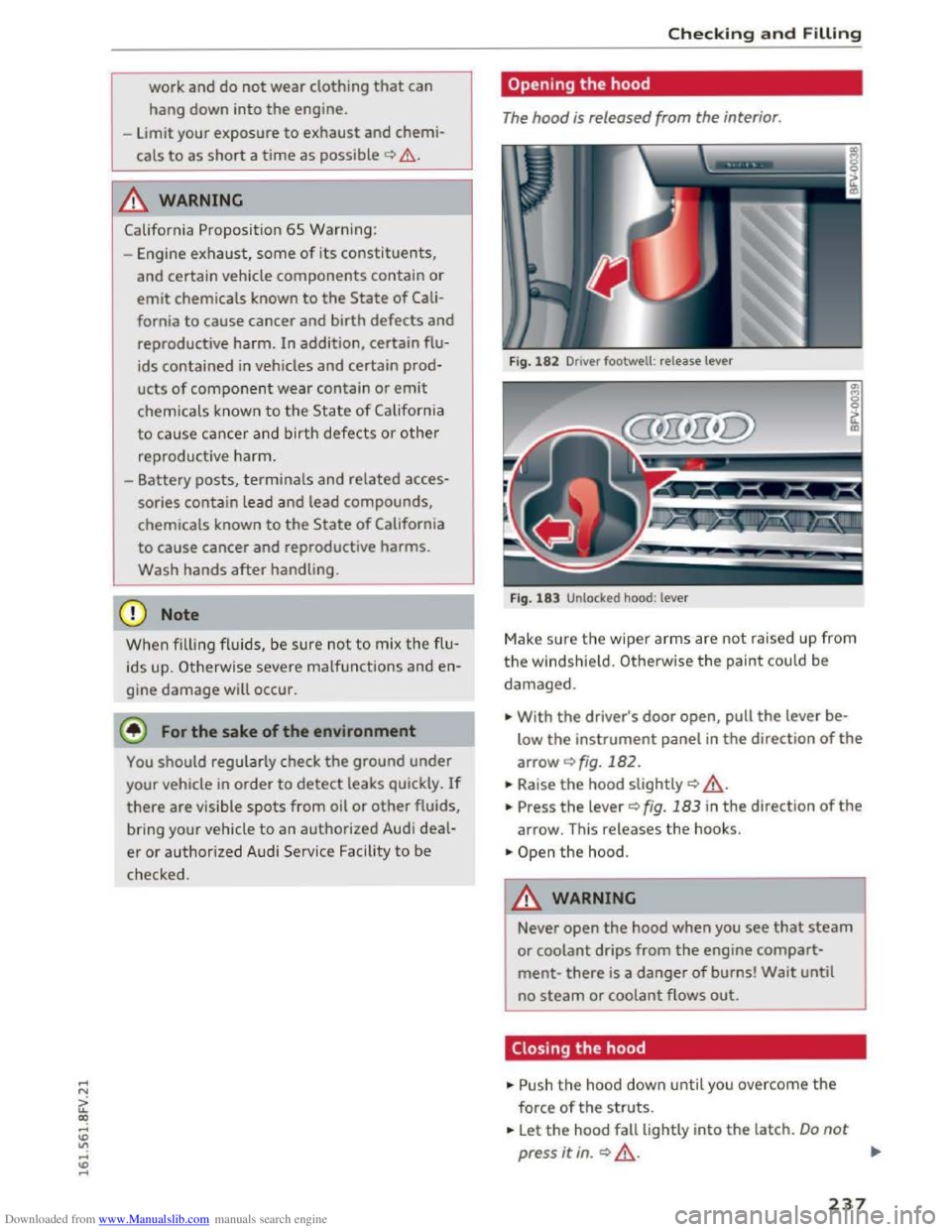
The hood is released from the interior.
Fig. 182 Driver footwell : release lever
Fig.
183 Unlocked hood: lever
Make sure the wiper arms are not raised up from
the windsh ield. Otherwise the paint could be
damaged.
... With the driver's door open, pull the lever be
low the instrument panel in the direction of the
arrowc::>fig.182 .
... Raise the hood slightly c::> ,&.
... Press the lever c::>fig. 183 in the direction of the
arrow. This releases the hooks.
.. Open the hood.
.&. WARNING
Never open the hood when you see that steam
or coolant drips from the engine compart
ment-there is a danger of burns! Wait until
no steam or coolant flows out.
Closing the hood
.. Push the hood down until you overcome the
force of the struts .
... Let the hood fall lightly into the latch. Do not
press it in. c::> ,&. ...
237
Page 241 of 322
Downloaded from www.Manualslib.com manuals search engine Engine oil
Engine oil specifications
The engine oil used must conform to exact speci
fications.
The ser vice interva l disp lay in the instrument
cluster of your vehicle will inform you when it is
time for an oil change . We recommend that you
have your
oil changed by an authorized Audi Serv
ice Advisor.
If you have to top off the oil between oil changes,
use the Audi oil quality standard specified in the
table.
Audi oil quality standard
G
asoline VW S02 00 or
engin e vw S0400
Using the proper engine oil is important for the
functionality and service life of the engine. Your
engine was factory-filled
with a high-quality oil
which
can usually be used throughout the entire
year.
CD Note
Your Limited New Vehicle Warranty does not
cover damage or malfunctions due to failure
to follow recommended maintenance and use
requirements as set forth in the Audi Owner's
Manual and Warranty
& Maintenance booklet.
-
Use only a high quality engine oil that ex-
pressly complies
with the Audi oil quality
standard specified for your vehicle's engine.
Using any other oil can cause serious engine
damage.
-
Do not mix any lubricants or other additives
into the engine oil. Doing so can cause en
gine damage.
Tips
If you need to add oil and there is none availa
ble
that meets the Audi oil quality standard
your engi
ne requires, you may add a tota l of
no more than O.S qt/l of a high-quality "syn
thetic" oil that meets the following spec ifica
tions.
Checking and F illing
-ACEA A3 or API SM with a viscosity grade of
SAE OW-30, SAE SW-30 or SAE SW-40.
-For more information about engine oil that
has been approved for your vehicle, please
contact either your
authorized Audi dealer
or Audi Customer
Relations at
1 (800) 822-2834 o r visit our web site at
www .audiusa .com or www.audicanada .ca.
Engine oil consumption
The engine in your vehicle depends on an ade
quate
amount of oil to lubricate and cool all of
its moving parts.
In order to provide effective lubrication and cool
i ng
of internal engine components, all internal
combustion engines consume a certa in amount
of oil. Oil consumption varies from engine to en
gine and may change significantly over
the life of
the engine. Typically, engines with a specified
break-in period
(see~ page 56) consume more
oil during the break-in period than they consume
after oil consumption has stabilized.
Under normal cond it ions, the rate of oil con
s u
mption depends on th e qu ality and viscos ity of
the oil, the RPM (revolutions per minute) at
which the engine is operated, the ambient tem
perature and road conditions. Further factors are
the amount of oil dilution from water condensa
tion or fuel residue and the oxidation level of the
oil. As any engine is subject to wear as mileage
builds
up, the oil consumption may increase over
t ime
until replacement of worn components may
become necessary.
With all these variab les coming into play, no
standard rate
of oil consumption can be estab
lished
or specified. There is no alternative to reg
ular and frequent checking of the oil level, see
Note .
If the yellow engine oil level warning symbol II
in the instrument cluster lights up, you should
check
the oil level as soon as possible
~page 240. Top off the oil at your earliest con-
venience
Q page 240. ..,..
239
Page 243 of 322
Downloaded from www.Manualslib.com manuals search engine A WARNING
1-
-When adding oil, do not let oil drip onto hot
engine components. Th ere could be risk of a
fire.
-
You must secure the cap on the oil filler
opening correctly so that oil does not leak
out onto the hot engine and exhaust system
when the engine is r unning, because this is
a fire
hazard.
- Always clean skin thoroughly if it comes into
co ntact with engine oil.
«I) Note
-The oil level must not be above the@
range, because this can cause damage to
the catalytic converter or the engi ne. Con
tact an authorized Audi dealer or authorized
A udi Service Facility to have excess oil ex
tracted if necessary.
-
Do no t mix any additional lu bricants into
the engine oil. Damage cause by such addi
tives is not covered by the warranty.
@ For the sake of the environment
-Oil should never enter the sewer system or
come into contact with the ground.
-
Pay attention to legal requirements when
disposi ng of empty oi l containers.
Changing the engine oil
We recommend that have your oil changed by an
authorized Audi dealer or a qualified service
sta
tion.
Before you check anything in the engine compart
ment, alwa y s read and heed all WARNINGS
~page236.
The engine oil must be changed accord ing to the
intervals specified i n your Warranty & Mainte
nance booklet. This is very important be cause the
lubricati ng properties of o il d iminish gradually
dur ing normal vehi cle use.
Unde r some circumstances the engine oil should
be changed more frequently. Change oil more of
ten if yo u drive mostly short dis tances, opera te
the vehicle in dusty areas or u nder predominantly
Checking and Filling
stop-and-go traffi c conditions, or have your vehi
cle where temperatures remain be low freezing
for extended periods.
Dete r
gent additives in the oi l w ill make fresh oil
l
ook dark after the engine has been r u nning for a
short time. This is normal and is not a reason to
change the oil more often than recommended.
Beca u
se of the problem of proper disposal, along
with the special tools and necessary expertise re
quired, we strongly recommend that you have
you r o
il changed by an authorized Audi dealer or
a q ualified service station.
If you choose to change your oil yourself, please
note the following important information:
A WARNING
~ -
To reduce the risk of personal injury if you
must change the engine oil in you r vehicle
yourself:
-
Wear eye protection.
- To reduce the risk of burns from hot engine
oil, let th e engine cool down to the touch.
-When removing the oil drain plug with your
fingers,
stay as far away as possible. Always
keep your forearm parallel to the ground to
help prevent hot oil from running down your
arm.
-Drain the oil into a container designed for
this purpose, one large enough to hold at
least the total amount of oil in your engine.
-Engine oil is poisonous. Keep it well out of
the reach of children.
-
Continuous contact with used engine oil is
harmful to your skin. Always protect your
skin by washing oil off thoroughly with soap
and water.
CD Note
Never mix oil additives with your engine oil.
These additives can damage your engine and
adversely affect yo ur Audi Limited New Vehi
cle Warranty.
241
Page 244 of 322
Downloaded from www.Manualslib.com manuals search engine Checking and Filling
@) For the sake of the environment
-Before changing your oil, first make sure
you know where you can properly dispose of
the used oil.
- Always
dispose of used engine oil properly.
Do not dump it on garden soil, wooded
areas, into open streams or down sewage
drains.
- Recycle
used engine oil by taking it to a used
engine oil collection facility in your area, or
contact a service station.
Coo Ling system
Coolant
The engine coolant performs two functions: it
keeps
the engine from overheating and it pro
tects the engine from freezing in the winter.
The cooling system is sealed and generally re
q uires
little attention.
The cooling
system has been filled at the factory
with a
permanent coolant which does not need to
be changed. The coolant consists of a mixture of
specially conditioned water and the manufactur
er's glycol-based coolant additive G13 antifreeze
with anticorrosion additives (50% for USA mod
els; 60% for Canadian models). This mixture
both assures the necessary frost protection and
protects metal components in the engine's cool
ing
system from corrosion and scaling. It also
raises
the boiling point of the coolant.
Do not reduce the concentrat ion of the coolant in
the summer by addi ng p la in water. The propor
tion of coolant additive must be at least 50°/o
but not more than 60°/o to maintain antifreeze
protection and cooling efficiency. If the coolant
frost protection is too low, the coolant could
freeze and damage the vehicle heating and en
gine cooling system.
For year-round driving,
antifreeze is added at the
factory for temperatures down to:
- -
31 °F ( -35 °C) USA
- -40 °F ( -40 °C) Canada.
242
If you must add coolant, use a mixture of water
and coolant additive. Mixing the coolant additive
with distilled
water is recommended.
A WARNING
~ h . Before you check anything in t e engine com-
partment, always read and heed all WARN
INGS C)page 236.
CD Note
-Before winter sets in, have the coo lant
checked to see if the coolant additive in you r
vehicle is
sufficient to meet the climate con
d itions. This is especia l
ly important if you
live
in a regio n where the winter is extre m e
ly cold . If necessary, increase the proportion
o f coo la
nt ad ditive to 60o/o.
-When add ing coolant additive to your cool
ing
system, remember:
-We recommend using only coolant addi
tive G12++
or G13 (check the label) for
your vehicle. This coolant additive is avail
able at authorized Audi dealers. Other
types of antifreeze can significantly re
duce corrosion protection. The resulting
corrosion can cause a loss of coolant and
serious engine damage.
-Do not add any type of radiator leak sealant
to your vehicle's engine coolant. Adding ra
dia to r repair fluid may adversely
affect the
func tion and performance of your cooling
system and could result in damage not cov
ered by your New Veh icle Limited W arranty .
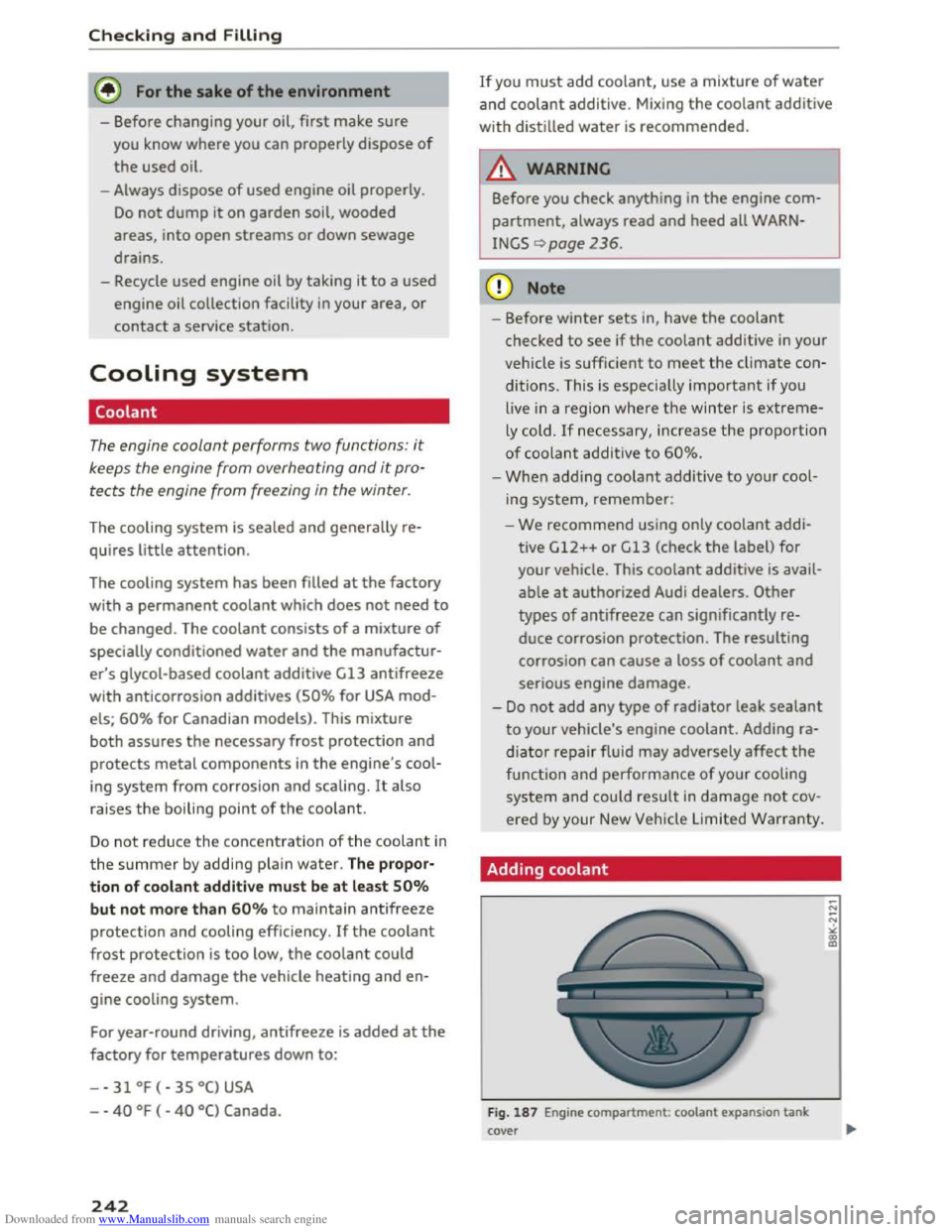
Adding coolant
Fig. 187 Engine compartment : coolant expansion tank
cover
Page 245 of 322
Downloaded from www.Manualslib.com manuals search engine ...... N
> u. CX> ...... u:>
"' ...... u:> ......
Read and follow the WARNINGS before check
ing anything
in the engine compartment
Qpage236.
Checking the engine coolant level
""Park your vehicle on a level surface.
"" switch the ignition off.
.. Read the coolant level on the coolant expansion
tank
Q page 238, fig. 184. The coolant level
must be between the markings when the en
gine
in cold. When the engine is warm it can be
slightly above
the upper marking.
Adding coolant
Requirement: there must be a res idual amount of
coo l
ant in the expans io n tank c:?(i) .
""Let the engine cool down.
.. Place a cloth over the coolant expansion tank
cap and unscrew
the cap counterclockwise
c:?,8..
""Add coolant mixed in the correct ratio
i:?page 242 up to the upper marking.
""Make sure that the fluid level remains stable.
Add more coolant if necessary.
"" Close the cap securely .
A coolant loss suggests a leak. Immediately drive
your vehicle
to an authorized Audi dealer or au
thorized
Audi Service Facility and have the cool
ing system inspected.
If the cooling system is not
leaking, a loss can come from
the coolant boiling
through overheating and being pushed
out of the
cooling system.
.&. WARNING
-The cooling system is pressurized and can be-
come very hot.
To reduce the risk of burns
from hot coolant:
-
Do not open the coolant expansion tank cap
w ith
the engine hot. There is a risk of burns .
- Stop
the engine and allow it to cool.
-
Protect your face, hands and arms from es-
caping coolant and
steam by covering the
coolant tank cap with a large, thick cloth.
- Turn
the coolant tank cap counterclockwise
slowly and keep light pressure on
the cap.
-
To reduce the risk of burns, do not allow any
antifreeze or coolant to dr
ip onto the ex-
Checking and Filling
ha ust system or hot engine components.
The ethylene glycol in engine coolant can
catch fire under certain circumstances.
- The coolant additive and the coolant can be
dangerous to your health.
For this reason,
keep
the coolant in the original container
away from children. There is a
risk of poi
soning.
-When working in the engine compartment,
remember
that the radiator fan can switch
on even if
the ignition is switched off, which
increases
the risk of personal injury.
CD Note
Do not add coolant if the expans ion tank is
empty . Air could enter the cooling system and
damage
the eng ine. If this is the case, do not
continu e driving. See an authorized
Audi dea l
er or authorized
Audi Service Facility for assis
tance.
Radiator fan
The radiator fan switches on automatically by it
self.
An auxiliary electric radiator fan switches on and
off depending on coolant temperature and other
vehicle operating conditions.
After you switch
the engine off, the auxiliary fan
can continue running for
up to 10 minutes -even
with
the ignit ion off. It can even switch on again
later by itself c:? & . if
- the temperature of
the engine coolant rises due
to
the heat build-up from the engine in the en
gine compartment, or
-
the engi ne compartment heats up because the
vehicle is parked in intense sunlight.
.&. WARNING
-To reduce the risk of personal injury never
touch
the radiator fan.
- The auxiliary electric fan
is temperature
controlled and can switch on suddenly even
when
the engine is not running.
243