wheel AUDI TT COUPE 2017 Owner's Guide
[x] Cancel search | Manufacturer: AUDI, Model Year: 2017, Model line: TT COUPE, Model: AUDI TT COUPE 2017Pages: 322, PDF Size: 79.73 MB
Page 146 of 322
Navig ation
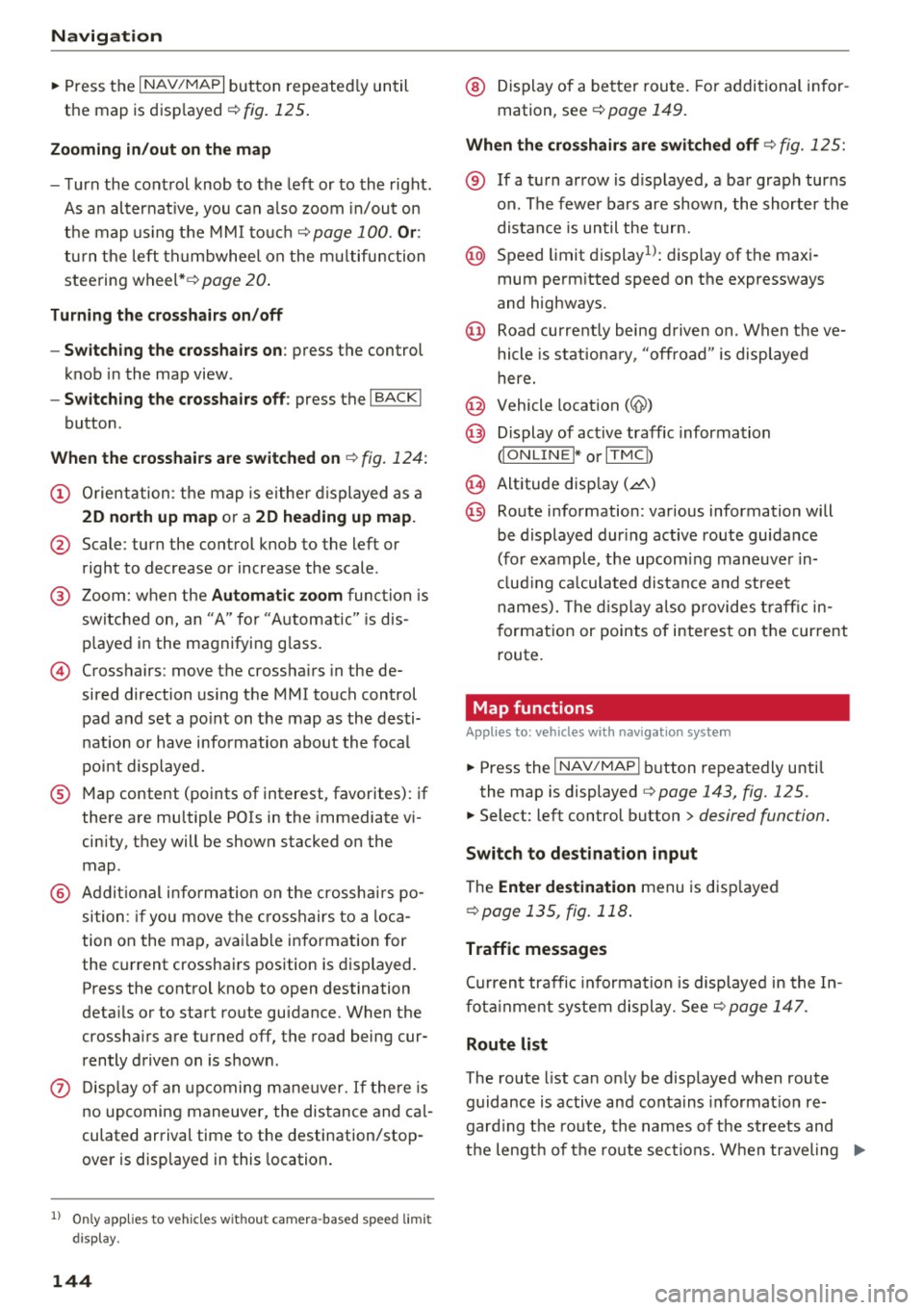
"' Press the I NAV/MAPI button repeated ly until
the map is disp layed
¢ fig. 125 .
Zo oming in /out on the m ap
- T urn the control knob to the left or to the right .
As an alternat ive, you can a lso zoom in/out on
the map using the MMI touc h
¢page 100. Or:
turn the left thumbwheel on the mu ltifunction
steering wheel*¢
page 20 .
Turning th e cros shair s on /off
- Sw itching the crosshai rs on :
press the control
knob in the map view .
-Sw itching the crossh air s o ff : press the I BACKI
button.
When the crosshairs are switched on ¢ fig. 124:
(D Orientation : the map is eithe r displayed as a
2D n orth up m ap or a 2D hea ding up map.
@ Scale: turn the control knob to the left or
right to decrease or increase the scale .
@ Zoom: when the Automa tic zo om func tion is
sw itched on, an "A" for "Automatic" is dis
p layed in the magnifying g lass.
© Crosshairs: move the crossha irs in the de
sired direction using the MM I touch control
pad and set a po int on the map as the desti
nation or have information about the focal
point displayed.
® Map content (points of interest, favorites) : if
there are mu ltiple POis in the immediate vi
cinity, they will be shown stacked on the
map .
@ Addit io nal info rmation on the crosshairs po
sition : if you move the c rosshairs to a loca
tion on the map, avai lab le information for
the current crossha irs position is displayed.
Press the control knob to open destination
deta ils or to start route guidance. When the
crossha irs are turned off, the road being cur
rently driven on is shown .
0 Display of an upcoming ma neuver. If the re is
n o upcoming maneuver, the distance and cal
culated arrival time to the destination/stop
over is disp layed in this location.
l ) O nly app lies to veh icl es withou t camer a-b as ed speed limi t
dis play .
144
@ Display of a better route. For additional in for
mation, see
¢ page 149.
When the cro ssha ir s are swit ched off ¢ fig. 125:
® If a turn arrow is d isplayed, a bar graph turns
on. The fewe r bars are shown , the shorter the
distance is until the turn.
@ Speed limit display1>: d isp lay of the max i
mum permitted speed on the expressways
and highways.
@ Road current ly being driven on . When t he ve
hicle is stat iona ry, "off road " is displayed
here.
@ Vehicle location (@)
@ Display of active traffic information
dO NLIN EI* or I TM Cb
@ Altitude disp lay (.d\)
@ Route information : various information will
be displayed dur ing active route guidance
(for example, the upcom ing maneuver in
cl ud ing ca lculated distance and street
names). The d isplay a lso provides traff ic in
format ion or points of interest on the current
route.
Map functions
Appl ies to: vehicles wit h navigat ion syste m
"'Press the I NAV/MAP I button repeatedly until
the map is displayed
¢ page 143, fig. 125.
"'Select: left control button > desired function.
Switch to de stination input
The Ente r de stination menu is disp layed
¢ page 135, fig. 118 .
Traffic messages
Cu rrent traffic informa tion is displayed in the In
fot ainment system display. See
¢ page 147.
Route list
The route list can only be displayed when route
guidance is active and conta ins informat ion re
gard ing the ro ute, the names of the streets and
t h e lengt h of t he ro ute sections. When traveling
jll,-
Page 183 of 322
CD
CD
.... N
" N .... 0
0
Ill co
.. Fasten your safety be lt and wear it properly. Al
so instruct your passengers to fasten their
safety belts properly ¢
page 189.
What impairs driving safety?
Safe driving is directly related to the condition of
the vehicle, the driver as well as the driver's abili
ty to concentrate on the road without being dis
tracted.
The driver is responsible for the safety of the ve
hicle and all of its occupants . If your ability to
drive is impaired, safety risks for everybody in the
veh icle increase and you also become a hazard to
everyone else on the road ¢,&. .Therefore:
.. Do not let yourself be distracted by passengers
or by using a cellular te lephone .
.. NEVER drive when your driv ing ability is im
paired (by medications, alcohol, drugs, etc.).
.. Observe a ll traffic laws, rules of the road and
speed limits and plain common sense.
.. ALWAYS adjust your speed to road, traffic and
weather cond itions.
.. Ta ke frequent breaks on long trips. Do not drive
for more than two hours at a stretch .
.. Do NOT drive when you are tired, under pres
sure or when you are stressed.
A WARNING
Impaired driving safety increases the risk of
ser ious personal injury and death whenever a
vehicle is being used.
Safe d riving
Correct passenger
seating positions
Proper seating position for the driver
The proper driver seating position is important
for safe, relaxed driving.
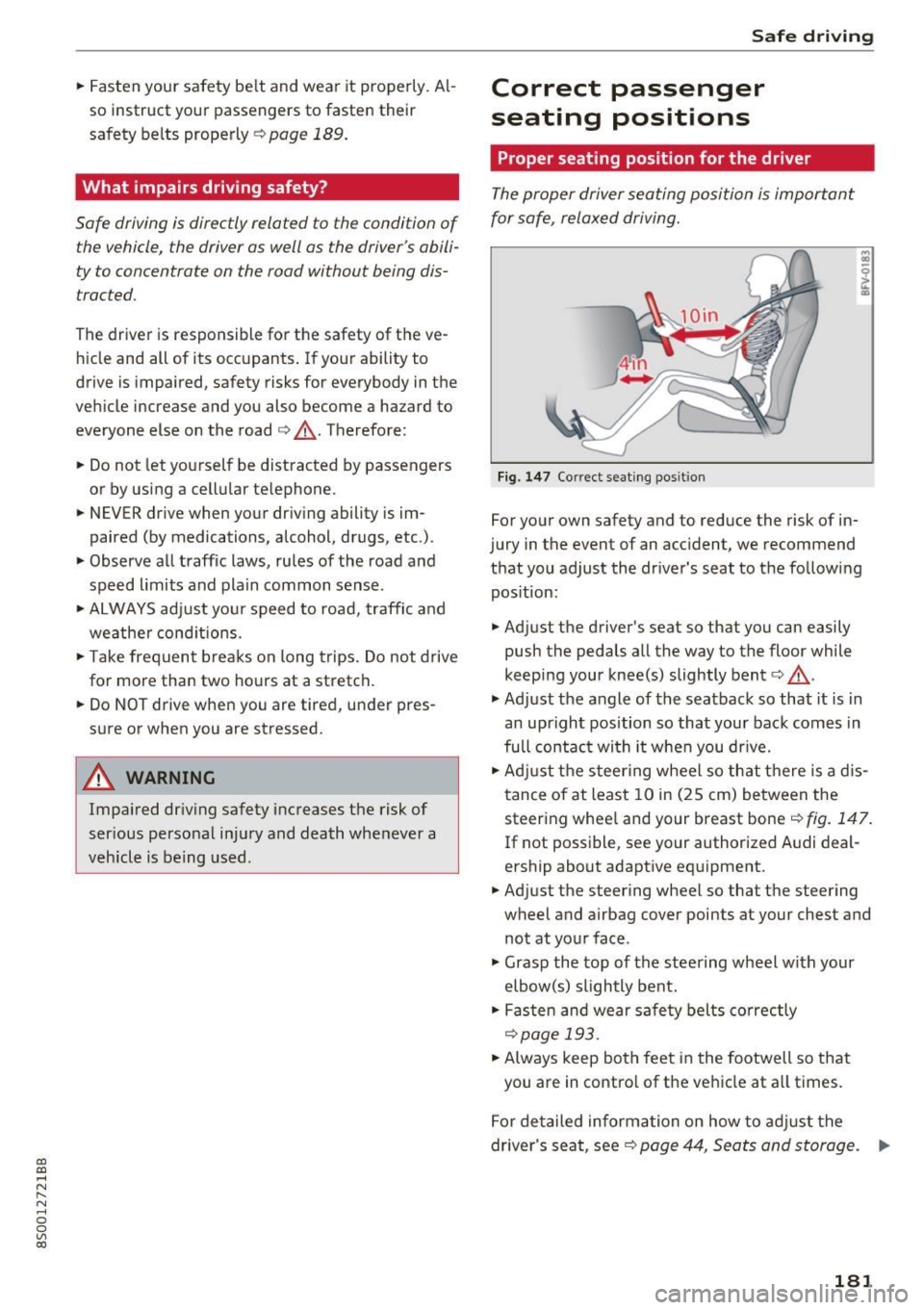
Fig. 147 Correct seating position
For your own safety and to reduce the risk of in
jury in the event of an accident, we recommend
that you adjust the driver's seat to the following position:
.. Adjust the driver's seat so that you can easily
push the pedals all the way to the floor while
keep ing your knee(s) slightly bent¢,&. .
.,. Adjust the angle of the seatback so that it is in
an upright position so that your back comes in
full contact wi th it when you dr ive.
.. Adjust the steering wheel so that there is a dis
tance of at least 10 in (25 cm) between the
steering whee l and your breast bone¢
fig. 147.
If not possible, see your author ized A udi deal
ership about adaptive equipment .
.. Adjust the steering wheel so that the steering
wheel and airbag cover points at your chest and
not at your face .
.,. Grasp the top of the steering wheel with your
elbow(s) slightly bent .
.. Fasten and wear safety belts correctly
¢page 193 .
.. Always keep both feet in the footwell so that
you are in contro l of the vehicle at all times.
For detailed information on how to adjust the
driver's seat, see¢
page 44, Seats and storage. ..,..
181
Page 184 of 322
Safe driving
A WARNING
Drivers who are unbelted, out of position or
too close to the airbag can be seriously in
jured by an airbag as it unfolds . To help re
duce the risk of serious personal injury:
- Always adjust the driver's seat and the steering wheel so that there are at least 10 in (25 cm) between your breastbone and
the steering wheel.
- Always adjust the driver's seat and the
steering wheel so that there are at least 4 in
(10 cm) between the knees and the lower
part of the instrument panel.
- Always hold the steering wheel on the out
side of the steering wheel rim with your
hands at the 9 o'clock and 3 o'clock posi
tions to help reduce the risk of personal in
jury if the driver's airbag inflates.
- Never hold the steering wheel at the 12 o'clock position or with your hands at
other positions inside the steering wheel
rim or on the steering wheel hub. Holding
the steering wheel the wrong way can cause
serious injuries to the hands, arms and head if the driver's airbag inflates
- Pointing the steering wheel toward your
face decreases the ability of the supplemen
tal driver's airbag to protect you in a colli
sion.
- Always sit in an upright position and never
lean against or place any part of your body
too close to the area where the airbags are
located.
- Before driving, always adjust the front seats
properly and make sure that all passengers
are properly restrained.
- Never adjust the seats while the vehicle is
moving. Your seat may move unexpectedly
and you could lose control of the vehicle.
- Never drive with the backrest reclined or
tilted far back! The farther the backrests are
tilted back, the greater the risk of injury due
to incorrect positioning of the safety belt
and improper seating position.
- Children must always ride in child seats ¢
page 221. Special precautions apply
182
when installing a child seat on the front passenger seat¢
page 197.
Proper seating position for the front
passenger
The proper fron t passenger sea ting posi tion is
impor tan t for safe , relaxed driving.
For your own safety and to reduce the risk of in
jury in the event of an accident, we recommend
that you adjust the seat for the front passenger
to the following position:
.,. Adjust the angle of the seatback so that it is in
an upright position and your back comes in full
contact with it whenever the vehicle is moving.
.,. Keep both feet flat on the floor in front of the
front passenger seat.
.,. Fasten and wear safety belts correctly
¢ page 193.
For detailed information on how to adjust the
front passenger's seat, see ¢
page 44.
.&, WARNING
Front seat passengers who are unbelted, out
of position or too close to the airbag can be
seriously injured or killed by the airbag as it
unfolds. To help reduce the risk of serious
personal injury:
- Passengers must always sit in an upright po
sition and never lean against or place any
part of their body too close to the area
where the airbags are located.
- Passengers who are unbelted, out of posi tion or too close to the airbag can be seri
ously injured by an airbag
as it unfolds with
great force in the blink of an eye.
- Always make sure that there are at least
10 in (25 cm) between the front passen
ger's breastbone and the instrument panel.
- Always make sure that there are at least 4 in
(10 cm) between the front passenger's
knees and the lower part of the instrument
panel.
- Each passenger must always sit on a seat of
their own and properly fasten and wear the safety belt belonging to that seat .
~
Page 199 of 322
co
co
.... N
" N .... 0
0
Vl c:o
Airbag system
Important information
Importance of wearing safety belts and
sitting properly
Airbags are only supplemental restraints. For
airbags to do their job, occupants must always
properly wear their safety belts and be in a prop
er seating position.
For your safety and the safety of your passen
gers, before driving off, always:
.,. Adjust the driver's seat and steering wheel
properly
9 page 181,
.,. Adjust the front passenger's seat properly
¢page 182,
.,. Wear safety belts properly ¢page 192,
.,. Always properly use the proper child restraint
to protect children
¢ page 221.
In a collision airbags must inflate within the blink
of an eye and with considerable force. The sup
plemental airbags can cause injuries if the driver
or the front seat passenger is not seated proper
ly. Therefore in order to help the airbag to do its
job, it is important, both as a driver and as a pas
senger to sit properly at all times.
By keeping room between your body and the
steering wheel and the front of the passenger
compartment, the airbag can inflate fully and
completely and provide supplemental protection in certain frontal collisions¢
page 181, Correct
passenger seating positions.
For details on the
operation of the seat adjustment controls
¢page 44.
It's especially important that children are proper
ly restrained
¢page 221.
There is a lot that the driver and the passengers
can and must do to help the individual safety fea
tures installed in your Audi work together as a
system.
Proper seating position is important so that the
front airbag on the driver side can do its job. If
you have a physical impairment or condition that prevents you from sitting properly on the driver
seat with the safety belt properly fastened and
Airbag system
reaching the pedals, or if you have concerns with
regard to the function or operation of the Ad
vanced Airbag System, please contact your au
thori zed Audi dealer or qualified workshop, or
call Audi Customer Relations at 1(800)
822 -2834 for possible modifications to your ve
hicle.
When the airbag system deploys, a gas generator
will fill the airbags, break open the padded cov ers, and inflate between the steering wheel and
the driver and between the instrument panel and
the front passenger. The airbags will deflate im mediately after deployment so that the front oc
cupants can see through the windshield again
without interruption .
All of this takes place in the blink of an eye, so
fast that many people don't even realize that the
airbags have deployed. The airbags also inflate
with a great deal of force and nothing should be in their way when they deploy. Front airbags in
combination with properly worn safety belts slow
down and limit the occupant's forward move
ment. Together they help to prevent the driver
and front seat passenger from hitting parts of
the inside the vehicle while reducing the forces
acting on the occupant during the crash. In this
way they help to reduce the risk of injury to the
head and upper body in the crash. Airbags do not
protect the arms or the lower parts of the body.
Both front airbags will not inflate in all frontal
collisions . The triggering of the airbag system de
pends on the vehicle deceleration rate caused by
the collision and registered by the electronic con
trol unit. If this rate is below the reference value
programmed into the control unit, the airbags
will not be triggered, even though the car may be badly damaged as a result of the collision . Vehi
cle damage, repair costs or even the lack of vehi
cle damage is not necessarily an indication of
whether an airbag should inflate or not .
Since the circumstances will vary considerably between one collision and another, it is not possi
ble to define a range of vehicle speeds that will
cover every possible kind and angle of impact
that will always trigger the airbags. Important
factors include, for example, the nature (hard or soft) of the object which the car hits, the angle of
II>
197
Page 200 of 322
Airbag syste m
impact, veh icle speed, etc. The front airbags will
also not inflate in side or rear co llisions, or in
roll -overs.
A lwa ys re memb er: Airbags will deploy only once,
and only in certain kinds of coll isions. Your safety
be lts are always there to offer protection in those
situations in which airbags are not supposed to
deploy, or when they have already deployed ; for
example, when your vehicle strikes or is struck by
another vehicle after the first collision .
This is just one of the reasons why an airbag is a
supp lementary restraint and is not a substitute
for a safety belt. The a irbag system works most
effectively when used with the safety belts.
Therefore, always properly wear your safety belts
c::> page 189 .
A WARNING
Sitting too close to the steering whee l o r i n
strument panel will decrease the effective
ness of the airbags and will increase the risk
of persona l injury in a co llision.
- Never sit closer than 10 in (25 cm) to the
steering wheel or instr ument pane l.
- If you cannot si t mo re than 10 in (25 cm)
from the steering wheel, inves tigate wheth
er adaptive equipment may be avai lab le to
held yo u reach the pedals and increase your
seating distance from the steering wheel.
- If you are unrestrained, leaning forward, s it
ting sideways or out of position in any way,
your risk of injury is much higher.
- Yo u will also receive serious injuries and
could even be killed if you are up aga inst the
airbag or too close to it when it inflates -
even with an Advanced Airbag.
- To reduce the risk of injury when an airbag inflates, always wear safety belts properly
¢ page 193, Safety belts .
-Always make certain that chi ldren age 12 or
younger always ride in the rear seat. If chil dren are not properly restra ined, they may
be severely injured or k illed when an airbag
inflates .
- Never let children ride unrestrained or im prope rly rest ra in ed in the vehicle . Adjust the
front seats properly .
198
-
-Never ride with the back rest recl ined.
-Always sit as far as possible from the steer -
ing wheel or the instrument panel
¢ page 181.
-Always sit upright with your back against
the backrest of your seat.
- Never p lace your feet on the instrument
panel or on the seat . Always keep both feet
on the floor in front of the seat to help pre
vent serious injur ies to the legs and hips if
the airbag inflates.
- Never recl ine the front passenger's seat to
transport objects. Items can also move into
the area of the s ide a irbag or the front air
bag during brak ing or in a sudden maneu
ver. Objects near the airbags can become proje cti les and cause injury when an airbag
inflates.
A WARNING
A irbags that have deployed in a crash m ust be
replaced.
- Use o nly orig inal eq uipment airbags ap
p roved by A ud i and inst alled by a trained
technician who has the ne cessary tools and
diagnostic equipment to properly replace
any airbag in yo ur vehicle and assure system
effectiveness in a crash.
'
- Never permit salvaged or recycled airbags to
be installed in your vehicle .
Child restraints on the front seat - some
important things to know
.,. Be sure to read the important informat ion and
head the WARNINGS fo r important details
about c hildren and Advanced A irbags
c::> page 221 .
Even though your veh icle is equipped w ith an Ad
vanced Airbag Sys tem, make certa in that a ll chil
dre n, especia lly those 12 yea rs and younger, al
ways ride i n the b ack seat prope rly res trained fo r
their age and size. The airbag on the passenger
s ide makes the front seat a potentially dange rous
place for a child to r ide . The front seat is not the
safest place for a chi ld in a forward-fac ing chi ld ...,.
Page 203 of 322
-Always carefully follow the manufacturer's
instructions provided w ith the child seat or
carrier.
- Always make sure that there is nothing on
the front passenger seat that will cause the
capacitive passenger detection system in
the seat to signal to the Airbag System that
the seat is occupied by a person when it is
not, or to signa l that it is occ upied by some
one who is heavier than the pe rson actua lly
s itting on the seat. The p resence of addi
tional objects could cause the passenger
fro nt airbag to be turned on when it shou ld
be off, or could cause the airbag to work in a
way that is different from the way it would
have worked without the object on the seat .
Front airbags
Description of front airbags
The airbag system can provide supplemental
protection to properly restrained front seat occu
pants.
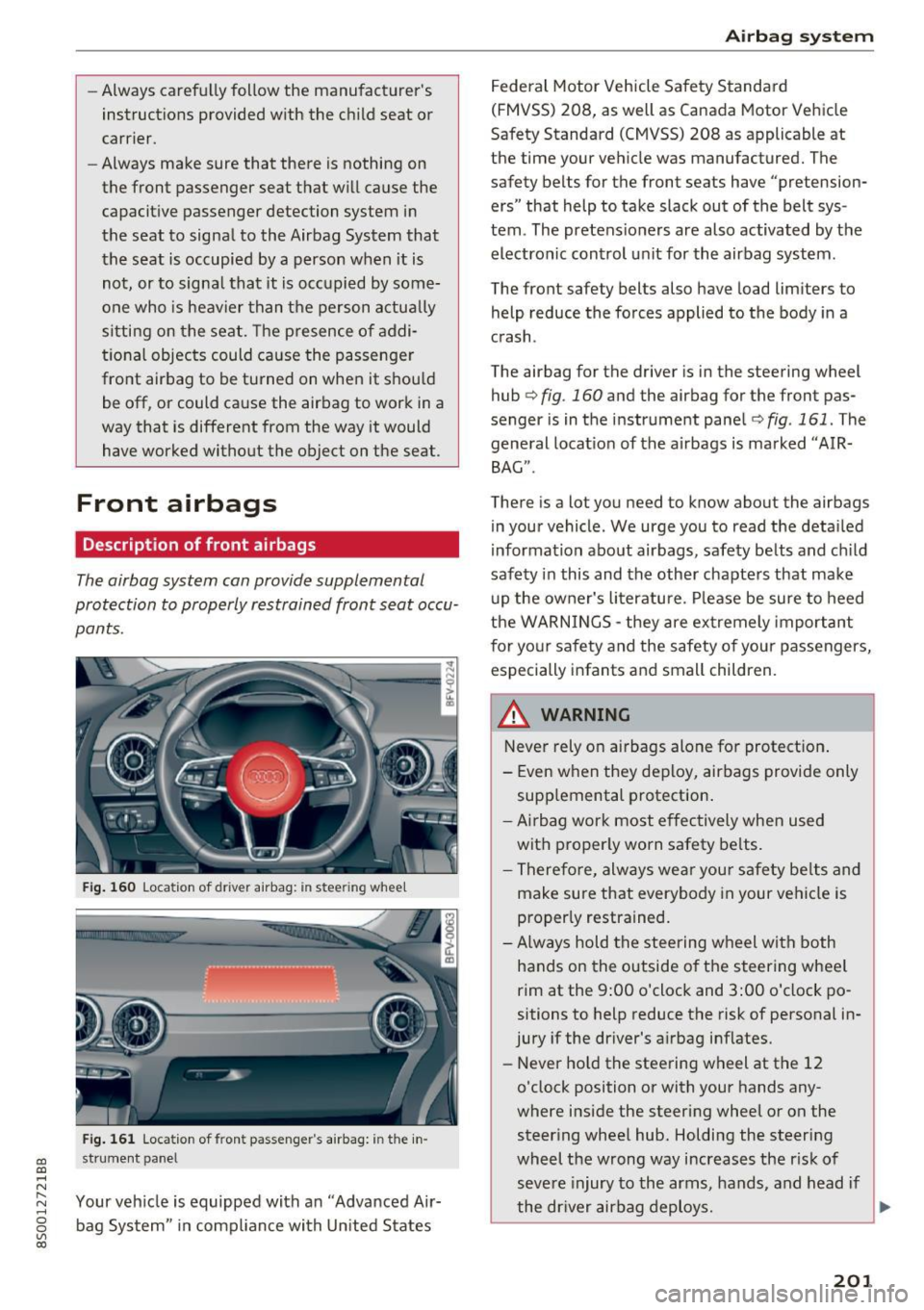
F ig . 160 Locat ion of driver a irbag: in stee ring wheel
Fig . 1 61 Locat ion of front passenger's airbag: i n the in -
CD st rume nt panel CD ,-t N
" ~ Your veh icle is equipped with a n "Adva nced Air-
~ bag System" in compl iance wi th Un ited States
co
Airb ag sys tem
Federal Motor Vehicle Safety Standa rd
(FMVSS) 208, as well as Canada Motor Vehicle
Safety Standard (CMVSS) 208 as applicable at
the time your ve hicle was manufactured. The
safety belts for the front seats have "pretension
ers" that help to take slack out of the belt sys
tem . The pretens ioners are also activated by the
electronic control unit for the airbag system.
The front safety belts also have load limiters to
help reduce the fo rces applied to the body in a
crash.
The airbag for the driver is in the steering wheel
hub ¢
fig. 160 and the airbag for the front pas
senger is in the instrument panel¢
fig . 161. The
general locat io n of the a irbags is marked "AIR
BAG" .
There is a lot you need to know about the airbags
in you r vehicle. We urge you to read the deta iled
information about airbags, safety be lts and c hild
safety in this and the other chapte rs that make
u p the ow ner's literature. Please be sure to heed
the WARNINGS - they are ex tremely important
for yo ur safety and the safety of your passengers,
especially infants and small children.
A WARNING
-
Never rely on airbags alone fo r protect ion .
- Even when they deploy, airbags provide only
supp lemental protection .
- Ai rbag work most effectively when used
with proper ly worn safety be lts.
- T herefo re, always we ar you r safe ty be lts and
make sure that everybody in your vehicle is
proper ly restrained.
- Always hold the stee ring w heel with both
hands on the outside o f the steering wheel
rim at the 9 :00 o'clock and 3:00 o'clock po
sitions to help reduce the risk of personal in
jury if the driver's a irbag inflates.
- Never ho ld the steering wheel at the 12
o'clock position or with your hands any
where inside the steering wheel o r on the
steer ing whee l hub. Holding the steering
wheel the wrong way increases the r is k of
seve re injury to the arms, hands, and head if
the dr iver airbag deploys.
~
201
Page 204 of 322
Airbag system
A WARNING
Objects between you and the airbag will in
crease the risk of injury in a crash by interfer
ing with the way the airbag unfolds and/or by
being pushed into you as the airbag inflates.
- Always make sure nothing is in the front air-
bag deployment zone that could be struck
by the airbag when it inflates.
- Objects in the zone of a deploying airbag
can become projectiles when the airbag de
ploys and cause serious personal injury.
- Never hold things in your hands or on your
lap when the vehicle is in use .
-
-Never place accessories or other objects
(such as cup holders, telephone brackets,
note pads, navigation systems, or things
that are large, heavy, or bulky) on the doors;
never attach then to the doors or the wind
shield; never place them over or near or at
tach them to the area marked .,AIRBAG" on
the steering wheel, instrument panel or the
seat backrests; never place them between
these areas and you or any other person in
the vehicle.
- Never attach objects to the windshield
above the passenger front airbag, such as
accessory GPS navigation units or music players. Such objects could cause serious in
jury in a collision, especially when the air bags inflate.
- Never recline the front passenger seat to transport objects. Items can also move into
the deployment area of the side airbags or
the front airbag during breaking or in a sud
den maneuver. Objects near the airbags can
fly dangerously through the passenger com
partment and cause injury, particularly
when the seat is reclined and the airbags in
flate.
A WARNING
A person on the front passenger seat, espe cially infants and small children, will receive
serious injuries and can even be killed by be
ing too close to the airbag when it inflates.
- Although the Advanced Airbag System in
your vehicle is designed to turn off the front
202
passenger airbag if an infant or a small child
is on the front passenger seat, nobody can
absolutely guarantee that deployment un
der these special conditions is impossible in
all conceivable situations that may happen
during the useful life of your vehicle.
- The Advanced Airbag System can deploy in accordance with the "low risk" option under
the U.S. Federal Standard if a child that is
heavier than the typical one-year old child is
on the front passenger seat and the other
conditions for airbag deployment are met.
- Accident statistics have shown that children
are generally safer in the rear seat area than
in the front seating position.
- For their own safety, all children, especially
12 years and younger, should always ride in
the back properly restrained for their age
and size .
Advanced front airbag system
Your vehicle is equipped with a front Advanced
Airbag System in compliance with United States
Federal Motor Vehicle Safety Standard (FMVSS)
208, as well as Canada Motor Vehicle Safety
Standard (CMVSS)
208 as applicable at the time
your vehicle was manufactured .
The front Advanced Airbag System supplements
the safety belts to provide additional protection
for the driver's and front passenger's heads and upper bodies in frontal crashes . The airbags in
flate only in frontal impacts when the vehicle de
celeration is high enough.
The front Advanced Airbag System for the front
seat occupants is not a substitute for your safety belts. Rather, it is part of the overall occupant re
straint system in your vehicle. Always remember
that the airbag system can only help to protect
you, if you are sitting upright, wearing your safe
ty belt and wearing it properly. This is why you
and your passengers must always be properly re
strained, not just because the law requires you to be.
The Advanced Airbag System in your vehicle has
been certified to meet the "low risk" require-
ments for 3 and 6 year-old children on the ..,.
Page 205 of 322
passenger side and very small adults on the driv
er side. The low risk deployment criteria are in
tended to help reduce the risk of injury through interaction with the front airbag that can occur,
for example, by being too close to the steer ing
wheel and instrument panel when the a irbag in
flates .
In addition, the system has been certified to
comply w ith the "suppression" requirements of
the Safety Standard, to turn off the front a irbag
for infants 12 months old and younger who are
restrained on the front passenger seat in child re
stra ints that a re listed in the Standa rd
q page 223, Child restraints and Advanced front
airbag system .
"Suppression" requ ires the front a irbag on the
passenger side to be turned off if:
- a ch ild up to about one year of age is restra ined
on the front passenger seat i n one of the rear
facing or forward-fac ing infant restra ints listed
in Federal Motor Vehicle Safety Standard 208
with wh ic h t he Advanced Airbag System in your
vehicle was certified . For a listing of the ch ild
restraints that were used to certify your vehi
cle's comp liance with the US Safety Standard
q page 223,
-When a person is detected on the front passen
ger seat that has an electrical capacitance that
is more than the tota l electrical capac itance of
a ch ild that is about 1 year old restra ined in one
of the rear-facing or forward-facing infant re
straints (listed in Federal Motor Veh icle Safety
Sta ndard 208 w ith wh ich the Advanced A irbag
System i n your ve hicle was certified), the front
airbag o n the passenge r side may o r may not
deploy.
The
PA SSENGER AIR BAG OFF~; light comes on
when the e lectron ic cont rol u nit detects a total
e lectrical capacitan ce on the front passenger seat
that requ ires the fron t ai rbag to be turned off. If
the
PASSENGER AIR BAG OFF~; light does not
come on, the front ai rbag on the passenger side
has not been turned off by the control unit and
~ can dep loy if the control unit senses an impact
;:::: that meets the conditions stored in its memory.
" N ...... 0
0
Vl c:o
Airb ag sys tem
If the total e lectr ica l capacitance reg istered on
the front passenger seat is more than that of a
typ ica l 1 year -o ld, but less than the weight of a
small adult, the front a irbag on the passenger
s ide may deploy (the
PASSEN GER AIR BA G OFF
~; light does not come on) .
For example, the airbag may deploy if :
-a small ch ild that is heav ier than a typica l 1
year -o ld child is on the front passenger seat
(regardless of whethe r the child is in one of the
child seats listed
¢ page 223),
- a child who has outgrown c hild restraints is on
the front passenge r seat .
If the front passenge r a irb ag is t urned off, the
PASSENGER AIR BAG OFF~; light in the head
liner wi ll come on and stay on .
If the front passenge r a irbag deploys, the Feder
al S tanda rd requi res the ai rbag to meet the "low
risk" deployment cri teria to he lp red uce the r isk
of inj ury through interaction with the airbag .
" Low risk" deployment occurs in those cras hes
that take p lace at lower decelerations as defined
in the electronic contro l unit
q page 209.
Always remember: Even tho ugh yo ur vehicle is
equipped with Advanced Airbags, the safest place
for children is properly restrained on the back
seat. Please be sure to read the important infor
mation in the sections that follow and be sure to
heed all of the WARNINGS .
A WARNING
To reduce the risk of injury when an airbag in
f lates, always wea r safety be lts prope rly.
- If you are u nrestra ined, leaning forward, si t
ting sideways or ou t of position in any way,
your r is k of injury is much highe r.
- You will a lso receive ser ious injuries and
could even be killed if yo u are up agains t the
a ir bag or too close to i t whe n it in flates -
even with an Advan ced Airb ag
Qpage 197.
203
Page 207 of 322

co
co
.... N
" N .... 0
0
Vl c:o
control unit "decides" whether to fire the front
airbags based on the information received from
the crash sensors. The control unit also "de
cides" whether the safety be lt pretensioners
shou ld be activated.
- An Advanced Airbag with gas generator for the
driver inside the steering wheel hub.
- An Advanced Airbag with gas generator inside
the instrument panel for the front passenger.
- A capacitive passenger detection system under
neath the front passenger seat cover. This sys
tem measures the electrical capacitance of the
person in the seat. The information registered
is sent continuously to the electronic control
unit to regulate deployment of the front Ad
vanced Airbag on the passenger side.
- An airbag monitoring system and indicator
light
El in the instrument cluster.
- A sensor in each front seat registers the dis
tance between the respective seat and the
steering wheel or instrument panel. The infor
mation registered is sent continuously to the
electronic control unit to regulate deployment
of the front Adv a need Airbags.
- The
PASSENGER AIR BAG OFF~; light comes
on and stays on in the headliner¢
page 209,
fig. 163 and tells you when the front Advanced
Airbag on the passenger side has been turned
off.
-A sensor in the safety belt latch for the driver
and for the front seat passenger that senses
whether that safety belt is latched or not and
transm its this information to the electronic
contro l unit.
A WARNING
Damage to the front passenger seat can pre
vent the front airbag from working properly.
- Improper repair or disassembly of the front
passenger and driver seat will prevent the
Advanced Airbag System from functioning properly.
- Repairs to the front passenger seat must be
performed by qualified and properly trained
workshop personnel.
- Never remove the front passenger or driver
seat from the vehicle.
Airbag system
-Never remove the upholstery from the front
passenger seat.
- Never disassemble or remove parts from the
seat or disconnect wires from it.
- Never carry sharp objects in your pockets or
put them on the seat. The capacitive pas
senger detection mat in the front passenger
seat will not function properly if it is punc
tured.
- Never carry things on your lap or carry ob
jects on the front passenger seat. Such ob
jects can influence the capacitance regis
tered by the capacitive passenger detection
system, so that incorrect information is pro
vided to the airbag control unit.
- Never store items under the front passenger
seat. Parts of the Advanced Airbag System
under the passenger seat could be dam
aged , preventing them and the airbag sys
tem from working properly.
- Never place seat covers or replacement up
holstery that have not been specifically ap
proved by Audi on the front seats.
- Seat covers can prevent the Advanced Air
bag System from recognizing child re
straints or occupants on the front passenger
seat and prevent the side airbag in the seat
backrest from deploying properly.
- If a seat heater has been retrofitted or oth
erwise added to the front passenger seat,
never install any child restraint system on
this seat.
- Never use cushions, pillows, blankets, or
similar items on the front passenger seat.
The additional layers prevent the capacitive
passenger detection system from accurately
measuring the capacitance of the child safe
ty seat and/or the person on the seat and
thus keep the Advanced Airbag System from
working properly.
- Never place or use any electrical device
(such as a laptop, CD player, electronic
games device, power inverter or seat heater
for child seats) on the front passenger seat
if the device is connected to the 12-volt
socket or the cigarette lighter socket. Such
devices can influence the capacitance regis
tered by the capacitive passenger detection
205
Page 210 of 322

Airbag syste m
-Always install rear -facing child seats on the
rear seat.
- If you must install a rearward facing chi ld
seat on the front passenger seat because of
exceptional c ircumstances and the
PA SSEN
G ER AIR BAG OFF ~;
light does not come
on and stay on, immediately install the rear
facing child seat in a rear seating position and have the airbag system inspected by
you r Audi dealer.
_& WARNING
Objects between you and the a irbag w ill in
crease the risk of in jury in a crash by interfer
ing with the way the airbag unfo lds or by be
ing pushed into yo u as the airbag inflates.
-
- Never hold th ings in your hands or on your
lap when the vehicle is in use.
- Never transport items on or in the area of
the front passenger seat . Objects could
move into the area of the front airbags du r
ing brak ing or other sudden maneuver and
become dangerous projectiles that can
cause serious personal injury if the a irbags
inflate.
- Never place or attach accessor ies or other
objects (such as cup holders, te lephone
brackets, large, heavy or bulky objects) on
the doors, over or near the area marked "AIRBAG" on the steering wheel, instru
ment pane l, seat backrests or between
those areas and yourself. These objects could cause injury in a crash, espe cially
when the airbags inflate.
- Never recline the front passenge r's seat to
t ransport objects . Items can also move into
the area of the side airbag or the front air bag during braking or in a sudden maneu
ver. Objects near the airbags can become projectiles and cause injury, particularly
when the seat is reclined .
- Never place or transport objects on the
front passenger seat. Objects on the front passenge r seat could cause the capac itive
sensor in t he seat to signal to airbag system
that the seat is occupied by a person when it in fact is not, or that the person on the seat
208
is heavier than he or she actually is. The
change in electric capacitance because of
such objects can cause the passenger front
airbag to be t urned on when it should be
off, or can cause the airbag to work in a way
that is different from the way it would have
wo rked without objects on the seat.
- Always make sure that there is noth ing o n
the front passenge r seat that will cause the
capacitive passenge r de tection system in
the sea t to signal to the Airbag System tha t
the seat is occup ied by a person when it is
not , or to signal that it is occupied by some
one who is heavier than the person act ually
sitt ing on the seat. The presence of an ob
ject could cause the passenger front airbag
to be turned on when it should be off , or
could cause the airbag to work in a way that is diffe rent from the way it would have
wo rked without the object on the seat.
- Never til t the front passenger seat backrest
forward when the vehicle is mov ing . An in
flating airbag wi ll force t he bac krest back
ward and can injure rear seat occup ants .
_& WARNING
The fine dus t created when airbags deploy can
cause breathing prob lems for people with a
h istory of asthma or other breathing condi
tions.
- To reduce the r isk of breathing problems,
those with asthma o r other respiratory con
ditions sho uld get fresh ai r right away by
getting out of the vehicle or opening win
dows or doors.
- If you are in a co llision in which airbags de
ploy, wash your hands and face with m ild
soap and water before eating.
- Be carefu l not to get the dust into your eyes,
or into any cuts or scratches .
-If the residue shou ld get into your eyes,
flush them w ith water .