engine AUDI TT ROADSTER 2008 Owners Manual
[x] Cancel search | Manufacturer: AUDI, Model Year: 2008, Model line: TT ROADSTER, Model: AUDI TT ROADSTER 2008Pages: 316, PDF Size: 70.1 MB
Page 245 of 316
__________________________________________________ T_ ir_e_ s_ a_ n_d _ w_ h_ e_ e_l_s __ __
•
ating the vehicle at ma ximum load , you must increase the t ire pre s
sures to those specified for maximum vehi cle load
~ & .
Bear in mind that the t ire pressure mo nitoring system can only
monitor the tire pressures you have stored . The system does not
reco gnize the load cond itio n of your vehicle.
T he effectiveness of the tire pressure monitoring system will be
impaire d if you stor e nor mal loa d pressures but then operate the
vehic le at its maximum load~&. See the
illustration~ page 242, fig. 160 for the location of the label
on driver's si de B -pillar (co lor of the ac tual label a nd exact loca tion
on the veh ic le will vary slightly).
N ote that the following tab le is accu rate at the time of going to
press and is subject to cha nge . In t he event o f discrepancies, the t ire
pressure label (on driver's side B -pillar) a lways takes precedence .
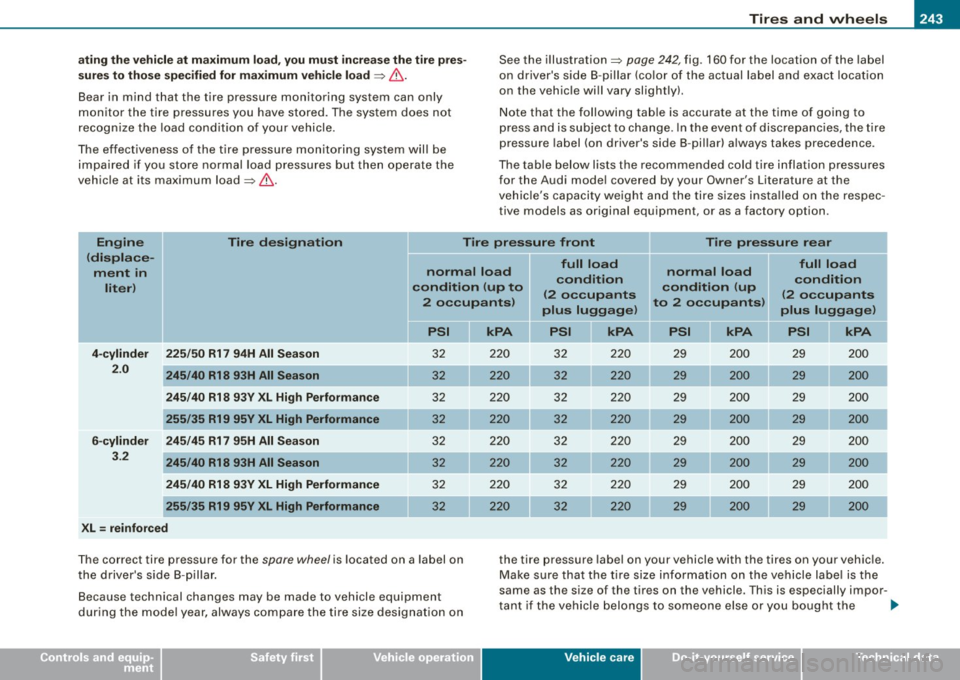
The table belo w lists t he r ecom mend ed cold tire i nflatio n pressures
for the Audi mode l covered by your Owner's Literature at the
vehic le' s capacity weigh t and the tire size s insta lled o n the respec
tive models as original equipment , or as a factory option .
Engine Tire designation
Tire pressure front II Tire pressure rear
(displace -
= " full load full load
ment in normal load
condition normal
load
condition
liter ) condition
(up to condition (up
( 2 oc cupants (2 occupants
2 o ccupants ) to 2 occupants)
plus luggage) plus luggage)
I
PSI II kPA PSI II kPA II PSI II kPA
PSI I[ kPA I
I
4-cylinder
225/50 R17 94H All Season 32 220 3 2 220 29 200 29 200
2.0
245/40 R18 93H All Season 32 220 32 220 29 200 29 200
245 /40 R18 93Y XL High Performance 32 220 32 220 29 200 29 200
255 /35 R19 95Y XL High Performance 32 220 32 220 29 200 29 200
6 -cylinder 245/45 R17 95H All Season 3 2 220 32 2 20 29 200 29 2 00
3.2
245/40 R18 93H All Season 32 220 32 220 29 200 29 200
245 /40 R18 93V XL High Performance 32 220 3 2 220 29 200 29 200
255/35 R19 95V XL High Performance 32 2 20 32 220 29 200 29 200
XL = reinforced
T he correct tire pressure for the spare wheel is located on a label on the tire p ressure label on your vehicle with the tires on your vehic le.
t he d river's s ide B -pilla r. Make sure that the tire s ize inf ormat ion on t he veh icle labe l is t he
Because technical changes may be made to vehicle equipment same as the si
ze of the tires on the vehicle. This is especially impor -
t ant if the ve hicle belongs to so meo ne else or you bought the
dur ing th e mode l year, always co mpare the tire size designa tion on
Vehicle care
I t •
.,
Page 265 of 316
_____________________________________________ W_ h_ a_t _d.....;. o_ l _d _o :....:.. n:..o:.. w.:....... ?:....:..--Jffllll
& WARNING
• Using a bumper jac k to raise the vehicle will damage the
bumper system . The jack may slip , causing injury .
• Never support your veh icle on cinder blocks , bri cks or other
obje cts. The se may not be able to support the load and could
c ause injury when they fail.
• Never start or run the engine while the vehicle is supported by
the jack .
• If you mu st work under the vehicle, always use safety stands
specifically des igned for this purpose .
• Never use the he xagonal socket in the handle of the screw
driver to loo sen or tighten the wheel bolts . •
Tire repair
App lies to vehicles: with Tire Mob ility System
General and safety pointers
Tire repair is in tended only for te m porary, shor t- te rm use.
®
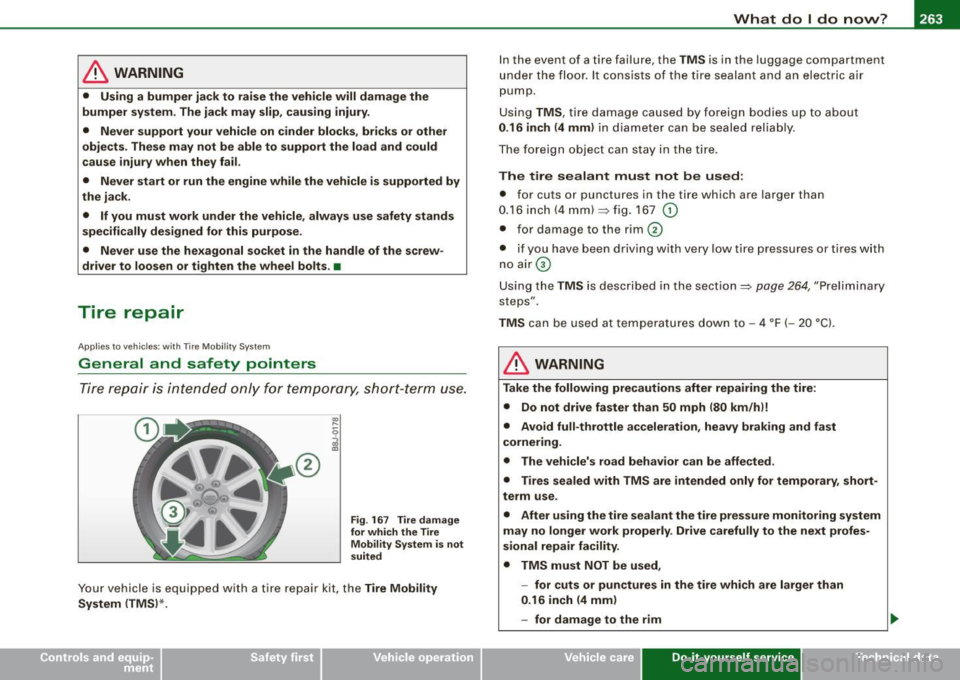
Fig . 16 7 Tire damage
for which the Tire Mobility Sy stem is not
suited
Your vehicle is equipped with a tire repai r kit, the Tire Mobil ity
System (TMS) *. I
n the event of a tire fai lure, the TMS is in the luggage compartment
u nde r th e floo r. It cons ists of the tir e sealan t and an el ectric a ir
pump .
U sing TMS, tire damage caused by foreign bodies up to about
0 .16 inch (4 mm ) in diam eter can be seale d relia bly.
T he foreign object can stay in the tire .
The tire sealant must not be used:
• for cuts or punctures in the tire which are large r than
0.16 inch (4 mm)~ fig . 167
G)
• for damage to the rim 0
• if you have been driving with very low tire pressures or tires w ith
n o air G)
Using the TMS is described in the section~ page
264, "Preliminary
steps" .
TMS can be used a t te m peratures down to -4 °F ( -20 °C).
& WARNING
Take the following precautions after repairing the tire :
• Do not drive faster than 50 mph (80 km /hi!
• Avoid full -throttle acceleration , heavy braking and fast
cornering .
• The vehicle's road behavior can be affe cted .
• Tires sealed with TMS are intended only for temporary , short
term use .
• After using the tire sealant the tire pressure monitoring system
m ay no longer work properly . Drive carefully to the next profes
s ional repair facility.
• TMS must NOT be used ,
- for cuts or punctures in the tire whi ch are larger than
0 .16 inch (4 mm )
- for damage to the rim
Vehicle care Do-it-yourself service irechnical data
Page 275 of 316
Fuses and bul bs -
------------------
Fuses and bulbs
Fuses
Replacing a fuse
A problem in the electrical system may be caused by a
blown fuse.
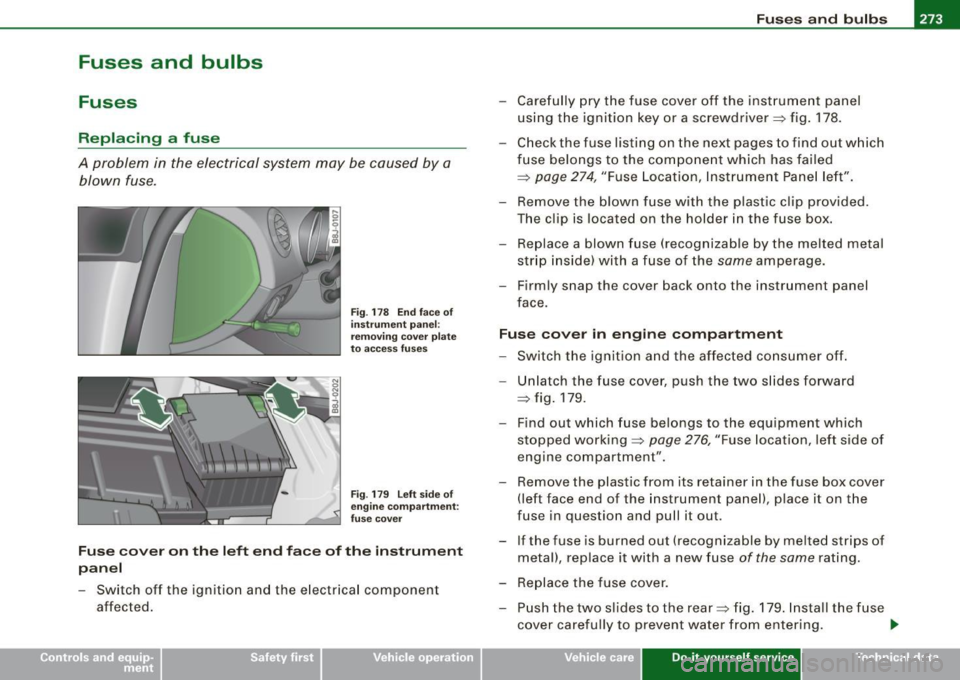
Fig . 178 End face o f
i n str ume nt pan el:
re m ov ing cover pla te
t o access f uses
Fig . 179 Left si de o f
engine co mpartm ent:
fu se cover
Fus e cove r on the left end face of the instrum ent
panel
- Switch off the ignition and the e lectr ica l component
affected . - Carefully pry the fuse cover off the instrument panel
using the ignition key or a screwdriver=> fig. 178.
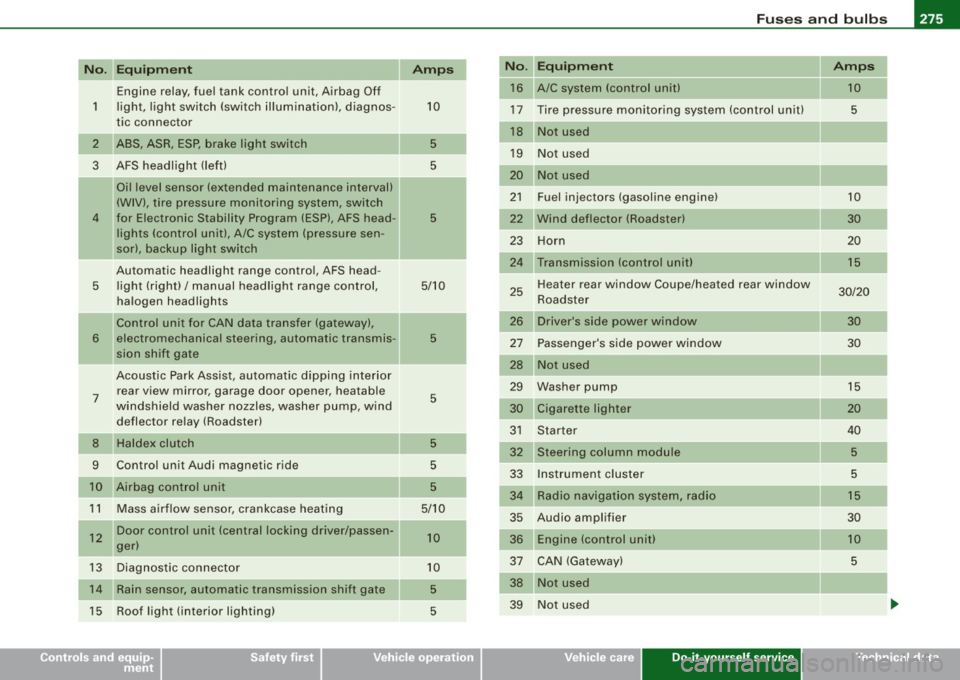
- C heck the fuse listing on the next pages to find out w hich
fuse belongs to the component which has failed => page 274, "F use Location, Instrument Pane l le ft".
- Remove the blown fuse with the plastic clip provided .
The clip is located on the holder in the fuse box .
Replace a blown fuse (recognizable by the melted metal
str ip inside) with a fuse of the same amperage.
- Firmly snap the cover back onto the instrument panel
face.
Fuse cov er in engin e compartment
- Switch the ignition a nd the affec ted co nsumer off .
- Unlatch the fuse cover, push the two s lides forward
=> fig . 179.
- Find out which fuse belongs to the equipment which
stopped working=> page 276, "Fuse location, left side of
engine compartment".
- Remove the plastic from its retainer in the fuse box cover (left face end of the instrument pane l), place it on the
fuse in question and pull it out.
- If the fuse is burned out (recognizable by melted strips of metal), replace it with a new fuse of the same rating.
- Replace the fuse cover.
- Push the two slides to the rear=> fig. 179 . Install the fuse
cover carefully to prevent water from entering. .,
Vehicle care Do-it-yourself service irechnical data
Page 277 of 316
Fuses and bulbs -
----------------
Equipment No. Equipment
Amps
Engine relay, fuel tank control unit, Airbag Off
16 A/C system (control unit) 10
1
light, light switch (switch illumination), diagnos-10
tic connector
17 Tire pressure monitoring system (control unit) 5
18
Not used
ABS, ASR, ESP, brake light switch
5 19
Not used
3 AFS headlight (left) 5
Not used
Oil level sensor (extended maintenance interval)
(WIV), tire pressure monitoring system, switch
21 Fuel injectors (gasoline engine) 10
4 for Electronic Stability Program (ESP), AFS head-5 Wind deflector (Roadster) 30
lights (control unit), A/C system (pressure sen -23 Horn 20 sorl, backup light switch
Automatic headlight range control, AFS head-
24 Transmission (control unit) 15
5
light (right)/ manual headlight range control, 5/10
25 Heater rear window Coupe/heated rear window 30/20
halogen headlights Roadster
Control unit for CAN data transfer (gateway),
26 Driver's side power window 30
6 electromechanical steering, automatic transmis-5
27 Passenger's side power window 30
sion shift gate
28 Not used
Acoustic Park Assist, automatic dipping interior
rear view mirror, garage door opener, heatable
29 Washer pump 15
7
windshield washer nozzles, washer pump, wind 5
30 Cigarette lighter 20
deflector relay (Roadster)
31 Starter 40
8
Haldex clutch 5 32 Steering column module 5
9
Control unit Audi magnetic ride 5 33
Instrument cluster 5
Airbag control unit 5 34 Radio navigation system, radio 15
1 1 Mass airflow sensor, crankcase heating 5/10
35
Audio amplifier 30
12 Door control unit (central locking driver/passen-10
36 Engine (control unit) 10 ger)
13 Diagnostic connector 10 37 CAN (Gateway) 5
Rain sensor, automatic transmission shift gate 5 38 Not used
15 Roof
light (interior lighting) 5 39 Not used
• Do-it
-yourself service
Page 278 of 316
-L____:F_:U::..: S::: e:::. S ::::....:: a::. n :..:.::: d:....::: b:..:U :.: l.=b :.::S :..._ ____________________________________________ _
No. Equ ipm ent
40 Not used
41 Not used
42 Not used
43 Not used
44 Not used
45 Not used
46 Not used Amps
47 SDARS tuner, cell phone package, TV tuner
5
48 VDA interface 5
49 Not used
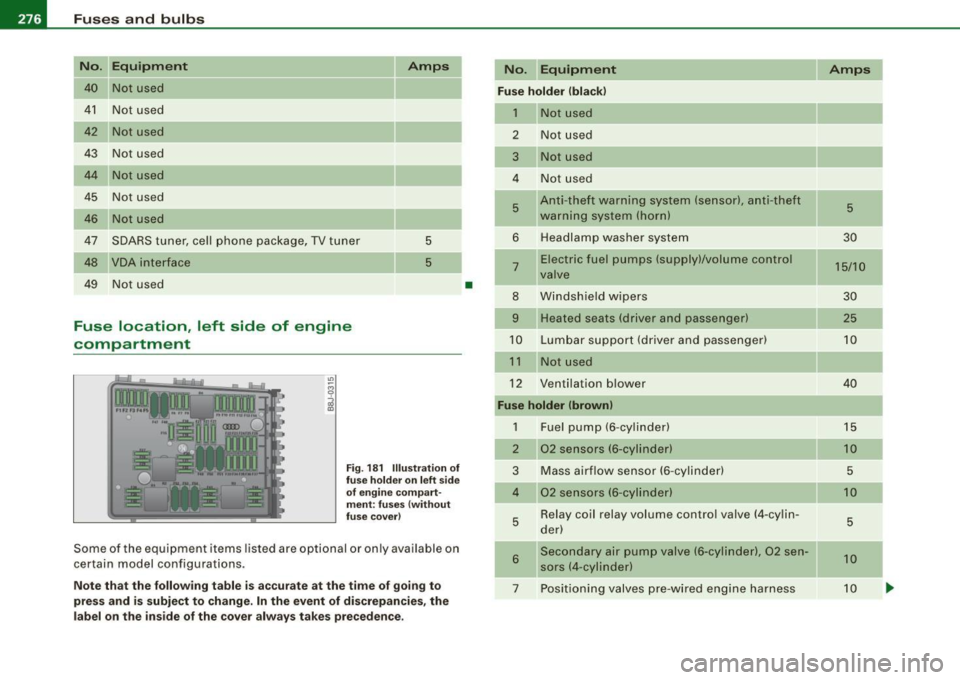
Fuse location , left side of engine
compartment
Fig . 18 1 Ill ustra tio n of
fu se h old er o n l eft s ide
of e ngine co mpart
m en t: fu se s (w ithout
fu se cov er)
Some of the equipment items listed are optional or only ava ilable on
certain model configurations .
Note th at th e fo llowi ng t able is acc urate at the t ime o f go ing to
pre ss a nd is subj ect to change. In the eve nt o f discre pancie s, the
l a bel on the ins ide of the cover a lways ta k es pre cede nce .
•
No . Equipm ent
Fu se hold er (bl ack)
1 Not used
2 Not used
3 Not used
___ ,
4 Not used
5
6
7
8
Anti-theft warning system (sensor), anti -theft
warning system (horn)
Headlamp washer system
Electric fuel pumps (supplyl/volume control
valve
Windshield w ipers
9 Heated seats (driver and passenger)
10 Lumbar support (driver and passenge r)
1 1 Not used
12 Ventilation blower
Fuse hold er (brown )
1
2
3
4
5
6
7
Fuel pump 16 -cy linder)
02 sensors (6-cylinderl
Mass airflow sensor 16 -cylinderl
02 sensors (6-cylinder) Relay coil relay volume con trol valve 14-cylin
de r)
Secondary air pump valve 16-cylinder), 02 sen
sors 14 -cylinde r)
Positioning valves pre-wired engine harness Amps
5
30
15/10
30
25
10
40 15
10
5
10
5
10
10
Page 279 of 316
_______________________________________________ F_ u_ s _ e_s _ a _ n_d _ b_ u_ l_ b_ s __ ffllll
•
No. II Equipment Amps
8
Ignition coils (4 -cylinder)/ignition coils (6 -cylin -20/30 der)
-
9 Engine (control unit) 25
Water pump delayed-off 10
11 Feed (clutch pedal, brake pedal) 5
12
Activated charcoal filter/charge pressure con-10 trol valve (4-cylinder)
--
Bulbs
Replacing light bulbs
For your safety, we recommend that you have your autho
rized Audi dealer replace burned out bulbs for you.
It is becoming increasingly more and more difficult to replace
vehicle light bulbs since in many cases, other parts of the car must
first be removed before you are able to get to the bulb. This applies
especially to the light bulbs in the front of your car which you can
only reach through the engin e compartment .
Sheet metal and bulb holders can have sharp edges that can cause
serious cuts, and parts must be correctly taken apart and then prop
erly put back together to help prevent breakage of parts and long
term damage from wa ter that can enter housings that have not
been properly resealed.
For your safety , we recommend that you have your authorized Audi
dealer replace any bulbs for you, since your dealer has the proper
tools, the correct bulbs and the expertise.
Gas discharge lamps (Xenon lights)*:
•
Due to the high electrical voltage, have the bulbs replaced by a qual
ified technician. Headlights with Xenon light can be identified by the
high voltage sticker.
& WARNING
Contact with high-voltage components of the electrical system
and improper replacement of gas discharge (Xenon) headlight
bulbs can cause serious personal injury and death.
• Xenon bulbs are pressurized and can explode when being
changed.
• Changing Xenon lamps requires the special training, instruc
tions and equipment .
• Only an authorized Audi dealer or other qualified workshop
should change the bulbs in gas discharge lamps.
& WARNING
There are parts with sharp edges on the openings and on the bulb holders that can cause serious cuts.
• If you are uncertain about what to do, have the work performed
by an authorized Audi dealer or other qualified workshop. Serious
personal injury may result from improperly performed work.
[ i] Tips
• If you must replace the light bulbs yourself, always remember
that the engine compar tment of any vehicle is a hazardous area to
work in. Always read and heed all WARNINGS =>
page 212, "Engine
compartment"=> &.
• It is best to ask your authorized Audi dealer whenever you need
to change a bulb. •
Do-it-yourself service
Page 280 of 316
.,,___E_ m_ e_r -=g :...e_ n _ c-=y _ s_ i_t _u _a _t_ i_o _n_ s _______________________________________________ _
Emergency situations
General
This chapter is intended for trained emergen cy crew s and working
personnel who have the necessary tools and equ ipment to perform
the se operations. •
Starting by pushing or towing
0 Note
Vehicles with an automatic tran smission cannot be started by
pushing or towing . •
Starting with jumper cables
If n ecess ary, the e ngin e c an b e starte d by conne ctin g it to
the ba ttery of anoth er vehicle .
If the engine shou ld fai l to start because of a discharged or weak
ba tte ry, the bat te ry can be connected t o the ba ttery of
another
vehic le, using a pair of jumper cables to start the engine.
Jumper cables
Use
only jumper cables of suffic iently large cross section to safely
c a rr y th e st arter cu rre nt. Re fer to th e m an ufacture r's spec ific a tio ns.
Use on ly jump er cables wh ic h have
insulated termina l c lamps and
a re prope rly marked for distinction :
plus (+l cable in mo st cas es c olo red red
minus (-l cable in most cases co lored black .
& WARNING
Batteries contain electricity , acid , and gas . Any of these can cause
very serious or fatal injury. Follow the instructions below for safe
handling of your vehicle 's battery .
• Always shield your eyes and avoid leaning over the battery
whenever possible .
• A discharged battery can already freeze at temperatures just
below 32 °F (0 °Cl. Before connecting a jumper cable, the frozen
battery must be thawed completely , otherwise it could explode .
• Do not allow battery a cid to contact eyes or skin . Flush any
contacted area with water immediately.
• Improper use of a booster battery to start a vehicle may cause
an explosion.
• Vehicle batteries generate e xplosive gases . Keep sparks, flame
and lighted cigarettes away from batteries.
• Do not try to jump start any vehicle with a low ac id level in the
battery.
• The voltage of the booster battery must also have a 12-Volt
rating . The capacity (Ahl of the booster battery should not be
lower than that of the discharged battery . Use of batteries of
different voltage or substantially different "Ah " rating may cause
an e xplosion and personal injury .
• Never charge a frozen battery. Gas trapped in the ice may cause
an explosion .
• Never charge or use a battery that has been frozen . The battery
case may have be weakened.
• Use of batteries of different voltage or substantially different
capacity (Ah ) rating may cause an explosion and injury . The
capacity (Ahl of the booster battery should not be lower than that
of the discharged battery . .,_
Page 281 of 316
________________________________________________ E_ m_ e_r ,,::g c..e_ n _ c..::y;._ s_ i_t _u _a_ t_ i_o _n_ s _ ___.ffllll
& WARNING !continued)
• Before you check anything in the engine compartment, always
read and heed all WARNINGS~ page 212, "Engine compartment".
0 Note
• Applying a higher voltage booster battery will cause expensive
damage to sensitive electronic components, such as control units,
relays, radio, etc .
• There must be no electrical contact between the vehicles as
otherwise current could already start to flow as soon as the positive
(+) terminals are connected.
[ i) Tips
The discharged battery must be properly connected to the vehicle's
electrical system. •
Use of jumper cables
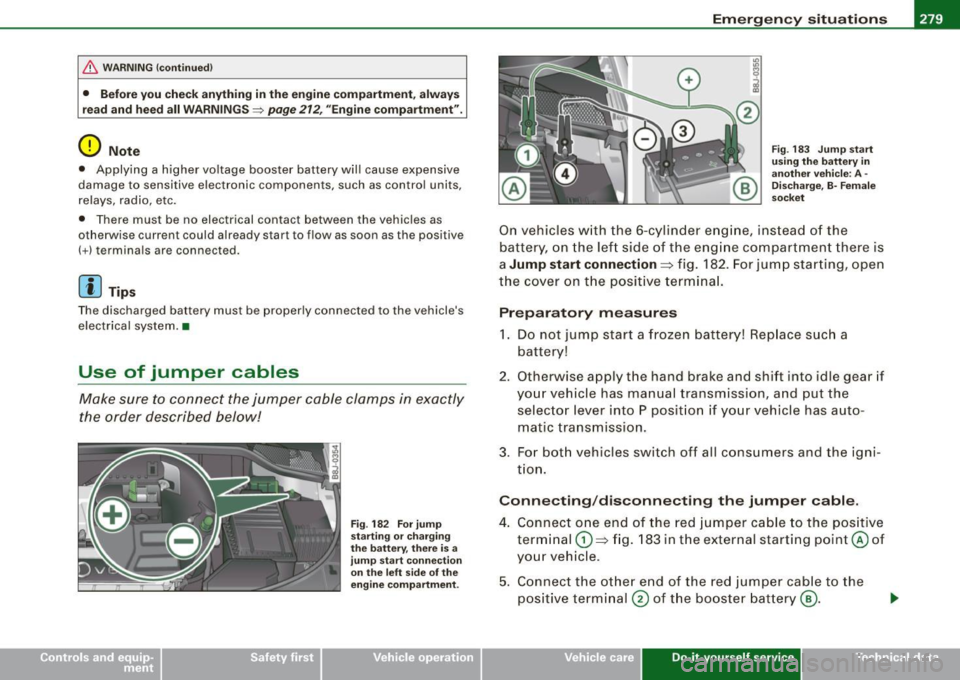
Make sure to connect the jumper cable clamps in exactly
the order described below!
Fig. 182 For jump
starting or charging
the battery, there is a
jump start connection
on the left side of the
engine compartment . Fig. 183 Jump
start
using the battery in
another vehicle: A -
Discharge, B-Female
socket
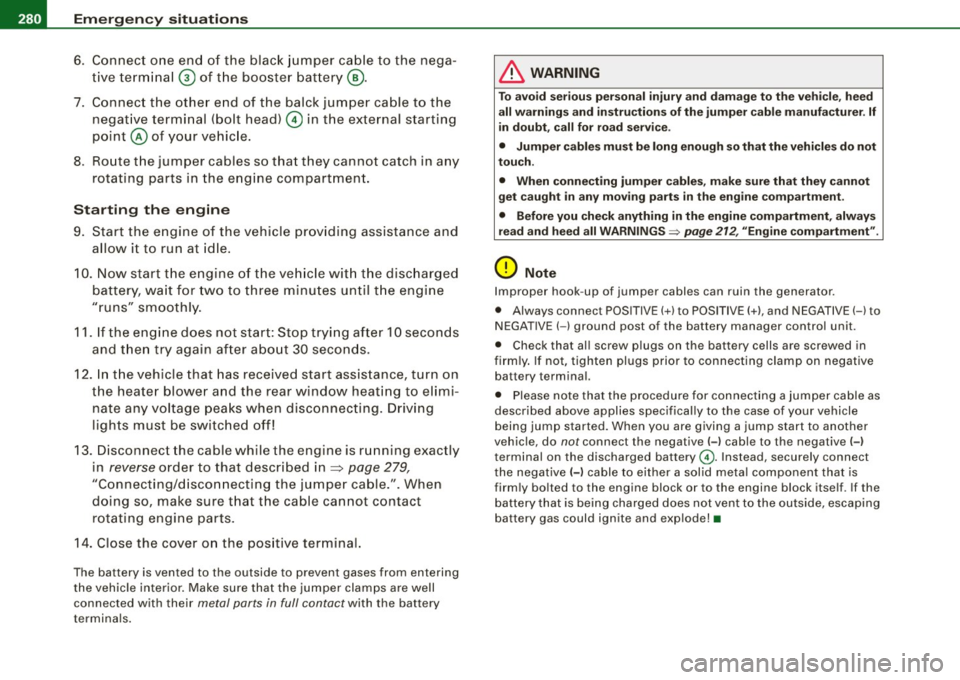
On vehicles with the 6-cylinder engine, instead of the
battery, on the left side of the engine compartment there is
a
Jump start connection=:> fig. 182. For jump starting, open
the cover on the positive terminal.
Preparatory measures
1. Do not jump start a frozen battery! Replace such a
battery!
2. Otherwise apply the hand brake and shift into idle gear if
your vehicle has manual transmission, and put the
selector lever into P position if your vehicle has auto
matic transmission.
3. For both vehicles switch off all consumers and the igni
tion.
Connecting/disconnecting the jumper cable.
4. Connect one end of the red jumper cable to the positive
terminal
G) =:> fig. 183 in the external starting point@ of
your vehicle .
5. Connect the other end of the red jumper cable to the
positive terminal
® of the booster battery®·
Vehicle care Do-it-yourself service irechnical data
Page 282 of 316
llll1.--___;E::. m :..:..:. e .::..:..r_,.g ~e:..: n:..:..: c:.!y ;__: s:... i..:.t ..:.u :...a ..:.t:... i..::o ..:.n..:.. s::.... ______________________________________________ _
6. Connect one end of the black jumper cable to the nega
tive term inal
0 of t he booster bat tery @.
7. Connect the other end of the balck jumper cable to the negative terminal (bolt head)
G) in the external starting
point @ of your ve hic le.
8. Route the jumper cables so tha t they cannot catch in any
rotating parts in the engine compartment.
Starting the engin e
9. Start the engine of the vehicle providing assistance and
allow it to run at id le.
10 . Now start t he engine o f the ve hicle wit h the disc harged
battery, wa it for two to three minutes until t he engine
"runs" smoothly.
11 . If the engi ne does not start : Stop tryi ng after 10 seconds
and t hen try ag ain after abo ut 30 secon ds.
12. In the vehicle that has received start assistance, turn on
the heate r blower and the rear window heating to elimi
nate any voltage pea ks when disconnecting. Driving
lights must be switched off!
1 3. Disconnect the cable while the engine is running exactly
in
reverse order to that described in=> page 279,
"Connecting/d isconnecting the jumper cable .". When
doing so, make sure t hat the cable cannot contact
rotating engine parts.
14 . Close the cover on the pos itive terminal.
The battery is vented to the outside to prevent gases from entering
the vehic le interior. Make sure that the jumper clamps are well
connected with their
metal parts in full contact with the battery
termina ls .
& WARNING
To a vo id se riou s pe rso nal in jur y a nd d am age t o the vehi cle, heed
all wa rnings and in stru ction s of th e jumper cable manuf acturer. If
i n doubt , call for r oad ser vic e.
• Jumper c able s mu st be long enough so that the vehicle s do not
t o uch .
• When connecting jumper cable s, make sur e th at they cannot
g et ca ught in any mo ving p arts in the eng ine comp artment .
• Bef ore you che ck anyth ing in the engin e comp artment , alway s
r ea d and heed all WARNING S=:,
page 21 2, "Engine c omp artment ".
0 Note
Improper hook -up of jumper cables can ruin the generator .
• Always connect POS ITIVE ( +l to POSITIVE(+), and NEGAT IVE( -) to
NEGAT IVE( -) ground post of the battery manager control unit .
• Check that al l screw plugs on the battery cells are screwed in
firm ly . I f not, tighten plugs prior to connecting clamp on negative
battery terminal.
• Please note that the procedure for connect ing a jumper cable as
described above applies specifical ly to the case of your vehicle
being jump started. When you are giving a jump start to another
vehicle, do
not connect the negative(-) cable to the negative 1- l
terminal on the discharged battery@. Instead, securely connect
the negative( -) cable to either a sol id metal component that is
firm ly bolted to the engine block or to the engine block itself . If the
battery that is being charged does not vent to the outside, escaping
battery gas could ignite and explode! •
Page 283 of 316
________________________________________________ E_ m_ e_r ,,::g c..e_ n _ c..::y;._ s_ i_t _u _a_ t_ i_o _n_ s _ ___._
Emergency towing with commercial
tow truck
General hints
Your Audi requires special handling for towing.
The following information is to be used by commercial tow truck
operators who know how to operate their equipment safely.
• Never tow your Audi, towing will cause damage to the engine
and transmission.
• Never wrap the safety chains or winch cables around the brake
lines.
• To prevent unnecessary damage, your Audi must be transported
with a car carrier (flatbed truck).
• To load the vehicle on to the flat bed, use the towing loop found
in the vehicle tools and attach to the front or rear anchorage
=> page 281 and=> page 282.
& WARNING
A vehicle being towed is not safe for passengers. Never allow
anyone to ride in a vehicle being towed, for any reason. •
Front towing loop
Do not install the front towing loop until it is needed.
Fig. 184 Front
bumper: removing the
grill
Fig . 185 Front
bumper: screwing
in
the towing loop
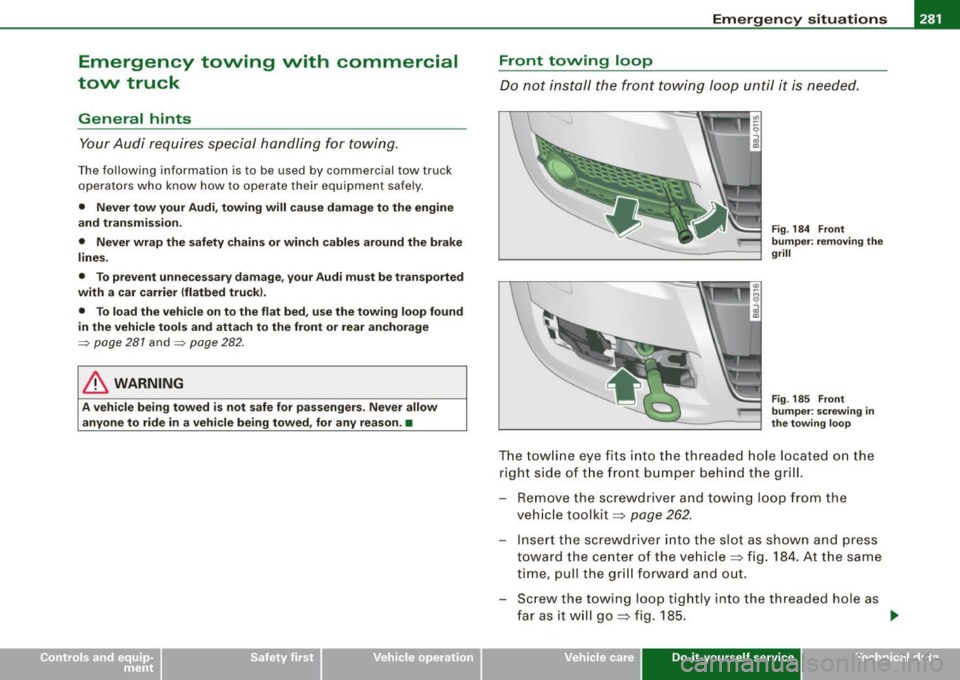
The towline eye fits into the threaded hole located on the
right side of the front bumper behind the grill.
- Remove the screwdriver and towing loop from the
vehicle toolkit=>
page 262.
-Insert the screwdriver into the slot as shown and press
toward the center of the vehicle => fig. 184. At the same
time, pull the grill forward and out.
- Screw the towing loop tightly into the threaded hole as
far as it will go => fig. 185.
~
Vehicle care Do-it-yourself service irechnical data