ignition AUDI TT ROADSTER 2008 Owners Manual
[x] Cancel search | Manufacturer: AUDI, Model Year: 2008, Model line: TT ROADSTER, Model: AUDI TT ROADSTER 2008Pages: 316, PDF Size: 70.1 MB
Page 237 of 316
Checking and filling -
------------- --------=----" =---------
0 Note
Do not overfill the battery, otherwise battery acid will overflow
through the vent opening. This can damage the paint and cause
corrosion. •
Checking the battery acid level on
conventional batteries *
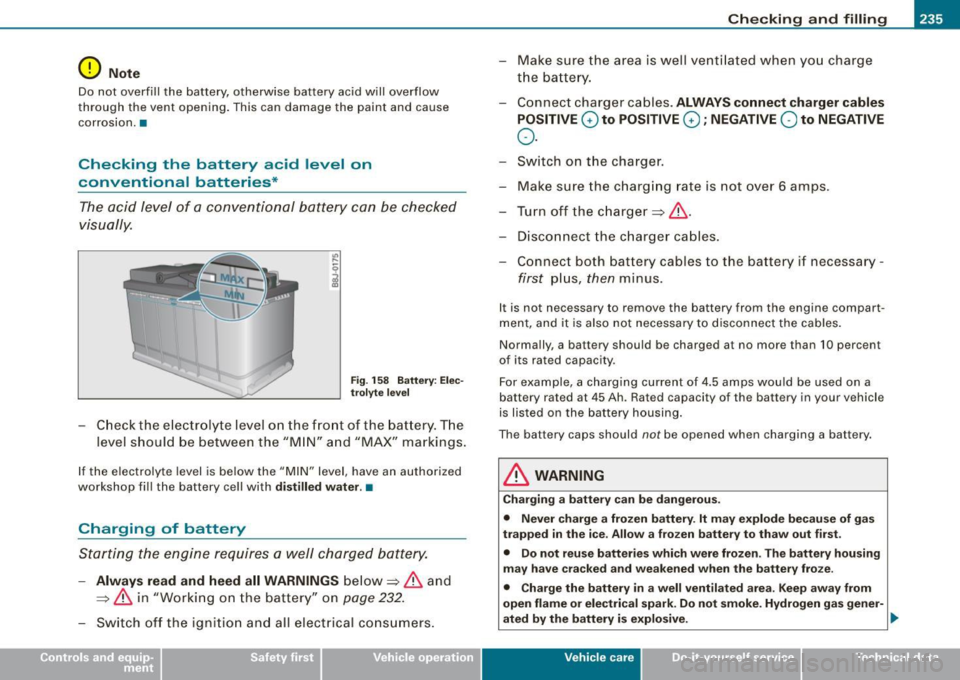
The acid level of a conventional battery can be checked
visually.
Fig. 158 Battery : Elec
trolyte level
-Check the electrolyte level on the front of the battery. The
level should be between the "MIN" and "MAX" markings.
If the electrolyte level is below the "MIN" level, have an authorized
workshop fill the battery cell with
distilled water.•
Charging of battery
Starting the engine requires a well charged battery.
-Always read and heed all WARNINGS below => & and
=> & in "Working on the battery" on
page 232.
- Switch off the ignition and all electrical consumers. - Make sure
the area is well ventilated when you charge
the battery.
- Connect charger cables.
ALWAYS connect charger cables
POSITIVE
(v to POSITIVE (v ; NEGATIVE Q to NEGATIVE
o.
- Switch on the charger.
- Make sure the charging rate is not over 6 amps.
- Turn off the charger=>&.
- Disconnect the charger cables.
- Connect both battery cables to the battery if necessary -
first plus, then minus.
It is not necessary to remove the battery from th e engine compart
ment, and it is also not necessary to disconnect the cables.
Normally, a battery should be charged at no more than 10 percent
of its rated capacity .
For example, a charging current of 4.5 amps would be used on a
battery rated at 45 Ah. Rated capacity of the battery in your vehicle
is listed on the battery housing.
The battery caps should
not be opened when charging a battery.
& WARNING
Charging a battery can be dangerous.
• Never charge a frozen battery. It may explode because of gas
trapped in the ice . Allow a frozen battery to thaw out first.
• Do not reuse batteries which were frozen. The battery housing
may have cracked and weakened when the battery froze .
• Charge the battery in a well ventilated area. Keep away from
open flame or electrical spark. Do not smoke. Hydrogen gas gener-
ated by the battery is explosive. .,_
Vehicle care I I irechnical data
Page 275 of 316
Fuses and bul bs -
------------------
Fuses and bulbs
Fuses
Replacing a fuse
A problem in the electrical system may be caused by a
blown fuse.
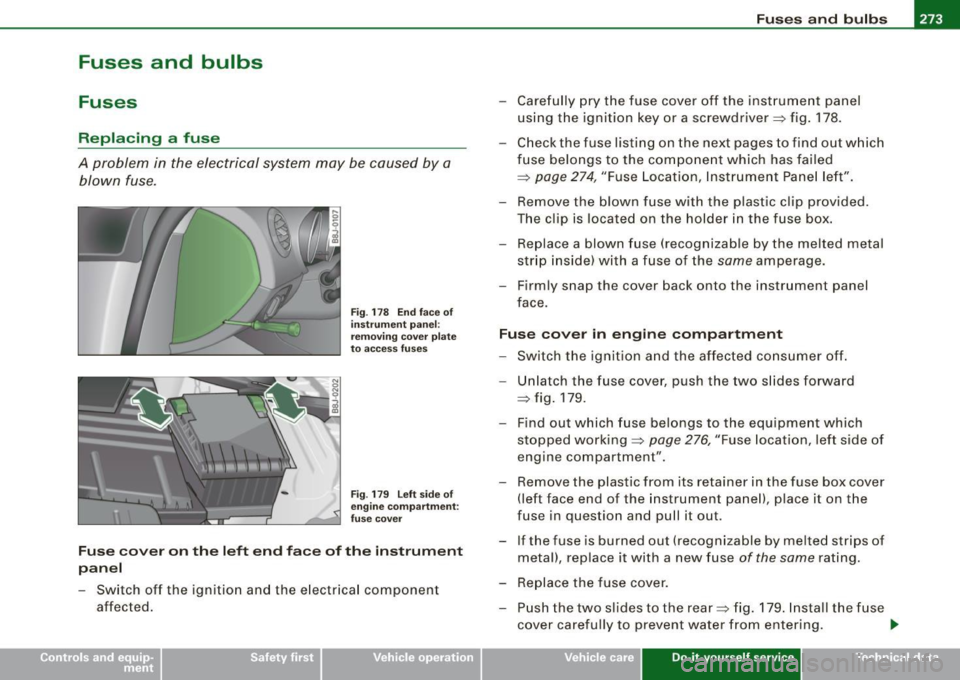
Fig . 178 End face o f
i n str ume nt pan el:
re m ov ing cover pla te
t o access f uses
Fig . 179 Left si de o f
engine co mpartm ent:
fu se cover
Fus e cove r on the left end face of the instrum ent
panel
- Switch off the ignition and the e lectr ica l component
affected . - Carefully pry the fuse cover off the instrument panel
using the ignition key or a screwdriver=> fig. 178.
- C heck the fuse listing on the next pages to find out w hich
fuse belongs to the component which has failed => page 274, "F use Location, Instrument Pane l le ft".
- Remove the blown fuse with the plastic clip provided .
The clip is located on the holder in the fuse box .
Replace a blown fuse (recognizable by the melted metal
str ip inside) with a fuse of the same amperage.
- Firmly snap the cover back onto the instrument panel
face.
Fuse cov er in engin e compartment
- Switch the ignition a nd the affec ted co nsumer off .
- Unlatch the fuse cover, push the two s lides forward
=> fig . 179.
- Find out which fuse belongs to the equipment which
stopped working=> page 276, "Fuse location, left side of
engine compartment".
- Remove the plastic from its retainer in the fuse box cover (left face end of the instrument pane l), place it on the
fuse in question and pull it out.
- If the fuse is burned out (recognizable by melted strips of metal), replace it with a new fuse of the same rating.
- Replace the fuse cover.
- Push the two slides to the rear=> fig. 179 . Install the fuse
cover carefully to prevent water from entering. .,
Vehicle care Do-it-yourself service irechnical data
Page 279 of 316
_______________________________________________ F_ u_ s _ e_s _ a _ n_d _ b_ u_ l_ b_ s __ ffllll
•
No. II Equipment Amps
8
Ignition coils (4 -cylinder)/ignition coils (6 -cylin -20/30 der)
-
9 Engine (control unit) 25
Water pump delayed-off 10
11 Feed (clutch pedal, brake pedal) 5
12
Activated charcoal filter/charge pressure con-10 trol valve (4-cylinder)
--
Bulbs
Replacing light bulbs
For your safety, we recommend that you have your autho
rized Audi dealer replace burned out bulbs for you.
It is becoming increasingly more and more difficult to replace
vehicle light bulbs since in many cases, other parts of the car must
first be removed before you are able to get to the bulb. This applies
especially to the light bulbs in the front of your car which you can
only reach through the engin e compartment .
Sheet metal and bulb holders can have sharp edges that can cause
serious cuts, and parts must be correctly taken apart and then prop
erly put back together to help prevent breakage of parts and long
term damage from wa ter that can enter housings that have not
been properly resealed.
For your safety , we recommend that you have your authorized Audi
dealer replace any bulbs for you, since your dealer has the proper
tools, the correct bulbs and the expertise.
Gas discharge lamps (Xenon lights)*:
•
Due to the high electrical voltage, have the bulbs replaced by a qual
ified technician. Headlights with Xenon light can be identified by the
high voltage sticker.
& WARNING
Contact with high-voltage components of the electrical system
and improper replacement of gas discharge (Xenon) headlight
bulbs can cause serious personal injury and death.
• Xenon bulbs are pressurized and can explode when being
changed.
• Changing Xenon lamps requires the special training, instruc
tions and equipment .
• Only an authorized Audi dealer or other qualified workshop
should change the bulbs in gas discharge lamps.
& WARNING
There are parts with sharp edges on the openings and on the bulb holders that can cause serious cuts.
• If you are uncertain about what to do, have the work performed
by an authorized Audi dealer or other qualified workshop. Serious
personal injury may result from improperly performed work.
[ i] Tips
• If you must replace the light bulbs yourself, always remember
that the engine compar tment of any vehicle is a hazardous area to
work in. Always read and heed all WARNINGS =>
page 212, "Engine
compartment"=> &.
• It is best to ask your authorized Audi dealer whenever you need
to change a bulb. •
Do-it-yourself service
Page 291 of 316
_________________________________________________ G_ e_ n_ e_r _a _l_ i_n _f_o _ r_ m_ a_ t _i _o _ n __ lftlll
vehicle identification number of your vehicle (perforation) as well as
the Gross Vehicle Weight Rating (GVWR) and the Gross Axle Weight
Rating (GAWRl.
The high voltage warning label
is located on the lock carrier.
The spark ignition system meets all requirements of the Canadian
Interference-Causing Equipment Regulations. •
Displaying Vehicle Identification
Number in the Driver Information
display
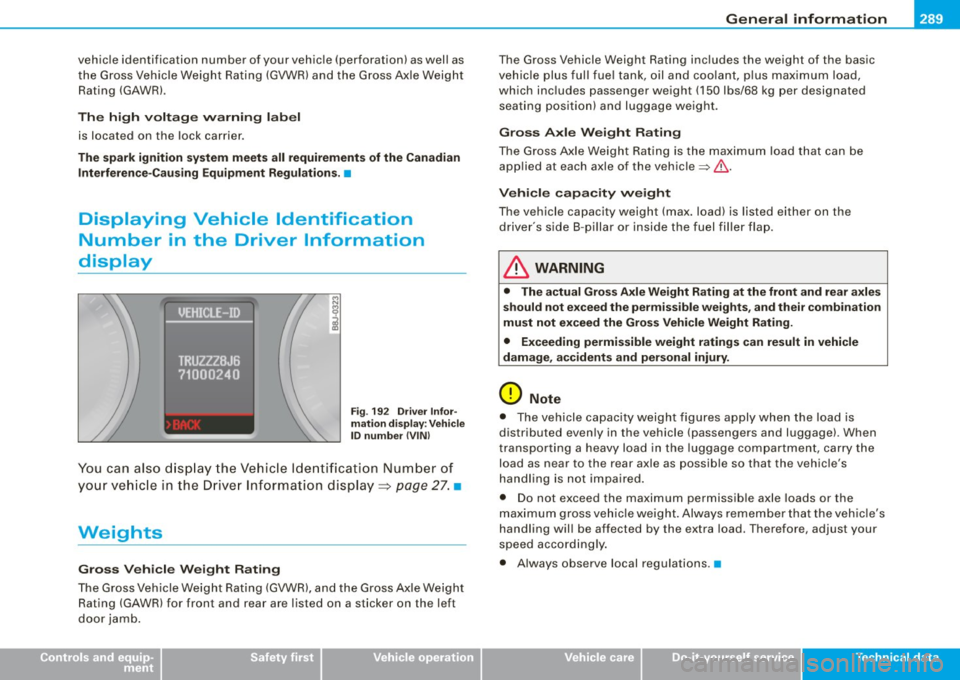
Fig . 192 Driver Infor
mation display: Vehicle
ID number (VIN)
You can also display the Vehicle Identification Number of
your vehicle in the Driver Information display=:>
page 27. •
Weights
Gross Vehicle Weight Rating
The Gross Vehicle Weight Rating (GVWR), and the Gross Axle Weight
Rating (GAWR) for front and rear are listed on a sticker on the left
door jamb.
Controls and equip ment Safety first Vehicle operation
The
Gross Vehicle Weight Rating includes the weight of the basic
vehicle plus full fuel tank, oil and coolant, plus maximum load,
which includes passenger weight (150 lbs/68 kg per designated
seating position) and luggage weight.
Gross Axle Weight Rating
The Gross Axle Weight Rating is the maximum load that can be
applied at each axle of the vehicle~&.
Vehicle capacity weight
The vehicle capacity weight (max. load) is listed either on the
driver's side 8 -pillar or inside the fuel filler flap.
& WARNING
• The actual Gross Axle Weight Rating at the front and rear axles
should not exceed the permissible weights, and their combination
must not exceed the Gross Vehicle Weight Rating.
• Exceeding permissible weight ratings can result in vehicle
damage, accidents and personal injury.
0 Note
• The vehicle capacity weight figures apply when the load is
distributed evenly in the vehicle (passengers and luggage). When
transporting a heavy load in the luggage compartment, carry the
load as near to the rear axle as possible so that the vehicle's
handling is not impaired.
• Do not exceed the maximum permissible axle loads or the
maximum gross vehicle weight. Always remember that the vehicle's
handling will be affected by the extra load. Therefore, adjust your
speed accordingly.
• Always observe local regulations. •
Vehicle care Do-it-yourself service Tec hn ica l da ta
Page 297 of 316

_______________________________________________ C _o_ n _ s_u _ m_ e_ r_l_n _f_o _ r_ m_ a_ t _i _o _ n __ _
workshop personne l in order to assure proper performance, reli
abil ity and sa fe ty of the vehicle a nd i ts many sys te m s.
I mproper maintenance, adjustments and repairs can impair the
operation and reliabil ity of your vehicle and even void your vehicle
war ra nty. T here fore, proof o f serv ic ing in accorda nce with the main
tenance schedule may be a condition for uphold ing a possible
war ra nty claim made withi n th e warranty per iod .
Above all, operat ional safety can be adverse ly affected, creating
unnece ssary risks fo r you and you r passengers .
If in doubt about a ny servici ng, have it do ne by your authorized Aud i
dea ler or any other properly equipped and qua lified workshop. We
str ongly u rge you to give your auth orized Audi dealer the oppo rtu
nity to perform al l scheduled maintenance and necessary repairs.
You r deale r has the facil ities, origi nal par ts and trained special is ts
to keep your vehic le running proper ly.
Performing limited maintenance yourself
T he fo llow ing pages describe a limited numbe r of procedures which
can be perfo rme d on you r vehicle wi th ordi nary too ls, should the
need arise and trained personne l be unavailab le. Before performing
any of these proced ures, always thor oug hly read a ll of th e appli
cable text and carefu lly fo llow the instructions given. Always rigor
ously observe the
WARNINGS provided .
Before you check anything in the engine compartment , alway s read
and heed all WARNINGS:::>
& and:::> & in "Wo rking in the engine
compartment" on
page 220.
& WARNING
• Ser ious persona l injury may occur as a result of improperly
performed maintenance , adjustments or repairs.
• Always be e xtremely careful when working on the vehicle .
Always follow commonly accepted safety practices and general
c ommon sense . Never ri sk per sonal injury .
Controls and equip ment Safety first Vehicle operation
& W
ARNING (continued )
• Do not attempt any of the maintenance , checks or repairs
described on the following pages if you are not fully familiar with
these or other pro cedures with respect to the vehicle , or are uncer
tain how to proceed.
• Do not do any work without the proper tools and equipment.
Have the necessary work done by your autho rized Audi dealer or
another properly equipped and qualified workshop .
• The engine compartment of any motor vehicle is a potentially
hazardous area . Never reach into the area around or touch the
radiator fan . It i s temperature controlled and can switch on
suddenly -even when the engine is off and the ignition key has
been removed . The radiator fan switche s on automatically when
the coolant reaches a certain tempe rature and will continue to run
until the coolant temperature drops .
• Always remove the ignition key before anyone gets under the
vehicle.
• Always support your vehicle with safety stands if it is neces
sary to work underneath the vehicle. The jack supplied with the
vehicle is not adequate for this purpose and could collapse
causing serious personal injury .
• If you must work underneath the vehicle with the wheels on
the ground, always make sure the vehicle is on level ground , that
the wheels are always securely blocked and that the engine
cannot be started .
• Always make sure the transmission selector lever (automatic
transmission) is in "P" (Park position ) (automatic transmission ) or
Neutral (manual tr ansm ission) and the hand brake is firmly
applied.
levels. This is detrimenta l to the environment and increases fuel
co nsu mp tion.
Vehicle care Do-it-yourself service Tec hn ica l da ta
Page 303 of 316
______________________________________________ A_ l.:.. p _h_ a_ b_e _t_ic _ a _ l _in _ d_e _ x __ _
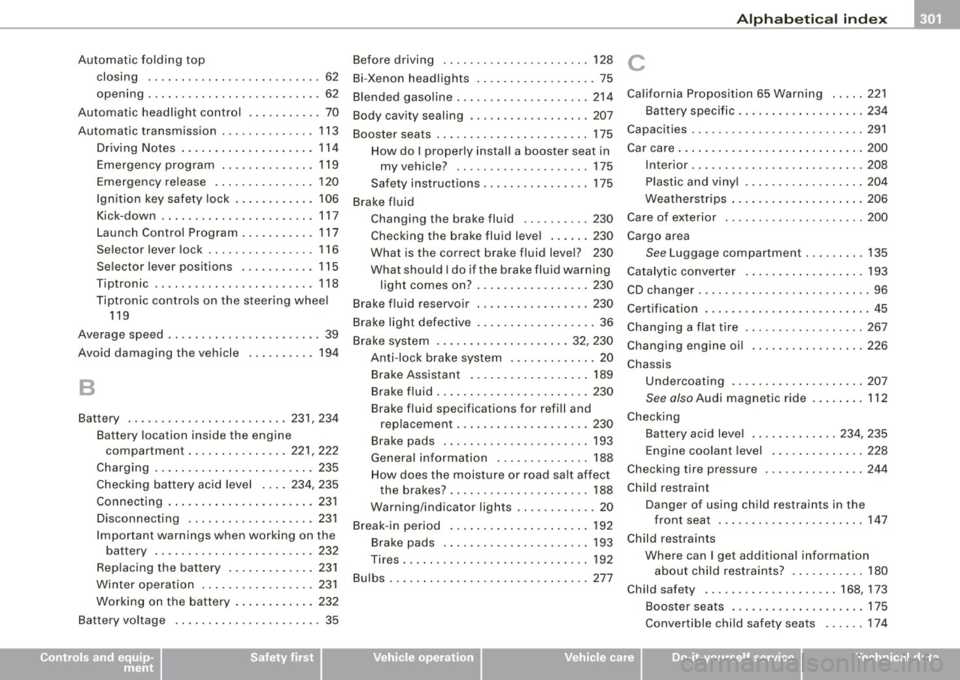
Automatic folding top
closing .. .... .... ....... ..... ... . 62
opening ... ... ... .... .... ... .... .. 62
Automatic headlight control .. ......... 70
Automatic transmission .. .... .... .... 113
Driving Notes ......... .... .. ..... 114
Emergency program .... ...... .... 119
Emergency release . . . . . . . . . . . . . . . 120
Ignition key safety lock . ...... ..... 106
Kick -down .. ... .. .... .... ...... .. 117
Launch Control Program ........... 117
Selector lever lock ........ .... .... 116
Selector lever positions .... ..... .. 115
Tiptronic ... .. .... .... ... .... .... 118
Tiptronic controls on the steering wheel
119
Average speed ... ... ..... ... .... .... . 39
Avoid damaging the vehicle ..... .... . 194
B
Battery .. ... .... .... .... ..... .. 231, 234
Battery location inside the engine
compartment . ...... .... .... 221, 222
Charging ........................ 235
Checking battery acid level .. .. 234, 235
Connecting ...................... 231
Disconnecting .... .... .... ...... . 231
Important warnings when working on the
battery ........................ 232
Replacing the battery .. .......... . 231
Winter operation ................. 231
Working on the battery ... .... .... . 232
Battery voltage . .... .... .... ... .... .. 35
Controls and equip
ment Safety first
Before
driving . .... . .. ... ... ........ 128
Bi -Xenon headlights .................. 75
Blended gasoline . ... .... .... .... .... 214
Body cavity sealing ...... ...... ... .. . 207
Booster seats .. ...... .... .... .... ... 175
How do I properly install a booster seat in
my vehicle? . .......... .... ... .. 175
Safety instructions . .... .... ... .... 175
Brake fluid Changing the brake fluid .. ........ 230
Checking the brake fluid level ...... 230
What is the correct brake fluid level? 230
What should I do if the brake fluid warning
light comes on? ... .. .... .... .... 230
Brake fluid reservoir . ...... ...... .... 230
Brake light defective ........ .... .... .. 36
Brake system ... ... .. .... ........ 32, 230
Anti-lock brake system .. ....... .... 20
Brake Assistant ........ ... .. .... . 189
Brake fluid ................... .... 230
Brake f luid specifications for refill and
replacement .... ...... ...... .... 230
Brake pads ... ... .... .... .... .... 193
General information .............. 188
How does the moisture or road sa lt affect
the brakes? ..... ...... ...... .... 188
Warning/indicator lights .. ...... .... 20
Break -in period ...... ...... ... .. .... 192
Brake pads ...................... 193
Tires .. .... .... ... .... .... .... ... 192
Bulbs .... ... .... .. . .. .............. 277
C
California Proposition 65 Warning . .... 221
Battery specific .... ... .... .... .... 234
Capacities ... .... ........ ... .... .... 291
Car care ... .... ... .. .... .... .... .... 200
Interior ..... .... .. .... ........... 208
Plastic and vinyl .................. 204
Weatherstrips ..... .... ...... ..... 206
Care of exterior .. .... ....... ........ 200
Cargo area
See Luggage compartment . ... .... . 135
Catalytic converter ...... .... .... .... 193
CD changer ..... .... .... .... .... ..... 96
Certification ...... ... .... ...... ...... 45
Changing a flat tire ... .... .... ....... 267
Changing engine oil ............. .... 226
Chassis Undercoating .... ..... ... .... .... 207
See also Audi magnetic ride .... .... 112
Check ing
Battery acid level ......... ... . 234, 235
Engine coolant level .............. 228
Checking tire pressure . ... .... .... ... 244
Child restraint
Danger of using child restraints in the front seat .... ... .... .... .... ... 147
Child restraints Where can I get additional information
about chi ld restraints? ... ........ 180
Child safety ...... .... ... .... ... 168, 173
Booster seats .... .... .... .... ... . 175
Convertible child safety seats ... ... 174
Vehicle operation Vehicle care Do-it-yourself service Technical data
Page 307 of 316
______________________________________________ A_ l_,_ p _h_ a_ b_e _t_ic _ a _ l _in _ d_e _ x __ _
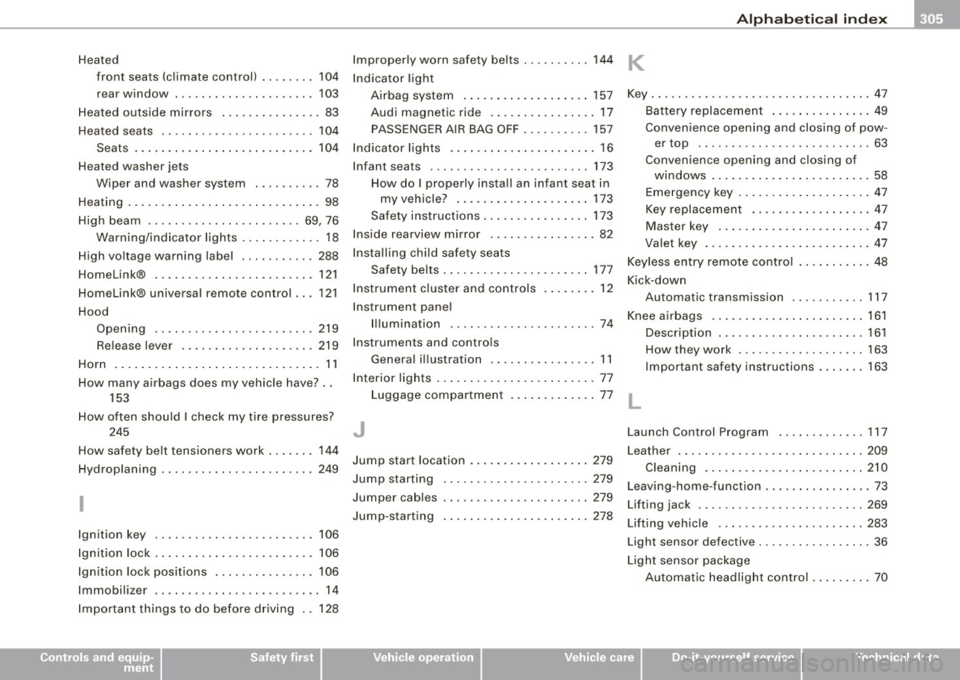
Heated
front seats (climate control) .... .... 104
rear window ...... ....... ..... ... 103
Heated outside mirrors ... .. .... .... .. 83
Heated seats .................. .... . 104
Seats ...... ...... .... ........ ... 104
Heated washer jets
Wiper and washer system . ......... 78
Heating .. .... ... .... .... ......... ... 98
High beam ...... ................. 69, 76
Warning/indicator lights ... ... .... .. 18
High voltage warning label ........... 288
Homelink® ... .. .... .... ........... 121
Homelink® universal remote control ... 121
Hood Opening .. ............... ... .... 219
Release lever .................... 219
Horn ......... ... .. .... .... ...... ... 11
How many airbags does my vehicle have? . .
153
How often should I check my tire pressures?
245
How safety belt tensioners work .... ... 144
Hydroplaning ........ .... .... .... ... 249
I
Igni tion key 106
Ignition lock ...... ...... .... ...... .. 106
Ignition lock positions ............... 106
Immobili zer ... ............. ..... ... . 14
Important things to do before driving .. 128
Controls and equip
ment Safety first
Improperly
worn safety belts ... .. ... .. 144 K
Indicator light
Airbag system ........ .... .... ... 157 Key .....
........ ........ ...... ... .. . 47
Audi magnetic ride ................ 17 Battery replacement ......
.... .... . 49
PASSENGER AIR BAG OFF ... ....... 157 Conven
ience opening and closing of pow-
Indicator lights .. ...... .... .... ...... 16
Infant seats ........ ...... ... .... ... 173
How do I properly insta ll an infant seat in
my vehicle? ....... ...... ....... 173
Safety instructions ......... ....... 173
Inside rearview mirror ......... ...... . 82
Installing child safety seats
Safety belts ...................... 177
Instrument cluster and controls . ...... . 12
Instrument panel
Illumination ......... ............. 74
Ins truments and controls
Genera l il lustration ................ 11
Interior lights ....... ..... ....... .... . 77 er top
... .... .... ... ............ 63
Convenience opening and closing of windows ............ .... ........ 58
Emergency key .. ...... ............ 47
Key replacement ......... .... ..... 47
Master key . ...... .... ...... .... .. 47
Valet key ... .. .... .... .... .... .... 47
Key less entry remote contro l .......... . 48
Kick-down Automatic transmission ........... 117
Knee airbags ........ ... .... ........ 161
Description . ...... .... ....... .... 161
How they work ................... 163
Important safety instructions ... .... 163
Luggage compartment .. ....... .... 77
L
J Launch Control Program ............. 117
Jump start location ........... ... .... 279
Jump starting ...................... 279
Jumper cables ... ..... ...... .... .... 279
Jump-starting . ........ .... ... .. .... 278 Leather ...
... .... ....... .... ...... . 209
Cleaning ...... .... ..... .. .... ... 210
Leaving -home-function ................ 73
Lifting jack ......................... 269
Lift ing vehicle .... .................. 283
Light sensor defective ........... ...... 36
Light sensor package Automatic headlight control .. ....... 70
Vehicle operation Vehicle care Do-it-yourself service Technical data
Page 310 of 316
__ _.!::.A~IEp~ h~a~ b~e~ ti~c~a~ l~ i~ n ~d ~e:,: x~ -------------------------------------------
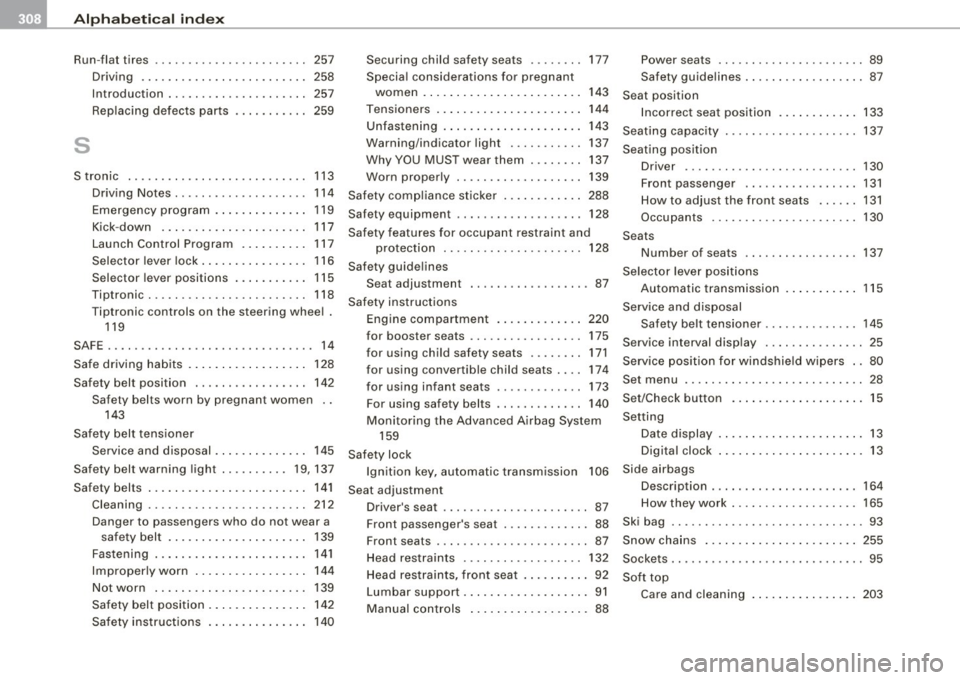
Run-flat tires 257
258
257
259
Driving
... ..... .. .... .... ...... .
Introduction . ....... ..... .... ... .
Replacing defects parts .... ...... .
s
S tronic 113
Driving Notes .. .... .... .... .... .. 114
Emergency program . . . . . . . . . . . . . . 119
Kick -down . . . . . . . . . . . . . . . . . . . . . . 117
Launch Control Program .... .. .... 117
Selector lever lock . . . . . . . . . . . . . . . . 116
Selector lever positions . . . . . . . . . . . 115
Tiptronic . . . . . . . . . . . . . . . . . . . . . . . . 118
Tiptron ic controls on the steering wheel .
119
SAFE ....... ... ..................... 14
Safe driving habits . ...... .... .... ... 128
Safety belt position . . . . . . . . . . . . . . . . . 142
Safety belts worn by pregnant women 143
Safety belt tens ioner
Service and disposal ... .... .. . .... 145
Safety belt warning light ...... ... . 19, 137
Safety be Its . . . . . . . . . . . . . . . . . . . . . . . . 141
Cleaning .. ........ ....... .... ... 212
Danger to passengers who do not wear a safety belt . . . . . . . . . . . . . . . . . . . . . 139
Fastening . . . . . . . . . . . . . . . . . . . . . . . 141
Improper ly worn ...... ........ ... 144
Not worn . . . . . . . . . . . . . . . . . . . . . . . 139
Safety belt position . . . . . . . . . . . . . . . 142
Safety instructions . . . . . . . . . . . . . . . 140 Securing child safety seats
..... .. .
Special considerations for pregnant women . .... ....... ...... ..... .
Tensioners ......... ... .... ..... .
Unfastening . ...... .... .... .... . .
Warning /indicator light .... .... .. .
Why YOU MUST wear them ....... . 177
1
43
144
143
137
137
Worn properly . . . . . . . . . . . . . . . . . . . 139
Safety compliance sticker ......... ... 288
Safety equipment .... ...... ... .. .... 128
Safety features for occupant restraint and
protection . . . . . . . . . . . . . . . . . . . . . 128
Safety guidelines Seat adjustment .................. 87
Safety instructions Engine compartment ....... ... ... 220
for booster seats . . . . . . . . . . . . . . . . . 175
for using child safety seats ...... .. 171
for using convertible child seats .... 174
for using infant seaits ............. 173
For using safety bel ts . . . . . . . . . . . . . 140
Monitoring the Advanced Airbag System
159
Safety lock Ignition key, automatic transmission 106
Seat adjustment Driver's seat . . . . . . . . . . . . . . . . . . . . . . 87
Front passenger's seat . . . . . . . . . . . . . 88
Front seats . . . . . . . . . . . . . . . . . . . . . . . 87
Head restraints . . . . . . . . . . . . . . . . . . 132
Head restraints, front seat ...... .... 92
Lumbar support .. ... .. ........ .... 91
Manual controls ..... ... ....... ... 88 Power
seats . . . . . . . . . . . . . . . . . . . . . . 89
Safety guide lines .. .... .... .... .... 87
Seat position Incorrect seat position ... .... ... .. 133
Seating capacity .. .... ....... .... ... 137
Seating position Driver ...................... .... 130
Front passenger ................. 131
How to adjust the front seats ... ... 131
Occupants
Seats 130
Number of seats ... .... ... ... .... 137
Selector lever positions
Automatic transmission .... .... ... 115
Service and disposal Safety belt tensioner .... .... ...... 145
Serv ice interval disp lay .... .... .... .. . 25
Service position for windshie ld wipers .. 80
Set menu ........................... 28
Set/Check button . . . . . . . . . . . . . . . . . . . . 15
Setting Date display
Digital clock
Side airbags .
. .. .. .... .... .... .... 13
13
Description ...................... 164
How they work . . . . . . . . . . . . . . . . . . . 165
Ski bag .. .... .... .... .... ... .... .... 93
Snow chains ..... .... .... ... .... ... 255
Sockets ............................. 95
Soft top
Care and cleaning ...... .... .... .. 203