ignition AUDI TT ROADSTER 2008 Manual Online
[x] Cancel search | Manufacturer: AUDI, Model Year: 2008, Model line: TT ROADSTER, Model: AUDI TT ROADSTER 2008Pages: 316, PDF Size: 70.1 MB
Page 215 of 316
Cleaning and protection -
----------------
•
& WARNING (continued )
• Before reaching into the front plenum panel , always remove the
ignition key . Otherwise , the windshield wiper system could unin
tent ionally be sw itched on, possibly caus ing personal injury from
the moving wiper linkage.
• Never reach into the area around or touch the radiator fan. The
auxiliary fan is temperature controlled and can switch on suddenly
- even when the ignition is off .
• Do not wash, wax or dry the engine with the engine running .
Moving or hot parts could injure you .
• Do not clean the underside of the chassis , fenders, wheel
covers , or other hard to reach parts without protecting your hands
and arms. You may cut yourself on sharp-edged metal parts .
• Always read and heed all WARNINGS and other information
=> page 200. •
Vehicle care I t •
Page 216 of 316
Fue l sup ply and fillin g your fu el tank
Fuel supply and filling your fuel tank
Gasoline
Fuel supply
Using the right fuel helps keep the environment clean and
prevents engine damage.
Fu el r eco mmend ati on
The fuel recommended for your vehicle is unleaded pr em ium grade
gasoline . See also =>
page 291, "Data". Audi recommends using TOP
TIER Detergent Gasoline with a minimum octane rating of 91 AKI (95
RON). For more information on TOP TIER Detergent Gasoline, please
go to the official website (www.toptiergas.coml.
The recommended gasoline octane rating for your engine can a lso
be found on a label located on the ins ide of the fuel filler flap. This
rating may be specified as AKI or RON .
Your vehicle may also be operated us ing un leaded regu lar gasoline
with a minimum octane rating of 87 AKl/91 RON. However, using 87
AKl/91 RON octane fuel will slight ly reduce engine performance .
Use u nlea d ed ga solin e only. Unleaded gasoline is available
throughout the USA, Canada, and in most European countries . We
recommend that you do not take your vehicle to areas or countries
where unleaded gasoline may not be available.
For more information on refueling your vehicle, see=>
page 215 .
O ctane ra tin g
Octane rating indicates a gasoline's abil ity to resist engine
damaging "knock" caused by premature ignition and detonation.
Therefore, buying the correct grade of gasoline is very important to help prevent possible engine damage and a loss of engine perfor
mance. Gasoline most commonly used in the United States and Canada has
the following octane ratings that can usual ly be found on the filler
pump:
• Premium Grade: 91 -96 AKI
• Regular Grade : 87 -90 AKI
Explanation of the abbreviations:
AKI = Anti Knock Index= (R +Ml/2 = (RON +MON)/2
RON= Research Octane Number
MON = M otor Octane Number .
0 Note
• Do not use any fuel with octane ratings lower than 87 AK I or 91
RON otherwise expensive engine damage will occur .
• Do
not use leaded gaso line! The use of leaded gasoline will
severely damage your vehic le's cata lytic converter and its abi lity to
contro l exhaust emissions. •
Blended gasoline
Use o f gaso line containin g alco ho l o r MTB E (met hy l
t e rt iary butyl e th er)
You may use unleaded gaso line blended with alcohol or MTBE
(common ly referred to as oxygenates) if the blended mixture meets
t he fo llowing criteria:
Bl end of g asoline m eth anol (wood alcoho l or methyl al coh ol)
• Anti-knock index must be 87 AKI or higher.
• Blend must contain no more than 3% methanol.
• Blend must contain more than 2% co-so lvents.
Page 218 of 316
Fuel supply and filling your fuel tank
The label on the inside of the fuel filler flap tells you the correct fuel
for your vehicle. For more information about fuel specifications, see
~ page 214.
Your vehicle fuel tank has an on -board refuelling vapor recovery
system. This feature helps to prevent fuel vapors from escaping
from the tank and polluting the environment while you refuel your
vehicle. In order to fill the tank properly while protecting the envi
ronmen t, please follow this refueling procedure carefully.
& WARNING
Under normal operating conditions, never carry additional fuel
containers in your car. Gas canisters and other containers used to
transport fuel can be dangerous. Such containers, full or empty,
may leak and could cause a fire in a collision. If you must transport
fuel to use for your lawn mower, snow blower, etc ., be very careful
and always observe local and state laws regarding the use, trans
portation and storage of such fuel containers . Make certain the
container meets industry standards (ANSI/ASTM F852 -861.
0 Note
Never drive your vehicle until the fuel tank is completely dry. The
irregular supply of fuel can cause misfiring . Gasoline could enter
into the exhaust system and damage the catalytic converter. •
Refuelling
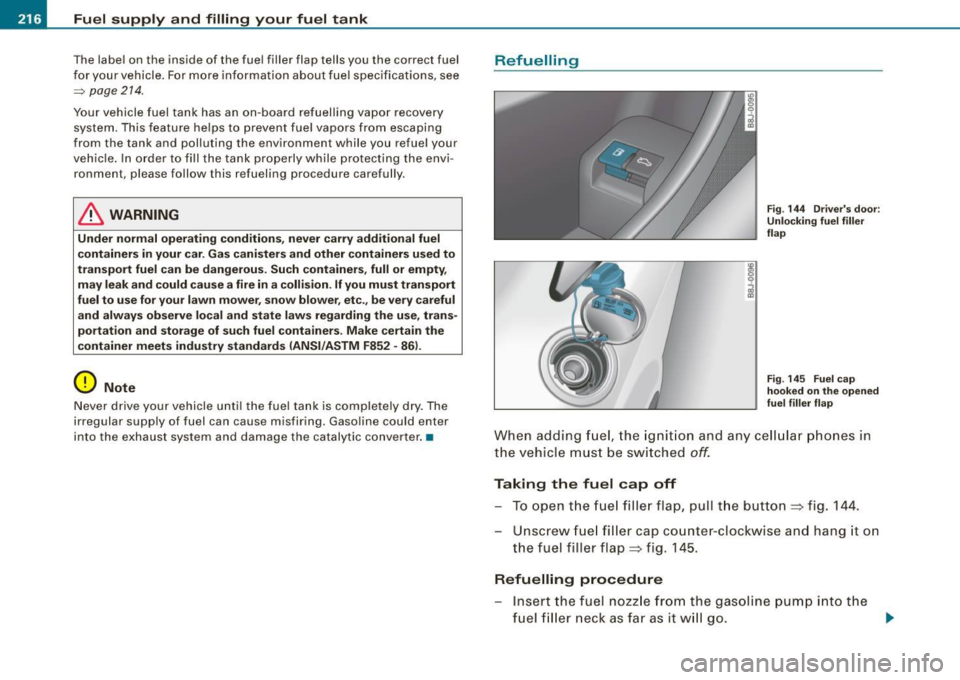
Fig. 144 Driver's door:
Unlocking fuel filler
flap
Fig . 145 Fuel cap
hooked on the opened
fuel filler flap
When adding fuel, the ignition and any cellular phones in
the vehicle must be switched
off.
Taking the fuel cap off
To open the fuel filler flap, pull the button ~ fig. 144.
Unscrew fuel filler cap counter-clockwise and hang it on
the fuel filler flap~ fig. 145 .
Refuelling procedure
Insert the fuel nozzle from the gasoline pump into the
fuel filler neck as far as
it will go. .,_
Page 220 of 316
![AUDI TT ROADSTER 2008 Manual Online Fuel supply and filling y our fu el ta nk
will be filled -causing the fuel to overflow when it becomes warm
and pollute the environment.
[ i ] Tips
• Running your engine wh](/img/6/57671/w960_57671-219.png "AUDI TT ROADSTER 2008 Manual Online Fuel supply and filling y our fu el ta nk
will be filled -causing the fuel to overflow when it becomes warm
and pollute the environment.
[ i ] Tips
• Running your engine wh")
Fuel supply and filling y our fu el ta nk
will be filled -causing the fuel to overflow when it becomes warm
and pollute the environment.
[ i ] Tips
• Running your engine while refuel ling may cause vapors to
escape or even fuel to spill out of the tank . This would then shut off
the fue l nozzle before the tank is full.
• Do not refuel your vehicle with the ignition switched on . The fuel
gauge may otherwise not indicate the correct fuel level after
refuel ling .•
Unlocking the fuel filler flap by hand
You c an open the fuel filler flap by hand i f the p ower
locking system should fail .
Fig . 14 6 Lugg age
co mp artm ent : Cove r in
t h e r igh t-side interi or
tri m
If the power loc king syst em sho uld fa il, you can still open
the flap manually :
- Ope n the rear lid .
Open the round cover in the right -s ide interior trim.
Remove the red plastic knob from its reta iner . -
Pull the plastic cord in the direction of the arrow to
unlock the fuel filler flap~ fig. 146 . •
Page 222 of 316
-~_C_ h_e _c _ k_ i_n ...:::g::;...._ a_n_ d_ f_ i_ll _in -'g:::;.._ ___________________________________________ _
Closing the engine hood
- Pull the hood down until the pressure from the struts is
reduced.
- Let the hood
drop down and latch in place. Do not try to
push it shut;
it may fail to engage~& .
& WARNING
A hood that is not completely latched could fly up and block your
view while driving.
• When you close the engine hood, check it to make sure the
safety catch has properly engaged. The hood should be flush with
the surrounding vehicle body parts.
• If you notice while driving that the hood is not secured prop
erly, stop at once and close it. •
Working in the engine compartment
Be especially careful whenever you work in the engine
compartment!
Whenever you must perform any work in the engine compartment,
for example checking and filling the different fluids, there is a risk of injury, burns and accidents. To prevent personal injury always
observe the following WARNINGS. The engine compartment of any
vehicle is a hazardous area!
=> &
& WARNING
To help avoid injury, before you check anything under the hood :
• Switch off the engine.
• Remove the ignition key.
• Apply the parking brake.
& WARNING (continued)
• Move selector lever of automatic transmission to "P" {Park);
put manual transmission in Neutral.
• Always let the engine cool down. Hot components will burn
skin on contact.
• To reduce the risk of being burned, never open the hood if you
see or hear steam or coolant escaping from the engine compart
ment. Wait until no steam or coolant can be seen or heard before
carefully opening the hood .
• Keep children away from the engine compartment.
• Never spill fluids on hot engine components. They can cause a
fire.
• Never touch the radiator fan. The auxiliary electric fan is
temperature controlled and can switch on suddenly.
• Never open the coolant reservoir cap when the engine is still
warm. The coolant system is pressurized and hot coolant could
spray out.
• Protect your face, hands and arm from steam or hot engine
coolant by placing a thick rag over the cap when you open the
coolant reservoir.
• If work on the fuel system or the electrical system is necessary:
- Always disconnect the battery .
- Never smoke or work near heaters or open flames. Fluids in
the engine compartment could start a fire.
- Keep an approved fire extinguisher immediately available.
• To avoid electrical shock and personal injury while the engine
is running or being started, never touch :
- Ignition cables
- Other components of the high voltage electronic ignition
system.
• If you must perform a check or repair with the engine running: .,_
Page 230 of 316
___ C_h_ e_ c_k _in --== g'-- a_n _d_ f_il _li _n ..:::g:::..- ___________________________________________ _
function and performance of your cooling system and could result
in damage not covered by your New Vehicle Limi ted Warranty .•
Checking the engine coolant level
The engine coolant level can be checked with a quick
g lance .
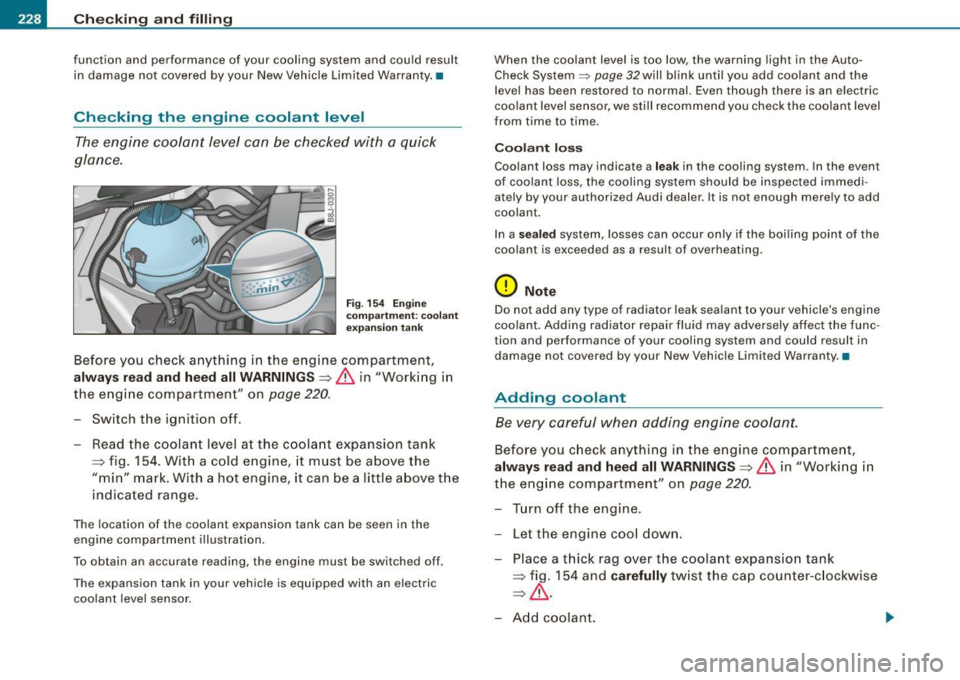
Fig. 154 Engin e
co mpartment : coo lan t
e xpansio n tank
Before you check anything in the engine compartment,
always read and heed all WARNINGS =>
& in "Working in
the engi ne compa rtment" on
page 2 20.
- Switch t he ignition off.
- Rea d the coo lan t leve l at th e co ola nt e xpansion tank
=> fig . 154. Wit h a c old engine , it must be a b ove the
"min" mark . With a hot engine, it can be a little a bove t he
indicated range .
The location of the coo lant expansion tank can be seen in the
engine compartment i llustration.
To obtain an accurate reading, the engine must be switched off .
The expans io n tank in your vehicle is equipped with an electric
coo lant level sensor . When the coolant leve
l is too low , the warning light in the Auto
Check System ~
page 32will blink un til you add coolant and the
level has been restored to normal. Even though there is an electric
coo lant level sensor, we still recommend you check the coolant level
from time to time .
Coolant los s
Coolant loss may indicate a leak in the cooling system . In the event
of coo lant loss, the cooling system should be inspec ted i mmedi
a tely by your authorized Audi dealer . It is no t enough mere ly to add
coolant.
In a
sealed system, losses can occur only if the boi ling point of the
coolant is exceeded as a result of overheating.
0 Note
Do not add any type of radiator leak sea lant to your vehicle's engine
coo lant. A dding ra diator repair fluid may adversely affec t the func
tion and performance of your cooling system and could result in
damage not cove red by your New Veh icle Limi ted War ranty. •
Adding coolant
Be very careful when adding en gine coolant.
Before you c heck anything in the engine compartment,
always read and heed all WARNINGS =>
& in "Working in
the eng ine compa rtment" on
page 220 .
-Turn off the engine.
- Let the engine coo l dow n.
- Place a t hick rag
over th e coola nt expansio n tank
=> fig . 154 and carefully twist the cap cou nter -c lockwise
=> & .
- Add coolant .
Page 231 of 316
___________________________________________ C_ h_e _c_ k_ i_n _g _ a_n _d_ f_il _li _n _g __ ffllll
•
- Twist the cap on again tightly.
Replacement engine coolant must conform to exact specifications
=>
page 227, "Coolant ". If in an emergency coolant additive G12 + is
not avai lab le, do
not use a d ifferen t addit ive. Use p lain water
instead until you can get the correct additive and can restore the
correct ratio . This should be done as soon as possib le .
If you have lost a considerable amoun t of coolant, then you should
add cold antifreeze and cold water only when the engine is cold.
Always use
new engine coolan t when refilling .
Do not fi ll coolant above the "MAX" mark. Excess coo lant will be
forced out through the pressure relief va lve in the cap when t he
engine becomes hot.
& WARNING
• The cooling system is under pres sure a nd can g et very hot.
Reduce the ri sk of scald ing from ho t co olant b y following the se
s tep s.
- Turn off the engine and allow it to cool d own .
- Prote ct your fa ce , hand s and arm s from e scaping fluid and
st eam b y covering the cap with a l arge , thick rag .
- Turn the cap slo wly and very carefully in a count er-c lockw ise
dire ction while applying light , do wnward pres sure on th e top
o f the cap.
- To avoid b eing burned , do not spill antifre eze or coolant on
th e ex haus t syste m or hot e ngine parts . Under cert ain co nd i
tion s, the eth yle ne gly col in en gine co ola nt can cat ch fire .
• Antifr ee ze is poison ous. Alw ay s s tore antifr ee ze in its origi nal
c ontainer and well out of the re ach of children.
• If you dr ain th e coola nt , it mu st be caught and safe ly stored in
a proper contain er cle arly m ark ed "p oison ".
0 Note
• Coolant po llutes the env ironment and could cause an engine
fire . Excess coo lant wil l be forced out through the pressure relief
valve in the cap when the engine becomes ho t.
• I f, in an emergency, only water can be added, the correct ratio
between water and antifreeze=>
page 227must be restored as soon
as possib le .
<£> For the sake of the environment
Drained coolant should not be reused . Always dispose of used
coolant while observi ng all environmental regulations. •
Radiator fan
The radiator fan switches on automatically by itself.
The electric radiator fan is controlled by thermoswitches that switch
on and off depending on coolant and engine compartment temper
atures.
An auxiliary electric radiator fan * switches on and off depending on
coolant temperature and other vehic le operation conditions .
After you switch the eng ine o ff, the aux iliary fan can continue
running for up to 10 minutes -even with the ignition off. It can even
switch on again later by itself=>& , if
• the temperature of the engine coolant rises due to the heat
build -up from the engine in the engine compar tment, or
• the engine compartment heats up because the vehicle is parked
in intense sunlight.
& WARNING
• To reduc e the ri sk of per sonal in jur y nev er t ouch t he radiato r
f a n . .,_
Vehicle care
I t •
Page 233 of 316
Checkin g and fillin g ---------------~-!':WIii
•
& WARN ING (co ntinued)
- Use only br ake flu id th at m eet s SAE spec ificati on J 1703 and
c onf orms to F ed eral Motor Vehi cle St and ard 11 6. Always ch ec k
w ith your a uthori zed A ud i de aler to m ake sure you are u sin g
the corre ct brake fluid . Th e co rrect typ e of br ake fluid i s also
indic ate d on the br ake fluid res ervo ir .
- The br ake fluid mu st be ne w. Heavy u se of the br ake s c an
c au se a vapor lo ck if the brake fluid i s left in the s yste m too
long. Thi s ca n seriou sly affe ct the eff iciency of the brake s as
w ell as your safety . This could resu lt in an a ccident .
0 Note
Brake fluid wi ll damage the paint of your vehicle.
t he special too ls required and the necessary expertise, we recom
mend that you have the brake f luid changed by your authorized Audi
dea ler .•
Battery
General information
Your vehicle is equipped with a specia l battery, an AGM battery. This
battery is located in the luggage compartment and must be
replaced with an origina l equipment battery. Under normal oper
ating conditions, the battery is
maintenan ce-free .
Have the battery checked when you take your vehicle in for service.
You a re we ll advised to replace a battery that is olde r th an 5 years .
Disc onn ectin g th e batt ery t erm inal s
Some vehic le functions (power window regulators, for e xample) are
lost if the battery terminals are disconnected. These functions have
to be relearned after the batte ry term inals are connected again. To
prevent this, the battery should only be disconnected from the
vehicle electrical system when abso lutely necessary for repairs.
V ehi cle s not dri ven for long period s
If you are going to le t your vehicle stand for a long t ime a nd not
drive it, you should remember there are electrica l components
which are still functioning and they will draw energy from the
battery and drain it, for examp le, the engine immob ilizer. To prevent
this, you can either charge the battery occasionally to keep it in
good working condition or you can d isconnect the negative cab le
on the battery.
W inter op era ti on
During the winter months, battery capacity tends to decrease as
temperatures drop. This is because more power is a lso consumed
while starting, and the headlights, rear window defogger, etc., are
used more often .
Avoid unnecessary power consumption, particularly in city traffic or
when trave ling on ly shor t distances . Let your au thorized Audi dea ler
check the capacity of the vehicle battery before winter sets in
=>
page 235 . A well charged battery will not on ly prevent start ing
p rob lems when the weather is cold , but wi ll a lso last longer .
Replacing battery
The new battery must h ave the same capacity, voltage (12 volts},
amperage, construction and p lug sea ling, as the origina l battery.
Specifications are l isted on the battery hous ing. Batteries specially
developed by Audi fulfill the ma intenance, output, and safety
requirements.
When installing the battery, make sure the ignition and all electrical consumers are switched off=>
0. .,_
Vehicle care I t •
Page 235 of 316
__________________________________________ C_ h _ e_c _k _in _ g =- a_ n __ df _i_ lli _n ___ g __ __
•
The following WARNINGS are very important when
working on the battery:
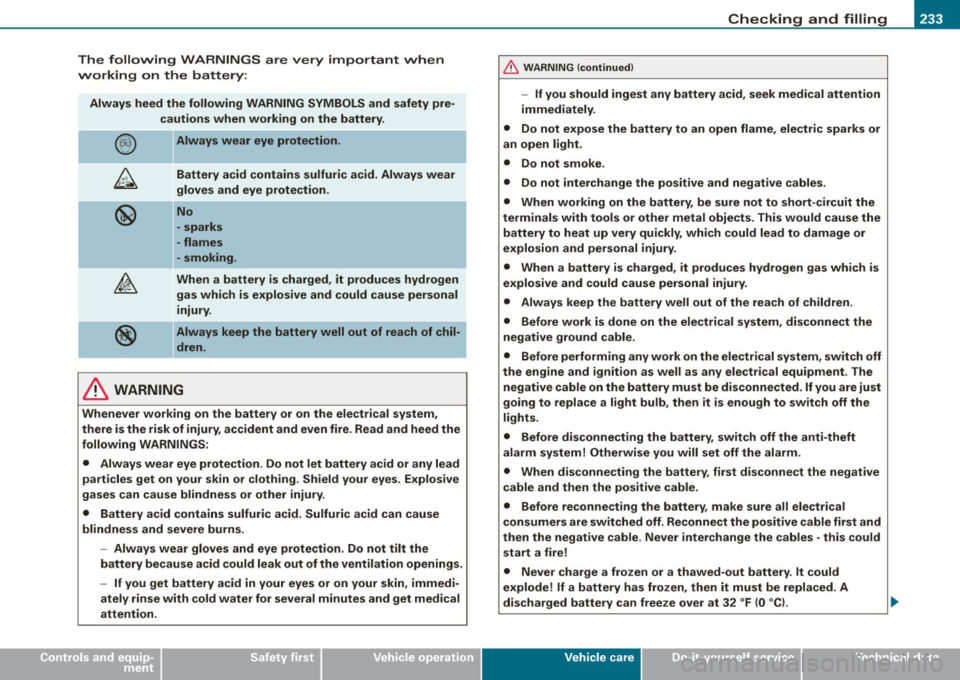
Always heed the following WARNING SYMBOLS and safety pre
cautions when working on the battery .
Always wear eye protection.
Battery acid contains sulfuric acid. Always wear
gloves and eye protection.
No
- sparks
- flames
- smoking.
When a battery is charged, it produces hydrogen
gas which is explosive and could cause personal
injury.
Always keep the battery well out of reach of chil
dren.
& WARNING
Whenever working on the battery or on the electrical system,
there is the risk of injury, accident and even fire. Read and heed the
following WARNINGS:
• Always wear eye protection. Do not let battery acid or any lead
particles get on your skin or clothing. Shield your eyes. Explosive
gases can cause blindness or other injury.
• Battery acid contains sulfuric acid. Sulfuric acid can cause
blindness and severe burns.
- Always wear gloves and eye protection. Do not tilt the
battery because acid could leak out of the ventilation openings.
- If you get battery acid in your eyes or on your skin, immedi
ately rinse with cold water for several minutes and get medical
attention.
& WARNING (continued)
-If you should ingest any battery acid, seek medical attention
immediately.
• Do not expose the battery to an open flame, electric sparks or
an open light.
• Do not smoke.
• Do not interchange the positive and negative cables .
• When working on the battery, be sure not to short -circuit the
terminals with tools or other metal objects. This would cause the battery to heat up very quickly, which could lead to damage or
explosion and personal injury.
• When a battery is charged, it produces hydrogen gas which is
explosive and could cause personal injury.
• Always keep the battery well out of the reach of children.
• Before work is done on the electrical system, disconnect the
negative ground cable.
• Before performing any work on the electrical system, switch off
the engine and ignition as well as any electrical equipment. The
negative cable on the battery must be disconnected.
If you are just
going to replace a light bulb, then it is enough to switch off the
lights.
• Before disconnecting the battery, switch off the anti-theft
alarm system! Otherwise you will set off the alarm.
• When disconnecting the battery, first disconnect the negative
cable and then the positive cable.
• Before reconnecting the battery, make sure all electrical
consumers are switched off. Reconnect the positive cable first and
then the negative cable . Never interchange the cables - this could
start a fire!
• Never charge a frozen or a thawed-out battery. It could
explode! If a battery has frozen, then it must be replaced. A
discharged battery can freeze over at 32 °F (0 °CI. .,,_
Vehicle care
I t •
Page 236 of 316
___ C_h_ e_ c_k _in --== g'-- a_n _d_ f_il _li _n ..:::g:::..- ___________________________________________ _
& WARNING (continued)
• Make sure the vent hose is always attached to the opening on
the side of the battery.
• Never use batteries which are damaged. Danger of explosion!
Always replace a damaged battery .
& WARNING
California Proposition 65 Warning :
• Battery posts, terminals and related accessories contain lead
and lead compounds, chemicals known to the State of California
to cause cancer and reproductive problems. Wash hands after
handling .
0 Note
• Do not disconnect the vehicle battery when the ignition is
switched on or when the engine is running, otherwise, you will
damage electronic components in the electrical system.
• When working on the engine, protect the battery housing from
ultraviolet (UV) rays by not parking the vehic le in direct sunlight.
• If your vehicle is going to stand for a long period of time without
being driven , protect the battery from "freezing", otherwise it will
be damaged and will then have to be replaced. •
Checking the battery acid level on magic eye
batteries*
The battery acid level in the battery can be checked
through the clear inspection window.
I
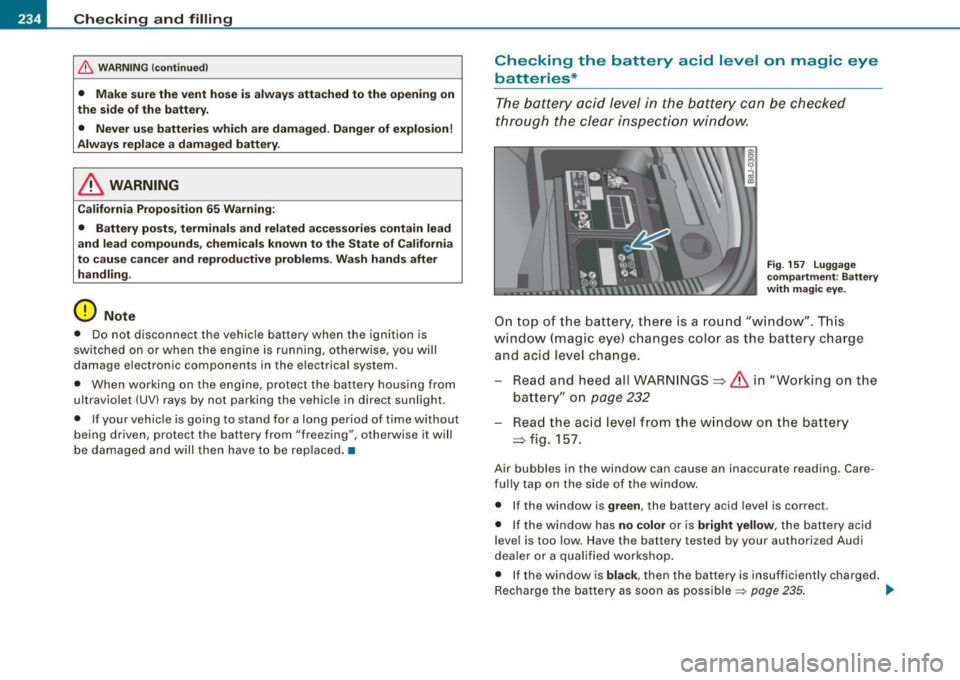
Fig. 157 Luggage
compartment : Battery
with magic eye.
On top of the battery, there is a round "window". This
window (magic eye) changes color as the battery charge
and acid level change.
- Read and heed all WARNINGS=>
& in "Working on the
battery" on
page 232
- Read the acid level from the window on the battery
=> fig. 157.
Air bubbles in the window can cause an inaccurate reading. Care
fully tap on the side of the window.
• If the window is
green, the battery acid level is correct.
• If the window has
no color or is bright yellow, the battery acid
level is too low. Have the battery tested by your authorized Audi
dealer or a qualified workshop.
• If the window is
black , then the battery is insufficiently charged.
Recharge the battery as soon as possible =>
page 235. ...