ignition AUDI TT ROADSTER 2008 Manual PDF
[x] Cancel search | Manufacturer: AUDI, Model Year: 2008, Model line: TT ROADSTER, Model: AUDI TT ROADSTER 2008Pages: 316, PDF Size: 70.1 MB
Page 171 of 316
_____________________________________________ C_ h _ il_d _S_ a _ fe_t.....: y'----""
& WARNING
If , in e xceptional circum sta n ce s, y ou mu st in stall a forward -fa cing
c hild re straint on the front pa ssenger' s seat:
• Always m ake sure the forw ard-f acing se at has b een de signed
and cert ified by it s manufa cturer for use on a front seat with a
p ass eng er fro nt and side airbag .
• Alwa ys follow the manufacturer' s instruc tion s provided with
the child s afet y seat or carrier .
• Alway s move the p assenger sea t into it s rearmo st po sition in
the seat's fore and aft adjustme nt r ange , as far a way from the
airbag as po ssible before in stalling the child restraint. The ba ck
rest must be adju sted to an upr ight p osition .
• Alway s m ake sure th at the PASSEN GER AIR BA G OFF l ight
c ome s on and stay s on all the time wheneve r the ignition is
s witched on. •
Advanced front airbag system and children
Your vehicle is equipped with a dual-stage front "Advanced Airbag
System" in comp liance with United States Federal Motor Vehicle
Safety Standard (F MVSS) 208 as applicab le at the t ime your vehic le
was manufactured .
The Advanced Airbag sys tem in yo ur vehicle has been cer tified to
meet the "low -risk" requirements for 3 and 6 year -old children on
the passenger side and small adults on the d river side. The low risk
deployment criteria are intended to reduce the risk of injury through
interaction with the airbag that can occur, for examp le, by being too
close to the steering wheel and instrument pane l when the airbag
inflates . In addition, the system has been certified to comp ly with
the "suppression" requirements of the Safety Standa rd, to turn off
the front airbag for infants up to 12 months who are restrained on
the front passenger sea t in child restraints that are listed in the
Standard .
Controls and equip
ment Safety first Vehicle operation
Even though your vehicle is equipped with an Advanced Airbag
system, a child should always ride in theseat pr operly restrained for
its age and size. The airbag on the passenger side makes the front
seat a potentially dangerous place for a child to ride. The front seat
is not the safest place for a child in a forward -facing child safety
seat . It can be a very dangerous p lace for an infant or a larger child
in a rearward -facing seat. •
Advanced Airbags and the weight -sensing
mat in the front seat
The Advanced A irbag System in your vehicle detects the presence
of an infan t or child in a chi ld rest rain t on the front passenger seat
using the weight -sensing mat in the seat cushion and the sensor
below the safety belt latch on the front passenger seat that
measures the tension on the sa fety belt.
The weight -sensing mat measures total weight of the child and the
child safety seat and a chi ld blanke t on the front passenger seat . The
weight on the front passenger seat is related to the design of the
child res tra int a nd i ts "footprin t", the size and shape o f the b ottom
of the child restraint as it sits on the seat . T he weight of a child
restra in t and its " footprint" va ry for different kinds of ch ild
restraints and for the different models of the same kind of chi ld
restraint offered by child restraint manufacturers .
The weight ranges for the ind ividual types, makes and models of
child restraints that the NHTSA has specified in the Safety Standard
t ogether with the weight ranges of typical infan ts and typica l 1 year
old chi ld have been stored in the control unit of the Advanced
Airbag Sys tem. When a child res traint is being used on the front
passenger seat with a typical 1 year-old chi ld, the Advanced Airbag
System compares the weight measured by the we ight sensing ma t
with the information stored in the e lectronic control unit.
The electronic contro l unit also registers the tension on the front
passenger safe ty bel t. The tension on the safety be lt for the front
passenger seat will be different for an adult who is properly using •
Vehicle care Do-it-yourself service Technical data
Page 173 of 316
Child Safety -
--------------------''---
& WARNING
To reduce the risk of serious injury, make sure that the PASSENGER
AIR BAG OFF light comes on and stays on whenever a child restraint is installed on the front passenger seat and the ignition
is switched on.
• Never install a rearward facing child safety seat on the front
passenger seat unless the PASSENGER AIR BAG OFF light comes
on and stays on. If the PASSENGER AIR BAG OFF light does not
come on and stay on the inflating airbag will hit the child safety
seat or infant carrier with great force and will smash the child
safety seat and child against the backrest, door or roof. Have the
airbag system inspected immediately by your Audi dealer.
[ i] Tips
The child seats listed in categories A to C have been tested by Audi
only for the Advanced Airbag function. •
Important safety instructions for
using child safety seats
Correct use of child safety seats substantially reduces the
risk of injury in an accident!
As the driver, you are responsible for the safety of every
body in the vehicle, especially children:
- Always use the right child safety seat for each child and
always use it properly ::::>
page 173.
-Always carefully follow the child safety seat manufac
turer's instructions on how to route the safety belt prop
erly through the child safety seat.
Controls and equip ment Safety first Vehicle operation
-
When using the vehicle safety belt to install a child safety
seat, you must first activate the convertible locking retractor on the safety belt to prevent the child safety
seat from moving ::::>
page 177.
-Push the child safety seat down with your full weight to
get the safety belt really tight so that the seat cannot
move forward or sideways more than one inch (2.5 cml.
Always remember: Even though your vehicle is equipped with an
Advanced Airbag system, a child should always ride in the seat
properly restrained for its age and size.
& WARNING
Not using a child safety seat, using the wrong child safety seat or
improperly installing a child restraint increases the risk of serious
personal injury and death.
• All vehicle occupants and especially children must always be
restrained properly whenever riding in a vehicle.
-An unrestrained or improperly restrained child can be injured
or killed by being thrown against the inside of the vehicle or by
being ejected from it during a sudden maneuver or impact.
- An unrestrained or improperly restrained child is at much
greater risk of injury or death by being struck by an inflating
airbag.
• Commercially available child safety seats are required to
comply with U.S. Federal Motor Vehicle Safety Standard (FMVSS)
213 (in Canada CMVSS 213).
- When buying a child restraint, select one that fits your child
and the vehicle.
- Only use child restraint systems that fully contact the flat
portion of the seat cushion. The child restraint must not tip or
lean to either side. Audi does not recommend using child safety
seats that rest on legs or tube-like frames. They do not provide
adequate contact with the seat. ..
Vehicle care Do-it-yourself service Technical data
Page 174 of 316
-Child Safety
---=-------------------
& WARNING
(continued )
-Always heed all legal requirements pertaining to the installa
tion and use of child safety seats and carefully follow the instructions provided by the manuf acturer of the seat you are
using.
• Never let more than one child occupy a child safety seat .
• Never let babies or older children ride in a vehicle while sitting
on the lap of another passenger.
-Holding a child in your arms is never a substitute for a child
restraint system.
- The strongest person could not hold the child with the forces
that exist in an accident . The child will strike the interior of the
vehi cle and can also be struck by the passenger.
- The child and the passenger can also injure each another in an accident .
• Never install a rearward facing child safety seat on the front
passenger seat unless the PASSENGER AIR BAG OFF light comes
on and stays on. If the PASSENGER AIR BAG OFF light does not
come on and stay on the inflating airbag will hit the child safety
seat or infant carrier with great force and will smash the child
safety seat and child against the backrest , door or roof . Have the
airbag system inspected immediately by your Audi dealer.
• Forward-facing child safety seats installed on the front
passenger's seat can interfere with the airbag when it inflates and
cause serious injury to the child .
• If exceptional circumstances require the use of a forward
facing child restraint on the front passenger's seat , the child's
safety and well-being require that the following special precau
tions be taken :
- Make sure the forward -facing seat has been designed and
certified by its manufacturer for use on a front seat with a
passenger front and side airbag.
- Always carefully follow the manufacturer's instruct ions
provided with the child safety seat or carrier.
& WARNING (continued)
- Always move the front passenger seat into the rearmost
position of the passenger seat's fore and aft adjustment range ,
and as far away from the airbag as possible before installing
the child restraint .
- Always make sure that nothing prevents the front
passenger's seat from being moved to the rea rmost position in
its fore and aft adjustment range .
- Always make sure that the backrest is in the upright posi
tion.
• Always buckle the child safety seat firmly in pla ce even if a
child is not sitting in it . A loose child safety seat can fly around
during a sudden stop or in a collision .
• Always read and heed all WARNINGS whenever using a child
restrained in a vehicle is being used=>
page 137 , "Safety belts ",
=>
page 146, "Airbag system" and=> page 168 , "Child Safety".
& WARNING
To reduce the risk of serious injury , make sure that the PASSENGER
AIR BAG OFF light comes on and stays on whenever a child
restraint is installed on the front passenger seat and the ignition
is switched on .
• Never install a rearward facing child safety seat on the front
passenger seat unless the PASSENGER AIR BAG OFF light comes
on and stays on . If the PASSENGER AIR BAG OFF light does not
come on and stay on the inflating airbag will hit the child safety
seat or infant carrier with great force and will smash the child
safety seat and child against the backrest, door or roof. Have the
airbag system inspected immediately by your Audi dealer. •
Page 177 of 316
& WARNING !continued)
• Always follow the manufacturer's instructions provided with
the child safety seat or carrier.
• Always move the front passenger seat into the rearmost posi
tion of the passenger seat's fore and aft adjustment range, and as
far away from the airbag as possible before installing the child
restraint.
• Always make sure that nothing prevents the front passenger's
seat from being moved to the rearmost position in its fore and aft
adjustment range.
• Always make sure the backrest is in an upright position.
• Make sure that the PASSENGER AIR BAG OFF light comes on
and stays on all the time whenever the ignition is switched on.
• If the light does not stay on, perform the checks~
page 157,
uMonitoring the Advanced Airbag System".
• If the PASSENGER AIR BAG OFF light does not come on and stay
on have the airbag system inspected immediately by your Audi
dealer. •
Safety first
Child Safety
Booster seats
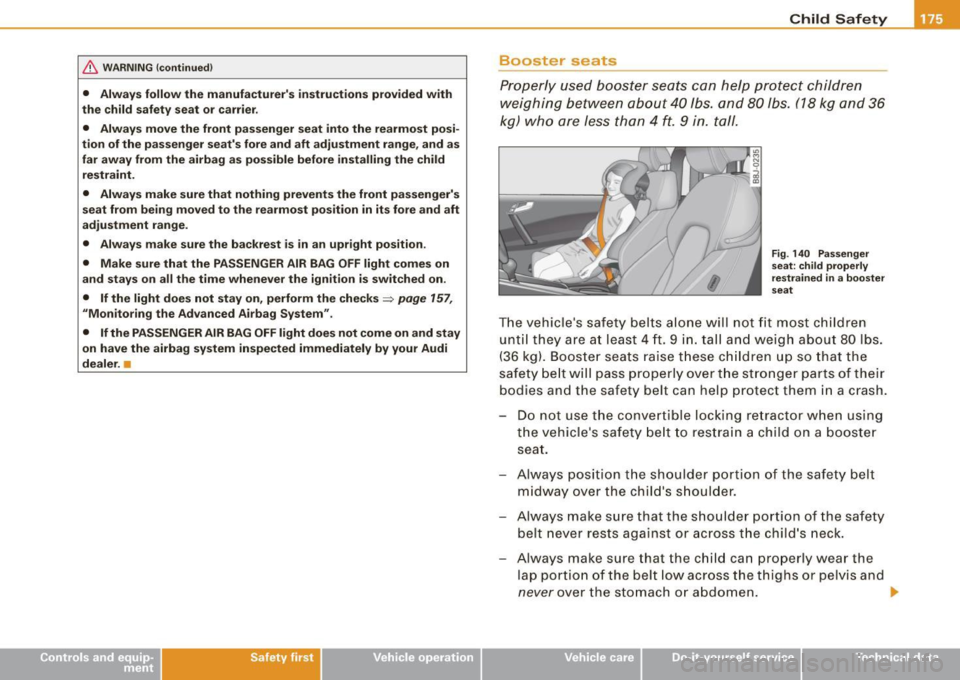
Properly used booster seats can help protect children
weighing between about 40 lbs. and 80 lbs. (18 kg and 36
kg) who are less than
4 ft. 9 in. tall.
II
Fig . 140 Passenger
seat: child properly
restrained
in a booster
seat
The vehicle 's safety belts alone will not fit most children
until they are at least
4 ft. 9 in. tall and weigh about 80 lbs.
(36 kg). Booster seats raise these children up so that the
safety belt will pass properly over the stronger parts of their bodies and the safety belt can help protect them in a crash .
- Do not use the convertible locking retractor when using
the vehic le 's safety belt to restrain a child on a booster
seat.
- Always posit ion the shoulder portion of the safety belt
midway over the child's shoulder.
- Always make sure that the shoulder port ion of the safety
belt never rests against or across the child's neck .
- Always make sure that the child can properly wear the
lap portion of the belt low across the thighs or pelvis and
never over the stomach or abdomen. •
Vehicle care I I irechnical data
Page 178 of 316
___ C_h_ i_ ld _ S_ a_ f_ e_ t_y ____________________________________________ _
Children up to about 40 lbs (18 kg) are best protected in child safety
seats designed for their age and weigh t. Experts say that t he skel
eta l structure, part icularly the pelv is, of these ch ildren is not fully
developed, and they s hou ld not use the vehicle sa fe ty be lts
::::>fig .140 .
Children who weigh more than 40 lbs . (1 8 kg) may generally use the
available three point combinat ion lap and shou lder belts when t hey
sit on an appropriate booster seat. Be sure the booster seat meets
all applicable safety sta ndards .
Booster seats raise the seating position of the ch ild and reposition
both the lap and s hou lder par ts of t he safety belt so tha t they pass
across the c hild's body in the right places. The routing o f the belt
over the child's body is very important for the child 's p rotection.
This app lies whenever a ch ild uses the vehicle's safety bel ts, even
when the child is big enough to use them without a booster seat.
In a crash, air bags must inflate with in a blink o f an eye and with
considerable force . In order to do its job, the airbag needs room to
inf late so tha t it wi ll b e there to pr otec t th e occ up ant as the occu
pant moves forward into the airbag .
A vehic le occupant including a child who is out of position and too
close to the airbag ge ts in the way of an inflati ng airbag. When an
occupant is too close , he or she will be struck vio lent ly and will
receive serious or p ossi bly eve n fatal injury.
In order for the airbag to offer protect ion , it is important that all
veh ic le occupan ts, especia lly any c hild ren, who mu st be in the fron t
seat in exceptional circumstances , be properly restrained and as far
away from the airbag as possible. By keeping room between the
child's or othe r occupant's body and the front of the passenger
compartment, the airbag can inflate fully and comp letely and
provid e supp lemental pro tec tion in cer tain fro ntal crashes.
& WARNING
Not using a booster seat , using the booster seat improperly , incor
rectly installing a booster seat or using the vehicle s afety belt
& WARNING (continued )
improperly in creases the r isk of serious personal injur y and death
in a collision or other emergency situation . To help reduce the risk
of ser ious p ersonal injury and /or death :
• Alway s make sure to position the shoulder portion of the three
point belt over the middle of child's shoulder .
• Never let the shoulder portion of the belt rest against or acro ss
the neck , face , chin , or throat of the child .
• Always make sure the lap belt portion of the three -point belt is
worn snug and passes as low as possible across the child's pelvis .
Never let the belt pass o ver the soft abdomen.
• Failure to properly route safety belts over a child's body will
cause severe injuries in an accident or other emergency situation
=> page 137 .
• Children on the front seat of any car , even with Advanced
Airbags, can be seriously injured or even killed when an airbag
inflates. A child in a rearward -facing child safety seat installed on
the front pa ssenger seat will be seriously injured and can be killed
if the front airb ag inflates .
• Never let a child stand or kneel on any seat , for example the
front seat .
• Never let a child ride in the cargo area of your vehicle .
• Alway s remembe r that a child leaning forward , sitting side
ways or out of po sition in any way during an accident can be
s truc k by a deploy ing airb ag. This will result in serious personal
injury or death .
• If you must install a rearward facing child safety seat on the
front passenger seat because of exceptional circumstances the PASSENGER AIR BAG OFF light must come on and stay on , when
ever the ignition is swit ched on .
• If the PASSENGER AIR BAG OFF light does not come on and st ay
on , perform the check s described =>
page 157, "Monitoring the
Advanced Airbag System ". .,_
Page 179 of 316
& WARNING !continued)
• If the PASSENGER AIR BAG OFF light does not come on and stay
on whenever the ignition is switched on the inflating airbag will
hit the child safety seat or infant carrier with great force and will
smash the child safety seat and child against the backrest, door or
roof. Have the airbag system inspected immediately by your Audi
dealer.
• Always read and heed all WARNINGS whenever using a child
restrained in a vehicle is being used=>
page 137, "Safety belts",
=>
page 146, "Airbag system" and=> page 168, "Important things
to know". •
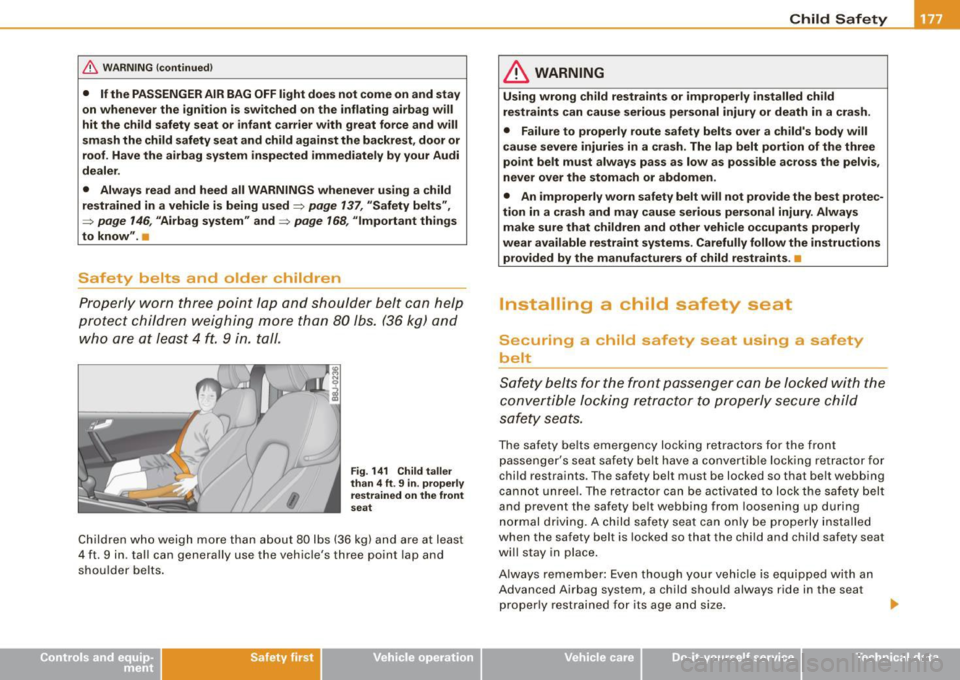
Safety belts and older children
Properly worn three point lap and shoulder belt can help
protect children weighing more than 80 lbs. (36 kg) and
who are at least 4 ft. 9 in. tall.
I
Fig. 141 Child taller
than 4 ft. 9 in. properly
restrained on the front
seat
Children who weigh more than about 80 lbs (36 kg) and are at least
4 ft . 9 in . tall can generally use the vehicle's three point lap and
shoulder belts.
Safety first
Child Safety
& WARNING
Using wrong child restraints or improperly installed child
restraints can cause serious personal injury or death in a crash.
• Failure to properly route safety belts over a child's body will
cause severe injuries in a crash. The lap belt portion of the three
point belt must always pass as low as possible across the pelvis,
never over the stomach or abdomen.
• An improperly worn safety belt will not provide the best protec
tion in a crash and may cause serious personal injury. Always
make sure that children and other vehicle occupants properly
wear available restraint systems. Carefully follow the instructions provided by the manufacturers of child restraints. •
Installing a child safety seat
Securing a child safety seat using a safety
belt
Safety belts for the front passenger can be locked with the
convertible locking retractor to properly secure child
safety seats.
The safety belts emergency locking retractors for the front
passenger's seat safety belt have a convertible locking retractor for
child restraints. The safety belt must be locked so that belt webbing
cannot unreel. The retractor can be activated to lock the safety belt
and prevent the safety belt webbing from loosening up during
normal driving. A child safety seat can only be properly installed
when the safety belt is locked so that the child and child safety seat
will stay in place.
Always remember: Even though your vehicle is equipped with an
Advanced Airbag system, a child should always ride in the seat properly restrained for its age and size. .,_
Vehicle care
I I irechnical data
Page 180 of 316
___ C_ h_ il_d _S_ a_f _e _ty ~----------------------------------------------
& WARNING
Improperly installed child safety seats increase the risk of serious
personal injury and death in a collision.
• Always make sure that the safety belt retractor is locked when
installing a child safety seat. An unlocked safety belt retractor
cannot hold the child safety seat in place during normal driving or
in a crash.
• Always buckle the child safety seat firmly in place even if a
child is not sitting in it. A loose child safety seat can fly around
during a sudden stop or in a collision
• The inflating airbag will hit the child safety seat or infant
carrier with great force and will smash the child safety seat and
child against the backrest, door or roof.
• Forward-facing child safety seats or infant carriers installed on
the front passenger's seat may interfere with the deployment of
the airbag and cause serious injury to the child .
• Always read and heed all WARNINGS whenever using a child
restrained in a vehicle is being used=>
page 168. Special precau
tions apply when installing a child safety seat on the front passenger seat=>
page 147, "Child restraints on the front seat -
some important things to know" .
& WARNING
Always take special precautions if you must install a forward or
rearward-facing child restraint on the front passenger's seat in
exceptional situations :
• Whenever a forward or rearward-facing child restraint is
installed on the front passenger seat , the PASSENGER AIR BAG
OFF light must come on and stay on whenever the ignition is
switched on.
• If the PASSENGER AIR BAG OFF light does not come on and stay
on , perform the checks described=>
page 157, ''Monitoring the
Advanced Airbag System".
& WARNING (continued)
• If the PASSENGER AIR BAG OFF light does not come on and stay
on whenever the ignition is switched on the inflating airbag will
hit the child safety seat or infant carrier with great force and will
smash the child safety seat and child against the backrest , door or
roof . Have the airbag system inspected immediately by your Audi
dealer.
• Improper installation of child restraints can reduce their effec
tiveness or even prevent them from providing any protection .
• An improperly installed child restraint can interfere with the
airbag as it deploys and seriously injure or even kill the child.
• Always carefully follow the manufacturer's instructions
provided with the child safety seat or carrier .
• Never place additional items on the seat that can increase the
total weight registered by the weight -sensing mat and can cause
injury in a crash .
in. WARNING
Forward-facing child restraints:
• Always make sure the forward-facing seat has been designed
and certified by its manufacturer for use on a front seat with a
passenger front and side airbag .
• Never put the forward-facing child restraint up , against or very
near the instrument panel.
• Always move the passenger seat into its rearmost position in
the seat's fore and aft adjustment range, as far away from the
airbag as possible before installing the forward -facing child
restraint. The backrest must be adjusted to an upright position.
• Make sure that the PASSENGER AIR BAG OFF light comes on
and stays on all the time whenever the ignition is switched on.
~
Page 181 of 316
_______________________________________________ C_h _ i_ld _ S_ a_ f_ e_ t..,:c y __ __
& WARNING
Rearward-facing child restraints:
• A child in a rearward-facing child safety seat installed on the
front passenger seat will be seriously injured and can be killed if
the front airbag inflates -even with an Advanced Airbag System.
• The inflating airbag will hit the child safety seat or infant
carrier with great force and will smash the child safety seat and
child against the backrest, door or roof.
• Always be especially careful if you must install a rearward
facing child safety seat on the front passenger seat in exceptional
circumstances.
• Make sure that the PASSENGER AIR BAG OFF light comes on
and stays on all the time whenever the ignition is switched on.
• Never install a rearward facing child safety seat on the front
passenger seat unless the PASSENGER AIR BAG OFF light comes
on and stays on. If the PASSENGER AIR BAG OFF light does not
come on and stay on have the airbag system inspected immedi
ately by your Audi dealer. •
Activating the convertible locking retractor
Use the convertible locking retractor to secure a child
restraint.
Always heed the child safety seat manufacturer's instruc
tions when installing a child restraint in your vehicle . To
activate the convertible locking retractor:
- Place the child restraint on a seat .
- Slowly pull the belt
all the way out.
- Route it around or through the child restraint belt path
~& -
Controls and equip
ment Safety first
Vehicle operation
-Push the child safety seat down with your full weight to
get the safety belt really tight.
- Insert the belt tongue into the buckle for that seating
position .
- Guide the safety belt back into the retractor unt il the belt
lies flat and snug on the child safety seat.
- You should hear a "clicking" noise as the belt winds back
into the inertia reel. Test the convertible locking retractor
by pul ling on the belt. You should no longer be able to
pull the belt out of the retractor. The convertible locking
retractor is now activated .
- Make sure that the red release button is facing away from
the child restraint so that it can be unbuckled quickly.
- Pull on the belt to make sure the safety belt is properly
tight and fastened so that the seat cannot move forward
or sideways more than one inch (2.5 cm).
& WARNING
Using the wrong child restraint or an improperly installed child
restraint can cause serious personal injury or death in a crash.
• Always make sure that the safety belt retractor is locked when
installing a child safety seat. An unlocked safety belt retractor
cannot hold the child safety seat in place during normal driving or
in a crash.
• Always buckle the child safety seat firmly in place even if a
child is not sitting in it. A loose child safety seat can fly around
during a sudden stop or in a crash.
• Always make sure the seat backrest to which the child restraint
is installed is in an upright position. Otherwise, the seat back with
the child safety seat attached to it could fly forward in the event of
an accident or other emergency situation. ..,
Vehicle care Do-it-yourself service Technical data
Page 197 of 316
one half. Never drive faster than the posted speed limit and weather
conditi ons permit. •
Reducing unnecessary Idling
Even when your car is just idling it burns up fuel.
- Shut the eng ine off when you are not driving the vehicle .
- Do not warm up the vehicle by letting the eng ine run at
idle.
I t makes sense to shut off the engine in traffic jams, when waiting
for trains to pass at railroad crossings, or at traffic lights that have long waits on red. Turning the engine off for just 30 -40 seconds
saves more fue l than is burned s tarting the engine again .
It takes a long time for the engine to warm up fully when it is
running at idle . However, wear and noxious emissions a re especial ly
high when the engine is warming up . So you should drive away as
soon as you start the engine and avoid running at high RPMs whi le
the engine is stil l warming up .
0 Note
Do not leave engine idling unattended after starting . If warning
lights should come on to indicate improper operation, they would
go unheeded. Extended idl ing also produces heat, wh ich cou ld
result in overheating or other damage to the vehicle or other
property .•
Regular maintenance
A badly tuned en gine unnecessarily wastes a lot of fuel.
- Have your v ehicl e serv ice d at reg ular intervals.
Controls and equip
ment Safety first Vehicle operation
Dri
ving and environm ent
By having your vehicle regularly serviced by an Audi dea ler helps to
ensure that i t runs properly and economically . The conditio n of your
vehic le not only affects its safety and abi lity to hold its va lue, it also
affects
fuel consumption .
Check your oil each time you fill your tank.
The amount of oil used is related to engine load and speed .
I t is normal for the oi l consumption of a new eng ine to reach its
lowest va lue after a certain mi leage has been driven.
You must drive your vehicle about 3,000 miles (5,000 kilometres) be fore you can proper ly assess o il consumpt ion.
This also applies to fuel consumption and engine output .
0 Note
• Have your vehicle maintained properly and in accordance with
t he service recommendations in your Main tenance
& Warranty
booklet. Lack of proper ma intenance as well as improper use of the
vehicle wi ll impair the function of the emission control system and
cou ld lead to da mage.
• Do not alter or remove any component of the Emission Contro l
System unless approved by the manufacturer .
• Do no t al te r or remove any device, such as heat shields,
switches, ignition wires, valves, which are designed to protect your
veh ic le' s Emission Control System and o ther i mportant vehicle
components. •
Fewer short trips
Fu el consu mption will alwa ys be relatively high on shor t
trips.
- Try to avo id driving short dista nce s wi th a cold engine.
Vehicle care Do-it-yourself service Technical data
Page 214 of 316
-Cleaning and prot
ection
-~--------------
Safety belts
Only well-maintained safety belts work reliably when
needed.
H eavily soiled safety be lts may no t retract properly.
- Keep belts c lean.
- For clean ing, use a mild soa p an d wa ter so luti on. Let
belts dry thoroughly and away from d irect sunlight.
- D o not allo w inertia reel safe ty belts to retra ct before
they are com pletely dry .
- Check the condition of your safety belts
regularly .
& WARNING
Damaged safety belt s can break in a crash .
• Anything that might damage your safety belts could mean that
y ou and yo ur pas senger s would not be adequatel y prote cted in an
accident .
• Safety belt performance depend s on correct in stallation . Never
remove belt s from the vehicle to clean them.
• Do not u se chemi cal cleaning agents , blea ch or dyes . They h ave
c orrosive propertie s wh ich weaken the webbing.
• When cleaning your safety belts , in spect them for dam age . If
you discover damage, see your Audi dealer .
• Alway s read and heed all WARNINGS and the infor mation
=> page 200 . •
Engine compartment
Be es pecially caref ul when cle aning the engine compart
ment.
Alwa ys swit ch off the ignition before cle aning the engine => & .
Plenum pan el
Remove leaves from the plenum pane l in front of the w indshield
under the engine hood. This prevents the water drain holes from
becoming blocked, and it prevents debris from entering the vehicle
inter ior through the heating and ventilation ducts.
Corrosion protection
The engine compartment and transmission have been corrosion
pro tected at the factory.
Good anti -co rros io n treatment is very important, particularly in the
winter. If the vehicle is frequent ly driven on salt treated roads, the
enti re eng ine compartmen t and p lenum panel should be thor
oughly cleaned at the end of winter and retreated to prevent salt
damage . At the same time, the unde rside o f the vehicle shou ld be
washed as we ll.
I f the engine compartment is cleaned at any time with grease
removing solut ions
ll, or if you have the engine washed, the anti
corrosion treatment is almost a lways removed as well. It is therefore
essential to have a long-lasting corrosio n pro tec tion reapp lied to a ll
surfaces, seams, joints and components in the engine compart
ment .
& WARNING
Be awa re: Th e engine comp artment of any motor vehicle is a
potentially hazardou s area .
• Befo re working in the eng ine compartme nt, be sure to read the
i nformat ion =>
page 212 . .,.
11 Use on ly the correct cleaning so lutions. Never use gasol ine or diesel fuel.