warning AUDI TT ROADSTER 2008 Owners Manual
[x] Cancel search | Manufacturer: AUDI, Model Year: 2008, Model line: TT ROADSTER, Model: AUDI TT ROADSTER 2008Pages: 316, PDF Size: 70.1 MB
Page 236 of 316
___ C_h_ e_ c_k _in --== g'-- a_n _d_ f_il _li _n ..:::g:::..- ___________________________________________ _
& WARNING (continued)
• Make sure the vent hose is always attached to the opening on
the side of the battery.
• Never use batteries which are damaged. Danger of explosion!
Always replace a damaged battery .
& WARNING
California Proposition 65 Warning :
• Battery posts, terminals and related accessories contain lead
and lead compounds, chemicals known to the State of California
to cause cancer and reproductive problems. Wash hands after
handling .
0 Note
• Do not disconnect the vehicle battery when the ignition is
switched on or when the engine is running, otherwise, you will
damage electronic components in the electrical system.
• When working on the engine, protect the battery housing from
ultraviolet (UV) rays by not parking the vehic le in direct sunlight.
• If your vehicle is going to stand for a long period of time without
being driven , protect the battery from "freezing", otherwise it will
be damaged and will then have to be replaced. •
Checking the battery acid level on magic eye
batteries*
The battery acid level in the battery can be checked
through the clear inspection window.
I
Fig. 157 Luggage
compartment : Battery
with magic eye.
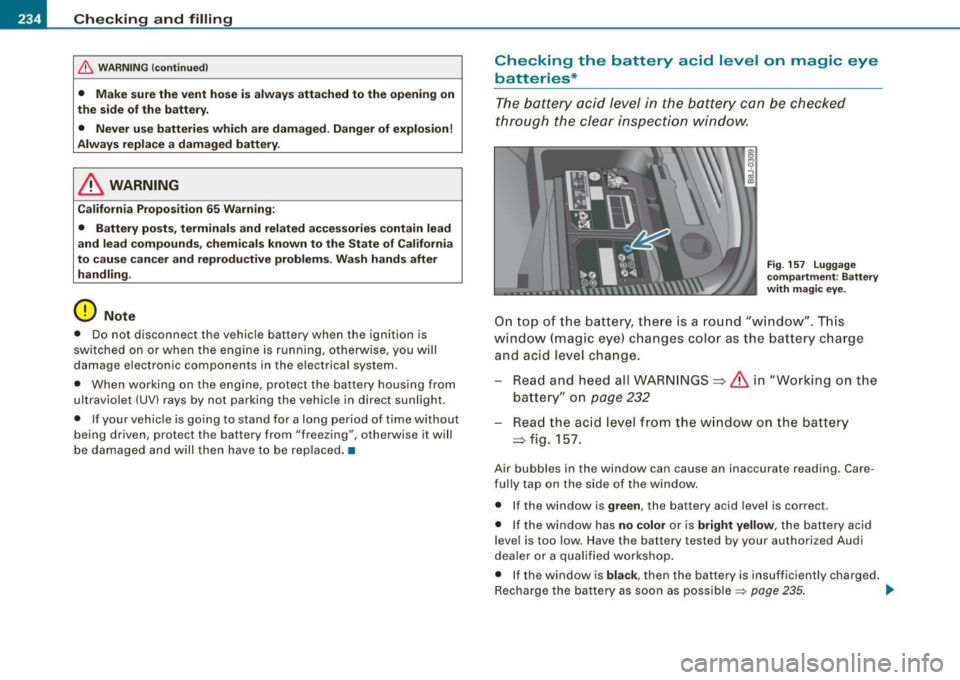
On top of the battery, there is a round "window". This
window (magic eye) changes color as the battery charge
and acid level change.
- Read and heed all WARNINGS=>
& in "Working on the
battery" on
page 232
- Read the acid level from the window on the battery
=> fig. 157.
Air bubbles in the window can cause an inaccurate reading. Care
fully tap on the side of the window.
• If the window is
green, the battery acid level is correct.
• If the window has
no color or is bright yellow, the battery acid
level is too low. Have the battery tested by your authorized Audi
dealer or a qualified workshop.
• If the window is
black , then the battery is insufficiently charged.
Recharge the battery as soon as possible =>
page 235. ...
Page 237 of 316
Checking and filling -
------------- --------=----" =---------
0 Note
Do not overfill the battery, otherwise battery acid will overflow
through the vent opening. This can damage the paint and cause
corrosion. •
Checking the battery acid level on
conventional batteries *
The acid level of a conventional battery can be checked
visually.
Fig. 158 Battery : Elec
trolyte level
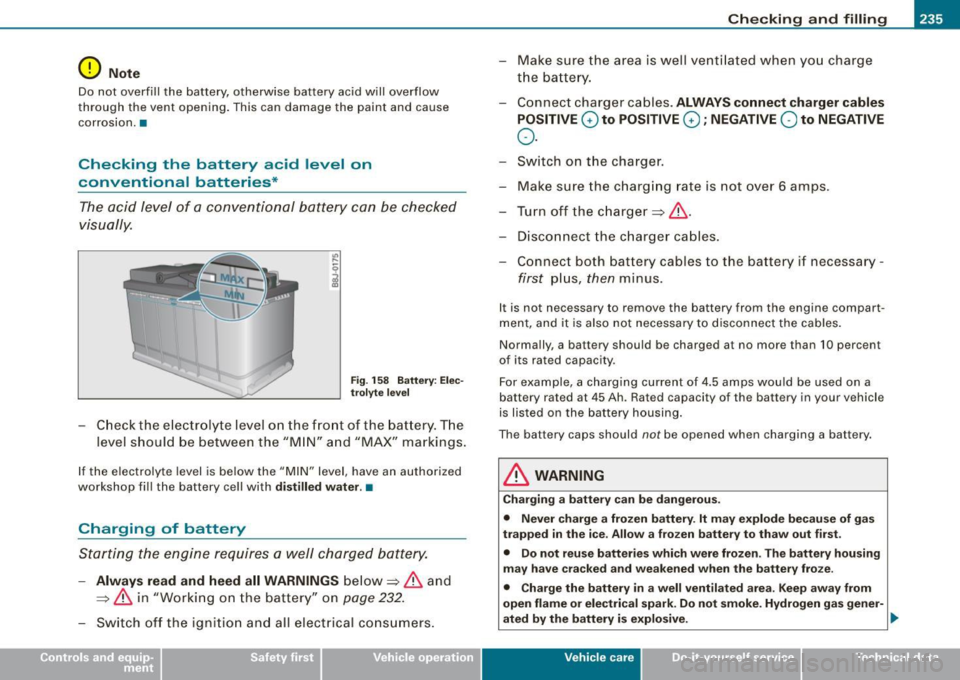
-Check the electrolyte level on the front of the battery. The
level should be between the "MIN" and "MAX" markings.
If the electrolyte level is below the "MIN" level, have an authorized
workshop fill the battery cell with
distilled water.•
Charging of battery
Starting the engine requires a well charged battery.
-Always read and heed all WARNINGS below => & and
=> & in "Working on the battery" on
page 232.
- Switch off the ignition and all electrical consumers. - Make sure
the area is well ventilated when you charge
the battery.
- Connect charger cables.
ALWAYS connect charger cables
POSITIVE
(v to POSITIVE (v ; NEGATIVE Q to NEGATIVE
o.
- Switch on the charger.
- Make sure the charging rate is not over 6 amps.
- Turn off the charger=>&.
- Disconnect the charger cables.
- Connect both battery cables to the battery if necessary -
first plus, then minus.
It is not necessary to remove the battery from th e engine compart
ment, and it is also not necessary to disconnect the cables.
Normally, a battery should be charged at no more than 10 percent
of its rated capacity .
For example, a charging current of 4.5 amps would be used on a
battery rated at 45 Ah. Rated capacity of the battery in your vehicle
is listed on the battery housing.
The battery caps should
not be opened when charging a battery.
& WARNING
Charging a battery can be dangerous.
• Never charge a frozen battery. It may explode because of gas
trapped in the ice . Allow a frozen battery to thaw out first.
• Do not reuse batteries which were frozen. The battery housing
may have cracked and weakened when the battery froze .
• Charge the battery in a well ventilated area. Keep away from
open flame or electrical spark. Do not smoke. Hydrogen gas gener-
ated by the battery is explosive. .,_
Vehicle care I I irechnical data
Page 238 of 316
___ C_h_ e_ c_k _in --== g'-- a_n _d_ f_il _li _n ..:::g:::..- ___________________________________________ _
& WARNING (continued)
• To reduce the danger of explosion, never connect or disconnect
charger cables while the charger is operating.
• Fast charging a battery is dangerous and should only be
attempted by a competent technician with the proper equipment.
• Battery acid that may spill during charging should be washed
off with a solution of warm water and baking soda to neutralize
the acid.
0 Note
Never use a fast charger as a booster to start the engine. This will
seriously damage sensitive electronic components , such as control
units, relays, radio, etc., as well as the battery charger.
[ i ] Tips
The vehicle battery must not be charged with a standard small
charger that plugs into the cigarette lighter or outlet .•
Windshield /headlight washer
container
Using plain water is not adequate for filling the wind
shield washer system and the headlight washer system*.
Fig . 159 Fender, left:
Windshield washer
fluid reservoir
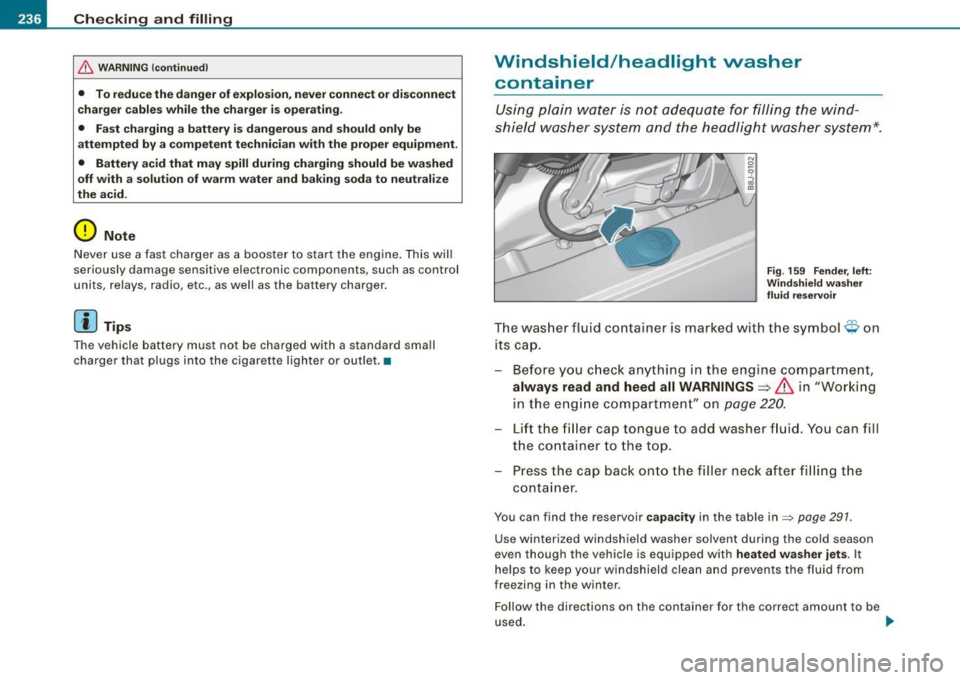
The washer fluid container is marked with the symbol e.;. on
its cap.
- Before you check anything in the engine compartment,
always read and heed all WARNINGS=> & in "Working
in the engine compartment" on
page 220.
-Lift the filler cap tongue to add washer fluid. You can fill
the container to the top.
- Press the cap back onto the filler neck after filling the
container .
You can find the reservoir capacity in the table in~ page 291.
Use winterized windshield washer solvent during the cold season
even though the vehicle is equipped with heated washer jets. It
helps to keep your windshield clean and prevents the fluid from
freezing in the winter.
Follow the directions on the container for the correct amount to be
used.
~
Page 240 of 316
-~_T_ ir_e_ s_ a_ n_d _ w_ h_ e_e _l_s _________________________________________________ _
Tires and wheels
Tires
General notes
Tires may be the least appreciated and most abused parts
of a motor vehicle.
Tires may be the least appreciated and most abused parts of a
motor vehicle. Tires are, however, one of the most important parts
of a vehicle, particu larly considering the comparatively small patch
of rubber on each tire that assures that all -important contact
between you, your vehic le and the road.
Maintaining the correct tire pressure, making sure that your vehicle
and its tires do not have to carry more weight than they can safely
handle, avoiding damage from road hazards and regularly inspecting tires for damage inc luding cuts, s lashes irregular wear
and overa ll condition are the most important things that you can do
to help avoid sudden tire failure including tread separation and
blowouts.
A vo iding d am age
If you have to drive over a curb or similar obstac le, drive very slowly
and as close as possible at a right angle to the curb.
A lways keep chemica ls including grease, oi l, gaso line and brake
fluid off the tires.
Inspect the ti res regu larly for damage (cuts, cracks or b listers, etc.l .
Remove any foreign bodies embedded in the treads.
Storing tir es
Mark tires when you remove them to indicate the direction of rota
t ion. This ensures you to be able to mount them correctly when you
reinstal l them. When removed, the wheels or tires shou
ld be stored in a coo l, dry
and preferably dark place.
S tore tires in a vertical pos it ion if they a re not mounted on r ims, in
a horizonta l position if they are mounted on rims.
New tir es
New tires have to be broken in=>&.
The tread depth of new ti res may vary, according to the type and
make of tire and the tread pattern.
H idd en damage
Damage to tires and rims is often not readily visible. If you notice
unusual vibration or the vehicle pu lls to one s ide, this may indicate
that one of the tires has been damaged . The tires must be checked
immediately by an authorized Audi dealer or qualified workshop .
Unidire cti ona l t ires
A unidirectional tire can be identif ied by arrows on the sidewa ll, that
point in the direction the tire is designed to rotate . You must fo llow
t he specified directio n of rotation . This is necessary s o that these
tires can develop their optimum characteristics regarding grip, road noise, wear and hydrop laning resistance . For more information
=>
page 272.
& WARNING
New t ires o r ti re s th at a re old , worn or d am aged cann ot pro vid e
maximum cont rol and braking ability .
• New tires te nd to be slippery and mu st be bro ken in . To redu ce
the ri sk o f lo sin g co ntro l, a collis ion and serious per sonal injurie s,
dri ve w ith special care f or the fi rst 350 m ile s ( 560 km l.
• Driving w ith w orn or damaged tire s can lead to lo ss of control ,
sudd en tir e fa ilure , inc ludi ng a blowout a nd sudden defl atio n, ..,_
Page 243 of 316
__________________________________________________ T_ ir_e_ s_ a_ n_d _ w_ h_ e_ e_l_s __ _
•
Sidewa ll
means that portion of a tire between the tread and bead.
Speed ra ting
extended periods of time. The ratings range from 93 mph (150 km/h)
t o 186 mph (298 km/h) =>
page 251. You may not find this informa
tion on all tires because it is not required by law.
The speed rating letter code, where applicab le, is molded on the tire
sidewa ll and indicates the maximum perm issible road speeds=>
&
in "Winter tires" on page 254.
T ire pre ssu re m on it o rin g syste m
means a system that detects when one or more of a vehicle's tires
are under inflated and illuminates a low tire pressure warning tell
tale.
Tre ad
means that portion of a tire that comes into contact with the road .
Tread sepa ra ti on
means pu lling away of the tread from the tire carcass.
Tr ea dw ear indi cato rs ( TW I)
means the projections with in the principal grooves designed to give
a visual indication of the degrees of wear of the tread . See
~ page 248, "Tread Wear Indicator (TWI)" for more information on
measuring tire wear.
U ni form Tire Q ua lity G radin g
is a tire information system developed by the United States National
Highway Traffic Safety Administration (N HTSA) that is designed to
help buyers make re lative comparisons among tires. The UTQG is
not a safety rating and not a guarantee that a tire will last for a
prescribed number of miles or perform in a certain way. It simply
gives tire buyers additiona l information to combine with other
considerations, such as price, brand loya lty and dealer recommen- dations
. Under UTQG, tires are graded by the tire manufacturers in
three areas : treadwear, trac tion and temperature resistance. The
U TQG information on the tires, molded into the sidewalls.
U .S . DOT Tire Identifi cation Number (TIN )
This is the tire's "serial number" It begins with the letters "DOT" and
indicates that the ti re meets a ll federa l standards. The next two
numbers or letters indicate the plant where it was manufactured,
and the last four numbers represent the week a nd year of manufac
ture . For example,
DOT ... 2207 ...
means that the tire was produced in the 22t h week of 2007. The
other numbers are marketing codes that may or may not be used by
t he tire manufacturer. This information is used to contact
consumers if a tire defect requires a recall.
Vehi cle cap acity we ight
means the rated cargo and luggage load plus 150 lbs. (68 kilograms)
times the vehicle's tota l seating capacity as l is ted on the label
located on the driver's side B -pi llar.
V eh icle maximum load on the tire
means that load on an individual tire that is determined by distrib
uting to each ax le its share of the max imum loaded vehicle weight
and dividing by two.
Ve hic le normal lo ad on the tire
means that load on an individual tire that is determined by distrib
uting to each ax le its share of the curb weight, accessory we ight,
and normal occupant weight (distributed in accordance with tab le
below =>
page 242) and dividing by two . ._
Vehicle care I t •
Page 246 of 316
-~_T_ ir_e_ s_ a_ n_d _ w_ h_ e_e _l_s _________________________________________________ _
vehicle with different rims/tires or you bought the vehicle as a previ
ously owned vehicle.
Remember, your safety and that of your passengers also depends
on making sure that load limits are not exceeded. Vehicle load
includes everybody and everything in and on the vehicle. These load
limits are technically referred to as the vehicle's Gross Vehicle
Weight Rating ("GVWR"). The Gross Axle Weight Rating ("GAWR") is
the maximum load that can be applied at each of the vehicle's two
axles. The Gross Vehicle Weight Rating and the Gross Axle Weight
Rating are listed on the safety compliance sticker label located on
the driver's side 8-pillar. The tire pressure label on your Audi lists
the maximum combined weight of all of the occupants and luggage or other cargo that the vehicle can carry. For the location of the tire
pressure label =>
page 242, fig. 160.
& WARNING
Overloading a vehicle can cause loss of vehicle control, a crash or
other accident, serious personal injury, and even death.
• Carrying more weight than your vehicle was designed to carry
will prevent the vehicle from handling properly and increase the risk of a loss of vehicle control.
• The brakes on a vehicle that has been overloaded may not be
able to stop the vehicle within a safe distance.
• Tires on a vehicle that has been overloaded can fail suddenly
causing loss of control and a crash.
& WARNING
• Incorrect tire pressures and/or underinflation can lead to a
serious or fatal accident.
• Incorrect tire pressures and/or underinflation cause increased
tire wear and can affect the handling of the vehicle.
& WARNING (continued)
• Incorrect tire pressures and/or underinflation can also lead to
sudden tire failure, including a blowout and sudden deflation,
causing loss of vehicle control . •
Checking tire pressure
The correct tire pressure for the tires originally installed
on your vehicle is listed on the tire pressure label located
on driver's side 8-pillar.
The recommended tire pressures are on the tire pressure label and
in the table=>
page 242, "Cold tire inflation pressure". This means
that the pressure must be checked and adjusted when the tire has
not been driven for more than a couple of miles (kilometers) at low
speeds during the previous three hours. Air in the tires expands
when the tire heats up as a result of internal friction as it flexes in
use. The tire pressure is higher when the tire has warmed up than
when it is "cold."
It is the inflation pressure in a "cold" tire that counts. Therefore, you
should never let air out of a warm tire to match "Cold tire inflation
pressure" recommendations=>
page 242. The tires would then be
underinflated and could fail suddenly.
The tire pressure label on your Audi lists the recommended cold tire
inflation pressures for the new, original equipment tires that were
on your vehicle at the time it was manufactured . For the location of
the label
=> page 242, fig . 160.
Most tires lose air naturally over time. They can also lose some air if
you drive over a pothole or hit a curb while parking . It is usually not
possible to see whether the radial tires used today are underinflated
just by looking at them .
Therefore, be sure to check tire pressures at least once a month and
always before going on a long trip. Make sure to take the number of
people and the amount of luggage into account when adjusting tire .,_
Page 247 of 316
________________________________________________ T_ i _r_e _s_ a_n_ d_ w_ h_ e_e _ l_s __ _
•
pressure for a trip - even one that you would not consider to be
"long." See=>
page 246, "Tires and vehicle load limits" for more
important information .
Always use an accurate tire pressure gauge when checking and adjus ting inflation pressures . Check all of the tires and be sure not
to forget the spare tire . If the pressure in any tire is too high when
the tire is "cold," let air out of the tire slowly with the edge of the tire gaug e and keep checking the pressur e until you reach the pressure
that is correct for the load (passengers and luggage) and kind of driving you plan to do.
I f the pressure in any tire is too low, note the difference between the
pressure in the cold tire and the pressure you need and add the air
that you need to reach the correct pressure for the vehicle load
(passengers and luggage) for the tires on your vehicle as listed on
the on your vehicle and in this manual and the kind of driving you
plan to do.
Ne ver e xceed the m aximum inflat ion pre ssure l isted on the tire
sid ewall for any rea son .
Remember that the veh ic le manufacturer, not the tire manufacturer ,
determin es the correct tire pressure for the tires on your vehicle .
It is important to check the tire pressure when the tires are cold .
• Read the required tire pressure from the tire pressure label
located on driver 's side 8 -pillar.
• T urn the va lve stem cap counter -clockwise to remove it from the
tire valve .
• Place the air pressure gauge on the valve .
• The tire pressures should only be checked and adjusted when
the tires are cold. The s lightly raised pressures of warm tir es mus t
not be reduced.
• Adjust the tire pressure to the load you are carrying .
• Reinstall the va lve stem cap on the valve .
When should I ch eck the tir e pr essu re?
The correct tire pressure is especially important a t high speeds . The
pressure should therefore be checked a t least once a month and
a lways before sta rting a journey.
Wh en sho uld I adjust the tire p re ss ure s?
Adjust the tire pressure to the load yo u are carrying . After changing
a wheel
o r replacing wheels you have to adjust the tire pressures on
a ll whee ls . In addition, you must then initia lize the new tire pres
sures in the tire pressure monitoring system=>
page 41.
& WARNING
Incorre ct t ir e pre ssures and /or underinfl ati on ca n lead sudden tire
failure , los s of contro l, colli sion , seriou s per sonal injury or even
death .
• Whe n the w arnin g sy mbol appear s in the instrument
cl uster , sto p and in spe ct the tire s.
• Inco rre ct tire pre ssure and /or underin flati on can cau se
in creased tire wear and can affe ct the ha ndling of the vehicle and
s topping ability.
• Incorre ct t ire pre ssures and /or underinfl atio n c an a ls o le ad to
s udden tire f ailure , including a blowout and sudden deflation ,
ca usi ng loss o f vehi cle co ntrol.
• The driv er i s re sp o nsible for the correct tire p re ss ure s for all
tire s on the vehicle . T he appl icable pre ssure v alu es are lo ca ted o n
a stic ker on th e driver 's side B -pillar.
• Onl y w hen all tire s on th e veh icle a re fi lled to the corre ct pre s
s ure , the tire pre ssure monitor ing sy ste m can work correctly .
• The u se of incorre ct t ire pr essure val ues can lead to accidents
or other d am age. The refo re it is esse ntial th at the dri ver ob serve
the spe cified tire pr essur e value s fo r the t ire s and the correc t pr es
s ures for the function of the tire pr essure monitoring sy stem.
• Always inflate t ires to the r ecom mended and corre ct tir e pr es -
su re bef ore dri ving off.
~
Vehicle care I t •
Page 248 of 316
-~_T_ ir_e_ s_ a_ n_d _ w_ h_ e_e _l_s _________________________________________________ _
& WARN ING (continued )
• Driving with underinflated tires bend more , letting them get
too hot re sulting in t read separation , sudden t ire failure and loss
of control.
• Excessive speed and /overloading can cau se heat bu ild-up ,
sudden tire failure and lo ss of control.
• If the tire pressure is too low or too high , the tires will wear
prematurely and the vehicle will not handle well .
• If the tire is not flat and you do not have to change a wheel
immediately, drive at reduced speed to the nearest service station
to che ck the tire pres sure and add air as required .
0 Note
Driving without valve stem caps can cause damage to the tire
va lves. To prevent this, always ma ke sure that fact ory insta lled valve
stem caps on all whee ls are securely mounted on the valve .
<£> For the sake of the environment
Underinflated tires will also increase the fue l consumption. •
Tires and vehicle load limits
There are limits to the amount of load or weight that any vehicle and
any tire can carry. A vehicle that is overloaded will not handle well
and is more difficu lt to stop. Overload ing can not only lead to loss
of vehicle contro l, but can a lso damage important parts of the
veh ic le an d ca n lead to sudden t ire fa ilu re , inc lud ing a bl owout a nd
sudden deflation that can cause the vehicle to crash.
Yo ur saf ety a nd that of you r passenge rs also de pends on making
sure that load limits are not exceeded . Vehicle load includes every
body and eve ryt hing in and on the vehic le . Th ese load limi ts are technica
lly referred to as the vehicle's
Gross Vehicle We ight Rating
("GVWR").
Th e "GVWR" includes the weight of the basic vehicle, all factory
insta lled accessories, a ful l tank of fuel, oil, coolant and other f luids
p lus max imum load. The ma ximu m load inc ludes the numbe r of
passengers that the vehicle is intended to carry ("seating capacity")
w it h an assu med we ight o f 150 lbs (68 kg) for eac h pass enger at a
designated seating position and the total weight of any luggage in
t he vehicle.
T he
Gross Axle Weight Rating ("GAWR"l is the maximum load that
can be a pplied a t eac h of the vehic le's two a xles .
T he Gross Veh icle Weigh t Rat ing a nd the Gross A xle We igh t R ating
are listed on the safety comp liance stic ker label located on the
dr iver's s ide B -p illar . You r Aud i has 2 sea ting pos it io n s. Eac h seating
posit ion has a safety belt=>
page 137, "Safety belts".
T he fact that the re is a n up per lim it to yo ur vehicle's G ross Veh ic le
We ig ht Rating means that the to tal we ight o f what ev e r is be ing
ca rried in the ve hicle is lim ited. The mo re pas se ngers in the vehic le
or passe ngers w ho ar e heav ier t han th e sta ndard weights assumed
mean that less weight can be carried as luggage.
T he ti re p ress ure labe l on yo ur Aud i al so list s the maxi mum
combined weight of a ll of the occupants and luggage or other cargo
th at the vehicle can car ry. F or the lo ca tio n of t he label =>
page 242,
fig . 160.
& WARNING
Overloading a vehicle can cause loss of vehicle control , a crash or
other accident, serious personal injury , and even death .
• Carrying more weight than your vehicle was des igned to carry
will prevent the vehicle from handling properly and increase the risk of the loss of vehi cle control .
• The brakes on a vehicle that has been overloaded may not be
able to stop the vehicle within a safe distance. .,_
Page 249 of 316
& WARNING (continued)
• Tires on a vehicle that has been overloaded can fail suddenly,
including a blowout and sudden deflation , causing loss of control
and a crash .•
Determining correct load limit
Use the example below to calculate the
total weight of the passengers and
luggage or other things that you plan to
transport so that you can make sure that
your vehicle will not be overloaded.
Steps for Determining Correct
Load Limit
1. Locate the statement "THE COMBINED
WEIGHT OF OCCUPANTS AND CARGO SHOULD NEVER EXCEED XXX KG OR XXX
LBS"on your vehicle 's placard (tire infla
tion pressure label)=;>
page 242, fig. 160.
2. Determine the combined weight of the driver and passengers that will be riding
in your vehicle.
Tires and wheels 1111111
3. Subtract the combined weight of the driver and passengers from
"XXX" kilo
grams or
"XXX" pounds shown on the
sticker =;>
page 242, fig. 160.
4. The resulting figure equals the available amount of cargo and luggage load
capacity. For example, if the
"XXX"
amount equals 1400 lbs. and there will be five 150 lbs. passengers in your
vehicle, the amount of available cargo and luggage load capacity is 650 lbs.
( 1400 -750 (5 x 150) = 650 I bs.)
5. Determine the combined weight of
luggage and cargo being loaded on the
vehicle. That weight may not safely exceed the available cargo and luggage
load ca pa city calculated in Step 4.
6. If your vehicle will be towing a trailer, load from your trailer will be transferred
to your vehicle. Consult this manual to determine how this reduces the avail
able cargo and luggage load capacity of
your vehicle. .,_
Vehicle care I • •
Page 251 of 316
__________________________________________________ T_ ir_e _ s_ a_ n _ d_ w_ h_ e_ e_ls _ ____. 111111
Unbalanced wheels must be rebalanced to avoid excessive wear on
steering, suspension and tires. A wheel must also be rebalanced
when a new tire is installed.
Incorrect wheel alignment
Incorr ect wheel alignment can cause excessive tire wear, impairing
the safety of the vehicle. If tires show excessive wear, have the
wheel alignment checked by an authorized Audi dealer or qualified
workshop.
All Wheel Drive
Vehicles with quattro ® must always have tires of the same size,
construction and tread type. For details see
=> page 191.
& WARNING
Sudden tire failure can lead to loss of control, a crash and serious
personal injury!
• Never drive a vehicle when the tread on any tire is worn down
to the wear indicators .
• Worn tires are a safety hazard, they do not grip well on wet
roads and increase your risk of "hydroplaning" and loss of control .
• Always keep chemicals that can cause tire damage, such as
grease, oil, gasoline and brake fluid away from tires .
• Tires age even if they are not being used and can fail suddenly,
especially at high speeds . Tires that are more than 6 years old can
only be used in an emergency and then with special care and at
lower speeds.
• Never mount used tires on your vehicle if you are not sure of
their "previous history ." Old used tires may have been damaged
even though the damage cannot be seen that can lead to sudden
tire failure and loss of vehicle control. •
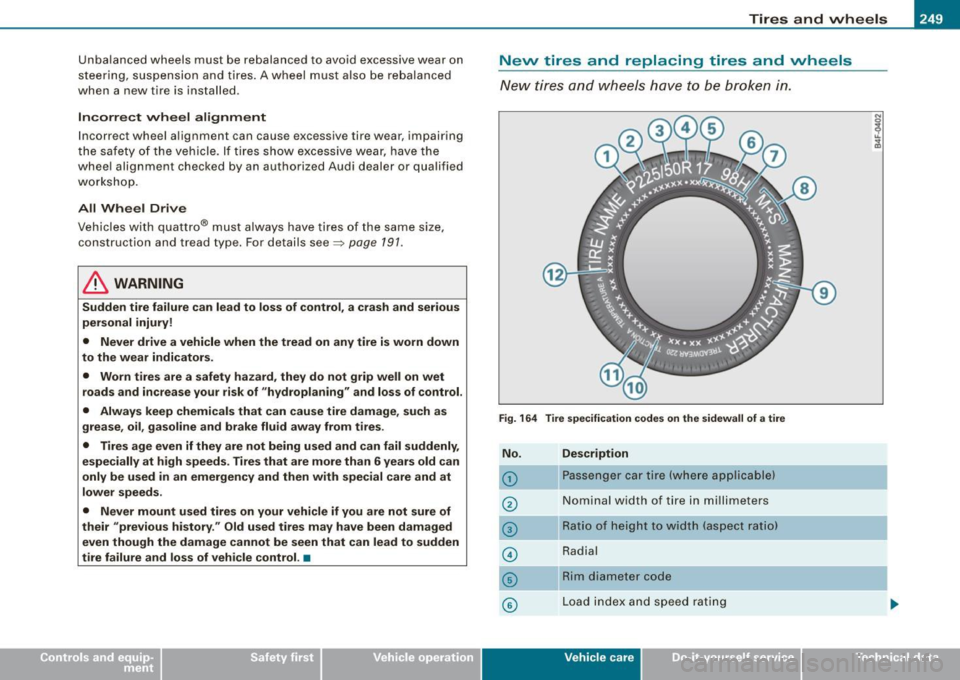
New tires and replacing tires and wheels
New tires and wheels have to be broken in.
Fig. 164 Tire specification codes on the sidewall of a tire
No.
©
0
©
©
©
©
Description
Passenger car tire (where app licable)
Nominal width of tire in mi llimeters
Ratio of height to width (aspect ratio)
Radial
ii Rim diameter code
Load index and speed rating
Vehic le care
I I irechnical data