change wheel AUDI TT ROADSTER 2008 User Guide
[x] Cancel search | Manufacturer: AUDI, Model Year: 2008, Model line: TT ROADSTER, Model: AUDI TT ROADSTER 2008Pages: 316, PDF Size: 70.1 MB
Page 248 of 316
-~_T_ ir_e_ s_ a_ n_d _ w_ h_ e_e _l_s _________________________________________________ _
& WARN ING (continued )
• Driving with underinflated tires bend more , letting them get
too hot re sulting in t read separation , sudden t ire failure and loss
of control.
• Excessive speed and /overloading can cau se heat bu ild-up ,
sudden tire failure and lo ss of control.
• If the tire pressure is too low or too high , the tires will wear
prematurely and the vehicle will not handle well .
• If the tire is not flat and you do not have to change a wheel
immediately, drive at reduced speed to the nearest service station
to che ck the tire pres sure and add air as required .
0 Note
Driving without valve stem caps can cause damage to the tire
va lves. To prevent this, always ma ke sure that fact ory insta lled valve
stem caps on all whee ls are securely mounted on the valve .
<£> For the sake of the environment
Underinflated tires will also increase the fue l consumption. •
Tires and vehicle load limits
There are limits to the amount of load or weight that any vehicle and
any tire can carry. A vehicle that is overloaded will not handle well
and is more difficu lt to stop. Overload ing can not only lead to loss
of vehicle contro l, but can a lso damage important parts of the
veh ic le an d ca n lead to sudden t ire fa ilu re , inc lud ing a bl owout a nd
sudden deflation that can cause the vehicle to crash.
Yo ur saf ety a nd that of you r passenge rs also de pends on making
sure that load limits are not exceeded . Vehicle load includes every
body and eve ryt hing in and on the vehic le . Th ese load limi ts are technica
lly referred to as the vehicle's
Gross Vehicle We ight Rating
("GVWR").
Th e "GVWR" includes the weight of the basic vehicle, all factory
insta lled accessories, a ful l tank of fuel, oil, coolant and other f luids
p lus max imum load. The ma ximu m load inc ludes the numbe r of
passengers that the vehicle is intended to carry ("seating capacity")
w it h an assu med we ight o f 150 lbs (68 kg) for eac h pass enger at a
designated seating position and the total weight of any luggage in
t he vehicle.
T he
Gross Axle Weight Rating ("GAWR"l is the maximum load that
can be a pplied a t eac h of the vehic le's two a xles .
T he Gross Veh icle Weigh t Rat ing a nd the Gross A xle We igh t R ating
are listed on the safety comp liance stic ker label located on the
dr iver's s ide B -p illar . You r Aud i has 2 sea ting pos it io n s. Eac h seating
posit ion has a safety belt=>
page 137, "Safety belts".
T he fact that the re is a n up per lim it to yo ur vehicle's G ross Veh ic le
We ig ht Rating means that the to tal we ight o f what ev e r is be ing
ca rried in the ve hicle is lim ited. The mo re pas se ngers in the vehic le
or passe ngers w ho ar e heav ier t han th e sta ndard weights assumed
mean that less weight can be carried as luggage.
T he ti re p ress ure labe l on yo ur Aud i al so list s the maxi mum
combined weight of a ll of the occupants and luggage or other cargo
th at the vehicle can car ry. F or the lo ca tio n of t he label =>
page 242,
fig . 160.
& WARNING
Overloading a vehicle can cause loss of vehicle control , a crash or
other accident, serious personal injury , and even death .
• Carrying more weight than your vehicle was des igned to carry
will prevent the vehicle from handling properly and increase the risk of the loss of vehi cle control .
• The brakes on a vehicle that has been overloaded may not be
able to stop the vehicle within a safe distance. .,_
Page 259 of 316
________________________________________________ T_ i _r_e _s_ a_n_ d_ w_ h_ e_e _ l_s __ !II
•
• After any impact, immediately inspect your tires or have them
inspected by the nearest authorized Audi dealer. Replace a
damaged tire as soon as possible .
• Inspect your tires every 2,000 miles (3,000 km) for damage and
wear . Damage is not always easy to see. Damage can lead to loss of
air and underinflation, which could eventua lly cause tire fai lure . If
you believe that a tire may have been damaged, replace the tire as
soon as possible .
• These tires may wear more quickly than others.
• Please a lso remember that, whi le these tires deliver responsive
handling, they may ride less comfortably and make more noise than
other choices.
R edu ced p erform an ce in w in te r/ c o ld sea son
co nditi ons
All tires are designed for certain purposes. The low aspect ratio,
ultra high performance tires originally installed on your vehicle are
intended for maximum dry and wet road performance and hand ling.
They are not suitable for cold, snowy or icy weather conditions . If
you drive under those circumstances, you should equip your vehicle
with al l- season or winter tires, which offer better traction under
those conditions . We suggest you use the recommended snow or
a ll- season tires specified for your vehicle, or their equivalent .
Refer to=>
page 254 for more detai led in formation regarding winter
tires. •
Run-flat tires
Applies to vehi cles : w ith R un-f lat tires
Introduction
Run-flat tires help keep you moving if a tire goes flat.
Reinforced s idewalls give the ti res run -flat capability if tire pressure
is lost . We recommend that run-flat tires only be mounted on vehicles that
we
re origina lly equipped with these special tires at the fac tory and
have a Tire Pressure Monitoring System .
Run-flat t ires can be ident ified by the letter s "RSC" on the tire side
wall.
If you do change the tires on your vehic le from normal to run -flat
tires, you must buy the special rims required for run-flat tires, and
the Tire Pressure Monitoring System must be reprogrammed by an
authorized Audi dea ler or other qualified workshop.
Wh at do run-fl at tir es do?
These special t ires have run-flat capabi lities that he lp keep you
moving if a tire loses pressure and goes flat. Under favorable condi
t ions tires can be driven
at least 30 miles (50 km ), but you must not
drive
f as ter t han 50 mph (80 km/h i=> page 258 , "Driving with run
flat t ires".
The Tire Pressure Moni toring System constantly checks the air pres
sure in the tires. If the run -flat system is active (shown in the center
display), you must inspect the affected tire or tires and then decide
whether to continue driving . Be sure to follow these tips
=>
page 258, "Driving with run-flat tires" .
When it is not po ssibl e to continue driving , even with
run -fl at tire s?
• If the Electronic Stabilization Program (ES P) is not working or
keeps coming on.
• If the Tire Pressure Monitoring System does not work.
• If the tire has been severely damaged, in a crash , for example .
The tread can separate from a damaged tire as the wheel turns, and
hit parts of the vehicle , such as the fue l tank filler neck, fuel lines or
brake lines.
• Do not continue driving if severe vibration occurs or if the tire
starts to smoke because the tire is running hot.
• Do not continue driving if damage to the tire, such as cracks in
the s idewall, appears .
~
Vehicle care I t •
Page 260 of 316
-Tires and wheels
---------------------------------------------
& WARNING
Improper use of run-flat tires can cause vehicle damage that can
lead to loss of vehicle control, a crash and serious personal injury.
• Run-flat tires can only be used with special rims.
• Run -flat tires must always be monitored with a properly
programmed Tire Pressure Monitoring System.
• Always inspect a tire that has lost air to make sure it is safe to
drive with the tire in the run-flat mode .
• Never drive with run-flat tires that have been damaged in a
collision.
• Never drive with run-flat tires if heat build-up causes the tire to
give off smoke.
• Never drive with run-flat tires if the vehicle shakes or vibrates
severely.
• Never drive with a run-flat tire that develops sidewall cracks or
other damage while in use.
0 Note
Run -flat tires have special characteristics and requirements, that are
very different from conventional tires . Run-flat tires require special
rims for run -flat use and cannot be used on conventional wheel
rims .
[ i] Tips
• If you are not able to continue driving with run-flat tires, please
seek professional assistance.
• Please contact your authorized Audi dealer or Audi of America,
Inc. if you have questions about tires and rims. •
Applie s t o vehic le s: wi th Run -flat tires
Driving with run-flat tires
Handling characteristics change when tire pressure is
low.
Driving on tires with low tire pressure changes the way a
vehicle handles, particularl y when cornering and braking.
The handling characteristics of run-flat tires do not seem to
change a lot even when driving on low pressure or in the
run -flat mode . Nevertheless you must still take special
precautions when operating a vehicle on run-flat tires when
tire pressure is low o r the tire(s) is flat:
- The Electronic Stabilization Program (ESP) must be
switched on.
- Never drive faster than 50 mph (80 km/h)~ &.
- Plan ahead when driving and anticipate what you will
have to do considering traffic and road conditions up
ahead.
- Accelerate carefully.
- Avo id unnecessary and sudden steering and braking
maneuvers .
- Reduce your speed in plenty of time before intersections,
curves and other places where you may have to react
quickly.
P lease see:=:, page 257, "When it is not possible to continue driving,
even with run-flat tires?" ..,_
Page 261 of 316
________________________________________________ T_ i _r_e _s_ a_n_ d_ w_ h_ e_e _ l_s __ lfll
•
Handling characteristi cs change wh en dri ving with
low air pressure or with flat tires even with special run
flat tires
A low pressure or flat front tire affects vehicle hand lin g charac te ri s
t ics by pulling the vehic le slightly to the side where the tire is
mounted and reduces brak ing performance .
A low pressure or flat
rear tire also affec ts driving c haracteristics by
pul ling to the side where th e tire is mounted and also reduces
b raki ng per for mance . T he ef fec t o n ve hic le han dlin g is most n otice
able when driving around curves .
& WARNING
Changed vehicle handling characteristics when driv ing in the run
flat mode can cause lo ss of vehicle control , a crash and serious
personal injury .
• Driving on special run-flat tires in the run -flat mode will change
vehicle handling characterist ics during braki ng , when cornering
and under heavy acceleration .
• Never drive faster than the max imum rated speed of 50 mph
(80 km /h) when driving in the run -flat mode .
• Always adjust vehicle speed to traffic , road and weather condi
tions and drive slower than the maximum rated speed if nece ssary
weather and road conditions are taken into ac count .
• Always obey speed limits and other traffic laws .
0 Note
We always recommend driv ing with even more care when using
these special tires in the run -flat mode. A lways avoid sudden
m aneuvers. •
Applies to vehic les: with Run-f lat tires
Replacing run -flat tires and rims
Y our vehicle was especi ally des igned to use special run
fl at t ires.
You may use and c ombi ne o nly approved run -flat t ires a nd specia l
matching rims that have been designed for run -flat tires. Mounting
special run -fla t tires o n stan dard wheels w ill not work and wi ll not
provide the advantages fo the run -falt feature. Never us e special
run-flat tir es o n standard whee l rims.
After driving with a tire in the run -f lat mode, always have the vehicle
and affected tire(s) and rim(s) inspected by an a uthorized Audi
dea ler. T ires tha t have been driven i n the run -fla t mode mus t be
replaced.
& WARNING
Use of damaged run-flat tires and rims c an cause vehicle damage
that can lead to loss of vehicle control , a crash and serious
personal injury.
• Always have the vehi cle and affected tire (sl and rim(s )
inspe cted by an authorized Audi dealer after driving a tire in the
run -flat mode .
• Tires that have been driven in the run -flat mode must be
repla ced .•
Vehicle care
I t •
Page 269 of 316
_____________________________________________ W_ h_ a_t _d_ o_l _ d_o _ n_o_ w_ ? _ __._
- If tire pressure is less than 1.3 bar, the tire is too severely
damaged. Do not continue to drive. Seek professional
assistance.
& WARNING
If tire pressure is less than 1.3 bar after driving for 10 minutes, the
tire is too severely damaged. Do not continue to drive. Seek profes
sional assistance.
[ i] Tips
After a tire repair, have the sealant bottle replaced at a dealership.
This restores full functionality to the Tire Mobility System. •
What should I be aware of when
changing a tire?
General information
The following sections will provide you with important information
on how to change a tire using the vehicle tool kit .
However , we recommend that you have a qualified service center
change the tire and perform all work associated with changing it.•
Ap plies 10 vehicles: with decora tive wheel covers
Decorative wheel covers
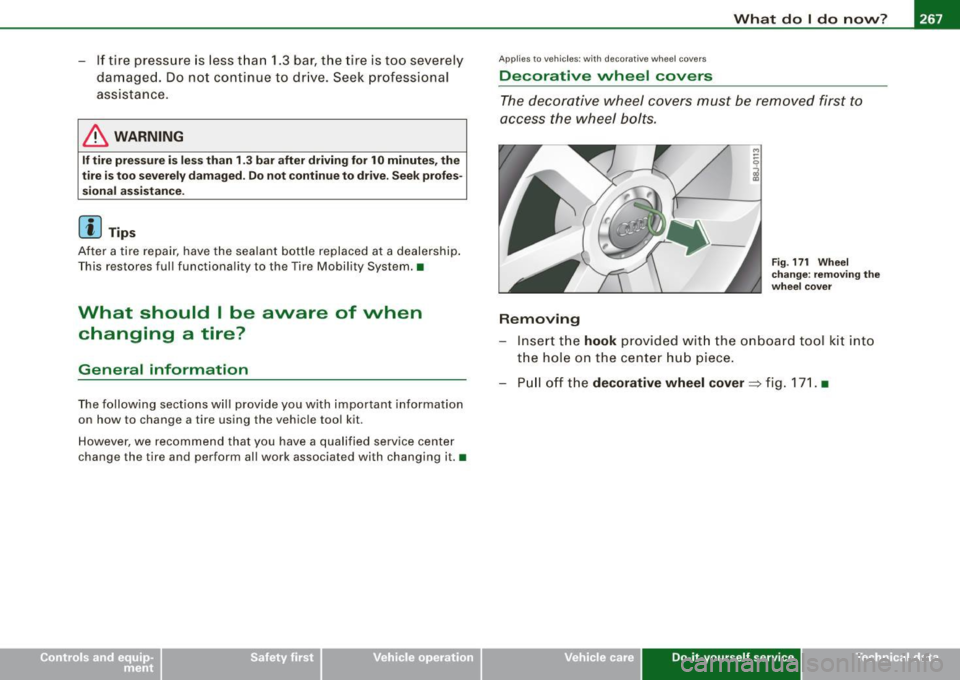
The decorative wheel covers must be removed first to
access the wheel bolts.
Removing
Fig. 171 Wheel
change : removing the
wheel cover
- Insert the hook provided with the on board tool kit into
the hole on the center hub piece.
- Pull off the
decorative wheel cover=> fig. 171. •
Vehicle care Do-it-yourself service Technical data
Page 271 of 316
_______________________________________________ W_ h_ a _ t_d_ o_ l _d _o_ n_ o_ w_ ? _ __.ffllll
& WARNING
• Using force without control to speed the wheel change up can
cause the vehicle to slip off the jack and cause serious personal
injuries.
• Do not loosen the wheel bolts more than one turn before you
raise the vehicle with the jack . - Risk of injury!
[ i] Tips
• Never try and use the hexagonal socket in the handle of the
screwdriver to loosen or tighten the wheel bolts.
• If a wheel bolt sits very tight, you may find it easier to loosen by
carefully pushing down on the end of the wheel bolt wrench with
one foot only . As you do, hold on to the car to keep yourself stable
and take care not to slip. •
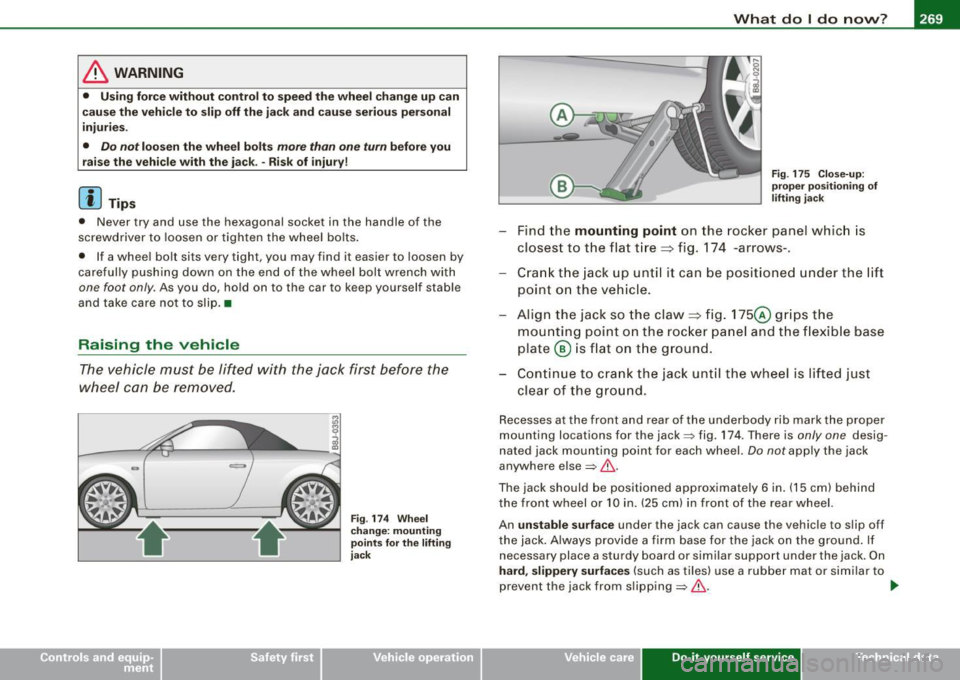
Rais ing the vehicle
The vehicle must be lifted with the jack first before the
wheel can be removed.
-
Fig. 174 Wheel
change: mounting
points for the lifting
jack Fig
. 175 Close-up:
proper positioning of
lifting jack
-Find the mounting point on the rocker panel which is
closest to the flat tire ~ fig. 174 -arrows-.
- Crank the jack up until it can be positioned under the lift
point on the vehicle.
- Align the jack so the claw~ fig. 175@ grips the
mounting point on the rocker panel and the flexible base
plate @ is flat on the ground.
- Continue to crank the jack until the wheel is lifted just
clear of the ground.
Recesses at the front and rear of the underbody rib mark the proper
mounting locations for the jack=> fig. 174 . There is
only one desig
nated jack mounting point for each wheel.
Do not apply the jack
anywhere else=>&.
The jack should be positioned approximately 6 in. (15 cm) behind
the front wheel or 10 in. (25 cm) in front of the rear wheel.
An
unstable surface under the jack can cause the vehicle to slip off
the jack. Always provide a firm base for the jack on the ground. If
necessary place a sturdy board or similar support under the jack. On
hard, slippery surfaces (such as tiles) use a rubber mat or similar to
prevent the jack from slipping=> &. .,
Vehicle care Do-it-yourself service irechnical data
Page 272 of 316
1111...__W_ h_ a _ t_d_ o_ l _d _o_ n_ o_ w_ ? ______________________________________________ _
& WARNING
• You or your passengers could be injured while changing a
wheel if you do not follow safety precautions:
-Mounting the jack under the vehicle at any other place than
indicated above may damage the vehicle or may result in
personal injuries.
- A soft or unstable surface under the jack may cause the
vehicle to slip off the jack. Always provide a firm base for the
jack on the ground.
If necessary, use a sturdy board under the
jack.
- On hard, slippery surface (such as tiles) use a rubber mat or
similar to prevent the jack from slipping.
• To help prevent injury to yourself and your passengers: -Do not raise the vehicle until you are sure the jack is securely
engaged.
- Passengers must not remain in the vehicle when it is jacked
up.
- Make sure that passengers wait in a safe place away from
the vehicle and well away from the roadway and traffic.
- Make sure jack position is correct, adjust as necessary and
then continue to raise the jack.
0 Note
A floor jack or the pads on the hoist arms must not be positioned at
the points shown~
page 269, fig . 174 -arrows -. •
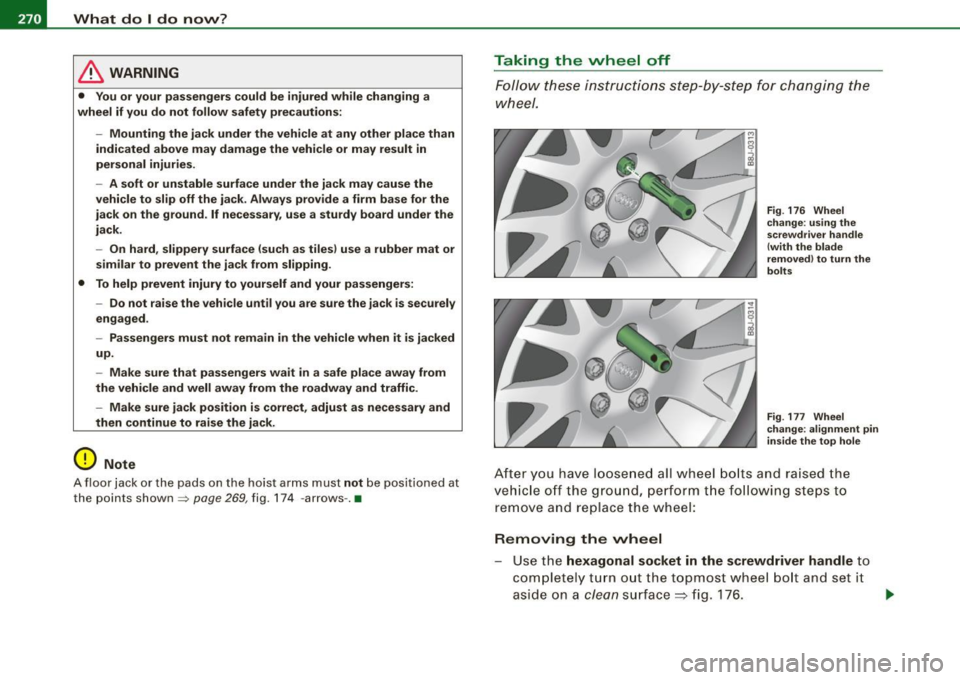
Taking the wheel off
Follow these instructions step-by-step for changing the
wheel.
Fig . 176 Wheel
change : using the
screwdriver handle
(with the blade
removed) to turn the
bolts
Fig. 177 Wheel
change : alignment pin
inside the top hole
After you have loosened all wheel bolts and raised the
vehicle off the ground, perform the following steps to
remove and replace the wheel:
Removing the wheel Use the hexagonal socket in the screwdriver handle to
completely turn out the topmost wheel bolt and set it
as ide on a
clean surface => fig. 176. ~
Page 273 of 316
What do I do now? -
----------------
•
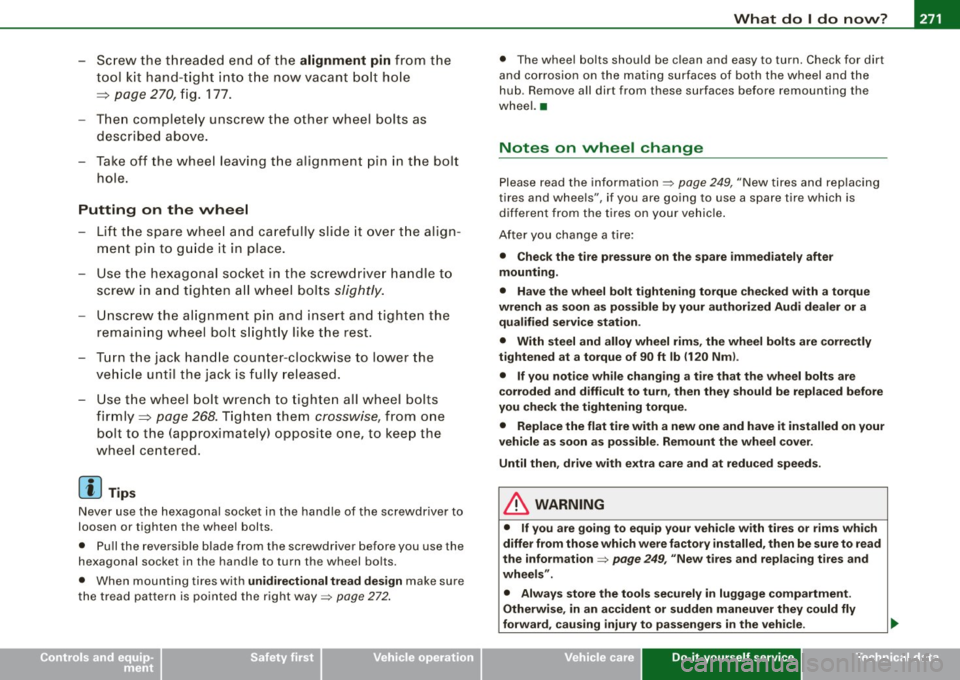
-Screw the threaded end of the alignment pin from the
tool kit hand-tight into the now vacant bolt hole
=:> page 270, fig. 177.
- Then completely unscrew the other wheel bolts as
described above.
- Take off the wheel leaving the alignment pin in the bolt
hole.
Putting on the wheel
- Lift the spare wheel and carefully slide it over the align
ment pin to guide it in place.
- Use the hexagonal socket in the screwdriver handle to
screw in and tighten all wheel bolts slightly.
- Unscrew the alignment pin and insert and tighten the
remaining wheel bolt slightly like the rest.
- Turn the jack handle counter -clockwise to lower the
vehicle until the jack is fully released.
- Use the wheel bolt wrench to tighten all wheel bolts
firmly =:> page 268. Tighten them crosswise, from one
bolt to the (approximately) opposite one, to keep the
wheel centered.
[ i J Tips
Never use the hexagonal socket in the handle of the screwdriver to
loosen or tighten the wheel bolts.
• Pull the reversible blade from the screwdriver before you use the
hexagonal socket in the handle to turn the wheel bolts.
• When mounting tires with
unidirectional tread design make sure
the tread pattern is pointed the right way~
page 272.
• The wheel bolts should be clean and easy to turn. Check for dirt
and corrosion on the mating surfaces of both the wheel and the
hub . Remove all dirt from these surfaces before remounting the
wheel. •
Notes on wheel change
Please read the information~ page 249, "New tires and replacing
tires and wheels", if you are going to use a spare tire which is
different from the tires on your vehicle.
After you change a tire:
• Check the tire pressure on the spare immediately after
mounting.
• Have the wheel bolt tightening torque checked with a torque
wrench as soon as possible by your authorized Audi dealer or a qualified service station .
• With steel and alloy wheel rims, the wheel bolts are correctly
tightened at a torque of 90 ft lb (120 Nml.
• If you notice while changing a tire that the wheel bolts are
corroded and difficult to turn, then they should be replaced before
you check the tightening torque.
• Replace the flat tire with a new one and have it installed on your
vehicle as soon as possible. Remount the wheel cover.
Until then, drive with extra care and at reduced speeds.
& WARNING
• If you are going to equip your vehicle with tires or rims which
differ from those which were factory installed, then be sure to read
the information
~ page 249, "New tires and replacing tires and
wheels".
• Always store the tools securely in luggage compartment.
Otherwise, in an accident or sudden maneuver they could fly
forward, causing injury to passengers in the vehicle.
Do-it-yourself service
Page 303 of 316
______________________________________________ A_ l.:.. p _h_ a_ b_e _t_ic _ a _ l _in _ d_e _ x __ _
Automatic folding top
closing .. .... .... ....... ..... ... . 62
opening ... ... ... .... .... ... .... .. 62
Automatic headlight control .. ......... 70
Automatic transmission .. .... .... .... 113
Driving Notes ......... .... .. ..... 114
Emergency program .... ...... .... 119
Emergency release . . . . . . . . . . . . . . . 120
Ignition key safety lock . ...... ..... 106
Kick -down .. ... .. .... .... ...... .. 117
Launch Control Program ........... 117
Selector lever lock ........ .... .... 116
Selector lever positions .... ..... .. 115
Tiptronic ... .. .... .... ... .... .... 118
Tiptronic controls on the steering wheel
119
Average speed ... ... ..... ... .... .... . 39
Avoid damaging the vehicle ..... .... . 194
B
Battery .. ... .... .... .... ..... .. 231, 234
Battery location inside the engine
compartment . ...... .... .... 221, 222
Charging ........................ 235
Checking battery acid level .. .. 234, 235
Connecting ...................... 231
Disconnecting .... .... .... ...... . 231
Important warnings when working on the
battery ........................ 232
Replacing the battery .. .......... . 231
Winter operation ................. 231
Working on the battery ... .... .... . 232
Battery voltage . .... .... .... ... .... .. 35
Controls and equip
ment Safety first
Before
driving . .... . .. ... ... ........ 128
Bi -Xenon headlights .................. 75
Blended gasoline . ... .... .... .... .... 214
Body cavity sealing ...... ...... ... .. . 207
Booster seats .. ...... .... .... .... ... 175
How do I properly install a booster seat in
my vehicle? . .......... .... ... .. 175
Safety instructions . .... .... ... .... 175
Brake fluid Changing the brake fluid .. ........ 230
Checking the brake fluid level ...... 230
What is the correct brake fluid level? 230
What should I do if the brake fluid warning
light comes on? ... .. .... .... .... 230
Brake fluid reservoir . ...... ...... .... 230
Brake light defective ........ .... .... .. 36
Brake system ... ... .. .... ........ 32, 230
Anti-lock brake system .. ....... .... 20
Brake Assistant ........ ... .. .... . 189
Brake fluid ................... .... 230
Brake f luid specifications for refill and
replacement .... ...... ...... .... 230
Brake pads ... ... .... .... .... .... 193
General information .............. 188
How does the moisture or road sa lt affect
the brakes? ..... ...... ...... .... 188
Warning/indicator lights .. ...... .... 20
Break -in period ...... ...... ... .. .... 192
Brake pads ...................... 193
Tires .. .... .... ... .... .... .... ... 192
Bulbs .... ... .... .. . .. .............. 277
C
California Proposition 65 Warning . .... 221
Battery specific .... ... .... .... .... 234
Capacities ... .... ........ ... .... .... 291
Car care ... .... ... .. .... .... .... .... 200
Interior ..... .... .. .... ........... 208
Plastic and vinyl .................. 204
Weatherstrips ..... .... ...... ..... 206
Care of exterior .. .... ....... ........ 200
Cargo area
See Luggage compartment . ... .... . 135
Catalytic converter ...... .... .... .... 193
CD changer ..... .... .... .... .... ..... 96
Certification ...... ... .... ...... ...... 45
Changing a flat tire ... .... .... ....... 267
Changing engine oil ............. .... 226
Chassis Undercoating .... ..... ... .... .... 207
See also Audi magnetic ride .... .... 112
Check ing
Battery acid level ......... ... . 234, 235
Engine coolant level .............. 228
Checking tire pressure . ... .... .... ... 244
Child restraint
Danger of using child restraints in the front seat .... ... .... .... .... ... 147
Child restraints Where can I get additional information
about chi ld restraints? ... ........ 180
Child safety ...... .... ... .... ... 168, 173
Booster seats .... .... .... .... ... . 175
Convertible child safety seats ... ... 174
Vehicle operation Vehicle care Do-it-yourself service Technical data