child lock AUDI TT ROADSTER 2008 User Guide
[x] Cancel search | Manufacturer: AUDI, Model Year: 2008, Model line: TT ROADSTER, Model: AUDI TT ROADSTER 2008Pages: 316, PDF Size: 70.1 MB
Page 173 of 316
Child Safety -
--------------------''---
& WARNING
To reduce the risk of serious injury, make sure that the PASSENGER
AIR BAG OFF light comes on and stays on whenever a child restraint is installed on the front passenger seat and the ignition
is switched on.
• Never install a rearward facing child safety seat on the front
passenger seat unless the PASSENGER AIR BAG OFF light comes
on and stays on. If the PASSENGER AIR BAG OFF light does not
come on and stay on the inflating airbag will hit the child safety
seat or infant carrier with great force and will smash the child
safety seat and child against the backrest, door or roof. Have the
airbag system inspected immediately by your Audi dealer.
[ i] Tips
The child seats listed in categories A to C have been tested by Audi
only for the Advanced Airbag function. •
Important safety instructions for
using child safety seats
Correct use of child safety seats substantially reduces the
risk of injury in an accident!
As the driver, you are responsible for the safety of every
body in the vehicle, especially children:
- Always use the right child safety seat for each child and
always use it properly ::::>
page 173.
-Always carefully follow the child safety seat manufac
turer's instructions on how to route the safety belt prop
erly through the child safety seat.
Controls and equip ment Safety first Vehicle operation
-
When using the vehicle safety belt to install a child safety
seat, you must first activate the convertible locking retractor on the safety belt to prevent the child safety
seat from moving ::::>
page 177.
-Push the child safety seat down with your full weight to
get the safety belt really tight so that the seat cannot
move forward or sideways more than one inch (2.5 cml.
Always remember: Even though your vehicle is equipped with an
Advanced Airbag system, a child should always ride in the seat
properly restrained for its age and size.
& WARNING
Not using a child safety seat, using the wrong child safety seat or
improperly installing a child restraint increases the risk of serious
personal injury and death.
• All vehicle occupants and especially children must always be
restrained properly whenever riding in a vehicle.
-An unrestrained or improperly restrained child can be injured
or killed by being thrown against the inside of the vehicle or by
being ejected from it during a sudden maneuver or impact.
- An unrestrained or improperly restrained child is at much
greater risk of injury or death by being struck by an inflating
airbag.
• Commercially available child safety seats are required to
comply with U.S. Federal Motor Vehicle Safety Standard (FMVSS)
213 (in Canada CMVSS 213).
- When buying a child restraint, select one that fits your child
and the vehicle.
- Only use child restraint systems that fully contact the flat
portion of the seat cushion. The child restraint must not tip or
lean to either side. Audi does not recommend using child safety
seats that rest on legs or tube-like frames. They do not provide
adequate contact with the seat. ..
Vehicle care Do-it-yourself service Technical data
Page 175 of 316
Child safety seats
Infant seats
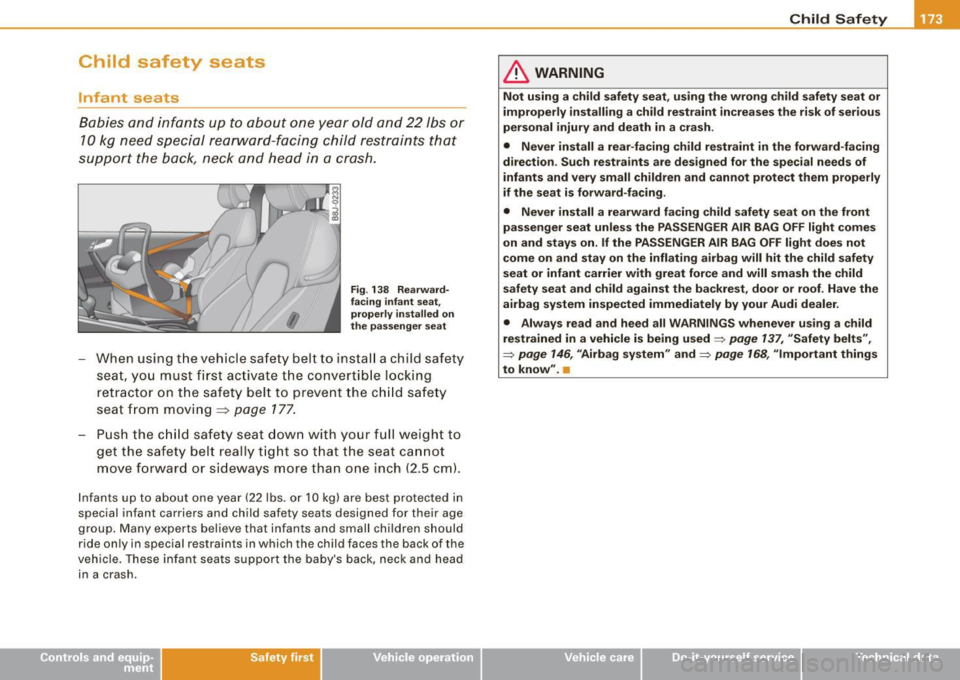
Babies and infants up to about one year old and 22 lbs or
10 kg need special rearward-facing child restraints that
support the back, neck and head in a crash.
Fig. 138 Rearward
facing infant seat,
properly installed on
the passenger seat
- When using the vehicle safety belt to install a child safety
seat, you must first activate the convertible locking
retractor on the safety belt to prevent the child safety
seat from moving ::::,
page 177.
-Push the child safety seat down with your full weight to
get the safety belt really tight so that the seat cannot
move forward or sideways more than one inch (2.5 cm).
Infants up to about one year (22 lbs. or 10 kg) are best protected in
special infant carriers and child safety seats designed for their age
group. Many experts believe that infants and small children should
ride only in special restraints in which the child faces the back of the
vehicle. These infant seats support the baby's back, neck and head
in a crash.
Safety first
Child Safety
& WARNING
Not using a child safety seat, using the wrong child safety seat or
improperly installing a child restraint increases the risk of serious
personal injury and death in a crash .
• Never install a rear-facing child restraint in the forward-facing
direction. Such restraints are designed for the special needs of
infants and very small children and cannot protect them properly
if the seat is forward-facing.
• Never install a rearward facing child safety seat on the front
passenger seat unless the PASSENGER AIR BAG OFF light comes
on and stays on. If the PASSENGER AIR BAG OFF light does not
come on and stay on the inflating airbag will hit the child safety
seat or infant carrier with great force and will smash the child
safety seat and child against the backrest, door or roof. Have the
airbag system inspected immediately by your Audi dealer.
• Always read and heed all WARNINGS whenever using a child
restrained in a vehicle is being used~
page 137, "Safety belts",
::::, page 146, "Airbag system" and::::, page 168, "Important things
to know". •
Vehicle care I I irechnical data
Page 176 of 316
___ C_h _i_ld _ S_a_ f_e _t .:..y ____________________________________________ _
Convertible child safety seats
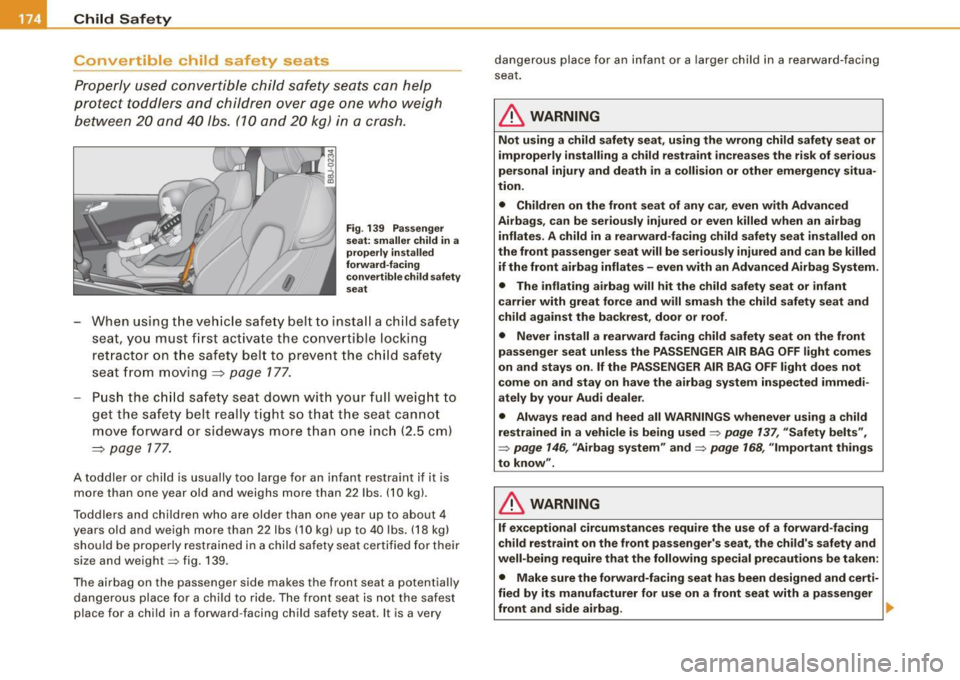
Properly used convertible child safety seats can help
protect toddlers and children over age one who weigh between 20 and 40 lbs. (10 and 20 kg) in a crash.
Fig. 139 Passenger
seat: smaller child in a
properly installed
forward-facing
convertible child safety
seat
When us ing the vehicle safety belt to install a child safety
seat, you must first activate the convert ible locking
retractor on the safety belt to prevent the child safety
seat from moving ~
page 177.
Push the child safety seat down with your full weight to
get the safety belt really tight so that the seat cannot move forward or sideways more than one inch (2.5 cm)
~ page 177.
A toddler or child is usually too large for an infant restraint if it is
more than one year old and weighs more than 22 lbs. (1 0 kg).
Toddlers and children who are older than one year up to about 4
years old and weigh more than 22 lbs (10 kg) up to 40 lbs. (18 kg) should be properly restrained in a child safety seat certified for their
size and weight=> fig. 139 .
The airbag on the passenger side makes the front seat a potentially dangerous place for a child to ride. The front seat is not the safest place for a child in a forward -facing child safety seat. It is a very dangerous place for an infant or a
larger child in a rearward-facing
seat.
& WARNING
Not using a child safety seat, using the wrong child safety seat or
improperly installing a child restraint increases the risk of serious
personal injury and death in a collision or other emergency situa
tion.
• Children on the front seat of any car, even with Advanced
Airbags, can be seriously injured or even killed when an airbag
inflates. A child in a rearward-facing child safety seat installed on
the front passenger seat will be seriously injured and can be killed
if the front airbag inflates -even with an Advanced Airbag System.
• The inflating airbag will hit the child safety seat or infant
carrier with great force and will smash the child safety seat and
child against the backrest, door or roof.
• Never install a rearward facing child safety seat on the front
passenger seat unless the PASSENGER AIR BAG OFF light comes
on and stays on. If the PASSENGER AIR BAG OFF light does not
come on and stay on have the airbag system inspected immedi
ately by your Audi dealer.
• Always read and heed all WARNINGS whenever using a child
restrained in a vehicle is being used=>
page 137, "Safety belts",
=>
page 146, "Airbag system" and=> page 168, "Important things
to know".
& WARNING
If exceptional circumstances require the use of a forward-facing
child restraint on the front passenger's seat, the child's safety and
well-being require that the following special precautions be taken:
• Make sure the forward-facing seat has been designed and certi
fied by its manufacturer for use on a front seat with a passenger
front and side airbag . .,
Page 177 of 316
& WARNING !continued)
• Always follow the manufacturer's instructions provided with
the child safety seat or carrier.
• Always move the front passenger seat into the rearmost posi
tion of the passenger seat's fore and aft adjustment range, and as
far away from the airbag as possible before installing the child
restraint.
• Always make sure that nothing prevents the front passenger's
seat from being moved to the rearmost position in its fore and aft
adjustment range.
• Always make sure the backrest is in an upright position.
• Make sure that the PASSENGER AIR BAG OFF light comes on
and stays on all the time whenever the ignition is switched on.
• If the light does not stay on, perform the checks~
page 157,
uMonitoring the Advanced Airbag System".
• If the PASSENGER AIR BAG OFF light does not come on and stay
on have the airbag system inspected immediately by your Audi
dealer. •
Safety first
Child Safety
Booster seats
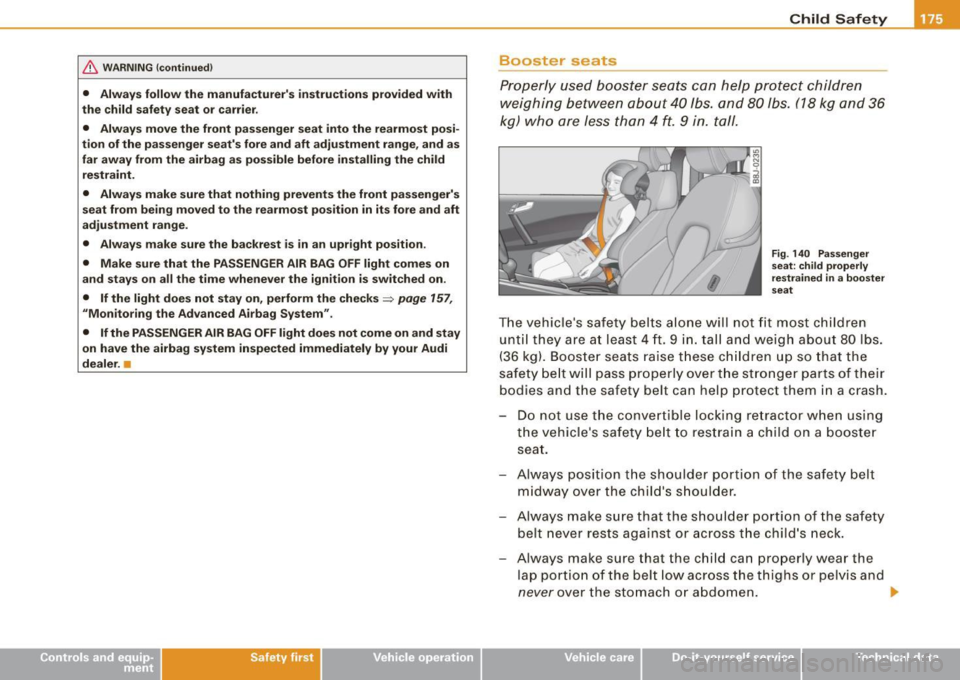
Properly used booster seats can help protect children
weighing between about 40 lbs. and 80 lbs. (18 kg and 36
kg) who are less than
4 ft. 9 in. tall.
II
Fig . 140 Passenger
seat: child properly
restrained
in a booster
seat
The vehicle 's safety belts alone will not fit most children
until they are at least
4 ft. 9 in. tall and weigh about 80 lbs.
(36 kg). Booster seats raise these children up so that the
safety belt will pass properly over the stronger parts of their bodies and the safety belt can help protect them in a crash .
- Do not use the convertible locking retractor when using
the vehic le 's safety belt to restrain a child on a booster
seat.
- Always posit ion the shoulder portion of the safety belt
midway over the child's shoulder.
- Always make sure that the shoulder port ion of the safety
belt never rests against or across the child's neck .
- Always make sure that the child can properly wear the
lap portion of the belt low across the thighs or pelvis and
never over the stomach or abdomen. •
Vehicle care I I irechnical data
Page 179 of 316
& WARNING !continued)
• If the PASSENGER AIR BAG OFF light does not come on and stay
on whenever the ignition is switched on the inflating airbag will
hit the child safety seat or infant carrier with great force and will
smash the child safety seat and child against the backrest, door or
roof. Have the airbag system inspected immediately by your Audi
dealer.
• Always read and heed all WARNINGS whenever using a child
restrained in a vehicle is being used=>
page 137, "Safety belts",
=>
page 146, "Airbag system" and=> page 168, "Important things
to know". •
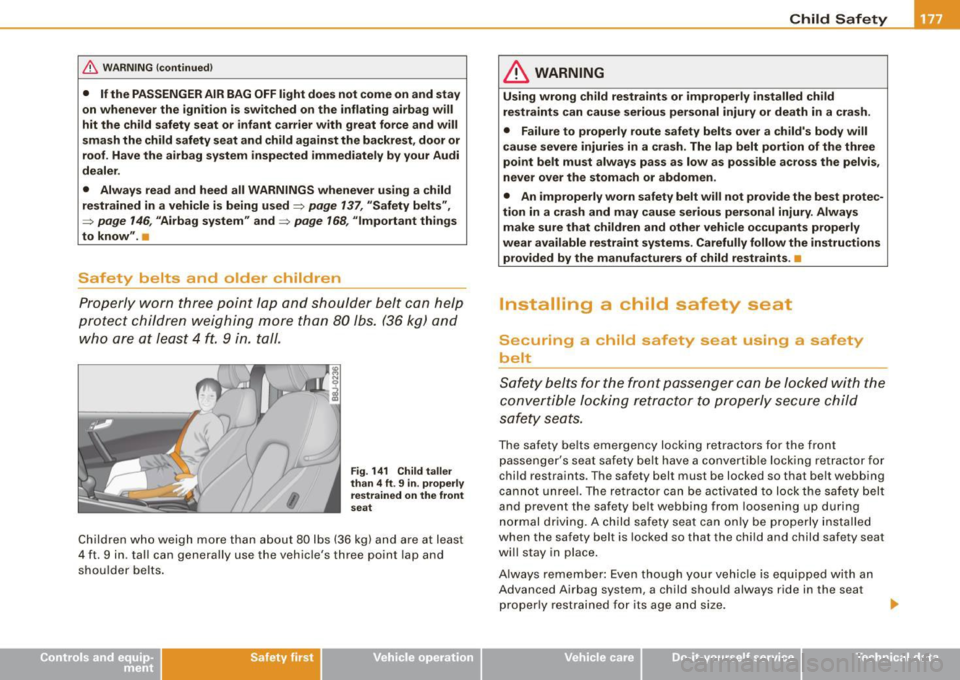
Safety belts and older children
Properly worn three point lap and shoulder belt can help
protect children weighing more than 80 lbs. (36 kg) and
who are at least 4 ft. 9 in. tall.
I
Fig. 141 Child taller
than 4 ft. 9 in. properly
restrained on the front
seat
Children who weigh more than about 80 lbs (36 kg) and are at least
4 ft . 9 in . tall can generally use the vehicle's three point lap and
shoulder belts.
Safety first
Child Safety
& WARNING
Using wrong child restraints or improperly installed child
restraints can cause serious personal injury or death in a crash.
• Failure to properly route safety belts over a child's body will
cause severe injuries in a crash. The lap belt portion of the three
point belt must always pass as low as possible across the pelvis,
never over the stomach or abdomen.
• An improperly worn safety belt will not provide the best protec
tion in a crash and may cause serious personal injury. Always
make sure that children and other vehicle occupants properly
wear available restraint systems. Carefully follow the instructions provided by the manufacturers of child restraints. •
Installing a child safety seat
Securing a child safety seat using a safety
belt
Safety belts for the front passenger can be locked with the
convertible locking retractor to properly secure child
safety seats.
The safety belts emergency locking retractors for the front
passenger's seat safety belt have a convertible locking retractor for
child restraints. The safety belt must be locked so that belt webbing
cannot unreel. The retractor can be activated to lock the safety belt
and prevent the safety belt webbing from loosening up during
normal driving. A child safety seat can only be properly installed
when the safety belt is locked so that the child and child safety seat
will stay in place.
Always remember: Even though your vehicle is equipped with an
Advanced Airbag system, a child should always ride in the seat properly restrained for its age and size. .,_
Vehicle care
I I irechnical data
Page 180 of 316
___ C_ h_ il_d _S_ a_f _e _ty ~----------------------------------------------
& WARNING
Improperly installed child safety seats increase the risk of serious
personal injury and death in a collision.
• Always make sure that the safety belt retractor is locked when
installing a child safety seat. An unlocked safety belt retractor
cannot hold the child safety seat in place during normal driving or
in a crash.
• Always buckle the child safety seat firmly in place even if a
child is not sitting in it. A loose child safety seat can fly around
during a sudden stop or in a collision
• The inflating airbag will hit the child safety seat or infant
carrier with great force and will smash the child safety seat and
child against the backrest, door or roof.
• Forward-facing child safety seats or infant carriers installed on
the front passenger's seat may interfere with the deployment of
the airbag and cause serious injury to the child .
• Always read and heed all WARNINGS whenever using a child
restrained in a vehicle is being used=>
page 168. Special precau
tions apply when installing a child safety seat on the front passenger seat=>
page 147, "Child restraints on the front seat -
some important things to know" .
& WARNING
Always take special precautions if you must install a forward or
rearward-facing child restraint on the front passenger's seat in
exceptional situations :
• Whenever a forward or rearward-facing child restraint is
installed on the front passenger seat , the PASSENGER AIR BAG
OFF light must come on and stay on whenever the ignition is
switched on.
• If the PASSENGER AIR BAG OFF light does not come on and stay
on , perform the checks described=>
page 157, ''Monitoring the
Advanced Airbag System".
& WARNING (continued)
• If the PASSENGER AIR BAG OFF light does not come on and stay
on whenever the ignition is switched on the inflating airbag will
hit the child safety seat or infant carrier with great force and will
smash the child safety seat and child against the backrest , door or
roof . Have the airbag system inspected immediately by your Audi
dealer.
• Improper installation of child restraints can reduce their effec
tiveness or even prevent them from providing any protection .
• An improperly installed child restraint can interfere with the
airbag as it deploys and seriously injure or even kill the child.
• Always carefully follow the manufacturer's instructions
provided with the child safety seat or carrier .
• Never place additional items on the seat that can increase the
total weight registered by the weight -sensing mat and can cause
injury in a crash .
in. WARNING
Forward-facing child restraints:
• Always make sure the forward-facing seat has been designed
and certified by its manufacturer for use on a front seat with a
passenger front and side airbag .
• Never put the forward-facing child restraint up , against or very
near the instrument panel.
• Always move the passenger seat into its rearmost position in
the seat's fore and aft adjustment range, as far away from the
airbag as possible before installing the forward -facing child
restraint. The backrest must be adjusted to an upright position.
• Make sure that the PASSENGER AIR BAG OFF light comes on
and stays on all the time whenever the ignition is switched on.
~
Page 181 of 316
_______________________________________________ C_h _ i_ld _ S_ a_ f_ e_ t..,:c y __ __
& WARNING
Rearward-facing child restraints:
• A child in a rearward-facing child safety seat installed on the
front passenger seat will be seriously injured and can be killed if
the front airbag inflates -even with an Advanced Airbag System.
• The inflating airbag will hit the child safety seat or infant
carrier with great force and will smash the child safety seat and
child against the backrest, door or roof.
• Always be especially careful if you must install a rearward
facing child safety seat on the front passenger seat in exceptional
circumstances.
• Make sure that the PASSENGER AIR BAG OFF light comes on
and stays on all the time whenever the ignition is switched on.
• Never install a rearward facing child safety seat on the front
passenger seat unless the PASSENGER AIR BAG OFF light comes
on and stays on. If the PASSENGER AIR BAG OFF light does not
come on and stay on have the airbag system inspected immedi
ately by your Audi dealer. •
Activating the convertible locking retractor
Use the convertible locking retractor to secure a child
restraint.
Always heed the child safety seat manufacturer's instruc
tions when installing a child restraint in your vehicle . To
activate the convertible locking retractor:
- Place the child restraint on a seat .
- Slowly pull the belt
all the way out.
- Route it around or through the child restraint belt path
~& -
Controls and equip
ment Safety first
Vehicle operation
-Push the child safety seat down with your full weight to
get the safety belt really tight.
- Insert the belt tongue into the buckle for that seating
position .
- Guide the safety belt back into the retractor unt il the belt
lies flat and snug on the child safety seat.
- You should hear a "clicking" noise as the belt winds back
into the inertia reel. Test the convertible locking retractor
by pul ling on the belt. You should no longer be able to
pull the belt out of the retractor. The convertible locking
retractor is now activated .
- Make sure that the red release button is facing away from
the child restraint so that it can be unbuckled quickly.
- Pull on the belt to make sure the safety belt is properly
tight and fastened so that the seat cannot move forward
or sideways more than one inch (2.5 cm).
& WARNING
Using the wrong child restraint or an improperly installed child
restraint can cause serious personal injury or death in a crash.
• Always make sure that the safety belt retractor is locked when
installing a child safety seat. An unlocked safety belt retractor
cannot hold the child safety seat in place during normal driving or
in a crash.
• Always buckle the child safety seat firmly in place even if a
child is not sitting in it. A loose child safety seat can fly around
during a sudden stop or in a crash.
• Always make sure the seat backrest to which the child restraint
is installed is in an upright position. Otherwise, the seat back with
the child safety seat attached to it could fly forward in the event of
an accident or other emergency situation. ..,
Vehicle care Do-it-yourself service Technical data
Page 182 of 316
___ C_ h_ il_ d _S_ a_f e _ ty ______________________________________________ _
& WARNIN G (co ntinued )
• Always read and heed all WARNINGS whenever u sing a child
re strained in a v ehicle i s being used
=> page 168 . Special p re ca u
tion s appl y when inst alling a chi ld safety se at o n the front
pa sseng er sea t =>
page 14 7, "Child restr aint s on the front seat -
s ome important thing s to know ".•
Deactivating the convertible locking retractor
The convertible locking retractor for child restraints will
be deactivated automatically when the belt is wound all
the way back into the retractor.
- Press the red button on the safety belt buckle. The belt
tongue will pop out of the buckle.
- Guide t he belt a ll the way back into its stowed position.
Always let the safety belt retract complete ly into its stowed position .
The safety belt can now be used as an ordinary safety belt without
the convertible locking retractor for child restraints.
If the conve rtible locking retractor should be activa ted inadvert
ently, the safety belt must be unfastened and guided completely
back in to its stowed posi tion to deactiva te this feature. If the
convertible locking retractor is not deactivated, the safety belt will
gradually become tighter and uncom fortable to wear .
& WARNING
Improperly in stalled child safe ty seat s inc rea se th e risk of serious
personal injur y and death in a c ollisio n.
• Never unfa sten the safet y belt to deacti vate the convertibl e
lo cking retr actor for ch ild restra int s w hile the veh icle is movin g.
You would not be re strained and could be seriou sly injured in an
acc ident .
& WARN IN G (c ontinued )
• Always read and h eed all WARNINGS whenever u sing a child
restr ained in a vehi cle is being u sed
=> page 1 68 . Spe cial pre cau
tio ns appl y when inst alling a child safet y s eat on the front
p ass enger seat =>
pag e 147 , "Child re strain ts on the front seat -
s ome i mport ant things to know ".•
Additional Information
Where can I get additional information about
child restraint application and usage?
T here are a number of sources of additional information about child
r estraint selection, installation and usage:
NH TSA advises that the best child safety seat is the one that fits
you r child and fits in your vehicle, and that you wi ll use correctly and
consistently.
T ry before you buy!
N atio nal High way Tra ffi c Safety Ad ministr ati on
Tel. : (888) DASH -2 -DOT
www.nhtsa.dot.gov
Nat iona l SAFE KID S Campaign
Tel.: (202) 662 -0600
www .sa fekids.org
Safety BeltSafe U .S .A
Tel.: (800) 745 -SAFE (Eng lish)
Tel. : (800) 747 -SANO (Spanish)
www.carseat.org
Tran sport Canad a
Tel.: (800! 333-0371
www .tc .gc .ca
Page 222 of 316
-~_C_ h_e _c _ k_ i_n ...:::g::;...._ a_n_ d_ f_ i_ll _in -'g:::;.._ ___________________________________________ _
Closing the engine hood
- Pull the hood down until the pressure from the struts is
reduced.
- Let the hood
drop down and latch in place. Do not try to
push it shut;
it may fail to engage~& .
& WARNING
A hood that is not completely latched could fly up and block your
view while driving.
• When you close the engine hood, check it to make sure the
safety catch has properly engaged. The hood should be flush with
the surrounding vehicle body parts.
• If you notice while driving that the hood is not secured prop
erly, stop at once and close it. •
Working in the engine compartment
Be especially careful whenever you work in the engine
compartment!
Whenever you must perform any work in the engine compartment,
for example checking and filling the different fluids, there is a risk of injury, burns and accidents. To prevent personal injury always
observe the following WARNINGS. The engine compartment of any
vehicle is a hazardous area!
=> &
& WARNING
To help avoid injury, before you check anything under the hood :
• Switch off the engine.
• Remove the ignition key.
• Apply the parking brake.
& WARNING (continued)
• Move selector lever of automatic transmission to "P" {Park);
put manual transmission in Neutral.
• Always let the engine cool down. Hot components will burn
skin on contact.
• To reduce the risk of being burned, never open the hood if you
see or hear steam or coolant escaping from the engine compart
ment. Wait until no steam or coolant can be seen or heard before
carefully opening the hood .
• Keep children away from the engine compartment.
• Never spill fluids on hot engine components. They can cause a
fire.
• Never touch the radiator fan. The auxiliary electric fan is
temperature controlled and can switch on suddenly.
• Never open the coolant reservoir cap when the engine is still
warm. The coolant system is pressurized and hot coolant could
spray out.
• Protect your face, hands and arm from steam or hot engine
coolant by placing a thick rag over the cap when you open the
coolant reservoir.
• If work on the fuel system or the electrical system is necessary:
- Always disconnect the battery .
- Never smoke or work near heaters or open flames. Fluids in
the engine compartment could start a fire.
- Keep an approved fire extinguisher immediately available.
• To avoid electrical shock and personal injury while the engine
is running or being started, never touch :
- Ignition cables
- Other components of the high voltage electronic ignition
system.
• If you must perform a check or repair with the engine running: .,_
Page 231 of 316
___________________________________________ C_ h_e _c_ k_ i_n _g _ a_n _d_ f_il _li _n _g __ ffllll
•
- Twist the cap on again tightly.
Replacement engine coolant must conform to exact specifications
=>
page 227, "Coolant ". If in an emergency coolant additive G12 + is
not avai lab le, do
not use a d ifferen t addit ive. Use p lain water
instead until you can get the correct additive and can restore the
correct ratio . This should be done as soon as possib le .
If you have lost a considerable amoun t of coolant, then you should
add cold antifreeze and cold water only when the engine is cold.
Always use
new engine coolan t when refilling .
Do not fi ll coolant above the "MAX" mark. Excess coo lant will be
forced out through the pressure relief va lve in the cap when t he
engine becomes hot.
& WARNING
• The cooling system is under pres sure a nd can g et very hot.
Reduce the ri sk of scald ing from ho t co olant b y following the se
s tep s.
- Turn off the engine and allow it to cool d own .
- Prote ct your fa ce , hand s and arm s from e scaping fluid and
st eam b y covering the cap with a l arge , thick rag .
- Turn the cap slo wly and very carefully in a count er-c lockw ise
dire ction while applying light , do wnward pres sure on th e top
o f the cap.
- To avoid b eing burned , do not spill antifre eze or coolant on
th e ex haus t syste m or hot e ngine parts . Under cert ain co nd i
tion s, the eth yle ne gly col in en gine co ola nt can cat ch fire .
• Antifr ee ze is poison ous. Alw ay s s tore antifr ee ze in its origi nal
c ontainer and well out of the re ach of children.
• If you dr ain th e coola nt , it mu st be caught and safe ly stored in
a proper contain er cle arly m ark ed "p oison ".
0 Note
• Coolant po llutes the env ironment and could cause an engine
fire . Excess coo lant wil l be forced out through the pressure relief
valve in the cap when the engine becomes ho t.
• I f, in an emergency, only water can be added, the correct ratio
between water and antifreeze=>
page 227must be restored as soon
as possib le .
<£> For the sake of the environment
Drained coolant should not be reused . Always dispose of used
coolant while observi ng all environmental regulations. •
Radiator fan
The radiator fan switches on automatically by itself.
The electric radiator fan is controlled by thermoswitches that switch
on and off depending on coolant and engine compartment temper
atures.
An auxiliary electric radiator fan * switches on and off depending on
coolant temperature and other vehic le operation conditions .
After you switch the eng ine o ff, the aux iliary fan can continue
running for up to 10 minutes -even with the ignition off. It can even
switch on again later by itself=>& , if
• the temperature of the engine coolant rises due to the heat
build -up from the engine in the engine compar tment, or
• the engine compartment heats up because the vehicle is parked
in intense sunlight.
& WARNING
• To reduc e the ri sk of per sonal in jur y nev er t ouch t he radiato r
f a n . .,_
Vehicle care
I t •