tow AUDI TT ROADSTER 2008 User Guide
[x] Cancel search | Manufacturer: AUDI, Model Year: 2008, Model line: TT ROADSTER, Model: AUDI TT ROADSTER 2008Pages: 316, PDF Size: 70.1 MB
Page 111 of 316
_________________________________________________ O .=.:.n.:....: t~h :.::e ::....:.. r.::o :.::a :.:d::...__lfflll
- Wit h a manual transm issi on, engage 1st gea r, or with a n
a utomatic transmission place the se lector lever in P
=> & .
- Remove the ignition key from the ignit io n lock.
Wha t el se you should do wh en parking yo ur v ehi cle on
a n incli ne or d ecline
Turn the steering whee l so that if the vehicle shou ld start to rol l, it
wi ll roll into the curb.
I f you are park ing on a
decline (the front of you r ve hicle facing
downhill) , turn the front wheels to the right so that they poin t
toward the curb .
If you are park ing on an in cline (the font of your vehicle facing
uphill!, turn the front whe els to the left so that they point
away from
the curb .
& WARNING
This is how you can reduce the ri sk of injury when le avi ng your
vehicle .
• Never p ark the vehi cle w here it can come
in cont act w ith dry
gra ss, s pilled fuel or any other flammable mater ial s.
• Never allow anyone -espe cially small ch ildren -to remain
in the
vehicle when it is locked . Locked doors make it more difficult for
re scu ers to ac ce ss the pa ssenger compartment in the e vent of an
emergency . Danger to life!
• Never lea ve childr en un super vis ed in the vehicle . Children
c ould release the parking brake or move the gearsh ift l ever out of
gear . The vehicle could start to r oll away a nd cau se an a ccident .
• No matter what the season i s, the temperature
in a parked
v ehi cle can reach dangerou s level s. •
Controls and equip
ment
Acoustic parking system
A pplies to veh ic les : wit h 4 -ch anne l a cou stic park ass is t
Rear acoustic park assist
Acoustic park assist gives a warning a bout o bstacles
behind the vehicle.
Description
The rear acoustic park assist (4 -channel acoustic park assist) deter
mines the d istance of the vehic le from an obstac le using u ltrasonic
sensors. The sensors are in the rear bumper. The volume and the
pitch of the chimes can be adjusted through the menu display
=> page 27.
The range at which the sensors start to m easure is about :
To the side
Center rear
Acti v atio n
2 feet (0 .60 m)
5 feet (1.60 ml
The pa rking assist is activated when rever se ge ar is engaged . A brief
tone confirms that the system is activated .
Backing up
Distance warning when backing up starts when an obstacle is
detec ted in the range of the park ass ist system . As the distance
decreases, the time interval between the aud ible tones becomes
shorter .
When the distance is less than 1 foot (0.30 m) , the tone becomes
continuous . At this point you should stop backing up.
Please note that low objects a lready signalled by a warning can
disappear from the sys tem's detection range and wil l not continue
t o be signa lled . ..,
I • •
Page 113 of 316
On the road -
----------------
CRUISE (US mod ell/ f-f (Canadian mod ell will a lso light up in the
instrument cluster .
& WARNING
• Always pay att enti on to traffic ev en whe n the c rui se control is
swi tched o n. Yo u are alway s resp onsi ble for your spe ed and the
di stanc e betw een your veh icle and other ve hic le s.
• Fo r sa fet y re as on s, th e c ruise control shou ld not be u sed in the
c it y, in stop -and -go traffic , on twi sting road s and when road condi
t ion s a re poor (such as ice, fog, gra vel, hea vy ra in and hydro
planing ) - risk of accid ent.
• Turn off the cr uis e control t empor arily when e nte ring turn
lane s, highwa y ex it lane s or in con stru ctio n z one s.
• Please note that inad vertentl y "re sting " your foot on the a ccel
er ato r ped al ca use s t he crui se control not to br ake . Thi s is because
the cru ise control i s overridden b y the dri ve r's acc eleration .
[ i] Tip s
• Vehicles w ith manua l transmission : You can at tain the set speed
only if the currently engaged gear allows it and the engine is not
stressed. Shifting to a higher or lower gear promptly will allow the
engine to run smooth ly .
• The cruise control cannot maintain a constant speed when
driving downhi ll. The vehicle will acce lerate under its own weight .
Downshift to a lower gear or use the brakes to s low down. •
Changing speed
-Press lever © in the 0 or O direction ~ page 110,
fig. 103 to increase or dec rease your speed.
- Release the lever to save that speed .
Controls and equip
ment
Change speed in increments of 1 mph (1 km/h) by lightly pressing
the lever . If you keep the lever pressed down, you will a lter your
speed in 5 mph (10 km /h) increments .
You can a lso press the acce lerator pedal down to increase your
speed, e.g. if you want to pass someone. The speed you saved
earlier will resume as soon as you release the accelerator pedal.
I f , however, you exceed your saved speed by 5 mph (10 km/h) for
longer than 5 minutes, the cruise control will turn off temporarily .
The symbol will go ou t but the saved speed will be retained. •
Presetting your sp eed
You can preset your desired speed while the vehicle is not
moving.
Turn on the ignition.
P ull lever @into position
0 ~ page 110, fig. 103.
Press the lever in the
0 or O direction to increase or
decrease your speed.
- Release the lever to save that speed .
This function makes it possible, for example, to save the speed you
want before driving on the highway . Once on the highway, activate
the cruise contro l by pulling the lever toward
(D . •
Switching the system off
Tempor ary d ea ctiv ati o n
Press the brake pedal, or
- Keep the c lutch pedal pressed down
longer, or
- Press t he lever © into positio n
0 (n ot c licked i nto pla ce)
~ page 110 , fig. 1 03 , or ~
I • •
Page 121 of 316
_______________________________________________________ T_ r _a_ n_s_ m __ is_ s_ io_ n _ __.1111111
Downshifting
- Tap the selector lever backward (in the tiptronic setting)
o.
Switching to manual can be carried out with the vehicle stationary
as well as moving .
When accelerating, the transmission shifts into the next gear in
gears 1, 2, 3, 4 and 5 shortly before the maximum permissible
engine speed is reached.
If you have selected a lower gear than the current one, the transmis
sion wil l only shift down when the engine cannot be overspeeded.
If kick -down is actuated, the transmission shifts into a lower gear
independently of speed and engine rpm.•
Applies to vehicles: with S tron ic® and with T iptronic controls on the s tee ring wheel
Steering wheel with Tiptronic ® controls
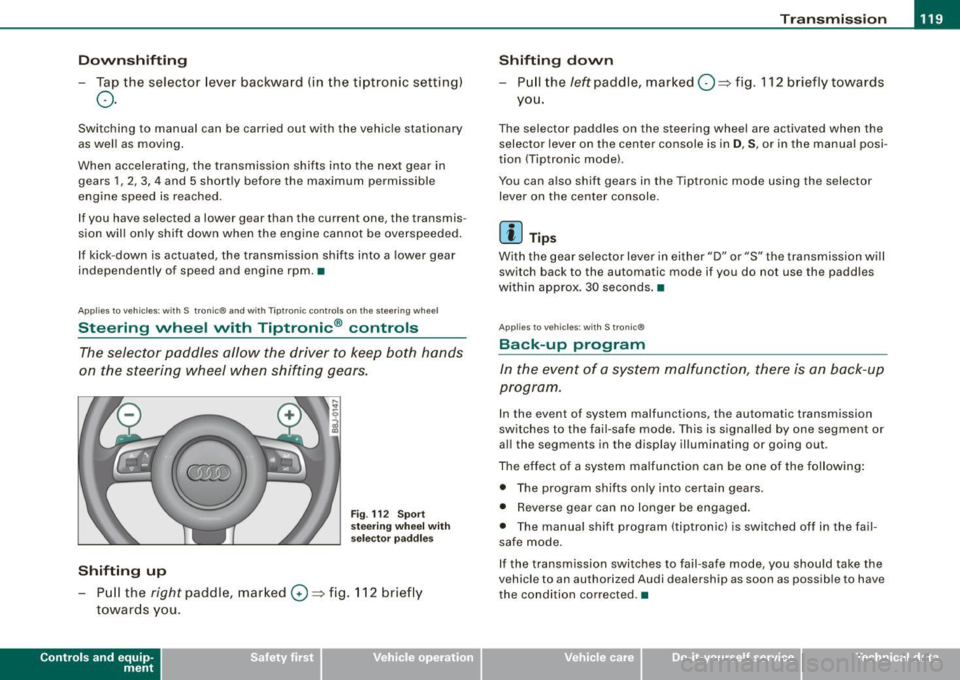
The selector paddles allow the driver to keep both hands
on the steering wheel when shifting gears.
Shifting up
F ig . 112 S port
stee ring w he el wi th
se lector paddl es
- Pu ll the right paddle, marked 0 => fig . 112 briefly
towards you .
Contro ls and eq uip
ment
Shifting d own
Pull the left paddle, marked O ::::> fig. 112 brief ly towards
you .
The selector paddles on the steering wheel are activated when the
selector lever on the center console is in
D, S, or in the manual posi
tion (Tiptronic model.
You can also shift gears in the Tiptronic mode using the selector
lever on the center console .
[ i ] Tips
With the gear se lector lever in either "D" or "S" the transmission wi ll
switch back to the automatic mode if you do not use the paddles
within approx . 30 seconds .•
App lies to vehic les: w ith S tronic®
Back -up program
In the event of a sys tem malfunction, there is an back-up
program .
In the event of system malfunctions, the automatic transmission
switches to the fai l-safe mode . This is signa lled by one segment or
al l the segments in the display illuminating or going out.
The effect of a system ma lfunction can be one of the fo llowing :
• The program shifts only into certain gears.
• Reverse gear can no longer be engaged .
• The manua l shift program (tiptronicl is switched off in the fail
safe mode.
If the transmission switches to fail-safe mode, you should take the
vehicle to an authorized Audi dea lership as soon as possible to have
the condition corrected .•
Vehicle care I I irechnical data
Page 122 of 316
• ..__T_ ra_ n_s_ m_ i_ s _s_ i_ o _n ___________________________________________________ _
Applies t o vehi cles: with S tr oni c®
Emergency release for selector lever
If the vehicle's power supply fails, the selector lever can
be released in an emergency.
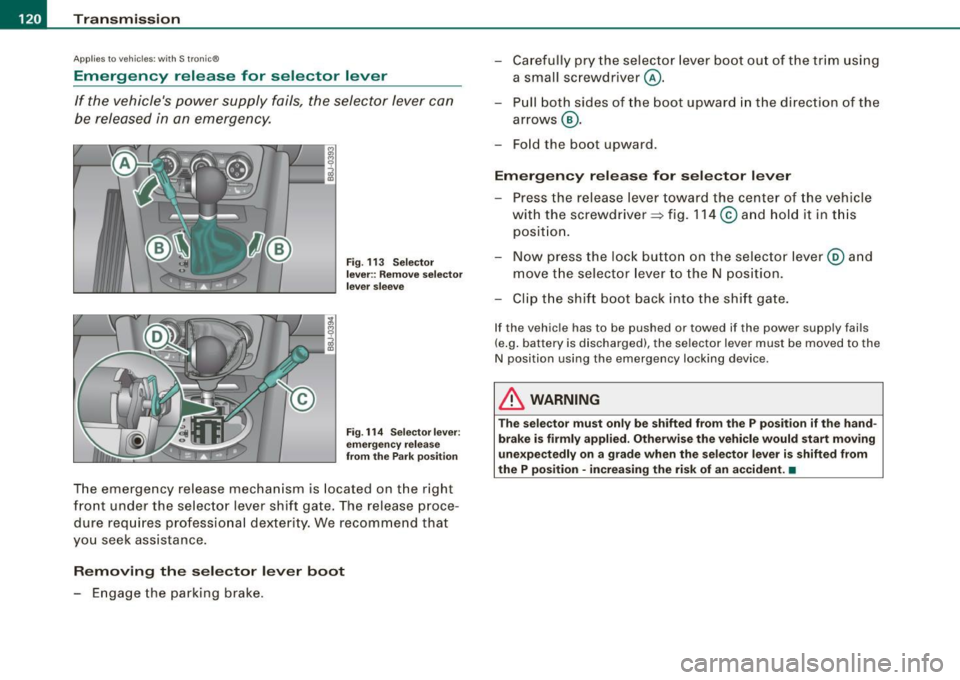
Fig. 113 Selector
lever:: Remove selector
lever sleeve
Fig. 114 Selector lever:
emergency release
from the Park position
The emergency release mechanism is located on the right
front under the selector lever shift gate. The release proce
dure requires professional dexterity. We recommend that
you seek assistance.
Removing the selector lever boot
- Engage the parking brake. -
Carefully pry the selector lever boot out of the trim using
a small screwdriver @.
- Pull both sides of the boot upward in the direct ion of the
arrows @.
- Fold the boot upward.
Emergency release for selector lever
- Press the release lever toward the center of the vehicle
with the screwdriver ~ fig. 114
© and hold it in this
position.
- Now press the lock button on the selector lever@ and
move the selector lever to the N position.
- Clip the shift boot back into the shift gate.
If the vehicle has to be pushed or towed if the power supply fails
(e.g. battery is discharged), the selector lever must be moved to the
N position using the emergency locking device .
& WARNING
The selector must only be shifted from the P position if the hand
brake is firmly applied. Otherwise the vehicle would start moving
unexpectedly on a grade when the selector lever is shifted from
the P position · increasing the risk of an accident. •
Page 133 of 316
Driving Safely -
----------------
& WARNING (continued)
• Always adjust the driver's seat and the steering wheel so that
there are at least 4 inches (10 cm) between the knees and the
lower part of the instrument panel.
• Always hold the steering wheel on the outside of the steering
wheel rim with your hands at the 9 o'clock and 3 o'clock positions
to help reduce the risk of personal injury if the driver's airbag inflates .
• Never hold the steering wheel at the 12 o'clock position or with
your hands at other positions inside the steering wheel rim or on
the steering wheel hub. Holding the steering wheel the wrong way
can cause serious injuries to the hands, arms and head if the
driver's airbag inflates
• Pointing the steering wheel toward your face decreases the
ability of the supplemental driver's airbag to protect you in a colli
sion .
• Always sit in an upright position and never lean against or
place any part of your body too close to the area where the airbags
are located.
• Before driving, always adjust the front seats and head
restraints properly and make sure that all passengers are properly
restrained .
• Never adjust the seats while the vehicle is moving. Your seat
may move unexpectedly and you could lose control of the vehicle.
• Never drive with the backrest reclined or tilted far back! The
farther the backrests are tilted back, the greater the risk of injury due to incorrect positioning of the safety belt and improper
seating position.
• Children must always ride in child seats=>
page 168. Special
precautions apply when installing a child seat on the front
passenger seat=>
page 146. •
Controls and equip
ment Safety first Vehicle operation
Proper seating position for the front
passenger
The proper front passenger seating position is important
for safe, relaxed driving.
For your own safety and to reduce the ris k of injury in the
event of an accident, we recommend that you adjust the
seat for the front passenger to the following pos ition:
- Move the front passenger seat back as far as possible.
There must be a minimum of 10 inches (25 cm) between
the breastbone and the instrument panel =>
&.
- Adjust the angle of the seatback so that it is in an upright
position and your back comes in full contact with it
whenever the vehicle is moving.
- Adjust the head restraint so that the upper edge is as
even with the top of your head as possible but not lower
than eye level and so that it is as close to the back of your
head as possible =>
page 132.
-Keep both feet flat on the floor in front of the front
passenger seat.
- Fasten and wear safety belts correctly=>
page 141.
For detailed information on how to adjust the front passenger's
seat, see => page 87.
& WARNING
Front seat passengers who are unbelted, out of position or too
close to the airbag can be seriously injured or killed by the airbag
as it unfolds. To help reduce the risk of serious personal injury : .,
Vehicle care Do-it-yourself service Technical data
Page 137 of 316
Driving Safely ---------------=------------'-
& WARNING (continued)
• Never place or install floor mats or other floor coverings in the
vehicle that cannot be properly secured in place to prevent them
from slipping and interfering with the pedals or the ability to
control the vehicle .
• Never place or install floor mats or other floor coverings on top
of already installed floor mats. Additional floor mats and other
coverings will reduce the size of the pedal area and interfere with
the pedals.
• Always properly reinstall and secure floor mats that have been
taken out for cleaning.
• Always make sure that objects cannot fall into the driver foot
well while the vehicle is moving. Objects can become trapped
under the brake pedal and accelerator pedal causing a loss of
vehicle control . •
Stovving luggage
Loading the luggage compartment
All luggage and other objects must be properly stowed
and secured in the luggage compartment.
Loose items in the luggage compartment can shift
suddenly, changing vehicle handling characteristics. Loose items can also increase the risk of serious personal injury in
a sudden vehicle maneuver or in a collision.
- Distribute the load evenly in the lugg age compartment.
- Always place and properly secure heavy items in the
luggage compartment as far forward as possible.
Controls and equip
ment Safety first
Vehicle operation
& WARNING
Improperly stored luggage or other items can fly through the
vehicle causing serious personal injury in the event of hard braking or an accident. To help reduce the risk of serious personal injury:
• Always put objects, for example, luggage or other heavy items
in the luggage compartment .
• Always secure objects in the luggage compartment using the
tie-down eyelets and suitable straps.
& WARNING
Heavy loads will influence the way your vehicle handles. To help
reduce the risk of a loss of control leading to serious personal
injury :
• Always keep in mind when transporting heavy objects, that a
change in the center of gravity can also cause changes in vehicle
handling:
-Always distribute the load as evenly as possible.
- Place heavy objects as far forward in the luggage compart-
ment as possible.
• Never exceed the Gross Axle Weight Rating or the Gross
Vehicle Weight Rating specified on the safety compliance sticker on the left door jamb . Exceeding permissible weight standards
can cause the vehicle to slide and handle differently.
• Please observe information on safe driving=:>
page 128.
& WARNING
To help prevent poisonous exhaust gas from being drawn into the
vehicle, always keep the rear lid closed while driving .
• Never transport objects larger than those fitting completely
into the luggage area because the rear lid cannot be fully closed.
9J),
Vehicle care Do-it-yourself service Technical data
Page 145 of 316
Pregnant women must also be properly
restrained The best way to protect the fetus is to make sure that
expectant mothers always wear safety belts correctly -
throughout the pregnancy.
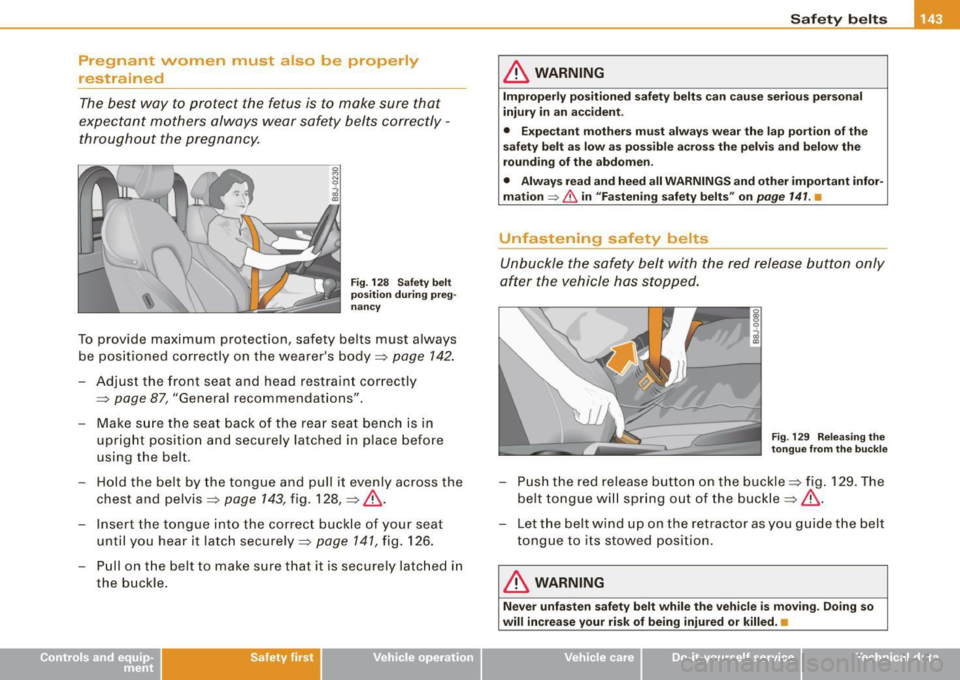
Fig . 128 Safety belt
position during preg
nancy
To provide maximum protection, safety belts must always
be positioned correctly on the wearer's body=>
page 142.
-Adjust the front seat and head restraint correctly
=> page 87, "General recommendations".
- Make sure the seat back of the rear seat bench is in
upright position and securely latched in place before
using the belt.
- Hold the belt by the tongue and pull it evenly across the
chest and pelvis::::,
page 143, fig. 128, => &.
- Insert the tongue into the correct buckle of your seat
until you hear it latch securely =>
page 141, fig. 126.
- Pull on the belt to make sure that it is securely latched in
the buckle.
Safety first
Safety belts
& WARNING
Improperly positioned safety belts can cause serious personal
injury in an accident.
• Expectant mothers must always wear the lap portion of the
safety belt as low as possible across the pelvis and below the
rounding of the abdomen.
• Always read and heed all WARNINGS and other important infor
mation ~
& in "Fastening safety belts" on page 141. •
Unfastening safety belts
Unbuckle the safety belt with the red release button only
after the vehicle has stopped.
Fig . 129 Releasing the
tongue from the buckle
- Push the red release button on the buckle=> fig. 129. The
belt tongue will spring out of the buckle =>
&.
- Let the belt wind up on the retractor as you guide the belt
tongue to its stowed position.
& WARNING
Never unfasten safety belt while the vehicle is moving . Doing so
will increase your risk of being injured or killed .•
Vehicle care
I I irechnical data
Page 156 of 316
_,___A_ ir_ b_ a.::g <-- s--
• Never carry sharp object s in your pockets or place them on the
seat.
If the weight- sen sing mat in the passenger seat is punctured
it cannot work properly .
• Never carry things on your lap or ca rry objects on the
passenger seat. Such items can increase the weight registered by
the weight -sen sing mat and send the wrong information to the
a irbag control unit .
• Never store item s under the front pas senge r seat . Part s of the
Advanced Airbag System under the passenger seat could be
damaged , preventing them and the airbag system from working
properly .
• Never place seat covers or replacement upholstery that ha ve
not been specifically approved by Audi on the front seats.
• Seat covers can prevent the Advan ced Airbag System from
recognizing child restraints or occupants on the front pa ssenger
seat and prevent the side airbag in the seat backrest from
deploying properly .
• Never use cushions , pillows , blankets or similar items on the
front passenger seat. The additional padding will prevent the
weight -sen sing mat in the seat from accurately registering the
child restraint or person on the seat and prevent the Advanced
Airbag System from functioning properly .
• If you must use a child re straint on the front passenger seat
and the ch ild restra int manufacturer' s instructions require the use
of a towel , foam cushion or something else to properly position
the child restraint , make certain that the PASSENG ER AIR BAG OFF
light comes on and stays on whenever the child restraint is
installed on the front passenger seat .
• If the PASSENGER AIR BAG OFF light does not come on and stay
on , have the airbag system inspected by your Audi dealer. •
How the Advanced Airbag System
components work together
The front Advanced Ai rbag System and the side airbags s upplement
th e pro tec tion offered by t he fro nt three -po int safety belts w ith
pretensioners and load limite rs and the adjustab le head restraints
t o help reduce the risk o f injury in a w ide ra nge o f acc ide nt and
crash situations . Be sure to read the important information about
sa fe ty an d heed the WAR NINGS in this chapte r.
D ep loyment of the Advanced Airbag System and the activation of
th e safe ty be lt pre tens ioners depends on th e decele ra tion
measu red by the crash se nsors and regist ered by the electronic
con trol un it. Crash seve rity depe nds on speed a nd decele ra tion a s
w ell as the mass a nd st iffne ss of the ve hicle or objec t in vo lv ed in th e
crash .
When t he elect ronic control unit registe rs a low sever ity crash and
the safety belt is be ing used, the airbag wi ll not deploy. If the safety
belt is no t being used, the fir s t stage de ploy s, f ollowed by th e
second stage after a much later time in the crash sequence .
I f the electronic control unit registers a crash of medium severity,
th e first stage o f the a irba g dep loys followed by the second sta ge at
a much later time in the crash sequence -regardless of whether the
sa fe ty belt is bein g use d or not. In hig her se ver ity cras hes as r eg is
tered by the electronic control unit, both the first and second stages
deploy al most at the same tim e.
On the passe nger s ide, regardless of safety belt use, the airbag wi ll
be tu rned off if the weight on the passenger seat is less than the
amount programmed in the e lectronic control unit. The front airbag
on the passenger side wi ll a lso be turned off if one of the child
sa fet y seats that has been cer tified under F ederal Mo to r V ehi cle
Safety Standard 208 has been recognized on the seat. The
PASSENGER AIR BAG OFF light co mes on and stays o n to tell y ou
when the front Advanced Airbag on the passenger side has been
t ur ned off ~
pag e 147, " C hi ld re stra int s on t he fro nt seat -so m e
important things to know". .,
Page 182 of 316
___ C_ h_ il_ d _S_ a_f e _ ty ______________________________________________ _
& WARNIN G (co ntinued )
• Always read and heed all WARNINGS whenever u sing a child
re strained in a v ehicle i s being used
=> page 168 . Special p re ca u
tion s appl y when inst alling a chi ld safety se at o n the front
pa sseng er sea t =>
page 14 7, "Child restr aint s on the front seat -
s ome important thing s to know ".•
Deactivating the convertible locking retractor
The convertible locking retractor for child restraints will
be deactivated automatically when the belt is wound all
the way back into the retractor.
- Press the red button on the safety belt buckle. The belt
tongue will pop out of the buckle.
- Guide t he belt a ll the way back into its stowed position.
Always let the safety belt retract complete ly into its stowed position .
The safety belt can now be used as an ordinary safety belt without
the convertible locking retractor for child restraints.
If the conve rtible locking retractor should be activa ted inadvert
ently, the safety belt must be unfastened and guided completely
back in to its stowed posi tion to deactiva te this feature. If the
convertible locking retractor is not deactivated, the safety belt will
gradually become tighter and uncom fortable to wear .
& WARNING
Improperly in stalled child safe ty seat s inc rea se th e risk of serious
personal injur y and death in a c ollisio n.
• Never unfa sten the safet y belt to deacti vate the convertibl e
lo cking retr actor for ch ild restra int s w hile the veh icle is movin g.
You would not be re strained and could be seriou sly injured in an
acc ident .
& WARN IN G (c ontinued )
• Always read and h eed all WARNINGS whenever u sing a child
restr ained in a vehi cle is being u sed
=> page 1 68 . Spe cial pre cau
tio ns appl y when inst alling a child safet y s eat on the front
p ass enger seat =>
pag e 147 , "Child re strain ts on the front seat -
s ome i mport ant things to know ".•
Additional Information
Where can I get additional information about
child restraint application and usage?
T here are a number of sources of additional information about child
r estraint selection, installation and usage:
NH TSA advises that the best child safety seat is the one that fits
you r child and fits in your vehicle, and that you wi ll use correctly and
consistently.
T ry before you buy!
N atio nal High way Tra ffi c Safety Ad ministr ati on
Tel. : (888) DASH -2 -DOT
www.nhtsa.dot.gov
Nat iona l SAFE KID S Campaign
Tel.: (202) 662 -0600
www .sa fekids.org
Safety BeltSafe U .S .A
Tel.: (800) 745 -SAFE (Eng lish)
Tel. : (800) 747 -SANO (Spanish)
www.carseat.org
Tran sport Canad a
Tel.: (800! 333-0371
www .tc .gc .ca
Page 191 of 316
Faults in the brake syst em
If you shou ld notice a sudden i ncrease in brake pedal travel, then
one of the two brake circuits may have failed=>
& -
Low brake fluid level
Ma lfunctions can occur in the brake system if the brake fluid leve l is
t oo low. The brake fluid level is moni tored e lect ronica lly .
Brake pow er assist unit
The brake p ow er assist un it increas es th e pressure that you
generate with the brake peda l. It works only when the engine is
running.
& WARNING
• You should perform braking maneuver s for the purpose of
c leaning the brake system only if road conditions permit . Other
road users must not be put at ri sk -you may cause an accident!
• Before des cending a steep grade , redu ce speed and sh ift trans
mi ssion into a lower gear or lower driving position . Do not ride the
br akes or hold the pedal down too long or too often . This could
cause the brakes to get hot and diminish braking efficiency .
• Do not "ride the brakes " by resting your foot on the pedal when
you do not intend to brake . Thi s may cause the brakes to overheat,
premature we ar and increased stopping distan ce .
• Under certain cl imatic and operating condit ions such as
pas sing through water , driv ing in heavy rain or after washing the
vehicle, the effectiveness of the brake s can be reduced . In winter ,
ice can ac cumulate on the brake pads , linings , discs and drums .
Cautiously apply brakes for a te st. Brakes will dry and ice coatings
will be cleaned off after a few cautious brake appli cations .
• Driving for an extended period of time on salt -covered road s
without using your brakes can also affect brak ing effic iency . Clean
off accumulated salt coating from brake discs and pads with a few
c autiou s brake applications .
Controls and equip ment Safety first Vehicle operation
Intelligent technology
& W
ARNING (continued )
• If you damage the front spo iler , or if you install a different
s poiler , be sure the air flow to the front brakes is not obstructed.
Otherwise the brake system could overheat redu cing the effective
ness of the entire br ake system.
• Failure of one brake circuit will impair the braking capability
resulting in an increa sed stopping distance. Avoid driving the
vehicle and have it towed to the nearest Audi dealer or qualified
workshop.
• Never let the veh icle roll to a stop with the engine shut off .
• If the b rake booster is not working , for e xample when towing
your vehicle, or because the brake booster has somehow been
damaged , the brake pedal must be pre ssed considerably harder to
make up for the lack of booster assistance . •
Anti- lock brake system (ABS)
ABS p revents the wheel s from loc king unde r br ak ing.
The anti -lock brake sys te m (ABS) makes a major contri but ion to
i ncreasing act ive d riv in g sa fety . You should not expect that brakin g
distances wi ll be
shortened unde r all c ircums tances wi th ABS.
B rak in g distance may even become somewhat
longer , for e xa m ple ,
on gravel or in new snow on s lippery ground, even if you are driving
carefully and slowly.
ABS operation
W hen a veh icle speed o f about 10 mph (20 km/ h) is reac hed , an au to
matic test sequence is run. Some noise from the pum p may be
audible.
I f the speed of a wheel s lows down too much re lative to vehicle
speed and i t starts to lock, br ake pressu re to th is whee l is reduce d.
T his adjustment process can be felt as a
pulsing motion of the b rake
pedal ,
accompanied by some noises. Yo u as the d rive r are in tent io n
a lly being g iven the in fo rmation that the wh eels a re tendin g to lock
Vehicle care Do-it-yourself service Technical data