check oil AUDI TT ROADSTER 2008 Owner's Manual
[x] Cancel search | Manufacturer: AUDI, Model Year: 2008, Model line: TT ROADSTER, Model: AUDI TT ROADSTER 2008Pages: 316, PDF Size: 70.1 MB
Page 229 of 316
_____________________________________________ C_h_ e_ c_k _in ____ g_ a_n _d_ f_il _li _n __ g ____ fflllll
•
0 Note
Never mix oil additives with your engine oil. These additives can
damage your engine and adversely affect your Audi Limited New
Vehicle Warranty .
W For the sake of th e environm ent
• Before changing your oi l, first make sure you know where you
can properly dispose of the used oil.
• Always dispose of used engine oil properly. Do not dump it on
garden soil, wooded areas, into open streams or down sewage
drains .
• Recycle used engine oi l by taking it to a used engine oil collec
tion fac ility in your area, or contact a service station. •
Engine cooling system
Coolant
The engine coolant performs two functions: it keeps the
engine from overheating and it protects the engine from
freez ing in the winter.
The coo ling system is sealed and generally requires little attention.
T he coo ling system has been filled at the factory with a permanent
coolant which does not need to be cha nged . The coolant consists of
a mixture of water and the manufacturer's glycol-basedcoolant
addit ive G 12 + antifreeze with an ticorrosi on addit ives (50% for USA
models; 60% for Canadian models). This mixture both assures the
necessary frost protection and protects metal components in the
engine's cooling system from corrosion and scaling . It a lso raises
the boiling point of the coo lant .
Do not reduce t he concentration of the coolant in the summer by
adding plain water.
The prop ort ion of coolant additi ve mu st be at le
as t 50 % but not more th an 60 %
to maintain antifreeze protection
and co oling effic iency . If the coo lant fros t protect ion is too low, the
coolant could freeze and damage the vehic le heating and engine
coo ling system.
For year-round driving, antifreeze is added at the factory for temper
atures down to:
• - 31 °F ( - 35 °C) USA
• -40 °F ( -40 °C) Canada.
You can mix the G12 + coo lant additive with other additives (f or
examp le G11 or G12l. Always check with your authorized Audi
dea ler .
& WARNING
Before you check anything in the engine compartment , alway s
read and heed all WARNIN GS
=:> & in "Working i n the engine
c ompartment " on
page 220.
0 Note
• Before winter sets in, have the coolant checked to see if the
coolant additive in your vehicle is sufficient to meet the climate
conditions . This is especia lly important if you live in a region where
the winter is extremely cold. If necessary, increase the proport ion o f
coo lant additive to 60%.
• When adding coolant additive to your coo ling system,
remember :
- We recommend using only coolant additive G12+ (check the
label) for your vehicle. This coolant additive is avai lable at autho
rized Audi dealers. Other types of antifreeze can significantly
reduce corrosion protection. The resulting corrosion can cause a
loss of coolant and serious engine damage.
• Do not add any type of radiator leak sea lant to your vehicle's
engine coolant. Adding radiator repair fluid may adverse ly affect the _.,
Vehicle care I t •
Page 232 of 316
___ C_h_ e_ c_k _in --== g'-- a_n _d_ f_il _li _n ..:::g:::..- ___________________________________________ _
& WARNING (continued)
• The auxiliary electric fan is temperature controlled and can
switch on suddenly even when the engine is not running.
• The auxiliary radiator fan switches on automatically when the
engine coolant reaches a certain temperature and will continue to
run until the coolant temperature drops. •
Brake fluid
Checking brake fluid level
The brake fluid level can be checked with a quick glance.
Fig. 155 Engine
compartment: brake
fluid reservoir
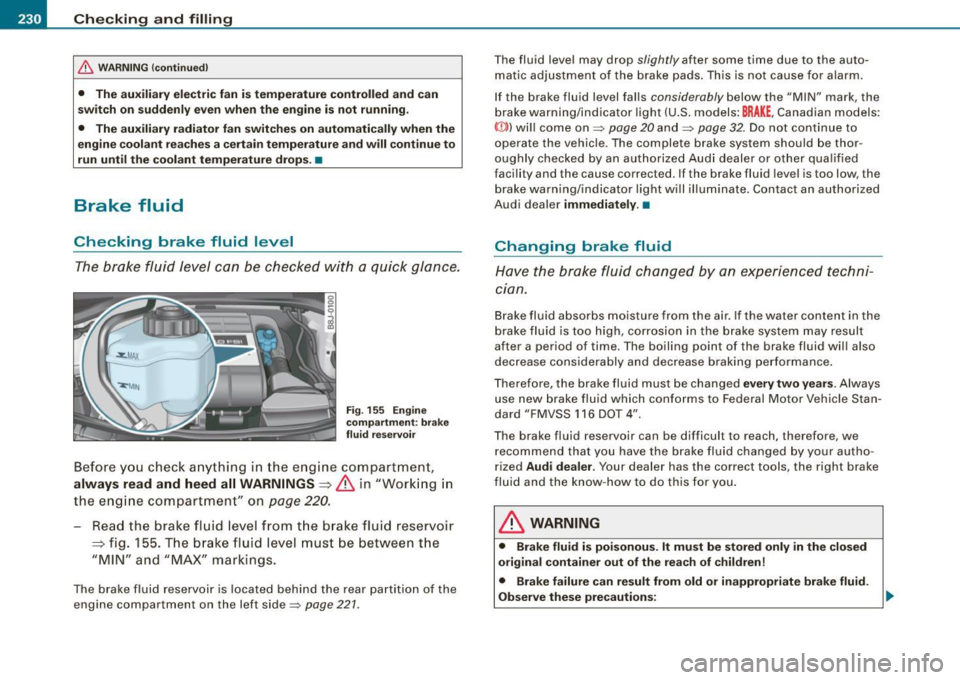
Before you check anything in the engine compartment,
always read and heed all WARNINGS =>
& in "Working in
the engine compartment" on
page 220.
- Read the brake fluid level from the brake fluid reservoir
~ fig. 155. The brake fluid level must be between the
"MIN" and "MAX" markings.
The brake fluid reservoir is located behind the rear partition of the
engine compartment on the left side~
page 221 .
The fluid level may drop slightly after some time due to the auto
matic adjustment of the brake pads. This is not cause for alarm.
If the brake fluid level falls
considerably below the "MIN" mark, the
brake warning/indicator light (U .S. models:
BRAKE , Canadian models:
ill) will come on~ page 20 and~ page 32. Do not continue to
operate the vehicle . The complete brake system should be thor
oughly checked by an authorized Audi dealer or other qualified
facility and the cause corrected. If the brake fluid level is too low, the
brake warning/indicator light will illuminate. Contact an authorized
Audi dealer
immediately .•
Changing brake fluid
Have the brake fluid changed by an experienced techni
cian.
Brake fluid absorbs moisture from the air. If the water content in the
brake fluid is too high, corrosion in the brake system may result
after a period of time. The boiling point of the brake fluid will als o
decrease considerably and decrease braking performance.
Therefore, the brake fluid must be changed
every two years. Always
use new brake fluid which conforms to Federal Motor Vehicle Stan
dard "FMVSS 116 DOT 4".
The brake fluid reservoir can be difficult to reach, therefore, we
recommend that you have the brake fluid changed by your autho
rized
Audi dealer . Your dealer has the correct tools, the right brake
fluid and the know -how to do this for you.
& WARNING
• Brake fluid is poisonous. It must be stored only in the closed
original container out of the reach of children!
• Brake failure can result from old or inappropriate brake fluid.
Observe these precautions : .,,_
Page 251 of 316
__________________________________________________ T_ ir_e _ s_ a_ n _ d_ w_ h_ e_ e_ls _ ____. 111111
Unbalanced wheels must be rebalanced to avoid excessive wear on
steering, suspension and tires. A wheel must also be rebalanced
when a new tire is installed.
Incorrect wheel alignment
Incorr ect wheel alignment can cause excessive tire wear, impairing
the safety of the vehicle. If tires show excessive wear, have the
wheel alignment checked by an authorized Audi dealer or qualified
workshop.
All Wheel Drive
Vehicles with quattro ® must always have tires of the same size,
construction and tread type. For details see
=> page 191.
& WARNING
Sudden tire failure can lead to loss of control, a crash and serious
personal injury!
• Never drive a vehicle when the tread on any tire is worn down
to the wear indicators .
• Worn tires are a safety hazard, they do not grip well on wet
roads and increase your risk of "hydroplaning" and loss of control .
• Always keep chemicals that can cause tire damage, such as
grease, oil, gasoline and brake fluid away from tires .
• Tires age even if they are not being used and can fail suddenly,
especially at high speeds . Tires that are more than 6 years old can
only be used in an emergency and then with special care and at
lower speeds.
• Never mount used tires on your vehicle if you are not sure of
their "previous history ." Old used tires may have been damaged
even though the damage cannot be seen that can lead to sudden
tire failure and loss of vehicle control. •
New tires and replacing tires and wheels
New tires and wheels have to be broken in.
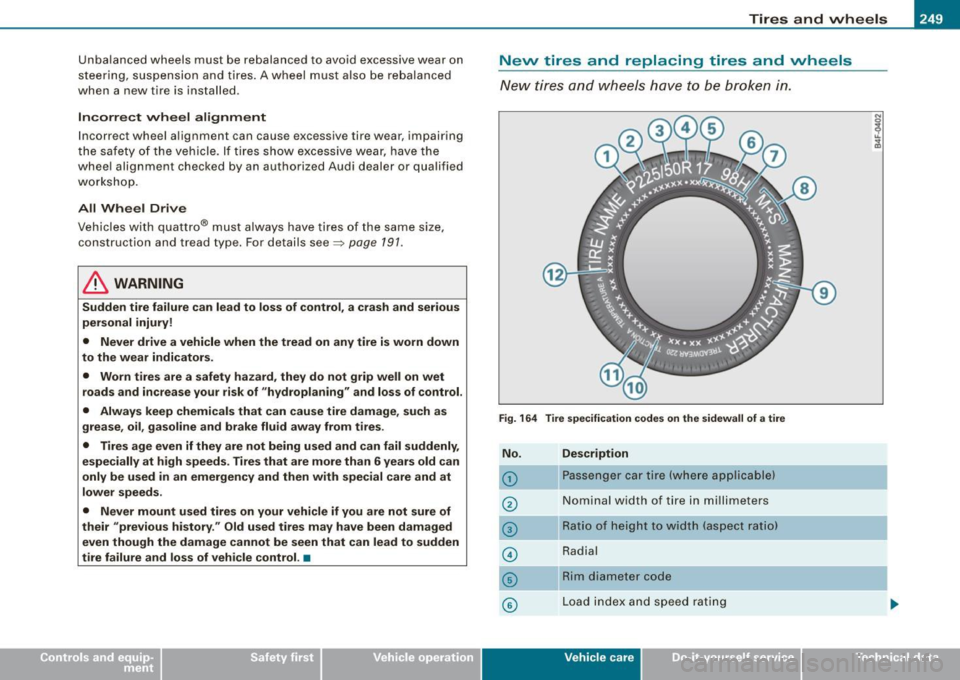
Fig. 164 Tire specification codes on the sidewall of a tire
No.
©
0
©
©
©
©
Description
Passenger car tire (where app licable)
Nominal width of tire in mi llimeters
Ratio of height to width (aspect ratio)
Radial
ii Rim diameter code
Load index and speed rating
Vehic le care
I I irechnical data
Page 258 of 316
_L_T~ir ~e :..:s~ a~n~ d~ w~ h ~e~e~ l~ s '.,_ ______________________________________________ _
Wheel bolts
W heel b olts mus t al wa ys be tigh te n ed to t he cor rect
to rqu e.
The design of wheel bolts is matched to the factory instal led rims . If
d ifferen t rims are fitted, the co rrect w heel bo lts wit h th e rig ht length
and correctly shaped bolt heads m ust be used. This ensures that
w hee ls are fitt ed s ecure ly a nd th at t he brake sys te m funct ions
correctly .
I n certain circums tances, yo u may no t use w heel b olts fr om a
differ ent vehicle -even if it is the same model::::;,
page 296.
&_ WARNING
Improperly tightened or maintained wheel bolts can become loose
causing loss of control , a collision and serious personal injury.
• Always keep the wheel bolts and the threads in the wheel hubs
clean so the wheel bolts can turn easily and be properly tightened.
• Never grease or oil the wheel bolts and the threads in the wheel
hubs. They can become loose while driving if greased or oiled,
even if tightened to the specified torque .
• Only use wheel bolts that belong to the rim being installed.
• Never use different wheels bolts on your vehicle.
• Always maintain the correct tightening torque for the wheel
bolts to reduce the risk of a wheel loss. If the tightening torque of
the wheel bolts is too low , they can loosen and come out when the
vehicle is moving . If the tightening torque is too high, the wheel
bolts and th reads can be damaged and the wheel can become
loose .
0 Note
The specified torque for the wheel bolts is 90 ft lb (120 Nm) with a
t ole ranc e of ± 7,4 ft lb(± 1 0 Nm). To rque whee l bolts diag onally.
After changing a wheel, the torque must be checked as soon as possible with a to
rque wrench -preferab ly by an authorized Audi
dea ler o r qu alif ied wo rksh op.•
Low aspect ratio tires
Yo ur Audi is fac tory-equip ped wi th l ow asp ect rati o tires. Th ese tires
have been thorough ly tested and been selected specifically for your
mod el for thei r su per b p erfo rma nce, road feel an d handl in g u nder
a variety of driving conditions . Ask your author ized Aud i dea ler for
mo re deta ils.
T he low aspec t ra tio o f th ese t ires is ind icate d by a numera l o f 55 or
less in the t ire's size designation. The numera l represents the ratio
of the ti re's s idewa ll height in re la ti on to its tread w idth e xpress ed
in percentage. Conventiona l tires have a height/width ratio of 60 or
mo re .
The performan ce of low -aspect -ratio t ires is part icularly sensitive to
improper inflation pressure . It is therefore important that low
aspect ratio tires are inflated to the specified pressure and that the
inflation pressure is regularly checked and maintained. Tire pres
sures should be checked at least once a month and alway s before a
long trip::::;,
page 244, "Checking tire p ressure".
What you can do to a void tire and rim damage
L ow a spect ratio tires can be damaged more easi ly by impact with
potho les, curbs, gull ies or ridges on the road, particularly if the t ire
is underinflated.
In orde r to minimi ze the occurrence o f im pact da mage to th e tire s
of your vehicle, we recommend that you observe the fo llowing
p reca utions:
• Always ma intain reco mm ende d inflat io n pressu res . C heck your
tire p ressure every 2, 000 miles (3 ,000 km) and add ai r if neces sary .
• D rive car eful ly on roads with potholes, deep gullies or ridges.
Th e impact from d riving th ro ugh o r ove r such o bstac les can
dama ge you r tires . Impact w ith a curb may also cause da mage to
your tires . .,_
Page 286 of 316
lllffl.___E_ m _ e _r-==g :...e_ n_ c...:y _ s_ i_t _u _a _t_ i_o _n_ s _______________________________________________ _
& WARNING
• To reduce the risk of serious injury and vehicle damage .
- Always lift the vehicle only at the special workshop hoist and
floor jack lift points illustrated
~ page 283, fig. 188 and
~ page 283, fig. 189.
- Failure to lift the vehicle at these points could cause the
vehicle to tilt or fall from a lift if there is a change in vehicle
weight distribution and balance. This might happen, for
example, when heavy components such as the engine block or
transmission are removed.
• When removing heavy components like these, anchor vehicle
to hoist or add corresponding weights to maintain the center of
gravity. Otherwise, the vehicle might tilt or slip off the hoist,
causing serious personal injury.
0 Note
• Be aware of the following points before lifting the vehicle:
- The vehicle should never be lifted or jacked up from under
neath the engine oil pan, the transmission housing, the front or
rear axle or the body side members . This could lead to serious
damage.
- To avoid damage to the underbody or chassis frame, a rubber
pad must be inserted between the floor jack and the lift points.
- Before driving over a workshop hoist, check that the vehicle
weight does not exceed the permissible lifting capacity of the hoist .
- Before driving over a workshop hoist, ensure that there is sufficient clearance between the hoist and low parts of the
vehicle. •
Page 302 of 316
___ A---" lp_h_ a_b_ e_ t_ i_ c _ a_ l_ in_d_ e_x ______________________________________________ _
A
A/C operation
Climate control
ABS 102
See Anti -Lock Brake System . . . . . . . . 189
Accessories . . . . . . . . . . . . . . . . . . . . . . . . 296
Acoustic park assist rear .. .... .. ... ... ....... .... .. .
Acoustic parking system
Adaptive Light 109
109
defective . . . . . . . . . . . . . . . . . . . . . . . . 36
Adaptive light . . . . . . . . . . . . . . . . . . . . . . . 72
Adding Engine coolant ... .... ........... 228
Engine oil ....................... 225
Windshield washer fluid . . . . . . . . . . 236
Additiona l accessories .. ...... ...... . 296
Additives Engine oi l ....................... 225
Adjustable steering column .......... 105
Adjusting front seats ... .. .... .... .... 87
Adjusting steering column ...... .. ... 105
Adjusting the seats ...... .... ........ 89
Advanced Airbag System Children ........................ 169
Components .. .................. 153
Front airbags ......... .... ...... . 151
How the components work together 154
Monitoring . . . . . . . . . . . . . . . . . . . . . . 157
Weight -sensing mat .. .. .. .... .... 169 Air distribution
Climate control
Air recirculation mode Climate control ...... .... ... .. .. .
Air vents Climate control
Airbag 101
102
102
Warning/indicator lights ..... ...... 19
Airbag system . . . . . . . . . . . . . . . . . . 146, 165
Care ... ........... .... .... ...... 160
Child restraints ............ .... .. 170
Components (front airbags) .. ... ... 153
Danger of fitting a child safety seat on the front passenger seat . . . . . . . . . . . . 147
Disposal . . . . . . . . . . . . . . . . . . . . . . . . 160
Front airbags ................. ... 150
How do the front aiirbags work? . . . . 155
How many airbags does my vehicle have?
153
Important safety instructions on the knee airbag system .......... ....... . 163
Important things to know ......... 146
Indicator light .. ..... ....... ..... 157
Knee a irbags .. ...... ......... ... 161
Monitoring . . . . . . . . . . . . . . . . . . . . . . 157
PASSENGER AIR BAG OFF light ... .. 157 Alternator
See Generator . . . . . . . . . . . . . . . . . . . . 19
Anti -freeze
See Engine coolant system ...... .. 227
Anti-glare inside day-night mirror ...... 82
Anti-Lock Brake System .............. 189
Anti -lo ck brake system
Warning/indicator lights . ...... .... . 20
Anti-Slip Regulation System (ASR) How the system works . . . . . . . . . . . . 186
Anti-theft systems Anti-Theft Alarm System ........... 56
Electronic immobilizer ............. 49
Ashtray .............. ........... .... 94
ASR How the Anti-Slip Regu lation System
works ......................... 186
Asterisk What does it mean when something is
marked with an asterisk? ... .... .... 6
Audi magnetic ride .... .... ..... .. 17, 112
Description .... .... .... ...... .... 112
Indicator light .... .... ............ 17
Audi Service Repair Manuals and Literature .
294
Repairs .. .... ....... ...... .... .. 160 Auto Safety Hotline . .... .... .... ..... 136
Side airbags . ........ ....... ..... 164 Auto-Check Contro l ................... 29
When must the system be inspected? . . . Automatic transmission ............ 31
157 Auto-Check -Control
All Wheel Drive . . . . . . . . . . . . . . . . . . . . . 191
Alloy wheels . . . . . . . . . . . . . . . . . . . . . . . 207 Manual
transmission
Automatic belt retractor 31
141
air conditioning All-wheel drive Automatic car wash
Temperature .. ............ ... ... 100 Winter tires ..................... 254 See Washing .................. .. 201
Page 303 of 316
______________________________________________ A_ l.:.. p _h_ a_ b_e _t_ic _ a _ l _in _ d_e _ x __ _
Automatic folding top
closing .. .... .... ....... ..... ... . 62
opening ... ... ... .... .... ... .... .. 62
Automatic headlight control .. ......... 70
Automatic transmission .. .... .... .... 113
Driving Notes ......... .... .. ..... 114
Emergency program .... ...... .... 119
Emergency release . . . . . . . . . . . . . . . 120
Ignition key safety lock . ...... ..... 106
Kick -down .. ... .. .... .... ...... .. 117
Launch Control Program ........... 117
Selector lever lock ........ .... .... 116
Selector lever positions .... ..... .. 115
Tiptronic ... .. .... .... ... .... .... 118
Tiptronic controls on the steering wheel
119
Average speed ... ... ..... ... .... .... . 39
Avoid damaging the vehicle ..... .... . 194
B
Battery .. ... .... .... .... ..... .. 231, 234
Battery location inside the engine
compartment . ...... .... .... 221, 222
Charging ........................ 235
Checking battery acid level .. .. 234, 235
Connecting ...................... 231
Disconnecting .... .... .... ...... . 231
Important warnings when working on the
battery ........................ 232
Replacing the battery .. .......... . 231
Winter operation ................. 231
Working on the battery ... .... .... . 232
Battery voltage . .... .... .... ... .... .. 35
Controls and equip
ment Safety first
Before
driving . .... . .. ... ... ........ 128
Bi -Xenon headlights .................. 75
Blended gasoline . ... .... .... .... .... 214
Body cavity sealing ...... ...... ... .. . 207
Booster seats .. ...... .... .... .... ... 175
How do I properly install a booster seat in
my vehicle? . .......... .... ... .. 175
Safety instructions . .... .... ... .... 175
Brake fluid Changing the brake fluid .. ........ 230
Checking the brake fluid level ...... 230
What is the correct brake fluid level? 230
What should I do if the brake fluid warning
light comes on? ... .. .... .... .... 230
Brake fluid reservoir . ...... ...... .... 230
Brake light defective ........ .... .... .. 36
Brake system ... ... .. .... ........ 32, 230
Anti-lock brake system .. ....... .... 20
Brake Assistant ........ ... .. .... . 189
Brake fluid ................... .... 230
Brake f luid specifications for refill and
replacement .... ...... ...... .... 230
Brake pads ... ... .... .... .... .... 193
General information .............. 188
How does the moisture or road sa lt affect
the brakes? ..... ...... ...... .... 188
Warning/indicator lights .. ...... .... 20
Break -in period ...... ...... ... .. .... 192
Brake pads ...................... 193
Tires .. .... .... ... .... .... .... ... 192
Bulbs .... ... .... .. . .. .............. 277
C
California Proposition 65 Warning . .... 221
Battery specific .... ... .... .... .... 234
Capacities ... .... ........ ... .... .... 291
Car care ... .... ... .. .... .... .... .... 200
Interior ..... .... .. .... ........... 208
Plastic and vinyl .................. 204
Weatherstrips ..... .... ...... ..... 206
Care of exterior .. .... ....... ........ 200
Cargo area
See Luggage compartment . ... .... . 135
Catalytic converter ...... .... .... .... 193
CD changer ..... .... .... .... .... ..... 96
Certification ...... ... .... ...... ...... 45
Changing a flat tire ... .... .... ....... 267
Changing engine oil ............. .... 226
Chassis Undercoating .... ..... ... .... .... 207
See also Audi magnetic ride .... .... 112
Check ing
Battery acid level ......... ... . 234, 235
Engine coolant level .............. 228
Checking tire pressure . ... .... .... ... 244
Child restraint
Danger of using child restraints in the front seat .... ... .... .... .... ... 147
Child restraints Where can I get additional information
about chi ld restraints? ... ........ 180
Child safety ...... .... ... .... ... 168, 173
Booster seats .... .... .... .... ... . 175
Convertible child safety seats ... ... 174
Vehicle operation Vehicle care Do-it-yourself service Technical data
Page 305 of 316
______________________________________________ A_ l_,_ p _h_ a_ b_e _t_i c_ a _ l _in _ d_e _ x __ lllll
Dimensions ... .. ...... . .... .. .. .... 290 Electronic differential lock (EDU
Dipstick Reading the dipstick properly
Direct Shift Gearbox 224
Emergency release . . . . . . . . . . . . . . . 120
Distance ........ .... ....... ...... ... 40
Driver information system . .... .... ... . 22
Digital speedometer ... .. .... ...... 24
Fuel filler cap ...... ..... .... .... .. 24
Menu button ..................... 28
Menu display ..................... 27
Open door or rear lid warning . ......
24
Outside temperature display .. .... .. 23
Parking brake warning ............. 30
red symbols .. ............. ....... 31
Setting ...... .... ... .... ..... .. .. 28
Sound system disp lay ............ .. 23
Text messages . .... .... .... .... ... 30
Driver seat See Seating position . ............. 130
Driving Run -flat tires . .... .... ....... .... . 258
Dr iving messages ... ..... .. ... .... ... 30
Driving safely . . . . . . . . . . . . . . . . . . . . . . . 128
Driving time ... .... ... ..... .... .... .. 39
Duplicate key .... .... ...... ....... ... 47
Dust filter . ....... .... .... ........ ... 99
E
Electro -mechanical power assist ... 21, 190 How the system works
............ 186
Warning/indicator lights ............ 20
Electronic immobilizer ...... ... .. .. 14, 49
Electronic power cont ro l
EPC warning/indicator light ..... .... 17
Electronic Stability Program .......... 184
Electronic stabilization program (ESP! Warning/indicator lights ........ .... 18
Emergency flasher Warning/ind icator lights .. .... ...... 19
Emergency flashers .................. 75
Emergency locking . ... .... .... ... .. .. 54
Emergency operation Folding top ....................... 64
Rear lid .. .... ....... .... .... .... . 56
Emergency release for selector lever ... 120
Emergency starting ........ ... .... ... 278
Emergency towing .. ............. .. . 281
Engine Cecking and filling locations ... ... . 222
Checking and filling locations ...... 221
Coolant ... .. .... .... ..... .. ... .. 227
Hood . ..... .. ... ... .. .... ..... .. 219
Starting ..................... 106, 107
Starting with jumper cables ........ 278
Stopping .... .... ...... ...... ... . 107
Engine compartment .... ...... ...... 221
Safety instructions ................ 220
Working in the engine compartment 220
Engine coolant sys tem ..... .... ...... 227
Adding coolant .... .... ..... ... ... 228
Checking the engine coolant leve l .. . 228 Radiator fan
... .. .. .. .... .... .... 229
Temperature gauge ................ 13
Engine cooling system Malfunction ... .. .... .... .... ..... 32
Engine data .. ............... .... ... 291
Engine hood Closing .. ... ........ .... ... ..... 220
How to release the hood ... ... ... .. 219
Engine oil . ...... .... .... ... .... .... 222
Adding .... ....... .... ... .... .... 225
Additives .. .... .... ... .... .... ... 225
Changing . .... .... .... ..... ..... . 226
Checking the engine oi l leve l ... .... 224
Indications and conditions requiring extra checking .... .... .... .... .... ... 224
Oil consumption . ...... ..... .. .... 224
Oil grades . ....... .... .... ....... 222
Pressure malfunction .............. 33
Recommended oil check intervals ... 224
Specification and viscosity ......... 222
Engine oi l leve l .. .... .... ... .... .... . 35
Engine oil sensor defective .... ...... .. 35
Environment Break-in period ..... .. ... .... .... . 192
Catalytic converter .......... ... .. . 193
Disposing of your vehic le battery .. . 231
Driving at high speeds . ...... .... . 194
Dr iving to minim ize pollution and noise .
194
Fuel .. .... .... .... ... .... .... ... 216
Fuel economy ......... ........ ... 194
Leakage from your vehicle . .... .... 220
Letting the vehicle stand and warm up ..
195
Controls and equip ment Safety first Vehicle operation
Vehicle care Do-it-yourself service Technical data
Page 309 of 316
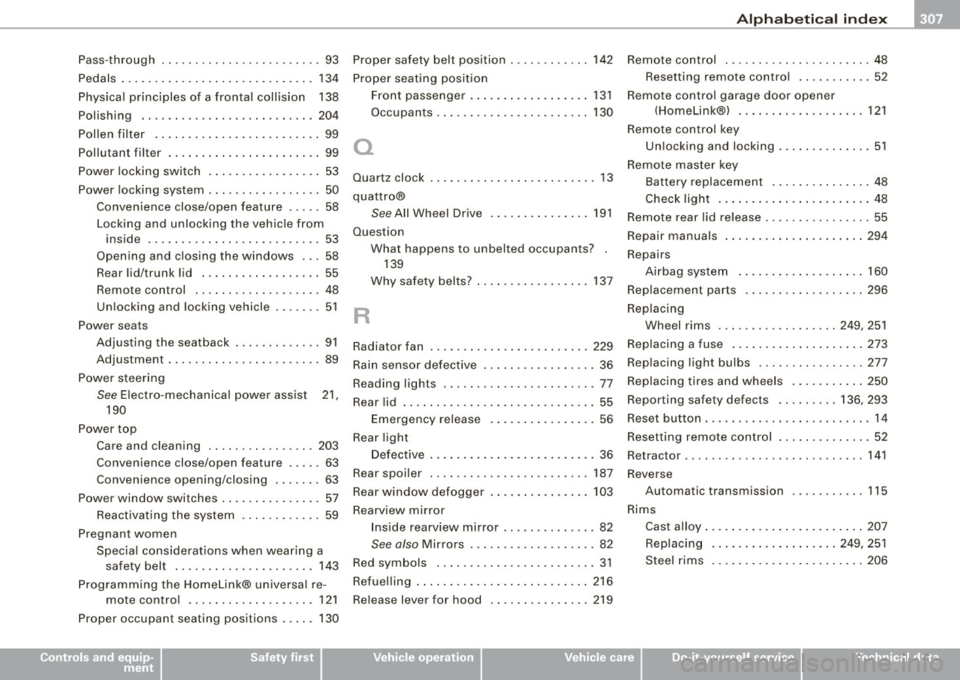
______________________________________________ A_ l_,_ p _h_ a_ b_e _t_ic _ a _ l _in _ d_e _ x __ lll
Pass-through .. ..... .... ... .... .... .. 93 Proper safety belt position . ... .. ...... 142 Remote control ....... ... .. .. ... .. ... 48
Pedals ...... .... ... ........ .... .... 134 Proper seating position Resetting remote control ...... ... .. 52
Physical principles of a frontal collision 138
Polishing ...... .... .... ....... .... . 204
Pollen filter ......................... 99
Pollutant filter .. .... .... .... .... ... .. 99
Power locking switch ........... .... .. 53
Power locking system ... .... .... .... .. 50
Convenience close/open feature .... . 58
Locking and unlocking the vehicle from
inside .. .. .. .... .... ... .... .... . 53
Opening and closing the windows ... 58
Rear lid/trunk lid ..... .... .... .... . 55
Remote control ...... .... .... ... .. 48
Unlocking and locking vehicle . .... .. 51
Power seats
Adjusting the seatback ....... .... .. 91
Adjustment .. .... .... .... ...... ... 89
Power steering
See Electro -mechanical power assist 21,
190
Power top
Care and cleaning . ....... .... .... 203
Convenience close/open feature ... .. 63
Convenience opening/closing ... .... 63
Power window switches ...... ...... ... 57
Reactivating the system .... .... .... 59
Pregnant women
Special cons iderations when wearing a
safety belt . .... .... .... ... .... . 143 Front
passenger . ...... ........... 131
Occupants .. ...... ...... ... .. .... 130
a
Quartz clock .. ...... ..... .. .... .... .. 13
quattro®
See All Wheel Drive ............... 191
Question
R
What happens to unbelted occupants? .
139
Why safety belts? ... .. .... .... .... 137
Radiator fan .... .... ..... .. .... .... . 229
Rain sensor defective ................. 36
Reading lights ... ... ..... ... .... .... . 77
Rear lid ........ ....... ...... .... .... 55
Emergency release ......... ...... . 56
Rear light
Defective . ................... .... . 36
Rear spoiler . .... .... ....... ........ 187
Rear window defoggeir ............... 103
Rearview mirror Inside rearview mirror .. .... .... ... . 82
See also Mirrors ........... ....... . 82
Red symbols . ... .... .... .... .... ... . 31
Programming the Homelink® universal re- Refuelling ............... .... .... ... 216
mote contro l ... .... .... ... .... . 121 Release lever for hood .. .... .... .... . 219
Proper occupant seating positions .. ... 130 Remote
control garage door opener
(Homelink®l .... .... .... .... ... 121
Remote control key Unlocking and locking ..... .... .... . 51
Remo te master key
Battery replacement ...... .... .... . 48
Check light .. ....... .. ...... ...... 48
Remote rear lid release .... ... .. ...... . 55
Repair manuals ...... .... .... .... ... 294
Repairs Airbag system ................... 160
Replacement parts ... .... ... .... .... 296
Replacing Wheel rims .... .... ... ....... 249, 251
Replacing a fuse .. ...... .... .... .... 273
Replacing light bulbs .. ... .. . .... .. . . 277
Replacing tires and wheels ...... ..... 250
Reporting safety defects .. ... .... 136, 293
Reset button . .... ........ .... ... .... . 14
Resetting remote control ......... .... . 52
Retractor .......... .. .... ...... .... . 141
Reverse Automatic transmission .... ... .... 115
Rims Cas t alloy ..... .... .... .... .... ... 207
Replacing .... .... ....... ... . 249, 251
Stee l rims . .... ... .... ...... ... .. 206
Controls and equip
ment Safety first Vehicle operation
Vehicle care Do-it-yourself service Technical data