charging AUDI TT ROADSTER 2008 Owners Manual
[x] Cancel search | Manufacturer: AUDI, Model Year: 2008, Model line: TT ROADSTER, Model: AUDI TT ROADSTER 2008Pages: 316, PDF Size: 70.1 MB
Page 21 of 316
Additional information about the electrically retractable rear spoiler
=:> page 187 . •
Turn signals ¢ Q
The indicator light blinks when you use either turn signal.
Whenever you use the left¢ or the right c::::> turn signal, the indicator
light blinks. When you use the emergency flasher, both indicator
lights flash .
If one of the turn signa l light bu lbs burn out, the turn signal will
blink twice as fast as normal.
Additiona l information on the turn signals :::::>
page 76. •
Cruise control
CRUISE (USA models )/ (')<> (Canada models)
The CRUISE warning/indicator light illuminates when the cruise
control is activated. •
Airbag system
~~ (USA models) / !_~· (Canada models)
This warning/indicator light monitors the airbag and the
tensioner systems .
The ti (USA models) !! 'tr (Canada models) warning light illuminates
for a few seconds each time you switch on the ignition .
If the m (USA mode ls)
/ J q· (Canada models) warning light does not
go out, or if it i lluminates whi le you are driving, or if it starts to blink,
then there is a malfunction somewhere in the system. If the light
does not illuminate when you switch on the ignition, this also
means there is a malfunction.
Controls and equip
ment
Instruments and warning /indi cator lights
& WARNING
If you have a malfunction in the airbag system, contact your autho
rized Audi dealer immediately. Otherwise the airbag or the belt
tensioner may not work properly in an accident. •
Generator 0
This warning/indicator light detects a malfunction in the
generator or in the vehicle's electrical system.
The D warning/indicator light illuminates when you switch on the
ignition and must go out after the engine has started.
If the D warning/indicator light illuminates while you are driving,
you should contact your authorized Audi deale r. Since the vehicle
battery is discharging, you should switch off any unnecessary elec
trical consumers (for example, the air conditioner).
0 Note
If the -~- warning/indicator light (malfunction in the engine cooling
system) in the instrument cluster shou ld illuminate :::::>
page 32, stop
the vehicle and turn off the engine . The coolant pump is not working
- this can cause engine damage!•
Applies to veh ic les : w ith safety belt warning l ight
Safety belt warning light 4
The warning light is a reminder to fasten safety belts.
The warning light 4 comes on for a few seconds after the ignition
is switched on as a reminder to fasten your safety belt.
Additional information on safety belts:::::>
page 137. •
I • •
Page 219 of 316
_____________________________________ F_ u_ e_l _s _u-= pc...:... p_ly =--- a_ n_ d_ f_ i_ ll _in -=: gc.. y -=--- o-u_ r_ fu_ e_l _t _a _n_ k __ fflllll
•
- Select a medium refuelling rate so that the nozzle
switches off automatically when the tank is full.
Putting the fuel cap back on
- After filling your tank, twist the fuel filler cap clockwise
until you hear a definite click.
- Close the fuel filler flap.
To avoid fuel spilling or evaporating from the fuel tank always close
fuel filler cap properly and completely. An improperly closed fuel
filler cap may also cause a message in the driver information system =>
page 24 or cause the MIL lamp=> page 26 to come on.
& WARNING
Improper refueling or handling of fuel can cause fire, explosion
and severe burns .
• Fuel is highly flammable and can cause severe burns and other
injuries.
• Failure to shut the engine off while refueling and/or to insert
the pump nozzle fully into the fuel filler neck could cause fuel to
spray out of filler neck or to overflow. Fuel spray and overflowing
fuel can cause a fire.
• Never use a cellular telephone while refueling . The electromag
netic radiation can cause sparks that can ignite fuel vapors and
cause a fire .
• Never get back into your vehicle while refueling. If in excep
tional circumstances you must get back in your vehicle while refu
eling, make certain that you close the door and touch metal to
discharge static electricity before touching the filler nozzle again.
Static electricity can cause sparks that can ignite fuel vapors
released during refueling.
• Never smoke or have an open flame anywhere in or near your
vehicle when refueling or filling a portable fuel container.
& WARNING (continued)
• For your safety, we strongly recommend that you do not travel
with a portable fuel container in your vehicle. The container, full or empty may leak and could cause a fire, especially in a crash .
• If, under exceptional circumstances, you must transport a
portable fuel container, please observe the following: -Never fill a portable fuel container while it is anywhere in or
on the vehicle (for example, in the luggage compartment, or on
the trunk). Static electricity can build up while filling and can ignite fuel vapors causing a fire.
- Always place a portable fuel container on the ground before
filling.
- Always keep the filler nozzle completely inside the portable
container before and during filling.
- If filling a portable container made of metal, the filler nozzle
must always be in contact with the container. This will help
prevent static electricity from discharging and cause a fire.
- Never spill fuel inside the vehicle or luggage compartment.
Fuel vapors are highly flammable.
- Always observe local and state/provincial laws regarding the
use, storage and transportation of fuel containers
- Make certain the fuel container meets industry standards
(ANSI / ASTM F852-86l.
(D Note
If any fuel has spilled onto the car, it should be removed immedi
ately to prevent damage to the paint.
<£> For the sake of the environment
As soon as the correctly operated nozzle switches off automatically
for the first time, the tank is full. Do not try to add more fuel because
fuel may spill out. In addition, the expansion space in the fuel tank ..,_
Vehicle care
I t •
Page 237 of 316
Checking and filling -
------------- --------=----" =---------
0 Note
Do not overfill the battery, otherwise battery acid will overflow
through the vent opening. This can damage the paint and cause
corrosion. •
Checking the battery acid level on
conventional batteries *
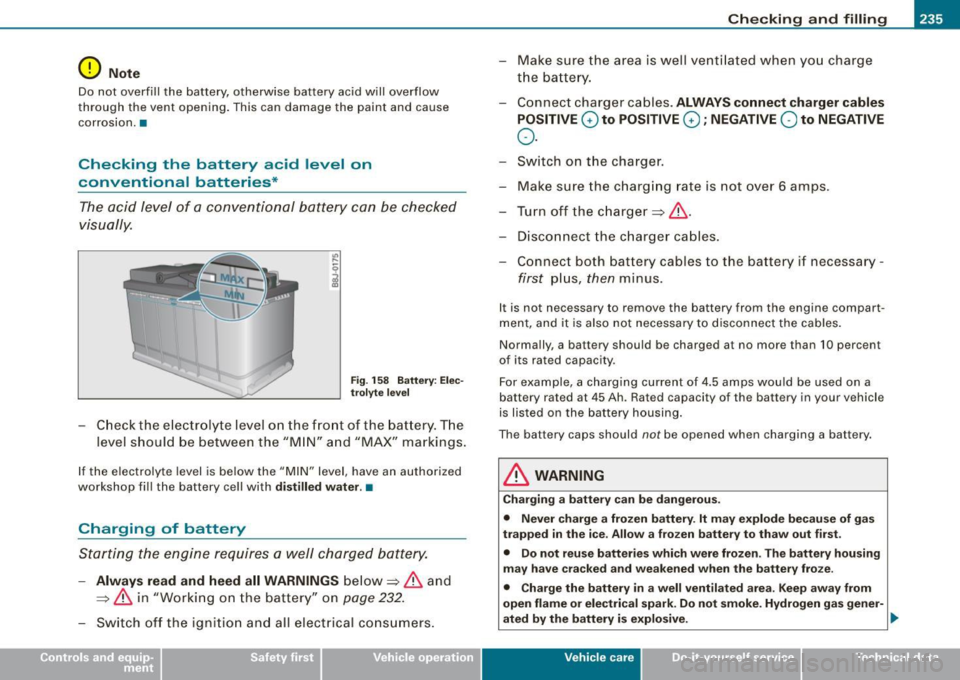
The acid level of a conventional battery can be checked
visually.
Fig. 158 Battery : Elec
trolyte level
-Check the electrolyte level on the front of the battery. The
level should be between the "MIN" and "MAX" markings.
If the electrolyte level is below the "MIN" level, have an authorized
workshop fill the battery cell with
distilled water.•
Charging of battery
Starting the engine requires a well charged battery.
-Always read and heed all WARNINGS below => & and
=> & in "Working on the battery" on
page 232.
- Switch off the ignition and all electrical consumers. - Make sure
the area is well ventilated when you charge
the battery.
- Connect charger cables.
ALWAYS connect charger cables
POSITIVE
(v to POSITIVE (v ; NEGATIVE Q to NEGATIVE
o.
- Switch on the charger.
- Make sure the charging rate is not over 6 amps.
- Turn off the charger=>&.
- Disconnect the charger cables.
- Connect both battery cables to the battery if necessary -
first plus, then minus.
It is not necessary to remove the battery from th e engine compart
ment, and it is also not necessary to disconnect the cables.
Normally, a battery should be charged at no more than 10 percent
of its rated capacity .
For example, a charging current of 4.5 amps would be used on a
battery rated at 45 Ah. Rated capacity of the battery in your vehicle
is listed on the battery housing.
The battery caps should
not be opened when charging a battery.
& WARNING
Charging a battery can be dangerous.
• Never charge a frozen battery. It may explode because of gas
trapped in the ice . Allow a frozen battery to thaw out first.
• Do not reuse batteries which were frozen. The battery housing
may have cracked and weakened when the battery froze .
• Charge the battery in a well ventilated area. Keep away from
open flame or electrical spark. Do not smoke. Hydrogen gas gener-
ated by the battery is explosive. .,_
Vehicle care I I irechnical data
Page 238 of 316
___ C_h_ e_ c_k _in --== g'-- a_n _d_ f_il _li _n ..:::g:::..- ___________________________________________ _
& WARNING (continued)
• To reduce the danger of explosion, never connect or disconnect
charger cables while the charger is operating.
• Fast charging a battery is dangerous and should only be
attempted by a competent technician with the proper equipment.
• Battery acid that may spill during charging should be washed
off with a solution of warm water and baking soda to neutralize
the acid.
0 Note
Never use a fast charger as a booster to start the engine. This will
seriously damage sensitive electronic components , such as control
units, relays, radio, etc., as well as the battery charger.
[ i ] Tips
The vehicle battery must not be charged with a standard small
charger that plugs into the cigarette lighter or outlet .•
Windshield /headlight washer
container
Using plain water is not adequate for filling the wind
shield washer system and the headlight washer system*.
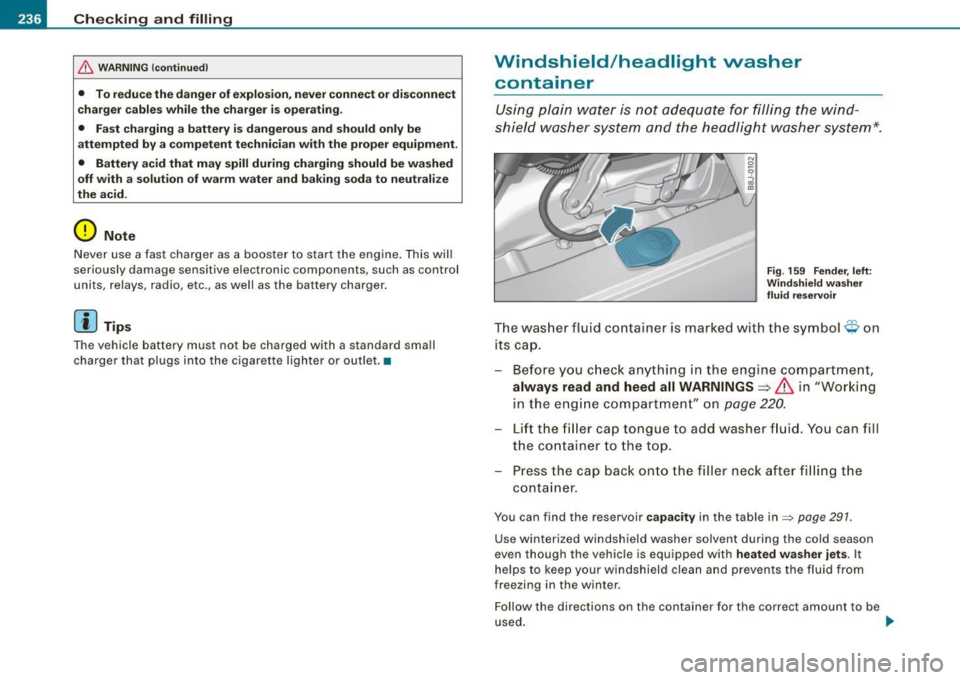
Fig . 159 Fender, left:
Windshield washer
fluid reservoir
The washer fluid container is marked with the symbol e.;. on
its cap.
- Before you check anything in the engine compartment,
always read and heed all WARNINGS=> & in "Working
in the engine compartment" on
page 220.
-Lift the filler cap tongue to add washer fluid. You can fill
the container to the top.
- Press the cap back onto the filler neck after filling the
container .
You can find the reservoir capacity in the table in~ page 291.
Use winterized windshield washer solvent during the cold season
even though the vehicle is equipped with heated washer jets. It
helps to keep your windshield clean and prevents the fluid from
freezing in the winter.
Follow the directions on the container for the correct amount to be
used.
~
Page 281 of 316
________________________________________________ E_ m_ e_r ,,::g c..e_ n _ c..::y;._ s_ i_t _u _a_ t_ i_o _n_ s _ ___.ffllll
& WARNING !continued)
• Before you check anything in the engine compartment, always
read and heed all WARNINGS~ page 212, "Engine compartment".
0 Note
• Applying a higher voltage booster battery will cause expensive
damage to sensitive electronic components, such as control units,
relays, radio, etc .
• There must be no electrical contact between the vehicles as
otherwise current could already start to flow as soon as the positive
(+) terminals are connected.
[ i) Tips
The discharged battery must be properly connected to the vehicle's
electrical system. •
Use of jumper cables
Make sure to connect the jumper cable clamps in exactly
the order described below!
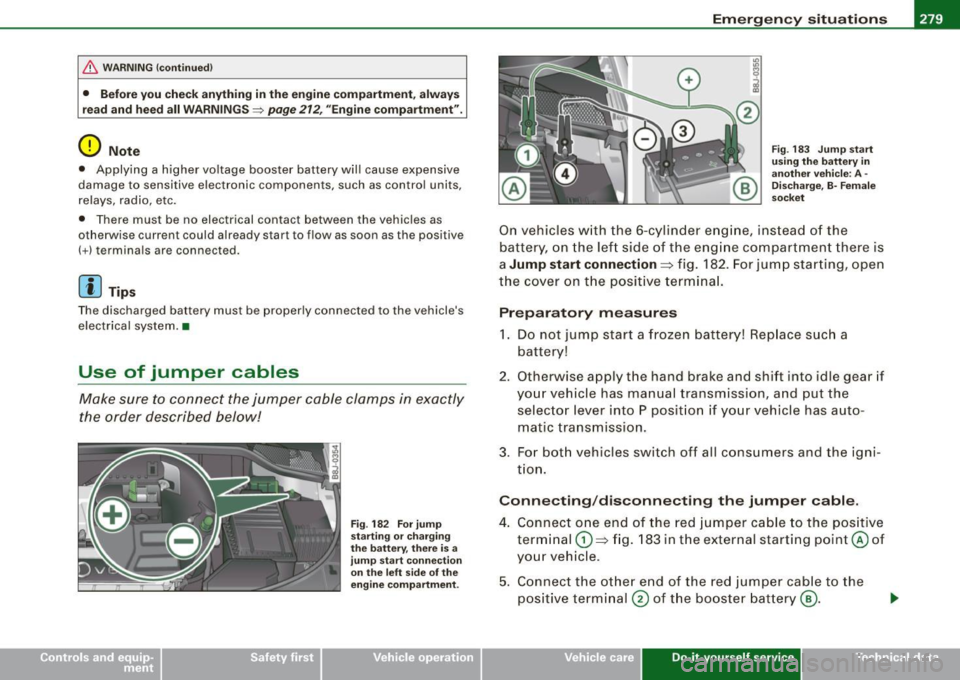
Fig. 182 For jump
starting or charging
the battery, there is a
jump start connection
on the left side of the
engine compartment . Fig. 183 Jump
start
using the battery in
another vehicle: A -
Discharge, B-Female
socket
On vehicles with the 6-cylinder engine, instead of the
battery, on the left side of the engine compartment there is
a
Jump start connection=:> fig. 182. For jump starting, open
the cover on the positive terminal.
Preparatory measures
1. Do not jump start a frozen battery! Replace such a
battery!
2. Otherwise apply the hand brake and shift into idle gear if
your vehicle has manual transmission, and put the
selector lever into P position if your vehicle has auto
matic transmission.
3. For both vehicles switch off all consumers and the igni
tion.
Connecting/disconnecting the jumper cable.
4. Connect one end of the red jumper cable to the positive
terminal
G) =:> fig. 183 in the external starting point@ of
your vehicle .
5. Connect the other end of the red jumper cable to the
positive terminal
® of the booster battery®·
Vehicle care Do-it-yourself service irechnical data
Page 303 of 316
______________________________________________ A_ l.:.. p _h_ a_ b_e _t_ic _ a _ l _in _ d_e _ x __ _
Automatic folding top
closing .. .... .... ....... ..... ... . 62
opening ... ... ... .... .... ... .... .. 62
Automatic headlight control .. ......... 70
Automatic transmission .. .... .... .... 113
Driving Notes ......... .... .. ..... 114
Emergency program .... ...... .... 119
Emergency release . . . . . . . . . . . . . . . 120
Ignition key safety lock . ...... ..... 106
Kick -down .. ... .. .... .... ...... .. 117
Launch Control Program ........... 117
Selector lever lock ........ .... .... 116
Selector lever positions .... ..... .. 115
Tiptronic ... .. .... .... ... .... .... 118
Tiptronic controls on the steering wheel
119
Average speed ... ... ..... ... .... .... . 39
Avoid damaging the vehicle ..... .... . 194
B
Battery .. ... .... .... .... ..... .. 231, 234
Battery location inside the engine
compartment . ...... .... .... 221, 222
Charging ........................ 235
Checking battery acid level .. .. 234, 235
Connecting ...................... 231
Disconnecting .... .... .... ...... . 231
Important warnings when working on the
battery ........................ 232
Replacing the battery .. .......... . 231
Winter operation ................. 231
Working on the battery ... .... .... . 232
Battery voltage . .... .... .... ... .... .. 35
Controls and equip
ment Safety first
Before
driving . .... . .. ... ... ........ 128
Bi -Xenon headlights .................. 75
Blended gasoline . ... .... .... .... .... 214
Body cavity sealing ...... ...... ... .. . 207
Booster seats .. ...... .... .... .... ... 175
How do I properly install a booster seat in
my vehicle? . .......... .... ... .. 175
Safety instructions . .... .... ... .... 175
Brake fluid Changing the brake fluid .. ........ 230
Checking the brake fluid level ...... 230
What is the correct brake fluid level? 230
What should I do if the brake fluid warning
light comes on? ... .. .... .... .... 230
Brake fluid reservoir . ...... ...... .... 230
Brake light defective ........ .... .... .. 36
Brake system ... ... .. .... ........ 32, 230
Anti-lock brake system .. ....... .... 20
Brake Assistant ........ ... .. .... . 189
Brake fluid ................... .... 230
Brake f luid specifications for refill and
replacement .... ...... ...... .... 230
Brake pads ... ... .... .... .... .... 193
General information .............. 188
How does the moisture or road sa lt affect
the brakes? ..... ...... ...... .... 188
Warning/indicator lights .. ...... .... 20
Break -in period ...... ...... ... .. .... 192
Brake pads ...................... 193
Tires .. .... .... ... .... .... .... ... 192
Bulbs .... ... .... .. . .. .............. 277
C
California Proposition 65 Warning . .... 221
Battery specific .... ... .... .... .... 234
Capacities ... .... ........ ... .... .... 291
Car care ... .... ... .. .... .... .... .... 200
Interior ..... .... .. .... ........... 208
Plastic and vinyl .................. 204
Weatherstrips ..... .... ...... ..... 206
Care of exterior .. .... ....... ........ 200
Cargo area
See Luggage compartment . ... .... . 135
Catalytic converter ...... .... .... .... 193
CD changer ..... .... .... .... .... ..... 96
Certification ...... ... .... ...... ...... 45
Changing a flat tire ... .... .... ....... 267
Changing engine oil ............. .... 226
Chassis Undercoating .... ..... ... .... .... 207
See also Audi magnetic ride .... .... 112
Check ing
Battery acid level ......... ... . 234, 235
Engine coolant level .............. 228
Checking tire pressure . ... .... .... ... 244
Child restraint
Danger of using child restraints in the front seat .... ... .... .... .... ... 147
Child restraints Where can I get additional information
about chi ld restraints? ... ........ 180
Child safety ...... .... ... .... ... 168, 173
Booster seats .... .... .... .... ... . 175
Convertible child safety seats ... ... 174
Vehicle operation Vehicle care Do-it-yourself service Technical data