engine overheat AUDI TT ROADSTER 2011 User Guide
[x] Cancel search | Manufacturer: AUDI, Model Year: 2011, Model line: TT ROADSTER, Model: AUDI TT ROADSTER 2011Pages: 260, PDF Size: 64.11 MB
Page 187 of 260
wooded areas, into open streams or
down sewage drains.
- Recycle used engine oil by taking it to a
used engine oil collection facility in your
area, or contact a service station.
Engine cooling system
Coolant
T he engine coolan t performs two functions: it
keeps the engine from overheating and it pro
tects the engine from freezing in the winter .
The cooling system is sealed and generally re
quires little attention .
T he cooling system has been filled at the fac
tory with a permanent coolant which does not
need to be changed . The coolan t consis ts of a
mixture of water and the manufacturer 's gly
col-basedcoolant additive G12 ++ antifreeze
with anticorrosion additives (50% for USA
models; 60% for Canad ian models). This mix
ture both assures the necessary frost protec
tion and protects metal components in the
engine 's cooling system from corrosion and
scaling. It also raises th e boiling point of the
c oolant.
Do not reduce the concentration of the coo l
ant in the summer by adding plain water .
The
proportion of coolant additive must be at
least 50% but not more than 60%
to main
tain antifree ze protection and cooling efficien
cy . If the coolant frost protection is too low,
the coolant could freeze and damage the veh i
cle heating and eng ine cooling system .
For year-round driving, an tifree ze is added at
the factory for temperatures down to:
- -31 ° F ( - 3 5 °C) USA
- -40 °F ( -40 °C) Canada.
You can mix the G12 ++ coolant addit ive with
other additives (G12+ or G12) . Always check
with your authorized Audi dealer.
& WARNING
Before you check anything in the engine
compartment, always read and heed all
-
Checkin g and fillin g 185
WARNINGS c:::> .& in Working in the engine
compartment on page 178.
(D Note
- Before winter sets in, have the coolant
checked to see if the coolant additive in
your vehicle is sufficient to meet the cli
mate conditions. This is especially impor
tant if you live in a region where the win
ter is extreme ly cold . If necessary, in
crease the proportion of coo lant add itive
to 60% .
- Whe n adding coolant additive to your
cooling system, remember :
- We recommend using only coo lant ad
ditive G12++ (check the labe l) for your
vehicle . This coolant additive is avai la
ble at authorized Audi dealers. Other
types of ant ifreeze can significantly re
duce corrosion protection . The result
ing corrosion can cause a loss of cool
ant and ser ious eng ine damage.
- Do not add any type of rad iator leak seal
ant to yo ur vehicle's engine coolant .
Add ing radiator repair fluid may adverse
ly affect the function and performance of
your cooling system and could resu lt in
damage not covered by your New Vehicle
Limited Warranty .
Checking the engine coolant level
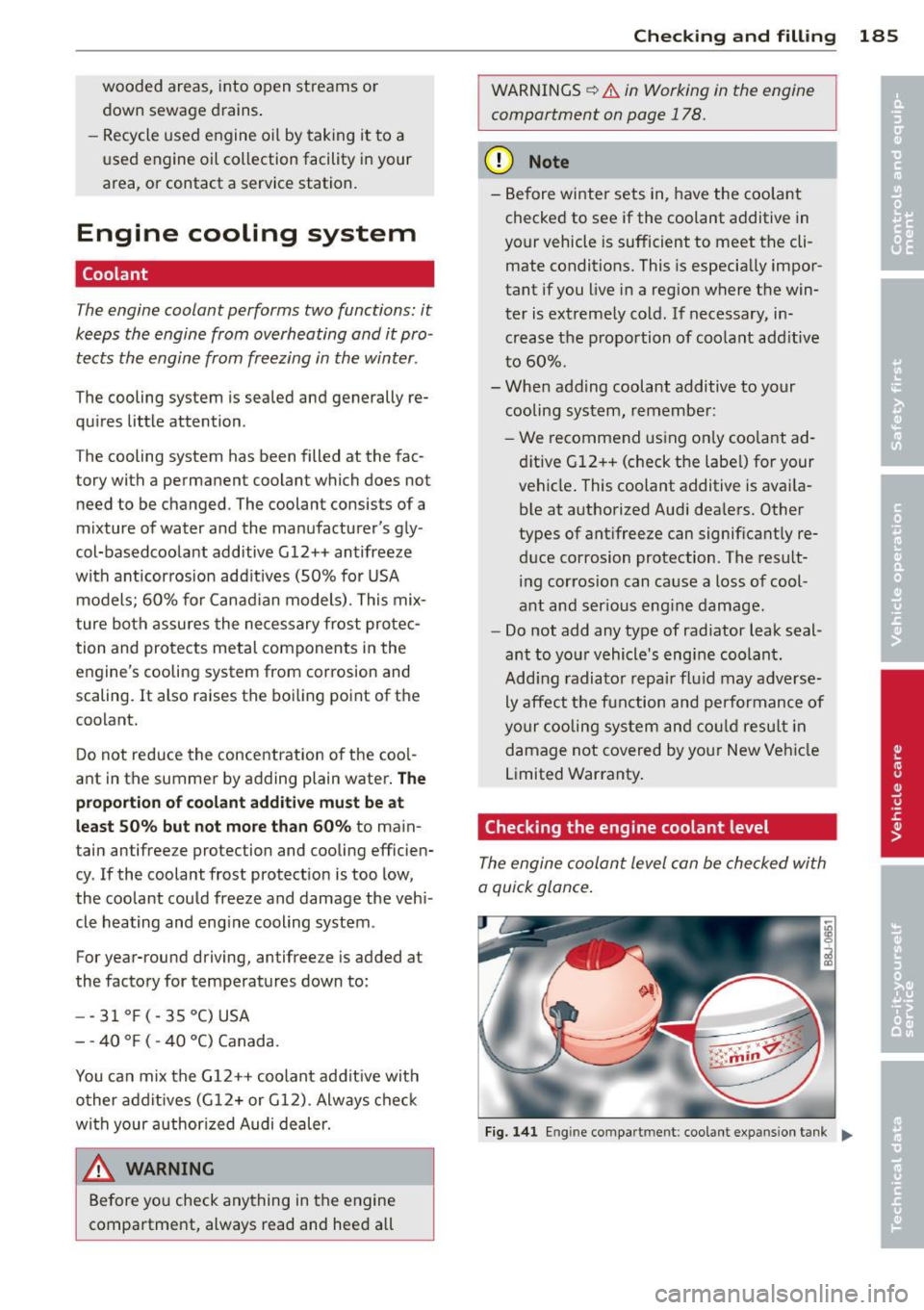
The engine coolant level can be checked with
a quick glance.
Fig. 141 E ng ine compart men t: coo lant ex pansion t ank Ill>
Page 188 of 260

186 Checking and filling
Before you check anything in the engine com
partment,
alwa ys r ea d and heed all WARN
INGS ¢ A in Working in the engine
comportment on page 178.
• Switch the ignition off .
• Read the coo lant level at the coolant expan
s ion tank ¢
fig. 141 . With a co ld engine, it
must be above the "min" mark. W ith a hot
engine, it can be a little above the indicated
range.
The location of the coolant expansion tank
can be seen in the engine compartment illus
tration .
To obtain an accurate reading , the engine
must be switched
off.
The expansion tank in you r vehicle is equipped
with an e lectric coolant level sensor .
When the coolant level is too low, the warning light in the Auto- Check System ¢
page 31 will
blink until you add coo lant and the level has
been restored to no rma l. Even though there is
an electric coolant level sen sor, we still rec
ommend you check the coolant leve l from
time to time.
Coolant loss
Coolant loss may indicate a leak in the cooling
system . In the event of coolant loss, the cool
ing system should be inspected immediately
by your authorized A udi dealer. It is not
enough merely to add coolant .
In a
sealed system, losses can occur only if
the boiling point of the coolant is exceeded as
a result of overheating.
@ Note
Do not add any type of ra diator leak seal
ant to yo ur vehicle's eng ine coolant. Add
ing radiator repair f luid may adversely af
fect the function and performance of your
cooling system and could result in damage
not covered by your New Vehicle Limited
Warranty.
Adding coolant
Be very careful when adding engine coolant.
Before you check anyth ing in the engine com
partment,
always read and heed all WARN
INGS ¢ A in Working in the engine comport
ment on page 178 .
•Turnoff the engine.
• Let the eng ine cool down.
• Place a thick rag ove r the coolant expansion
tank
¢ page 185, fig . 141 and carefully
tw ist the cap counter-clockwise ¢&_ .
• Add coolant.
• Twis t the cap o n aga in
tightly.
Replacement engine coolant must conform to
exact spec ificat ions
¢ page 185, Coolant.
E ven in a n emerge ncy, if coo lant addi -
t ive G1 2++, G12+ or G12 is not ava ilable , do
not use a d ifferen t addit ive. Use plain water
instead unti l you can get the cor rect additive
and can restore the correct ratio . This sho uld
be done as soon as possible .
If you have los t a considerab le amo unt o f
coolant , then you sho uld add cold ant ifreeze
and co ld wate r on ly w hen the engine is cold.
Always use
new engine coo la nt whe n refilling .
Do not fill coola nt above the "MAX" mark. Ex
cess coo la nt wi ll be fo rced o ut through the
pressure relief valve in t he cap w hen the en
gine becomes hot.
,&. WARNING ~ -
- T he cooling system is under pressure and
can get very hot. Reduce the risk of
scalding from hot coolant by followi ng
these steps.
- T urn
off the engine and allow it to coo l
down.
- Protect you r face, hands and a rms from
esca ping fluid and steam by covering
the cap w ith a large, t hick rag.
- T urn the cap slowly a nd ve ry carefully
in a counter-clo ckwise direction while
applying light, downward pres sure on
the top o f the cap.