height AUDI TT ROADSTER 2011 User Guide
[x] Cancel search | Manufacturer: AUDI, Model Year: 2011, Model line: TT ROADSTER, Model: AUDI TT ROADSTER 2011Pages: 260, PDF Size: 64.11 MB
Page 207 of 260
New tires and replacing tires and wheels
New tires and wheels have to be broken in.
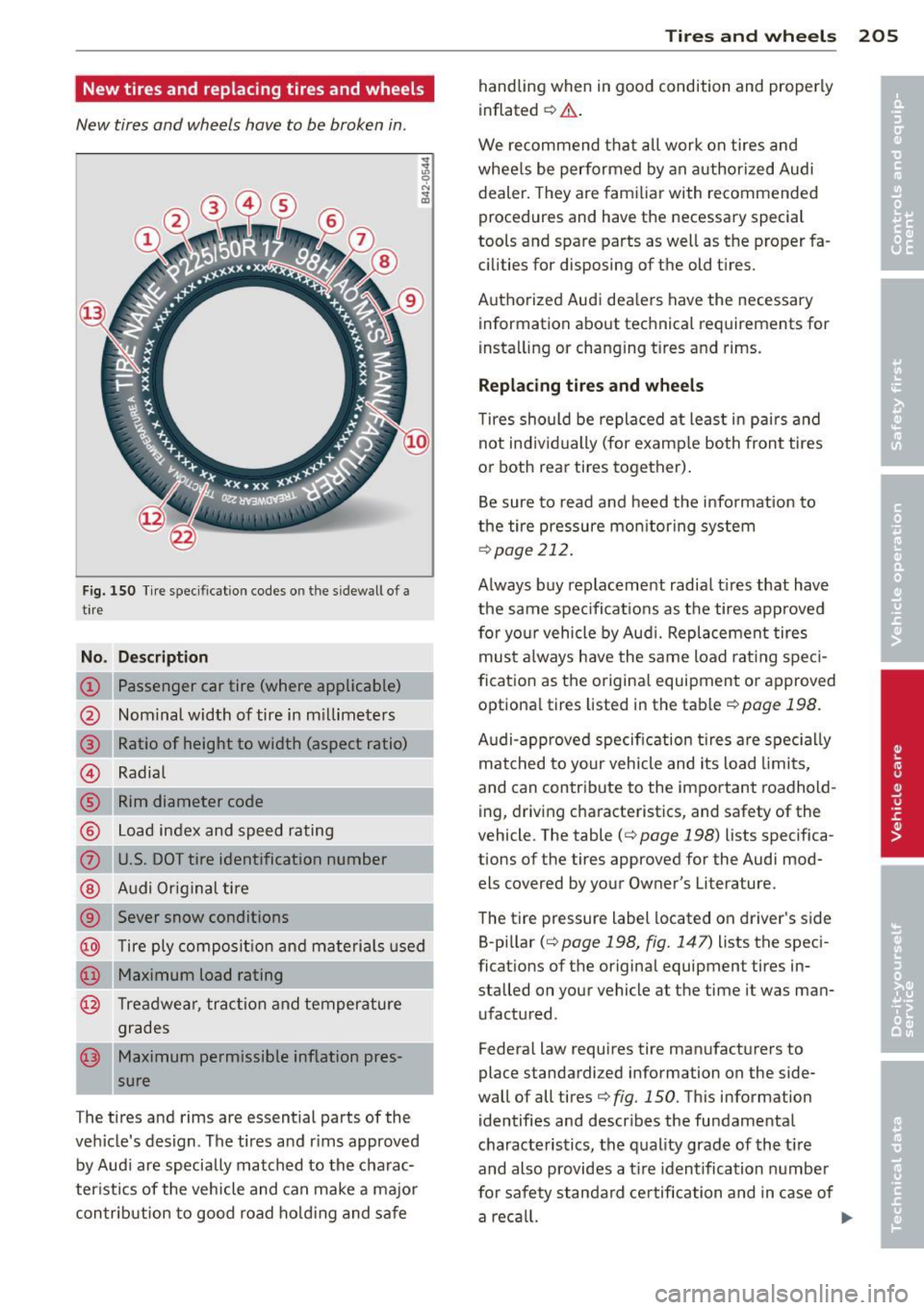
Fig. 150 Tire specification codes on the sidewall of a
t ire
No. Description
(D Passenger car tire (where applicable)
@ Nominal width of tire in millimeters
@ Ratio of height to width (aspect ratio)
@ Radial
@ Rim diameter code
@ Load index and speed rating
(J) U.S. DOT tire identification number
@ Audi Original tire
@ Sever snow conditions
@ Tire ply composition and materials used
@ Maximum load rating
@ Treadwear, traction and temperature
grades
@ Maximum permissible inflation pres
sure
The tires and rims are essential parts of the
veh icle's design . The tires and r ims approved
by Audi are specially matched to the charac
teristics of the vehicle and can make a major
contribution to good road holding and safe
Tires and wheels 205
handling when in good condition and properly
inflated
¢ .&..
We recommend that all work on tires and
wheels be performed by an authorized Audi
dealer. They are familiar with recommended
procedures and have the necessary special
tools and spare parts as well as the proper fa
cilities for disposing of the old tires.
Authorized Audi dealers have the necessary
information about technical requirements for
installing or changing tires and rims .
Replacing tires and wheels
Tires should be replaced at least in pairs and
not ind ividually (for example both front tires
or both rear tires together).
Be sure to read and heed the information to
the tire pressure monitoring system
¢page 212 .
Always buy replacement radial tires that have
the same spec ificat ions as the tires approved
for your vehicle by Audi. Replacement tires
must always have the same load rating speci
fication as the original equipment or approved
optional tires listed in the table¢
page 198.
Audi-approved specification tires are specially
matched to your vehicle and its load limits,
and can contribute to the important roadhold
ing, driving characteristics, and safety of the
vehicle. The table( <=>
page 198) lists specifica
tions of the tires approved for the Audi mod
els covered by your Owner's Literature.
The tire pressure label located on driver's side
B-pillar ( <=>
page 198, fig. 147) lists the speci
fications of the original equipment tires in
stalled on your vehicle at the time it was man
ufactured .
Federal law requires tire manufacturers to
place standardized information on the side
wall of all tires<=>
fig. 150 . This information
identifies and describes the fundamental
characteristics, the quality grade of the tire
and also provides a tire identification number
for safety standard certification and in case of
a recall. .,.
Page 208 of 260
206 Tires and wheels
Tire specifications
Knowledge of tire specifications makes it eas
ier to choose the correct tires. Radial tires
have the tire specifications marked on the
sidewall, for example:
P245 / 45 R 17 95 H
This contains the follow ing informat ion:
P Indicates the tire is for passenger cars
245 Nominal tire width in mm of the tire
from s idewall edge to sidewall edge. In
general, the larger the number, the wider
the tire
45 Height/width ratio in percent (aspect ra-
tio)
R Tire construction: Rad ial
17 Rim diameter code (in inches)
95 L oad rating code
H Speed rating letter code
XL (or "xl", "EXTRA LOAD", or "RF") indicates
that th e tire is a"Reinfo rced" or an "Ex tra
Loa d" tire
M+S (or "M/5") Indicates that the tire has
some mud and snow capability
The tires could also have the information of
direction of rotation ¢
page 194.
Tire manufacturing date
The manufacturing date is also indicated on
the tire s idewall (possibly only on the
inner
side of the wheel) :
"DOT .. . 2209 ... "means, for example, that
the tire was produced in the 22nd week of
2009.
Speed rating (letter code)
The speed rating letter code on the wheels in
dicates the maximum permissib le road speeds
¢ &. in Winter tires on page 209.
P up to 93 mph (150 km/h)
Q up to 99 mph (158 km/h)
R up to 106 mph (170 km/h)
ll For tir es w it h a m ax im um spee d ca pabil ity ove r 149
mph (2 40 km/ h), ti re manufact urers sometimes use
the lett ers " ZR."
S up to 110 mph ( 180 km/h)
T up to 118 mph (190 km/h)
U up to 124 mph (200 km/h)
H up to 130 mph (210 km/h)
V up to 149 mph (240 km/h)1l
Z over 149 mph (240 km/h)ll
W up to 168 mph (270 km/h)
1>
Y up to 186 mph (298 km/h)1>
Your vehicle is normally factory equipped w it h
tires, which possess exce llent dr iving charac
teristics and give your Aud i optimum driving
com fort. An electronic speed limiter
¢ page 28 will normally prevent your vehicle
from going faster than the tire speed rating
¢,&. .
U.S. DOT Tire Identification Number (TIN)
and tire manufacture date
This is the tire's "seria l number". It begins
with the letters "DOT" and ind icates that the
tire meets all federal standards. The next two
numbers or letters ind icate the plant where it
was manufactured, and the last four numbers
represent the week and year of manufacture.
For example, the numbers 2209 mean that
the tire was produced in the 22nd week of
2009. The other numbers are marketing co
des that may or may not be used by the tire
manufacturer. This information is used to con
tact consumers if a tire defect requires a re
ca ll.
Audi Original tire
Tires with the identification "AO" or "RO" have
been specially matched with your Audi. We
recommend using only these tires because
they meet the highest standards regarding
safety and driving characterist ics when used
correctly. Your authorized Audi dealer will
gladly prov ide you w ith more information.
Tire ply compos ition and materials used
The number of plies indicates the number of
layers of rubber-coated fabric in the tire. In
Ill>
Page 213 of 260
can be damaged and the wheel can be
come loose.
@ Note
The specified torque fo r the wheel bo lts is
90 ft lb (120 Nm) with a tolerance of± 7,4
ft lb(± 10 Nm). Torque wheel bo lts diago
nally. After chang ing a wheel, the torque
must be checked as soon as possib le wit h a
torque wrench -preferab ly by an author
ized Aud i dealer or qualified workshop .
Low aspect ratio tires
Your Audi is factory-equipped with low aspect
ratio t ires. These t ires have been thorough ly
tes ted and been selected spec ifica lly for your
model for the ir superb pe rformance, road feel
and handling under a variety of driving condi
tions . Ask your a uthorized Audi dea le r for
more deta ils.
The low aspect ratio of these tires is indicated
by a numeral of
55 or le ss in the tire's size
designation. The numeral represents the ratio
of the tire's sidewall height in relat ion to its
tread width expressed in percentage . Conven
tional tires have a height/width ratio of 60 or more .
The perfo rmance of low -aspect -rat io ti res i s
part icularl y sensit ive to improp er i nflation
pr essu re. It i s th erefore importan t that low
aspect r atio tire s are infla ted to th e specifi ed
pr ess ure and that the inflation pressure is
regu lar ly che cked and maintained. Tir e pr es·
s ur es sh ould b e chec ked at l ea st once a
month and alw ay s before a lon g trip
<=> page 200, Checking tire pressure.
What you can do to avoid tire and rim
damag e
Low aspec t ratio t ires can be damaged more
easi ly by impact with potho les, cu rbs, gu llies
or ridges on the road, part icu larly if the tire is
underinflated .
I n o rder to m inimize the occu rrence o f impact
damage to the t ires of your vehicle, we recom -
Tires an d wheel s 211
mend that you observe the following preca u
tions:
- Always ma inta in re commended inflation
pressures . Check your tire pressu re eve ry
2,000 miles (3,000 km) and add air if neces
sary.
- Drive caref ully on roads with potholes, deep
gullies or ridges. The impact from driving
through or over such obstacles can damage
your tires. Impact with a curb may also cause damage to your tires .
- After any impact, immediate ly inspect your
tires or have them inspected by the nearest
au thor ized Audi dealer. Replace a damaged
tire as soon as possible .
- Inspect your tires every 2,000 m iles (3,000
km) for damage and wear. Damage is no t al
ways easy to see . Damage can lead to loss of
air and under inflat ion, which could eventu
ally cause tire failure .
If you believe that a
tire may have been damaged, rep lace the
tire as soon as possib le .
- These tires may wear more quickly tha n oth
ers.
- Please also remember that, while these tires
de live r responsive handling, they may ride
less comfo rtably and make more noise than
other choices .
Reduced performanc e in winter /cold
season conditions
A ll ti res are designed for certa in p urposes.
T he low aspect ratio, ult ra h igh performance
tires originally installed on your vehicle are in
tended for maxim um dry and wet road per
formance and handling. They are not suitable
for cold , snowy or icy weather condi tions. If
you drive under those circumstances, you
should equ ip your vehicle w ith all-season or
winter tires, which offer bette r traction under
those conditions. We suggest you use the rec
ommended snow o r all-season t ires specified
f o r yo ur vehicle , or thei r equivalent .
Refer to
<=> page 209 fo r more detailed infor
mation regard ing winter tires .
•
•