height AUDI TT ROADSTER 2011 Owners Manual
[x] Cancel search | Manufacturer: AUDI, Model Year: 2011, Model line: TT ROADSTER, Model: AUDI TT ROADSTER 2011Pages: 260, PDF Size: 64.11 MB
Page 68 of 260
66 Seat s a nd s tor ag e
Seats and storage
General recommen
dations
Why is your seat adjustment so
important?
The safety belts and the airbag system can
only provide maximum protection if the front
seats are correctly adjusted.
There are various ways of adjust ing the front
seats to provide safe and comfortable support
for the driver and the front passenger . Adjust
your seat properly so that :
- you can easily and quick ly reach all the
switches and controls in the instrument
panel
-your body is prope rly supported thus reduc
ing physical stress and fatigue
- the safety be lts and airbag system can offe r
maximum protection
¢ page 115 .
In the following sec tions, you will see exactly
how you can best adjust you r seats .
There are special regulations and instructions
for insta lling a child safety seat on the front
passenger's seat. Always heed the informa
tion rega rd ing child safety provided in
¢ page 136, Child Safety .
A WARNING
Incorrect seating position of the driver and
all other passengers can result in serious
personal injury.
- Always keep your feet on the floor when
the vehicle is in motion -never p ut your
feet on top of the instrument panel, out
of the w indow or on top of the seat cush
ion! This applies espec ially to the passen
gers .
If your seating position is incorrect
you increase the r isk of injury in the case
of sudden braking or an acc ident.
If the
airbag infla tes and the seating position
is incorrect this could result in personal
injury or even death.
- It is import ant for bo th the driver and
front passenger to keep a distance of at least 10 inches (25 cm) between them
selves and the steering wheel and/or in
strument panel. If you're s itting any
closer than th is, the a irbag system can
not protect you properly . In addition to
this, the front seats and head restra ints
must be adjusted to your body height so
that they can give you max imum protec
tion.
- Always try to keep as much distance as
possible between yourself and the s teer
ing wheel or instrument pane l.
- Do not adjust the driver's o r fron t pa s
senger's seat whi le the vehicle is moving.
Your seat may move unexpected ly, caus
ing sudden loss of vehicle contro l and
personal injury . If you ad just yo ur seat
while the veh icle is moving, you are out
of posit ion.
Driver's seat
The correct seat position is important for safe
and relaxed driving.
We recommend that you adjust the driver's
seat in the fo llowing manner:
.,. Adjust the seat in fo re and aft direction so
t ha t you can easily p ush the peda ls to the
floor wh ile keeping your knee slightly bent
i::> A in Why is your seat adjustment so im
portant? on page
66 .
.,. Adjust the seatback so that when you sit
w ith your back against the seatback, you can
still grasp the top of the steering wheel.
.,. Posit io n the head restraint according to the
occupant 's height
<=:>page 70 . For maxi
mum protection, t he top of the head re
s t raint shou ld be a t least at eye level, pref
erab ly higher and idea lly level with the top
of the head
¢ page 101, fig. 109 .
A WARNING "--
Never place any objects in the dr iver's foot-
well. An object could get into the pedal
area and interfere with pedal function. In
case of sudden braking or an acc ident, you
wo uld not be able to brake or accelerate!
Page 69 of 260
Front passenger's seat
Always move the front passenger seat into the rearmost position .
To avoid contact with the airbag while it is de
p loying, do not sit any closer to the instru
ment panel than necessary and always wear
the three-point safety belt provided adjusted
correctly . We recommend that you adjust the
passenger's seat in the following manner:
.,. Move the front passenger seat into the rear
most position of the fore and aft adjustment
range
c:::> &. in Why is your seat adjustment
so important? on page
66.
.,. Bring the backrest up to an (almost) upright
position.
Do not ride with the seat reclined .
.,. The idea l position for the head restraint is
with the upper edge of the restraint leve l
with the top of your head
c:::> page 70. You
shou ld
not lower the top of the restra int be
low the level of your eyes .
.,. Place your feet on the floor in front of the
passenge r's seat .
Adjusting front seats
manually
Adjustment controls
App lies to vehicles: with manual seat adjustment
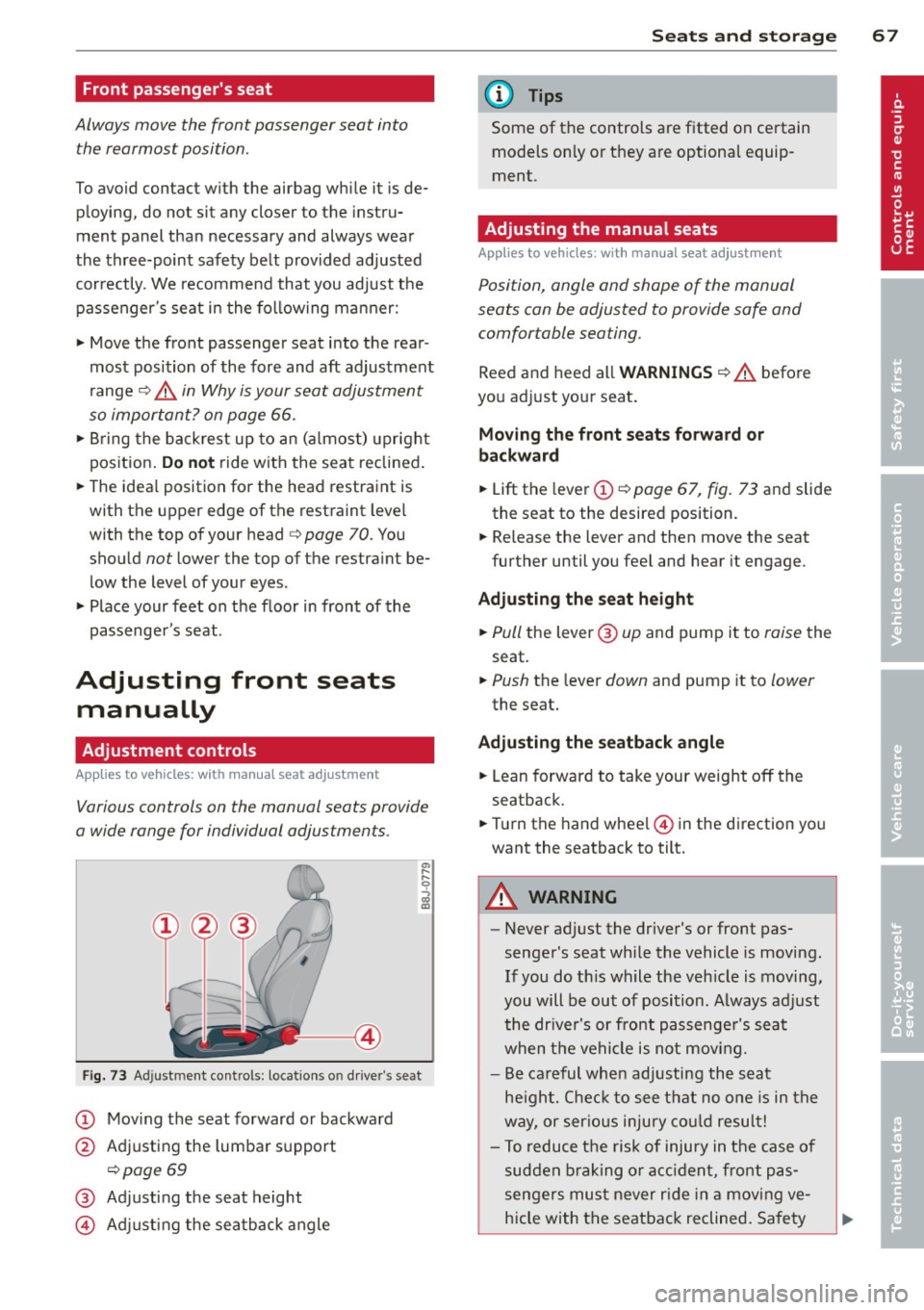
Various controls on the manual seats provide
a wide range for individual adjustments .
Fig. 73 Adjustment contro ls: loca tions o n dr iver's seat
CD Moving the seat forward or backward
@ Adjusting the lumbar support
c:::> page 69
@ Adjusting the seat height
© Adjusting the seatback angle
Seats and storage 67
(D Tips
Some of the controls are fitted on certain
models on ly or they are optional equip
ment .
Adjusting the manual seats
Applies to vehicles : wit h manual seat adjustment
Position, angle and shape of the manual
seats can be adjusted to provide safe and
comfortable seating .
Reed and heed all WARNINGS c:::> A before
you adjust your seat .
Moving the front seats forward or
backward
... Lift the lever CD c:::> page 67, fig. 73 and slide
the seat to the desired position.
.,. Release the lever and then move the seat
further until you feel and hear it engage.
Adjusting the seat height
.,. Pull the lever @ up and pump it to raise the
seat.
... Push the lever down and pump it to lower
the seat.
Adjusting the seatback angle
.,. Lean forward to take your weight off the
seatback.
... Turn the hand wheel © in the direction yo u
want the seatback to tilt.
A WARNING
-
- Never adjust the driver's or front pas
senger's seat whi le the vehicle is moving.
If you do th is while the vehicle is moving,
you will be out of position. Always adjust
the driver's or front passenger's seat
when the vehicle is not moving.
- Be careful when adjusting the seat
height. Check to see that no one is in the
way, or serious injury could result!
- To reduce the risk of injury in the case of
sudden braking or accident, front pas
sengers must never rid e in a moving ve
hicle with the seatback reclined . Safety
Page 70 of 260
68 Seats and st o ra ge
belts and the airbag system only offe r
maximum protection when the seat back
is u pright and the safety belts are prop
erly positioned on the body . The more
the seatback is reclined, the greater the
risk of personal injury from an incorrect
seating pos it ion and improperly posi
t ioned s afety be lts!
Power seats
Adjustment switches
App lies to vehicles: with power seats
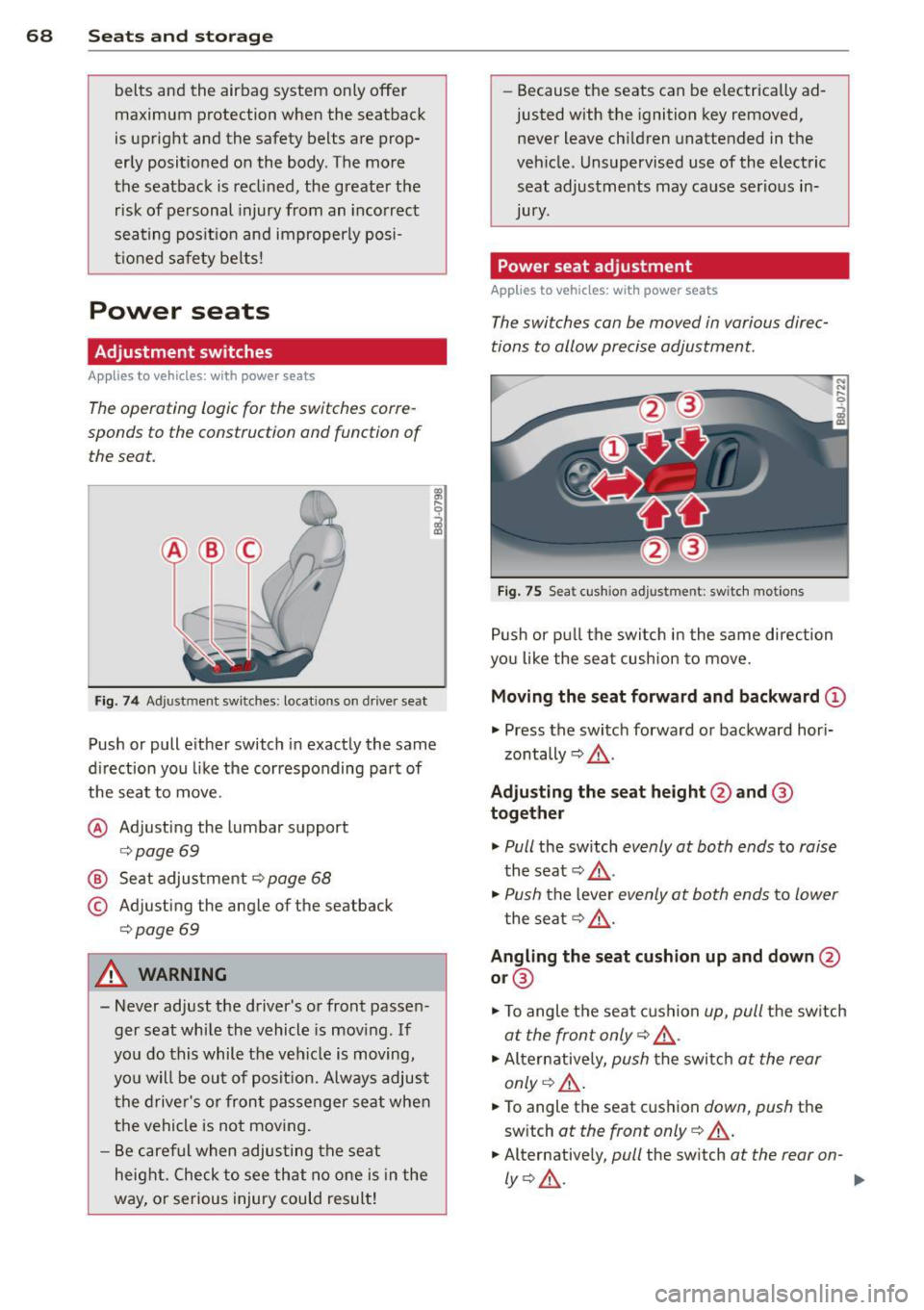
The operating logic for the switches corre
sponds to the construction and function of
the seat.
F ig . 7 4 Adju stm en t sw it c h es: locat io ns o n dr ive r seat
Push or pull e ither switch in exactly the same
d irection you like the corresponding part of
the seat to move.
@ Adjusting the lumba r support
¢ page 69
@ Seat adjus tment¢ page 68
© Adjusting the ang le of the seatback
¢ page 69
A WARNING
- Never adjust t he d river's o r front passe n
ger seat wh ile the vehicle is moving . If
yo u do this while t he veh icle is moving,
yo u will be ou t of posi tion. Always adjust
t h e dr ive r's or front passenger se at when
the vehicle is not mov ing.
- B e caref ul when adju sting t he seat
heig ht. Check to see that no one is in the
way, or serious injury could result! -
Because the seats can be e lectrically ad
justed with the ignition key removed,
never leave chi ldren unattended in the
veh icle . Unsupervised use of the electric
seat adjustments may ca use serio us in
Jury .
Power seat adjustment
Applies to vehicles: wit h power seats
The switches can be moved in various direc
tions to allow precise adjustment.
Fig. 75 Sea t cus hion ad ju st me nt: s wit c h m oti on s
P ush or p ull the switch i n the same direction
yo u like the sea t cushion to move.
Moving the seat forward and backward ©
.., Press the switc h forward or backward hor i-
zontally ¢& .
Adju sting the seat height@and @
together
.., Pull the sw itch evenly at both ends t o raise
the seat ¢ A.
.., Push the lever evenly at both ends to lower
t he sea t¢ & -
Angling the seat cushion up and down@
or @
.., To angle t he seat cushion up, pull the sw itch
at the fron t only ¢& .
.., Altern ative ly, push the switc h at the rear
only ¢& .
.., To angle the seat c ushion down, push the
sw itch
at the front only¢ A.
.., Alternative ly, pull the sw itch at the rear on-
ly ¢& . ....
Page 71 of 260
A WARNING
-Never adjust the driver's or front passen
ger seat while the vehicle is moving . If
you do this while the vehicle is moving,
you will be out of posit ion . Always adjust
the driver's or front passenger seat when
the vehicle is not moving .
- Be careful when adjusting the seat
height. Check to see that no one is in the
way, or serious injury could result!
- Because the seats can be elect rically ad
jus ted wi th the ign it ion key removed,
never leave children unattended in the
vehicle. Unsupervised use of th e electric
seat adj ustments may cause serious in
jury .
Adjusting the seatback
Applies to vehicles: with power seats
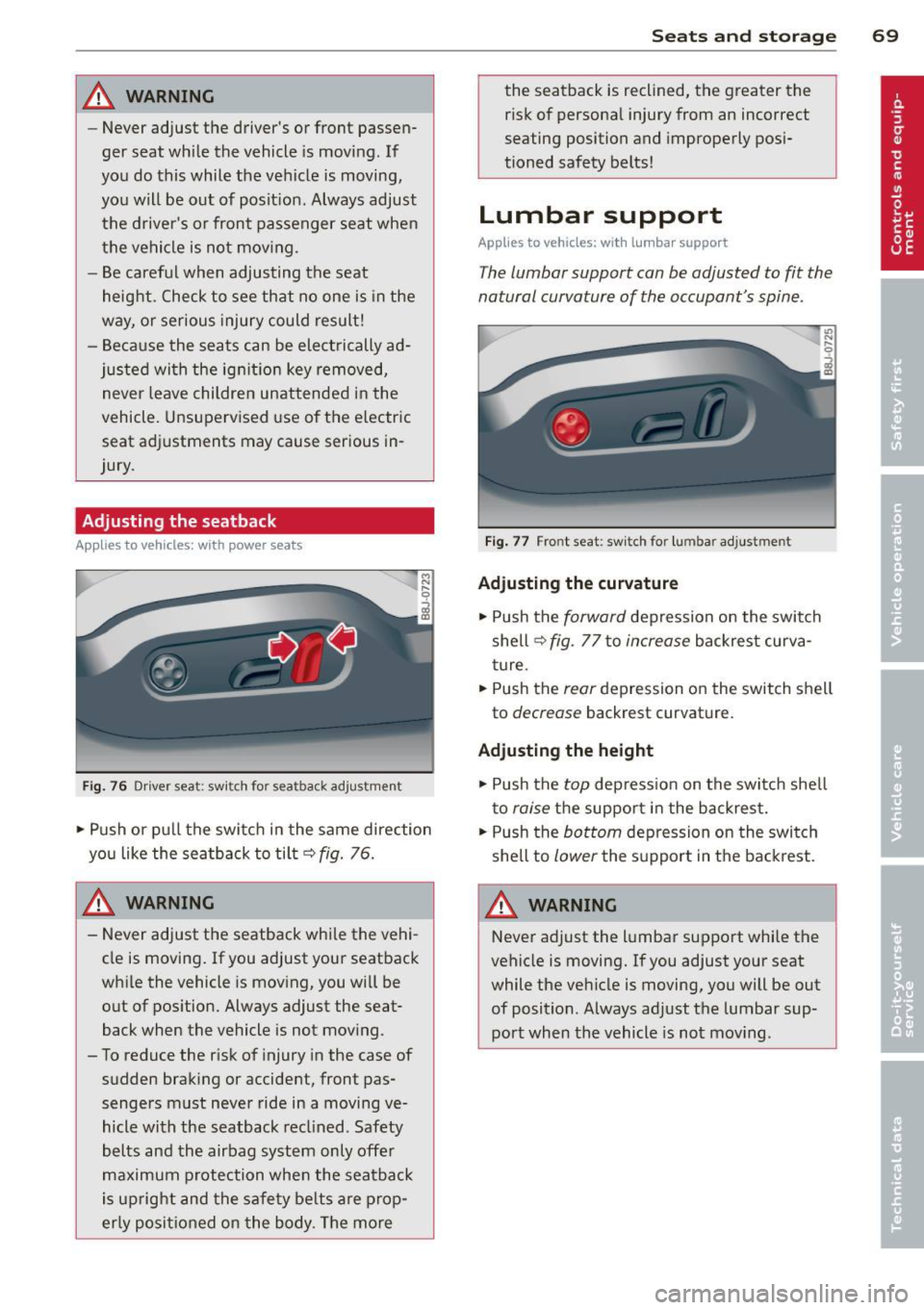
Fig. 76 Drive r s eat: swit ch for seatb ack adju stment
~ Push or pu ll the switc h in the same direction
you like the seatback to tilt ~
fig. 76.
A WARNING
- Never adjust the seatback while the vehi
cle is moving . If you adjust your seatback
whi le the vehicle is moving, you will be
out of pos ition. Always adjust the seat
back when the vehicle is not mov ing .
- To reduce the risk of injury in the case of
sudden braking or accident, front pas
sengers must never ride in a moving ve
hicle with the seatback recl ined . Safety
belts and the airbag system only offer
maximum p rotection whe n the seatback
is upright and the safe ty be lts are prop
erly posit ioned on the body . The more
S ea ts a nd s to rage 69
the seatback is reclined, the greater the
risk of persona l injury from an incorrect
seating position and improperly posi
tioned safety belts!
Lumbar support
Applies to vehicles: with lumbar support
T he lumbar support can be adju sted to fit the
natural curvature of the occupant 's spine .
Fig . 77 Fro nt seat: sw it c h fo r lumb ar adju stmen t
Adju sting the cur vatur e
~ Push the forward depression on the switch
shell
~ fig . 7 7 to increase backrest curva
ture .
~ Push the re ar depression on the switch shell
to
d ecr eas e backrest curvat ure.
Adju sting the height
~ Push the top dep ression on the switc h shell
to
raise the support in the backrest.
~ Push the bottom depression on the swi tch
shell to
low er the s upport in the backrest .
A WARNING
Never adjust the lumbar suppo rt while the
vehicle is moving.
If you adjust your seat
while the ve hicle is moving, you will be out
of position . Always adjust the lumbar sup
port when the vehicle is not mov ing .
Page 72 of 260
70 Seats and st o ra ge
Head restraints
Adjusting head restraints, front seats
The head restraints must be adjusted proper
ly to provide protection .
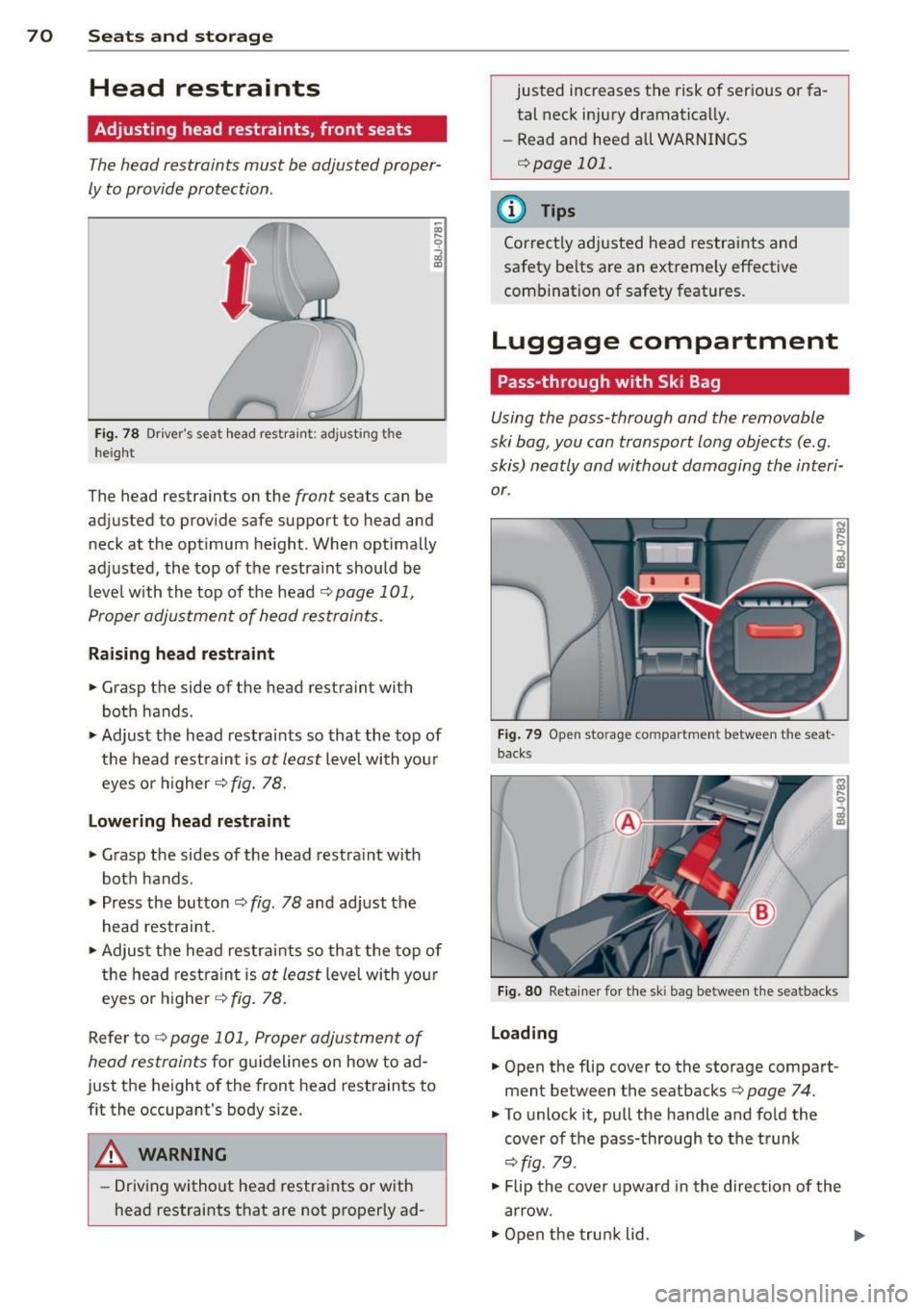
Fig. 78 Dr iver "s seat hea d restra int: ad justing the
height
The head restraints on the front seats can be
adjusted to prov ide safe support to head and
neck at the optimum he ight. When optimally
adjusted, the top of the restra int should be
leve l with the top of the head
qpage 101,
Proper adjustment of head restraints.
Raising head rest raint
• Grasp the side of the head restraint with
bot h hands.
• Adjust the head restra ints so that the top of
the head rest raint is
at l east level with you r
eyes or higher
qfig. 78.
Lowe ring head restraint
• Grasp the sides of the head restra int with
both hands.
• Press the button
q fig . 78 and adjust the
head restraint.
• Adjust the head restra ints so that the top of
t h e head restrain t is
at least level wi th you r
eyes or higher
q fig . 78 .
Refe r to q page 101, Proper adjus tment of
head restraints
for gu idelines o n how to ad
just the heigh t of the front head rest raints to
f it the occupa nt's body size.
&_ WARNING
- Driv ing witho ut head restra ints or with
head restraints that are not properly ad-
-
justed increases the risk of ser ious or fa
tal neck injury dramatica lly.
- Read and heed all WARNI NGS
qpage 101.
(D Tips
Correct ly adjusted head restraints and
safety be lts are an extreme ly effect ive
com bination of safety features.
Luggage compartment
Pass-through with Ski Bag
Using the pass-through and the removable
ski bag, you can transport long objects (e.g.
skis) neatly and without damaging the interi
or.
F ig. 79 Open sto rage compartment between the seat
backs
Fi g. 80 Reta iner fo r th e sk i bag betwee n the seatbacks
Loading
• Open the flip cover to the storage compart
ment between th e seatbacks
q page 7 4.
• To unlock it, pull the handle and fo ld the
cover of the pass-through to the t runk
qfig. 79.
"" Flip the cover upward in the direction of the
ar row.
• Open the tru nk lid.
Page 82 of 260
80 On the road
On the road
Steering
Adjusting the steering wheel column
The steering wheel position can be continu
ously adjusted in height and distance .
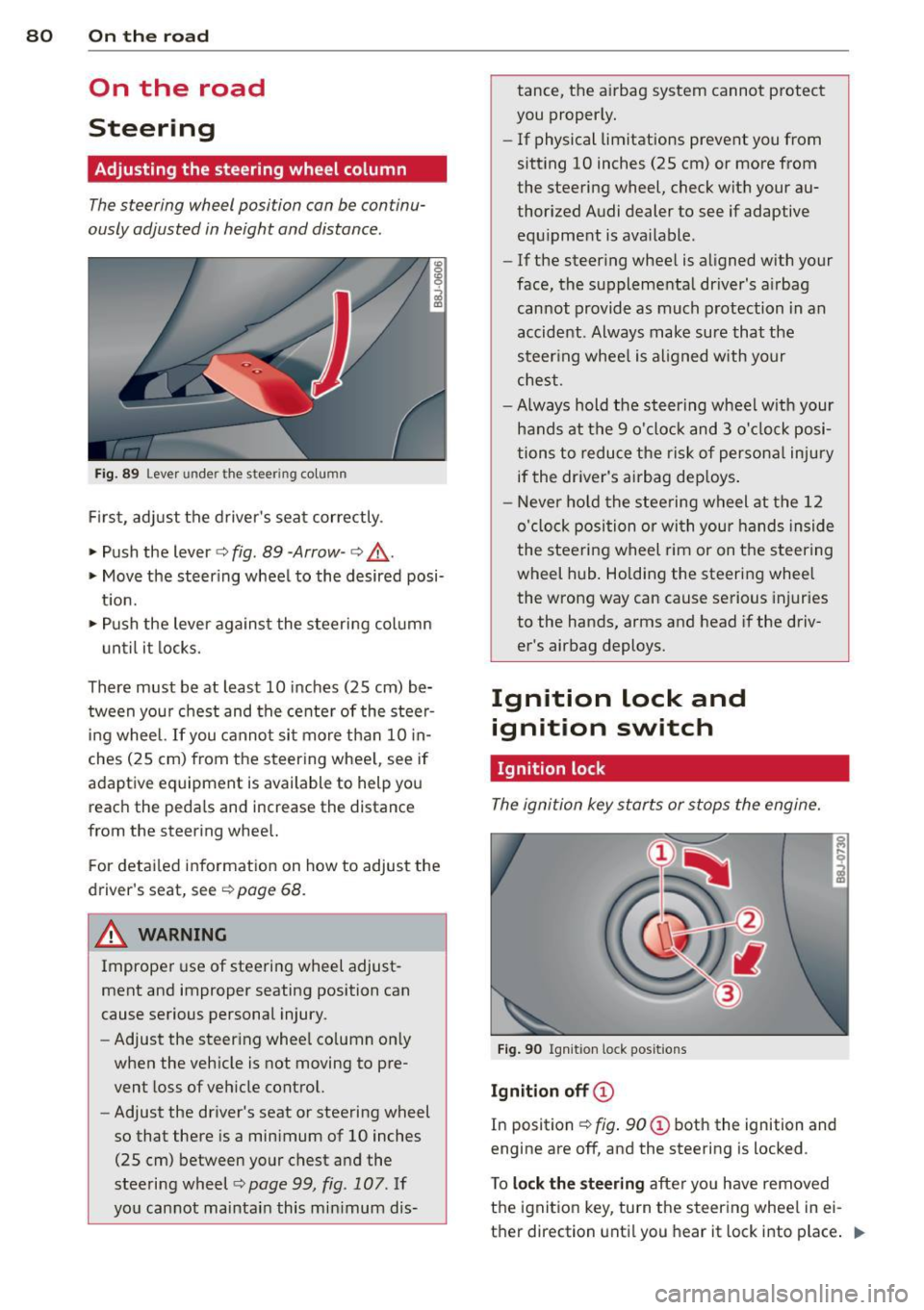
Fig. 89 Lever under the steer ing co lu m n
First, adjust the driver's seat correctly .
• Push the lever
c::> fig . 89 -Arrow -c::> ,&.
• Move the steer ing wheel to the desired posi
t ion.
• Push the lever against the steering column
until it locks.
There must be at least 10 inches (25 cm) be
tween your chest and the center of the steer
i ng wheel. If you cannot sit more than 10 in
ches (25 cm) from the steering whee l, see if
adaptive equipment is available to help you reach the pedals and increase the distance
from the steering whee l.
F or detai led information on how to adjust the
driver's seat, see
c::> page 68.
A WARNING
Improper use of steeri ng wheel adjust
ment and improper seating position can
cause serious personal injury.
- Adjust the steer ing whee l co lumn on ly
when the vehicle is not moving to pre
vent loss of veh icle control.
- Adjust the driver's seat or steering wheel
so that there is a minimum of 10 inches
(25 cm) between your chest and the
steering wheel
¢ page 99 , fig. 107. If
yo u cannot maintain this min imum dis- tance, the airbag system cannot protect
you proper ly.
- If physical limitations prevent you from
sitting 10 inches (25 cm) or more from
the steering wheel, check with your au
thorized Audi dealer to see if adaptive equ ipment is ava ilable .
- If the steer ing wheel is aligned with your
face, the supplementa l driver's a irbag
cannot provide as much protection in an
accident . Always make sure that the
steer ing wheel is aligned with your
chest.
- Always hold the steering wheel w ith your
hands at the 9 o'clock and 3 o'clock posi
tions to reduce the risk of persona l injury
if the driver's airbag dep loys .
- Never hold the stee ring wheel at the 12
o'clock position or with your hands inside
the steeri ng wheel rim or on the steering
wheel hub . Holding the steering wheel
the wrong way can cause serious injuries
to the hands, arms and head if the driv
er's airbag deploys.
Ignition lock and
ignition switch
Ignition lock
The ignition key starts or stops the engine.
Fig . 90 Ign iti on lock pos it ions
Igniti on off ©
In pos ition c::> fig . 90 @ both the ignition and
engine are off , and the steering is locked .
T o
loc k th e steering after you have removed
the ignition key, turn the steering whee l in ei
ther direction until you hear it lock into place .
1)),-
Page 100 of 260
98 Driving Safel y
Driving Safely
General notes
Safe driving habits
Please remember -safety first!
This chapter contains important information,
tips, instructions and warnings that you need
to read and observe for your own safety, the
safety of your passengers and others . We have
summarized here what you need to know
about safety belts, a irbags, ch ild restra ints as
well as child safety. Your safety is for us
priori
ty number 1.
Always observe the info rmat ion
and warn ings in th is sect ion -fo r yo ur own
safety as well as for that of your passengers.
The information in this se ction app lies to all
model ve rsions of your veh icle . Some of the
feat ures desc ribed in this sec tions may be
standa rd equipment on some models, or may
be optional equipment on others . If you are
not sure, ask your authorized Aud i dealer.
A WARNING
- Make certain that you follow the instruc
t ions and heed the WARNINGS in this
Manual. It is in your interest and in the
interest of your passengers .
- Always keep the complete Owner's Liter
ature in your Audi when you lend or sell
yo ur vehicle so that this important info r
mation will a lways be ava ilable to the
dr iver and passenge rs.
- Always keep the Owner's literature handy
so that you can find i t eas ily if yo u have
ques tions.
Safety equipment
The safety features are part of the occupant
restraint system and work together to help
reduce the risk of injury in a wide variety of
accident situations.
Your safety and the safety of your passenge rs
should not be left to chance. Advances in
technology have made a varie ty o f fea tures
avai la bl e to he lp re duce the risk of injury in an accident
. The following is a lis ting o f just a
few of the safety features in your Audi:
- sophis tic ated s afety be lts fo r drive r and a ll
passenger sea ting pos it ions,
- safety belt pre-tensione rs,
- fro nt airbags,
- knee airbags for the front seats,
- side airbags in the front seats,
- LATCH anchorages for child restraints,
- ad justab le steering column .
T hese ind iv idual safety features can wor k to
ge ther as a sys tem to he lp p rotec t you and
you r passengers in a wide range of accidents.
These features cannot wo rk as a system if
they are not always p roper ly adjusted and
properly used!
Safet y is everybody's re sponsibilit y!
Important things to do before driving
Safety is everybody's job! Vehicle and occu
pant safety always depends on the informed and careful driver.
For yo ur safe ty and the safety of you r passen
gers,
befor e driving alwa ys:
"' Make s ure that all lights and signa ls are op
erati ng correctly .
"' Ma ke su re t hat the t ire p ressu re is co rrec t.
"' Mak e su re that all windows are clean and a f
ford good vis ibility to the outs ide.
"' Sec ure all luggage and other items caref ully
I:!) page 7 3.
"'Make sure that nothing can interfere with
the pedals.
"' Adjust front seat, head restraint and mirrors
correctly for your height .
"' Inst ruct passe ngers to adjust the head re
st raints accord ing to the ir height .
"' Ma ke sur e to use the r igh t chi ld restraint
correc tly to protect c hild ren
¢ page 136,
Child Safety .
"'Sit properly in your seat and make sure that
your passengers do the same
I:!) page 66,
General recommendations. .,_
Page 113 of 260
During normal driving the belt lets you move
freely.
Safety belt pretensioners
The safety belts are equipped with a belt p re
tensione r that helps to t igh ten the safety be lt
and remove s lack when the pretensione r is ac
tivated. The function of the pretensioner is monitored by a warning light
¢ page 16.
Switchable locking feature
Every safe ty belt excep t the one on the driver
seat is eq uipped w ith a switchab le locking fea
ture that
mu st be used when the safety belt is
used to attach a child seat . Be s ure to read the
important informat ion about th is f eature
c:;, page 144.
A WARNING
Improperly positioned safety belts can
cause serious injury in an accident
¢ page 111, Safety belt position .
-Safety belts offer optimum protection
only when the seatback is upright and
belts are properly positioned on the
body .
-
-Never attach the safety belt to the buck
le for another seat . Attach ing the belt to
the wrong buckle will reduce safety belt effect iveness and ca n cause seri ous per
sonal in jury.
- A passenger who is no t properly rest rain
ed can be se rio usly inju red by the safety
belt itself when it moves from the stron
ger parts of the body into critical areas
like the abdomen .
- Always lock the convert ible locking re
tractor when yo u are secur ing a chi ld
seat in the vehicle
c:;, page 146 .
Safety belts 111
Safety belt position
Correct belt position is the key to getting
maximum protection from safety belts .
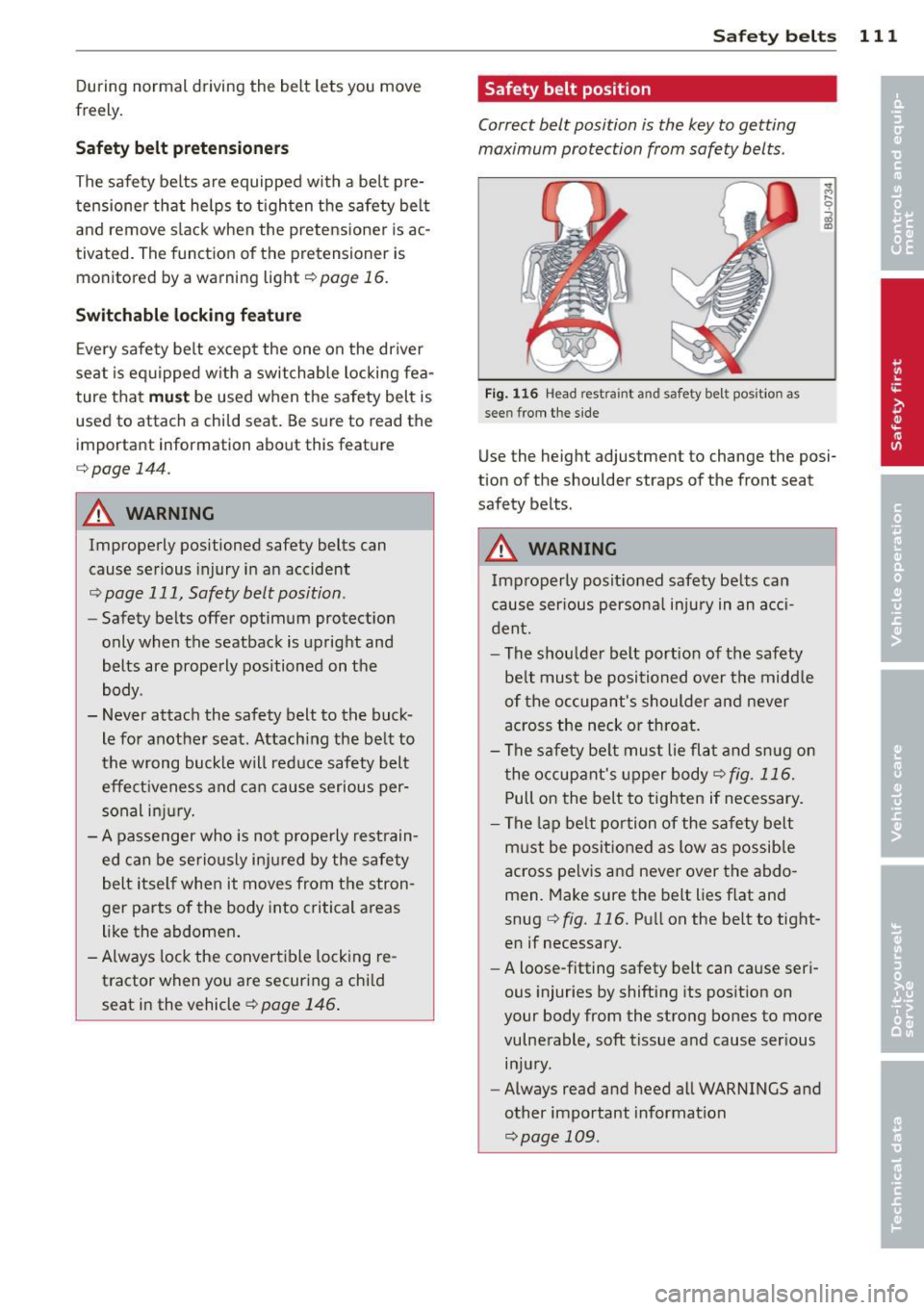
Fig . 1 16 Head restra int a nd safety be lt pos it io n as
see n fr om t he side
Use the height adjustment to change the posi
tion of the shoulder straps of the fro nt seat
safety belts .
A WARNING
Imp roperly posit ioned safety be lts can
cause ser ious persona l injury in an acci
dent.
- The shou lder belt portion of the safety
be lt must be posi tioned over the midd le
of the occupant's shoulder and never
across the neck or throat.
- The safety be lt must lie fla t and sn ug on
the occupant's upper body¢
fig. 116.
Pull on the belt to tighten if necessary.
-
- The lap be lt po rtion of the safety belt
must be posit ioned as low as possib le
across pelvis and never over the abdo
men. Make sure the belt lies flat and
snug ¢
fig. 116 . Pull on the belt to tight
en if necessary .
- A loose-fitting safety belt can cause seri
ous injuries by shifting its pos it ion on
your body from the strong bones to more
vulne rable , soft tissue and cause ser ious
in jury .
- Always read and heed all WARNINGS and
other important information
¢page 109.
Page 132 of 260
130 Airbag system
& WARNING
Cha nging the vehicle's suspension includ
ing use of unapproved tire -r im combina
tions can change Advanced Airbag per
formance and increase the risk of serious pers onal in jury in a crash.
- Never install suspens ion components
t h at do not have the same performance
c harac teristics as the components origi
n ally inst alled on you r vehicle.
- Never use ti re- rim combinat io ns that
h ave not been approved by A udi.
& WARNING
-
Ite ms stored be tween the s afety bel t
buckle and the center console can cause
the senso rs in the buckle to send the
w rong informat ion to the elect ronic con
trol mod ule and prevent the Advanced A ir
bag System from work ing proper ly.
- Always make sure that noth ing can inter
fere w ith the sa fety belt buckles and that
they a re not obstructed.
@) For the sake of the environment
Unde ployed airbag modu les and preten
sioners might be classified as Perchlorate Material -specia l hand ling may apply, see
www.dtsc.ca.gov/haza rdouswaste/per chlorate . Whe n the vehicle or parts of the
restraint system including airbag modules
safety belts w ith pretens ioners ar e scrap
pe d, all appli cable laws and regulat io ns
m ust be observed. Yo ur authoriz e d Au di
dea le r i s f amiliar wit h these requ ireme nts
an d we recommend th at you have your
dea le r p erfo rm this service for you.
Knee airbags
Description of knee a irbags
The airbag system can provide supplemental
protection to properly restrained front seat occupants .
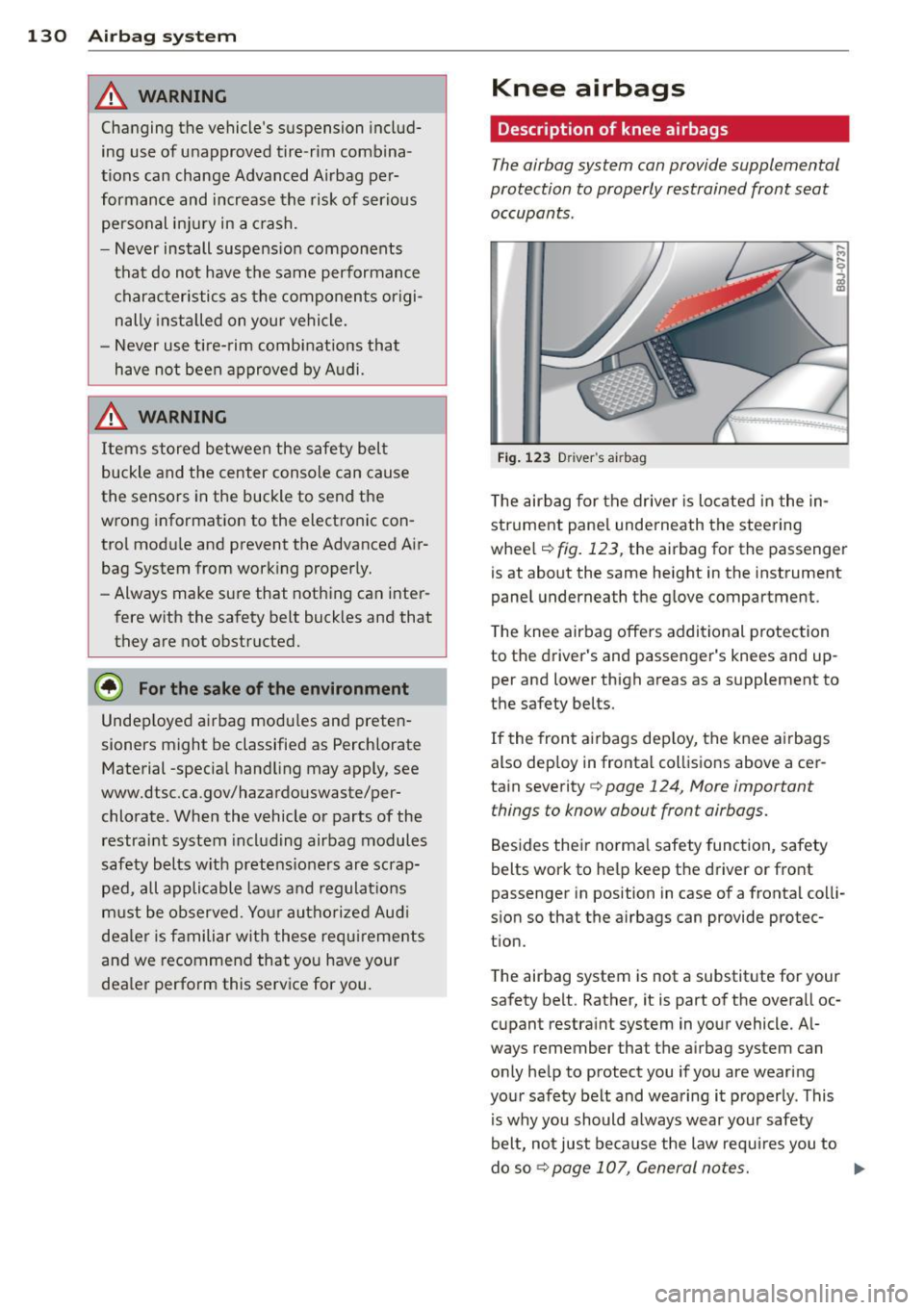
Fig . 1 23 Driv er's ai rbag
T he airbag for the driver is lo ca ted in the in
str ument pane l unde rneath t he stee ring
whee l
I:!) fig. 123, the airbag for the passenger
is at about the same height in the instrument
pane l underneath t he glove compartment .
T he knee airbag offe rs addi tional protection
to the d river 's and passenger's knees and up
per and lower thigh areas as a s upplement to
the safety belts.
If the fron t ai rbags dep loy, the knee a irbags
also dep loy in frontal collisions above acer
ta in seve rity
¢ page 124, More important
things to know about front airbags.
Besides the ir norma l safety func tion, safety
belts work to he lp keep the d river or front
passenger in position in case o f a fronta l co lli
s ion so that the a irbags can provide protec
t ion.
T he airbag system is not a substit ute for your
safety belt. Rather, it is part of the overa ll oc
cupant restra int system in yo ur vehicle. A l
ways remember that the a irbag system can
only help to protect you if you are wearing
you r safety belt and wearing it p roperly . This
i s why you should always wear your safety
belt , no t jus t be ca use the law requ ires you to
do so
¢ page 107, General no te s . ..,.
Page 197 of 260
-Never mount used tires on yo ur vehicle if
you are not sure of their "previous histo
ry." Old used tires may have been dam
aged even though the damage cannot be
seen that can lead to sudden tire failure
and loss of vehicle control.
Glossary of tire and loading terminology
Accessory weight
means the comb ined weight (in excess of
those standard items wh ich may be rep laced)
of automa tic tra nsmission, power steering,
power br akes, power w indows, power sea ts,
radio, and heater, to the ex tent that these
items are avai lab le as factory -installed eq uip
ment (whether installed or not).
Aspect ratio
means the rat io of the height to the w idt h of
the tire in percent . Numbers of 55 o r lower in
d icate a low sidewall fo r improve d steer ing re
sponse and better overall handling on dry
pavement.
Bead
means the pa rt of the t ire t hat is made o f
s teel wires, wrapped o r reinforce d by ply cor ds
and that is shaped to fit the r im.
Bead separation
means a b reakdown of the bond between
com ponents in the bead .
Cord
means the strands forming the plies in the
tire .
Cold tire infl ation pres sure
means the tire pressure recommended by the
vehicle manufacturer for a t ire of a designated
size that has not been dr iven for more than a
couple of miles (kilometers) at low speeds in
the three hour period before the tire pressure
i s measu red or adjusted.
Tire s an d wheel s 195
-If you notice un usua l vibration or if the
veh icle pulls to one side when driv ing, a l
ways stop as soon as it is safe to do so and check the wheels and tires for dam
age.
Curb weight
mea ns the we ight of a motor ve hicle w it h
standard equipment in cl ud ing t he maximum
capacity of fuel, o il, and coolant, ai r cond i
tion ing and addi tional weig ht o f optiona l
equipment .
Extra load tire
means a t ire designed to operate at higher
loads and at highe r inflat ion p ressu res tha n
th e co rresponding standard tire. Extr a load
tir es my be i dent ified as "X L", "xl", " EXTRA
L O AD", or "RF" on t he sidewall.
Gross Axle Weight Rating ("GAWR ")
mea ns the load-carry ing capac ity of a s ingle
axle system, measured at the tire-ground in
te rfaces .
Gross Vehicle Weight Rating ( "GVWR ")
mea ns the maximum total loaded we ight of
t h e ve hicle.
Groove
means the space between two adjacent tread
ribs.
Load rating (code )
means the maximum load tha t a t ire is rate d
to ca rry for a given inflation press ure. Yo u
may not find this information on all tires be
ca use it is not required by law.
Maximum load rating
me ans the loa d ra ting f or a t ire a t the maxi
mum pe rm issi ble inflat ion pressure for that
ti re . •
•
...