air condition AUDI TT ROADSTER 2011 Owner's Manual
[x] Cancel search | Manufacturer: AUDI, Model Year: 2011, Model line: TT ROADSTER, Model: AUDI TT ROADSTER 2011Pages: 260, PDF Size: 64.11 MB
Page 207 of 260
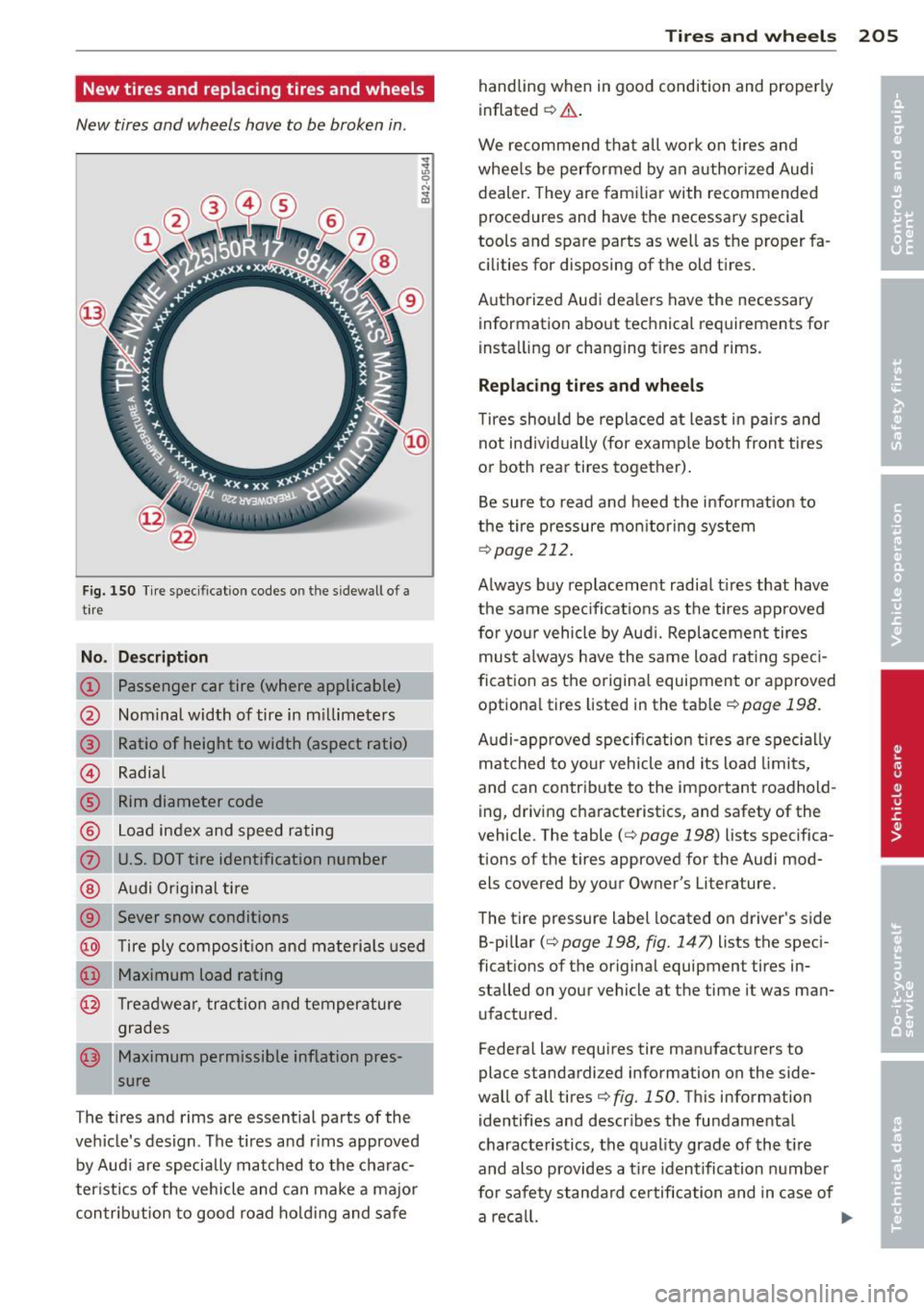
New tires and replacing tires and wheels
New tires and wheels have to be broken in.
Fig. 150 Tire specification codes on the sidewall of a
t ire
No. Description
(D Passenger car tire (where applicable)
@ Nominal width of tire in millimeters
@ Ratio of height to width (aspect ratio)
@ Radial
@ Rim diameter code
@ Load index and speed rating
(J) U.S. DOT tire identification number
@ Audi Original tire
@ Sever snow conditions
@ Tire ply composition and materials used
@ Maximum load rating
@ Treadwear, traction and temperature
grades
@ Maximum permissible inflation pres
sure
The tires and rims are essential parts of the
veh icle's design . The tires and r ims approved
by Audi are specially matched to the charac
teristics of the vehicle and can make a major
contribution to good road holding and safe
Tires and wheels 205
handling when in good condition and properly
inflated
¢ .&..
We recommend that all work on tires and
wheels be performed by an authorized Audi
dealer. They are familiar with recommended
procedures and have the necessary special
tools and spare parts as well as the proper fa
cilities for disposing of the old tires.
Authorized Audi dealers have the necessary
information about technical requirements for
installing or changing tires and rims .
Replacing tires and wheels
Tires should be replaced at least in pairs and
not ind ividually (for example both front tires
or both rear tires together).
Be sure to read and heed the information to
the tire pressure monitoring system
¢page 212 .
Always buy replacement radial tires that have
the same spec ificat ions as the tires approved
for your vehicle by Audi. Replacement tires
must always have the same load rating speci
fication as the original equipment or approved
optional tires listed in the table¢
page 198.
Audi-approved specification tires are specially
matched to your vehicle and its load limits,
and can contribute to the important roadhold
ing, driving characteristics, and safety of the
vehicle. The table( <=>
page 198) lists specifica
tions of the tires approved for the Audi mod
els covered by your Owner's Literature.
The tire pressure label located on driver's side
B-pillar ( <=>
page 198, fig. 147) lists the speci
fications of the original equipment tires in
stalled on your vehicle at the time it was man
ufactured .
Federal law requires tire manufacturers to
place standardized information on the side
wall of all tires<=>
fig. 150 . This information
identifies and describes the fundamental
characteristics, the quality grade of the tire
and also provides a tire identification number
for safety standard certification and in case of
a recall. .,.
Page 209 of 260
general, the greater the number of plies, the more weight a tire can support . Tire manufac
turers also must indicate the materials in the
tire, wh ich include steel, nylon, polyester, and
others .
Ma ximum Load R ating
This number indicates the maximum load in
kilograms and pounds that can be carried by
the tire.
Tire qualit y gr ad ing for treadw ear,
tract ion , an d temp erature resis ta nce
Tread wear , traction and temperature grades
c::> pag e208.
M aximum Permis sibl e Inflation Pr essur e
This n umbe r is the greatest amount of air
pressure that should ever be put in the tire
under normal driving conditions .
& WARNING
- Using incorrect or unmatched tires and/
or whee ls or improper tire and whee l
combinations can lead to loss of contro l,
collision and serious personal injury.
- Always use tires, rims and wheel bo lts
that meet the specifications of orig inal
factory-installed tires or other combina
t ions that have been spec ifically ap
proved by the vehicle manufacturer .
- Tires age even if they are not be ing used
and can fail suddenly, especially at high
speeds . T ires that are more than 6 years
o ld can only be used in an emergency
and then with special care and at lower
speeds.
- Never mount used ti res on you r vehicle if
yo u are not s ure of their "previous histo
ry ." Old used tires may have been dam
aged even though the damage cannot be
seen that can lead to sudden tire failure
and loss of vehicle control.
- All four wheels must be fitted with radia l
t ires of the same type, size (roll ing cir
cumference) and the same tread pattern .
Driv ing with different tires reduces veh i-
Tire s an d wheel s 207
cle handling and can lead to a loss of
contro l.
- If the spare tire is not the same as the
tires that are mounted on the vehicle -
for examp le w ith winter t ires -only use
the spare t i re for a short period of time
and drive with extra care . Refit the nor
mal road wheel as soon as safely poss i
ble .
- Never drive faster than the max imum
speed for which the tires on your vehicle
are rated because tires that are dr iven
faster than their rated speed can fa il
suddenly.
- Ove rloading tires cause heat build-up,
sudden tire fa ilure, including a blowout
and sudden deflation and loss of contro l.
- Temperature grades apply to tires tha t
are properly infla ted and not over or un
derinf lated .
- For technical reasons it is not always
possible to use whee ls from other vehi
cles -in some cases not even wheels
from the same ve hicle mode l.
-If you install wheel trim discs on the ve
hicle wheels, make sure that the air flow
to the brakes is not b locked. Reduced air
f low to the brakes can them to overheat,
increas ing stopping d istances and caus
ing a co llision .
- Run flat tires may only be used on vehi
cles that were equ ipped w ith them at the
factory. The veh icle must have a chassis
des igned for run flat ti res and a factory
installed t ire p ressure monito ring sys
tem that indicates a loss of ti re p ressu re.
I nco rrec t use of run fl at tires can lead to
veh icle damage o r accidents. Check with
an authorized Audi dealer or tire special ist to see if your vehicle can be equipped
with run flat tires. If run flat tires are used, they must be installed on all four
wheels. Mixing tire types is not permit-
ted .
Ill>
•
•
Page 213 of 260
can be damaged and the wheel can be
come loose.
@ Note
The specified torque fo r the wheel bo lts is
90 ft lb (120 Nm) with a tolerance of± 7,4
ft lb(± 10 Nm). Torque wheel bo lts diago
nally. After chang ing a wheel, the torque
must be checked as soon as possib le wit h a
torque wrench -preferab ly by an author
ized Aud i dealer or qualified workshop .
Low aspect ratio tires
Your Audi is factory-equipped with low aspect
ratio t ires. These t ires have been thorough ly
tes ted and been selected spec ifica lly for your
model for the ir superb pe rformance, road feel
and handling under a variety of driving condi
tions . Ask your a uthorized Audi dea le r for
more deta ils.
The low aspect ratio of these tires is indicated
by a numeral of
55 or le ss in the tire's size
designation. The numeral represents the ratio
of the tire's sidewall height in relat ion to its
tread width expressed in percentage . Conven
tional tires have a height/width ratio of 60 or more .
The perfo rmance of low -aspect -rat io ti res i s
part icularl y sensit ive to improp er i nflation
pr essu re. It i s th erefore importan t that low
aspect r atio tire s are infla ted to th e specifi ed
pr ess ure and that the inflation pressure is
regu lar ly che cked and maintained. Tir e pr es·
s ur es sh ould b e chec ked at l ea st once a
month and alw ay s before a lon g trip
<=> page 200, Checking tire pressure.
What you can do to avoid tire and rim
damag e
Low aspec t ratio t ires can be damaged more
easi ly by impact with potho les, cu rbs, gu llies
or ridges on the road, part icu larly if the tire is
underinflated .
I n o rder to m inimize the occu rrence o f impact
damage to the t ires of your vehicle, we recom -
Tires an d wheel s 211
mend that you observe the following preca u
tions:
- Always ma inta in re commended inflation
pressures . Check your tire pressu re eve ry
2,000 miles (3,000 km) and add air if neces
sary.
- Drive caref ully on roads with potholes, deep
gullies or ridges. The impact from driving
through or over such obstacles can damage
your tires. Impact with a curb may also cause damage to your tires .
- After any impact, immediate ly inspect your
tires or have them inspected by the nearest
au thor ized Audi dealer. Replace a damaged
tire as soon as possible .
- Inspect your tires every 2,000 m iles (3,000
km) for damage and wear. Damage is no t al
ways easy to see . Damage can lead to loss of
air and under inflat ion, which could eventu
ally cause tire failure .
If you believe that a
tire may have been damaged, rep lace the
tire as soon as possib le .
- These tires may wear more quickly tha n oth
ers.
- Please also remember that, while these tires
de live r responsive handling, they may ride
less comfo rtably and make more noise than
other choices .
Reduced performanc e in winter /cold
season conditions
A ll ti res are designed for certa in p urposes.
T he low aspect ratio, ult ra h igh performance
tires originally installed on your vehicle are in
tended for maxim um dry and wet road per
formance and handling. They are not suitable
for cold , snowy or icy weather condi tions. If
you drive under those circumstances, you
should equ ip your vehicle w ith all-season or
winter tires, which offer bette r traction under
those conditions. We suggest you use the rec
ommended snow o r all-season t ires specified
f o r yo ur vehicle , or thei r equivalent .
Refer to
<=> page 209 fo r more detailed infor
mation regard ing winter tires .
•
•
Page 215 of 260
the !CHECK I button @c:> page 10, fig. 3. If on
l y one tire is affected, the display will indicate
its pos ition.
The tire p ress ure moni to ring m ust be reset in
the menu display each time the pressures are
adjusted (e .g. when switc hing between parti
a l and full load pressure) or after chang ing or
replac ing a tire on your vehicle
c:> page 214.
You can find the recommended tire pressures
for your vehicle on the label on the driver's
door p illar
c:> page 198.
Tire tread circumference and vibration charac
ter istics can change and cause a tire pressure
warn ing if:
- the tire pressure in one or more t ires is too
low,
- the tire has structural damage,
- the tire pressure was changed, whee ls rotat -
ed or replaced but the TPMS was not reset
c:> page 214 .
Warning symbol s
[@] Loss of pressure in at least one tire c:> ,&..
Check the ti re or tires and rep lace or repair if
necessary . The indicator light
RI] in the instru
ment cluster also illuminates
r=:>page 13.
Check/correct the pressures of all four tires
and reset TPMS in the menu display.
11@1@1 < T ire Pressure Monitoring Sys tem) Tire
p re ss ure! Sy stem malfunction. JfllAl@ ap
pears after switching the ignition on or while
driving
r=:> fig. 152 and the indicator light RI] in
the instrument cluster blinks for approxi
mately one minute and then stays on, there is
a system malfunction . See your author ized
Aud i dealer as soon as possible.
.&, WARNING
- If the t ire pressure indicator appea rs in
the instrument cl uster d isplay, one or
more o f you r tires is s ignificantly under
inflated. Reduce your speed immediately
and avoid any hard steering or bra king
maneuvers. Stop as soon as possible and
check the t ires and the ir pressures. In
flate the tire pressure to the proper pres-
.
Tire s an d wheel s 213
sure as indicated on the vehicle's tire
pressure labe l
r=:>page 198. Driving on a
significantly under-inflated tire causes
the t ire to overheat and can lead to tire
fa ilure . Unde r-inflation also is l ikely to
impair the vehicle's handling and stop
ping ability.
- The d rive r is respons ib le for maintaining
the co rrect tire pressures. You must
check the tire pressures regularly.
- Unde r ce rtain conditions (such as a spo r
ty driving style, winter conditions or u n
p aved roads), the pressu re monitor indi
ca tor may be delayed.
- Ask you r authorized Aud i dea le r i f run
f lat tires may be used on your vehicle.
Your vehicle registration becomes invalid
if you use these t ires when not perm it
ted. Damage to your vehicle or accidents
could a lso result.
- If you switch between standard and run
flat tires, an autho rized Audi dealer o r
qualified workshop must reprogram the
contro l modu le.
(D Tips
- The tire pressure monitor ing system
stops work ing when there is an ESP/ABS
ma lfunction.
- Us ing snow c hains may res ult in a system
ma lfunction.
- Tires wit h the identification "AO" or "RO"
have been specially matched with yo ur
Audi. We recommend using on ly these
tires because they meet the highest
standards regarding safety and dr iv ing
character istics when used correctly. Your
authorized Audi dealer wi ll gladly pro
vide you with more information .
•
•
Page 218 of 260
216 Tires and wheels
Run-flat tires have special characteristics
and requirements, that are very different
from conventiona l tires. Run-flat tires re
quire special rims for run-flat use and can
not be used on conventional wheel rims.
(D Tips
- If you are not able to continue driving
with run-flat tires, please seek professio
nal assistance .
- Please contact your authorized Audi
dealer or Audi of America, Inc. if you
have questions about tires and r ims.
Driving with run-flat tires
App lies to vehicles: with Run -flat tires
Handling characteristics change when tire
pressure is low .
Driving on tires with low tire pressure changes
the way a vehicle handles, particularly when
cornering and braking . The handling charac
teristics of run-flat tires do not seem to
change a lot even when dr iving on low pres
sure or in the run-flat mode . Nevertheless you
must still take special precautions when oper
ating a vehicle on run-flat tires when tire pres
sure is low or the tire(s) is fla t:
"'The Electronic Stabilization Program (ESP)
must be switched on.
> Never drive faste r than 50 mph (80 km/h)
¢,& .
"'Plan ahead when driving and anticipate
what you will have to do considering traffic
and road conditions up ahead.
"' Accelerate carefully.
"' Avoid unnecessary and sudden steer ing and
braking maneuvers .
"' Reduce your speed in plenty of time before
i ntersections, curves and other places where
you may have to react quickly.
Please see:
¢ page 215, When it is not possi
ble to continue driving, even with run-flat
tires?
Handling characteristics change when
driving with low air pressure or with flat
tires even with special run-flat tires
A low pressure or flat front tire affects vehicle
handling characterist ics by pulling the vehicle
slightly to the side whe re the tire is mounted
and reduces braking performance .
A low pressure or flat
rear tire also affects
driving characteristics by pulling to the s ide
where the tire is mounted and also reduces
braking performance . The effect on vehicle
handling is most noticeable when driving
aro und curves .
A WARNING
Changed vehicle hand ling characteristics
when driving in the run-flat mode can
cause loss of vehicle control, a crash and
serious personal injury.
- Driving on special run-flat tires in the
run-flat mode will change vehicle han
dling characterist ics dur ing braking,
when cornering and under heavy acceler
ation .
- Never drive faster than the max imum
rated speed of 50 mph (80 km/h) when
driving in the run-flat mode.
- Always adjust vehicle speed to traff ic,
road and weather conditions and drive
slower than the maximum rated speed if
necessary weathe r and road cond it ion s
are taken into account.
- Always obey speed limits and other traf
f ic laws.
(D Note
We always recommend driving with even
more care when using these special tires in
the run-flat mode. Always avoid sudden
maneuve rs.
Page 243 of 260
Consumer Information
Warranty coverages
Your Audi is covered by the following war
ranties :
-New Vehicle Limited Warranty
- Limited Warranty Against Corrosion Perfo-
ration
- Emissions Control System Warranty
- Emissions Performance Warranty
- California Emissions Control Warranty (USA
vehicles only)
- California Emissions Performance Warranty
(USA vehicles only)
Detailed information regarding your warran
ties can be found in your
Warranty & Mainte
nance booklet .
Operating your vehicle
outside the U.S.A. or
Canada
Government regulations in the United States
and Canada require that automobiles meet
specific emission regulations and safety
standards. Therefore, veh icles built for the
U.S.A. and Canada differ from vehicles sold in
other countries .
If you p lan to take your vehicle outside the
continental limits of the United States or Can
ada, there is the possibility that
- unleaded fuels for vehicles with cata lytic
converter may not be available;
- fuel may have a considerably lower octane
rating. Improper fuel may cause engine
damage;
- service may be inadequate due to lack of
proper service facilities, tools or testing
equipment;
- replacement parts may not be readily availa
ble.
- Navigation systems for vehicles built for the
U.S.A. and Canada will not necessari ly work
in Europe, and may not work in other coun
tries outside of North America.
Consumer Information 241
@ Note
Audi cannot be responsible for mechanical
damage that could result from inadequate
fuel, service or parts availability.
Audi Service Repair Manuals and Literature
Audi Offic ial Factory Service Manuals and Lit
erature are published as soon as possible after
model introduction. Service Manuals and liter
atu re are availabl e to order from the Audi
T echnical Literature Ordering Center at:
www.audi.techliterature.com
Maintenance
' General
Your vehicle has been designed to help keep
maintenance requirements to a minimum.
However, a certain amount of regular mainte
nance is still necessary to assure your vehicle's
safety, economy and reliability. For detailed
vehicle maintenance consult your Warranty& Maintenance booklet.
Under difficult operating conditions , for ex
ample at extremely low outside temperatures,
in very dusty regions, etc., some service work
shou ld be pe rformed between the intervals
specified. This applies particularly to:
- oil changes, and
- cleaning or replacing the air fi lter.
@ For the sake of the environment
By regu larly maintaining your vehicle, you
help make sure that emission standards
are maintained, thus min imizing adverse
effects on the environment.
Important considerations for you and
your vehicle
T he increasing use of electron ics, soph isticat
ed fuel injection and emission control sys
tems, and the generally increasing technica l
complexity of today's automobiles, have ..,_
•
•
Page 244 of 260
24 2 Con sum er Inf orm ation
steadi ly reduced the scope of maintenance
and repairs which can be carried out by vehicle
owners.
Als o, sa fe ty a nd en vir onm ent al con
cerns p lace very strict limits on the nature of
repairs and adjustments to engine and trans
miss ion parts which an owner can perform .
Maintenance, adjustments and repa irs usua lly
require special tools, testing dev ices and oth
er equipment available to specially trained
workshop personnel in order to assure proper pe rformance, reliab ility and safety of the vehi
cle and its many systems .
Improper maintenance, adjustments and re pa irs can impair the operation and reliab ility
of your vehicle and even void your vehicle war
ranty. Therefore , proof of servic ing in accord
ance w ith the ma intenance schedule may be a
condition for upholding a poss ible warranty
claim made within the warranty period.
Above all, operational safety can be adversely
affected, c reating unnecessary risks for you
and your passengers .
If in doubt about any se rv icing, have it done
by your author ized Audi dealer or any other
p roperly equipped and qualified workshop .
We strong ly urge you to give yo ur a utho rized
Aud i dealer the opportunity to perfo rm all
schedu led maintenance and necessary repairs .
Your dea ler has the facilities, original parts
and trained spec ialists to keep your vehicle
running properly .
Performing limit ed ma int enance your self
The following pages describe a limited num
ber of proced ures which can be performed on
your ve hicle with ordinary too ls, shou ld the
need arise and trained personnel be unavaila
ble. Before performing any of these proce
dures, always thoroughly read all of the app li
cable text and carefully follow the instruc
tions given . Always rigorously observe the
WARNINGS p rovided.
Before you chec k anything in th e eng ine
co mpartm ent , alway s re ad and h eed all
WA RNINGS
c::> .&. and c::> .&. in Working in the
engine compartment on page 178.
_& WARNING
- Ser ious personal injury may occur as a re
sult of improperly performed mainte
nance, adjustments or repa irs .
- Always be extremely careful when work
ing on the vehicle . Always follow com
monly accepted safety pract ices and gen
eral common sense. Never r is k personal
inju ry.
- Do not attempt any of the maintenance ,
checks or repairs descr ibed on the fol
lowing pages if you are not fu lly fam iliar
with these or other procedures with re
spect to the vehicle, or are uncertain how
to proceed .
- Do not do any work without the proper
too ls and equipment. Have the necessa ry
work done by your author ized A udi deal
er or another proper ly equipped and
qualified workshop.
- The engine compartment of any motor
veh icle is a potentially hazardous area.
Never reach into the area around or
touch the radiator fan. It is temperature controlled and can sw itch on suddenly -
even when the engine is off and the igni
tion key has been removed. The rad iator
fan switches on automa tical ly when the
coo lant reaches a certain temperature
and will continue to run until the coo lant
temperature drops .
- Always remove the ign ition key before
anyone gets under the vehicle.
- Always support your veh icle with safety
stands if it is necessary to work under
neath the vehicle. The jack supplied with
the vehicle is not adequate for this pur pose and cou ld collapse causing serious
personal injury.
- If you must work underneath the vehicle with the wheels on the ground, always
make sure the vehicle is on leve l ground,
that the wheels a re a lways secure ly
b locked and that the engine cannot be
started.
Page 246 of 260
244 Consumer Information
Technical Modifications
Our guidelines must be complied with when technical modifications are made .
Always consult an authorized Audi dealer be
fore starting work on any modifications.
This will help ensure that vehicle function,
performance and safety are not impaired
¢ &. .
Attempting to work on electronic components
and the software used with them can cause
malfunctions. Because of the way electronic
components are interconnected with each
other, such malfunctions can also have an ad
verse affect on other systems that are not di
rectly involved. This means that you risk both
a substantial reduction in the operational
safety of your vehicle and an increased wear of
ve hicle parts ¢
A:,..
Author ized Audi dealers will perform th is
wo rk in a professiona l and competent manner
or, in special cases, refer you to a professional
company that specializes in such modifica
tions .
A WARNING
Improper repairs and modifications can
change the way vehicle systems work and
cause damage to the veh icle and serious
personal injury.
If emergency repairs must be performed
elsewhere, have the vehicle examined by
an authorized Audi dealership as soon as
possible.
-
Declaration of
Compliance, Telecom
munications and
Electronic Systems
Radio Frequency Devices and Radiocommuni
cation Equipment User Manual Notice.
The manufacturer is not responsib le for any
radio or TV interference caused by unauthor
ized modifications to this equipment.
Devices
T he following devices each comply with FCC
Part 15.19, FCC Part 15.2 1 and RSS-Gen Iss ue
1:
- Cell phone package
- Electronic immobilizer
- Homelink® universal remote control
- Remote control key
FCC Part 15.19
This device complies with part 15 of the FCC
Rules . Operation is subject to the following
two conditions:
(1) This device may not cause harmful inter
ference, and
(2) this device must accept any interference
received, including interference that may
cause undesi red operation.
FCC Part 15.21
CAUTION:
Changes or mod ifications not expressly ap
proved by the party responsible for compli
ance could vo id the user's autho rity to operate
the equipment .
RSS-Gen Issue 1
Operation is subject to the following two con
ditions:
(1) this device may not cause interference,
and
(2) this device must accept any interfe rence,
including interference that may cause unde
sired operation of the device.