air condition AUDI TT ROADSTER 2011 User Guide
[x] Cancel search | Manufacturer: AUDI, Model Year: 2011, Model line: TT ROADSTER, Model: AUDI TT ROADSTER 2011Pages: 260, PDF Size: 64.11 MB
Page 127 of 260
-The inflating airbag will hit the child
safety seat or infant carrier with great
force and w ill smash the ch ild safety seat
and child against the backrest, center
arm rest, door or roof.
- If you must install a rearward facing
child safety seat on the front passenger
seat because of exceptional circumstan ces and the
PASSENGER AIR BAG OFF
light does no t come on and stay on, im
med iately install the rear-facing child
safety seat in a rear seating position and
have the airbag system inspected by your
Audi dealer .
&_ WARNING
Objects between you and the airbag will
increase the risk of in jury in a crash by in
terfering with the way the airbag unfolds or by being pushed into you as the a irbag
inflates.
- Never hold th ings in your hands or on
your lap when the vehicle is in use .
- Never transport items on or in the area
of the front passenger seat. Objects
could move into the area of the front air
bags dur ing braking or other sudden ma
neuver and become dange rous projec
t il es that can cause serious personal in
jury if the airbags inflate.
- Never place o r attach accessories or oth
er objects (such as cup ho lders, tele
phone brackets, large, heavy or b ulky ob
jects) on the doors, over or near the area
marked "AIRBAG" on the steering wheel,
instrument panel, seat backrests or be
tween those areas and yourself. These
objects could cause injury in a crash, es
pecially when the airbags inflate.
- Never recline the front passenger's seat
to transport objects. Items can also move into the area of the side airbag or
the front airbag dur ing braking or in a
sudden maneuver. Objects near the air
bags can be come project iles and cause
injury, part icularly when the seat is re
cl ined.
-
A irbag sys tem 125
&_ WARNING
The fine dust created when airbags deploy
can cause breathing prob lems fo r people
with a history of as thma or other breath
ing cond itions.
- To reduce the risk of breath ing problems,
those with asthma o r other respiratory
conditions s hou ld get fresh air r ight
away by getting o ut of the veh icle or
open ing windows or doors.
- If you are in a collision in which airbags
deploy, wash your hands and fa ce with
mild soap and wate r before eating.
- Be ca reful not to get the dust in to your
eyes, o r into any c uts or sc ratches.
- If the residue should get into your eyes,
f lush them w ith wate r.
Monitoring the
Advanced Airbag System
fl~ Airbag monitoring indicator light
Two separate indicators monitor the function
of the Advanced Airbag System: the airbag
monitoring indicator light and the
PASSEN
GER AIR BAG O FF
light.
T he Advanced A irbag System (includ ing the
electron ic co ntro l unit, sensor circu its and sys
tem wiring) is monitored continuously to
make sure that it is function ing properly
whenever the ignition is on. Each time you
turn on the ignition, the airbag mon itoring in
dicator light
I will come on for a few seconds
(self diagnostics).
Th e syste m mu st b e in spected when the
indicator light
I :
- does not come on when the ignition is
sw itched on,
- does not go out a few seconds after you
have switched on the ignit ion, or
- comes on while driving.
If an airbag system malfunction is detected,
the indicator light wi ll first start flashing to
catch the driver's attention and then stay on
llo-
•
•
Page 138 of 260
136 Child Safety
Child Safety
Important things to
know
Introduction
The physical princip les of what happens when
your vehicle is in a crash app ly also to children
c:> page 108, What happens to occupants not
wearing safety belts? .
But unlike adults and
teenagers, their muscles and bones are not
fully developed . In many respects children are
at greater risk of serious injury in crashes than
adults.
Because children's bodies are not fully devel
oped, they require restraint systems especial
ly designed for the ir s ize, weight, and body
structure . Many countries and all states of the
United States and provinces of Canada have
l aws requ iring the use of approved ch ild re
straint systems for infants and small children.
In a frontal crash at a speed of 20-35 mph
(30-56 km/ h) the fo rces acting on a 13-pound
(6 kg) infant w ill be more than 20 times the
weight of the child. This means the weight of
the child would suddenly be more than 260 pounds (120 kg) . Under these conditions,
only an appropriate ch ild restraint properly
used can reduce the risk of serious injury.
Child restra ints, like adult safety belts, must
be used properly to be effective. Used improp
erly, they can increase the risk of ser ious in
ju ry in an accident.
Consult the child safety seat manufacturer's instructions in order to be sure the seat is
right for your ch ild's s ize
c:> page 139, Impor
tant safety instructions for using child safety
seats.
Please be sure to read and heed all of
the important information and WARN INGS
about child safety, Advanced Airbags, and the installation of child restraints in this chapter.
There is a lot you need to know about the Ad
vanced Airbags in your vehicle and how they
work when infants and children in chi ld re
straints are on the front passenger seat. Be
cause of the large amount of important infor- mation, we cannot repeat it all here
. We urge
you to read the detailed information in this owner's manua l about airbags and the Ad
vanced Airbag System in your vehicle and the
very important information about transport
ing children on the front passenger seat.
Please be sure to heed the WARNINGS - they
are extremely importa nt for your safety and
the safety of you r passengers, especially in
fants and small chi ldren.
A WARNING
-
A ll vehicle occupants and especially chi l
dren must be restrained properly whenev
e r riding in a vehicle. An unrestrained or
improperly restrained child could be in
jured by str ik ing the interior or by being
ejected from the veh icle dur ing a sudden
maneuver or impact. An unrestra ined or
i mproperly restra ined child is also at great
er risk of injury or death through contact
with an inflat ing airbag.
_& WARNING
Children on the front seat of any car even
with Advanced Airbags c an be ser ious ly in
ju red or even ki lled when an airbag in
f lates. A child in a rearward-fac ing child
safety seat insta lled on the front passen
ger seat will be ser iously injured and can
be killed if the front airbag inflates.
- The inflating airbag will h it the ch ild
safety seat or infant carrier with great
force and will smash the child safety seat
and child aga inst the backrest, door or
roof.
- Never install a rearward facing child
safety seat on the front passenger seat
un less the
PASSENGER AIR BAG OFF
light comes on and stays on. If the PAS
SENGER AIR BAG OF F
light does not
come on and stay on, have the airbag
system inspected immediately by you r
Audi deale r.
.
Page 150 of 260

148 Intelligent technology
Intelligent technology Notice about data
recorded by vehicle
control modules
Your vehicle is not equipped with an Event Da
ta Recorder (EDR), installed by some manu
facturers fo r the express purpose of capturing
data for retrieval after an accident or crash
event . EDR's are sometimes called "crash re
corders".
Some state laws restrict the retrieval or down
loading of data stored by EDR's that were in
stalled in a vehicle for the express purpose of
retrieving data after an accident or crash
event without the owner's consent.
A lthough your vehicle is not equipped with an
EDR, it is equipped with a number of electron
ic control modules for various vehicle systems
such as, for example, engine function, emis
sion control, as well as for the airbags and
safety belts .
These electronic control modules also record
vehicle-related data during normal vehicle op
eration for diagnostic and repair purposes.
The recording capacity of the electronic con
trol modules is limited to data (no sound is re
corded) and only a small amount of data is ac
tually recorded over a very limited period of
time and stored when a system fault or other
condition is sensed by a control unit. Some of
the data then stored may relate to vehicle
speed, direction, braking as well as restraint
system use and performance in the event of a
crash or other condition. Stored data can only
be read and downloaded with special equip
ment.
Electronic Stabilization
Program (ESP)
General
The Electronic Stability Program increases
driving stability.
With ESP, control over the vehicle is increased
in situations when the vehicle is close to the
limits of grip, such as during acceleration and
in curves . ESP reduces the risk of skidding and
improves vehicle stability under all road con
ditions.
It operates at all speeds.
The Anti -Lock Brake System (ABS), Electronic
Differential Lock (EDS) and Anti-Slip Regula
tion System (ASR) are integrated in the Elec
tronic Stability Program .
How ESP works
The ESP control unit processes the following
data from high-sensitive sensors : the rota
tional speed of the vehicle about its vertical
axis , fore-and-aft and lateral acceleration
forces, brake pressure and steering angle.
Using steering angle and vehicle speed, the
direction the driver wishes to travel is deter
mined and continuously compared with actual
vehicle behavior. If the two do not match, for
example when the vehicle begins to skid, ESP
brakes the appropriate wheel automatically.
The vehicle is stabilized again by the forces
acting on the wheel during braking. With an
oversteering vehicle (tendency for the rear end to skid out of the curve), the brake appli
cation is mainly at the front wheel on the out
side of the curve, with an understeering vehi
cle (tendency to run wide in the curve) at the
rear wheel on the inside of the curve or addi
tionally at the other wheels as needed. This
brake application is accompanied by noises.
ESP works in conjunction w ith ABS
~ page 153. If there is malfunction in the
ABS, ESP is also inoperative.
Page 153 of 260
Automatic mod e (normal operat ion)
- Automatic deployment: At a speed of about
75 mph (120 km/h), the rear spoiler deploys
automatically .
- Automatic retraction: When speed drops be
low abo ut SO mph (80 km/h), the rear spoil
er retracts automatically.
Manual mode
- Manua l dep loyment: Tapping briefly on the
switch
¢ fig. 131 dep loys the rear spo iler .
- Manual retraction: At speeds up to about 10
mph (20 km/h), retract the rear spoiler by
pressing and holding the switch ¢
fig. 131.
At speeds between 10 mph (20 km/h) and
75 mph (120 km/h), retract the rear spoi ler
by tapping on the switch
¢ fig. 131 .
A WARNING
Driv ing at higher speeds w ithout the rear
spoiler dep loyed can impair handling char
acteristics, making the vehicle harder to
control.
- Always make sure that the spoiler is de·
ployed whe n driving at speeds over 85
mp h (140 km/h) . If the rea r spo ile r
wa rning/ind icator light in the instru
ment cluster comes on, the rear spo iler
may not have dep loyed.
- Never drive at speeds hig her than 85
mp h (1 40 km/h) if the spoiler is not de
ployed. Have the spoi ler inspected as
soon as possible by an authorized A udi
dealer or qualified workshop .
- Always obey speed limits and other traf
fic laws.
A WARNING
Improper operation of the rear spoiler can
cause crushing injuries .
- Always make sure that nobody, especia lly
children, is in the way when the rear
spoiler is deployed or retracted.
Q) Note
Never push the vehicle o r apply fo rce to
the rear spoiler -it could be damaged.
Int ellig ent technolog y 151
(D Tips
Clean the spoiler compa rtment every 2 to
3 months. The spoiler compartment must
a lways be free of ice, snow, leaves or other
debr is .
Braking
General information
What affects braking efficiency?
Ope rating condition s and driving h abits
The brakes on today's automobiles are still
subject to wear, depending largely on operat
ing condit ions and driving habits ¢.&, . On ve
hicles that a re either dr iven mostly in stop
and-go city t raff ic or are dr iven hard, the
brake pads should be chec ked by yo ur author
ized Audi dea ler mo re often than specified in
the
W arranty & Maintenanc e boo klet. Failure
to have your brake pads inspected can result in reduced brake performance .
On steep slopes, you should use the braking
effect o f the engine . This way, you prevent un
necessary wear on the brake system. If you
must use your brakes, do not hold the brakes
down cont in uous ly. Pump the brakes at inter
vals.
Noises may occur when braking depending on
the speed, braking force and o utside condi
tions such as temperature and humid ity.
Moisture o r ro ad s alt
U nder certa in conditions, for examp le, when
driving through water or very heavy rain , or
even after washing your vehicle, the b raking
effect can be reduced due to moist ure (or in
freezing cond itions ice) on the brake pads. A
few cautious brake applications should dry off
the brake pads or remove any ice coatings .
The effectiveness of the brakes can be reduced
when the vehicle is driven on a salt-covered road and t he brakes are not used. L ikewise,
you clean off accumulated salt coating from brake d iscs and pads with a few cautious ap-
plications of the b rake ¢ .&, .
IJJ,
•
•
Page 164 of 260
162 Cleaning and protection
Cleaning and
protect ion
General information
Regular care preserves vehicle value .
Any automobile is exposed to industr ial
f umes, corrosive road salt, etc. A well cared
for Audi can look like new many years after pu rchase . Regula r and correct care w ill con
tr ibute to maintain ing the beauty and value of
your Aud i.
Furthermore , good care may be a condition
for substantiating a warranty claim should
corrosion damage or paint de fects occur.
Your authorized Audi dealer has a variety of
dedicated vehicl e-care products and can ad
v ise wh ich ones to use for cleaning the exter i
or and inte rior of your vehicle .
Whether you use produc ts recommended by
Aud i or other commercially ava ilable clean ing
agents, please make sure you apply t hem cor
r ectly .
A WARNING
-Cleaning agents may be poisonous. Keep
them o ut of t he rea ch of childre n.
- Heed a ll ca ution labels.
- Always read directions on th e co ntai ner
b efore using a ny product . Follow the di
rec tions caref ully.
- Most chemical cleaners a re concentrat ed
and have to be diluted.
- Use spot removing fluids only in well
ventilated areas.
- Do not use gasoline, kerosene, d iesel
fuel, nail pol is h remover or ot her volati le
fluids. They may be toxic, flammab le or
h azar dou s in other w ays. Do not was h,
w ax or dry the vehicle wi th the ig nit ion
on or the eng ine running .
- D o not cl ea n the under sides of ch assis,
f en ders, wheel cove rs , etc. without pro
tectin g your hands and a rms. You may
c u t yourself on s harp-ed ged metal parts . -
Moisture and ice on b rakes may impair
brak ing eff ic iency
c::> page 151 , General
information.
Test the brakes carefully
each time you wash t he vehicle .
@ For the sake of the environment
Select on ly environ mentally friendly clean
i ng products. Leftover cleaning products
s hou ld not d isposed of in the househo ld
waste .
Care of exterior
Washing
Frequent washing protects the vehicle .
The best p rotection against environmen tal i n
fluences is
frequent wash ing and waxing . How
often t his is requi red depends o n:
- How much t he ve hicle is used
- Whe re the veh icle is parked (garage, i n the
open under trees, etc.)
- The seasona l and weather conditions
- Environmental infl uences
T he longer b ird d roppings, inse cts, tree res in,
r oad and indus trial grime, ta r, soo t, road salt
and other mater ials remain on the vehicle
paint, the more lasting t heir destr uctive ef
f ects w ill be .
Hig h tempera tures, as from e xpos ure to in
tense sun light, intensify the co rrosive e ffect
part icu lar ly when humidity is high as well.
Un der certa in ci rcumstances,
weekly w ashing
may be ne cessary. Un der othe r cond it ions , a
mon thly washing and waxing may be a de
quate.
After the winter, the unders ide of the vehicle
sho uld be thoro ughly washe d pre ferab ly in a
pro fessional ca r wash.
A WARNING ~
A lways read and heed all WARNINGS a nd
the information
c::> page 162.
Page 169 of 260
Never dry windows with the same chamois
that you use to dry painted surfaces . Wax resi
due on the chamois can impair vision through
the windows.
_& WARNING
- The windshield must not be treated with
water-repellent materials. They can in
crease glare under poor visibility condi
tions such as wetness, darkness, or when
the sun is low on the horizon. In addi
tion, they can cause the windshield wip
ers to chatter.
- Always read and heed all WARNINGS and
other information <=;>
page 162.
([) Note
-Never use warm or hot water to remove
snow and ice from windows and mirrors.
This could cause the glass to crack.
- To prevent damage to the wires of the
rear defogger, do not place any adhesive
stickers on the inside of the rear window
over the wires.
- To help prevent dirt from scratching the
window, always scrape in a forward di
rection -pushing the scraper away from
you -never back and forth.
Weatherstrips
Complete car care includes the weatherstrips
as well.
.,. Apply a suitable rubber conditioner to the
weatherstrips from time to time.
To be able seal properly, the weatherstrips
around the hood, doors, rear lid, etc. must re main pliable . Spray the weatherstrips with sil
icone or coat them with talcum powder or
glycerine to retain the flexibility of the rubber
and to protect them against freezing in the
winter .
_& WARNING
Always read and heed all WARNINGS and
the information
¢page 162.
Cleaning and protection 167
(D Tips
Keep silicone sprays off the windshield to
avoid wiper smear in rain.
Steel wheels
App lies to vehicles : wit h stee l w hee ls
The wheels also have to be cleaned.
.,. Always include the hub caps and wheel rims
when washing your vehicle to remove road
dirt, salt sprays and brake dust.
If necessary, use a commercial wheel cleaner
to remove accumulated brake dust.
The wheel rims are easier to keep clean if they
are regularly coated with liquid wax.
Paint scratches should be touched up as soon
as possible to prevent corrosion
¢ page 166,
Touch-up paint .
_& WARNING
-Moisture and ice on brakes may affect
braking efficiency-
¢page 151, General
information. Test the brakes carefully af
ter each vehicle wash.
-Always read and heed all WARNINGS and
the information¢
page 162.
Cast (light) alloy wheels
Applies to vehicles : wi th Cas t alloy w hee ls
-
Cast (light) alloy wheels require special care .
.,. Wash the wheels with a sponge or hose
brush every other week .
.,. For deep cleaning afterwards, use only a
dedicated
acid-free cast alloy wheel cleaner .
.,. Rub a coat of
liquid wax onto the rims every
three month. Be sure to reach and treat all
parts of the rim.
To preserve the decorative appearance of the
cast alloy wheels, some special care is neces
sary. In addition to road dirt and salt, brake
dust is also corrosive. If left on for too long,
brake dust can cause pitting. .,..
•
•
Page 172 of 260
170 Cleaning and protection
-Serious injuries can result if plastic parts
come loose when the airbag is deployed.
- Always read and heed all WARNINGS and
the information
¢page 162.
(D Note
Cleaning agents containing solvents will
attack the material and can change the
way it behaves.
Instrument cluster glass
~ Clean the glass with a soft, damp cloth .
In order to preserve the anti-glare properties
of the instrument cluster glass, it should only
be cleaned with a soft, damp cloth.
Natural leather
Applies to vehicles: with natural leather
Audi makes great efforts to maintain the
properties , natural look and feel of interior
leather.
General
We offer many different types of leather on
our vehicles. Most are different types of nappa
leather, which has a smooth surface and
comes in various colors .
The intensity of the color determines the visu
al characterist ics and appearance. If the sur
face of the leather has a typical natural look,
then the leather is a nappa leather that has
been left in a relatively natural condition. This
leather offers par ticularly good com fort and
breathes well . Fine veins, closed grains , insect
bites, skin folds , and subtle variations in color
remain visible. These characteristics demon
strate that the material is natural.
Natural nappa leather is not covered by a col
or finish .
It is therefore more sensitive to soil
ing and wear, which is something you need to
consider if children, animals or other factors
might prove to be particularly hard on the
leather.
By contrast, leather types that are covered by
a colored finish layer are more durable. This has a positive effect on the leather's resist
ance to wear and soiling in daily us
e. On the
other hand, the typical characteristics of natu
ral leather are barely or not apparent. Howev
er, this does not mean that the leather itself
is of inferior quality .
Care and handling
Because of the exclusive nature of the types of
leather that Audi uses and their unique prop
erties (such as sensitivity to oils, grease, soil
ing, etc.), you will need to be somewhat care
ful with these leathers, and a certain type of care is required. For example, dark clothing
materials can discolor leather seats (especial
ly if such clothing is damp and was not dyed
correctly) . Dust and dirt particles in pores,
folds, and seams can have an abrasive effect
and can damage the leather surface as well as
weaken seams.
The leather should be cleaned regularly as
needed. After having been used for a relatively
long time, your leather seats will acquire a
rich aged finish. This is a characteristic of nat
ural leather and a sign of true quality .
In order to maintain the value of this natural
product over the life of your vehicle, you
should follow the recommendations below:
(D Note
- To keep your leather from bleaching out,
do not allow it to be exposed to bright
sunlight for long periods of time. If you
have to leave the vehicle parked outside
for long periods, cover the leather to
protect it from direct exposure to sun
light .
- Sharp objects on clothing, such as zip
pers, rivets or sharp pieces on belts can
leave permanent scratches or scrape
marks on the surface of the leather.
(l) Tips
-After each time you clean the leather and
at regular intervals, use a leather preser
vative creme that contains UV-blockers
and that works into the leather. This
Page 183 of 260
oils available today provide better engine lu
brication that can outlast traditional petrole
um-based oils, making them a smart choice
for use throughout the life of your Audi.
Whether you use synthetic or petroleumbased engine oil, the oil that you use must
conform to Audi's oil quality standard
VW 502 00 to help keep your vehicle's engine running smoothly and help prevent the for
mation of harmful deposits, sometimes called
" sludge," that over t ime can lead to expensive
repairs .
At the time of printing, engine oils available in the U .S . and Canada that meet the exacting
specifications of Audi oil standard VW 502 00
are synthetic engine oils . This does not mean,
however, that every synthetic engine oil will
meet Audi oil standard VW 502 00. So always
be sure that you use an approved oil.
To help prevent the formation of harmful de posits use only oil with the following specifi
cations printed on the oil container :
Audi oil standard VW S02 00
Oil container labels may carry the specifica
tion singly or in combination with other desig
nations and oil quality standards .
Viscosity
Engine oils are graded according to their vis
cosity . The proper viscosity grade oil for your
engine depends on climactic or seasonal con
ditions where you drive. You can use oil with a
viscosity grade of SA E SW40 across all tem
perature ranges for normal driving conditions.
However, if engine oil viscosity grade SAE
SW40 is not available, you can also use viscos
ity grade SAE SW-30 or SAE OW-40 as long as
it meets Audi oil quali ty standard VW 502 00
specifications .
Because engine oil that meets the Audi oil
standard may not be available everywhere
when you need it, we strongly recommend
that you always carry with you an extra quart (liter) of oil that expressly conforms to the
Checking and filling 181
VW 502 00 specification, in case you have to
top
off the oil while on the road.
Only if the level of the oil is at or below the
minimum mark on the oil dipstick - and no oil
that expressly conforms to Audi oil standard
VW 502 00 specifications is available - may
you top
off with a high quality engine oil, pref
erably synthetic-based, that meets ACEA A3,
ACEA AS or ACEA BS or AP! SL specifications,
but even then, only in viscosity grades SA E
SW-40, SAE SW-30, or SAE OW-40 . However,
during the entire time between oil change in
tervals , never top
off with more than a total
of 0 .5 qt/liter engine oil that does not con
form to Audi oil specification VW 502 00.
For more information about engine oil that
has been approved for your vehicle, please
contact either your autho rized Audi dealer or
Audi Customer Relations at 1 (800) 822-2834
or visit our web site at www.audiusa .com or
www.audicanada.ca . Here you will also find a
current list of oils (manufacturers, brand
names etc.) that conform to Audi oil standard
vw 502 00.
Changing the engine oil
The engine oil and oil filter must be changed
according to the mileage (kilometers) and
time intervals specified in your vehicle's War
ranty
& Maintenance booklet. Do not exceed
these intervals -harmful deposits from old
engine oil can reduce engine performance and
can lead to expensive engine repairs.
Changing the oil at the recommended inter
vals is so very important because the lubricat
ing properties of oil decrease gradually during
normal vehicle use . If you are not sure when
you have your oil changed, ask your author
ized Audi Serv ice Adv isor .
Under some circumstances the engine oil
should even be changed more frequently. Change oil more often if you drive mostly
short distances, operate the vehicle in dusty
areas or mostly under stop-and-go traffic con
ditions, or when you use your vehicle where
temperatures stay below freezing point for
long periods.
•
•
Page 187 of 260
wooded areas, into open streams or
down sewage drains.
- Recycle used engine oil by taking it to a
used engine oil collection facility in your
area, or contact a service station.
Engine cooling system
Coolant
T he engine coolan t performs two functions: it
keeps the engine from overheating and it pro
tects the engine from freezing in the winter .
The cooling system is sealed and generally re
quires little attention .
T he cooling system has been filled at the fac
tory with a permanent coolant which does not
need to be changed . The coolan t consis ts of a
mixture of water and the manufacturer 's gly
col-basedcoolant additive G12 ++ antifreeze
with anticorrosion additives (50% for USA
models; 60% for Canad ian models). This mix
ture both assures the necessary frost protec
tion and protects metal components in the
engine 's cooling system from corrosion and
scaling. It also raises th e boiling point of the
c oolant.
Do not reduce the concentration of the coo l
ant in the summer by adding plain water .
The
proportion of coolant additive must be at
least 50% but not more than 60%
to main
tain antifree ze protection and cooling efficien
cy . If the coolant frost protection is too low,
the coolant could freeze and damage the veh i
cle heating and eng ine cooling system .
For year-round driving, an tifree ze is added at
the factory for temperatures down to:
- -31 ° F ( - 3 5 °C) USA
- -40 °F ( -40 °C) Canada.
You can mix the G12 ++ coolant addit ive with
other additives (G12+ or G12) . Always check
with your authorized Audi dealer.
& WARNING
Before you check anything in the engine
compartment, always read and heed all
-
Checkin g and fillin g 185
WARNINGS c:::> .& in Working in the engine
compartment on page 178.
(D Note
- Before winter sets in, have the coolant
checked to see if the coolant additive in
your vehicle is sufficient to meet the cli
mate conditions. This is especially impor
tant if you live in a region where the win
ter is extreme ly cold . If necessary, in
crease the proportion of coo lant add itive
to 60% .
- Whe n adding coolant additive to your
cooling system, remember :
- We recommend using only coo lant ad
ditive G12++ (check the labe l) for your
vehicle . This coolant additive is avai la
ble at authorized Audi dealers. Other
types of ant ifreeze can significantly re
duce corrosion protection . The result
ing corrosion can cause a loss of cool
ant and ser ious eng ine damage.
- Do not add any type of rad iator leak seal
ant to yo ur vehicle's engine coolant .
Add ing radiator repair fluid may adverse
ly affect the function and performance of
your cooling system and could resu lt in
damage not covered by your New Vehicle
Limited Warranty .
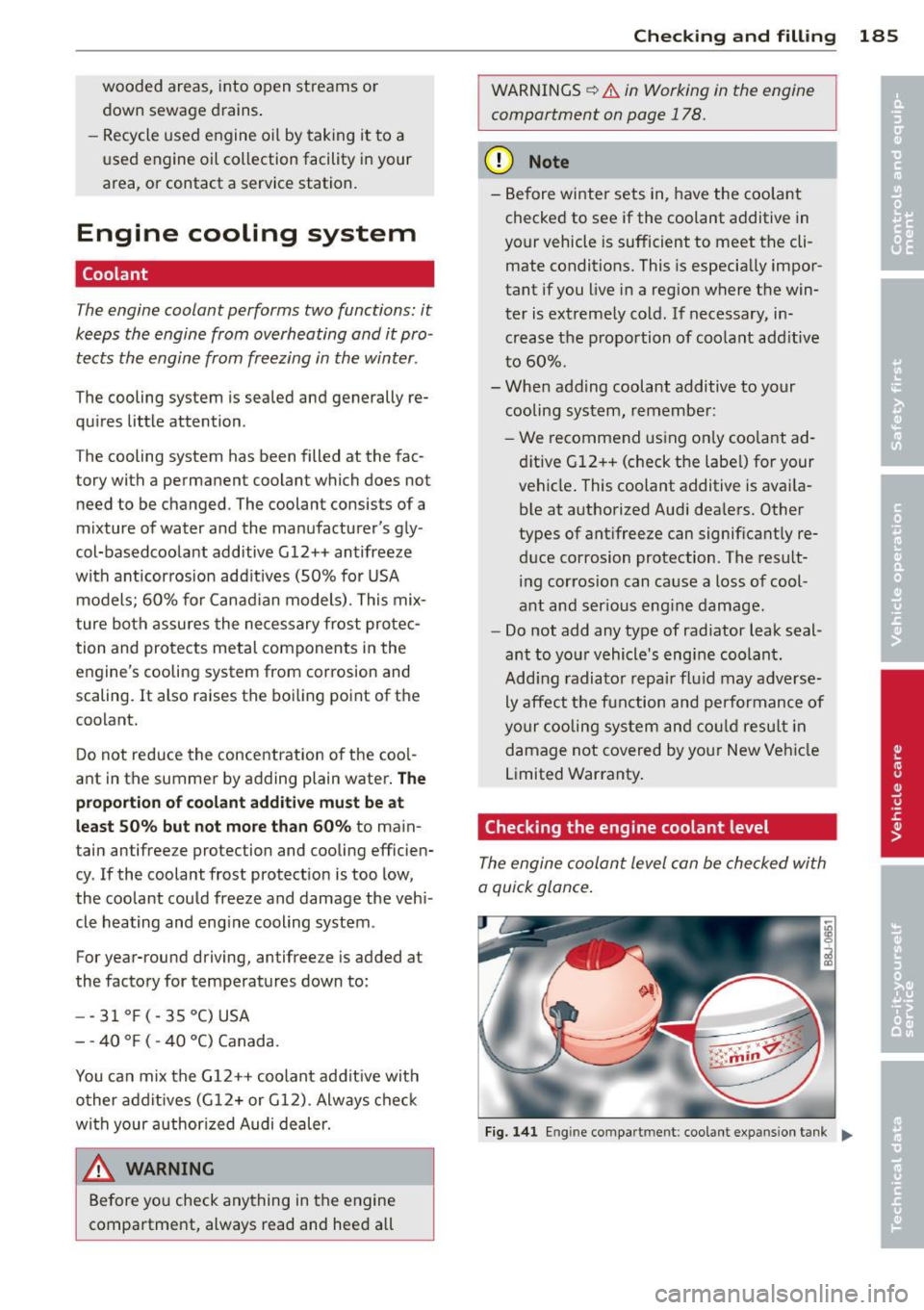
Checking the engine coolant level
The engine coolant level can be checked with
a quick glance.
Fig. 141 E ng ine compart men t: coo lant ex pansion t ank Ill>
Page 200 of 260
198 Tires and whe els
Cold tire inflation pressure
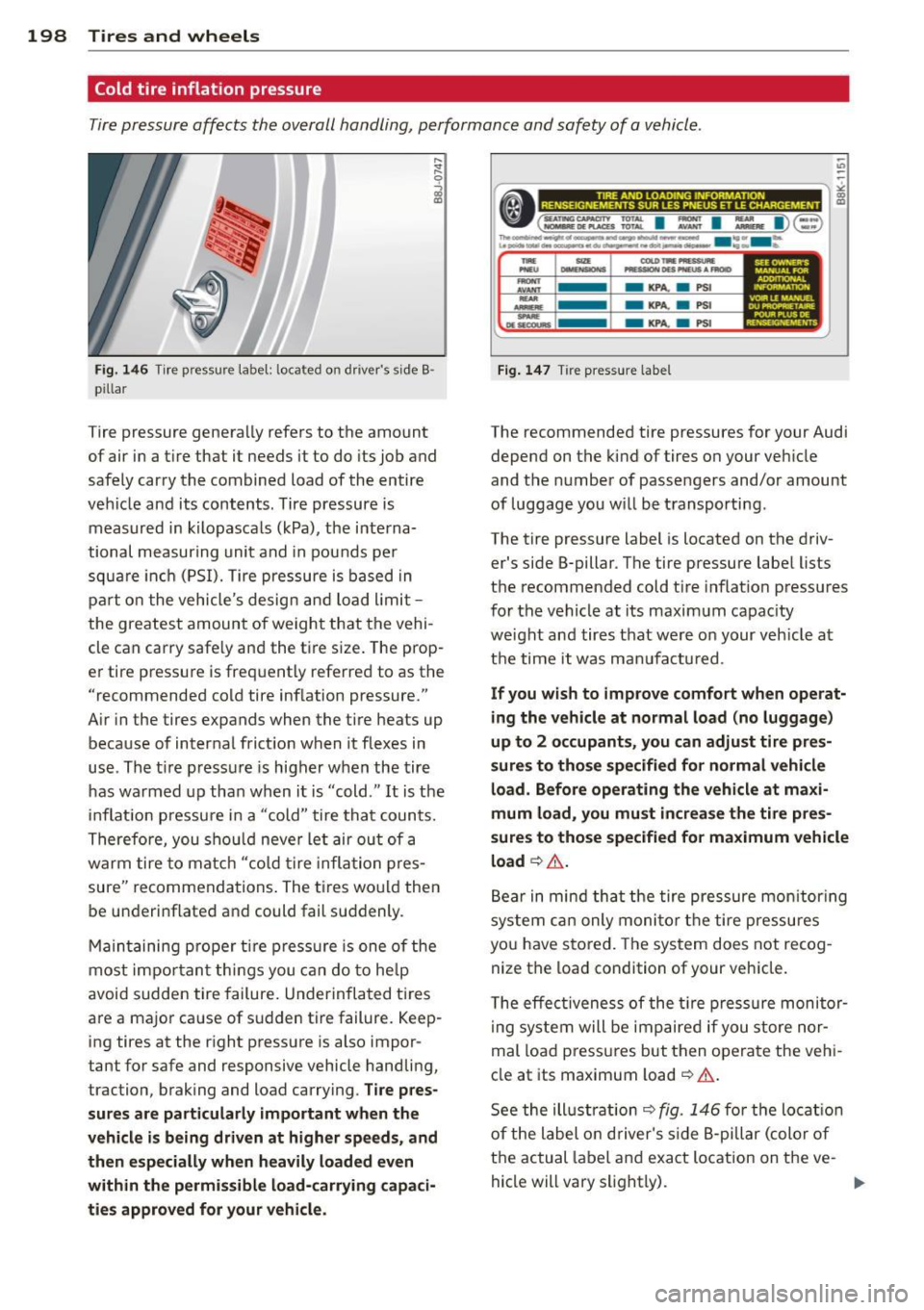
Tire pressure affects the overall handling, performance and safety of a vehicle .
Fig. 14 6 Tire p ress ure labe l: loca ted on dr iver 's side B ·
p ill ar
Tire pressure generally refers to the amount
of air in a t ire that it needs it to do its job and
safely carry the combined load of the entire
vehicle and its contents . Tire pressure is
measured in kilopasca ls (kPa), the interna·
tional measuring unit and in pounds per
squa re inch (PSI). Tire pressure is based in
part o n the vehicle's design and load limit
the greatest amount of weight that the vehi·
cle can carry safe ly and the t ire size. The prop·
er tire pressure is freq uently referred to as the
"recommended cold tire inflation pressure."
A ir in the tires expands when the tire heats up
because of internal frict ion when it flexes in
use . The t ire p ressure is higher when the tire
has warmed up than when it is "cold ." It is the
i n flat ion pressure in a "cold " tire that counts.
Therefore, you shou ld neve r let air ou t of a
warm tire to match " co ld tir e infla tion p res
sure" recommendations . The tires wo uld then
be underinflated and could fail su ddenly .
M aintaining p roper t ire press ure is one o f the
most impo rtan t things you can do to he lp
avoid sudden tire failure. Underinflated ti res
are a major cause of s udden tire failure. Keep
ing tires at the right pressure is also impor
tant for safe and responsive vehicle handling,
traction, braking and load carrying .
Tir e pres
s ur es are part icularly important wh en th e
vehicl e is being driven at higher speed s, and
then es pecially wh en heav ily loaded even
w ithin th e permis sible load -carrying capa ci
tie s approv ed for y our vehi cle.
,;
•(=~: I : I :,.. I)@ ~
The~-----~---w-o- ....... -e.....i -·· - u ........ -.-..,.0, ... -....,.,...tot~---....... ._.,. -..
....
-..... ...........
- KPA. a PSI
- KPA.
a PSI
- KPA.
a PSI
Fig . 14 7 Tir e pressure labe l
SEE OWNER'S MANUAl FOR
A DOMlONAL
T10N VOl!ILEMANU£1. DU _,...,
POUR P\.US DE
REHSEKiloiEMENTS
The recommended tire pressures for your Audi
depend on the kind of tires on your veh icle
and the number of passengers and/or amount
of luggage you w ill be transporting .
The tire pressure label is located on the driv
er's side B-pillar . The tire pressure label lists
the recommended cold t ire inflat io n pressures
for the vehicle at its maxim um capac ity
we ight and tires that were on your veh icle at
the time it was manufa ctu red .
If you wish to impro ve comfort when operat
ing the v ehicle at normal lo ad (no luggag e)
up to 2 occupant s, you can adju st ti re pr es
sures to tho se spe cified f or normal vehi cle
load. Before oper ating th e vehicl e at maxi
mum load, yo u must increase the tire pr es
sure s to tho se spe cified f or ma ximum vehicle
load ~.&. .
Bear in mind that the tire pressure mon itor ing
system c an only moni to r the tire pressu res
you have stored. The sys tem does not recog
nize the load condition of your veh icle.
T he effec tiveness of the t ire press ure monitor
i ng system will be impaire d if you store nor
mal load pressures but then operate the vehi
cle at its maximum load
~ .&. .
See the ill ustration ~ fig. 146 fo r the locat io n
of the label on d river 's s ide B-pillar (colo r of
the actual label and exact location on the ve-
hicle will vary slight ly) .
IJi,,