battery AUDI TT ROADSTER 2011 Owner's Manual
[x] Cancel search | Manufacturer: AUDI, Model Year: 2011, Model line: TT ROADSTER, Model: AUDI TT ROADSTER 2011Pages: 260, PDF Size: 64.11 MB
Page 192 of 260
190 Checking and filling
Working on the battery
Be especially careful when working on or near
the battery!
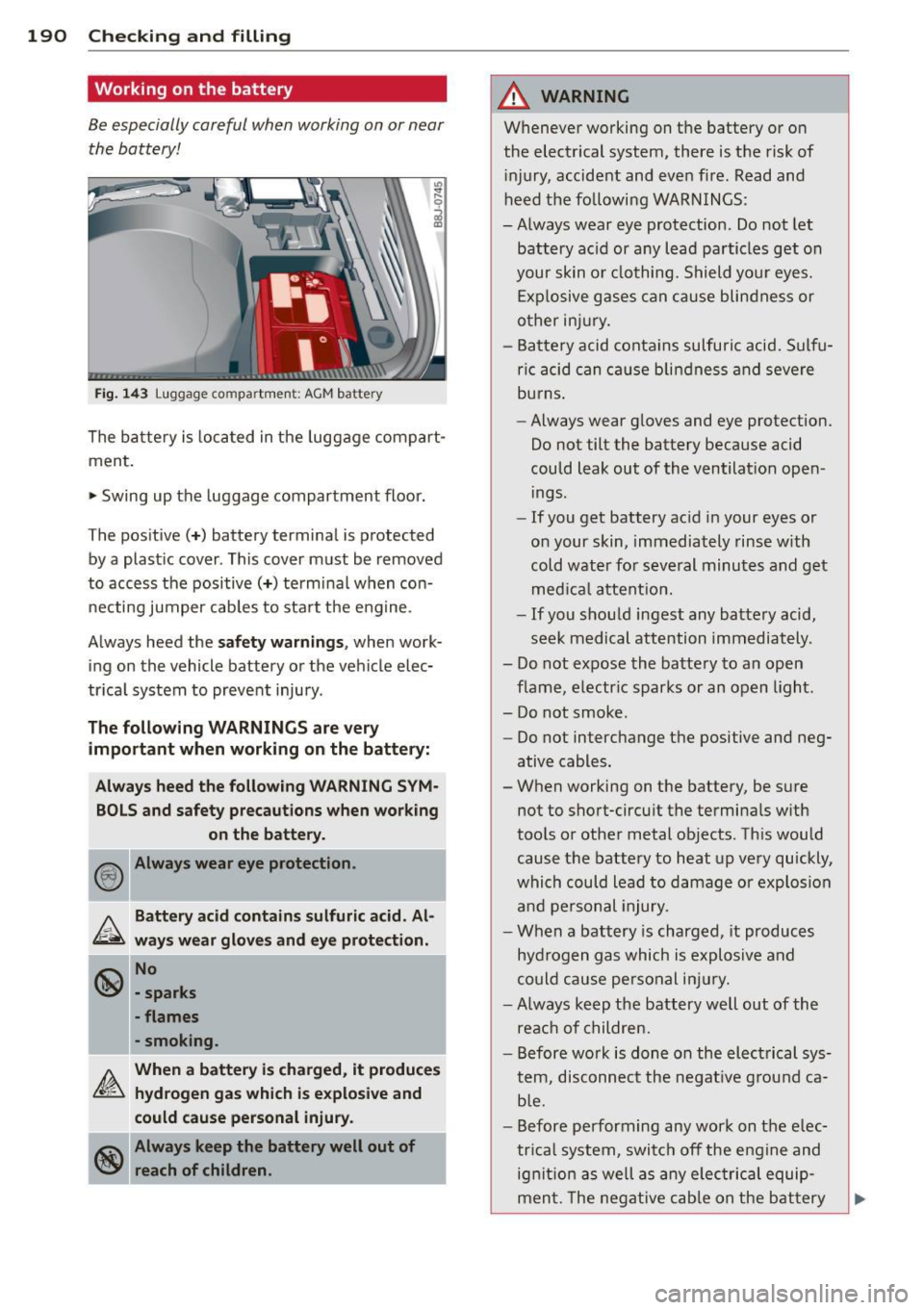
Fig . 14 3 Luggage compartment: AGM battery
The battery is loca ted in the luggage compart
ment.
~ Swing up the luggage compartment floor.
The positive( +) battery terminal is p rotected
by a plast ic cover . This cover must be removed
to access the positive( +) termina l when con
necting jumper cables to start the eng ine .
Always heed the
safe ty war nings, when work
ing on the vehicle battery or the vehicle elec
tr ica l system to prevent injury .
The following WARN INGS are ver y
import ant when w orking on the battery:
Alw ays heed t he follow ing W ARNING SYM ·
BOLS a nd safety precautions wh en working
on th e bat tery.
® Always wear eye protection .
I).. Battery acid contain s sulfuric acid. Al
~ ways wear gl oves a nd e ye prot ecti on.
I/£ No
\l:!S' -spar ks
• flames
- smoking.
When a batter y is ch arged , it pr odu ce s
h y d rogen g as which i s ex plosi ve and
could cau se personal injury.
----Always keep the battery well out of
re ach of children .
®
.&_ WARNING
Whenever working on the battery or on
the elect rical system, there is the risk of
i njury, accident and even fire. Read and
heed the fo llowing WARNINGS:
-Always wear eye protection. Do not let battery ac id or any lead particles get on
your skin o r clothing. Shield your eyes.
E xp losive gases can cause blindness or
o ther inju ry.
- Ba ttery acid conta ins sulfuric acid. Sulfu
ric acid can ca use blindness and severe
burns .
- Always wear gloves and eye protection.
Do not tilt the battery because acid
could leak out of the ventilat ion open
ings .
- If you get battery acid in your eyes or
on your skin, immediately rinse w ith
cold water for several minutes and get
medica l attent ion.
- If you shou ld ingest any battery acid,
seek medical attention immediately.
- Do not expose the battery to an open flame, e lectr ic sparks or an open light .
- Do not smoke.
- Do not interchange the positive and neg-
ative cables.
- When working on the battery, be sure
not to short-circuit the terminals with
tools or other metal objects . Th is would
cause the battery to heat up very quickly,
which could lead to damage or explosion and personal injury.
- When a battery is charged, it produces
hydrogen gas which is explos ive and
could cause pe rsonal in ju ry.
- Always keep the battery well out of the
reac h of children.
- Before work is done on the electrical sys
tem, disconnect the negat ive g round ca
b le.
- Before performing any work on the e lec
tr ica l system, switch off the engine and
ignit ion as well as any elec trical equip
ment. The negative cable on the bat tery
Page 193 of 260
must be disconnected. If you are just go
ing to replace a light bulb, then it is
enough to switch off the lights.
- Before disconnecting the battery, switch
off the anti-theft alarm system! Other
wise you will set off the alarm.
- When disconnecting the battery, first
disconnect the negative cable and then
the positive cable.
- Before reconnecting the battery, make
sure all electrical consumers are switch
ed off. Reconnect the positive cable first
and then the negative cable. Never inter
change the cables -this could start a fire!
- Never charge a frozen or a thawed-out battery. It could explode! If a battery has
frozen, then it must be replaced. A dis
charged battery can freeze over at 32 °F
(0 oc).
-Make sure the vent hose is always attach
ed to the opening on the side of the bat
tery.
- Never use batteries which are damaged.
Danger of explosion! Always replace a
damaged battery.
A WARNING
California Proposition 65 Warning:
- Battery posts, terminals and related ac
cessories contain lead and lead com
pounds, chemicals known to the State of
California to cause cancer and reproduc
tive problems. Wash hands after han
dling.
CD Note
- Do not disconnect the vehicle battery
when the ignition is switched on or when
the engine is running, otherwise, you will
damage electronic components in the
electrical system.
- If your vehicle is going to stand for a
long period of time without being driven,
protect the battery from "freezing", oth
erwise it will be damaged and will then have to be replaced.
Checking and filling 191
Checking the battery acid level on magic
eye batteries*
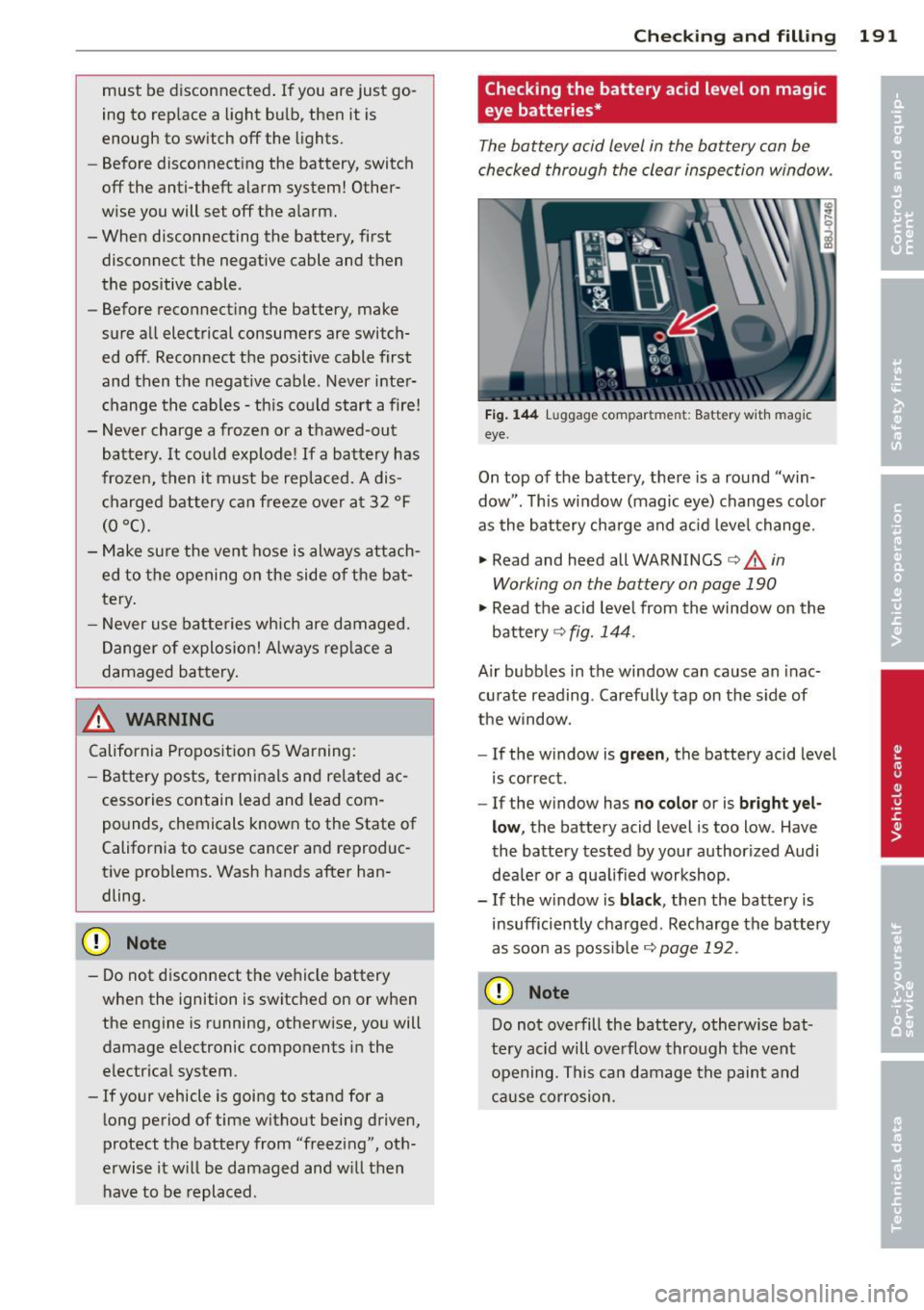
The battery acid level in the battery can be
checked through the clear inspection window .
Fig. 144 Luggage compartment: Battery With magic
eye.
On top of the battery, there is a round "win
dow". This window (magic eye) changes color
as the battery charge and acid level change.
.. Read and heed all WARNINGS
c::> &_ in
Working on the battery on page 190
.. Read the acid level from the window on the
battery
c:> fig. 144.
Air bubbles in the window can cause an inac
curate reading . Carefully tap on the side of
the window.
- If the window is
green, the battery acid level
is correct.
- If the window has no color or is bright yel
low ,
the battery acid level is too low . Have
the battery tested by your authorized Audi
dealer or a qualified workshop.
- If the window is
black , then the battery is
insufficiently charged . Recharge the battery
as soon as possible
r:::, page 192 .
CD Note
Do not overfill the battery, otherwise bat
tery acid will overflow through the vent
opening. This can damage the paint and
cause corrosion .
Page 194 of 260
192 Checking and filling
Charging of battery
Starting the engine requires a well charged battery.
,. Always read and heed all W ARNIN GS be
low
c> A and c> A in Working on the bat
tery on page 190.
,. Switch off the ignitio n and all electrical con
s u mers.
,. Make sure the area is well vent ilated when
yo u charge the battery.
,. Connect charger cables.
ALWAY S co nnect
ch arg er ca ble s PO SITIV E
G) to POSITIVE
G) ; NE GATI VE Q to NEGATI VE Q .
,. Switch on the charger.
,. Make sure the charging rate is not over
6 amps.
,. Turn off the charger¢.&_.
,. Disconnect the charger cables .
,. Connect both battery cables to the battery if
necessary-
first plus, then m inus.
It is not necessary to remove the battery from
the luggage compartment, and it is also not
necessa ry to disconnect the cables.
Normally, a battery should be charged at no
more than 10 percent of its rated capacity.
For example, a charging current of 4.5 amps
wou ld be used on a battery rated at 45 Ah.
Rated capacity of the battery in your veh icle is
listed on the battery housing .
The battery caps should
not be opened when
charging a battery.
&,. WARNING
-
Charging a battery can be dangerous.
- Never charge a frozen battery . It may ex
plode because of gas trapped in the ice.
Allow a frozen battery to thaw out first.
- Do not reuse batteries which were fro
zen. The battery housing may have
c racked and weakened whe n the battery
froze.
- Charge the battery in a we ll ventilated
area . Keep away from open f lame o r elec
t ric al spa rk . Do not smoke. Hydrogen gas
gene rate d by the b attery is exp losive. -
To reduce the danger of explosion, never
connect or d isconnect charger cab les
while the charger is operating .
- Fast charging a battery is dangerous and
should only be attempted by a compe
tent tech nician with the proper equip
ment .
- Battery acid that may spill during charg
ing should be washed off with a solution
of wa rm water and bak ing soda to neu
tralize th e ac id .
(D Note
Never use a fast charger as a booster to
start the eng ine . Th is w ill seriously dam
age sensit ive electronic components, such
as cont ro l units, re lays, radio, etc., as well
as the battery charger.
{1) Tips
The vehicle batte ry must not be charged
with a standa rd small charger that p lugs
i nto the cigarette lig hter or outlet.
Windshield/head Light
washer container
Fig . 14 5 Fender, left: Windshie ld washer fluid reser·
vo ir
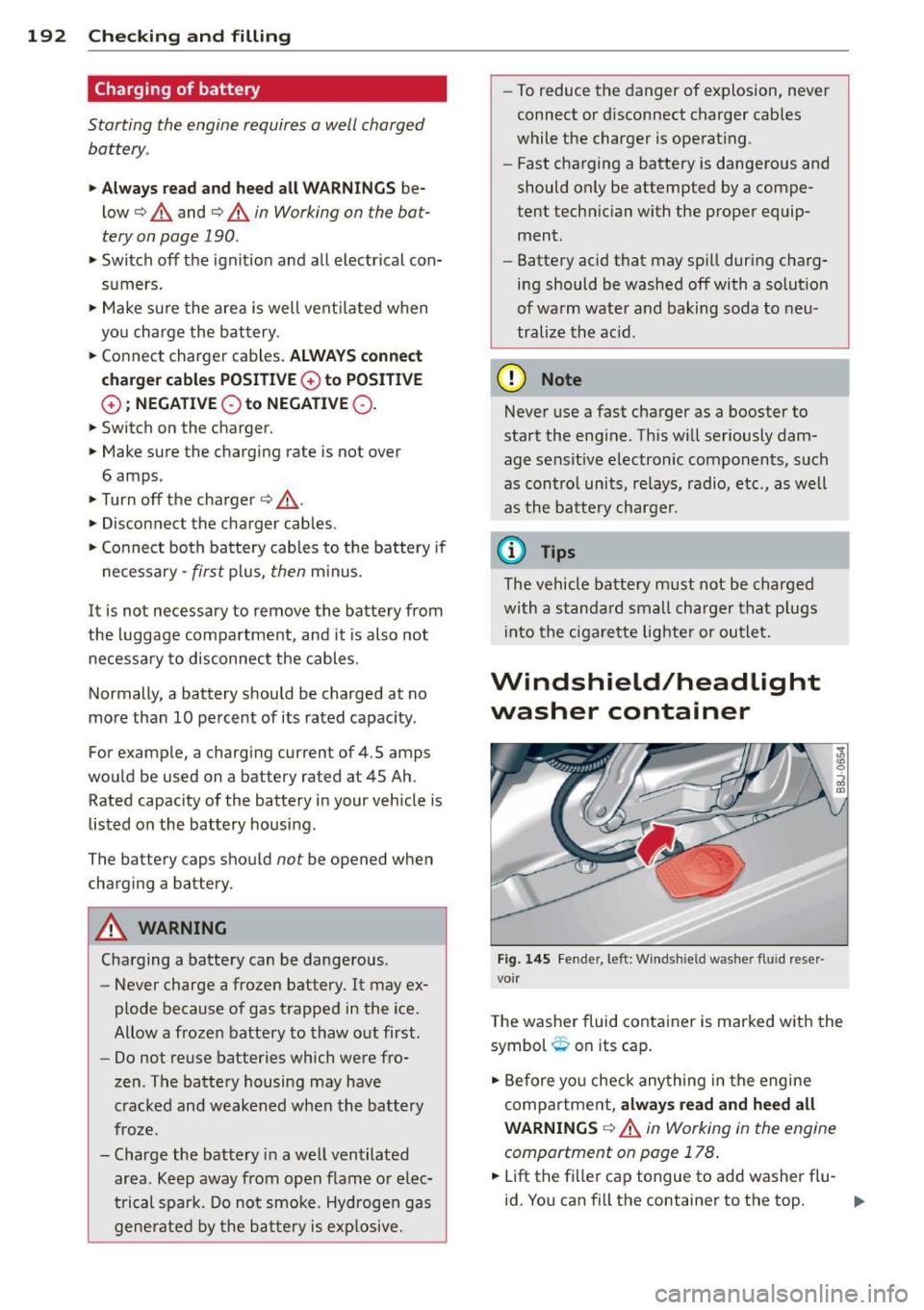
T he washer fluid container is marked with the
symbol
O on its cap.
,. Before you check any thing in the engine
compa rtme nt,
a lwa ys read and heed all
WARNINGS ¢
A in Working in the engine
compartment on page 178 .
,. Lift the filler cap tongue to add washer flu-
id. You can fill the container to the top.
111>
Page 198 of 260
196 Tires and wheels
Maximum loaded vehicle weight
means the sum of:
(a) Curb weight
(b) Accessory weight
(c) Vehicle capacity we ight, and
(d) Production options weight
Maximum (permissible) inflation pressure
means the maximum cold inflation pressu re
to which a tire may be inflated. Also called
"maximum inflation p ressure."
Normal occupant weight
means 150 lbs. (68 kilograms) times the
number of occupants seated in the vehicle up
to the total seating capacity of your vehicle.
Occupant distribution means distribution of occupants in a vehicle .
Outer diameter means the overa ll diameter of an inf lated new
tire.
Overall width
means the linear distance between the exteri
ors of the sidewalls of an inflated tire, includ
ing e levations due to labeling, decorations, or
protective bands or ribs.
Ply
means a laye r of rubber-coated parallel cords.
Production options weight
means the comb ined we ight of those installed
regular production options weighing over 5
lbs . (2 .3 kg) in excess of those standard items
which they replace, not previously considered
in curb weight or accessory weight, including
heavy duty brakes, r ide leve lers, heavy duty
battery, and special trim.
Radial ply tire
means a pneumatic tir e in which the p ly cords
that extend to the beads are laid at substan
tially 90 degrees to the centerline of the
tread . Recommended inflation pressure
see
~
page 195, Cold tire inflation pressure.
Reinforced tire
means a t ire designed to operate at higher
loads and at higher inflation p ressures than
the corresponding standard tire. Reinforced
ti res my be ident ified as "XL" "xl" "E XTRA
, ,
LOAD", or "RF" on the sidewall.
Rim
means a metal support for a tire or a t ire and
tube assembly upon which the tire beads are seated.
Rim diameter
means nominal d iameter of the bead seat. If
you change your wheel s ize, you w ill have to
purchase new tires to match the new r im di
ameter .
Rim size designation
means rim diameter and width.
Rim width
means nominal distance between rim flanges .
Sidewall
means that portion of a tire between the
tread and bead.
Speed rating (letter code)
means the speed at which a tire is designed to
be driven for extended periods of time. The
r atings range from 93 mph (150 km/h) to
186 mph (298 km/h)
~ page 206 . You may
not find this information on all tires because
it is not requ ired by law.
T he speed rating letter code, where applica
ble, is molded on the tire sidewall and indi
cates the maximum perm iss ibl e road speeds
~ A in Winter tires on page 209 .
Tire pressure monitoring system
means a system that detects when one or
more of a veh icle's tires are underinflated and
i lluminates a low tire pressure warning tell-
tale. ..,_
Page 233 of 260
Emergency situations
General
This chapter is intended for trained emer
gency crews and working personnel who
have the necessary tools and equipment to
perform these operations.
Starting by pushing or
towing
(D Note
Vehicles with an automatic transmission
cannot be started by pushing or towing .
Starting with jumper
cables
If necessary, the engine can be started by
connecting it to the battery of another vehi
cle.
If the engine should fail to start because of a
discharged or weak battery, the battery can be
connected to the battery of
another vehicle,
using a
pair of jumper cables to start the en
gine.
Jumper cables
Use only jumper cables of sufficiently
largec ross section to safely carry the starter
current. Refer to the manufacturer's specifica
tions.
Use only jumper cables which have
insulated
termina l clamps and are properly marked for
distinction :
plus(+) cable in most cases colored red
minus(-) cable
i n most cases colored black.
_& WARNING
Batteries contain electricity, ac id, and gas.
Any of these can cause very serious or fatal
injury. Follow the instructions below for
safe handling of your vehicle's battery.
- Always shield you r eyes and avoid lean
ing over the battery whenever possible.
Emergency situations 231
-A discharged battery can already freeze
at temperatures just below 32 °F (0 °C).
Before connecting a jumper cable, the
frozen battery must be thawed com
pletely, othe rwise it could explode .
- Do not allow battery acid to contact eyes
or skin . Flush any contacted area with
water immediately .
- Improper use of a booster battery to
start a vehicle may cause an explosion.
- Vehicle batter ies generate explosive gas
es. Keep sparks, flame and lighted ciga
rettes away from batteries.
- Do not try to jump start any veh icle w ith
a low ac id level in the battery.
- The voltage of the booster battery must
also have a 12-Volt rating. The capacity
(Ah) of the booster battery should not be
lower than that of the discharged bat
tery . Use of batteries of different voltage
or substantially different "Ah" rat ing
may cause an exp losion and personal in
jury.
- Never charge a frozen battery. Gas trap
ped in the ice may cause an explosion.
- Never charge o r use a battery that has
been frozen . The battery case may have
be weakened.
- Use of batter ies of different voltage or
substantially different capacity (Ah) rat
ing may cause an exp losion and injury .
The ca pa city (Ah) of the booster battery
should not be lower than that of the dis
charged battery.
- Before you check anything in the engine
compartment, always read and heed all
WARNINGS¢
page 172, Engine com
partment.
(D Note
- App lying a higher voltage booster bat
tery will cause expensive damage to sen
sit ive electronic components, such as
control units, relays, rad io, etc .
- There must be no electrical contact be
tween the vehicles as otherwise current
could already start to flow as soon as the
posit ive(+) terminals are connected. ..,. •
•
Page 234 of 260
232 Emergency situations
@ Tips
The discharged battery must be properly
connected to the vehicle's electrical sys
tem.
Use of jumper cables
Make sure to connect the jumper coble
clomps in exactly the order described below!
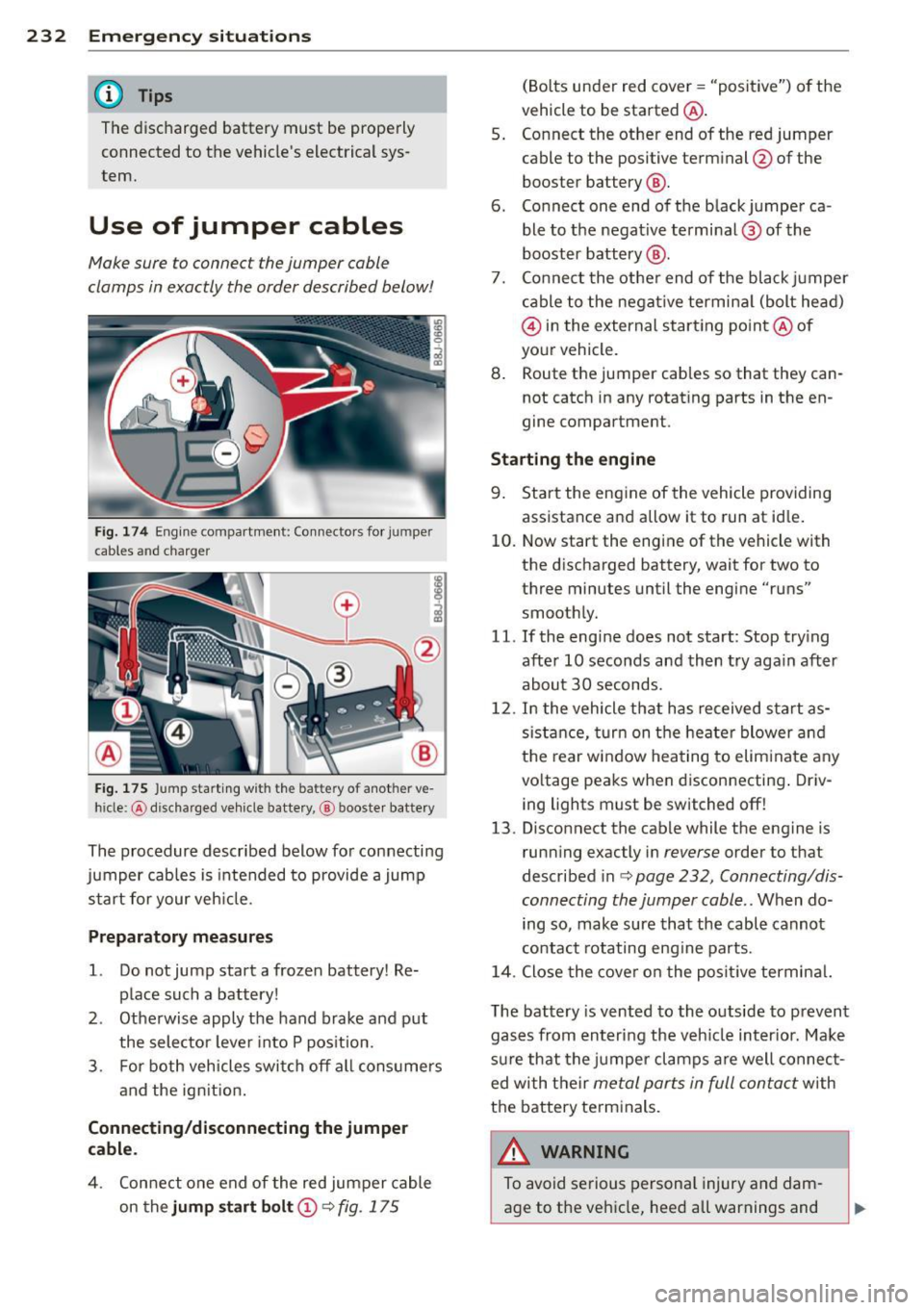
Fig. 174 Engine compart ment: Co nnectors for jumper
cables and charger
Fig. 175 Jump starting with the battery of another ve
hicle: @discharged veh icle battery, ® booste r battery
The procedure described below for connecting
jumper cables is intended to provide a jump
start for your veh icle.
Preparatory measures
1. Do not jump start a froze n battery! Re
place such a battery!
2 . Otherwise apply the hand brake and put
the selector lever into P position.
3. For both vehicles switch off all consumers
and the ign ition.
Connecting/disconnecting the jumper
cable .
4. Connect one end of the red jumper cable
on the
jump start bolt (D 9 fig. 175
(Bolts under red cover = "positive") of the
vehicle to be started @.
5. Connect the other end of the red jumper
cable to the positive terminal @of the
booster battery @.
6. Connect one end of the black jumper ca
ble to the negat ive terminal @of the
booster battery @.
7. Connect the other end of the black jumper
cable to the negative terminal (bolt head)
@ in the external start ing point @ of
your vehicle.
8. Route the jumper cables so that they can
not catch in any rotat ing parts in the en
gine compartment.
Starting the engine
9. Start the engine of the vehicle providing
assistance and allow it to run at id le .
10. Now start the engine of the vehicle with
the discharged battery, wait for two to
three minutes until the engine "runs"
smoothly.
11. If the eng ine does not start: Stop try ing
after 10 seconds and then try again after
about 30 seconds.
12. In the vehicle that has received start as
sistance, turn on the heater blower and
the rear window heating to elim inate any
vo ltage peaks when disconnecting . Driv
ing lights must be switched off!
13 . Disconnect the cable while the engine is
running exactly in
reverse order to that
described inc:>
page 232, Connecting/dis
connecting the jumper coble ..
When do
ing so, make sure that the cable cannot
contact rotating eng ine parts.
14. Close the cover on the posi tive terminal.
The battery is vented to the outside to prevent
gases from entering the vehicle inter ior. Make
sure that the jumper clamps are well connect
ed with their
metal parts in full contact with
the battery terminals.
A WARNING ~
To avoid serious personal injury and dam-
age to the vehicle, heed all warnings and
Page 235 of 260
instructions of the jumper cable
manufacturer. If in doubt, call for road
service.
- Jumper cables must be long enough so
that the vehicles do not touch.
- When connecting jumper cables, make
sure that they cannot get caught in any
moving parts in the engine compart
ment.
- Before you check anything in the engine
compartment, always read and heed all
WARNINGS
<=> page 172, Engine com
partment .
@ Note
Improper hook-up of jumper cables can ru
in the generator.
-Always connect POSITIVE(+) to POSI
TIVE(+), and NEGATIVE(-) to NEGATIVE
( - ) ground post of the battery manager
control unit.
- Check that all screw plugs on the battery
cells are screwed in firmly . If not, tighten
plugs prior to connecting clamp on nega
tive battery terminal.
- Please note that the procedure for con
necting a jumper cable as described
above applies spec ifically to the case of
your vehicle being jump started. When
you are giving a jump start to another ve
hicle, do
not connect the negative( -) ca
ble to the negative(- ) terminal on the
discharged battery@. Instead, securely
connect the negative (-) cable to either a
solid metal component that is firmly bolted to the engine block or to the en
gine block itself. If the battery that is be
in g charged does not vent to the outside,
escaping battery gas could ignite and ex
plode!
Emergency situations 233
Emergency towing
with commercial tow
truck
General hints
Your Audi requires special handling for tow
ing.
T he following information is to be used by
commercial tow truck operators who know
how to operate their equipment safely.
- Never tow your Audi, towing will cause
damage to the engine and transmission.
- Never wrap the safety chains or winch ca
ble s around the brake lines .
- To prevent unnecessary damage, your Audi
must be transported with a car carrier
(flatbed truck).
- To load the vehicle on to the flat bed, use
the towing loop found in the vehicle tools
and attach to the front or rear anchorage
<=> page 234 and c:> page 235.
A WARNING
A vehicle being towed is not safe for pas
sengers. Never allow anyone to ride in a
vehicle be ing towed, for any reason.
-
•
•
Page 248 of 260
246 Index
Auto Safety Hotline ............ .... . 105
Average fuel mileage ........... .. .... 20
Average speed . . . . . . . . . . . . . . . . . . . . . . . 20
Avoid damaging the vehicle ...... .... . 158
B
Battery . . . . . . . . . . . . . . . . . . . . . . 188, 191
Charging . .. ............. .. .. .. .. . 192
Check ing battery acid level ..... .... . 191
Connecting ............... ... .... . 188
Disconnecting ............... .... . 188
Important warnings when working on
the battery .................. .... .
190
Low . .. .. .. ............. .. .. .. ... 155
Replacing the battery .............. 189
State of charge . . . . . . . . . . . . . . . . . . . . 155
W inter operation ............... ... 188
Working on the battery ............. 190
Battery voltage ................ .... .. 33
Before driving .............. ... .... . .
Blended gasoline ..... ..... .. .. .. .. .
Body cavity sealing
Booster seats
Brake fluid 98
174
168
143
Changing the brake fluid ....... .. ... 188
Checking the brake fluid level .... .... 187
What is the correct brake flu id level? .. 187
What should I do if the brake fluid warn-
ing light comes on? ................
187
Brake fluid reservoir ......... ... .. .. . 187
Brake system ............... ... .... . 187
Anti-lock brake system ............. . 17
Brake Assistant .......... .. .. .... . 153
Brake fluid .................. ..... 187
Brake fluid spec ificat ions for refill and re-
placement .... .. ... ..... .. .. .. .. .
188
Brake light defective ................ 33
Brake pads .............. .... .... . 157
General information ............... 151
How does the moisture or road sa lt affect
the brakes? ............... ... .... .
151
Malfunction .............. ... .... . . 30
Warning/indicator lights ..... .. .. .. . . 16
Worn brake pads symbol ... .. .. .... .. 32
Break-in period .............. .. .... . 157
Brake pads ............... ... .... . 157
Tires .... .. ................ ..... . 157
Bulbs ..... ..... .. ............. .... 230
C
Cal iforn ia Proposition 65 Warn ing . ... .
Battery specific . ................. .
Capacities .. .. .. .. .. ...... ..... .. . . 179
191
239
Car care ... ..... .. ............. .... 162
Interior ..... .. .. ................. 168
Plastic and vinyl ................... 166
Weatherstrips 167
Care of exterior .... ................ . 162
Cargo area
refer to Luggage compartment ....... 103
Catalytic converter .................. 158
CD changer ..... .. .................. 73
Certification . . . . . . . . . . . . . . . . . . . . . . . 244
Changing a flat tire .................. 222
Changing engine oil ............... .. 184
Chassis
Undercoating .. .. ... .... ...... .. ..
168
also refer to Audi magnetic r ide .. .. .. . 86
Checking
Battery acid level .................. 191
Engine coolant level ................ 185
Checking tire pressure .............. . 200
Child restraint
Danger of using child restraints in the
front seat . ................... ....
116
Child restraints
Where can I get additional information
about child restraints and the ir use? ..
147
Child safety . ....................... 136
Convertible locking retractor ......... 144
Important safety instructions for using
ch ild safety seats .... .... ...... .. ..
139
Important things to know when driving
with children .....................
136
Child safety seat .................... 141
Convertible locking retractor . .. ..... . 144
Installing ... .. .. ....... ...... .. .. 144
Child safety seats
Booster seats . . . . . . . . . . . . . . . . . . . . .
143
Convertible child seats ............. 142
How do I properly install a child safety
· h' l ? 139 seat in my ve 1c e ...... ........... .
Page 250 of 260

248 Index
Dipstick
Reading the dipstick prop erly ..... .. . 183
Distance . . . . . . . . . . . . . . . . . . . . . . . . . . . 20
Driver information . . . . . . . . . . . . . . . . . . . 30
Dr iver info rmation system
M enu button . . . . . . . . . . . . . . . . . . . . . . 22
M enu display .............. .. .... .. 21
Open door or front lid warning .. .... .. 19
Outside temperature display .. .. .. .... 19
Red symbols ....................... 29
Service interval d isplay ......... ..... 24
Setting . . . . . . . . . . . . . . . . . . . . . . . . . . . 23
Sound system display ..... .. .. .. .. . . 19
Trip computer . . . . . . . . . . . . . . . . . . . . . . 20
ye llow symbo ls ........... .... .... .. 29
Driver seat
refer to Seat ing pos ition ........ ..... 99
Driving Run-flat tires ............ .. .. .... . 216
Driving saf ely . . . . . . . . . . . . . . . . . . . . . . . 98
Driving through water ....... .... .... 158
Duplicate key .............. ... .... .. 35
Dust filter . . . . . . . . . . . . . . . . . . . . . . . . . . 76
E
Efficiency program . . . . . . . . . . . . . . . . . . . 23
Fu el economy messages . . . . . . . . . . . . . 24
Memory levels . . . . . . . . . . . . . . . . . . . . . 20
Other equipmen t . . . . . . . . . . . . . . . . . . . 24
Elapsed time . . . . . . . . . . . . . . . . . . . . . . . . 20
Electro-mechanical power assist . . . 18, 153
El ect ronic different ial lock (EDL)
How the system works ..... .. .. .. .. . 149
Warning/indicator lights ....... .... .. 17
E lect ronic immobilizer . . . . . . . . . . . . 12, 36
Electronic power control
EPC warning/indicator light .. .. .. .... 14
El ect ronic speed limiter . . . . . . . . . . . . . . . 28
Electronic Stability Program ...... .... 148
Electronic stabilization program (ESP) Warning/indicator lights ... .. .. .... .. 15
Emergency flasher . . . . . . . . . . . . . . . . . . . 56
Warning/indicator lights ....... .... . . 15
Emer gency locking . . . . . . . . . . . . . . . . . . . 40 Emergency
operation
Convertible top .. .................. 49
Rear lid ... .. .. .. .. .............. .. 42
Emergency starting ............. .. .. 231
Emergency towing . ................ . 233
Energy management ................ 155
Battery power ... ................. 156
Driver notification ................. 156
Engine Check ing and filling locations ..... ... 180
Coolant . . . . . . . . . . . . . . . . . . . . . . . . . . 185
Hood ......... .. .. .............. . 178
Starting . . . . . . . . . . . . . . . . . . . . . . 80, 81
Starting with jumper cables ..... .... 231
Stopping .. .. .. .. .. ........... .... . 82
Eng ine compartment . . . . . . . . . . . . . . . . 180
Safety instructions ................ . 178
Working in the engine compartment 178
Engine coolant system
Malfunction ... .. .................. 31
Radiator fan ..... ................. 187
T em perature gauge ............ .... . 11
Engine cooling system . . . . . . . . . . . . . . . 185
Adding coolant . .. ............. .. .. 186
Checking the engine coolant level ... .. 185
Engine data ..... ................... 239
Engine hood Closing ... .... ................... 178
How to release the hood ............ 178
Engin e oil . ..... .. .. .............. . 180
Adding ....... .. ............. .... 183
Additives . ..... .. .. .............. . 183
Changing . .... .. ............. .... 184
Checking the engine oil level ..... .... 183
Indications and conditions requiring ex-
tra checking ..... ................ . 183
Oil consumpt io n .. .. ..... ........ .. 182
Oil grades . .. .. .. ............. .. .. 180
Recommended oil check intervals ... .. 183
Specification and viscosity ........... 180
Engine oil level . . . . . . . . . . . . . . . . . . . . . . 32
Engine oil pressure (malfunction) ... ... . 31
Engine oil sensor defective . . . . . . . . . . . . 32
Engine speed limitation .............. . 33
Environm ent
Break-in period ... ............. .... 157
Catalytic converter ................ . 158
Page 251 of 260
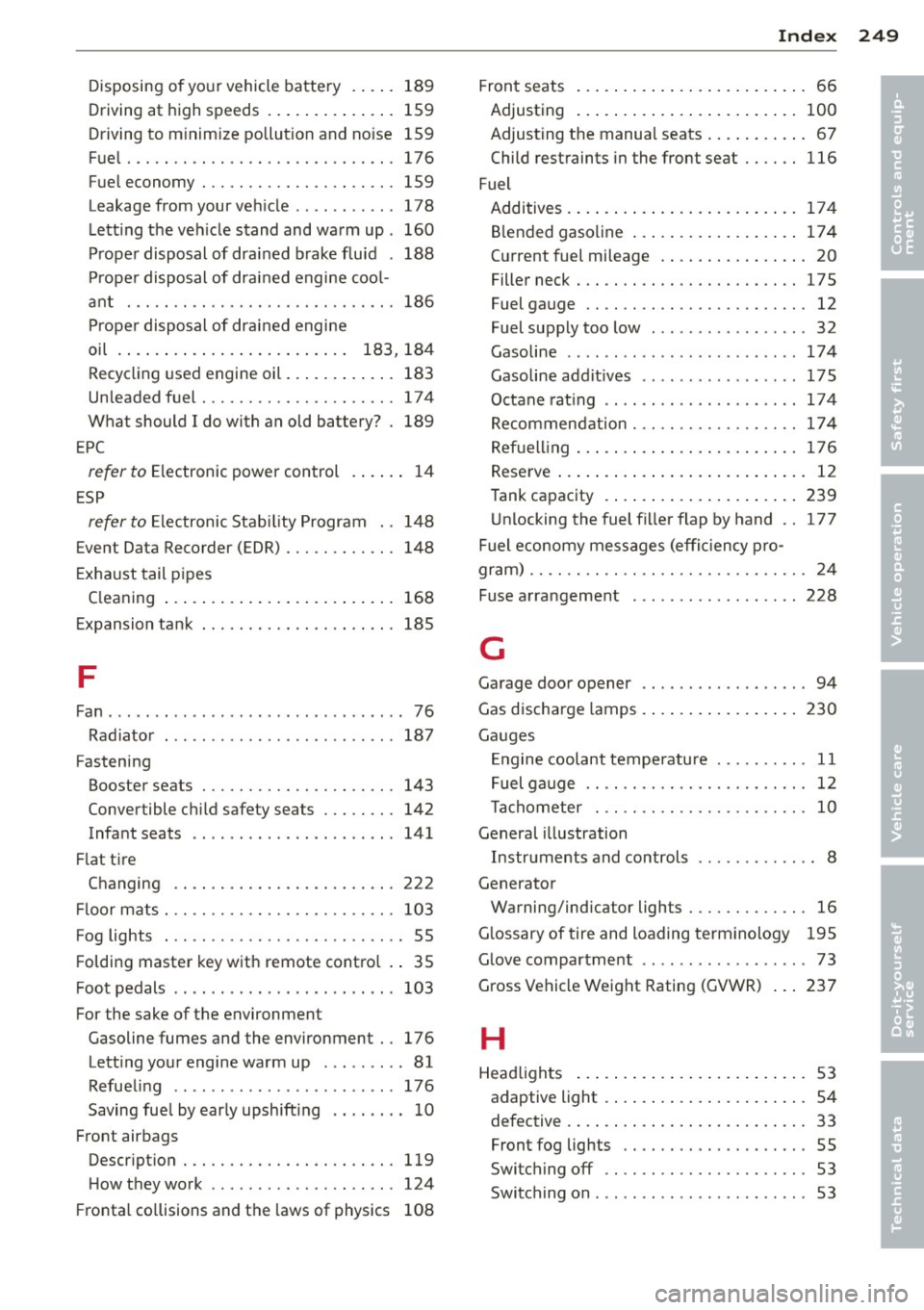
Disposing of your vehicle battery .. .. . 189
Driving at high speeds . . . . . . . . . . . . . . 159
Driving to minimize pollution and no ise 159
Fuel ... .. .. ................. .. ... 176
Fuel economy ................ .. ... 159
Leakage from your veh icle ...... . ... . 178
Letti ng the ve hicle stand and warm up . 160
Proper disposal of drained brake fluid . 188
Proper disposal of drained engine coo l-
ant ... .. .. ................. .. ... 186
Proper disposal of drained engine
oil . . . . . . . . . . . . . . . . . . . . . . . . . 183, 184
Recycling used engine oil ......... .. . 183
Un leaded fuel ............ .. .. .. ... 174
What should I do with an old battery? . 189
EP C
refer to Electronic power control . . . . . . 14
E SP
refer to Electronic Stability Program . . 148
Event Data Recorder (E DR) ... .. .. .. .. . 148
E xhaust tail pipes
Cleaning ... .. ... ........ .. .. .. ... 168
E xpansion tank .... .. ... ... .. .. .. .. . 185
F
Fan .... .... ... ................ .... . 76
Radiator ... .. ........ ... .. ... ... . 187
Fastening Booster seats . . . . . . . . . . . . . . . . . . . . . 143
Convertible c hild safety sea ts . .. .. .. . 142
Infant seats .. ..... ............. .. 141
Fl at tire
Changing .. .. .. ........... .. .. ... 222
Fl oor mats ... .... ............. .. .. . 103
Fog lights . . . . . . . . . . . . . . . . . . . . . . . . . . 55
F olding master key with remote contro l .. 35
Foot pedals .. .......... ... .... .. .. . 103
For the sake of the environment
Gasoline fumes and the environment .. 176
Lett ing your engine warm up . .. ... ... 81
Refuel ing . . . . . . . . . . . . . . . . . . . . . . . . 176
Saving fuel by early upshift ing .. .. .. .. 10
Front airbags Descr ipt ion ..... ............. .. .. . 119
H ow they work ... .. ...... .. .. .. .. . 124
Fr onta l co llisions and the laws of physics 108
Index 249
Front seats . . . . . . . . . . . . . . . . . . . . . . . . . 66
Adjusting ... .. .... . ............ .. 100
Adjusting the manual seats . . . . . . . . . . . 67
Child restraints in the front seat .... .. 116
Fuel Additives . ... .. .... . ............ .. 174
Blended gasoline . . . . . . . . . . . . . . . . . . 17 4
C ur rent fuel mileage . .......... .. .. . 20
Filler neck . .. .. .. .. .. ........... .. 175
Fuel gauge . . . . . . . . . . . . . . . . . . . . . . . . 12
Fuel supply too low . . . . . . . . . . . . . . . . . 32
Gasoline .. .. .. .. .. . .. .. ...... .. .. 174
Gasoline addit ives .. .............. . 175
Octane rat ing .. .. ................. 174
Recommendation . .... ......... .. .. 174
Refuelling ... .. .. .. . .. .......... .. 176
Reserve ... .. .. .... . ............ .. . 12
Tank capacity ....... .. ........ .. .. 239
Unlocking the fuel filler flap by hand .. 177
Fuel economy messages (efficiency pro-
gram) ...... .. .. .. .. . .............. . 24
Fuse arra ngeme nt ........ ......... . 228
G
Garage door opener .. ............... . 94
Gas discharge lamps . .. .. .......... .. 230
Ga uges
En gine coolant temperatu re . . . . . . . . . . 11
Fuel gauge . . . . . . . . . . . . . . . . . . . . . . . . 12
Tachom eter . . . . . . . . . . . . . . . . . . . . . . . 10
General illustration
Instruments and controls ... ... ... .. .. 8
Generator Warning/indicator lights .......... .. . 16
Glossary of tire and loading terminology 195
G lo ve compar tme nt . . . . . . . . . . . . . . . . . . 73
Gross Vehicle Weight Rating (GVWR) ... 237
H
Head lights ....... .. . .. .......... .. . 53
adaptive light . . . . . . . . . . . . . . . . . . . . . . 54
defective . . . . . . . . . . . . . . . . . . . . . . . . . . 33
Front fog lights . . . . . . . . . . . . . . . . . . . . 55
Switching off . . . . . . . . . . . . . . . . . . . . . . 53
Switching on . . . . . . . . . . . . . . . . . . . . . . . 53
•
•