fuel AUDI TT ROADSTER 2011 Owner's Manual
[x] Cancel search | Manufacturer: AUDI, Model Year: 2011, Model line: TT ROADSTER, Model: AUDI TT ROADSTER 2011Pages: 260, PDF Size: 64.11 MB
Page 164 of 260
162 Cleaning and protection
Cleaning and
protect ion
General information
Regular care preserves vehicle value .
Any automobile is exposed to industr ial
f umes, corrosive road salt, etc. A well cared
for Audi can look like new many years after pu rchase . Regula r and correct care w ill con
tr ibute to maintain ing the beauty and value of
your Aud i.
Furthermore , good care may be a condition
for substantiating a warranty claim should
corrosion damage or paint de fects occur.
Your authorized Audi dealer has a variety of
dedicated vehicl e-care products and can ad
v ise wh ich ones to use for cleaning the exter i
or and inte rior of your vehicle .
Whether you use produc ts recommended by
Aud i or other commercially ava ilable clean ing
agents, please make sure you apply t hem cor
r ectly .
A WARNING
-Cleaning agents may be poisonous. Keep
them o ut of t he rea ch of childre n.
- Heed a ll ca ution labels.
- Always read directions on th e co ntai ner
b efore using a ny product . Follow the di
rec tions caref ully.
- Most chemical cleaners a re concentrat ed
and have to be diluted.
- Use spot removing fluids only in well
ventilated areas.
- Do not use gasoline, kerosene, d iesel
fuel, nail pol is h remover or ot her volati le
fluids. They may be toxic, flammab le or
h azar dou s in other w ays. Do not was h,
w ax or dry the vehicle wi th the ig nit ion
on or the eng ine running .
- D o not cl ea n the under sides of ch assis,
f en ders, wheel cove rs , etc. without pro
tectin g your hands and a rms. You may
c u t yourself on s harp-ed ged metal parts . -
Moisture and ice on b rakes may impair
brak ing eff ic iency
c::> page 151 , General
information.
Test the brakes carefully
each time you wash t he vehicle .
@ For the sake of the environment
Select on ly environ mentally friendly clean
i ng products. Leftover cleaning products
s hou ld not d isposed of in the househo ld
waste .
Care of exterior
Washing
Frequent washing protects the vehicle .
The best p rotection against environmen tal i n
fluences is
frequent wash ing and waxing . How
often t his is requi red depends o n:
- How much t he ve hicle is used
- Whe re the veh icle is parked (garage, i n the
open under trees, etc.)
- The seasona l and weather conditions
- Environmental infl uences
T he longer b ird d roppings, inse cts, tree res in,
r oad and indus trial grime, ta r, soo t, road salt
and other mater ials remain on the vehicle
paint, the more lasting t heir destr uctive ef
f ects w ill be .
Hig h tempera tures, as from e xpos ure to in
tense sun light, intensify the co rrosive e ffect
part icu lar ly when humidity is high as well.
Un der certa in ci rcumstances,
weekly w ashing
may be ne cessary. Un der othe r cond it ions , a
mon thly washing and waxing may be a de
quate.
After the winter, the unders ide of the vehicle
sho uld be thoro ughly washe d pre ferab ly in a
pro fessional ca r wash.
A WARNING ~
A lways read and heed all WARNINGS a nd
the information
c::> page 162.
Page 166 of 260
164 Cleaning and protection
regular basis, fo r example when
refuelling your vehicle.
- Never use a dry cloth or sponge to clean
the headlights . Only use wet cloths or
sponges to prevent scratches. It is best
to use soapy water.
@J For the sake of the environment
In the interest of the env ironment, the ve
hicle sho uld only be washed in special
wash bays.
Washing your vehicle with a power
washer
Cleaning the exterior of your car with a high
pressure power washer is safe as long as you observe a few simple rules .
.. Before us ing the power washer, make sure
you have read and understood the WARN INGS
c> & in General information on
page 162.
.. Always fo llow the operating instructions for
the power washer .
.. Make sure that the jet on the spray hose pro
duces a "fan shaped spray".
.. Do
not hold the spray nozzle too close to
soft materia ls.
N eve r u se a pow er w asher to clean the power
top itse lf.
When clea ning t he vehicle w it h a powe r wash
e r
always fo llow the operating instructions.
This applies particularly to the
o pera tin g
p re ssu re
and the s p ra yi ng dist ance. Maintain
a sufficient distance to soft materials such as
rubber hoses and so und/vibration deadening
materia ls (part icularly on the underside of the
engine hood). Do not use a jet wh ich sprays
water in a
dire ct st ream or one that has a ro
tat ing
jet .
Water temperature shou ld not exceed 140 °F
(60
°() .
A WARNING
Never wash tires w ith a jet that sprays wa
ter in a d irect stream. This could cause in- visible damage to the tires and weaken
them, even
if the spray is from a relative ly
long distance and for a short time. Dam
aged and weakened tires can fail and cause
accidents and personal inju ry.
(D Note
- Never use a power washer to clean the
power top itself.
- To avoid damaging your veh icle, always
make sure that there is sufficient dis
tance between the spray head and soft
materials like rubber hoses, plast ic parts
and sound-deadening materials. Never
aim the spray head at the same point for
a long time. This also app lies to cleaning
head lights and pa inted b umpe rs. Re
member: the closer the nozz le is to the
surface of the material, the greate r the
stress on the materia l.
Convertible top care
The convertible top requires special care.
Keeping you r top looking great and mak ing
certain tha t it lasts a long time depend to a
great extent on proper use and care . Remove
bird droppings as soon as possible, since the
corrosive chemicals in them will cause the
rubber impregnation in your top to swell and
poss ibly allow the fabric to leak .
With
normal soiling, all you need to do is
clea r the top with a soft br ush and clear wa
ter. A lways brush in the direction of the fabric
from front to rear.
If the top is very dirty and has spotted areas
clean it with a brush using a convertible top
cleaner . Always brush in the direction of the
fabric from front to rear. R inse with plenty of
clear water, and allow the top to air-dry.
Chamois are not suitable for drying the top.
Never use gaso line, spot remover, benzene,
paint thinner or solvents to remove spots . We
recommend that you on ly use cleaners espe
cia lly formulated for use on convertib le tops,
and that you fo llow the produce use directions ...
Page 174 of 260
172 Cleaning and protection
• Once the stain is no longer visib le, use a soft
dry cloth or tissu e to soak up the moisture .
Do not use leather cleaning produc ts on Al
cantara .
You may use a suitable shampoo fo r remov ing
dust and dirt.
Dust and grit in the pores and seams can
scratch and damage the surface . If the car is
l eft stand ing i n the sun fo r long pe riods, the
A lcantara should be p rotected against direc t
sun light to preven t it from f ad ing. Slig ht color
va ria tions will develop in normal use an d are
not an indication of material deterioration .
CI) Note
-Never use chemi cal solven ts (e.g. lighter
fl uid , turpentine), waxes, shoe po lish or
s imilar products on Alcantara ® sur faces.
- To avoid damage, have stubborn stains
r emoved by a commerc ia l cleaning spe
cia list.
- Do no t use br ushes, st iff sponges or sim
ilarly abrasive cleaning a ids.
Safety belts
Only well-maintained safety belts work relia
bly when ne eded .
Heavily soiled safety belts may not retr act
p rope rly.
• Keep be lts clean.
• For cleaning, use a m ild soap and wate r sol
u tio n. Le t be lts d ry thoro ughly and away
from direct s unli gh t.
• Do no t all ow ine rtia reel safety be lts to re
t ract before they are completely d ry .
• Check the condition of your safety belts
reg
ularly.
A WARNING
Damaged safety belts can break in a crash.
1l Use o nly th e co rrec t cle anin g so lu ti on s. Ne ver use gas
oli ne or d ie se l fuel.
- Anyth ing that might damage yo ur sa fety
be lts could mean that you and your pas
sengers would not be adequate ly pro
tected in an accident .
- Safety belt performance depends on co r
rect insta llation. Never remove be lts
from the veh icle to clean them .
- Do not use chemical clea ning agents,
b leach or dyes . They have corrosive prop
ert ies which wea ken the webb ing .
- When clean ing your safety be lts, inspect
them for damage . If you discover dam
age, see your Audi dea ler .
'
-Always read a nd heed a ll WARNINGS and
the information
<=;> page 162 .
Engine compartment
Be especially careful when cleaning the en
gine compar tment.
Always switch off the ignition before clean
ing the engine<=;>.&, .
Plenum panel
Remove leaves from the plenum panel in front
of the w indshield under the eng ine hood . This
preve nts the water drain holes from becomin g
block ed, and it prevents debris from enter ing
the ve hicle interio r thr ough the heating and
ventilat ion duc ts.
Corrosion protection
T he eng ine compartment and transmission
have been corrosion -protected at the factory .
G ood anti- corrosio n treatmen t is very impor
tant, par ticul arly in the w inter.
If the vehi cle
is frequently driven on salt t reated roads, the
entire engine compa rtment an d plen um panel
sho uld be thoro ughly cleaned at the end of
winter and retreated to prevent salt damage.
At the same time, the unde rside of the vehicle
shou ld be washed as well.
If the engine compa rtment is cleaned at any
time with grease remov ing solutions
1> , or if ..,.
Page 176 of 260
174 Fuel supply and filli ng your fuel tank
Fuel supply and filling
your fuel tank
Gasoline
Fuel supply
Using the right fuel helps keep the environ
ment clean and prevents engine damage .
Fuel recomm endation
The fuel recommended for your vehicle is un
lead ed pr emium
grade gasoline . See also
¢ page 239, Data . Audi recommends using
TOP TIER Detergent Gasol ine with a minimum
octane rating of 91 AK I (95 RON). For more
information on TOP TI ER Detergent Gasoline,
p lease go to the officia l website (www.toptier
gas.com).
The recommended gasoline octane rating for
your engine can a lso be found on a label locat
ed on the inside of the fuel filler flap . This rat
ing may be specified as AKI or RON.
Your veh icle may also be operated using un
leaded regular gasoline with a minimum oc
tane rating of 87 AKI/91 RON . However, using
87 AKI/91 RON octane fue l wi ll slightly re
duce engine performance.
U se unl ead ed gasolin e onl y. Unleaded gaso
line is available throughout the USA, Canada ,
and in most European countries . We recom
mend that you do not take your vehicle to
areas or countries where unleaded gasoline may not be available.
F or more informat ion on refue ling your vehi
cle, see
¢ page 175.
Octane rat ing
Octane rating ind icates a gasoline's ability to
resist engine damaging "knock" caused by
premature ign ition and detonation. Therefore,
buying the correct grade of gasoline is very
important to help prevent possible engine
damage and a loss of engine performance.
Gasoline most commonly used in the United
States and Canada has the following octane ratings that can us
ually be found on the fi ller
pump:
- Premium Grade: 91 -96 AKI
- Regular Grade: 87 - 90 AKI Explanation of the abbreviations:
AKI = Anti Knock Index = (R+M)/2 = (RON
+ MON)/2
RON= Research Octane Number
MON = Motor Octane Number .
(D Note
-Do not use any fuel w ith octane rat ings
lower than 87 AKI or 91 RON otherwise
expensive engine damage w ill occur.
- Do
not use leaded gasoline! The use of
leaded gasoline w ill severely damage
your vehicle's catalytic converter and its
ability to control exhaust emissions .
Blended gasoline
Use of gaso line co ntainin g alc ohol or
MTBE (m ethyl tertia ry butyl eth er)
You may use unleaded gasoline blended with
alcohol or MTBE (commonly referred to as
oxygenates) if the blended mixture meets the
fo llowing criteria:
Blend of gaso line m ethanol (wood alc ohol or
methyl alcohol )
-Anti -knoc k index must be 87 A KI or h igher.
- Blend must contain no more than 3% meth-
anol.
- Blend must contain more than 2% co-sol-
vents .
Blend of g asoline and etha nol (gra in alcohol
or eth yl alcohol )
-Anti -knock index must be 87 AKI or higher .
- Blend must not contain more than 10% ethanol.
Blend of g asoline a nd MTBE
-Anti-knock index must be 87 AKI or h igher . ll-
Page 177 of 260
-Blend must contain not more than 15%
MTBE.
Seasonally adjusted gasoline
Many gasoline grades are blended to perform
espec ially we ll for winter or summer driving.
During seasonal change-over, we suggest that
you fill up at busy gas stat ions where the sea
sonal adjustment is more likely to be made in
time .
(D Note
-Methanol fuels which do not meet these
requirements may cause corrosion and
damage to plastic and rubber compo
nents in the fuel system .
- Do not use fue ls that fail to meet the
specified criter ia in this chapter.
- If you are unable to determine whether
or not a particular fue l blend meets the
specifications, ask your service station or
its fuel supp lier.
- Do not use fuel for which the contents
cannot be identified.
- Fuel system damage and performance
problems resulting from the use of fuels
different from those specified are not
the responsibility of Audi and are not
covered under the New Vehicle or the Emission Control System Warranties.
- If you experience a loss of fuel economy
or driveability and performance prob l ems due to the use of one of these fuel
blends, we recommend that you switch
to unblended fuel.
Gasoline additives
A major concern among many auto manufac
turers is carbon deposit build- up caused by
the type of gasoline you use.
Although gasoline grades differ from one manufacturer to another , they have certain
things in common. All gasoline grades contain
substances that can cause deposits to collect
on vital engine parts, such as fuel injectors
and intake valves. Although most gasoline brands include additives to keep engine and
Fuel supply and filling your fuel tank 175
fuel systems clean, they are not equally effec
tive .
A udi recommends using TOP TIER Detergent
Gasoline. For more information on TOP TIER
Detergent Gasoline, please go to the official
website (www.toptiergas.com).
After an extended period of using inadequate
fuels, built-up carbon deposits can rob yo ur
engine of peak performance.
Q) Note
Damage or malfunction due to poor fue l
quality is not covered by the Aud i New Ve
hicle Limited Warranty.
Fuel tank
Fuel filler neck
The fuel filler neck is located on the right rear
side panel behind the fuel fille r flap.
If the unlocking system should fail, you can
still open the flap manually -for detailed in
structions see ¢
page 177.
You can find the fuel tank capacity of your ve
hicle in
Technical Data ¢ page 239.
The label on the inside of the fuel fi ller flap
tells you the correct fue l for your vehicle. For
more information about fuel specifications,
see ¢
page 174.
Your vehicle fue l tank has an on -board refue l
li ng vapor recovery system. This feature helps
to prevent fuel vapors from escaping from the
tank and polluting the environment while you refuel your vehicle . In order to fill the tank
properly while protecting the environment,
please fo llow this refueling procedure careful
ly.
_&. WARNING
Under normal operating conditions, never
carry additional fue l conta iners in yo ur car.
Gas canisters and other containers used to
transport f uel can be dangero us. Such con
tainers, full or empty, may leak and could
cause a fire in a collision. If you must
•
•
Page 178 of 260
1 76 Fuel supply and filling your fuel tank
transport fuel to use for your lawn mower,
snow blower, etc., be very careful and al
ways observe local and state laws regard
ing the use, transportation and storage of
such fuel containers. Make certain the con
tainer meets industry standards (ANSI/
ASTM F852 - 86).
(D Note
Never drive your vehicle until the fuel tank
is completely dry. The irregular supply of
fuel can cause misfiring. Gasoline could
enter into the exhaust system and damage
the catalytic converter.
Refuelling
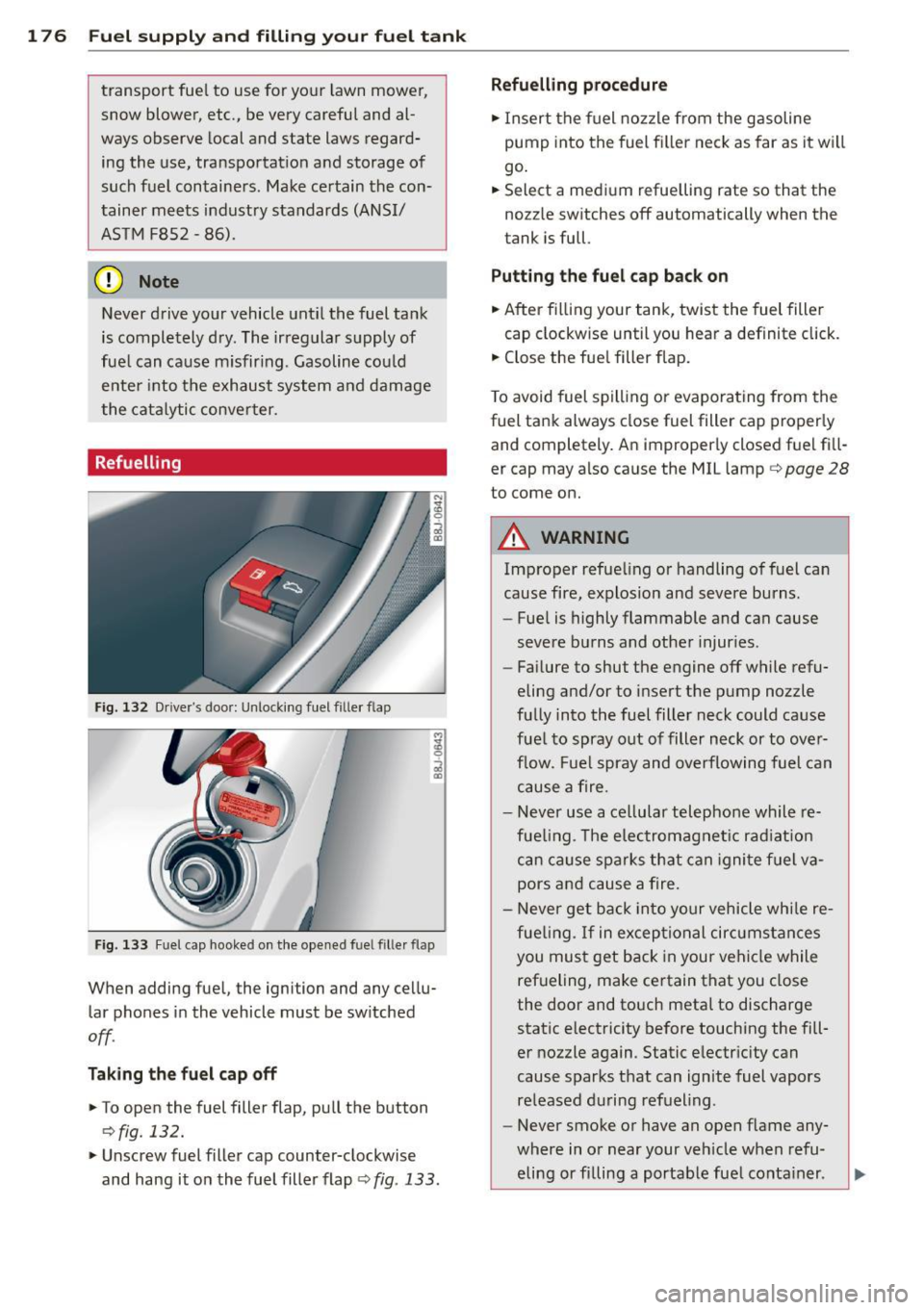
Fig. 132 Driver's door: Un locking fuel filler flap
Fig. 133 Fuel cap hooked on the opened fue l filler flap
When adding fue l, the ignition and any ce llu
lar phones in the vehicle must be switched
off .
Taking the fuel cap off
• To open the fuel filler flap, pull the button
9fig. 132.
• Unscrew fuel filler cap counter-clockwise
and hang it on the fuel filter flap¢
fig. 133 .
Refuelling procedure
• Insert the fuel nozzle from the gasoline
pump into the fuel filler neck as far as it will
go.
• Select a medium refuelling rate so that the
nozzle switches off automatically when the
tank is full.
Putting the fuel cap back on
• After filling your tank, twist the fuel filter
cap clockwise until you hear a definite click.
• Close the fuel filler flap.
To avoid fuel spilling or evaporating from the
fuel tank always close fuel filler cap properly and completely. An improperly closed fuel fill
er cap may also cause the MIL lamp¢
page 28
to come on.
A WARNING
Improper refueling or handling of fuel can
cause fire, explosion and severe burns.
- Fue l is highly flammable and can cause
severe burns and other injuries.
- Failure to shut the engine off while refu
eling and/or to insert the pump nozzle
fully into the fuel filter neck could cause
fuel to spray out of filler neck or to over
flow. Fuel spray and overflowing fuel can
cause a fire.
- Never use a cellular telephone while re
fueling. The electromagnetic radiation
can cause sparks that can ignite fuel va
pors and cause a fire.
- Never get back into your vehicle while re
fueling.
If in exceptional circumstances
you must get back in your vehicle while
refueling, make certain that you close
the door and touch metal to discharge
static electricity before touching the fill
er nozzle again. Static electricity can
cause sparks that can ignite fuel vapors
released during refueling .
- Never smoke or have an open flame any
where in or near your vehicle when refu
eling or filling a portable fuel container.
Page 179 of 260
-For your safety, we strongly recommend
that you do not travel with a portable
fuel container in your vehicle. The con
tainer, full or empty may leak and could
cause a fire, especially in a crash.
- If, under exceptional circumstances, you
must transport a portable fuel container,
please observe the following:
- Never fill a portable fuel container
while it is anywhere in or on the vehicle (for example, in the luggage compart
ment, or on the trunk) . Static electrici
ty can build up while filling and can ig
nite fuel vapors causing a fire.
- Always place a portable fuel container
on the ground before filling .
-Always keep the filler nozzle complete
ly inside the portable container before
and during filling.
- If filling a portable container made of
metal, the filler nozzle must always be
in contact with the container. This will
help prevent static electricity from dis
charging and cause a fire.
- Never spill fuel inside the vehicle or
luggage compartment. Fuel vapors are
highly flammable.
- Always observe local and state/provin
cial laws regarding the use, storage
and transportation of fuel containers
- Make certain the fuel container meets
industry standards (ANSI/ ASTM
F852-86).
(D Note
If any fuel has spilled onto the car, it
should be removed immediately to prevent
damage to the paint.
@ For the sake of the environment
As soon as the correctly operated nozzle switches off automatically for the first
time, the tank is full. Do not try to add
more fuel because fuel may spill out. In
addition, the expansion space in the fuel
tank will be filled -causing the fuel to
Fuel supply and filling your fuel tank 177
overflow when it becomes warm and pol
lute the environment.
a) Tips
- Running your engine while refuelling
may cause vapors to escape or even fuel
to spill out of the tank. This would then
shut off the fuel nozzle before the tank
is full.
- Do not refuel your vehicle with the igni
tion switched on. The fuel gauge may
otherwise not indicate the correct fuel
level after refuelling.
Unlocking the fuel filler flap
by hand
You can open the fuel filler flap by hand if the
power locking system should fail .
Fig. 134 Lu ggage compartment: Cover in the right
side interior trim
If the power locking system should fail, you
can still open the flap manually:
.. Open the rear lid.
.. Open the round cover in the right-side interi
or trim .
.. Remove the red plastic knob from its retain
er.
.. Pull the plastic cord in the direction of the
arrow to unlock the fuel filler flap
~fig. 134 .
Page 181 of 260
-Apply the parking brake.
- Move selector lever to "P" (Park).
- Always let the engine cool down. Hot
components will burn skin on contact.
- To reduce the risk of being burned, never
open the hood if you see or hear steam
or coolant escaping from the engine
compartment. Wa it until no steam or
coolant can be seen or heard before care
fully opening the hood.
- Keep children away from the engine com
partment .
- Never spill fluids on hot engine compo
nents. They can cause a fire.
- Never touch the radiator fan. The auxili
ary electric fan is temperature controlled
and can switch on suddenly.
- Never open the coolant reservoir cap
when the engine is still warm. The cool
ant system is pressurized and hot cool
ant could spray out .
- Protect your face, hands and arm from
steam or hot engine coolant by placing a
thick rag over the cap when you open the
coolant reservoir .
- If work on the fuel system or the electri
cal system is necessary:
- Always disconnect the battery.
- Never smoke or work near heaters or
open flames. Fluids in the engine com
partment could start a fire.
- Keep an approved fire extinguisher im
mediately available.
- To avoid electrical shock and personal in
jury while the engine is running or being
started, never touch:
- Ignition cables
- Other components of the high voltage
electronic ignition system.
-If you must perform a check or repair
with the engine running:
- First, fully apply the parking brake,
move selector lever to "P" (Park).
Checking and filling 179
-Always use extreme caution to prevent
clothing, jewelry, or long hair from get
ting caught in the radiator fan, V-belts
or other moving parts, or from contact ing hot parts . Tie back hair before
starting, and wear no clothing that will
hang or droop into the engine.
- Minimize exposure to emission and
chemical hazards
9 .&, .
&_ WARNING
California Proposition 65 Warning:
- Engine exhaust, some of its constituents,
and certain vehicle components contain
or emit chemicals known to the State of
California to cause cancer and birth de
fects and reproductive harm. In addition,
certain fluids contained in vehicles and
certain products of component wear con
tain or emit chemicals known to the
State of California to cause cancer and birth defects or other reproductive harm.
- Battery posts, terminals and related ac
cessories contain lead and lead com
pounds, chemicals known to the State of
California to cause cancer and reproduc
tive harms. Wash hands after handling .
(D Note
When adding fluids, always make sure that
they are poured into the proper container
or filler opening, otherwise serious dam
age to vehicle systems will occur.
@ For the sake of the environment
To detect leaks in time, inspect the vehicle
floor pan from underneath regularly . If
you see spots from oil or other vehicle flu
ids, have your vehicle inspected by an au
thorized Audi dealer. •
•
Page 184 of 260
182 Checking and filling
Deterge nt additives in the o il wi ll make fresh
oil look dark after the engine has been run
n ing for a short time . This is norma l and is not
a reason to change the oil more often than recommended.
D am ag e o r m alfun ction s due to lack of
m ainten ance
It is essent ial that yo u change your oil at the
recommended intervals using only engine oil
that complies with Audi oi l standard
VW 502 00. Yo ur Limited New Veh icle War
ranty does not cover damage or malfunctions
due to failure to follow recommended mainte
nance and use requ irements as set forth in
the Audi Owner's Manual and Warranty& Maintenance book let . Your dea ler will have to
deny warranty coverage un less you p resen t to
the dea ler proof in the form of Servi ce or Re
pa ir Orde rs that all schedu led maintenance
was performed in a timely manner.
Engine oil consumption
The engine in your vehicle depends on an ade
quate amount of oil to lubricate and cool all
of its moving ports.
I n o rder to prov ide effective lubr ication and
cooling of internal engine components, a ll in
ternal comb ustion engines consume a certain
amount of oil. Oi l consumption varies from
engine to engine and may change significantly
over the life of the eng ine . Typically, eng ines
with a specif ied break-in period (see
c::;, page 157) consume more oil during the
break-in per iod than they consume after oil
consumption has stabilized .
Under normal conditions, the rate of oil con
sumpt io n depends on the quality and viscosity
of the oil, the RPM (revolutions per m inute) at
which the engine is operated, the ambient
temperature and road cond it io ns. Furthe r fac
tors are the amo unt of o il d ilution from wate r
condensation or fuel residue and the ox ida
tion level of the oi l. As any engine is s ubject to
wear as mileage bui lds up, the oil consump
tion may increase over t ime until replacement
of worn components may become necessary. Wi
th a ll these variab les coming into p lay, no
standard rate of oil consumption can be es
tab lished or spec ified. There is no alte rnative
to regular and frequent check ing of the o il lev
el, see
Note .
If the yellow engine oil leve l warning symbo l
in the instr ument cluster
m lights up, yo u
sho uld check the oil leve l as soon as possib le
with the oil dipstick c::;, page 183. Top off the
o il at your earliest conve nience
c::;, page 183 .
A WARNING
-Before you chec k anything in the engine
compartment, a lways read and heed a ll
WAR NIN GS
c::;, .& in Working in the engine
comportment on page 178.
CI) Note
D riving with an insufficient o il level is like
l y to cause sever e damage to the engine.
(D Tips
- The oil pressure warn ing display. is
not an indicator of the oil level. Do not
re ly on it . Instead, check the oil level in
your engine at r egular interval s, pr ef
erably e ach time you refu el, and always
before going on a long trip.
- If you have the impressio n yo ur engine
cons umes ex cessive amoun ts of oil, we
recommend that you consult your Aud i
dealer to have the cause of your concern
properly diagnosed. Keep in mind that
the accurate meas urement of o il con
sumption requ ires great care and may
take some t ime . Your Audi dea ler has in
struct ions about how to measure oil con
sumption acc urately.
Page 197 of 260
-Never mount used tires on yo ur vehicle if
you are not sure of their "previous histo
ry." Old used tires may have been dam
aged even though the damage cannot be
seen that can lead to sudden tire failure
and loss of vehicle control.
Glossary of tire and loading terminology
Accessory weight
means the comb ined weight (in excess of
those standard items wh ich may be rep laced)
of automa tic tra nsmission, power steering,
power br akes, power w indows, power sea ts,
radio, and heater, to the ex tent that these
items are avai lab le as factory -installed eq uip
ment (whether installed or not).
Aspect ratio
means the rat io of the height to the w idt h of
the tire in percent . Numbers of 55 o r lower in
d icate a low sidewall fo r improve d steer ing re
sponse and better overall handling on dry
pavement.
Bead
means the pa rt of the t ire t hat is made o f
s teel wires, wrapped o r reinforce d by ply cor ds
and that is shaped to fit the r im.
Bead separation
means a b reakdown of the bond between
com ponents in the bead .
Cord
means the strands forming the plies in the
tire .
Cold tire infl ation pres sure
means the tire pressure recommended by the
vehicle manufacturer for a t ire of a designated
size that has not been dr iven for more than a
couple of miles (kilometers) at low speeds in
the three hour period before the tire pressure
i s measu red or adjusted.
Tire s an d wheel s 195
-If you notice un usua l vibration or if the
veh icle pulls to one side when driv ing, a l
ways stop as soon as it is safe to do so and check the wheels and tires for dam
age.
Curb weight
mea ns the we ight of a motor ve hicle w it h
standard equipment in cl ud ing t he maximum
capacity of fuel, o il, and coolant, ai r cond i
tion ing and addi tional weig ht o f optiona l
equipment .
Extra load tire
means a t ire designed to operate at higher
loads and at highe r inflat ion p ressu res tha n
th e co rresponding standard tire. Extr a load
tir es my be i dent ified as "X L", "xl", " EXTRA
L O AD", or "RF" on t he sidewall.
Gross Axle Weight Rating ("GAWR ")
mea ns the load-carry ing capac ity of a s ingle
axle system, measured at the tire-ground in
te rfaces .
Gross Vehicle Weight Rating ( "GVWR ")
mea ns the maximum total loaded we ight of
t h e ve hicle.
Groove
means the space between two adjacent tread
ribs.
Load rating (code )
means the maximum load tha t a t ire is rate d
to ca rry for a given inflation press ure. Yo u
may not find this information on all tires be
ca use it is not required by law.
Maximum load rating
me ans the loa d ra ting f or a t ire a t the maxi
mum pe rm issi ble inflat ion pressure for that
ti re . •
•
...