lock AUDI TT ROADSTER 2011 Manual PDF
[x] Cancel search | Manufacturer: AUDI, Model Year: 2011, Model line: TT ROADSTER, Model: AUDI TT ROADSTER 2011Pages: 260, PDF Size: 64.11 MB
Page 203 of 260
Never exceed the m aximum inflati on pres
s u re li sted on the ti re sidew all for any rea
son.
Remembe r that the vehicle manufacturer, not
the t ire manufacturer, determines the co rrect
tire pressure for the tires on your vehicle.
It is importan t to check the tire pressure when
t he t ires are cold .
- Read the requ ired ti re pressure from the tire
pressure label located on d river's s ide B-pi l
l ar .
- T urn the valve stem cap counter-clockwise
to remove it from the tire valve .
- Place the air pressure gauge on the valve .
- The tire pressures should only be checked
and adjusted when the tires are cold . The
s li ght ly raised p ressures of warm tires must
not be reduced.
- Adjust the t ire pressure to the load you a re
ca rrying.
- Re install the valve stem cap on the valve .
When should I ch eck the ti re pres sur e?
The correct tire pressure is especially impor
tant at high speeds. The pressure should
therefore be checked at least once a month
and a lways before start ing a journey .
When should I ad just th e tir e pre ss ures?
Ad just the tire pressure to the load you are
carrying . After changing a wheel
or replacing
wheels you have to adjust the tire pressures
on all wheels. In addition, you must then in it i
alize the new tire pressures in the tire pres
sure mon itor ing system
q page 212 .
A WARNING
Incorrect tire pressures and/or unde rinfla
tion can lead sudden tire failure, loss of cont ro l, col lision, ser ious persona l inju ry
or even death.
- When the warning symbo l
[D] appears in
the instrument cl uster, stop and inspect
the tires.
- Incor rect tire pressure and/or underinfla
tion can cause increased tire wear and
Tire s an d wheel s 201
can affect the handling of the vehicle and
stopping ability .
- Incorrect tire pressures and/or underin
flation can a lso lead to sudden t ire fail
ure, including a blowout and sudden de
flation, caus ing loss of veh icle control.
- The driver is responsible for the correct
tire pressures for all tires on the veh icle.
The applicable pressure values are locat ed on a sticker on the dr iver's s ide B-pil
lar .
- On ly when all tires on the vehicle are fil
led to the correct pressure, the t ire p res
sure mon itor ing system can work cor
rectly.
- The use of incorrect tire p ressu re va lues
can lead to acc idents or other damage.
Therefore it is essential that the drive r
observe the spec ified t ire p ress ure val ues
for the t ires and the correct pressures for
the function of the tire press ure monito r
ing system.
-A lways inflate tires to the recommended
and correct tire pressure before dr iv ing
off.
- Driving with underinf lated tires bend
mo re, letting them get too hot resulting
in tread separation, sudden tire failure
and loss of control.
- Excessive speed and/over loading can
cause heat b uild-up, sudden tire failure
and loss of control.
- If the tire pressure is too low or too high,
the t ires will wear prematurely and the
veh icle w ill not handle well.
- If the tire is not flat and you do not have
to change a wheel immediately, drive at
reduced speed to the nearest service sta
tion to check the t ire p ressu re and add
a ir as requ ired.
(D Note
Driving w it h out valve stem caps can cause
damage to the tire valves. To prevent this,
always make sure that factory installed
valve stem caps on all whee ls are secu rely
mounted o n the valve. .,.
•
•
Page 209 of 260
general, the greater the number of plies, the more weight a tire can support . Tire manufac
turers also must indicate the materials in the
tire, wh ich include steel, nylon, polyester, and
others .
Ma ximum Load R ating
This number indicates the maximum load in
kilograms and pounds that can be carried by
the tire.
Tire qualit y gr ad ing for treadw ear,
tract ion , an d temp erature resis ta nce
Tread wear , traction and temperature grades
c::> pag e208.
M aximum Permis sibl e Inflation Pr essur e
This n umbe r is the greatest amount of air
pressure that should ever be put in the tire
under normal driving conditions .
& WARNING
- Using incorrect or unmatched tires and/
or whee ls or improper tire and whee l
combinations can lead to loss of contro l,
collision and serious personal injury.
- Always use tires, rims and wheel bo lts
that meet the specifications of orig inal
factory-installed tires or other combina
t ions that have been spec ifically ap
proved by the vehicle manufacturer .
- Tires age even if they are not be ing used
and can fail suddenly, especially at high
speeds . T ires that are more than 6 years
o ld can only be used in an emergency
and then with special care and at lower
speeds.
- Never mount used ti res on you r vehicle if
yo u are not s ure of their "previous histo
ry ." Old used tires may have been dam
aged even though the damage cannot be
seen that can lead to sudden tire failure
and loss of vehicle control.
- All four wheels must be fitted with radia l
t ires of the same type, size (roll ing cir
cumference) and the same tread pattern .
Driv ing with different tires reduces veh i-
Tire s an d wheel s 207
cle handling and can lead to a loss of
contro l.
- If the spare tire is not the same as the
tires that are mounted on the vehicle -
for examp le w ith winter t ires -only use
the spare t i re for a short period of time
and drive with extra care . Refit the nor
mal road wheel as soon as safely poss i
ble .
- Never drive faster than the max imum
speed for which the tires on your vehicle
are rated because tires that are dr iven
faster than their rated speed can fa il
suddenly.
- Ove rloading tires cause heat build-up,
sudden tire fa ilure, including a blowout
and sudden deflation and loss of contro l.
- Temperature grades apply to tires tha t
are properly infla ted and not over or un
derinf lated .
- For technical reasons it is not always
possible to use whee ls from other vehi
cles -in some cases not even wheels
from the same ve hicle mode l.
-If you install wheel trim discs on the ve
hicle wheels, make sure that the air flow
to the brakes is not b locked. Reduced air
f low to the brakes can them to overheat,
increas ing stopping d istances and caus
ing a co llision .
- Run flat tires may only be used on vehi
cles that were equ ipped w ith them at the
factory. The veh icle must have a chassis
des igned for run flat ti res and a factory
installed t ire p ressure monito ring sys
tem that indicates a loss of ti re p ressu re.
I nco rrec t use of run fl at tires can lead to
veh icle damage o r accidents. Check with
an authorized Audi dealer or tire special ist to see if your vehicle can be equipped
with run flat tires. If run flat tires are used, they must be installed on all four
wheels. Mixing tire types is not permit-
ted .
Ill>
•
•
Page 212 of 260
210 Tir es and whe els
Snow chains
Snow chains may be fitted only to the front
wheels, and only to certain tire sizes. Ask your
authorized Audi dealer on which tire sizes
snow chains can be used.
If you are going to use snow chains , then you
must install them on the front wheels at
least.
The snow chains must have low-profile links
and must not be thicker than 0.53 inch
(13.S mm), including the lock .
Remove wheel center covers and tr im discs
before putting snow cha ins on your vehicle
¢ Q) . For safety reasons cover caps must the n
be fitted over the whee l bolts. These are avai l
ab le from authorized Audi dea lers.
A WARNING
Using the wrong snow chains for yo ur vehi
cle or installing them incorrectly can in
crease the risk of loss of control leading to
ser ious personal inj ury.
- Snow chains are ava ilable in different
sizes. Always make sure to follow the in
struct ions provided by the snow chain
manufacturer .
- When driving w ith snow chains never
dr ive faster than the speed permitted for
your specific snow cha ins.
- Always observe local regulat ions.
([) Note
-Remove snow chains before driving on
roads not covered with snow to avoid
damaging tires and wear ing the snow
chains down unnecessar ily.
- Snow chains, which come into direct con
tact with the wheel rim, can scratch or
damage it. Therefore, make sure that the
snow chains are suitably covered. Check
the position of the snow chains after
driving a few yards and correct if neces
sa ry. Follow the i nstructions from the
snow cha in manufacture r when doing so.
(D Tips
Where snow chains are mandatory on cer
tain roads, th is normally a lso applies to ve
hicles with All Whee l Dr ive.
Wheel bolts
Wheel bolts must always be tightened to the
correct torque.
T he design of wheel bo lts is matched to the
factory installed rims. If different rims are fit
ted, the correct whee l bolts with the right
l ength and correctly shaped bolt heads must
be used. Th is ensures that wheels are fitted
securely and that the brake system functions correctly.
In certa in circumstances, you may not use
whee l bolts from a different vehicle -even if it
is the same model
¢page 243.
A WARNING
-Imp roperly t ightened or ma inta ined wheel
bo lts can become loose causing loss of
control, a coll is ion and serious pe rsonal in
jury.
- Always keep t he wheel bo lts and the
threads in the wheel hubs clean so the
wheel bo lts can turn easily and be prop
erly tightened.
- Never grease or oil the wheel bolts and
the threads in the whee l hubs . They can
become loose while driving if g reased or
oiled, even if tightened to the specified
torque.
- Onl y use whee l bolts that belong to the
rim being installed.
- Never use different wheels bo lts on yo ur
vehicle .
- Always maintain the correct tightening
torque for the whee l bolts to reduce the
risk of a whee l loss. If the tightening tor
que of the whee l bolts is too low, they
can loosen and come out when the vehi
cle is mov ing. If the tightening torque is
too high, the wheel bolts a nd threads
II>-
Page 220 of 260
218 What do I do now?
What do I do now?
Trunk escape handle
In case of an emergency, the rear lid can be
opened from the inside using the trunk es
cape handle.
Fig. 157 Luggage compartment: Trunk escape handle
... To open the trunk lid pull the handle down
as indicated by the -arrow- ~
fig. 157.
The trunk escape handle inside the storage
compartment is made of fluorescent materia l
to g low in the dark.
A WARNING
The trunk escape handle is to be used only
in an emergency.
Vehicle tool kit
The tools are stored underneath the floor
panel in the luggage compartment.
Fig. 158 Luggage compa rtmen t: vehicle tool kit
... Swing the Luggage compartment floor up
wards .
... Remove the vehicle tool k it.
The on board tool kit includes: -
Hook for removing wheel covers *
- Plastic clip to remove wheel bo lt covers•
- Wheel bolt wrench
-Alignment pin for changing wheels
- Screwdriver with reversible blade
- Replacement bit (reversible Torx bit for
chang ing lamps)
- Open ended wrench 10 x 13
- Towing eye
Note : some of the on board items listed above
are provided on certain models only or are op
tiona l extras .
A WARNING ~
-Using a bumper jack to raise the vehicle
will damage the bumper system. The
jack may slip, caus ing injury .
- Never support your vehicle on cinder
b locks, bricks or other objects. These
may not be able to support the load and
could cause injury when they fail.
- Never start or run the eng ine while the
veh icle is supported by the jack.
- If you must work under the vehicle, al
ways use safety stands specifically de
signed for th is purpose.
- Never use the hexagonal socket in the
handle of the screwdriver to loosen or
tighten the wheel bolts.
Tire repair
General and safety pointers
Appl ies to vehicles: wit h Tire Mobility Sys tem
Tire repair is intended only for temporary,
short-term use.
Fig. 159 Tire damage for whic h t he Tir e Mob ility Sys-
tem is not suited
II>
Page 225 of 260
Loosening
• Fit the wheel bolt wrench over the wheel
bolt and push it down as far as it will go .
• Close your grip aro und the
end of the
wrench handle for maximum torque and
turn the wheel bolts
counter-clockwise
about one single turn in the direction of ar
row
¢ fig . 165.
Tightening
• Fit the wheel bolt wrench over the wheel
bo lt and push it down as far as it will go .
• Close your gr ip around the
end of the
wrench handle for max imum torque and
turn each wheel bolt
clockwise until it sits
t ight .
& WARNING
-Using force without cont rol to speed the
wheel change up can cause the vehicle to
slip off the jack and cause serious per
sonal inj uries.
-Do not loosen the wheel bolts more than
one turn
before you raise the veh icle with
the jack. -Risk of inj ury!
(j) Tips
-Never try and use the hexagonal socket
in the handle of the screwdriver to loos
en or tighten the wheel bolts.
- If a whee l bolt sits very tight, you may
find it easier to loosen by carefully push
ing down on the end of the whee l bolt
wrench w ith
one foot only . As you do,
hold on to the car to keep yourse lf stable
and take care not to slip.
What do I do now? 223
Raising the vehicle
The vehicle must be lifted with the jack first
before the wheel can be removed .
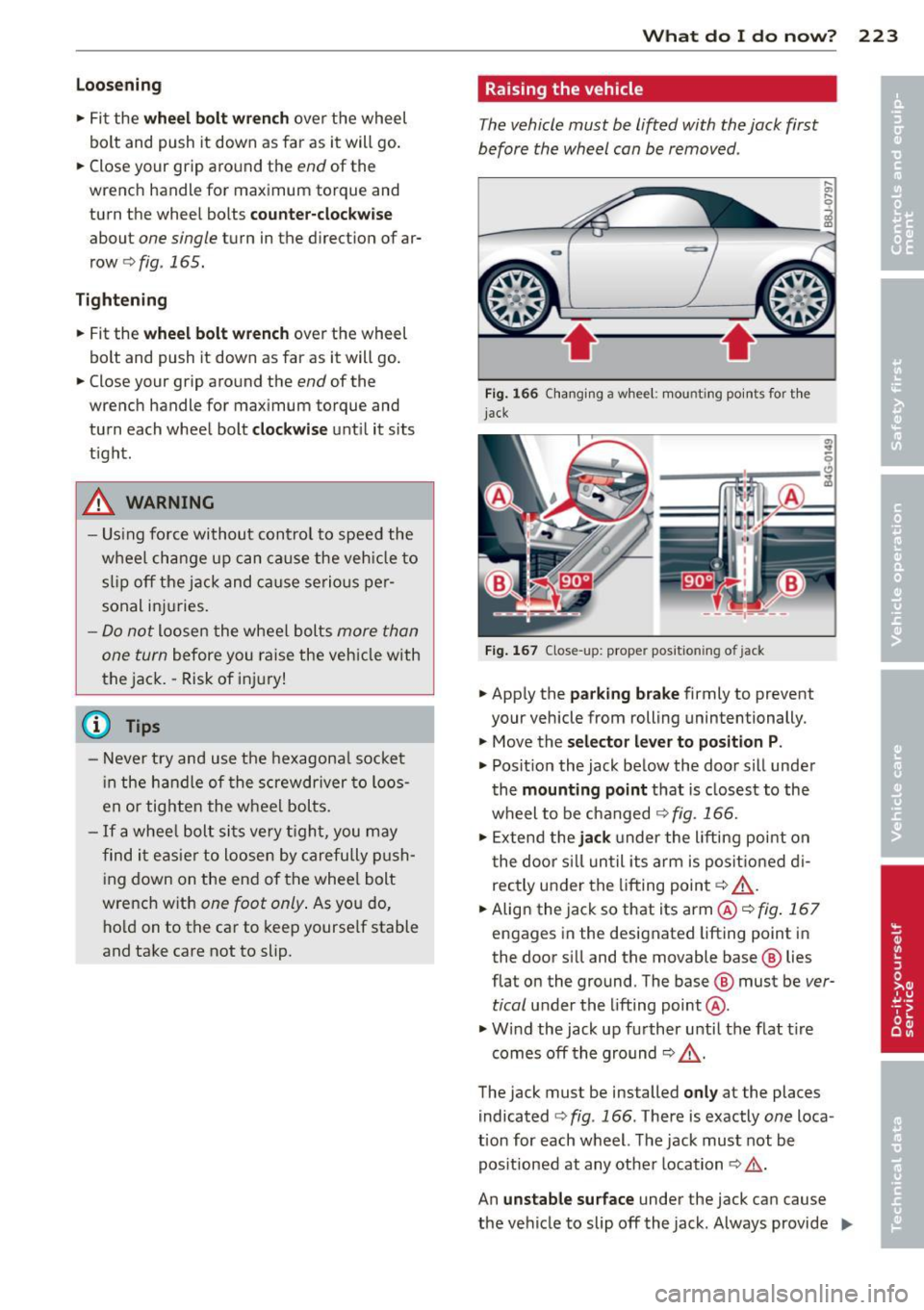
Fig . 166 Chang ing a w hee l: mo unting points for t he
jack
Fig. 1 67 Close-up: proper position ing of jack
• App ly the parking brake firmly to prevent
your vehicle from rolling unintentionally.
• Move the
selector lever to position P.
• Posit ion the jack below the door sill under
the
mounting point that is closest to the
wheel to be changed
¢ fig. 166.
• Extend the jack under the lifting poi nt on
the door sill until its arm is posit ioned di
rectly under the lifting point ¢.&_ .
• Align the jack so that its arm ®¢
fig. 167
engages in the designated lifting point in
the door s ill and the movable base ® lies
flat on the ground. The base @ must be
ver
tical
under the lifting point@.
• Wind the jack up further until the flat tire
comes off the ground ¢
_&.
The jack must be installed only at the places
indicated ¢
fig. 166 . Ther e is exactly one loca
tion for each wheel. The jack must not be
positioned at any othe r location
¢ .& .
An unstable surface under the jack ca n cause
the vehicle to slip off the jack. Always provide .,._
Page 227 of 260

~ Use the hexagonal socket in the screwdriver
handle to screw in and tighten all wheel
bo lts
slightly .
~ Unscrew the alignment pin and insert and
t ighten the remaining wheel bolt s light ly
like the rest.
~ T urn the jack handle counter-clockw ise to
l ower the vehicle unti l the jack is fully re
leased .
~ Use the whee l bolt w rench to t ighten al l
whee l bolts firmly <=>
page 222 . Tighten
them
crosswise, from one bolt to the (ap
proximate ly) opposite one, to keep the
whee l cente red.
Q;) Note
When removing or installing the wheel,
the rim could hit the brake rotor and dam
age the rotor. Work carefully and have a
second person help you.
(D} Tips
Never use the hexagonal socket in the han
dle of the screwdriver to loosen or t ighten
the wheel bolts .
- Pull the reversib le b lade from the screw
driver before yo u use the hexagonal
socket in the handle to t urn the whee l
bo lts .
- When mounting tires with
unid irectional
tread design
make su re the tread pat
te rn is poi nted the r ight way
<=> page 226.
- The wheel bolts should be clea n and easy
to tu rn . Check for d irt and corrosion on
the mat ing s urfaces of both the wheel
and the hub. Rem ove a ll dirt from these
su rfaces before rem ounting the wheel.
Notes on wheel change
Please read the information <=> page 205 , New
tires and replacing tires and wheels ,
if you are
going to use a spare t ire which is different
from the tires on your ve hicle.
Afte r you change a tire :
What do I do now? 225
-Check the tire pre ssure on the spare imme
diately after mounting.
- Have the whe el bolt tightening torque
checked with a torque wrench as soon a s
possible by your authorized Audi dealer or
a qualified service station.
- With steel and alloy wheel rim s, the wheel
bolt s are cor rectly tightened at a torque of
90 ft lb (120 Nm ).
- If you noti ce while changing a tire that the
wheel bolts are corroded and difficult to
turn , then they should be replaced before
you check the tightening to rque.
- Replace the flat tire w ith a new one and
have it installed on your vehicle as soon as
possible. Remount the whee l co ver.
Until then , dr ive with extra care and at re
duced speeds.
A WARNING
- If you are going to equ ip your vehicle
w it h tires o r rims which differ from those
which were factory installed, then be
sure to rea d the information
¢ page 205,
New tire s and replacing tires and
wheels.
- Always sto re the too ls secu rely in lug
gage com partmen t. Othe rwise , in a n ac
cident or s udden m aneuver they cou ld fly
forwa rd, causing inj ury to passengers in
the vehicle.
(D Note
D o not use comme rcially ava ilab le tire
se alants . Ot herwise, t he e lectr ic al c ompo
nen ts of the tire pressu re monitoring sys
tem will no lo nger work p roperly and the
sensor fo r the tire pressure mon itor ing
system will have to be rep laced by a quali
fied workshop. •
•
Page 230 of 260
228 Fuses and bulbs
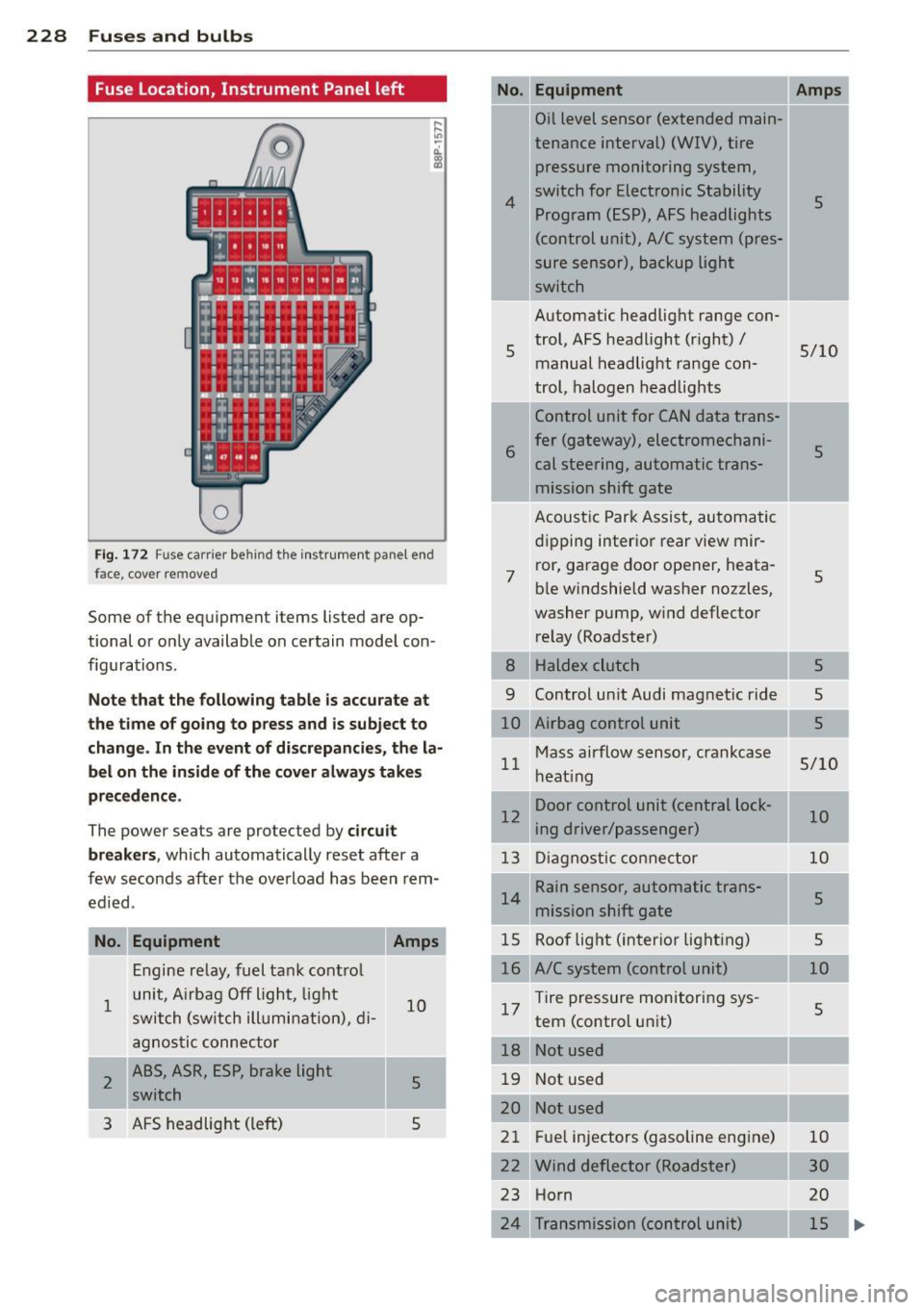
Fuse Location, Instrument Panel left
0
Fig. 172 Fuse ca rrier be hind the inst rum ent pan el end
fa ce, cover rem oved
Some of the equipment i tems lis ted are op
tional or only available on certain model con
figurations.
Note that the following table is accurate at
the time of going to press and is subject to
change. In the event of discrepancies, the la
bel on the inside of the cover always takes
precedence.
The power seats are protected by circuit
breakers,
which automatically reset after a
few seconds after the overload has been rem
edied .
No. Equipment
1
I 2
Engine relay, fuel tank control
unit , Airbag Off light, light
switch (switch illumination), di-
agnostic connector
ABS, ASR, ESP, brake light switch
3 AFS headlight (left)
Amps
10
5
s
No.
4
5
6
7
Equipment
Oil level sensor (extended main-
tenance interval)
(WIV), tire
pressure monitoring system,
switch for Electronic Stability Program (ESP), AFS headlights
(control unit), A/C system (pres-
sure sensor), backup light
switch
Automatic headlight range con
trol, AFS headlight (right)/
manual headlight range con
trol, halogen headlights
Control unit for CAN data trans
fer (gateway), electromechani
cal steering, automatic trans mission shift gate
Acoustic Park Assist, automatic
dipping interior rear
view mir-
ror, garage door opener, heata
ble windshield washer nozzles,
washer pump, wind deflector
relay (Roadster)
--r-
Amps
5
5/10
5
5
8 Haldex clutch 5
9 Control unit Audi magnetic ride 5
10 Airbag control unit 5
Mass airflow sensor, crankcase
11 5/10
heating
Door control unit (central lock-
12 10
ing driver/passenger)
--
13 Diagnostic connector 10
Rain sensor, automatic trans-
14 5
mission shift gate
15 Roof light (interior lighting) 5
16 A/C system (control unit) 10
17 Tire pressure monitoring sys-
5
tern (control unit)
l
I
18 Notused -
19 Not used
20 Not used
21 Fuel injectors (gasoline engine)
Wind deflector (Roadster)
Horn
24 Transmission (control unit) 10
30
20
15
..,.
Page 235 of 260
instructions of the jumper cable
manufacturer. If in doubt, call for road
service.
- Jumper cables must be long enough so
that the vehicles do not touch.
- When connecting jumper cables, make
sure that they cannot get caught in any
moving parts in the engine compart
ment.
- Before you check anything in the engine
compartment, always read and heed all
WARNINGS
<=> page 172, Engine com
partment .
@ Note
Improper hook-up of jumper cables can ru
in the generator.
-Always connect POSITIVE(+) to POSI
TIVE(+), and NEGATIVE(-) to NEGATIVE
( - ) ground post of the battery manager
control unit.
- Check that all screw plugs on the battery
cells are screwed in firmly . If not, tighten
plugs prior to connecting clamp on nega
tive battery terminal.
- Please note that the procedure for con
necting a jumper cable as described
above applies spec ifically to the case of
your vehicle being jump started. When
you are giving a jump start to another ve
hicle, do
not connect the negative( -) ca
ble to the negative(- ) terminal on the
discharged battery@. Instead, securely
connect the negative (-) cable to either a
solid metal component that is firmly bolted to the engine block or to the en
gine block itself. If the battery that is be
in g charged does not vent to the outside,
escaping battery gas could ignite and ex
plode!
Emergency situations 233
Emergency towing
with commercial tow
truck
General hints
Your Audi requires special handling for tow
ing.
T he following information is to be used by
commercial tow truck operators who know
how to operate their equipment safely.
- Never tow your Audi, towing will cause
damage to the engine and transmission.
- Never wrap the safety chains or winch ca
ble s around the brake lines .
- To prevent unnecessary damage, your Audi
must be transported with a car carrier
(flatbed truck).
- To load the vehicle on to the flat bed, use
the towing loop found in the vehicle tools
and attach to the front or rear anchorage
<=> page 234 and c:> page 235.
A WARNING
A vehicle being towed is not safe for pas
sengers. Never allow anyone to ride in a
vehicle be ing towed, for any reason.
-
•
•
Page 238 of 260
236 Emergency situations
Lifting vehicle
Lifting with workshop hoist and with
floor jack
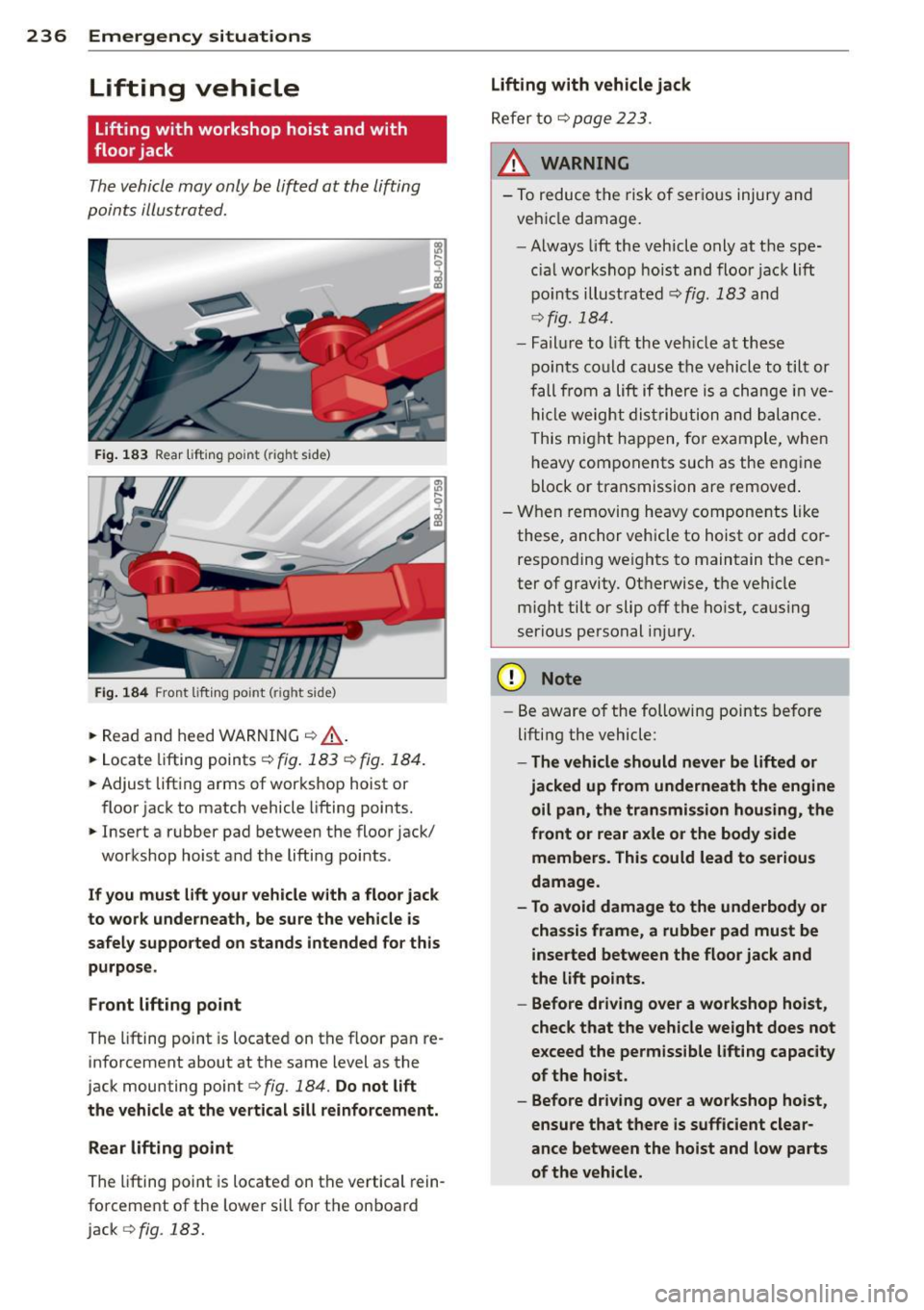
The vehicle may only be lif ted at the lifting
points illustra ted.
F ig. 18 3 Rear lift in g poin t (ri gh t side)
Fi g. 184 Front lift in g po int (r ig ht s ide)
• Read and heed WARNI NG ¢,& .
• Locate lifting points
q fig . 183 qfig . 184 .
• Adjust lift ing arms of workshop hoist or
floor jack to match vehicle lifting points.
• In se rt a rubber pad between the floor jack/
workshop hoist and the lifti ng po ints.
If you must lift your vehicle with a floor jack
to work underneath, be sure the vehicle is safely supported on stands intended for this
purpose.
Front lifting point
The lifting point is locate d on the floor pan re
info rcement about at the same level as the
jac k mounting point
q fig. 184. Do not lift
the vehicle at the vertical sill reinforcement.
Rear lifting point
The lifting point is locate d on t he vertical rein
forcement of the lower s ill for t he on boa rd
j ac k
¢fig . 183.
Lifting with vehicle jack
Refer to ¢page 223 .
/n.. WARNING
- To reduce the risk of ser io us injury and
veh icle d amage .
- Always lift th e vehicle onl y at t he spe
c ia l works ho p h oist and floor jac k lift
p o ints illust rated¢
fig . 183 and
¢fig. 184.
- Fa il u re t o lift th e veh icle at th ese
p oi nts co ul d cau se the vehicle to tilt or
f a ll from a li ft if th ere is a ch an ge i n ve
h icl e weig ht distr ibu tio n an d ba lan ce.
This mi ght happen, for ex amp le, when
h eavy com ponent s such as the engine
b lock o r transmission are remove d.
- W hen removin g heavy compone nts like
these , anch or vehicle to hoist or ad d co r
respon ding we ights to maintain t he cen
ter of gravity. Ot herwise , th e ve hicle
might tilt or slip off the ho ist, causing
serio us personal injury.
(D Note
-Be aware o f the following points before
lifting the vehicle:
- The vehicle should never be lifted or
jacked up from underneath the engine
oil pan, the transmission housing, the
front or rear axle or the body side members. This could lead to seriou s
damage .
- To avoid damage to the underbody or
chassis frame, a rubber pad must be inserted between the floor jack and
the lift points.
- Before driving over a workshop hoist ,
check that the vehicle weight does not
exceed the permissible lifting capacity
of the hoist .
- Before driving over a workshop hoist,
ensure that there is sufficient clear
ance between the hoist and low parts
of the vehicle.
-
Page 239 of 260
General information Explanation of
technical data
Some of the technical data listed in this man
ual require further explanation.
The tecical data for your vehicle are listed in
the charts starting on
c:> page 239 . This chap
ter p rovides general informa tion, notes and
restr ictions wh ich app ly to these data .
Vehicle identification
The key data are given on the vehicle identifi
ca tion number
(V IN) pla te and the vehicle da
ta sticker.
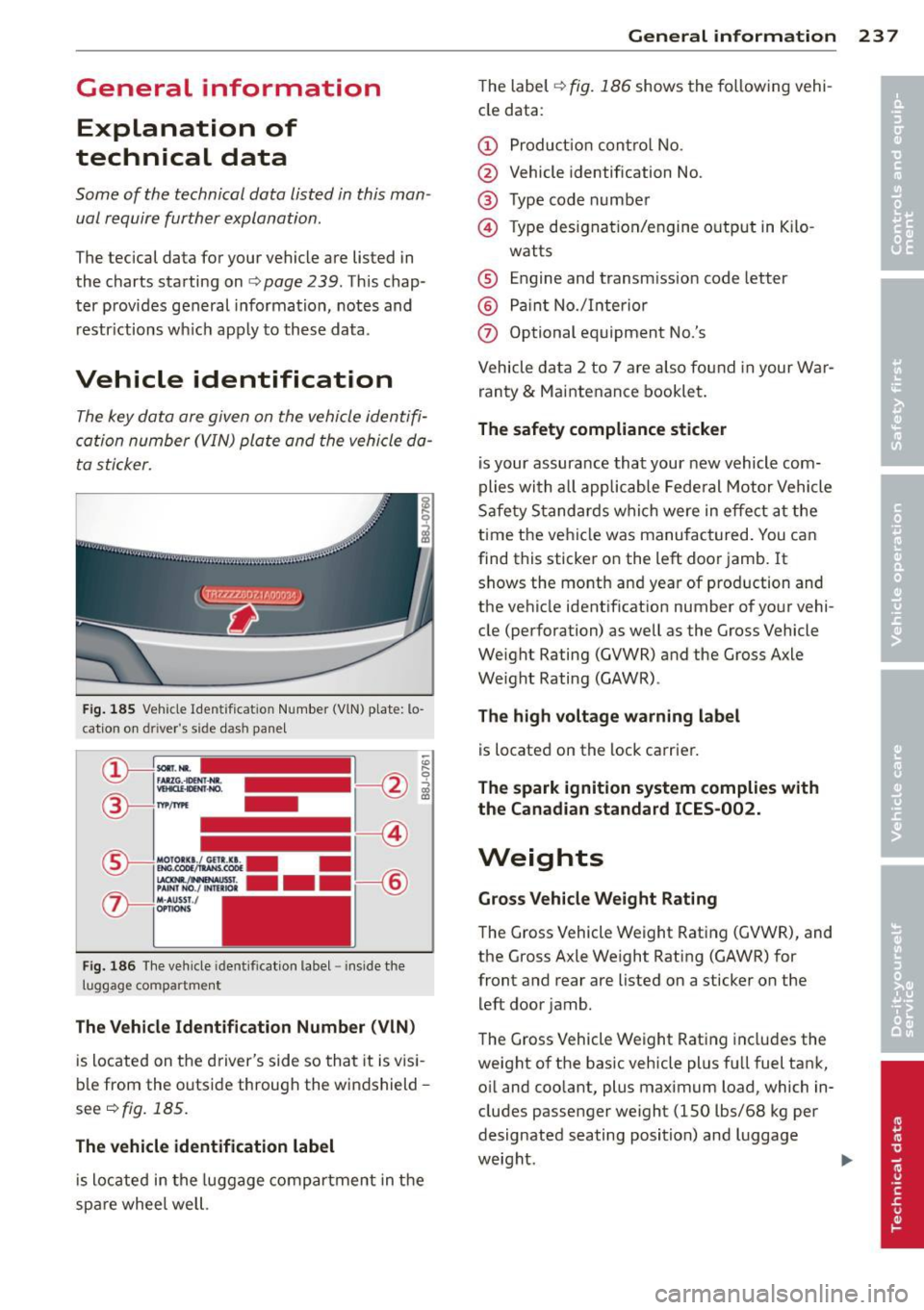
F ig. 1 85 Vehicle Ident ificat io n Num ber {V lN) p la te: lo
cation o n dr iver's s ide dash pa nel
Fi g. 18 6 Th e ve hicle ident ificat ion label -inside the
l u ggage co mpartme nt
The Vehicle Identification Number (VlN)
is located on the d river's side so tha t it is v is i
b le from the outside through the windshield -
see
c!) fig. 185.
The vehicle identification label
i s located in the luggage compartment in t he
sp are wheel well.
General inform ation 23 7
The label c:> fig. 186 shows the fo llow ing vehi
cle data :
(D Productio n con trol No .
@ Vehicle identification No.
@ Type code numbe r
@ Type designat ion/en gine o utp ut in K ilo -
watts
® Engine and t ransmission code letter
® Pa in t No./Interior
(J) Optional equipment No.'s
Vehicle da ta 2 to 7 are a lso fo und in your W ar
ran ty
& Maintenance booklet .
The safety compliance sticker is your assurance that your new vehicle com
plies wi th a ll applicab le Fede ral Motor Vehicle
S afety S tandards which were in effect at the
time the ve hicl e was manufactured. You can
find this sticke r on the left door jamb. It
shows the month and yea r of prod uction and
the vehicle ident ificat ion number of yo ur vehi
cle (perforation) as well as the Gross Vehicle
Weight Rating (GVWR) and the Gross Axle
Weight Rating (GAWR) .
The high voltage warning label is located on the lock carrier.
The spark ignition system complies with
the Canadian standard ICES-002.
Weights
Gro ss Vehicle Weight Rating
The Gross Vehicle Weight Rat ing (GVWR), and
the Gross Axle Weight Rating (GAWR) for
front and rear are listed on a sticker on the left door jamb.
The Gross Vehicle Weight Rat ing includes the
weight of the bas ic vehicle plus fu ll fuel tank,
oi l and coo lant, plus maximum load, which in
cludes passenger we ight (150 lbs/68 kg per
designated seating position) and luggage
weight .