ECU AUDI TT ROADSTER 2014 User Guide
[x] Cancel search | Manufacturer: AUDI, Model Year: 2014, Model line: TT ROADSTER, Model: AUDI TT ROADSTER 2014Pages: 244, PDF Size: 60.87 MB
Page 100 of 244
98 Driving Safely
• Distribute the load evenly in the luggage
compartment.
• Always place and properly secure heavy
items in the luggage compartment as far
forward as possible.
A WARNING
Improperly stored luggage or other items
can fly through the vehicle causing serious
personal injury in the event of hard brak
ing or an accident. To help reduce the risk
of serious personal injury:
- Always put objects, for example, luggage
or other heavy items in the luggage com
partment.
- Always secure objects in the luggage
compartment using the tie-down eyelets
and suitable straps.
A WARNING
Heavy loads will influence the way your ve
hicle handles. To help reduce the risk of a
loss of control leading to serious personal
injury:
-Always keep in mind when transporting
heavy objects, that a change in the cen
ter of gravity can also cause changes in
vehicle handling:
- Always distribute the load as evenly as
possible.
- Place heavy objects as far forward in
the luggage compartment as possible.
- Never exceed the Gross Axle Weight Rat
ing or the Gross Vehicle Weight Rating
specified on the safety compliance stick
er on the left door jamb. Exceeding per
missible weight standards can cause the
vehicle to slide and handle differently.
- Please observe information on safe driv
ing
!:? page 92 .
A WARNING
To help prevent poisonous exhaust gas
from being drawn into the vehicle, always
keep the rear lid closed while driving.
- Never transport objects larger than
-
those fitting completely into the luggage area because the rear lid cannot be fully
closed.
- If you absolutely must drive with the rear
lid open, observe the following notes to
reduce the risk of poisoning:
- Close all windows,
- Close the convertible top,
- Open all air outlets in the instrument
panel,
- Switch off the air recirculation,
- Set the fresh air fan to the highest
speed.
A WARNING
-Always make sure that the doors, all win-
dows, the convertible top and the rear lid
are securely closed and locked to reduce
the risk of injury when the vehicle is not
being used.
- After closing the rear lid, always make
sure that it is properly closed and locked.
- Never leave your vehicle unattended es pecially with the rear lid left open . A
child could crawl into the vehicle through
the luggage compartment and close the
rear lid becoming trapped and unable to
get out. Being trapped in a vehicle can
lead to serious personal injury.
- Never let children play in or around the
vehicle.
- Never let passengers ride in the luggage
compartment. Vehicle occupants must
always be properly restrained in one of
the vehicle's seating positions.
@ Tips
- Air circulation helps to reduce window
fogging. Stale air escapes to the outside
through vents in the trim panel , on the
left side of the luggage compartment.
Be sure to keep these slots free and
open.
- The tire pressure must correspond to the
load. The tire pressure is shown on the
tire pressure label. The tire pressure la bel is located on the driver's side B-pillar .
The tire pressure label lists the ..,
Page 106 of 244
104 Safety belts
-Never strap more than one person, in
cluding small children, into any single
safety belt.
- Never place a safety belt over a child sit
t ing on your lap.
- Always keep feet in the footwell in front
of the seat while the vehicle is being driv
en.
- Never let any person ride with feet on
the instrument panel or sticking out the
window or on the seat.
- Never remove a safety belt while the ve
hicle is moving. Doing so will increase
your risk of being injured or killed.
- Never wear belts twisted.
- Never wear belts over rigid or breakable
objects in or on your clothing, such as
eye glasses, pens, keys, etc., as these
may cause injury.
- Never wear the shoulder part of the belt
under your arm or otherwise out of posi
tion.
- Several layers of heavy clothing may in
terfere with correct positioning of belts
and reduce their effectiveness.
- Always keep belt buckles free of anything
that may prevent the buckle from latch
ing securely.
- Never use comfort clips or devices that
create slack in the shoulder belt. Howev
er, special clips may be required for the
correct use of some child restraint sys
tems.
- Never allow safety belts to become dam
aged by being caught in door or seat hardware.
- Torn or frayed safety belts can tear and
damaged belt hardware can break in an
accident. Inspect belts regularly.
If web
bing, bindings, buckles, or retractors are
damaged, have belts replaced by an au
thorized Audi dealer or qualified work
shop.
- Safety belts that have been worn and
loaded in an accident must be replaced
with the correct replacement safety belt by an authorized Audi dealer or qualified
workshop . Replacement may be necessa- ry even if damage cannot be clearly seen.
Anchorages that were loaded must also
be inspected.
- Never remove, modify, disassemble, or
try to repair the safety belts yourself.
- Always keep the belts clean. Dirty belts
may not work properly and can impair
the function of the inertia reel¢
ta
ble Cleaning interior on page 157.
Safety belts
Fastening safety belts
Seat first -everybody buckle up!
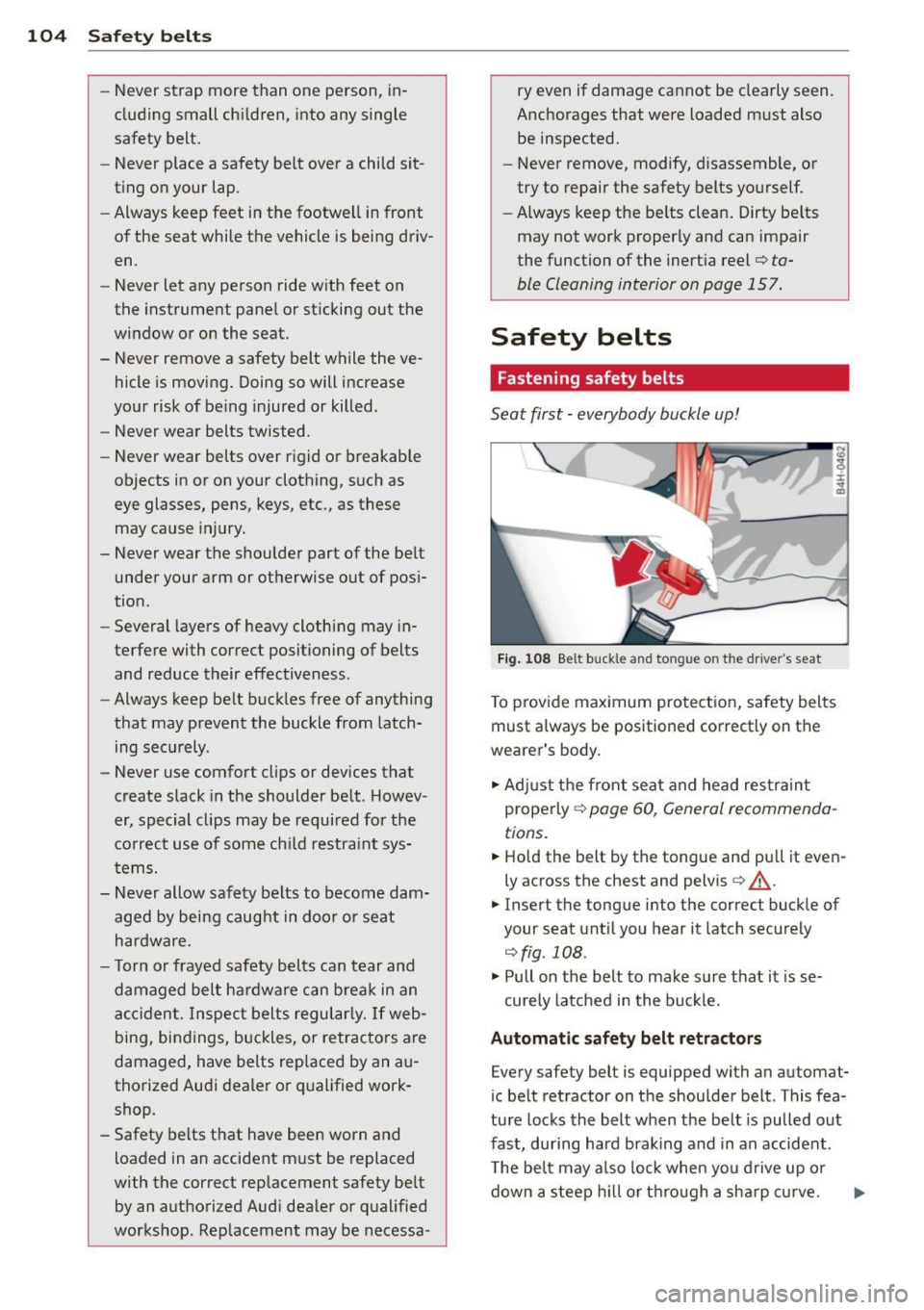
Fig. 108 Belt buckle and tongue on the driver's seat
To provide maximum protection, safety belts
must always be positioned correctly on the
wearer's body.
.,. Adjust the front seat and head restraint
properly ¢
page 60, General recommenda
tions.
.,. Hold the belt by the tongue and pull it even
ly across the chest and pelvis ¢
.&_.
.,. Insert the tongue into the correct buckle of
your seat until you hear it latch securely
¢fig . 108.
.,. Pull on the belt to make sure that it is se-
curely latched in the buckle.
Automatic safety belt retractors
Every safety belt is equipped with an automat
ic belt retractor on the shoulder belt . This fea
ture locks the belt when the belt is pulled out
fast, during hard braking and in an accident .
The belt may also lock when you drive up or
down a steep hi ll or through a sharp curve.
Page 107 of 244
During normal driving the belt lets you move
freely.
Safety belt pretensioners
The safety belts are equipped with a belt p re
tensione r that helps to t igh ten the safety belt
and remove s lack when the pretensione r is ac
tivated. The function of the pretensioner is monitored by a warning light
q page 15.
Switchable lo cking feature
Every safe ty belt excep t the one on the driver
seat is eq uipped w ith a switchab le locking fea
ture that
mu st be used when the safety belt is
used to attach a child seat . Be s ure to read the
important informat ion about th is feature
q page 138.
A WARNING
Improperly positioned safety belts can
cause serious injury in an accident
¢ page 105, Safety belt position .
-Safety belts offer optimum protection
only when the seatback is upright and
belts are properly positioned on the
body .
-
- Never attach the safety belt to the buck
le for another seat . Attach ing the belt to
the wrong buckle will reduce safety belt
effect iveness and ca n cause serious per
sonal in jury.
- A passenger who is no t properly rest rain
ed can be serio usly inju red by the safety
belt itself when it moves from the stron-
ger parts of the body into critical areas
like the abdomen .
- Always lock the convert ible locking re
tractor when yo u are secur ing a chi ld
seat in the vehicle
¢ page 140.
Safety belts 105
Safety belt position
Correct belt position is the key to getting
maximum protection from safety belts .
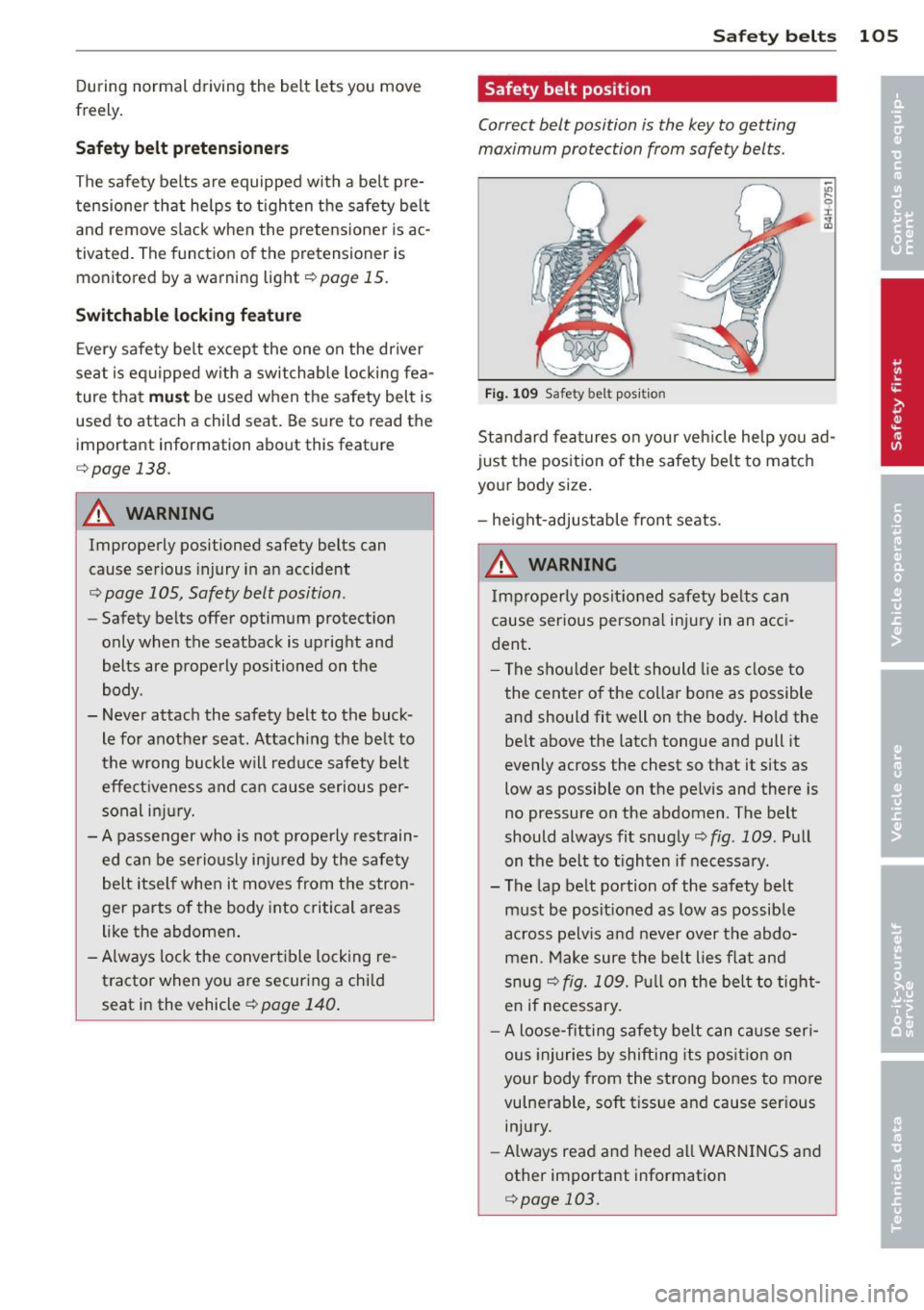
Fig . 1 09 Safety belt po sit ion
;;;
9 r ., a,
Standard fea tures on your veh icle he lp you ad
just the position o f the safety bel t to matc h
your body size .
- he ight-adjustable fron t seats.
A WARNING
Improperly posit ioned s afety be lts c an
cause serious persona l injury in an acci
dent .
-
-The s hou lder belt should lie as close to
the center o f the collar bone as possible
a nd should fit well on the body. Hold the
be lt above the latch tongue and pull it
evenly across the chest so that it sits as
low as possib le on the pelv is and there is
no pressure on the abdomen . The belt
should always fit snugly¢
fig. 109 . Pull
on the belt to t ighten if necessary.
- The lap belt portion of the safety belt
must be posit ioned as low as possible
across pelvis and never over the abdo
men . Make sure the belt lies flat and
snug
q fig. 109. Pu ll on the be lt to tight
e n if necessary.
- A loose-fitting safety belt can cause seri
ous injuries by shifting its pos it ion on
your body from the strong bones to more
vulnerable, soft tissue and cause ser ious
injury.
- Always read and heed all WARNINGS and
other important information
¢ page 103.
Page 108 of 244
106 Safet y belt s
Pregnant women must also be properly
restrained
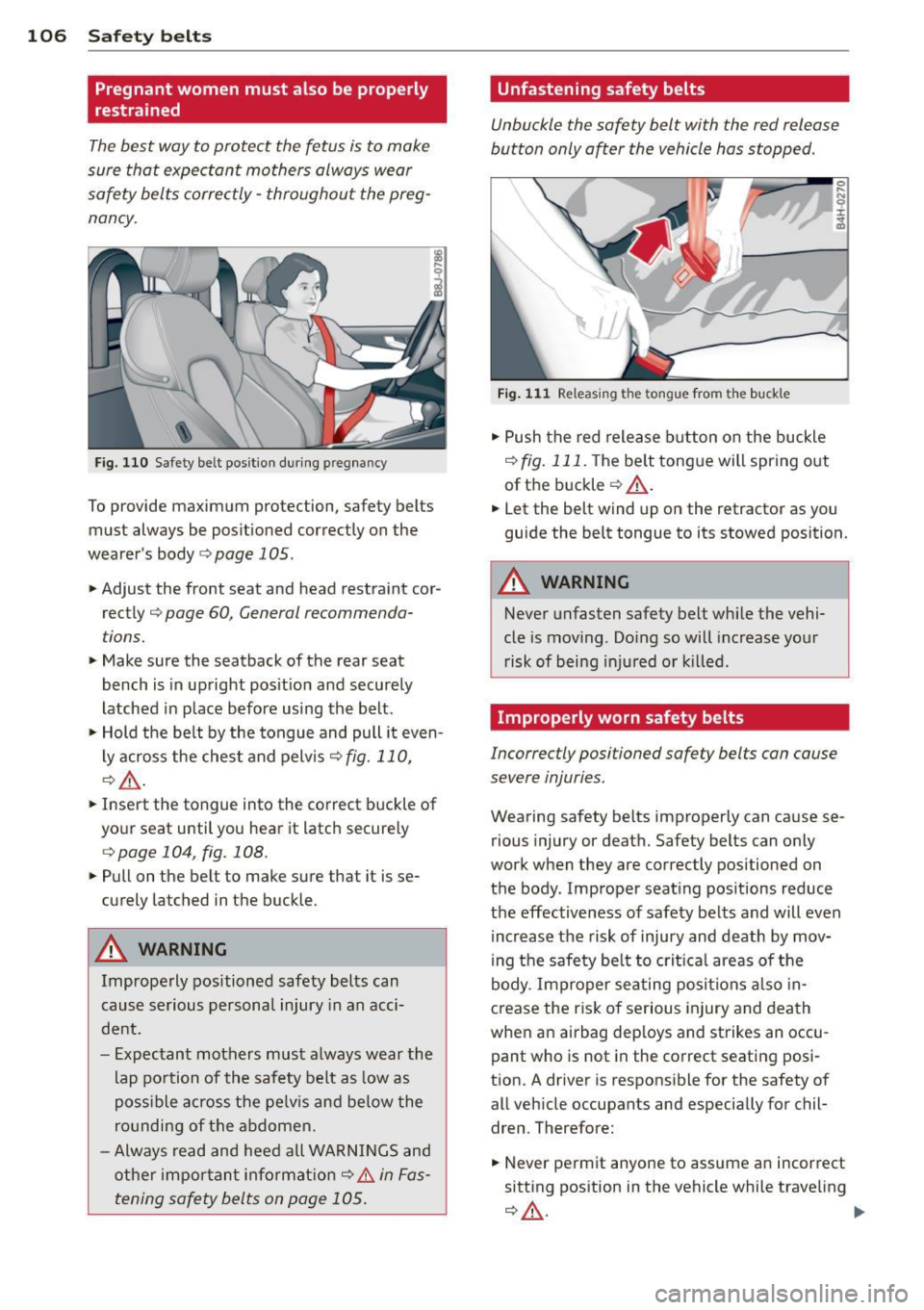
The best way to protect the fetus is to make
sure that expectant mothers always wear
safety belts correctly -throughout the preg
nancy.
Fig . 1 10 S afety be lt pos it io n dur ing p regnancy
To provide maximum prote ction , safety belts
must always be po sitioned correctly on the
wearer's body
c> page 105 .
• Adjust the front seat and head restraint cor
rect ly
c> page 60, General recommenda
tions.
• Make sure the seatback of the rear seat
bench is in up right posit io n and securely
latched in p lace before using the b elt .
• Hold the be lt by the tongue and pull it even
l y across the ches t and pelvis
c> fig. 110,
c>,& .
• Inse rt the tongue into the correct buckle of
yo ur seat until you hear it latc h securely
c> page 104 , fig . 108.
•Pullon the belt to make sure that it is se
curely latched in t he buckle .
A WARNING
Imprope rly positioned safety belts can
cause se rious personal injury in an acci
de nt.
-
- E xpec tant mothers mus t always wear the
lap po rtion of the safety b elt as low as
poss ible ac ross the pe lv is and be low the
ro unding of the a bdome n.
- Always read and heed all WARN INGS and
ot her impo rtan t info rma tion
c> .&. in Fas
tening safety belts on page 105.
Unfastening safety belts
Unbuckle the safety belt with the red release
button only a~er the vehicle has stopped .
,,
}_
Fig . 11 1 Rele asing the ton gu e from the buc kle
• Push the red release b utton on the buckle
c> fig . 111. T he be lt tongue will spring out
of t he b uckle
c> ,& .
N 0 ;c
a1i
• Let the belt wind up on the retractor as you
guide the belt tongue to its stowed position .
A WARNING
-
Never unfasten safety belt whi le the vehi-
cle is mov ing . Do ing so will increase yo ur
r isk of being i njured o r kill ed .
Improperly worn safety belts
Incorrectly positioned safety belts can cause
severe injuries.
Wearing safety belts improper ly can ca use se
rious injury or deat h. Safety belts can o nly
work when they are correc tly positioned on
the body . Improper seat ing positions reduce
the effectiveness of safety be lts and will even
increase the risk of inju ry and death by mov
ing the safety be lt to crit ical areas o f the
body . Imp roper seati ng po siti ons also in
c rease the risk of serious injury and death
whe n an a irbag dep loys and strikes an occu
pant who is not in the co rrect seating posi
t ion. A driver is respons ible for the safety of
all veh icle occupants and especially for chil
dren . There fore:
• Never pe rm it anyone to assume an incorrect
sitt ing position in the vehicle while trave ling
c> ,& . ~
Page 140 of 244
138 Child Saf ety
,8. WARNING
Not using a booster seat, using the boos
ter seat improperly, incorrectly install ing a
booster seat or using the vehicle safety
belt improperly increases the risk of seri
ous personal injury and death in a collision
or other eme rgency s ituation. To help re
duce the risk of serious persona l injury
and/or death:
- T he shoulder belt must lie as close to the
center of the child· s collar bone as possi
ble and must lie and snug on the upper
body. It must never lie across the throat
or neck. The lap belt must lie across the
pelvis and never across the stomach or
abdomen . Make sure the belt lies flat
and snug . Pull on the belt to t ighten if
necessary .
- Failure to properly route safety belts over a ch ild's body will cause severe inju
ries in an acc ident or other emergency
situation
¢ page 101 .
-Children on the front seat of any car,
even with Advanced A irbags, can be seri
ous ly inju red or even killed when an a ir
bag inflates.
- Never let a child stand or knee l on the
seat.
- Never let a child ride in the cargo a rea of
yo ur vehicle.
- Always remember that a ch ild lean ing
forward, sitting sideways or out of posi
t ion in any way during an acc ident can be
struck by a deploying airbag. This will re
sult in serious personal injury or death.
- If you must install a booster seat on the
front passenger seat because of excep
tional circumstances the
PASSENGER
AIR BAG OFF
light must come on and
stay on, whenever the ignition is switch
ed on.
- If the
PASSENGER AIR BAG OFF light
does not come on and stay on, perform
the checks described
¢page 119, Moni
toring the Advanced Airbag System .
-If the PASSENGER AIR BAG OFF light
does not come on and stay on whenever
-
the ignition is switched on the inflating
airbag w ill hit the child safety seat or in
fant carrier with great force and will smash the child safety seat and child
aga inst the backrest, door or roof. Have
the airbag system inspected immed iately
by your Audi dea ler.
- Always read and heed all WARNINGS
whenever using a child restrained in ave
h icle is being used
¢page 101, Safety
belts,
¢ page 109, Airbag system and
¢ page 130, Important things to know .
Installing a child safety
seat
Securing a child safety seat using a
safety belt
Safety belts for the front passenger can be
locked with the convertible locking retractor
to properly secure child safety seats.
T he safety belts emergency locking retracto rs
for the front passenger's seat safety belt have
a convertible locking retracto r for child re
straints. The safety be lt must be locked so
that belt webbing cannot unreel. The retrac
tor can be activated to lock the safety belt and
prevent the safety be lt webbing from loosen
ing up during normal driving. A child safety
seat can only be properly installed when the
safety belt is locked so that the child and child safety seat wi ll stay in place .
Always remember: Even though your vehicle is
equipped with an Advanced Airbag system, a
child should always ride in the seat properly
restrained for its age and s ize.
,8. WARNING
Imp roperly installed chi ld safety seats in
crease the risk of serious personal injury
and death in a collision.
- Always ma ke sure that the safety belt re
tractor is loc ked when insta lling a child
safety seat . An un locked safety belt re -
tractor cannot hold the child safety seat ..,_
Page 167 of 244
Checking and filling Engine hood
Releasing the engine hood
The engine hood is released from inside the
vehicle .
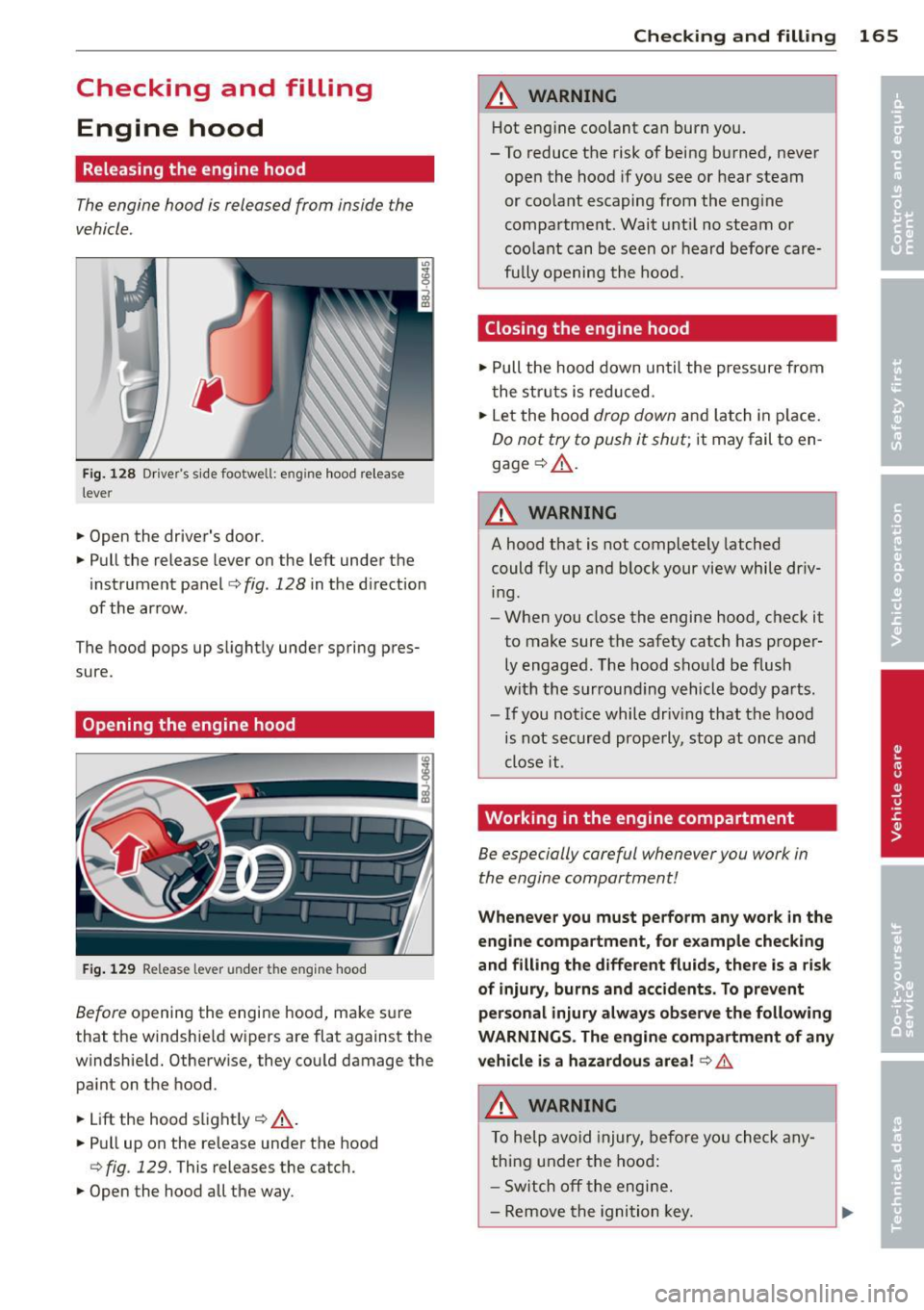
Fig. 128 Dr ive r's s ide footwe ll: e ng ine hood relea se
lever
"' Open the driver's door .
"' Pull the release lever on the left under the
instrument panel
i=> fig. 128 in the d irection
of the arrow .
The hood pops up slightly under spring pres
sure.
Opening the engine hood
F ig . 129 Release lever u nde r the engine hood
Before opening the engi ne hood, make sure
that the windshield wipers are flat against the
windshie ld. Otherwise, they could damage the
paint on the hood.
"' Lift the hood slight ly ¢
_A .
"' Pull up on the release under the hood
¢ fig . 129. This releases the catch.
"' Open the hood all the way .
Checking and fillin g 165
A WARNING
Hot engine coolant can burn you.
- To reduce the risk of being burned, never open the hood if you see or hear steam
or coolant escaping from the eng ine
compartment . Wait unt il no steam or
coolant can be seen or heard before care
fu lly opening the hood.
Closing the engine hood
"' Pull the hood down until the pressure from
the struts is reduced.
"' Let the hood
drop down and latch in p lace.
Do not try to push it shut; it may fail to en
gage ¢_& .
A WARNING
--
A hood that is not completely latched
could fly up and b lock your view while dr iv
ing.
- When you close the engine hood, check it
to make sure the safety catch has proper
ly engaged. The hood shou ld be flush
with the surround ing vehicle body parts.
- If you notice while driv ing that the hood
is not secured properly, stop at once and
close it .
Working in the engine compartment
Be especially careful whenever you work in
the engine compartment!
Whenever yo u must pe rform any wo rk in the
e n g ine compartment, for e xample ch ecki ng
and filling th e diff erent fluids, there is a risk
of injury, burn s and a ccidents. To prev ent
p ersonal injury always obse rve the foll owing
WARNINGS . The engine compa rtment of an y
vehicle i s a hazardou s area !
¢ &.
A WARNING ~
To help avoid injury, be fo re yo u check any
thing under the hood:
- Sw itch off the engi ne.
- Remove the ignition key.
Page 178 of 244
176 Check ing and filling
Have the battery checked when you take your
vehicle in for service. You are well advised to replace a battery that is older than S years .
Disconn ect ing the battery terminals
Some veh icle functions (power w indow regu
lators, for example) are lost if the battery ter
minals are disconnected . These functions have
to be re learned after the battery terminals are
connected again. To prevent this, the battery
should only be d isconnected from the vehicle
electr ical system when absolutely necessary
for repairs .
V ehicles not dri ven for l ong period s
If you do not drive your vehicle over a period
of several days or weeks, electrical compo nents are gradually cut back or switched off .
This reduces energy consumption and main tains starting capab ility over a longer period
c:::>
page 147. Some of the convenience func
tions may not operate, suc h as the inte rior
l ights or power seat adjustme nt. The conven
i ence functions wi ll be ava ilable aga in whe n
you switch on the ignition and start the en
gine.
Winter operati on
During the winter months, batte ry capacity
tends to decrease as tempe ratu res d rop . This
is because more powe r is also consumed while
start ing , and the headlights, rea r window de
fogger, etc., are used more often.
Avoid unnecessary power consumption, par
ticularly in c ity traffic or when t rave ling on ly
short distances. Let you r authorized Aud i
dea ler check the capacity of the vehicle bat
tery before winter sets inc:::>
page 179 . A we ll
charged battery w ill not only prevent starting
prob lems when the weather is cold, but will
a lso last longer .
Replacing battery
The new battery must have the same capaci
ty, vo ltage (12 volts), amperage, construction
and p lug sealing, as the origina l battery. Spec
if ications are listed on the battery housing.
Batteries specially developed by Audi fulfill the maintenance, outp
ut, and safety require
ments .
When install ing the battery, m ake su re the ig
ni tion and a ll ele ct rical consumers are switch
ed off
c:::> (i) .
We recommend that you use maintenance
free or
cy cle-re si stant /leak -proof b atter ies
accord ing to the s tanda rds TL 825 06 (from
Apri l 2008) and VW 7 SO 73 (from April
2010) .
Rep lac ing the bat tery shou ld be car ried by a
qualified wo rkshop. Please fo llow the instruc
tions on the battery cover .
(D Note
- All wo rk on the ba tte ry req uire s techn i
c al know ledge . Please con ta ct an Aud i
dealership o r another authorized faci lity
for questions abo ut the batte ry -danger
o f ac id burns and exp losion hazard!
- The battery must not be opened! Do not
try to change the battery's liquid level,
otherwise detonating gas will escape
from the battery - explosion hazard!
- The AGM battery in the l uggage com
partment cannot leak, because the elec
tro lyte for this battery is absorbed into a
special glass mat. This leak-proof battery
must not be replace with a convent ional
battery.
- Make sure the ventilation hose on the
side of the battery is connected, other
w ise fumes or battery ac id can leak out .
- Batte ry holder and termina ls always
have to be secured correctly .
- Before all work on the battery follow the
warnings be low c:::> .&. in Working on the
battery on page 177.
@ For the sake of the environment
Because of the prob lem of proper disposal
of a battery, we recommend your author
iz ed Audi dealer change the battery for
you. Batteries contain sulfur ic acid and
l ead and must a lways be disposed o f prop-
erly in compliance wi th al l envi ronmental ..,.
Page 191 of 244
-If the tire pressure is too low or too high,
the tires w ill wear prematurely and the
vehicle will not handle we ll.
- If the tire is not flat and you do not have
to change a wheel immed iate ly, drive at
reduced speed to the nearest service sta
t ion to check the tire pressure and add
air as required.
([) Note
Driving without va lve stem caps ca n cause
damage to the tire va lves . To prevent this ,
always make su re that facto ry installed
valve stem caps on all wheels a re secure ly
mounted on the va lve.
@ For the sake of the environment
Underinflated tires will a lso increase the
fue l consumption .
Tires and vehicle load limits
There are limits to t he amount of load or
weight that any veh icle and any t ire can carry.
A veh icle that is overloaded w ill no t handle
well and is more diff icult to stop. Overloading
can not on ly lead to loss of veh icle contro l,
but can a lso damage important parts of the
ve hicle and can lead to sudden tire failure, in
cluding a blowout and sudden deflation that
can cause the veh icle to crash .
Your safety and that of yo ur passengers a lso
depends on making sure that load limits are
no t exceeded. Vehicle load includes everybody
and everyth ing in and on the vehicle . These
load limits a re techn ica lly refer red to as the
ve hicle's
Gro ss Vehicl e W eight Rat ing
(" GVWR ").
T he "GVWR " includes the we ight of the basic
vehicle, all factory installed accesso ries , a full
tank of fue l, oil, coo lant and other fluids pl us
maximum load. The maximum load includes
the number of passengers th at the ve hicl e is
i ntended to carry ("seating capacity") with an
assumed weight of 150 lbs (68 kg) for eac h
passenger at a designated seating position
Tire s an d wheel s 189
and the total weight of any luggage i n the ve
hicle .
T he
Gro ss Ax le Weight Rating ( " G AWR ") is
the max imum load th at can be applied at each
of the vehicle's two axles .
T he Gross Vehicle Weight Rat ing and the
G ross Ax le Weig ht Ra ting are l iste d on the
s af ety comp liance s ticke r label lo cated on the
driver's side 8-pillar . Your Audi has 2 seating
positions. Each seating position has a safety
belt ~
page 101, Safety belts.
The fac t that there is an upper limit to yo ur
vehicle's G ross Vehicle Weight Rating means
that the total weight of whatever is being car ried in the vehicle is lim ited . The more passen
gers in the vehicle or passengers who are
heavier than the standard we ights assumed
mea n that less we ight can be carried as lug
gage .
The tire pressure label on your Audi also lists
the maximum combined weight of a ll of the
occupants and luggage or other cargo that
t h e ve hicle can ca rry . Fo r th e locat ion of the
label
~ page 185, fig . 138 .
_&. WARNING
Overloading a veh icle can cause loss of ve
h icl e co ntro l, a crash or o ther accide nt, se
rio us pe rsonal inj ury, and even dea th.
- Ca rrying more we igh t tha n your ve hicle
was des igned to carry wi ll prevent the
veh icle from handling properly an d in
crease the risk of the loss of vehicle con
trol.
- T he b rakes on a vehicle that has been
overloaded may not be able to stop the
veh icle w ith in a safe distance .
- Tires on a vehicle that has been over load
ed can fail suddenly, incl uding a blowo ut
and sudden deflation, causing loss of
control and a crash.
•
•
Page 200 of 244
198 Tire s and wheel s
snow cha ins a re suitab ly covered. Check
the position of the snow chains after driving a few yards and correct if neces
sary. Follow the instr uctions from the
snow cha in manufacturer when doing so.
{O) Tips
Where snow cha ins are mandatory oncer
tain roads, this norma lly also applies to
veh icles with all-wheel dr ive.
Wheel bolts
Wheel bolts must always be tightened to the
correc t torque .
The design of whee l bolts is matched to the
factory installed r ims . If different rims are fit
ted, the correct wheel bolt s with the r ight
length and correctly shaped bol t heads mus t
be used . This ensures that wheel s are fitted
securely and that the brake system functions
correctly .
In certain circumstances, you may not use
wheel bolts from a d iffe rent vehicle -even if it
i s the same model
Q page 228.
A WARNING
Imprope rly tig htened o r maintained whee l
bolts can be come loose ca using loss of
cont ro l, a co llision and serious person al in
jury .
- Always keep the w heel bol ts and the
t h reads in t he wheel hubs clean so the
wheel bolts can t urn easily and be p rop
er ly t ightened .
- N ever grease or oil the wheel bo lt s an d
the threads in the wheel h ubs. They can
become loose w hile d riving if greased or
oi led, even if tightened to the specif ied
torque.
- Only use whee l bolts that be long to the
rim being installed.
- Never use different whee ls bolts on your
vehicle .
- Always mai ntai n the co rrect tighte ning
torq ue for the wheel bolts to reduce the
risk of a wheel loss. If the tightening tor- que of the whee
l bolts is too low, they
can loosen and come out when the vehi
cle is mov ing. If the tig hte ning torq ue is
too high, the w heel bolts a nd threads
can be damaged and the whee l can be
come loose.
(D Note
The specified torque for t he whee l bolts is
90 ft lb (120 Nm) with a tolerance of± 7,4
ft lb(± 10 Nm). Torque whee l bolts diago
nally . After changing a whee l, the to rq ue
must be checked as soon as possible with a
torque w rench - prefe rably by an author
iz ed A udi dealer or quali fied workshop .
Low aspect ratio tires
Your Audi is factory-eq uipped w ith low aspect
ratio tires. These tires have b een tho ro ughly
tested and been se lected specifically for your
model for their supe rb performance, road fee l
and hand ling under a variety of driving condi
t ions . Ask your author ized Audi dealer for
more de tails .
The low aspect ratio of these t ires is ind icated
by a numeral of
55 or less in the tire 's s ize
designation . The numera l rep resents the ratio
of the tire 's s idewa ll height in relation to its
t read width exp ressed in percentage. Conven
tiona l tire s have a he igh t/w idth rat io of 60 or
more.
The p erformance of low-a spect-ratio tire s is
particularly sensitiv e to improper inflation
pre ssure. It i s ther efore important that low
aspect ratio tires are inflated to the specified
pre ssure and that the inflation pre ssure i s
regularly checked and maintained. Tire pre s
sures should be checked at least once a month and always before a long trip
Q page 187, Checking tire pressure.
What you can do to avo id tire and rim
damage
Low aspect ratio tires can be damaged mo re
easily by impact w ith po tholes, curbs, gul lies ..,.
Page 207 of 244
What do I do now? Trunk escape handle
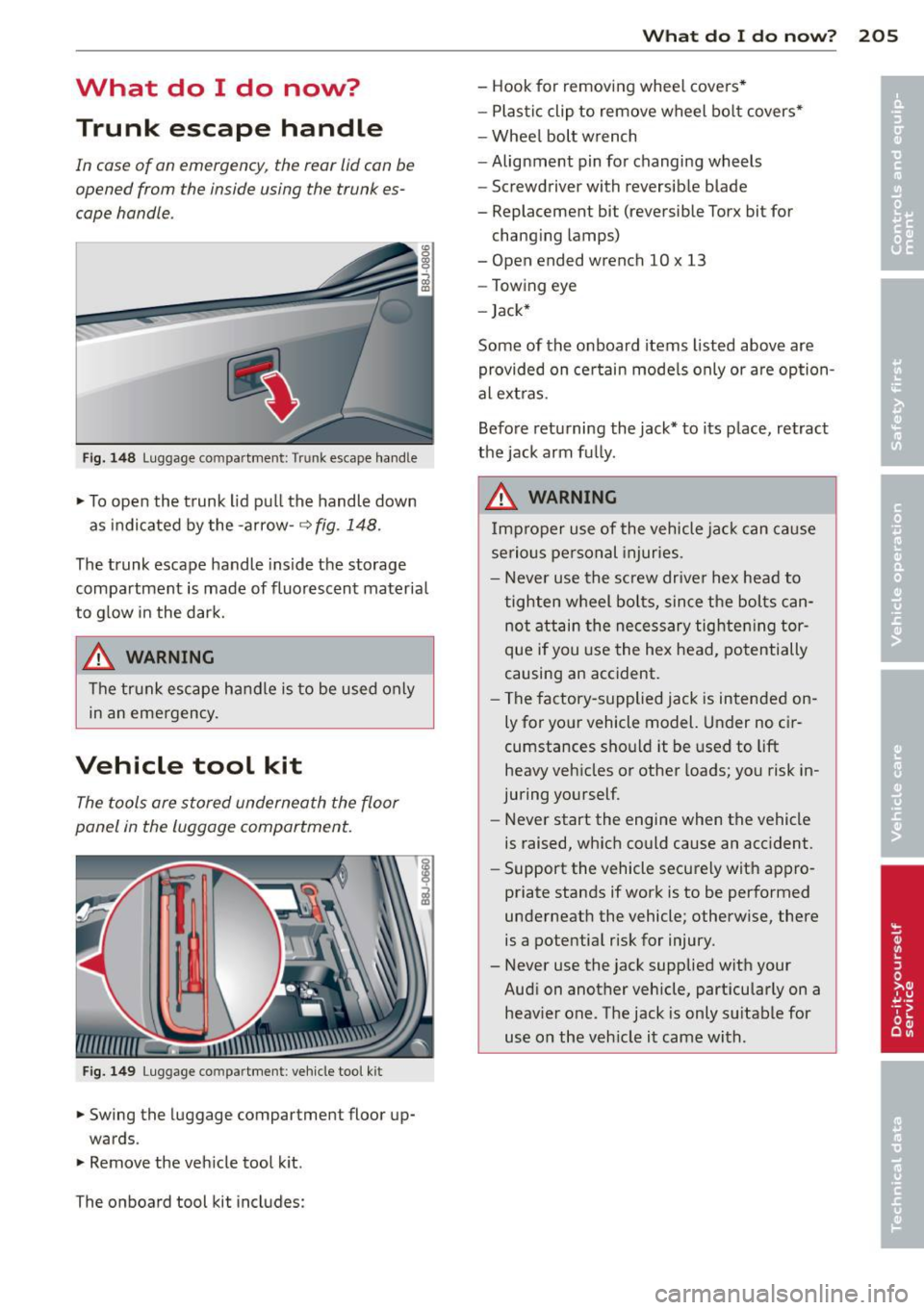
In case of an emergency, the rear lid can be
opened from the inside using the trunk es
cape handle .
Fig. 148 Luggage compa rtment: Tr unk escape handle
"' To open the trunk lid pu ll the handle down
as indicated by the -arrow-~
fig. 148.
The trunk escape handle inside the storage
compartment is made of fluorescent materia l
to g low in the dark.
& WARNING
The trunk escape handle is to be used only
in an emergency .
Vehicle tool kit
The tools ore stored underneath the floor
panel in the luggage compartment.
F ig. 1 49 Luggage co mpa rt ment : veh icle tool ki t
"'Swing the luggage compartment floor up
wards.
"' Remove the vehicle tool k it.
The onboard tool kit includes:
What do I d o now ? 205
- Hook for removing wheel covers*
- Plastic clip to remove wheel bo lt covers*
- Wheel bolt w rench
- Alignment pin for changing wheels
- Screwdriver with reversible blade
- Replacement bit (reversible Torx bit for changing lamps)
- Open ended wrench 10 x 13
- Towing eye
- Jack*
Some of the on board items listed above are
provided on ce rtain mode ls only or are option
al ext ras.
Before returning the jack* to its place, retract
the jack arm fu lly.
& WARNING
Improper use of the vehicle jack can cause
serious pe rsonal injuries .
- Never use the screw drive r hex head to
tighten wheel bo lts, since the bolts can
not attain the necessary tighte ning tor
que if you use the hex head, potentially
causing an accident.
- The factory-supplied jack is intended on
ly for yo ur vehicle model. Under no ci r
cumstances should it be used to lift
heavy veh icles or other loads; you risk in
juring yourself .
- Never start the engine when the vehicle
is raised, wh ich could cause an accident.
- Support the vehicle securely with appro
priate stands if work is to be performed
underneath the vehicle; otherwise, there
is a potential risk for injury.
- Never use the jack supplied with your Audi on another vehicle, particularly on a heav ier one . The jack is only suitable for
use on the veh icle it came with .