roof AUDI TT ROADSTER 2014 User Guide
[x] Cancel search | Manufacturer: AUDI, Model Year: 2014, Model line: TT ROADSTER, Model: AUDI TT ROADSTER 2014Pages: 244, PDF Size: 60.87 MB
Page 141 of 244
in place during normal driving or in a
crash.
- Always buck le the child safety seat firmly
in place even if a child is not sitting in it.
A loose ch ild safety seat can fly around
dur ing a sudden stop or in a col lision
- The inflating a irbag w ill hit the child
safety seat or infant carrier w ith great
force and w ill smash the ch ild safety seat
and child against the backrest, door or
roof.
- Forward -fac ing ch ild safety seats or in
fant ca rr iers installed on the front pas
senger 's seat may inte rfe re with the de
ployment of the airbag and cause se rious
injury to the ch ild.
- Always read and heed all WARNINGS
whenever u sing a child rest rained in ave
hicle is being used~
page 130 . Special
precautions apply when installing a ch ild
safety seat on the front passenger seat
~ page 110, Child restraints on the front
seat -some important things to know.
A WARNING
-
Always take special precautions if you
must install a forward or rearward-facing
child restraint on the front passenger's
seat in except ional situat ions :
- Whenever a forward or rearward-facing
child restraint is installed on the front
passenge r seat, the
PASSENGER AIR
BAG OFF
light must come on and stay on
whenever the ignition is switched on.
- If the
PASSENGER AIR BAG OFF light
does not come on and stay on, perform
the checks described
~page 119, Moni
toring the Advanced Airbag System.
- If the PA SSENGER AIR BAG OFF light
does not come on and s tay on whenever
the ignition is switched on the inflating airbag will hit the child safety seat or in
fant carr ier with great force and wi ll
smash the ch ild safety seat and chi ld
against the backrest, door or roof. Have
the a irbag system inspected immediately
by your Audi dealer .
Child Safet y 139
-Improper installation of chi ld restraints
can reduce their effectiveness or even
prevent them from providing any protec
tion .
- An improperly installed ch ild restra int
can interfere with the airbag as it de ploys and seriously injure or even k ill the
child.
- Always carefully follow the manufactur
er 's instructions prov ided with the child
safety seat or carrier .
- Never p lace add itiona l items on the seat
that can increase the total weight reg is
tered by the weight-sensing mat and can cause injury in a crash.
A WARNING
Forward-facing child restraints:
- Always make sure the forward-facing
seat has been designed and certified by
its manufacture r for use on a front seat
with a passenger fron t and s ide a irbag.
- Never put the fo rward-facing child re
s traint up, against o r ve ry nea r the in
strument panel.
- Always move the passenge r seat into its
rearmost pos ition in the seat's fore and
aft adj ustment range, as fa r away from
the airbag as possible before installing
the forward-fac ing ch ild restraint . The
backrest must be ad justed to an upright
position.
- Make sure that the
PASSENGER AIR BAG
OFF
li ght comes on and stays on all the
time whenever the ignit ion is switched
on.
A WARNING
Rearward -facing child restraints:
- A child in a rearward-facing child safety
seat insta lled on the front passenger
seat will be seriously in ju red and can be
killed if the front airbag inflates -even
with an Advanced A irbag System .
- The inflating airbag will h it the ch ild
safety seat or infant carrier with great
force and will smas h the child safety seat .,. •
•
Page 153 of 244
Avoid damaging the
vehicle
When you are driving on poor roads, or over
curbs, steep ramps, etc., make certain that
low-lying parts such as spoilers and exhaust
system parts do not bottom out and get dam
aged.
T his is especially true for vehicles with low
slung chassis (sports chassis) and fully loaded
vehicles .
Driving through water
on roads
Note the following to avoid vehicle damage
when driving through water, for example on
flooded roads:
- T he water must not be any higher than the
bottom of the veh icle body.
- Do not d rive faster than wa lking speed.
..&, WARNING
After driving through wate r, m ud, slush,
etc., the brakes may be slow to take effect
because of wet brake rotors and pads . Dry
the brakes first by braking carefully to re
store the full braking effect.
(D Note
Vehicle components such as the engine,
transmiss ion, suspension or electrical sys
tem can be severely damaged by driving
through water.
- Check the depth of the water before driv
ing through it.
- Do not s top the veh icle, drive in reverse
or switch the engine off when driving
through water.
- Keep in mind that oncoming vehicles may create waves that raise the water
level and make it too deep for your vehi
cle to drive through safely.
- Avoid driving thro ugh sa lt water because
it can cause corrosion.
-
Dri vin g and en vironm ent 151
Catalytic converter
It is very important that your emission con
trol system (catalytic converter) is function
ing properly to ensure that your vehicle is run
ning in an environmentally sound manner .
.,. Always use lead-free gasoline¢ page 161 ,
Fuel supply.
.,. Never run the tank down all the way to emp
ty.
.,. Never put too much motor o il in your engine
c:::> page 170, Adding engine oil 9::71 .
.,. Never try to push- or tow-sta rt you r vehicle.
The catalytic converter is an efficient "clean
up" dev ice built into the exhaust system of
the vehicle. The cata lytic conve rter bu rns
many of the pollutants in the exha ust gas be
f ore they are re leased into the atmosphere .
T he exclusive use of unleaded fuel is critically
important for the life of the catalyt ic convert
er and prope r fu nct ion ing of the engine .
A WARNING
-
- Do not park or operate the vehicle in
areas where the hot exha ust system may
come in contact with dry grass, brush,
fue l spill or other materia l wh ich can
cause a fire .
- Do not apply additional undercoating or
rustproof ing on or near the exhaust
manifold, exhaust pipes, catalytic con
verter or heat shields. Dur ing driving, the
substance used for undercoating could
overheat and cause a fire .
(I) Note
-Be aware that just one tank filling with
leaded fuel w ill already ser iously de
grade the performance of the catalytic
converte r.
- Do not exceed the correct eng ine oil level
c:::> page 170.
- Do not drive until the fue l tank becomes
completely empty . The engine could m is-
fire. Unburned fuel could also get into
IJ,,
•
•
Page 161 of 244
-Window s
-Remove snow and ice on windows and
exterior mirrors with a plastic scraper .
To avoid scratches, move the scraper only in one direction and not back and
forth.
- Never remove snow or ice from w in
dows and m irrors using wa rm or hot
wate r because this cou ld cause crac ks
t o form .
- To avoid damage to the rear window
defogger, do not apply any sticke rs on
the heating wires on the ins ide of the
window.
- Deco rative p art s/ trim
- Never use chrome care or cleaning
products.
-Pa int
- To reduce the risk of scratches, the ve-
hicle must be free of dirt and dust be
fore polishing or waxing.
- To prevent paint damage, do not polish
or wax the veh icle in direct sunlight.
- To reduce the risk of paint damage, do
not polish away rust film .
-Trim
- To reduce the risk of damage , do not
treat the trim around the panorama
sunroof with paint po lish .
-Deco rative d eca ls
- To reduce the risk of damage, do not
use any rough powder or abrasive
cleaning products.
- To reduce the risk of damage, do not
polish decorat ive parts that have a
matte finish .
-Di spla ys
- To avoid scratches, do not use dry
cleaning methods on displays.
- Control s
-Make sure that no fluids enter the con-
trols, because this cou ld cause dam
age.
- Safe ty belt s
-Do not remove the safety belts to clean
them.
V ehicl e ca re a nd cl eanin g 159
- Neve r clean safety belts or their com
ponents chemically or with corrosive
flu ids or solvents and never allow
sharp objects to come into contact
with the safety belts . This could cause
damage to the belt webbing .
- If there is damage to the webbing, the
connections, the retractors or the buck
les, have them replaced by an author
ized Audi dealer or a qualified work
shop.
- Te xtil es/ Vin yl/ Alcantara
- Never treat Vinyl/Alcantara w ith leath-
er ca re p rod ucts, solvents, floor polish,
shoe polish, stain remover or similar products.
- To avoid damage, have stubborn stains
removed by an authorized Audi dea ler
o r a qualified workshop.
- Never use steam cleaners, brushes,
hard sponges, etc. when cleaning.
- Objects with sharp edges such as zip
pers, rivets on clothing or be lts can
cause damage to the surface.
- Open hook and loop fasteners, for ex
ample on clothing, can damage seat
covers. Make sure hook and loop fas
teners are closed .
-Natural leather
- Never treat leather w ith solvents, floo r
polish, shoe polish, stain remover or
similar products.
- Objects w ith sharp edges such as zip
pers, rivets on clothing or be lts can
cause damage to the surface.
- Never use steam cleaners, brushes,
hard sponges, etc. when cleaning.
- To help prevent the leather from fad
ing , do not leave the vehicle in d irect
sun light for long per iods of t ime .
If
leaving the vehicle par ked for long pe
riods of time, you should cover the
leather to protect it from d irect sun
light.
(D Tips
- Insects are easier to remove from paint
that has been freshly waxed.
•
•
Page 171 of 244
Detergent additives in the oil will make fresh
oil look dark after the engine has been run
n ing for a short time . This is norma l and is not
a reason to change the o il more often than
recommended.
D amage o r m alfu nctions due to lac k of
m ainten ance
It is essen tial that yo u change your oil at the
recommended inte rva ls using only engine oil
that complies with A udi oil standard
VW 502 00 . Your Lim ited New Vehicle War
ranty does not cover damage or malfunctions
due to failure to follow recommended mainte nance and use requ ireme nts as set forth in
the Audi Owner 's Manual and Warranty
&
Maintenance book let . Your dea ler will have to
deny warranty coverage u nless you p resent to
the dea ler proof in the form of Serv ice or Re
pa ir Orde rs that all scheduled maintenance
was performed in a timely manner.
Engine oil consumption
The engine in your vehicle depends on an ade
quate amount of oil to lubricate and cool all
of its moving ports.
I n o rder to prov ide effective l ubr ication and
cooling of internal engine components, a ll in
ternal comb ustion engines consume a certain
amo unt of oi l. Oi l cons umption varies from
engine to engine and may change significantly
over the life of the eng ine . Typ ically, eng ines
with a specified break-in per iod (see
¢ page 150) consume more o il during the
break-in per iod than they consume after oil
consumption has stab ilized .
Under normal conditions, the rate of oil con
sumpt io n depends on the quality and viscosity
of the oil, the RPM (revolutions per m inute) at
which the engine is ope rated, the ambient
temperature and road condi tions. Furt her fac
tors are the amo unt of oil d ilution from wate r
condensation or fuel residue and the oxida
tion level of the oi l. As any engine is subject to
wear as mileage bui lds up, the oil consump
tion may increase over time until rep lacement
of worn components may become necessary.
Checkin g and fillin g 169
With a ll these variab les coming into p lay, no
standard rate of oil consumption can be es
tab lished or spec ified . There is no alte rnative
to regular and frequent check ing of the o il lev
el, see
Note .
If the yellow engine oil leve l warning symbo l
in the instrument cluster
Ill li ghts up, you
sho uld check the oil leve l as soon as possib le
with the oil dipstick¢ page 170. Top off the
o il at your earliest convenience ¢
page 170 .
A WARNING
Before you check anything i n the engine
compartment, always read and heed a ll
WAR NINGS ¢
& in Working in the engine
compor tment on page 165.
(D Note
D riving w it h an insufficient o il level is like
l y to cause severe damage to the engine.
© Tips
- The oil pr essur e warn ing display. is
not an indicator of th e oil level. Do not
rely on it . Instead, che ck the oil level in
your engine at regu lar int ervals, pr ef
erably e ach time you r efuel, and always
before going on a long trip .
-If you have the impression yo ur engi ne
cons umes excess ive amoun ts of oil, we
recommend that you consu lt your Aud i
dea ler to have the cause of your concern
properly d iagnosed. Keep in mind that
the accurate meas urement of o il con
sumption requires great care and may
take some t ime . Your Audi dea ler has in
st ruct ions about how to measure oil con
sumption acc urately.
-
•
•
Page 178 of 244
176 Check ing and filling
Have the battery checked when you take your
vehicle in for service. You are well advised to replace a battery that is older than S years .
Disconn ect ing the battery terminals
Some veh icle functions (power w indow regu
lators, for example) are lost if the battery ter
minals are disconnected . These functions have
to be re learned after the battery terminals are
connected again. To prevent this, the battery
should only be d isconnected from the vehicle
electr ical system when absolutely necessary
for repairs .
V ehicles not dri ven for l ong period s
If you do not drive your vehicle over a period
of several days or weeks, electrical compo nents are gradually cut back or switched off .
This reduces energy consumption and main tains starting capab ility over a longer period
c:::>
page 147. Some of the convenience func
tions may not operate, suc h as the inte rior
l ights or power seat adjustme nt. The conven
i ence functions wi ll be ava ilable aga in whe n
you switch on the ignition and start the en
gine.
Winter operati on
During the winter months, batte ry capacity
tends to decrease as tempe ratu res d rop . This
is because more powe r is also consumed while
start ing , and the headlights, rea r window de
fogger, etc., are used more often.
Avoid unnecessary power consumption, par
ticularly in c ity traffic or when t rave ling on ly
short distances. Let you r authorized Aud i
dea ler check the capacity of the vehicle bat
tery before winter sets inc:::>
page 179 . A we ll
charged battery w ill not only prevent starting
prob lems when the weather is cold, but will
a lso last longer .
Replacing battery
The new battery must have the same capaci
ty, vo ltage (12 volts), amperage, construction
and p lug sealing, as the origina l battery. Spec
if ications are listed on the battery housing.
Batteries specially developed by Audi fulfill the maintenance, outp
ut, and safety require
ments .
When install ing the battery, m ake su re the ig
ni tion and a ll ele ct rical consumers are switch
ed off
c:::> (i) .
We recommend that you use maintenance
free or
cy cle-re si stant /leak -proof b atter ies
accord ing to the s tanda rds TL 825 06 (from
Apri l 2008) and VW 7 SO 73 (from April
2010) .
Rep lac ing the bat tery shou ld be car ried by a
qualified wo rkshop. Please fo llow the instruc
tions on the battery cover .
(D Note
- All wo rk on the ba tte ry req uire s techn i
c al know ledge . Please con ta ct an Aud i
dealership o r another authorized faci lity
for questions abo ut the batte ry -danger
o f ac id burns and exp losion hazard!
- The battery must not be opened! Do not
try to change the battery's liquid level,
otherwise detonating gas will escape
from the battery - explosion hazard!
- The AGM battery in the l uggage com
partment cannot leak, because the elec
tro lyte for this battery is absorbed into a
special glass mat. This leak-proof battery
must not be replace with a convent ional
battery.
- Make sure the ventilation hose on the
side of the battery is connected, other
w ise fumes or battery ac id can leak out .
- Batte ry holder and termina ls always
have to be secured correctly .
- Before all work on the battery follow the
warnings be low c:::> .&. in Working on the
battery on page 177.
@ For the sake of the environment
Because of the prob lem of proper disposal
of a battery, we recommend your author
iz ed Audi dealer change the battery for
you. Batteries contain sulfur ic acid and
l ead and must a lways be disposed o f prop-
erly in compliance wi th al l envi ronmental ..,.
Page 216 of 244
214 Fuses and bulbs
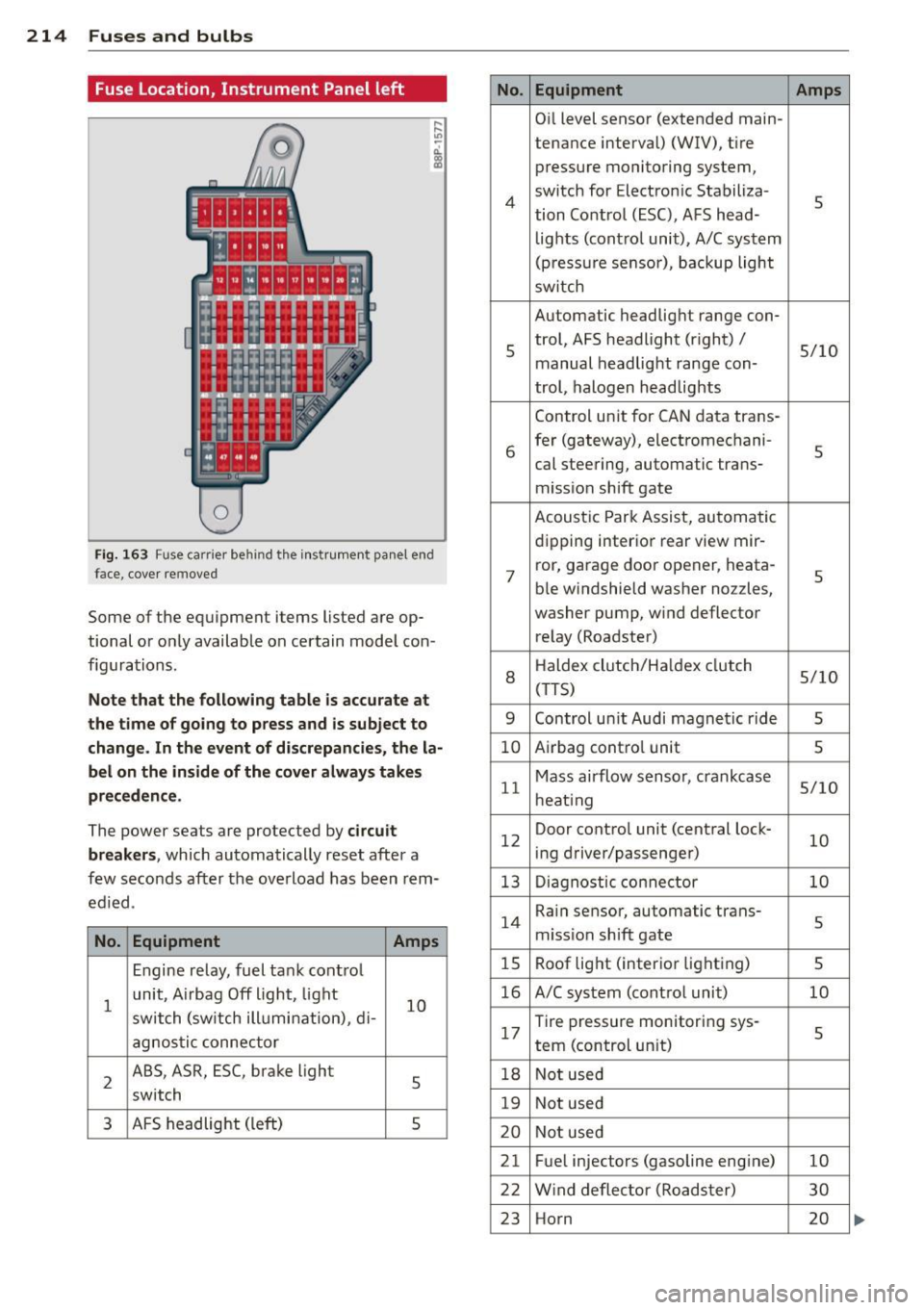
Fuse Location, Instrument Panel left
0
Fi g. 163 Fuse carrier behind the instrument panel end
face, cove r removed
Some of the equipment items listed are op
tional or only available on certain model con
figurations .
Note that the following table is accurate at
the time of going to press and is subject to
change. In the event of discrepancies, the la
bel on the inside of the cover always takes
preceden ce .
The power seats are protected by circuit
breaker s,
which automatically reset after a
few seconds after the overload has been rem
ed ied.
No . Equipment Amps
Engine relay, fuel tank control
1
unit, A irbag Off light, light
10 switch (sw itch illumination), d i-
agnos tic connector
2
ABS, ASR, ESC, brake light
5 switch
3 AFS headlight (left) s
No.
4
5
6
7
8
9
10
11
12
13
14
15
16
17
18
19
20
21
22
23
Equipment Amps
Oil level sensor (extended main-
tena nce interval) (WIV), tire
pressure monitoring system,
switch for Electronic Stabiliza-
s tion Control (ESC), AFS head-
lights (control unit), A/C system
(pressure sensor), backup light
sw itch
Automatic headlight range con-
trol, AFS headlight (right) /
5/10
manual headlight range con-
trol, halogen headlights
Control unit for CAN data trans-
fer (gateway), electromechani-
s cal steering, automatic trans-
mission shift gate
Acoustic Park Assist, automatic
dipping interior rear view mir- ror, garage door opener, heata-
s ble windshield washer nozzles,
washer pump, wind deflector
relay (Roadster)
H aldex clutch/Ha ldex clutch
5/10 (T TS)
Control un it Audi magnetic ride
s
Airbag contro l unit s
Mass airflow sensor, crankcase 5/10
heating
Door control unit (central lock-
10 ing driver/passenger)
Diagnostic connector
10
Rain sensor, automatic trans-
s miss ion shift gate
Roof light (interior lighting)
5
A/C system (control unit) 10
Tire pressure monitoring sys-
5 tern (control un it)
Not used
Not used
Not used
Fuel injectors (gasoline engine)
10
Wind deflector (Roadster) 30
Horn 20
Page 229 of 244
steadily reduced the scope of maintenance
and repairs which can be carried o ut by vehicle
owners.
Also, safe ty and en vironment al con
cerns p lace very strict limits on the nature of
repairs and adjustments to engine and trans
miss io n parts which an owner can perform .
Maintenance, adjustments and repa irs usua lly
require special tools, testing dev ices and oth
er equipment availab le to specially trained
workshop personne l in order to assure proper
pe rformance, reliab ility and safety of the vehi
cle and its many systems .
Improper ma intenance, adjustments and re
pa irs can impair the operation and reliability
of your vehicle and even void your vehicle war
ranty. Therefore, p roof of servic ing in accord
ance w ith the maintenance schedule may be a
condition for upholding a poss ible war ran ty
claim made within the warranty period .
Above all, operational safety can be adversely
affected, creating unnecessary risks for you
and your passengers .
If in doubt about any serv icing, have it done
by your authorized Audi dealer or any othe r
p roperly equipped and q ualified works hop .
We strong ly urge you to give yo ur auth o rized
Aud i dea ler the opportuni ty to perform all
schedu led maintenance and necessary repairs .
Your dea ler has the facilities, original parts
and tra ined spec ialists to keep your vehicle
running properly.
Performing limit ed ma inten anc e yourself
The fo llow ing pages describe a limited num
ber of proced ures which can be pe rformed on
your vehicle with ordina ry too ls, should the
need arise and trained personnel be unavaila
ble. Before performing any of these proce
dures, always t horoughly read a ll of the app li
cable text and carefully follow the instruc
tions given . Always rigorously obse rve the
WARNINGS provided.
Befo re you check anything in the engine
c ompartm ent, a lway s re ad and heed all
WARN INGS ~
A and ~ A in Working in the
engine compartment on page 165.
Con sumer In formation 22 7
_& WARNING
- Ser ious personal injury may occur as a re
sult of improperly performed mainte
nance, ad justments or repa irs .
- Always be extremely careful when work
ing on the vehicle . Always follow com
monly accep ted safety pract ices and gen
era l common sense. Never r is k personal
inju ry.
- Do not attempt any of the maintenance,
checks or repairs descr ibed o n the fol
lowing pages if you are not fully fam ilia r
with these or othe r procedures with re
spect to the vehi cle, or are uncertain how
to p roceed .
- Do not do any work without the proper
too ls and equipment. Have the necessa ry
wo rk done by your authorized A udi deal
er or another proper ly equipped and
qualified wor kshop.
- The engine compartment of any motor
veh icle is a potentially hazardous area.
Never reach into t he area around or
touch the rad iator fan. It is temperature
contro lled and can switch on suddenly -
even when the engine is off and the igni
tion key has been removed. The rad iator
f a n switches on a utomat ica lly when the
coo lant reaches a certain tempera ture
an d will continue to run until the coo lant
tem perature drops .
- Always remove the ign ition key before
anyone gets under the vehicle.
- Always support your veh icle with safety
stands i f it is necessary to work under
neath the vehicle. The jack s upplied with
the vehicle is not adequate for this pur
pose and cou ld collapse causing serio us
personal injury.
- I f you must work underneath the vehicle
with the wheels on t he ground, a lways
make sure the vehicle is on leve l ground,
that the wheels a re a lways securely
blocked a nd that the engine cannot be
started. •
•