brake light AUDI TT ROADSTER 2014 Owner's Manual
[x] Cancel search | Manufacturer: AUDI, Model Year: 2014, Model line: TT ROADSTER, Model: AUDI TT ROADSTER 2014Pages: 244, PDF Size: 60.87 MB
Page 144 of 244
142 Intelligent technology
Intelligent technology
Notice about data
recorded by vehicle
control modules
Your vehicle is not equipped with an Event Da
ta Recorder (EDR), installed by some manu
facturers fo r the express purpose of capturing
data for retrieval after an accident or crash
event . EDR's are sometimes ca lled "crash re
corders".
Some state laws restrict the retr ieval or down
loading of data stored by EDR's that were in
stalled in a vehicle for the express purpose of
retrieving data after an accident or crash
event without the owner's consent.
A lthough your vehicle is not equipped with an
EDR, it is equipped with a number of electron
ic control modules for various vehicle systems
such as, for examp le, eng ine function, em is
sion control, as well as for the airbags and
safety belts.
These electronic contro l modules also record
vehicle-re lated data during normal vehicle op
eration for diagnostic and repair purposes.
The recording capacity of the electronic con
trol modules is limited to data (no sound is re
corded) and only a small amount of data is ac
tually recorded over a very limited pe riod of
time and stored when a system fault or other
condition is sensed by a control unit. Some of
the data then stored may relate to vehicle
speed, direction, braking as we ll as restraint
system use and performance in the event of a
crash or other condition. Stored data can only
be read and downloaded with special equip
ment.
Electronic Stabilization
Control (ESC)
Description
ESC helps to improve road holding and vehicle
dynamics to help reduce the probability of
skidd ing and loss of vehicle control. It works
only when the engine is running. ESC detects certain difficult driving situat
ions, including
when the vehicle is beginning to spin (yaw)
out of control and helps you to get the veh icle
back under control by se lectively braking the
wheels, and/or reducing engine power and
providing steering assistance to help hold the
vehicle on the driver's intended course. The in
dicator light
G) in the instrument cluster
blinks when ESC is taking action to help you
control the vehicle.
ESC has limitations.
It is important to remem
ber that ESC cannot overcome the laws of
physics. It wi ll not always be able to help out
under all conditions you may come up against.
For example, ESC may not always be able to
help you master situations where there is a
sudden change in the coefficient of friction of
the road surface. When there is a section of
dry road that is suddenly covered with water,
slush or snow, ESC cannot perform the same
way it wou ld on the dry surface . If the vehicle
hydroplanes (rides on a cushion of water in
stead of the road surface), ESC will not be
able to help you steer the vehicle because con
tact with the pavement has been interrupted
and the vehicle cannot be braked or steered.
During fast cornering, particularly on winding
roads, ESC cannot always deal as effectively
with difficult driving situations as at lower
speeds.
Always adjust your speed and driving style to
road , traffic §&and weather conditions. ESC
cannot override the vehicle's physical limits,
increase the available traction, or keep a vehi
cle on the road if road departure is a result of
driver inattention . Instead, ESC improves the
poss ibility of keeping the vehicle under con
t rol and on the road dur ing extreme maneu
vers by using the driver's steering inputs to
help keep the vehicle go ing in the intended di
rection . If you are traveling at a speed that
causes you to run off the road before ESC can
provide any assistance, you may not experi
ence the benefits of ESC.
ESC includes and/or works togethe r with the
anti- lock brake system (ABS), brake assist sys-
tem and anti-slip regu lation (ASR). ESC is .,..
Page 145 of 244
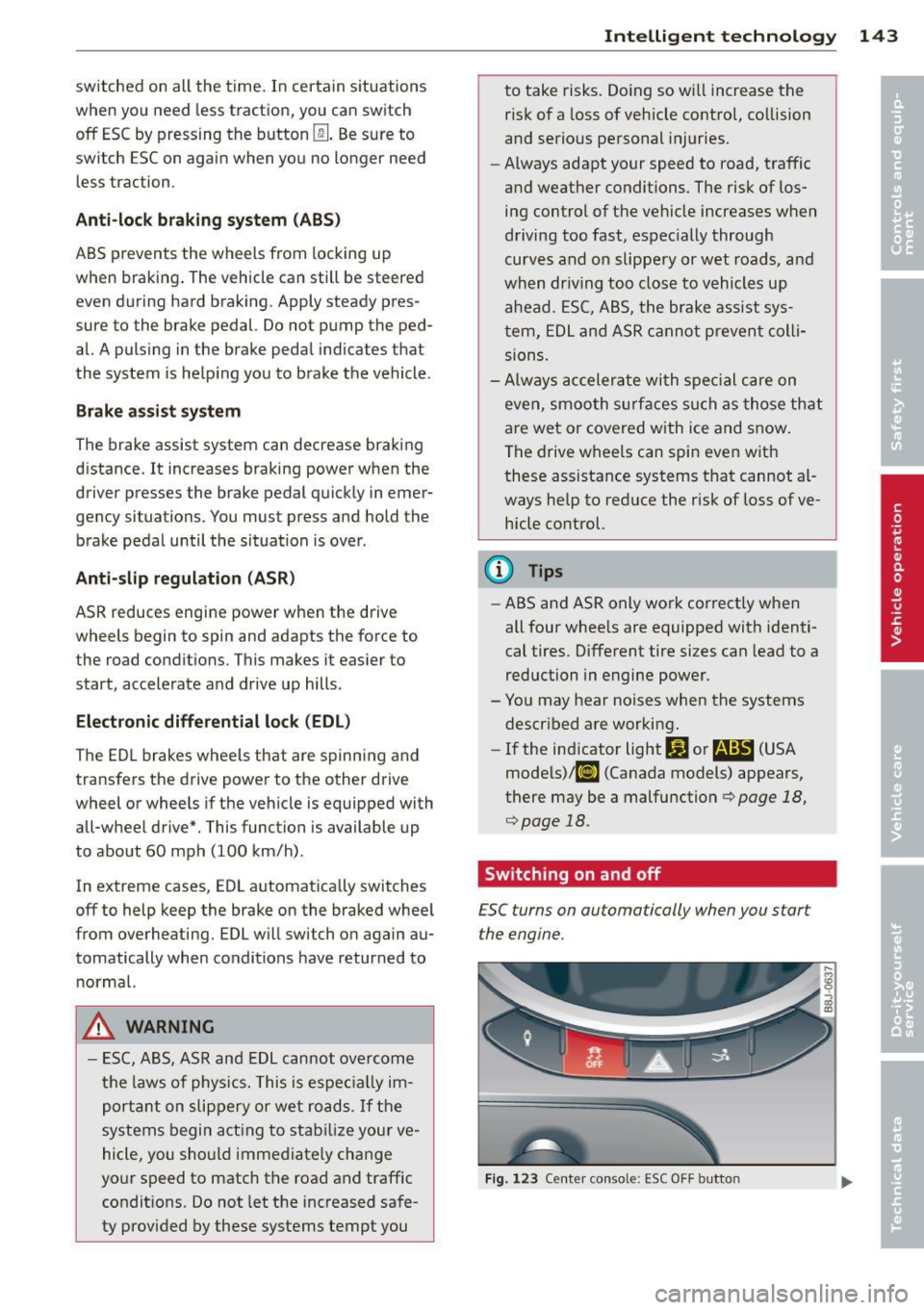
switched on all the time. In certain situations
when you need less traction, you can switch
off ESC by pressing the button
lru. Be sure to
switch ESC on again when you no longer need
less traction.
Anti-lock braking system (ABS)
ABS prevents the wheels from locking up
when braking . The vehicle can still be steered
even during hard braking . Apply steady pres
sure to the brake pedal. Do not pump the ped
al. A pulsing in the brake pedal indicates that
the system is helping you to brake the vehicle.
Brake assist system
The brake assist system can decrease braking
d istance. It increases braking power when the
driver presses the brake pedal quickly in emer
gency si tuations. You must press and hold the
brake pedal until the situation is over .
Anti-slip regulation (ASR)
ASR reduces engine power when the drive
wheels begin to spin and adapts the force to
the road condit ions. This makes it easier to
start, accelerate and drive up hills.
Electronic differential lock (EDL)
The EDL brakes wheels that are spinning and
transfers the drive power to the other drive
wheel or whee ls if the vehicle is equipped with
all-wheel drive*. This function is available up
to about 60 mph (100 km/h) .
In extreme cases, EDL automat ica lly switches
off to help keep the brake on the braked wheel
from overheating. EDL w ill switch on again au
tomatically when conditions have returned to
normal.
..&, WARNING
- ESC, ABS, ASR and EDL cannot overcome
th e laws of physics. This is especially im
portant on slippery or wet roads.
If the
systems begin acting to stabilize your ve
hicle, you should immediately change
your speed to match the road and traffic
condit ions. Do not let the increased safe
ty provided by these systems tempt you
Intelligent technology 143
to take risks. Doing so will increase the
risk of a lo ss of vehicle control, co llision
and serious personal injuries.
- Always adapt your speed to road, traffic
and weather conditions. The risk of los
ing control of the vehicle increases when
driving too fast, especially through
curves and on slippery or wet roads, and
when driving too close to vehicles up
ahead. ESC, ABS, the brake assist sys
tem, EDL and ASR cannot prevent colli
sions.
- Always accelerate with special care on
even, smooth surfaces such as those that
are wet or covered with ice and snow.
The drive wheels can spin even with
these assistance systems that cannot al
ways he lp to reduce the risk of loss of ve
hicle control.
@ Tips
- ABS and ASR only work correct ly when
all four whee ls are equipped with identi
cal tires. D ifferent tire si zes can lead to a
reduction in engine power.
- You may hear noises when the systems
described are working.
- If the ind icator lightD] orE (USA
models)/ [iJ (Canada models) appears,
there may be a malfunction¢
page 18,
¢ page 18.
Switching on and off
ESC turns on au tomatically when you start
the engine.
Fig . 123 Ce nter conso le: ESC OFF butto n
Page 148 of 244
146 Intellig ent technolog y
gear or lower driving range. Do no t ride
t h e brakes or hold the pedal down too
long or too often. This cou ld cause the
bra kes to get hot and dimin ish braking
efficiency .
- Do no t "ride the brakes" by resting your
foot on the pedal when you do not intend
to brake . Th is may cause the brakes to
overheat, prematu re wear and inc reased
stopp ing distan ce.
- Under certain climat ic and operating
c ondit ions such as passing through wa
ter, driving i n heavy ra in or after wash ing
the vehicle, the effect iveness of the
brakes can be red uced . In winter, ice can
accumulate on the brake pads, linings,
discs and d rums . Carefully apply brakes
for a test . Brakes will dry and ice coat
ings will be cleaned off after a few care
ful brake applications.
- Driving for an extended period of time on
salt-covered roads w ithout us ing your
brakes can also affect braking efficiency .
Clean off accumulated salt coating from
brake d iscs and pads w it h a few cautious
brake appli cat ions.
- If you damage the fro nt spo iler, or if you
ins tall a different spoiler, be su re the air
flow to the fron t bra kes is not o bstr uct
ed. O therwise the brake system co uld
overheat reducing the effectiveness of
the entire brake system.
- F ailure o f one bra ke c ircuit will impair
the b raking capability resulting in an in
creased stopp ing distance . Avoid driv ing
the vehicle and have it towed to the near
est Aud i dea le r o r qualified workshop.
- Never let the vehicle ro ll to a stop w ith
the engine shut off.
- If the brake booster is not working, t he
brake pedal must be pressed considera
bly harder to make up for the lack of
booster assistance . Electro-mechanical
power assist
The electro-mechanical power assist helps
the driver when steering .
The degree of power assi st is electronically
matched to vehicle speed .
T he power steering system assists the driver
so that he can steer the vehicle with reduced
physical effor t.
Power steering will not work if t he engine is
off . As a result, the steering wheel will be hard
to turn.
A WARNING
If the system develops a problem , you
must seek qualified profess iona l assis
tance .
(D Note
-
If there is an e lectronic malfunction, ser
votronic
will still function like a conven
tiona l power steering system, providing a
constant steering support force that is no
l onge r proportionate to the vehicle speed .
This is most not icea ble whe n tu rni ng the
s tee ring w heel a t low speeds (fo r example
when pa rking), -more effort w ill be re
q uired than us ua l.
- Be aware o f the diffe rent than usual
steering response and adjust your steer
ing force acco rdingly.
- Have the problem checked and set right
by an autho rize d Aud i dealer as soon as
possible.
- If a s teer ing mal func tion occurs, this is
signa led wit h the
,'Zr~ or .• indicato r
lights and a warning tone, see.
(D Tips
- If the powe r stee ring system sho uld fai l,
or if the engine is not ru nning (fo r exam
ple, whi le being towed), you will still be
able to steer the vehicle. However, more
effort will be required to do so.
11-
Page 154 of 244
152 Driving and en vironm ent
the exhaust system and this could cause
the catalytic converter to overheat.
- Do not turn off the ignition while the ve hicle is moving .
- Do not continue to operate yo ur vehicle
under these conditions, as otherw ise fuel
can reach the cata lytic converter . This
could result in overheating of the con
verter, requ iring its replacement.
- To assure efficient operation of the Emis
sion Control System:
- Have your veh icle ma intained properly
and in acco rdance with the service rec
ommendations in your Wa rranty
&
Ma intenance booklet.
- La ck of proper main tenance as well as
improper use of the vehicle will impa ir
t he funct ion of the emission control
system and cou ld lead to damage.
@ For the sake of the environment
E ven when the Emission Contro l System is
operating p roperly, the exhaust gas can
have a s ulfur -like exhaust gas smell under
some operating states. This depends on
the s ulfur content o f the fue l being used.
Using a different brand of fuel may help,
or filling the tank w it h lead-free super
grade gasoline.
Shutting down vehicle
If you wou ld like your veh icle to remain inop
erat ive for a longer period of time, contact an
Aud i or other specialized dealer . T hey ca n ad
vise you on necessary precautions e.g . corro
sion prevent ion, ma intenance and storage.
Pay atten tion to add it iona l information con
cerning the batte ry . Re fer to ~
page 175.
Operate your vehicle
economically and
minimize pollution
General
Your personal style of driving will determine
the economy of your vehicle, as well as ex
haust and noise levels .
Fuel economy, environmenta l impact, and
wear on your engine, brakes and tires largely
depend on three factors:
- your personal driving style
- oper ating conditions
- technical limitat ions
If you ant ic ipate what you need to do next and
drive economically, you can easily cut your
fuel consumpt ion by 1O-lS percent . This sec
t ion w ill give you some tips on how you can
help the env ironment and your pocketbook.
@ Tips
The consumption estimates as published
by ENVIRONME NTAL PROTEC TION AG ENCY
( EP A) and Transpo rt Canada may no t corre
spond to your actual consumption on the
r oad, which will va ry depending upon vehi
cle load and speed, road and weather con
ditions, trip length, etc.
Drive smoothly and keep a lookout
ahead
Vehicles use the most fuel when they ore ac
celerating.
Avoid unnecessary acce lerating and braking .
Vehicles use the mos t fu el when they are ac
ce le rat ing. If yo u ant icipate what is going to
happen next, you will need to brake less and,
t hu s, acce le rate less . Let the vehicle coast
whenever possible -for examp le when you see
that the next traff ic light is red.
Page 158 of 244
156 Vehicle care and cleaning
_& WARNING
- Only wash the vehicle when the ignition
is off and follow the instructions from
the car wash operator to reduce the risk
of accidents.
- To reduce the risk of cuts, protect your
self from sharp metal components when
washing the underbody or the inside of
the wheel housings.
- After washing the vehicle, the braking ef
fect may be delayed due to moisture on
the brake rotors or ice in the winter. The
brakes must be dried first with a few
careful brake applications .
@ Note
- If you wash the vehicle in an automatic
car wash, you must fold the exterior mir
rors in to reduce the risk of damage to
the mirrors. Power folding exterior mir rors* must only be folded in and out us
ing the power folding function.
- To prevent paint damage, do not wash
the vehicle in direct sunlight.
- To reduce the risk of damage, do not
wash the power top with a pressure
washer. -
To reduce the risk of damage, do not
wash decorative decals* with a pressure
washer.
- To reduc e the risk of damage to the sur
face, do not use insect removing spong
es, kitchen sponges or similar items.
- Matte finish painted vehicle compo
nents:
- To reduce the risk of damage to the
surface, do not use polishing agents or
hard wax.
- Never use car wash cycles that apply
protective wax.
It can destroy the
matte finish effect.
- Do not place any stickers or magnetic
signs on vehicle parts painted with matte finish paint. The paint could be
damaged when the stickers or magnets
are removed.
@ For the sake of the environment
Only wash the vehicle in facilities specially
designed for that purpose. This will reduce
the risk of dirty water contaminated with
oil from entering the sewer system.
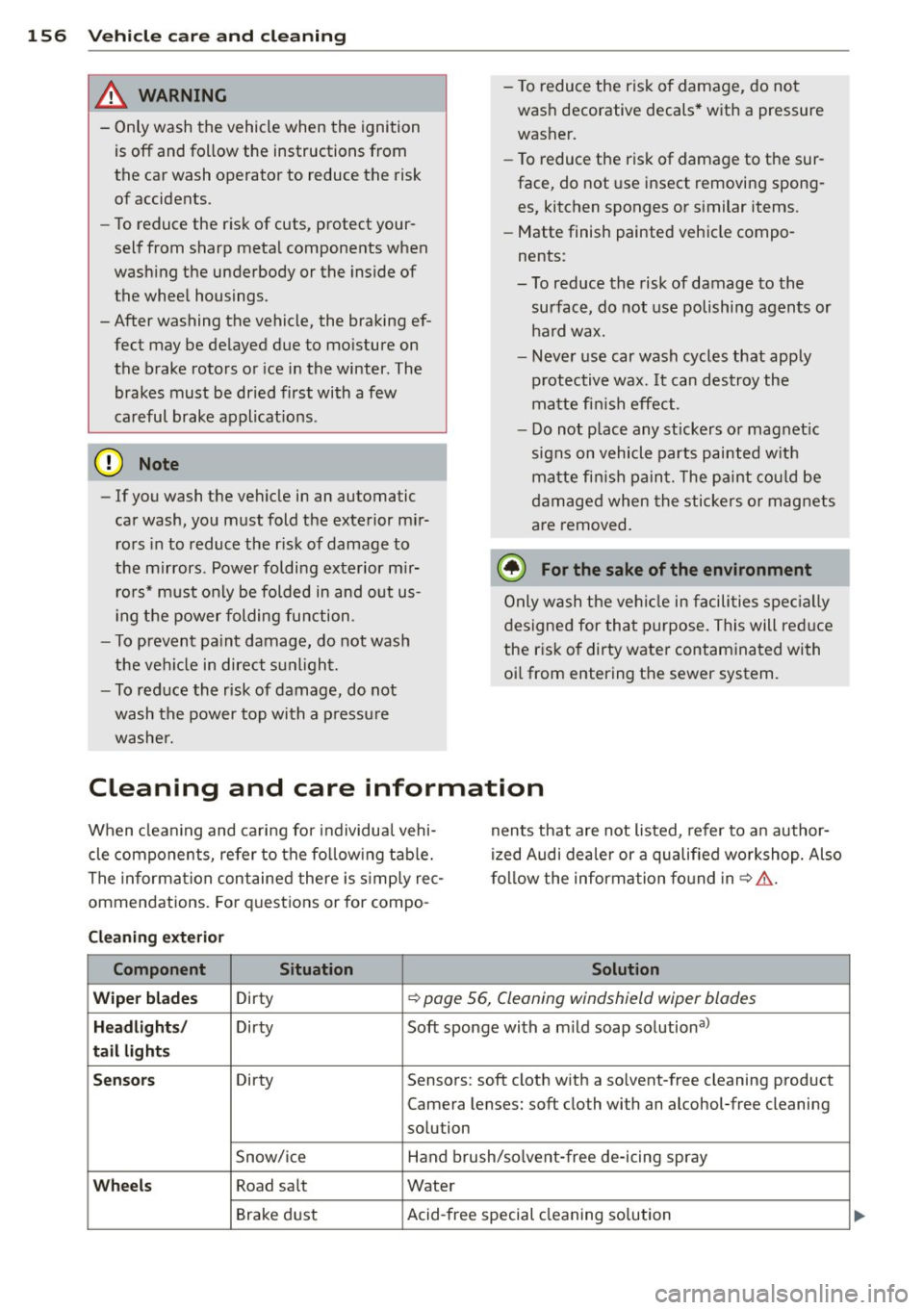
Cleaning and care information
When cleaning and caring for individual vehi
cle components, refer to the following table.
The information contained there is simply rec
ommendations. For questions or for compo- nents that are not listed,
refer to an author
ized Audi dealer or a qualified workshop. Also
follow the information found in~.&. .
Cleaning exterior Component Situation Solution
Wiper blades Dirty
~ page 56, Cleaning windshield wiper blades
Headlights/ Dirty Soft sponge with a mild soap solutional
tail lights
Sensors Dirty Sensors: soft cloth with a solvent-free cleaning product
Camera lenses: soft cloth with an alcohol-free cleaning
solution
Snow/ice Hand brush/solvent-free de-icing spray
Wheels Road salt Water
Brake dust Acid-free special
cleaning solution
Page 169 of 244
Checking and fillin g 167
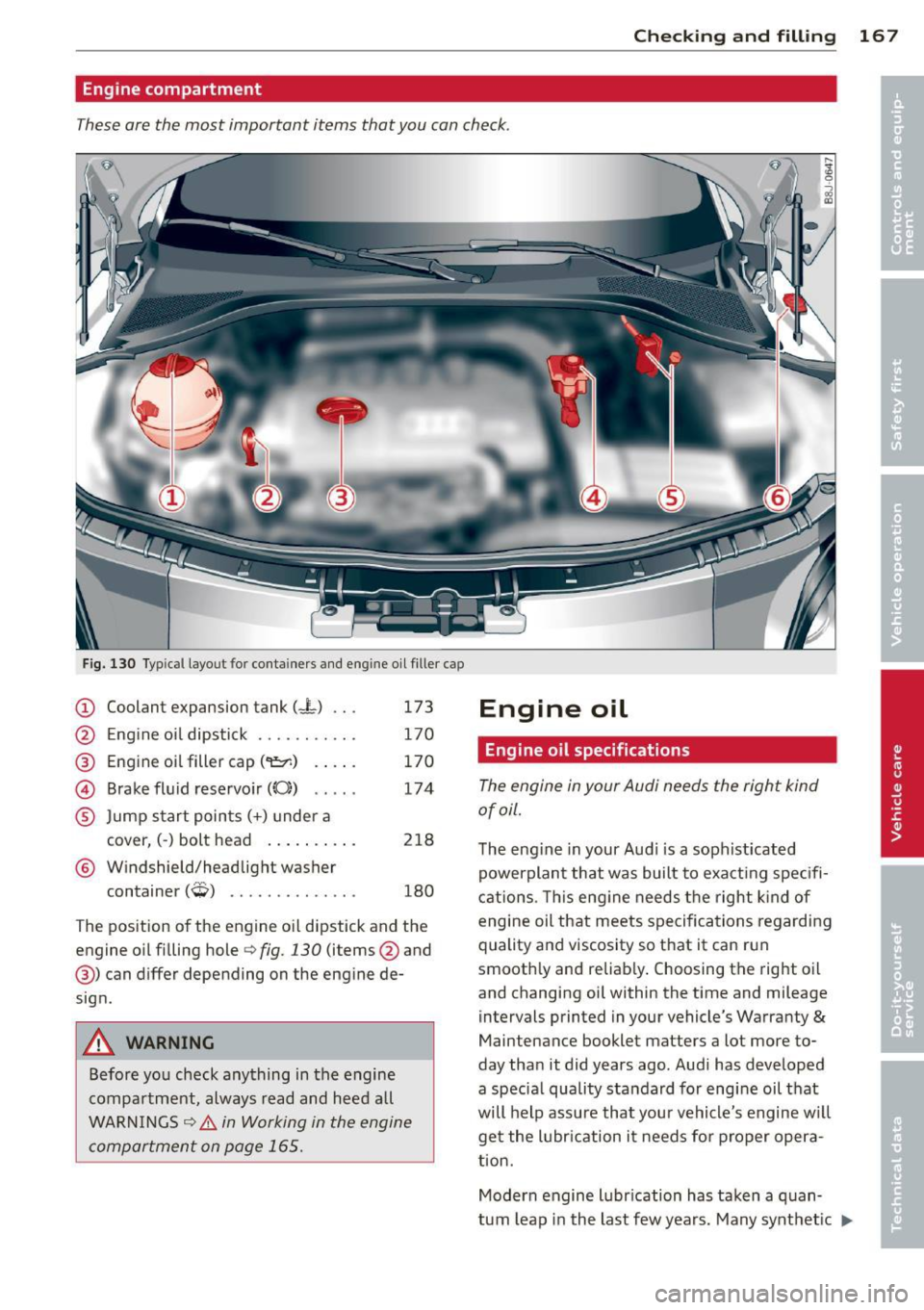
Eng ine compartment
These are the most important items that you can check .
•
Fig. 130 Typ ical layout for containers and eng ine oil filler cap
(D Coolant expansion tank (-L) . . . 173
@ Eng ine oi l dipstick . . . . . . . . . . . 170
@ Engine oil filler cap (
® Jump start points(+) under a
cover,(-) bolt head . . . . . . . . . . 218
® Windshield/headlight washer
t . (ffi) con amer *
...... ....... . 180
The position of the engine o il dipstick and the
engine oil filling hole
i::> fig. 130 (items @and
@) can differ depending on the engine de
sign.
_&. WARNING
Before yo u check anything in the engine
compartment, always read and heed all
WARN INGS
i::> &. in Working in the engine
compartment on page 165.
Engine oil
Engine oil specifications
The engine in your Audi needs the right kind
of oil.
The eng ine in your Aud i is a sophist icated
powerplant that was built to exacti ng spec ifi
cations . T his eng ine needs t he right k ind of
engine oil that meets specifications regarding
quality and viscosity so that it can run
smoot hly and reliably . Choosing the right o il
and changing oil within the time and mileage
intervals printed in your vehicle's Warranty
&
Maintenance booklet matters a lot more to
day than it did years ago. Audi has developed
a specia l quality standard for engine oil t hat
will help assu re that you r vehicle's engine w ill
get the l ubr ication i t needs fo r proper opera
tion.
Modern engine lubr ication has taken a q uan
tum leap in the last few years. Many synt het ic
IJI,,
Page 176 of 244
17 4 Che cking and filling
pressure relie f valve in the cap when the
engine becomes hot .
.&_ WARNING
-The coo ling system is under pressure and
can get
very hot. Reduce the risk of
sca lding from hot coolant by following
these steps .
- Turn off the eng ine and a llow it to cool
down.
- Protec t your face, hands and arms from
escap ing fl uid and steam by cover ing
the cap with a large, thick rag.
- Tu rn the cap slowly and
very ca refully
in a counter -clockwise direct ion while
applying light, downward p ress ure on
the top of the cap.
- To avo id being burned, do not sp ill an
tifreeze or coolant on the exhaust sys
tem or hot engine parts. Under certain
conditions, the ethylene glyco l in en
g ine coolant can catch fire.
- Antifreeze is poisonous. Always store an
t ifreeze in its or iginal container and we ll
out of the reach of children.
- If you drain the coolant, it must be
caught and safely stored in a proper con
ta iner clearly marked "poison".
(D Note
- Coolant po llutes the environment and
could cause an engine fire. Excess cool
ant will be forced out through the pres
sure re lief
valve in the cap when the en
gine becomes hot .
- If, in an emergency, only water can be
added, the correct ratio between wate r
and antifreeze~
page 172 must be re
stored as soon as possib le.
@) For the sake of the environment
Dra ined coolant should not be reused. Al
ways dispose of used coolant while obse rv
ing all environmental regulations .
Radiator fan
The radiator fan switches on automatically by
itself .
The electric radiator fan is controlled by ther
moswitches that switch on and off depending
on coolant and eng ine compartment tempera
tures.
An a uxiliary electric radiator fan* sw itches on
and off depending on coolant temperature
and other vehicle operat ion conditions .
After you switch the engine off, the aux iliary
fan can continue running for up to 10 minutes
-even w ith the ignition off. It can even switc h
on aga in later by itself
c> &. , if
- the temperature of the engine coo lant rises
due to the heat build-up from the engine in
the engine compartment, or
- the engine compartment heats up because
the vehicle is parked in intense sunlight.
.&_ WARNING
-
- To reduce the risk of personal inju ry nev-
er touch the radiator fan.
- The auxiliary electric fan is temperature
controlled and can sw itch on suddenly
even when the engine is not ru nning.
- The auxiliary radiator fan sw itches on au
tomatically when the engine coo lant
reac hes a certain t emperature and w ill
continue to run until the coolant temper
a ture drop s.
Brake fluid
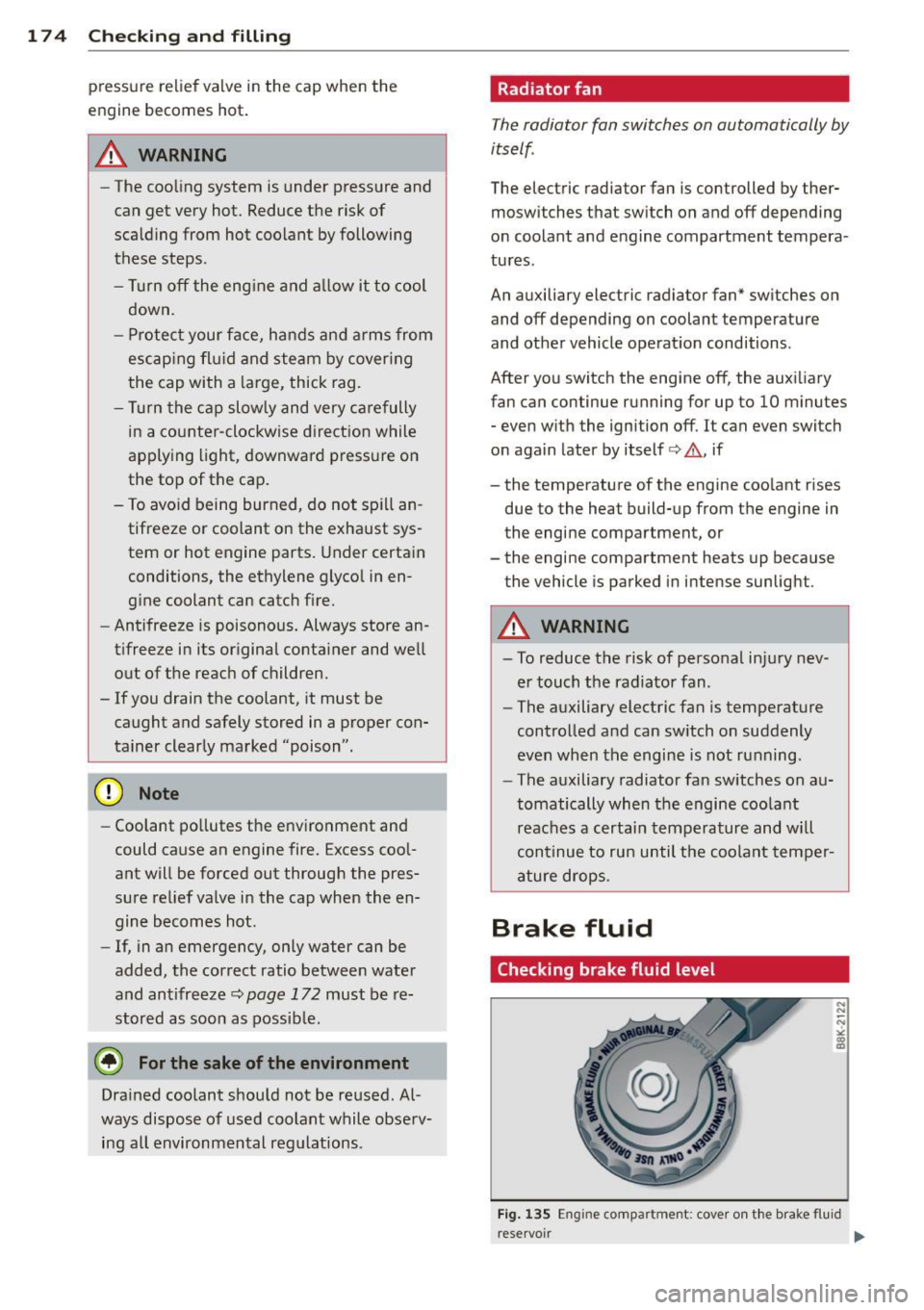
' Checking brake fluid level
N
N
N
" ~
Fi g. 13S Engine compartment: cover on th e brake fluid
reservoir
Page 177 of 244
Before you check anything in the engine com
partment,
always r ead and heed all WARN
ING S
~ A in Working in the engine compart
ment on page 165.
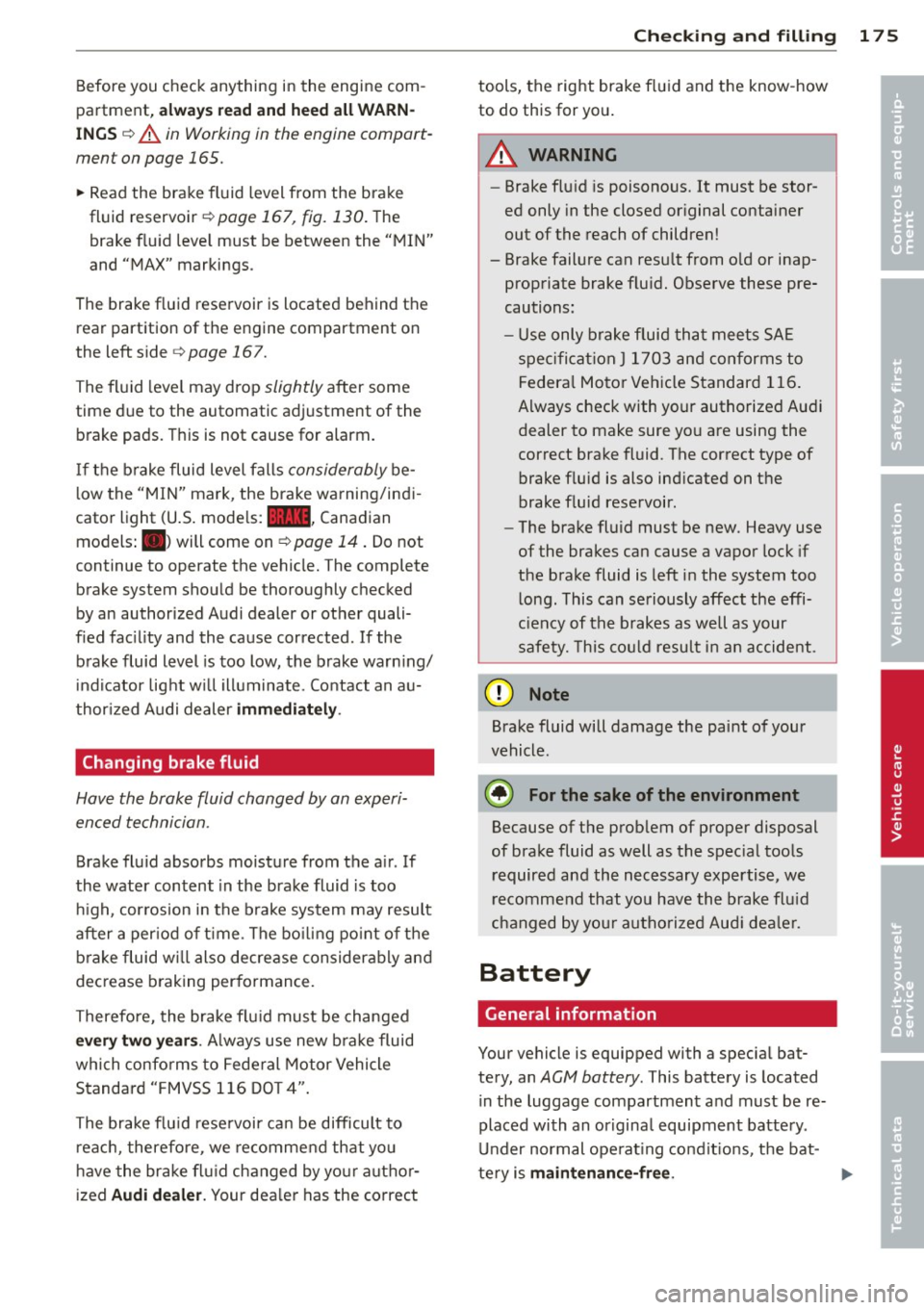
.. Read the brake flu id level from the brake
fluid reservoir
9 page 167, fig. 130 . The
brake f lu id leve l must be between the "MIN"
and "MAX" markings.
The brake f luid reservoir is located behind the
rear partition of the engine compartment on
the left side
9 page 167.
The fl uid level may drop slightly after some
time due to the automatic adjustment of the brake pads . This is not cause for alarm .
If the brake fluid level falls considerably be
l ow the "M IN" mark, the brake wa rning/indi
cator light (U .S . mode ls:
1111 , Canadian
models: .) will come on ¢
page 14 . Do not
continue to operate the vehicle. The complete
brake system shou ld be thoroughly checked
by an authorized Audi dealer or other quali
f ied fac ility and the cause corrected . If the
b rake fluid level is too low, the brake warn ing/
i ndicator light w ill illuminate . Co ntact an au
thor ized Audi dealer
immediately .
Changing brake fluid
Have the brake fluid changed by an experi
enced technician .
Brake fluid abso rbs moistu re from the a ir . If
the water content in the brake fluid is too
hi gh, cor ros ion in the b rake system may result
after a per iod of t ime . The bo iling po int of t he
b ra ke fluid w ill also decrease considerab ly and
decrease braking performance.
Therefore, the brake flu id must be changed
e very two year s. Always use new b rake fluid
which confo rms to Fede ral Motor Vehicle
Standard "FMVSS 1 16 DO T 4".
The brake flu id rese rvoi r ca n be difficult to
r each, therefo re , we recommend that yo u
h ave the brake fl uid changed by you r autho r
i zed
Audi dealer . Your deale r has the correct
Checkin g and fillin g 175
tools, the right brake fl uid and t he know -how
to do this for you .
A WARNING
-Brake flu id is poisonous. It must be stor
ed only in the closed or iginal container
out of the reach of children!
- Brake failure can res ult from o ld or inap
propriate brake f lu id. Observe these pre
cautions:
- Use only b rake fluid th at mee ts SA E
spe cificat ion
J 17 03 and conforms to
Federa l Mo to r Ve hicl e Standard 1 16.
Always check with yo ur authorized Au di
dealer to make sure yo u are using the
correct brake fluid. The cor rect type of
brake f luid is also ind icated on the
brake f luid reservoir .
- The bra ke fluid must be new. Heavy use
of the brakes ca n cause a vapor lock if
the brake fluid is left i n the system too
long. This can se riously affect the effi
c iency of the b rakes as well as your
safety , T his could result in an accide nt.
(!) Note
Brake fluid will damage the pai nt of your
vehicle.
@) For the sake of the environment
Because of the prob lem of proper disposal
of brake fluid as well as the spec ial too ls
r equired and the nec essary expertise, we
r ecommend that yo u have th e brake flu id
c hanged by you r aut ho rized Aud i dea le r.
Battery
General information
Your vehicle is equipped with a specia l bat
tery, an
ACM battery. This battery is located
in the luggage compartment and must be re
placed with an origina l equipment batte ry .
Un der normal ope rat ing condit io ns, t he bat-
te ry is
maintenanc e-free . .,.
•
•
Page 216 of 244
214 Fuses and bulbs
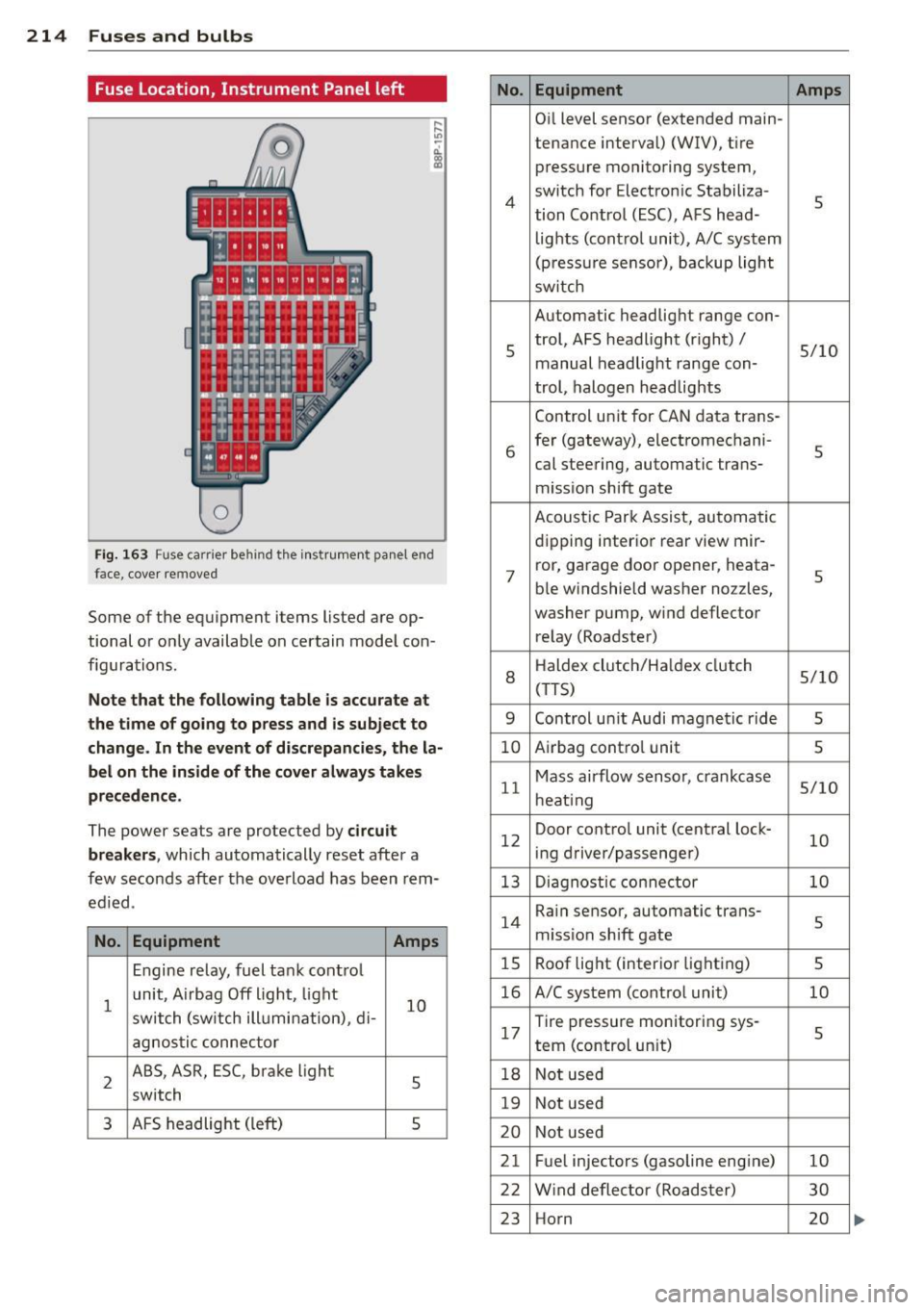
Fuse Location, Instrument Panel left
0
Fi g. 163 Fuse carrier behind the instrument panel end
face, cove r removed
Some of the equipment items listed are op
tional or only available on certain model con
figurations .
Note that the following table is accurate at
the time of going to press and is subject to
change. In the event of discrepancies, the la
bel on the inside of the cover always takes
preceden ce .
The power seats are protected by circuit
breaker s,
which automatically reset after a
few seconds after the overload has been rem
ed ied.
No . Equipment Amps
Engine relay, fuel tank control
1
unit, A irbag Off light, light
10 switch (sw itch illumination), d i-
agnos tic connector
2
ABS, ASR, ESC, brake light
5 switch
3 AFS headlight (left) s
No.
4
5
6
7
8
9
10
11
12
13
14
15
16
17
18
19
20
21
22
23
Equipment Amps
Oil level sensor (extended main-
tena nce interval) (WIV), tire
pressure monitoring system,
switch for Electronic Stabiliza-
s tion Control (ESC), AFS head-
lights (control unit), A/C system
(pressure sensor), backup light
sw itch
Automatic headlight range con-
trol, AFS headlight (right) /
5/10
manual headlight range con-
trol, halogen headlights
Control unit for CAN data trans-
fer (gateway), electromechani-
s cal steering, automatic trans-
mission shift gate
Acoustic Park Assist, automatic
dipping interior rear view mir- ror, garage door opener, heata-
s ble windshield washer nozzles,
washer pump, wind deflector
relay (Roadster)
H aldex clutch/Ha ldex clutch
5/10 (T TS)
Control un it Audi magnetic ride
s
Airbag contro l unit s
Mass airflow sensor, crankcase 5/10
heating
Door control unit (central lock-
10 ing driver/passenger)
Diagnostic connector
10
Rain sensor, automatic trans-
s miss ion shift gate
Roof light (interior lighting)
5
A/C system (control unit) 10
Tire pressure monitoring sys-
5 tern (control un it)
Not used
Not used
Not used
Fuel injectors (gasoline engine)
10
Wind deflector (Roadster) 30
Horn 20
Page 218 of 244
216 Fuse s a nd bul bs
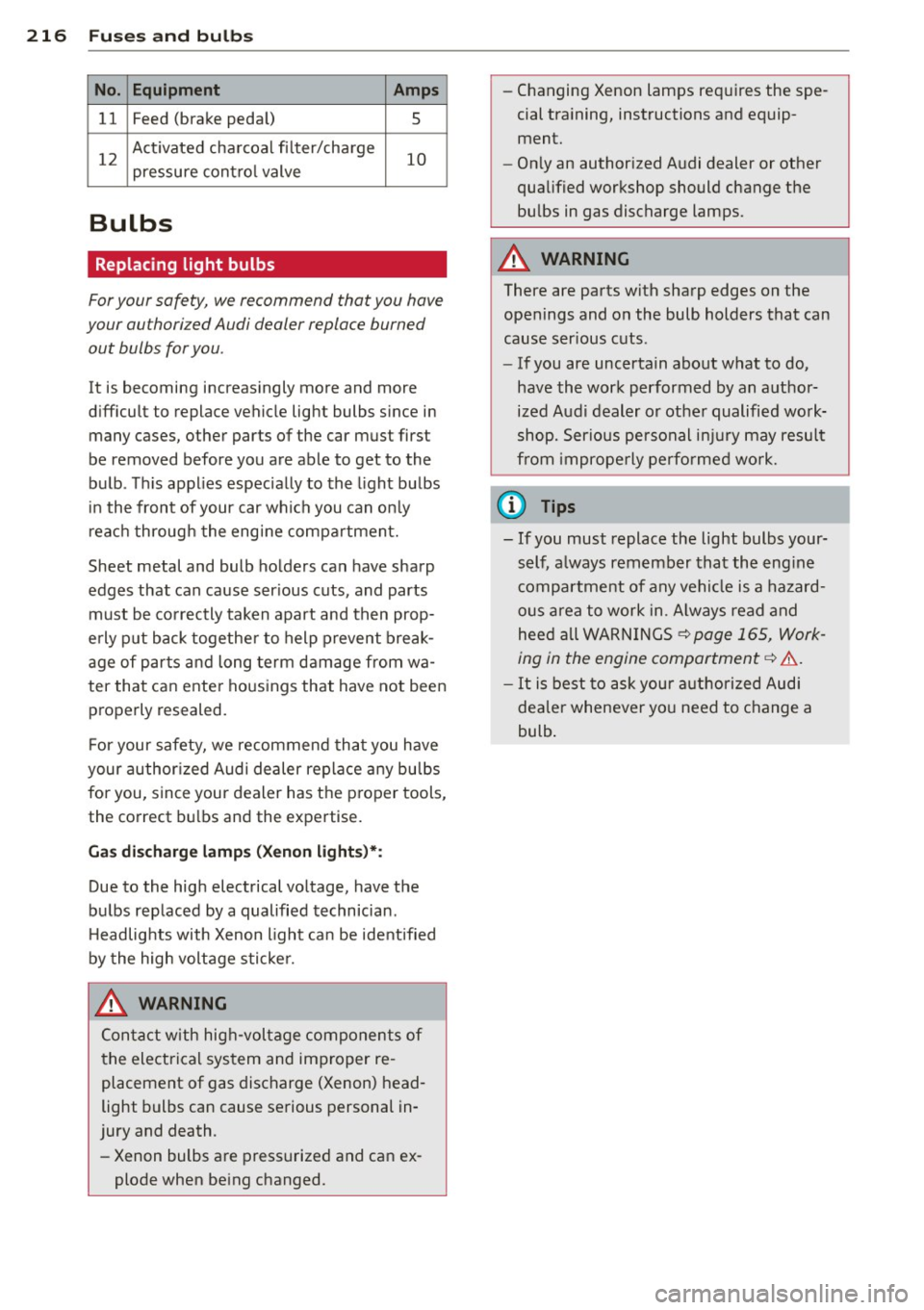
No. Equipment Amps
11 Feed (brake pedal) 5
12
Activated charcoal fi lter/charge
10 pressure contro l valve
Bulbs
Replacing light bulbs
For your safety, we recommend that you have
your authorized Audi dealer replace burned
out bulbs for you .
It is becoming increasingly more and more
difficult to replace vehicle light bulbs since in
many cases, other parts of the car must first
be removed before you are able to get to the
bulb . Th is appl ies especially to the l ight bulbs
in the front of your car which you can only
reach through the engine compartment.
Sheet metal and bulb holders can have sharp
edges that can cause ser ious cuts, and parts
must be co rrectly taken apart and then prop
e rly put back together to help prevent break
age of parts and long term damage from wa
ter that can enter housings that have not been properly resealed.
For your safety, we recommend that you have
your author ized Audi dealer replace any bulbs
for you, since your dealer has the proper tools,
the correct bu lbs and the expertise.
Gas disc harg e la mps (X enon l ig ht s}*:
Due to the high electrical voltage, have the
bulbs replaced by a qualified technician.
Headlights with Xenon light can be identified
by the high voltage sticker.
A WARNING
Contact with high-voltage components of
the electrical system and improper re
placement of gas discharge (Xenon) head
light bulbs can cause serious personal in
jury and death.
- Xenon bulbs are pressurized and can ex
plode when being changed. -
Changing Xenon lamps requires the spe
cial tra ining, instructions and equip
ment.
- Only an authorized Audi dealer or other
qualified workshop should change the
bulbs in gas discharge lamps.
A WARNING
=
There are parts with sharp edges on the
openings and on the bulb holders that can
cause ser ious cuts.
- If you are uncertain about what to do,
have the work performed by an author
ized Audi dealer or other qualified work
shop. Serious personal injury may result
from improperly performed work.
@ Tips
- If you must replace the light bulbs your
self, a lways remember that the eng ine
compartment of any vehicle is a hazard
ous area to work in. A lways read and
heed all WARNINGS
¢page 165, Work
ing in the engine compartment¢.&..
-It is best to ask your authorized Audi
dealer whenever yo u need to change a
bulb .
-