steering AUDI TT ROADSTER 2014 Owner's Manual
[x] Cancel search | Manufacturer: AUDI, Model Year: 2014, Model line: TT ROADSTER, Model: AUDI TT ROADSTER 2014Pages: 244, PDF Size: 60.87 MB
Page 128 of 244
126 Airbag system
Important safety instructions on the
knee airbag system
Airbags are only supplemental restraints. Al
ways wear safety bel ts correctly and ride in a
proper seating position.
There is a lot that you and your passenger
must know and do to help the safety belts and
a irbags to provide supp lemental protection.
.&_ WARNING
An inflating knee airbag can cause serious
injury. Wearing safety belts inco rrectly and
improper seating positions increase the
r isk of serious personal injury and death
whenever a veh icle is being used.
-
- The knee airbag system cannot protect
you properly if you are seated too close
to any of the airbag locations. When ad
just ing their seat positions, it is impor
tant that both the driver and the front
passenger keep their upper bodies and
knees at the fo llowing min imum safe
distances:
- at least 10 inches (25 cm) between the
chest and t he steering wheel/ instru
ment panel.
- at least 4 inches (10 cm) between the
knees and the lower part of the instru
ment panel.
- The risk of persona l injury increases if
you lean forward or to the side, or if the
seat is imp roperly posit ioned and you are
not wearing your safety belt. The r isk in
creases even more should the airbag de
ploy.
- Always make sure that the knee a irbag
c an in flate without interference. Obje cts
between you and the airb ag can increase
the risk of inju ry in an acc iden t by inter
f ering with the way the airbag dep loys or
by being pushed into you as t he a irbag
dep loys .
- Never let anybody, especially ch ild ren
or an imals ride in the footwe ll in front
of the passenger seat.
If the airbag de- ploys, this can result in serious or fatal
injur
ies.
- Never ca rry objects of any kind in the
footwell area in front of the dr iver's or
passenger 's seat. Bulky objects (shop
ping bags, for example) can interfere
with or prevent proper deployment of
the a irbag. Small objects can be
th rown thro ugh the ve hicle if th e air
bag deploys and injure yo u or your pas
sengers.
- Make sure there are no cracks, deep
scr atc hes or o ther dam age in the area of
the ins trumen t panel where the knee a ir
bags are lo cated .
- If chi ld ren are incorrectly se ated, their
ris k of injury increases in a co llision
~page 130, Child Safety.
Side airbags
Description of side airbags
The airbag system can provide supplemental
protection to properly restrained front seat
occupants.
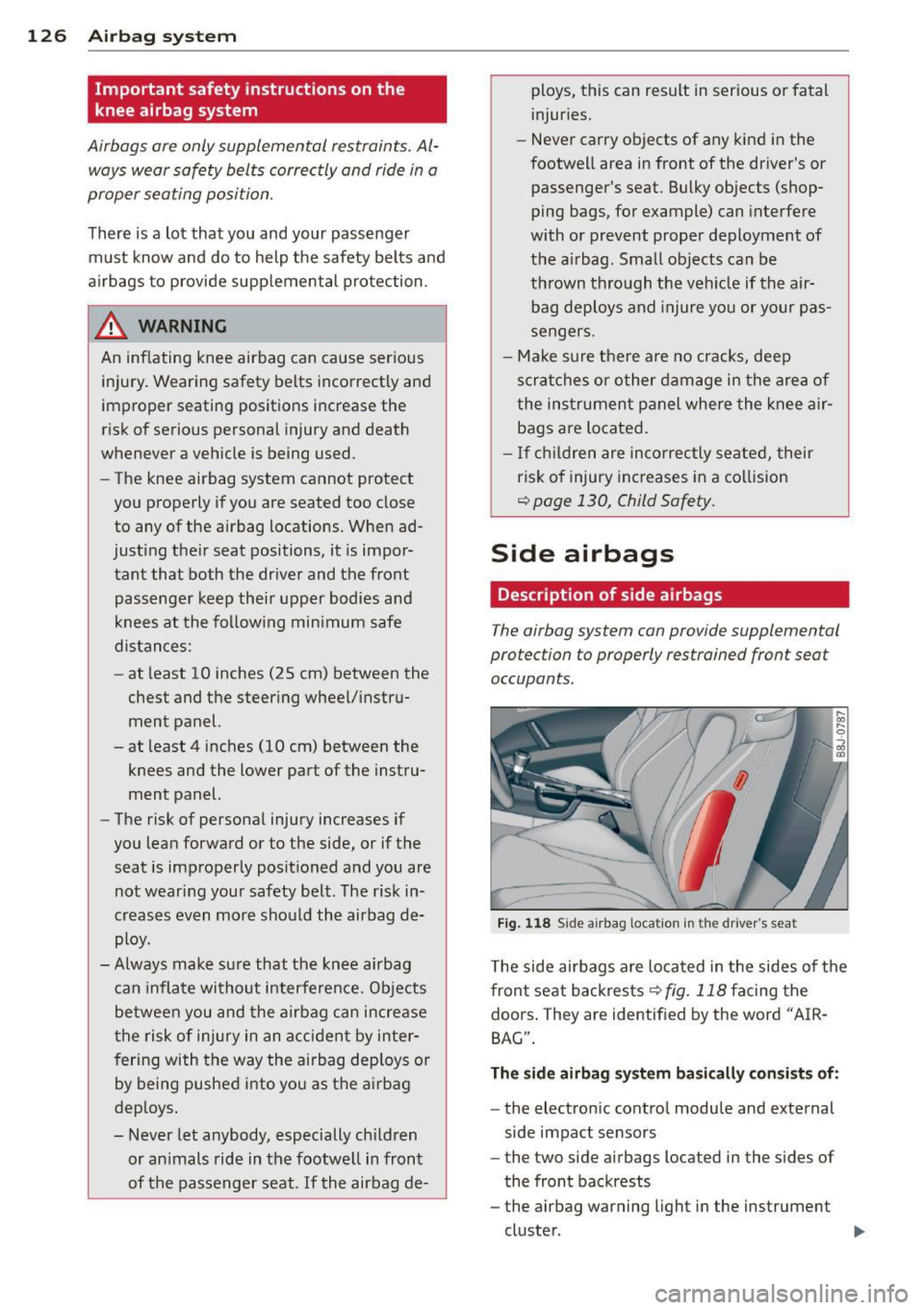
Fig . 11 8 Side airb ag locat ion in th e drive r's seat
The side airbags are loca ted in the sides of t he
fron t seat b ackrests
q fig. 118 fa cing the
doo rs . They are identif ied by the word "A IR
BAG".
Th e side airbag sy stem ba sic ally consi st s of:
- the electron ic contro l module and external
side impact sensors
- the two side airbags located in the sides of
the front backrests
- the airbag warning light in the instrument
cluster .
Page 133 of 244
A WARNING
-=
If, in exceptional circumstances, you must
install a forward-facing child restraint on
the front passenger's seat:
- Always make sure the forward-facing
seat has been designed and certified by
its manufacturer for use on a front seat
with a passenger front and side airbag.
-Always follow the manufacturer's in
structions provided with the child safety
seat or carrier.
- Always move the passenger seat into its
rearmost position in the seat's fore and
aft adjustment range, as far away from
the airbag as possible before installing
the child restraint. The backrest must be
adjusted to an upright position.
- Always make sure that the
PASSENGER
AIR BAG OFF light comes on and stays
on all the time whenever the ignition is
switched on.
(D Tips
Always replace child restraints that were
installed in a vehicle during a crash. Dam
age to a child restraint that is not visible
could cause it to fail in another collision
situation.
Advanced front airbag system and children
Your vehicle is equipped with an "Advanced
Airbag System" in compliance with United
States Federal Motor Vehicle Safety Standard
(FMVSS) 208 as applicable at the time your
vehicle was manufactured.
The Advanced Airbag system in your vehicle
has been certified to meet the "low-risk " re
quirements for 3- and 6-year old children on
the passenger side and small adults on the
driver side. The low risk deployment criteria
are intended to reduce the risk of injury
through interaction with the airbag that can
occur, for example, by being too close to the
steering wheel and instrument panel when
the airbag inflates. In addition, the system
Child Safety 131
has been certified to comply with the "sup
pression" requirements of the Safety Stand
ard, to turn off the front airbag for infants up
to 12 months who are restrained on the front passenger seat in child restraints that are list
ed in the Standard .
Even though your vehicle is equipped with an
Advanced Airbag system, a child should al
ways ride in the seat properly restrained for
its age and size . The airbag on the passenger
side makes the front seat a potentially dan
gerous place for a child to ride. The front seat
is not the safest place for a child in a forward
facing child safety seat .
It can be a very dan
gerous place for an infant or a larger child in a
rearward-facing seat.
Advanced Airbags and the weight
sensing mat in the front seat
The Advanced Airbag System in your vehicle
detects the presence of an infant or child in a
child restraint on the front passenger seat us
ing the weight-sensing mat in the seat cush
ion and the sensor below the safety belt latch
on the front passenger seat that measures the
tension on the safety belt.
The weight-sensing mat measures total
weight of the child and the child safety seat
and a child blanket on the front passenger
seat. The weight on the front passenger seat
is related to the design of the child restraint
and its "footprint", the size and shape of the
bottom of the child restraint as it sits on the
seat. The weight of a child restraint and its
"footprint" vary for different kinds of child re
straints and for the different models of the
same kind of child restraint offered by child restraint manufacturers.
The weight ranges for the individual types,
makes and models of child restraints that the
NHTSA has specified in the Safety Standard
together with the weight ranges of typical in
fants and typical 1 year-old child have been
stored in the control unit of the Advanced Air
bag System. When a child restraint is being
used on the front passenger seat with a
ll-
•
•
Page 144 of 244
142 Intelligent technology
Intelligent technology
Notice about data
recorded by vehicle
control modules
Your vehicle is not equipped with an Event Da
ta Recorder (EDR), installed by some manu
facturers fo r the express purpose of capturing
data for retrieval after an accident or crash
event . EDR's are sometimes ca lled "crash re
corders".
Some state laws restrict the retr ieval or down
loading of data stored by EDR's that were in
stalled in a vehicle for the express purpose of
retrieving data after an accident or crash
event without the owner's consent.
A lthough your vehicle is not equipped with an
EDR, it is equipped with a number of electron
ic control modules for various vehicle systems
such as, for examp le, eng ine function, em is
sion control, as well as for the airbags and
safety belts.
These electronic contro l modules also record
vehicle-re lated data during normal vehicle op
eration for diagnostic and repair purposes.
The recording capacity of the electronic con
trol modules is limited to data (no sound is re
corded) and only a small amount of data is ac
tually recorded over a very limited pe riod of
time and stored when a system fault or other
condition is sensed by a control unit. Some of
the data then stored may relate to vehicle
speed, direction, braking as we ll as restraint
system use and performance in the event of a
crash or other condition. Stored data can only
be read and downloaded with special equip
ment.
Electronic Stabilization
Control (ESC)
Description
ESC helps to improve road holding and vehicle
dynamics to help reduce the probability of
skidd ing and loss of vehicle control. It works
only when the engine is running. ESC detects certain difficult driving situat
ions, including
when the vehicle is beginning to spin (yaw)
out of control and helps you to get the veh icle
back under control by se lectively braking the
wheels, and/or reducing engine power and
providing steering assistance to help hold the
vehicle on the driver's intended course. The in
dicator light
G) in the instrument cluster
blinks when ESC is taking action to help you
control the vehicle.
ESC has limitations.
It is important to remem
ber that ESC cannot overcome the laws of
physics. It wi ll not always be able to help out
under all conditions you may come up against.
For example, ESC may not always be able to
help you master situations where there is a
sudden change in the coefficient of friction of
the road surface. When there is a section of
dry road that is suddenly covered with water,
slush or snow, ESC cannot perform the same
way it wou ld on the dry surface . If the vehicle
hydroplanes (rides on a cushion of water in
stead of the road surface), ESC will not be
able to help you steer the vehicle because con
tact with the pavement has been interrupted
and the vehicle cannot be braked or steered.
During fast cornering, particularly on winding
roads, ESC cannot always deal as effectively
with difficult driving situations as at lower
speeds.
Always adjust your speed and driving style to
road , traffic §&and weather conditions. ESC
cannot override the vehicle's physical limits,
increase the available traction, or keep a vehi
cle on the road if road departure is a result of
driver inattention . Instead, ESC improves the
poss ibility of keeping the vehicle under con
t rol and on the road dur ing extreme maneu
vers by using the driver's steering inputs to
help keep the vehicle go ing in the intended di
rection . If you are traveling at a speed that
causes you to run off the road before ESC can
provide any assistance, you may not experi
ence the benefits of ESC.
ESC includes and/or works togethe r with the
anti- lock brake system (ABS), brake assist sys-
tem and anti-slip regu lation (ASR). ESC is .,..
Page 148 of 244
146 Intellig ent technolog y
gear or lower driving range. Do no t ride
t h e brakes or hold the pedal down too
long or too often. This cou ld cause the
bra kes to get hot and dimin ish braking
efficiency .
- Do no t "ride the brakes" by resting your
foot on the pedal when you do not intend
to brake . Th is may cause the brakes to
overheat, prematu re wear and inc reased
stopp ing distan ce.
- Under certain climat ic and operating
c ondit ions such as passing through wa
ter, driving i n heavy ra in or after wash ing
the vehicle, the effect iveness of the
brakes can be red uced . In winter, ice can
accumulate on the brake pads, linings,
discs and d rums . Carefully apply brakes
for a test . Brakes will dry and ice coat
ings will be cleaned off after a few care
ful brake applications.
- Driving for an extended period of time on
salt-covered roads w ithout us ing your
brakes can also affect braking efficiency .
Clean off accumulated salt coating from
brake d iscs and pads w it h a few cautious
brake appli cat ions.
- If you damage the fro nt spo iler, or if you
ins tall a different spoiler, be su re the air
flow to the fron t bra kes is not o bstr uct
ed. O therwise the brake system co uld
overheat reducing the effectiveness of
the entire brake system.
- F ailure o f one bra ke c ircuit will impair
the b raking capability resulting in an in
creased stopp ing distance . Avoid driv ing
the vehicle and have it towed to the near
est Aud i dea le r o r qualified workshop.
- Never let the vehicle ro ll to a stop w ith
the engine shut off.
- If the brake booster is not working, t he
brake pedal must be pressed considera
bly harder to make up for the lack of
booster assistance . Electro-mechanical
power assist
The electro-mechanical power assist helps
the driver when steering .
The degree of power assi st is electronically
matched to vehicle speed .
T he power steering system assists the driver
so that he can steer the vehicle with reduced
physical effor t.
Power steering will not work if t he engine is
off . As a result, the steering wheel will be hard
to turn.
A WARNING
If the system develops a problem , you
must seek qualified profess iona l assis
tance .
(D Note
-
If there is an e lectronic malfunction, ser
votronic
will still function like a conven
tiona l power steering system, providing a
constant steering support force that is no
l onge r proportionate to the vehicle speed .
This is most not icea ble whe n tu rni ng the
s tee ring w heel a t low speeds (fo r example
when pa rking), -more effort w ill be re
q uired than us ua l.
- Be aware o f the diffe rent than usual
steering response and adjust your steer
ing force acco rdingly.
- Have the problem checked and set right
by an autho rize d Aud i dealer as soon as
possible.
- If a s teer ing mal func tion occurs, this is
signa led wit h the
,'Zr~ or .• indicato r
lights and a warning tone, see.
(D Tips
- If the powe r stee ring system sho uld fai l,
or if the engine is not ru nning (fo r exam
ple, whi le being towed), you will still be
able to steer the vehicle. However, more
effort will be required to do so.
11-
Page 149 of 244
-If the power steering system is not fu nc
tioni ng properly, contact your a uthorized
Audi dealer immediate ly.
Driving with your
quattro
App lies to vehicles: with a ll-wheel drive
With all-wheel drive, all four wheels are driv
en.
Gene ral inform ati on
With all-wheel drive, power is distributed to
all four wheels. This happens automatically
depending on your dr iving sty le and the road
conditions at the t ime. See a lso
r=;, page 142.
The all-wheel drive concept is designed for
h igh engine power. Your vehicle is exception
ally powerful and has excellent dr iving charac
ter istics both under normal driving conditions
and on snow and ice. Always read and follow
safety precautions
c::;, ,&. .
Winter t ire s
When drivi ng in the w inter, your ve hicle w ith
all-wheel drive has an advantage, even with
regular t ires. In winter road conditions it may
be adv isable to mount winter t ires (or all-sea
son t ires) for improved driveability and brak
ing: these tires must be mounted on
a ll f our
w heel s.
See also c::;, page 196, Winter tires.
Snow chains
Where t ire cha ins are mandatory on certain
roads, th is normally a lso applies to vehicles
w ith a ll-wheel d rive
c::;, page 19 7, Snow
chains .
Replacing wheels /tire s
Vehicles w ith all-wheel drive must always
have tires of the same size. Also avoid t i res
with d iffe ren t tread depths. For details see
page
c::;, page 192 , New tires and replacing
tires and wheels.
Off-Road driving?
Your Audi does not have enough ground clear
ance to be used as an off-road veh icle.
It is
Int ellig ent technolog y 147
therefore best to avoid rough tracks and un
even terrain as much as possib le . Also refer to
r=;, page 151.
_& WARNING
Always adjust your dr iv ing to road and traf
fic conditions. Do not let the extra safety
afforded by all-wheel drive tempt you into
taking extra risks .
- Although the all-wheel drive is very ef
fective, always remember that braking
capacity is lim ited by tire tract ion. You
should t herefore not d rive at excessive
speeds on icy or slippe ry road s urfaces.
- On wet road surfaces, be careful not to
drive too fast because the front wheels
could begin to slide on top of the water
(aquaplaning) . If th is should occur, yo u
wi ll have no warning from a s udden in
crease in engine speed as with a front
wheel drive veh icle. Always drive at
speeds which are su ited to the road con
ditions. -risk of crash.
Energy management
Starting ability is optimized
Energy management controls the distribution
of electrical energy and thus optimizes the
availability of electrical energy for starting
the engine.
If a vehicle with a conventiona l energy system
is not d rive n for a long per iod of t ime, the bat
te ry is discharged by idling current consumers
(e.g . immobilizer). In certain circumstances it
can res ult in there being insufficient energy
available to start the eng ine.
Intellige nt energy managemen t in your vehi
cle handles the dis tribution o f electrica l ene r
gy. Starting ability is marked ly improved and
the life of the battery is extended .
Bas ica lly, energy managemen t consis ts of
batt ery diagno sis, idling cur rent man age
ment
and dyn amic energ y management .
•
•
Page 184 of 244
182 Tire s and wheel s
-Never mount used tires on yo ur vehicle if
yo u are not sure of their "previous histo
ry." Old used tires may have been dam
aged even though the damage cannot be
seen that can lead to sudden t ire failure
and loss of vehicle control.
- If you notice unusual vibration or if the
vehicle pulls to one side when driving, al
ways stop as soon as it is safe to do so
and check the wheels and tires for dam
age.
(D Note
Please note that summer and wi nte r tires
are designed for the cond itions that are
Glossary of tire and loading terminology
Accessory weight
means t he comb ined we ight (in excess of
those sta ndard items which may be rep laced)
of au toma tic tra nsmission, power s teer ing,
power brakes, power windows, power seats,
ra dio, and heater, to the extent that th ese
items are availab le as factory -installed equip
ment (whether installed or not) .
Aspect ratio
means t he ratio of the he ight to the w idth of
the tire in percent . Numbers of 55 or lower in
dicate a low sidewall for improve d steering re
sponse and better overall handling on dry pavement .
Bead
means the part of the ti re that is made of
steel wires, wrapped or reinforced by ply cords
and that is shaped to fit the rim.
Bead separation
means a b reakdown of the bond between
components in the bead.
Cord
means the strands forming the plies in the
tire . typ
ica l in those seasons . Aud i recommends
using winter tires during the winter
months . Low temperatures signif icant ly
decrease the e lasticity of summer tires,
which affects tract ion a nd brak ing ability.
If summer tires are used in very co ld tem
peratures, cracks ca n form on the tread
bars, res ulting in permanent tire damage
that can cause loud driving no ise and un
balan ced t ires. Audi i s not responsible for
th is type of damage .
Cold tire inflation pressure
means the tire p ress ure recommended by t he
vehicle manufacture r fo r a tire of a des igna ted
s iz e t hat has not bee n driven for more than a
coup le of miles (k ilometers) at low speeds in
t h e three hour period before the tire pressure
is measured or adjusted.
Curb weight
mea ns the we ight of a motor ve hicle with
standard equipment in clu din g the max imum
capacity of fuel, oil, and coolant, air condi
tioning and additional weight of optiona l
equipment.
Extra load tire
me ans a tire designed to ope rate a t higher
loads and at highe r inflation p ress ures than
the corresponding standard tire. Extra load
tires my be identified as "XL", "xl", "EXTRA
LOAD", or "RF" on the sidewall.
Gross Axle Weight Rating ("GAWR ")
me ans the lo ad -c a rry ing c apac ity of a s ingle
axle system , measured a t the tire-ground in
terfaces.
Gross Vehicle Weight Rating ("GVWR ")
mea ns the max imum total loaded we ight of
t h e ve hicl e. .,.
Page 193 of 244
Tire service life
The service life of tires depends on a lot of
different things including proper installation
and balancing, correct tire pressure and driv
ing style.
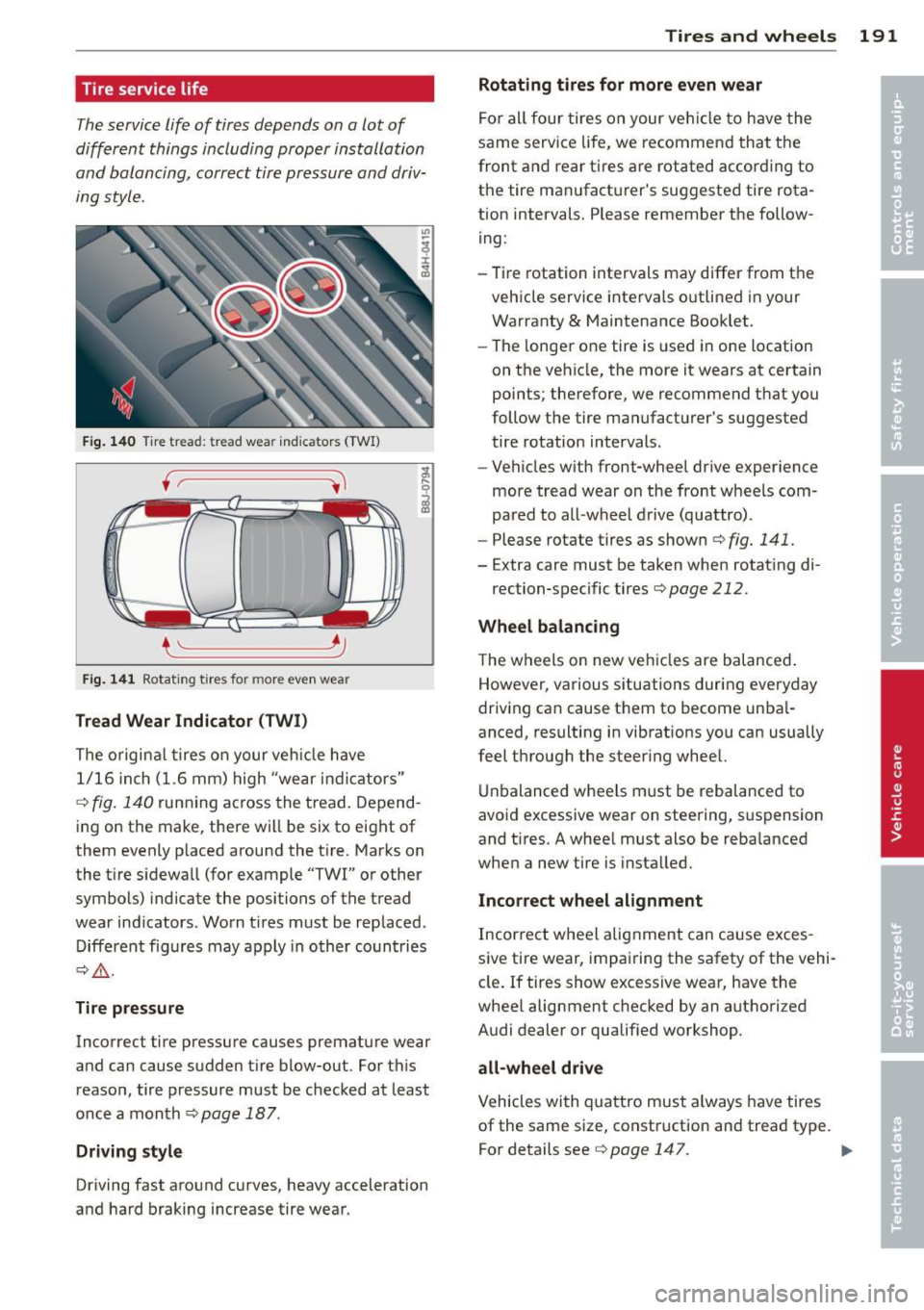
F ig. 14 0 Tire tread: tread wea r ind ica tors (TWI)
f ~----~
~ ------- .../
Fig. 141 Rotat ing t ires fo r m ore even wea r
Tread Wear Indicator (TWI)
The origina l tires on your veh icle have
1/16 in ch (1.6 mm) high "wear ind icators"
c::> fig . 140 run ning across the tread. Depend
ing on the make, there will be six to eight of
them evenly p laced around the t ire . Marks on
the t ire s idewall (for example "TWI" or other
symbols) indicate the positions of the tread
wear ind icators . Worn t ires must be replaced.
Different fig ures may apply in other countries
c::> & .
Tir e pressure
Incorrect tire pressure causes premat ure wear
and can cause sudden tire blow-out . For th is
reason, tire pressure must be checked at least
once a month
c::> page 18 7.
Dri ving sty le
Driving fast around curves , heavy acceleration
and hard braking increase tire wear.
Tires and wheels 191
Rotating tires for more even wear
For all four tires on your ve hicl e to have the
same service life, we recomme nd that the
front and rear tires are rotated according to
the tire manufacturer 's suggested tire rota
tion inte rvals. Please remember the follow
ing :
- Tire rotation intervals may differ from the
veh icle service inte rva ls o utlined in your
Warranty & Maintenance Booklet.
- The longer one tire is used in one location
on the vehicle, the more it wears at certain
points ; therefore, we recommend that you
follow the tire manufactu rer 's suggested
tire rotation intervals .
- Vehicles w ith front-wheel dr ive exper ience
more tread wear on the front wheels com
pared to all -wheel d rive (quattro) .
- Please rotate tires as shown
c::> fig. 141.
-Extra care must be taken when rotat ing di-
rection-specific tires
c::> page 212.
Wheel balancing
T he wheels on new veh icles are balanced .
However, various situations during everyday
driving can cause them to become unba l
anced, resulting in vibrat ions you can usually
feel through the steer ing wheel.
Unbalanced wheels must be rebalanced to
avoid excessive wear on steering, s uspension
and t ires. A whee l must also be reba lanced
when a new tire is insta lled.
Inco rrect wheel alignm ent
Incorrect wheel alignment can cause exces
sive tire wear, impai ring the safety of the vehi
cle . If tires show excessive wear, have the
whee l alignment checked by an authori zed
Audi dealer or qualified workshop.
all -wheel drive
Vehicles wi th quattro must always have tires
of the same size, construction and tread type. For details see
c::> page 147.
Page 205 of 244
When it i s not po ssibl e to co ntinu e
d riv ing, even with run-fl at ti res?
-If the E lectronic Stabilization Control (ESC)
is not working or keeps coming on.
- If the Tire P ressure Monitoring System does
not work .
- If the tire has been severely damaged, in a
crash, for example. The tread can separate
from a damaged tire as the whee l turns, and
hit parts of the vehicle, such as the fuel tank
filler neck, fuel lines or brake lines.
- Do not continue dr iving if severe vibration
occurs or if the tire starts to smoke because
the tire is runn ing hot .
- Do not continue driving if damage to the
tire, such as cracks in the sidewall, appears.
A WARNING
Improper use of run-flat t ires can cause
vehicle damage that can lead to loss of ve
hicle control, a crash and serious personal
injury.
- Run-flat tires can only be used with spe
c ial rims.
- Run-flat tires must always be mon itored
with a properly programmed Tire Pre
ss ure Mon itor ing System.
- Always inspect a tire that has lost air to
make su re it is safe to drive w ith the t ire
in the run-flat mode.
- Never drive with run-flat tires that have
been damaged in a collision.
- Never drive with run-flat tires if heat
build-up causes the t ire to give off
smoke.
- Never drive with run-flat tires if the vehi
cle shakes or v ibrates severely.
- Never drive with a run-flat tire that de
velops sidewall cracks or other damage
wh ile in use .
- If you switch between standard and run
flat tires, an author ized Audi dealer or
qualified wo rkshop must reprogram the
control module.
Tire s an d wheel s 203
@ Note
Run-f lat ti res have special characteristics
and requirements, that are very different
from convent ional tires. Run-flat tires re
quire special rims for run-flat use and can
not be used on conventional whee l rims .
(D Tips
- If you are not able to cont inue driving
w ith run-flat tires, please seek professio
nal ass istance.
- Please contact your authorized Audi
dealer or Aud i of America, Inc . if you
have questions about t ires and rims.
Driving with run-flat tires
Applies to veh icles: w it h Run -flat t ires
Handling characteristics change when tire
pressure is low.
Driving on tires with low tire pressure changes
the way a veh icle handles, particularly when
corner ing and braking. The handling charac
teristics of run -flat tires do not seem to
change a lot even when driving on low pres
sure or in the run-flat mode . Nevertheless you
must still take specia l precautions whe n oper
at ing a veh icle on run-flat tires when t ire pres
s u re is low o r the tire(s) is flat:
" The Electronic Stabilization Contro l (E SC)
must be switched on.
" Never drive fas ter than 50 mph (80 km/h)
q .&_ .
"Plan ahead when driving and anticipate
what you will have to do considering traffic
and road conditions up ahead.
" Accelerate carefully.
" Avo id unnecessary and sudden steering and
braking maneuvers.
" Reduce your speed in plenty of t ime before
intersections, curves and other places where
you may have to react quickly .
Please see:
q page 203, When it is not possi
ble to continue driving, even with run-flat tires?
•
•
...
Page 216 of 244
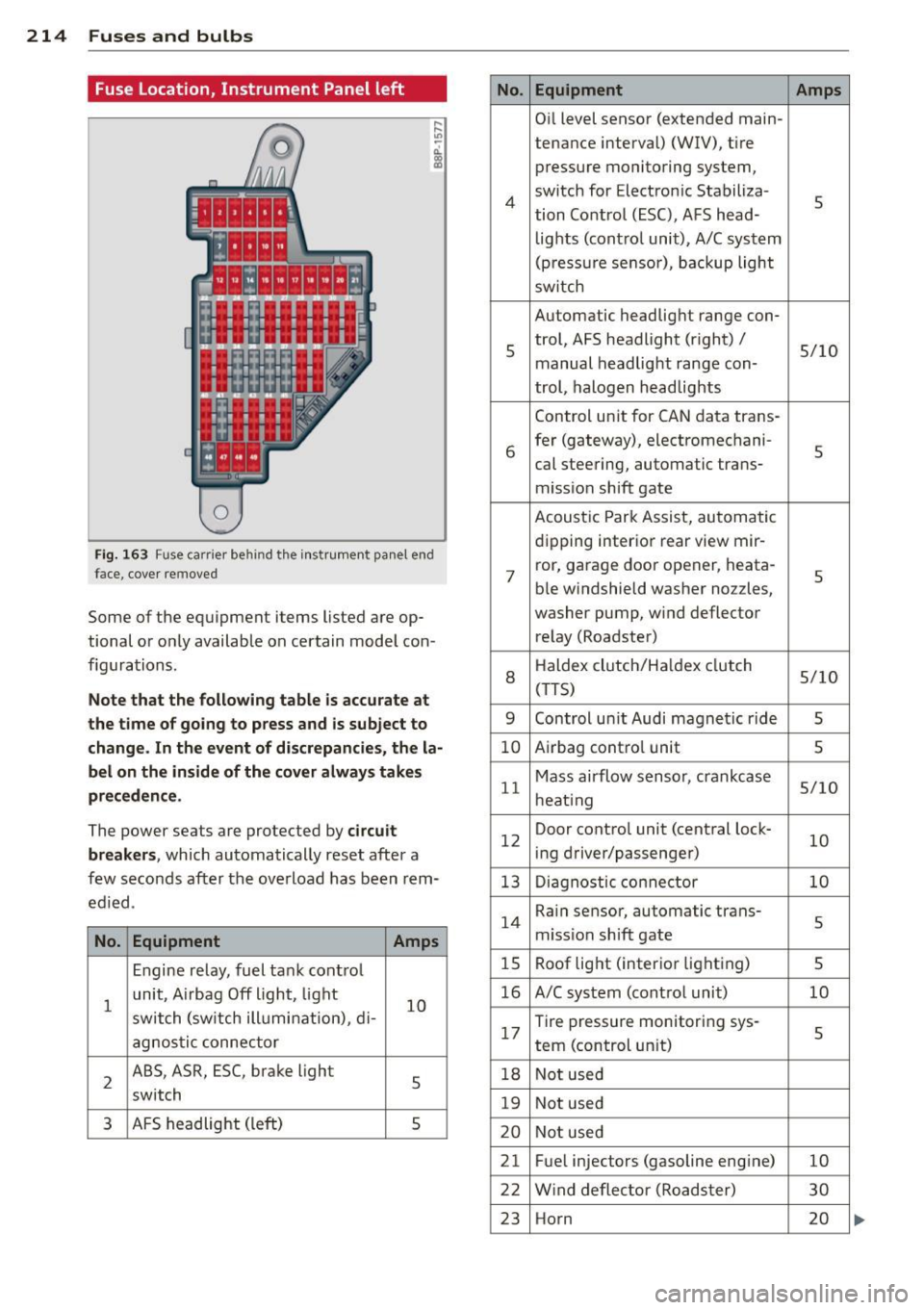
214 Fuses and bulbs
Fuse Location, Instrument Panel left
0
Fi g. 163 Fuse carrier behind the instrument panel end
face, cove r removed
Some of the equipment items listed are op
tional or only available on certain model con
figurations .
Note that the following table is accurate at
the time of going to press and is subject to
change. In the event of discrepancies, the la
bel on the inside of the cover always takes
preceden ce .
The power seats are protected by circuit
breaker s,
which automatically reset after a
few seconds after the overload has been rem
ed ied.
No . Equipment Amps
Engine relay, fuel tank control
1
unit, A irbag Off light, light
10 switch (sw itch illumination), d i-
agnos tic connector
2
ABS, ASR, ESC, brake light
5 switch
3 AFS headlight (left) s
No.
4
5
6
7
8
9
10
11
12
13
14
15
16
17
18
19
20
21
22
23
Equipment Amps
Oil level sensor (extended main-
tena nce interval) (WIV), tire
pressure monitoring system,
switch for Electronic Stabiliza-
s tion Control (ESC), AFS head-
lights (control unit), A/C system
(pressure sensor), backup light
sw itch
Automatic headlight range con-
trol, AFS headlight (right) /
5/10
manual headlight range con-
trol, halogen headlights
Control unit for CAN data trans-
fer (gateway), electromechani-
s cal steering, automatic trans-
mission shift gate
Acoustic Park Assist, automatic
dipping interior rear view mir- ror, garage door opener, heata-
s ble windshield washer nozzles,
washer pump, wind deflector
relay (Roadster)
H aldex clutch/Ha ldex clutch
5/10 (T TS)
Control un it Audi magnetic ride
s
Airbag contro l unit s
Mass airflow sensor, crankcase 5/10
heating
Door control unit (central lock-
10 ing driver/passenger)
Diagnostic connector
10
Rain sensor, automatic trans-
s miss ion shift gate
Roof light (interior lighting)
5
A/C system (control unit) 10
Tire pressure monitoring sys-
5 tern (control un it)
Not used
Not used
Not used
Fuel injectors (gasoline engine)
10
Wind deflector (Roadster) 30
Horn 20
Page 217 of 244
No. Equipment 24 Transmission (control unit)
25 Heater rear window Coupe/
heated rear window Roadster
26 Driver's side power window
27 Passenger's s ide power window
28 Not used
29 Washer pump
30 Cigarette lighter
31 Starter
32 Steering column module
33 Instrument cluster
34 Radio navigation system, radio
35 Audio amplifier
36 Engine (control un it)
37 CAN (Gateway)
38 Cigarette lighter
39 Not used
40 Not used
41 Not used
42 Not used
43 Not used
44 Not used
45 Not used
46 Not used
47 SOARS
tuner, cell phone pack-
age, TV tuner
48 VOA inte rface
49 Not used
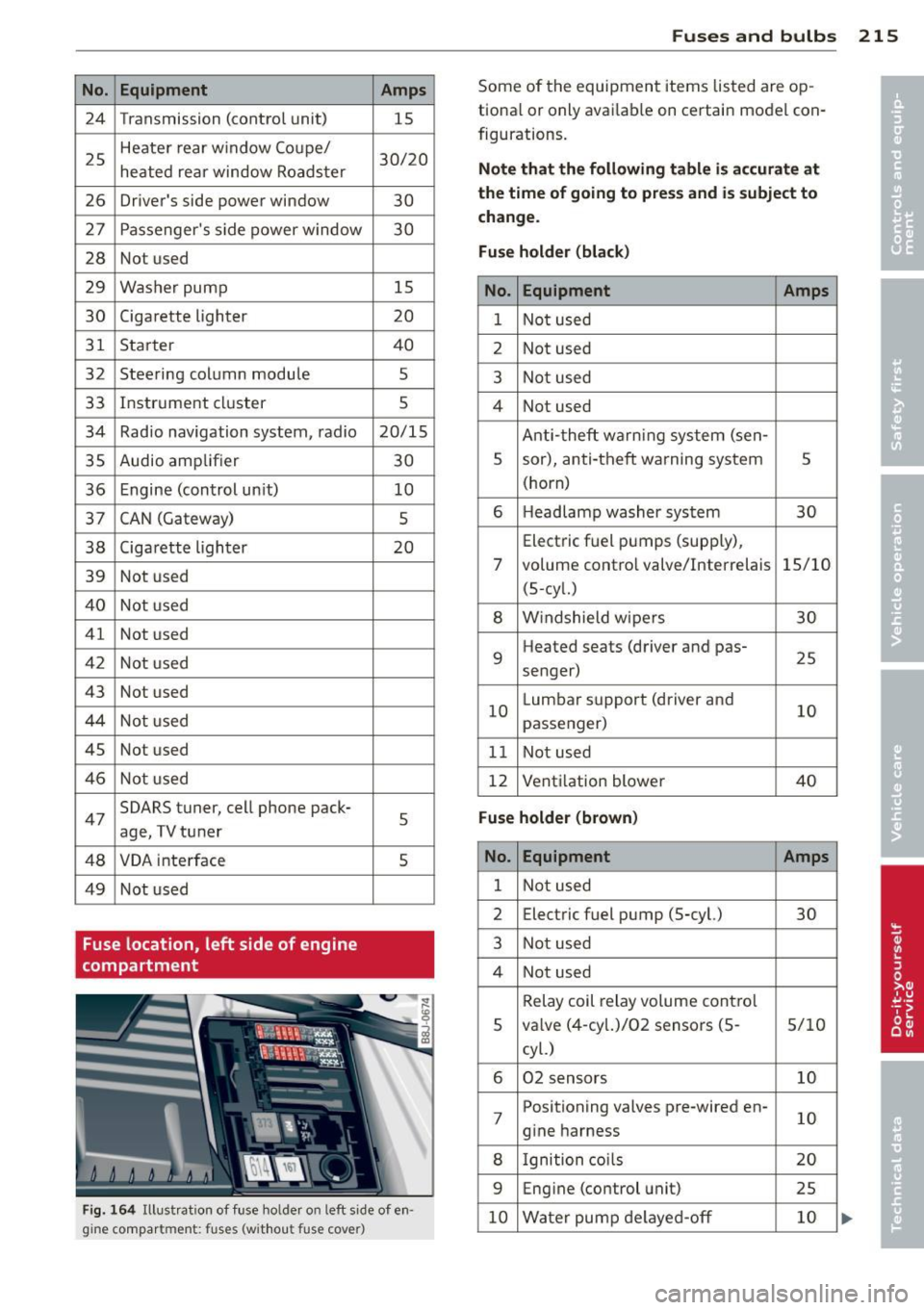
Fuse location, left side of engine
compartment Amps
15
30/20
30
30
15
20
40
5
5
20/15
30 10
5
20
5
5
Fig. 164 Illustrat ion of fuse ho lder on left side of en
gine compart ment: fuses (without fuse cover)
Fuse s and bulb s 215
Some of the equipment items listed are op
tiona l or only avai lab le on certain model con
figurations.
Note th at the foll owing t abl e is ac cur ate at
the time of going t o pre ss and i s subject to
ch ang e.
Fus e holder (bla ck )
No. Equipment Amps
1 Not used
2 Not used
3 Not used
4 Not used
Anti-theft warning system (sen-
5 sor), anti-theft warning system
5
(horn)
6 H
eadlamp washer system
30
Electric f uel pumps (supp ly),
7 volume contro l valve/Interrelais 15/10
(5-cy l.)
8 W indshield w ipers 30
9 Heated
seats (driver and pas-
25
senger)
10 L
umbar support (driver and
10
passenger)
11 Not used
12 Vent
ilation blower
40
Fu se holder (brown )
No. Equipment Amps
1 Not used
2 Electric
fuel pump (5-cyl.)
30
3 Not used
4 Not used
Relay coil relay volume cont ro l
5 va
lve (4-cy l.)/02 sensors (5 -
5/10
cyl.)
6 02 sensors 10
7 Positioning valves pre-wired en-
10
g ine harness
8 Ignition coi ls 20
9 Eng
ine (control unit)
25
10 Water pump de layed-off 10