belt AUDI TT ROADSTER 2015 User Guide
[x] Cancel search | Manufacturer: AUDI, Model Year: 2015, Model line: TT ROADSTER, Model: AUDI TT ROADSTER 2015Pages: 244, PDF Size: 60.74 MB
Page 95 of 244
~ Always keep both feet in the footwell so
that you are in control of the vehicle at all
times.
For detailed information on how to adjust the
driver's seat, see
c:> page 60.
A WARNING
Drivers who are unbelted, out of position
or too close to the airbag can be seriously
injured by an airbag as it deploys. To help
reduce the risk of serious personal injury:
- Always adjust the driver's seat and the
steering wheel so that there are at least
10 inches (25 cm) between your breast
bone and the steering wheel.
- Always adjust the driver's seat and the
steering wheel so that there are at least
4 inches (10 cm) between the knees and
the lower part of the instrument panel.
- Always hold the steering wheel on the
outside of the steering wheel rim with
your hands at the 9 o'clock and 3 o'clock positions to help reduce the risk of per
sonal injury if the driver's airbag inflates.
- Never hold the steering wheel at the
12 o'clock position or with your hands at
other positions inside the steering wheel
rim or on the steering wheel hub. Hold
ing the steering wheel the wrong way
can cause serious injuries to the hands,
arms and head if the driver's airbag in
flates
- Pointing the steering wheel toward your
face decreases the ability of the supple
mental driver's airbag to protect you in a
collision .
- Always sit in an upright position and nev
er lean against or place any part of your
body too close to the area where the air
bags are located.
- Before driving, always adjust the front
seats and head restraints properly and make sure that all passengers are prop
erly restrained.
- Never adjust the seats while the vehicle
is moving. Your seat may move unexpect-
Driving Safely 93
ed ly and you could lose control of the ve
hicle .
- Never drive with the backrest reclined or
tilted far back! The farther the backrests
are tilted back, the greater the risk of in
jury due to incorrect positioning of the safety belt and improper seating posi
tion .
- Children must always ride in child seats
c:> page 129 . Special precautions apply
when installing a child seat on the front passenger seat
c:> page 108.
Proper seating position for the front
passenger
The proper front passenger seating position
is important for safe, relaxed driving .
For your own safety and to reduce the risk of
injury in the event of an accident, we recom
mend that you adjust the seat for the front
passenger to the following position :
~ Adjust the angle of the seatback so that it is
in an upright position and your back comes
in full contact with it whenever the vehicle is
moving.
~ Adjust the head restraint so that the upper
edge is as even w ith the top of your head as
possible but not lower than eye level and so
that it is as close to the back of your head as
possible
c:> page 94.
~ Keep both feet flat on the floor in front of
the front passenger seat .
~ Fasten and wear safety belts correctly
c:> page 103.
For detailed information on how to adjust the
front passenger's seat, see
c:> page 59 .
A WARNING
Front seat passengers who are unbelted,
out of position or too close to the airbag
can be seriously injured or killed by the air
bag as it unfolds. To help reduce the risk of
serious personal injury:
•
•
Page 96 of 244
94 Driving Safely
-Passengers must always sit in an upright
position and never lean against or place
any part of their body too close to the
area where the airbags are located.
- Passengers who are unbelted, out of po
sition or too close to the airbag can be
seriously injured by an airbag as it un
folds with great force in the blink of an
eye.
- Always make sure that there are at least
10 inches (25 cm) between the front
passenger's breastbone and the instru
ment panel.
-Always make sure that there are at least
4 inches (10 cm) between the front pas senger's knees and the lower part of the
instrument panel.
- Each passenger must always sit on a seat
of their own and properly fasten and
wear the safety belt belonging to that
seat.
- Before driving, always adjust the front
passenger seat and head restraint prop
erly.
- Always keep your feet on the floor in
front of the seat. Never rest them on the
seat, instrument panel, out of the win
dow, etc. The airbag system and safety
belt will not be able to protect you prop
erly and can even increase the risk of in
jury in a crash .
- Never drive with the backrest reclined or
tilted far back! The farther the backrests
are tilted back, the greater the risk of in
jury due to incorrect positioning of the
safety belt and improper seating posi
tion.
- Children must always ride in child seats
¢
page 129. Special precautions apply
when installing a child seat on the front
passenger seat ¢
page 108.
Proper adjustment of head restraints
Correctly adjusted head restraints are an im
portant port of your vehicle's occupant re straint system and can help to reduce the risk
of injuries in occident situations.
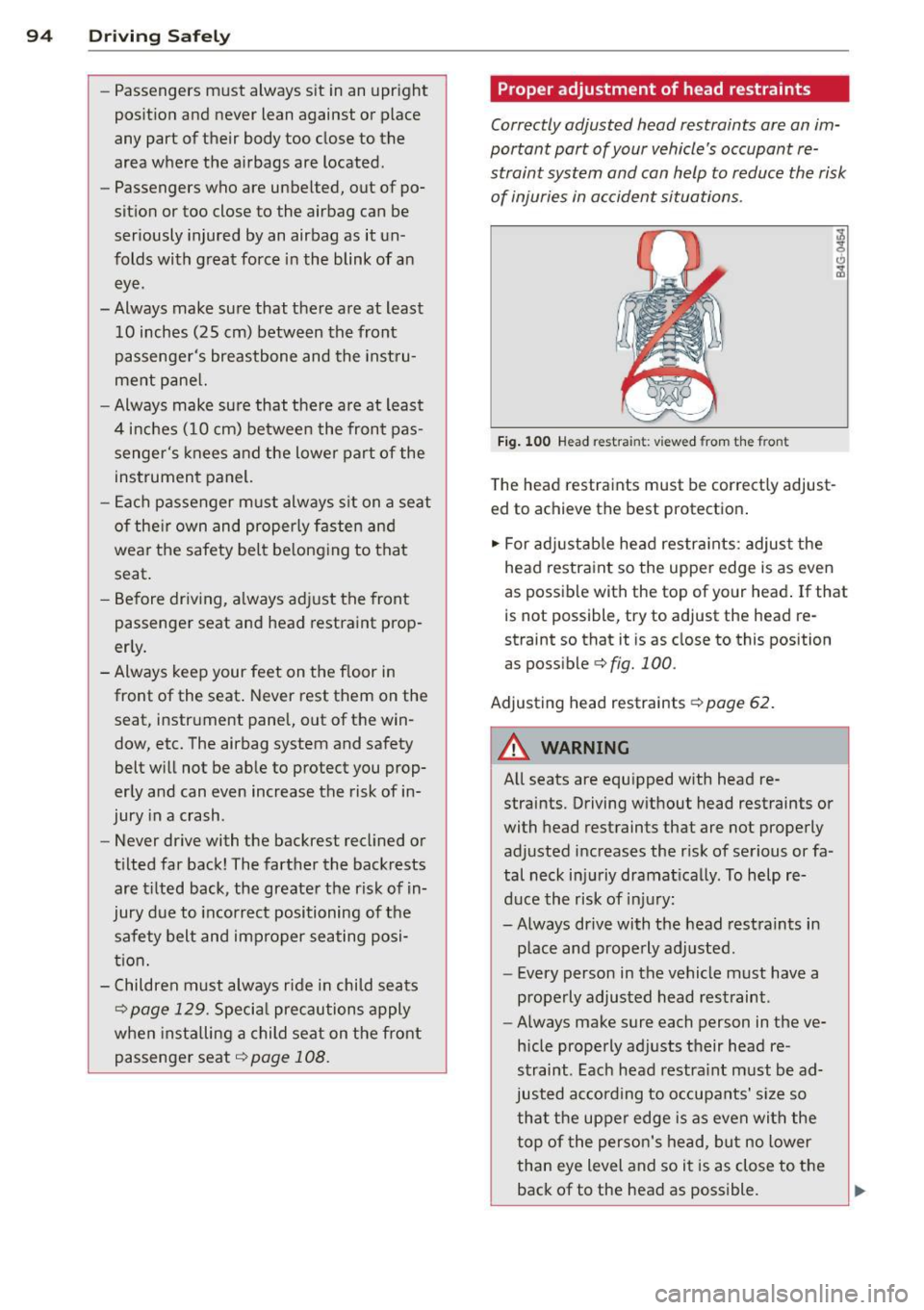
Fig. 100 Head restra int: v iewed from the front
The head restraints must be correctly adjust
ed to achieve the best protection.
" For adjustable head restraints: adjust the
head restraint so the upper edge is as even
as possible with the top of your head. If that
is not possible, try to adjust the head re
straint so that it is as close to this position
as possible¢
fig. 100.
Adjusting head restraints ¢ page 62.
A WARNING
-
All seats are equipped with head re-
straints. Driving without head restraints or
with head restraints that are not properly
adjusted increases the risk of serious or fa
tal neck injuriy dramatically . To help re
duce the risk of injury:
- Always drive with the head restraints in
place and properly adjusted.
- Every person in the vehicle must have a
properly adjusted head restraint.
- Always make sure each person in the ve
hicle properly adjusts their head re
straint . Each head restraint must be ad
justed according to occupants' size so
that the upper edge is as even with the
top of the person's head, but no lower
than eye level and so it is as close to the
back of to the head as possible.
Page 97 of 244
-Never attempt to adjust head restraint
while driving. If you have driven off and
must adjust the driver headrest for any
reason, first stop the vehicle safely be
fore attempting to adjust the head re
straint.
- Children must always be properly re
strained in a child restraint that is appro
priate for their age and size¢
page 129.
Examples of improper seating positions
The occupant restraint system can only re
duce the risk of injury if vehicle occupants are
properly seated.
Improper seating positions can cause serious
injury or death . Safety belts can only work
when they are properly positioned on the body. Improper seating positions reduce the
effectiveness of safety belts and will even in
crease the risk of injury and death by moving
the safety belt to critical areas of the body.
Improper seating positions also increase the
risk of serious injury and death when an air
bag deploys and strikes an occupant who is
not in the proper seating position. A driver is
responsible for the safety of all vehicle occu
pants and especially for children. Therefore:
.. Never allow anyone to assume an incorrect
seating position when the vehicle is being
used ¢,&. .
T he following bullets list only some sample
positions that will increase the risk of serious
injury and death. Our hope is that these exam
ples will make you more aware of seating po
sitions that are dangerous .
Therefore, whenever the vehicle is
moving :
-never stand up in the vehicle
- never stand on the seats
- never kneel on the seats
- never ride with the seatback reclined
- never lie down on the rear seat
- never lean up against the instrument panel
- never sit on the edge of the seat
- never sit sideways
Driving Safely 95
- never lean out the window
- never put your feet out the window
- never put your feet on the instrument panel
- never rest your feet on the seat cushion or
back of the seat
- never ride in the footwell
- never ride in the cargo area
A WARNING ,~
Improper seating positions increase the
risk of serious personal injury and death
whenever a vehicle is being used.
- Always make sure that all vehicle occu
pants stay in a proper seating position
and are properly restrained whenever the
vehicle is being used.
Driver and passenger
side footwell
Important safety instructions
A WARNING ~
Always make sure that the knee airbag can
inflate without interference. Objects be
tween yourself and the airbag can increase
the risk of injury in an accident by interfer
ing with the way the airbag deploys or by
being pushed into you as the airbag de
ploys.
- No persons (children) or animals should
ride in the footwell in front of the pas
senger seat. If the airbag deploys, this
can result in serious or fatal injuries.
- No objects of any kind should be carried
in the footwell area in front of the driv
er's or passenger's seat. Bulky objects
(shopping bags, for example) can ham
per or prevent proper deployment of the
airbag. Small objects can be thrown
through the vehicle if the airbag deploys
and injure you or your passengers.
-
•
•
Page 102 of 244
100 Safety belts
Safety belts
General notes
Always wear safety belts!
Wearing safe ty bel ts correctly saves lives!
This chapter exp lains why safety be lts are nec
essary, how they work and how to adjust and
wear them correctly .
.. Read a ll the information that fo llows and
heed all of the instructions and WARNINGS.
A WARNING
Not wearing safety belts or wearing them
improperly increases the risk of ser ious
personal in jury and death .
- Safety belts are the sing le most effective
means avai lab le to reduce the risk of se
r ious injury and dea th in a utomob ile acci
dents . For your protection and that of
yo ur passenge rs, always co rrectly wear
safety belts when the vehicle is moving .
- Pregnant women, injured, or physically
im paired perso ns m ust also use safety
belts . Lik e all veh icle occup ants, they are
more like ly to be ser iously injured if they
do not wea r safety be lts . The best way to
protect a fetus is to protect the mother -
throughout the entire pregnancy.
Number of seats
Your Audi TT Roadster has two seating posi tions. Each sea ting pos it ion has a sa fety be lt .
A WARNING
Not wearing safety belts or weari ng them
improperly increases the risk of ser io us
personal i njury and death.
- Never st rap more than one pe rson, in
cluding small ch ild ren, into any belt. It is
especially dange rous to place a safety
belt over a child s itting on y our lap.
- Never l et mo re peop le ride in the ve hicl e
than there are safety be lts ava ilable. -
Be s ure everyone riding in the vehicle is
properly restrained w ith a separate safe
ty belt or child restra int.
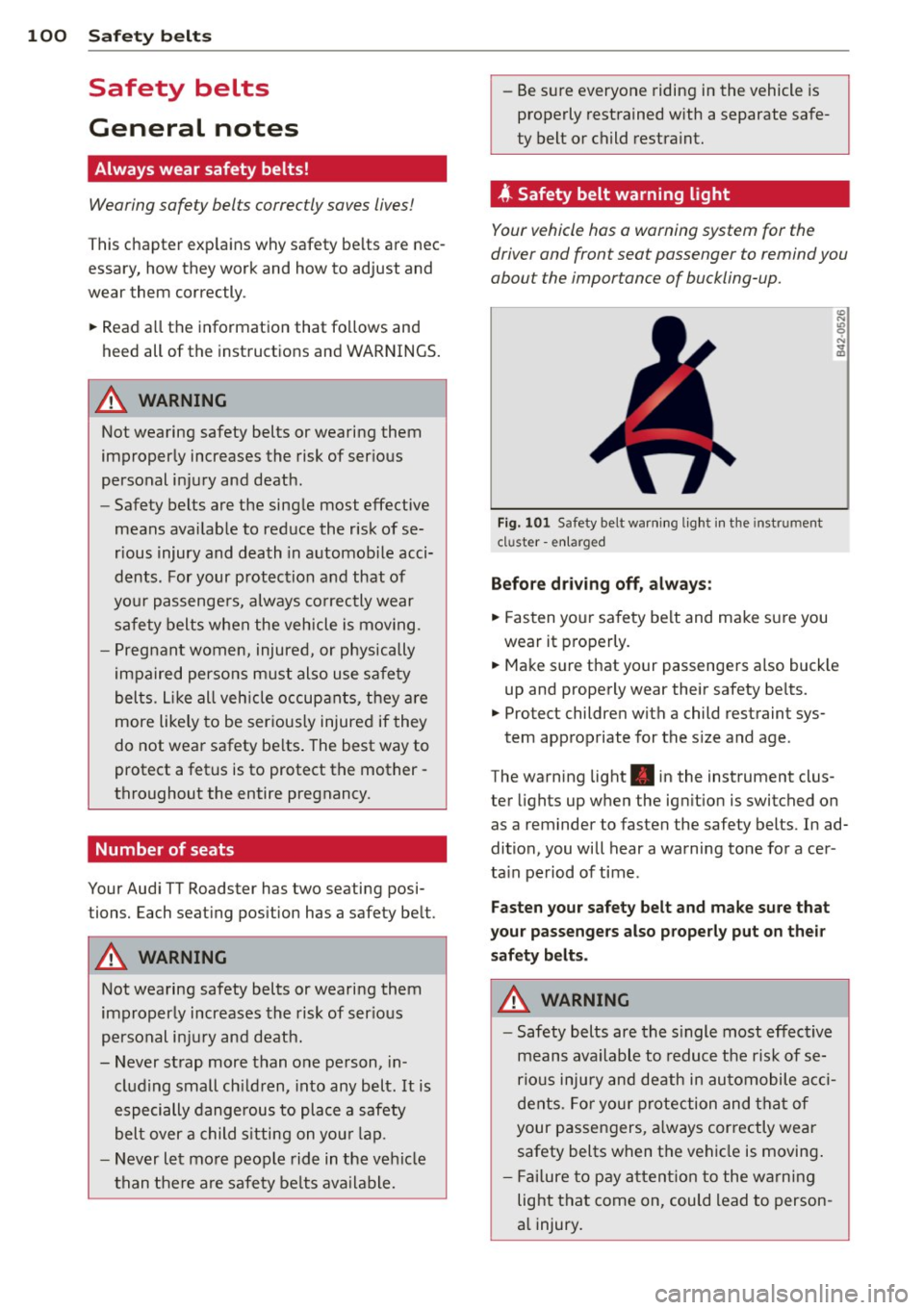
4 Safety belt warning light
Your vehicle hos o warning system for the
driver and front seat passenger to remind you
abou t the importance of buckling-up.
Fi g. 101 Safety bel t warni ng lig ht in the instr ument
cl uster -e nla rg ed
Befor e driv ing off, always:
.. Fas ten yo ur safe ty belt and make sure you
wear it properly.
.. Make s ure that your passenge rs also buck le
up and properly wear their safety be lts.
.. Protect children with a child restraint sys-
tem appropriate for the s ize and age .
T he warning light . in the instrument clus
ter lights up when the ig nition is switched on
as a reminder to fasten the safety belts . In ad
dition, you will hear a warning tone for a cer
ta in period of time .
Fasten your safety belt and make sure that
your passengers also properl y put on the ir
safety belt s.
A WARNING
-Safety belts are the s ingle most effec tive
means ava ilable to reduce the risk of se
rio us inju ry and death in au tomobile a cci
dents . Fo r you r protection and tha t of
your passengers, a lways cor rectly wear
safety belts when t he vehi cle is moving .
- F ailure to p ay a tten tion to the w arn ing
light that come on, could lead to person
a l injury.
Page 103 of 244
Why safety belts?
Frontal collisions and the law of physics
Frontal crashes create very strong forces for
people riding in vehicles .
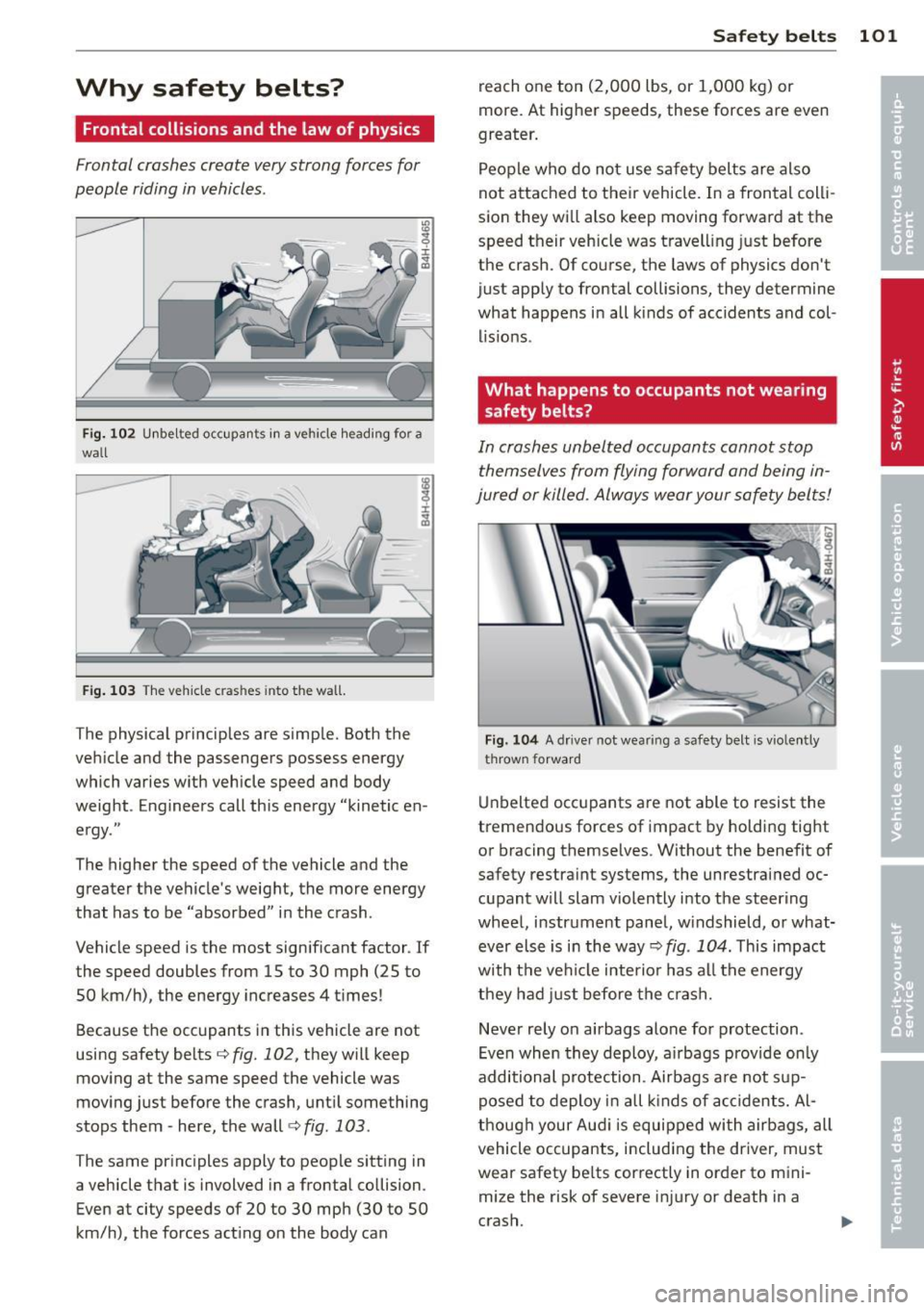
Fig. 102 Unbelted occupants in a ve hicle heading for a
wall
Fig. 103 The vehicle c ras hes into the wall.
The physical principles are simple. Both the
vehicle and the passengers possess energy
which varies with vehicle speed and body
weight . Engineers call this energy "kinetic en
ergy ."
The higher the speed of the vehicle and the greater the vehicle 's weight, the more energy
that has to be "absorbed" in the crash .
Vehicle speed is the most significant factor . If
the speed doubles from 15 to 30 mph (25 to
50 km/h) , the energy increases 4 times!
Because the occupants in this vehicle are not
using safety belts
r::;, fig. 102, they will keep
moving at the same speed the vehicle was
moving just before the crash, until something
stops them -here, the wall
c:> fig . 103 .
The same principles apply to people sitting in
a vehicle that is involved in a frontal collision .
Even at city speeds of 20 to 30 mph (30 to 50
km/h), the forces acting on the body can
Safety belts 101
reach one ton (2,000 lbs, or 1,000 kg) or
more. At higher speeds, these forces are even
greater.
People who do not use safety belts are also
not attached to their vehicle. In a frontal colli
sion they will also keep moving forward at the
speed their vehicle was travelling just before
the crash. Of course, the laws of physics don't
just apply to frontal collisions, they determine what happens in all kinds of accidents and col
lisions .
What happens to occupants not wearing
safety belts?
In crashes unbelted occupants cannot stop
themselves from flying forward and being in
jured or killed. Always wear your safety belts!
Fig. 104 A driver not wear ing a safety belt is v io len tly
thrown forward
Unbelted occupants are not able to resist the
tremendous forces of impact by holding tight
or bracing themselves . Without the benefit of
safety restraint systems, the unrestrained oc cupant will slam violently into the steering
wheel, instrument panel, windshield, or what
ever else is in the way r::;, fig . 104 . This impact
with the vehicle interior has all the energy
they had just before the crash.
Never rely on airbags alone for protection .
Even when they deploy , airbags provide only
additional protection . Airbags are not sup
posed to deploy in all kinds of accidents. Al
though your Audi is equipped with airbags, all
vehicle occupants, including the driver, must
wear safety belts correctly in order to mini
mize the risk of severe injury or death in a
crash.
Page 104 of 244
102 Safet y belt s
Remember too, that airbags wi ll deploy on ly
once and that your safety belts are always
there to offer protect ion in those accidents in
which airbag s are not suppo sed to deploy or
when they have already deployed . Unbelted
occupants can also be thrown out of the vehi
cle where even more severe o r fatal inju ries
can occu r.
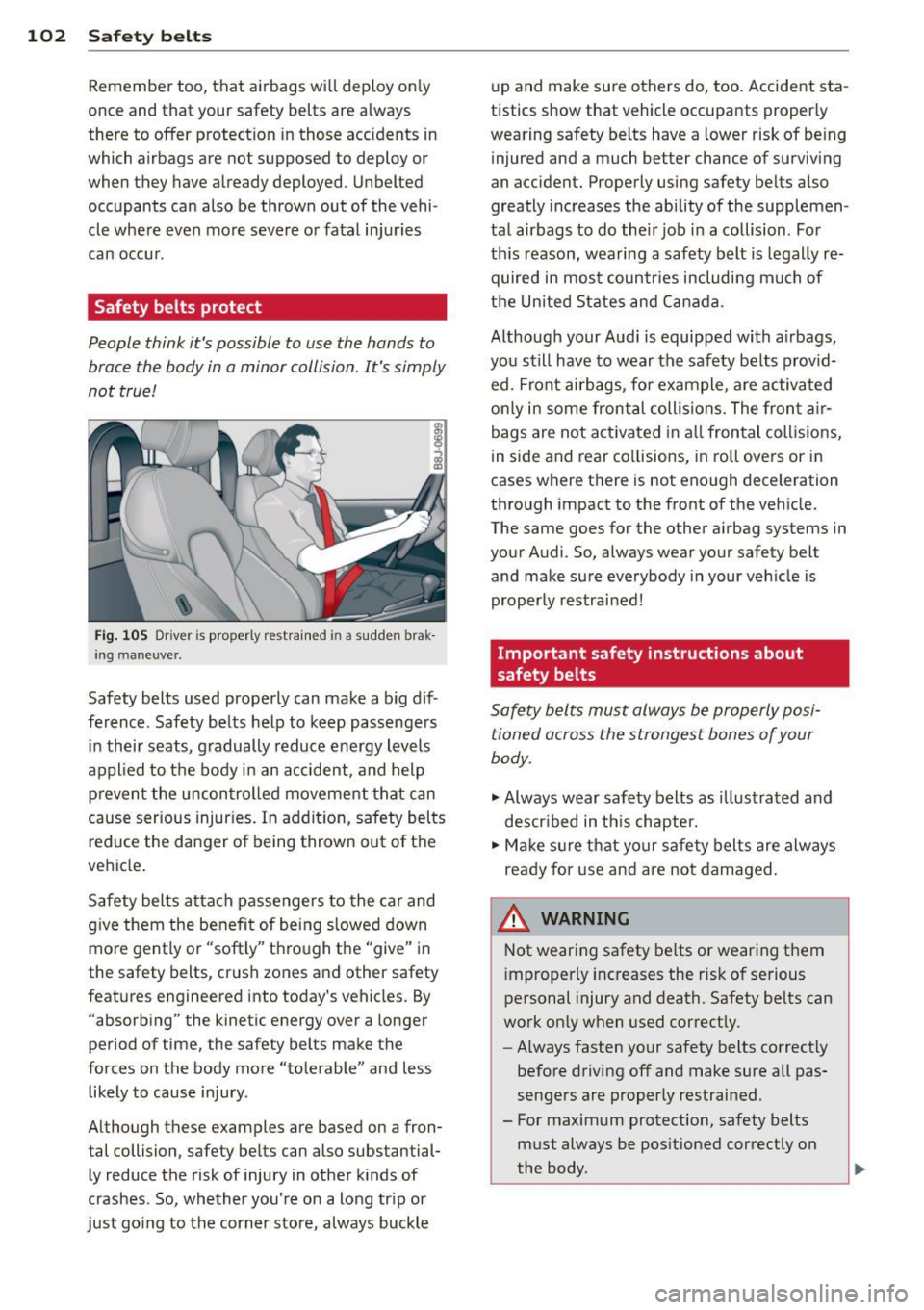
Safety belts protect
People think it's possible to use the hands to
brace the body in a minor collision. It's simply
not tru e!
Fig . 10 5 Driver is properl y re strain ed in a sudd en br ak
ing man euve r.
Safety belts used properly can make a big dif
ference . Safety be lts help to keep passengers
in their seats , g radually reduce energy levels
applied to the body in an accident, and help
preven t the uncontro lled moveme nt that can
cause serious injur ies . In additio n, safety belts
reduce the danger of being thrown out of the
ve hicle .
Safety belts attach passengers to the car and
g ive them the benefit of being s lowed down
more gently or "softly" t hrough t he "give" in
the safety belts , crush zones and other safety
fe atures engineered into today's vehicles. By
"absorb ing" the kinetic energy over a longer
period of time, the safety belts make the
forces on the body more "to lerable" and less
likely to cause injury .
Although these examples are based on a fron tal collision , safety belts can also subs tan tial
ly reduce the risk of injury in other k inds of
crashes . So, whether you' re on a long tr ip or
just going to the corner store, always buckle u
p and make sure others do, too. Accident sta
tist ics show that veh icle occupants properly
wearing safety belts have a lower risk of be ing
injured and a much better chance of surviving
an accident. Properly using safety belts also
greatly increases the ability of the supplemen
tal airbags to do the ir job i n a collision . Fo r
t hi s reason, wea ring a safety belt is legally re
quired in mos t countr ies includi ng m uch of
t h e Un ited States and Canada .
Although your Aud i is equipped wi th a irbags,
you still have to wear the safety be lts prov id
ed. Front ai rbags , fo r example , a re activated
only in some front al collisions. The fron t air
bags are not act ivated in a ll frontal coll is ions,
in side and rear co llisions, in roll overs or in
cases where there is not eno ugh deceleration
through impact to the front of the veh icle.
The same goes for the other a irbag systems in
your Aud i. So, always wear yo ur safety belt
and make su re everybody in your veh icle is
properly restrai ned!
Important safety instructions about
safety belts
Safety belts must always be properly posi
tioned across the strongest bones of your
body.
" Always wear safety belts as illust rated and
descr ibed in th is chapte r.
" Ma ke su re that yo ur safety belts are always
ready for use and are not damaged.
A WARNING
-
Not wear ing safety be lts or wearing them
i mproperly i ncreases the r is k of se rious
personal injury and death. Safety belts can
work on ly when used correctly.
- Always fasten your safety belts correct ly
befo re driving off and make sure all pas
sengers are properly restrained.
- For maximum protection, safety belts
must always be pos itioned c orrectly on
the body .
Page 105 of 244
-Never strap more than one person, in
cluding small children, into any single
safety belt.
- Never place a safety belt over a child sit
ting on your lap.
- Always keep feet in the footwell in front
of the seat while the vehicle is being driv
en.
- Never let any person ride with feet on
the instrument panel or sticking out the
window or on the seat.
- Never remove a safety belt while the ve hicle is moving. Doing so will increase
your risk of being injured or killed.
- Never wear belts twisted.
- Never wear belts over rigid or breakable
objects in or on your clothing, such as
eye glasses, pens, keys, etc., as these
may cause injury.
- Never wear the shoulder part of the belt under your arm or otherwise out of posi
tion.
- Several layers of heavy clothing may in
terfere with correct positioning of belts
and reduce their effectiveness.
- Always keep belt buckles free of anything
that may prevent the buckle from latch
ing securely .
- Never use comfort clips or devices that
create slack in the shoulder belt. Howev
er, special clips may be required for the
correct use of some child restraint sys
tems.
- Never allow safety belts to become dam
aged by being caught in door or seat hardware.
- Torn or frayed safety belts can tear and
damaged belt ha rdware can break in an
accident. Inspect belts regularly.
If web
bing, bindings, buckles, or retractors are
damaged, have belts replaced by an au
thorized Audi dealer or qualified work
shop.
- Safety belts that have been worn and
loaded in an accident must be replaced
with the correct replacement safety belt by an authorized Audi dealer or qualified
workshop . Replacement may be necessa-
Safety belts 103
ry even if damage cannot be clearly seen.
Anchorages that were loaded must also be inspected.
- Never remove, modify, disassemble, or
try to repair the safety belts yourself .
- Always keep the belts clean . Dirty be lts
may not work properly and can impair
the function of the inertia reel¢
ta
ble Cleaning interior on page 156.
Safety belts
Fastening safety belts
Seat first -everybody buckle up!
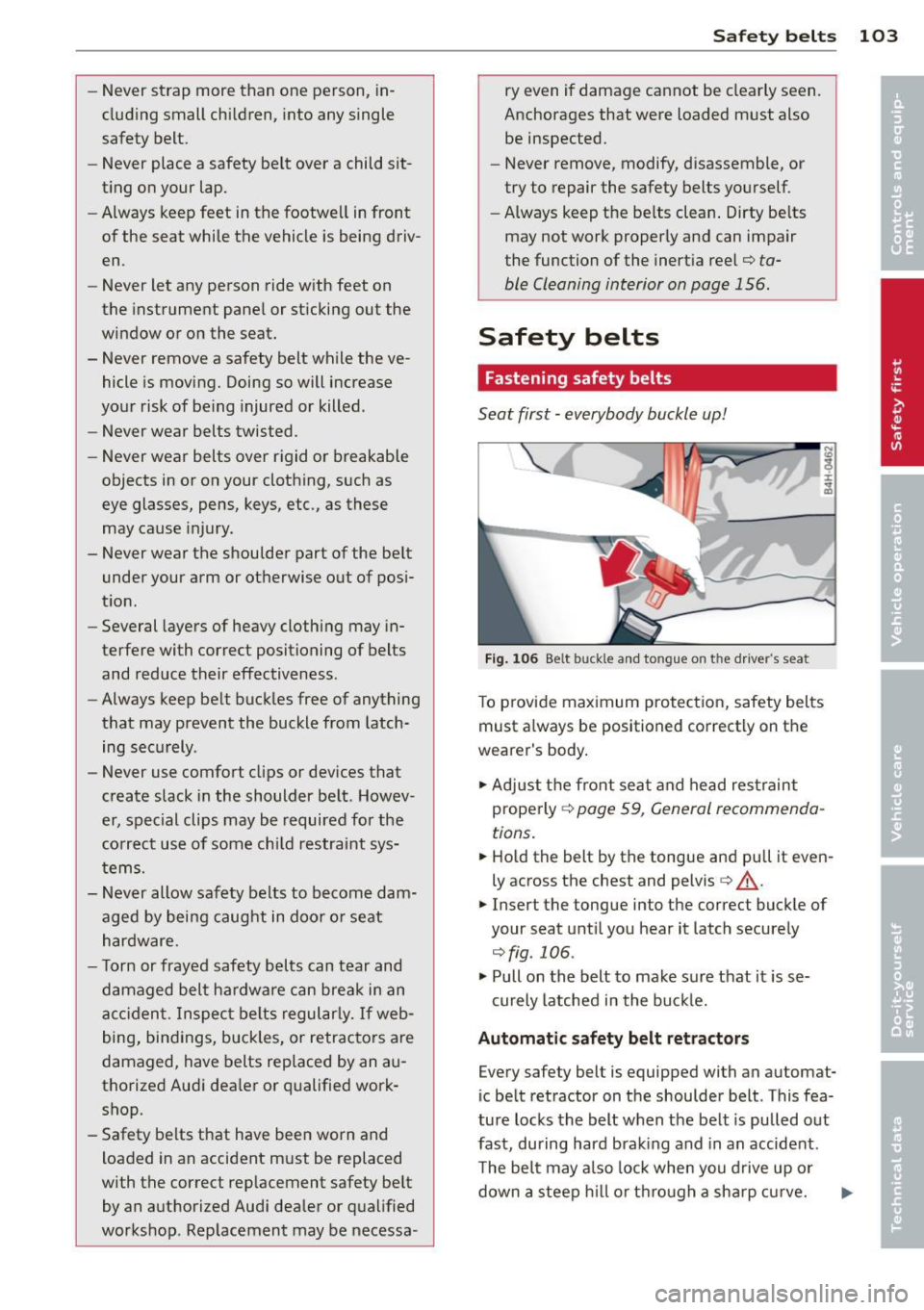
Fig. 106 Belt buck le and to ngue on t he driv er's se at
To provide maximum protection, safety belts
must always be positioned correctly on the
wearer's body.
.,. Adjust the front seat and head restraint
properly ¢
page 59, General recommenda
tions.
.,. Hold the belt by the tongue and pull it even
ly across the chest and pelvis
c:> _& .
.,. Insert the tongue into the correct buckle of
your seat until you hear it latch securely
¢fig . 106.
.,. Pull on the belt to make sure that it is se-
curely latched in the buckle.
Automatic safety belt retractors
Every safety belt is equipped with an automat
ic belt retractor on the shoulder belt . This fea
ture locks the belt when the belt is pulled out
fast, during hard braking and in an accident .
The belt may a lso lock when you drive up or
down a steep hill or through a sha rp curve.
Page 106 of 244
104 Safety belts
During normal driving the belt lets you move
freely.
Safety belt pretensioners
The safety belts are equipped with a belt pre
tensioner that helps to tighten the safety belt
and remove slack when the pretensioner is ac
tivated. The function of the pretensioner is
monitored by a warning light
q page 15.
Switchable locking feature
Every safety belt except the one on the driver
seat is equipped with a switchable locking fea
ture that
must be used when the safety belt is
used to attach a child seat. Be sure to read the
important information about this feature
¢ page 137.
.&_ WARNING
Improperly positioned safety belts can
cause serious injury in an accident
¢ page 104, Safety belt position .
-Safety belts offer optimum protection
only when the seatback is upright and
belts are properly positioned on the
body .
-
- Never attach the safety belt to the buck
le for another seat. Attaching the belt to
the wrong buckle will reduce safety belt
effectiveness and can cause serious per
sonal injury.
- A passenger who is not properly restrain
ed can be seriously injured by the safety
belt itself when it moves from the stron-
ger parts of the body into critical areas
like the abdomen.
- Always lock the convertible locking re
t ractor when you are securing a child
seat in the vehicle
q page 139.
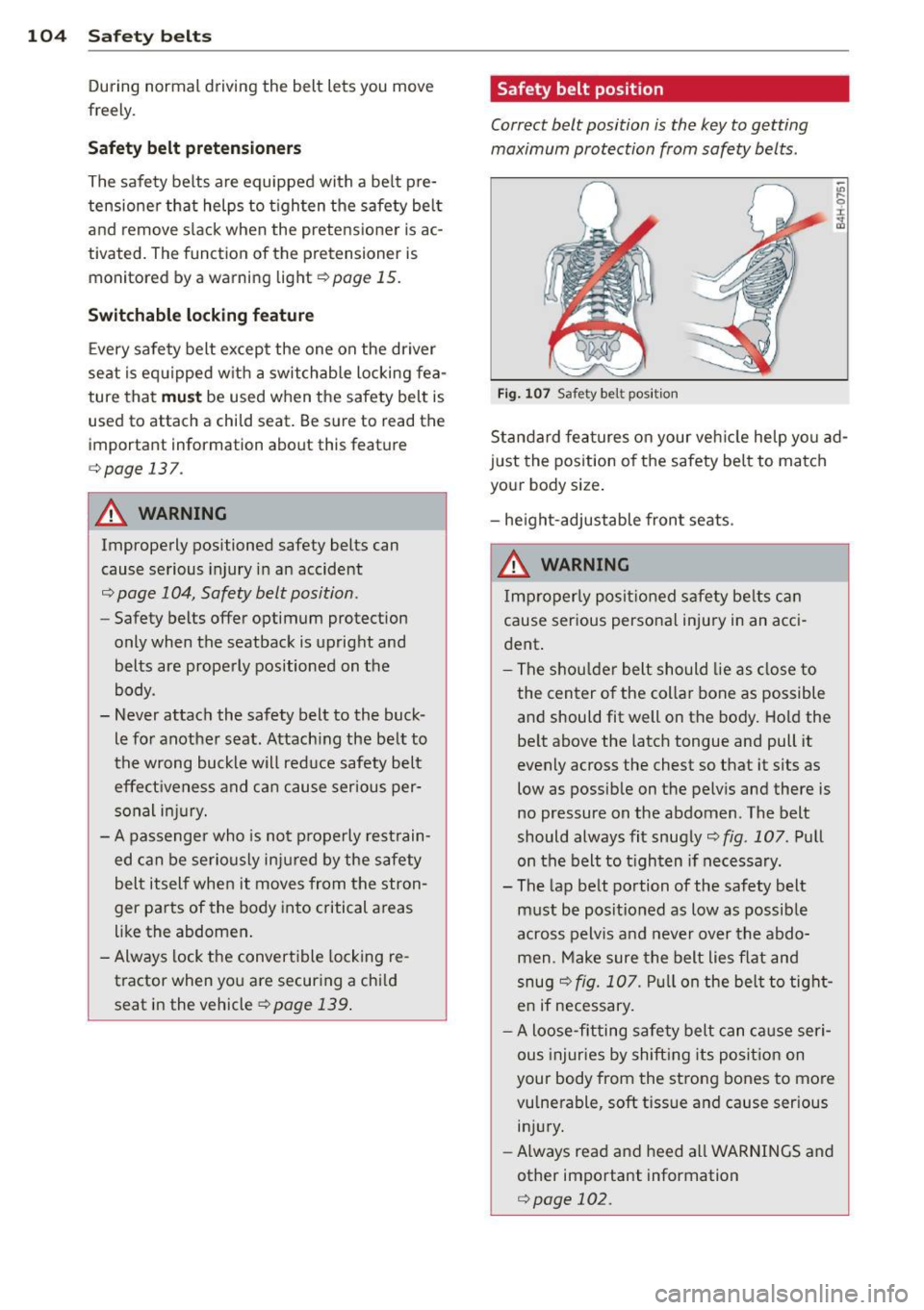
Safety belt position
Correct belt position is the key to getting
maximum protection from safety belts.
Fig. 107 Safety belt position
Standard features on your vehicle help you ad
just the position of the safety belt to match
your body size .
- height-adjustable front seats .
.&_ WARNING
Improperly positioned safety belts can
cause serious personal injury in an acci
dent.
-
- The shoulder belt should lie as close to
the center of the collar bone as possible and should fit well on the body. Hold the
belt above the latch tongue and pull it
evenly across the chest so that it sits as
low as possible on the pelvis and there is
no pressure on the abdomen . The belt
should always fit snugly
¢ fig . 10 7. Pull
on the belt to tighten if necessary .
- The lap belt portion of the safety belt
must be positioned as low as possible
across pelvis and never over the abdo
men . Make sure the belt lies flat and
snug
q fig. 107. Pull on the belt to tight
en if necessary.
- A loose-fitting safety belt can cause seri
ous injuries by shifting its position on
your body from the strong bones to more vulnerable, soft tissue and cause serious
injury.
- Always read and heed all WARNINGS and
other important information
¢page 102.
Page 107 of 244
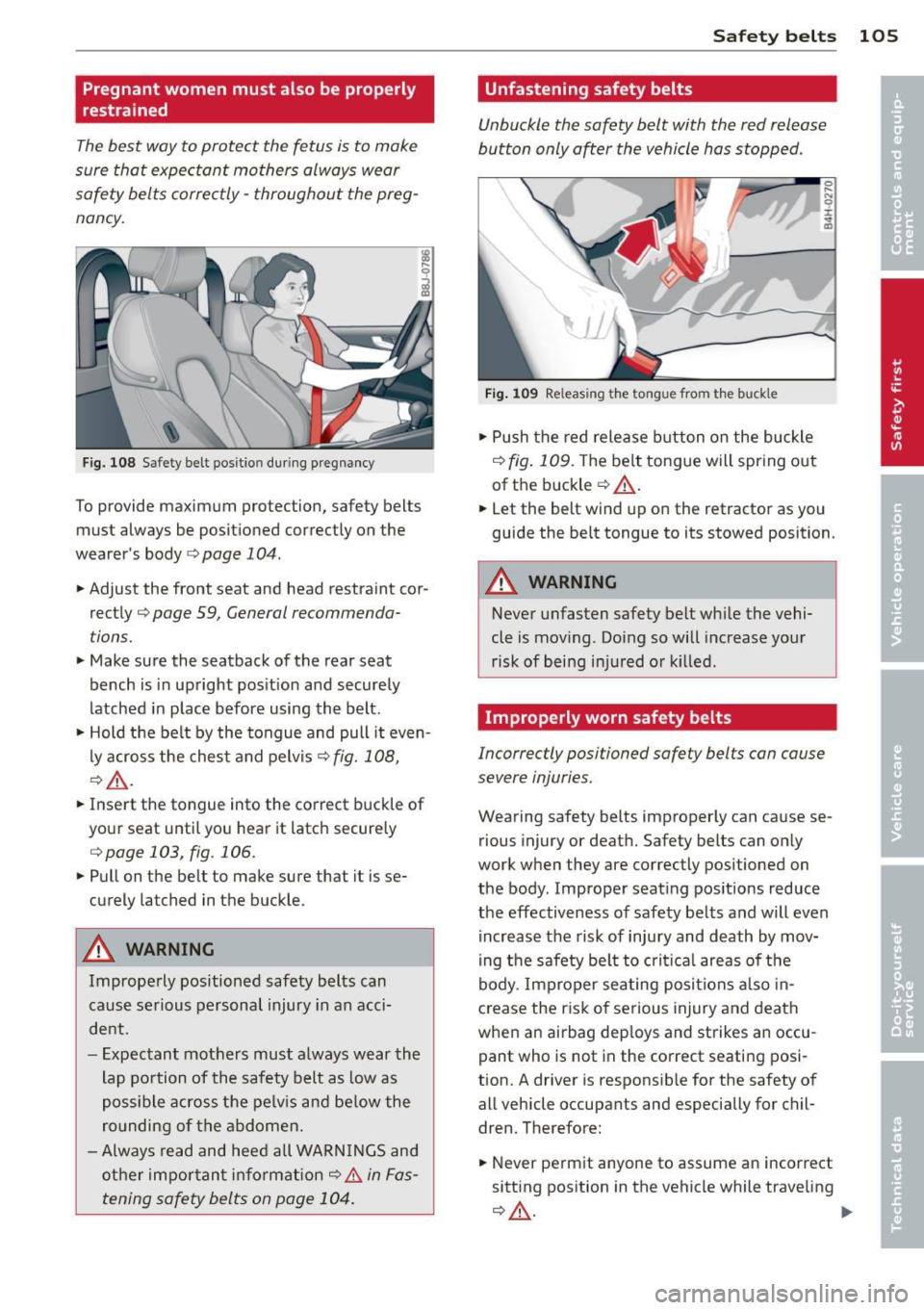
Pregnant women must also be properly
restrained
The best way to protect the fetus is to make
sure that expectant mothers always wear safety belts correctly -throughout the preg
nancy.
F ig. 108 Safety belt pos itio n during pregnancy
To provide maximum protection, safety belts
must always be posit ioned correctly on the
wearer's body
¢ page 104.
.. Adjust the front seat and head restraint cor
rect ly
¢ page 59, General recommenda
tions .
.. Make sure the seatback of the rear seat
bench is in upright pos it ion and securely
latched in place before using the belt .
.. Hold the be lt by the tongue and pull it even
ly across the chest and pelvis¢
fig. 108,
¢.&, .
.. Insert the tongue into the correct buckle of
your seat until you hear it latch securely
¢ page 103, fig . 106.
.. Pull on the belt to make sure that it is se
curely latched in the buckle .
A WARNING
Improperly positioned safety belts can
cause serious personal injury in an acci
de nt.
- Expectant mothers must always wear the
lap po rtion of the safety belt as low as
poss ible across the pe lv is and be low the
rounding of the abdomen.
- Always read and heed all WARN INGS and
other impor tan t in forma tion¢ .&.
in Fas
tening safety belts on page
104.
Safety belts 105
Unfastening safety belts
Unbuckle the safety belt with the red release
button only o~er the vehicle hos stopped .
Fig . 1 09 Releas ing the tongue from t he buck le
.. Push the red release button on the buckle
¢
fig. 109. T he be lt tongue will spring out
of the buckle ¢ .&, .
.. Let the belt wind up on the retractor as you
guide the belt tongue to its stowed position.
A WARNING
Never unfasten safety belt while the vehi
cle is mov ing . Doing so will increase your
risk of being inj ured or k illed.
Improperly worn safety belts
Incorrectly positioned safety belts can cause
severe injuries.
Wearing safety belts improperly can cause se
rious injury or death. Safety belts can only
work when they are correctly positioned on
the body . Improper seating pos itions reduce
the effectiveness of safety be lts and will even
increase the risk of injury and death by mov
ing the safety be lt to crit ica l areas of the
body. Improper seating positions a lso in
crease the risk of serious injury and death
when an airbag dep loys and strikes an occu
pant who is not in the correct seati ng posi
tion. A driver is respons ible for the safety of
all vehicle occupants and especially for chil
dren. Therefore:
.. Never permit anyone to assume an incorrect
sitting position in the vehicle while traveling
¢ .&, .
~
Page 108 of 244

106 Safety belts
_& WARNING
Improperly worn safety belts increase the
risk of serious personal injury and death
whenever a veh icle is being used .
- Always make sure that all vehicle occu-
pants are cor rect ly restrained and stay in
a correct seating posit ion whenever the
vehicle is be ing used.
- Always read and heed all WARNINGS and
other important informat ion
c::>page 102.
Safety belt preten
sioners
How safety belt pretensioners work
In front and side collisions above a particular
severity , safety belts in use are tensioned au
tomatically .
The safe ty belts are equippe d with safety be lt
pretensioners. The sys tem is activated by sen
sors in front and side collisions of great se
verity. This tightens the belt and takes up belt
slack
c::> .&. in Service and disposal of safety
belt pretensioner on page 106.
Tak ing up the
slack helps to reduce forward occupant move
ment during a co llision .
(D Tips
The safety be lt pretensioner can only be
activated once.
- In m inor frontal and side coll isions, in
rear-end collisions, in a rollover and in
accidents involving very little impact
fo rce , the safety belt pretens io ner are
not act ivated.
- When the safety be lt pretensioner is ac
tivated, a fine dust is released . This is
no rma l and is not caused by a fi re in the
vehicle.
- The rel eva nt safety requirements must
be obse rved when t he vehicle or compo
nen ts of the system are scr ap ped . A
q ualified dea le rship is famili ar wi th
these re gulations and w ill be pleased to
p ass on the informat io n to you. - Be sure to observe all safety, env
iron
menta l and other regu lations if the ve hi
cle or individual parts of the system, par
ticu larly the safety belt or airbag, are to
be disposed. We recommend you have
your authorized Audi dealer perform this service fo r you.
Service and disposal of safety belt
pretensioner
T he safety belt pretens ioners a re parts o f the
safety belts on your Audi . Insta lling, remov
ing, servicing or repairing of be lt pretension
ers can damage the safety belt system and
prevent it from working correctly in a co lli
s io n.
There are some important t hings yo u have to
know to make sure that the effectiveness o f
the system w ill not be impaired and that dis
ca rded components do not cause injury o r pol
l u te the environment .
_& WARNING
-Improper care, serv ic ing and repair p roce-
dur es ca n increase the risk of pe rsonal in
jur y and death by prevent ing a safety belt
pr etensioner from activ at ing w hen neede d
or ac tiva ting i t unexpectedly:
- T he belt pretensione r system can be a ct i
vated only once . If be lt pre tensioners
have been activated , the system m ust be
replaced .
- Never repair, adjus t, or change any parts
of the safety be lt system .
- Safety belt systems incl uding safety belt
p retens ioners cannot be repaired. Spe
cial procedures are require d for removal,
installation and disposa l of th is system.
- For any wo rk on the safety belt system,
we strong ly recommend t hat you see
your author ized Audi dealer or qualified
technician who has an Audi approved re pa ir manua l, train ing and special eq uip
ment necessary.