steering wheel AUDI TT ROADSTER 2015 User Guide
[x] Cancel search | Manufacturer: AUDI, Model Year: 2015, Model line: TT ROADSTER, Model: AUDI TT ROADSTER 2015Pages: 244, PDF Size: 60.74 MB
Page 111 of 244
angle of impact that will always trigger the
airbags, since the circumstances will vary con
siderably between one collision and another.
Important factors include, for example, the nature (hard or soft) of the object which the
car hits, the angle of impact, vehicle speed,
etc. The front airbags will also not inflate in
side or rear collisions, or in ro ll-overs .
A lwa ys
rem ember : Airbags will deploy only
once, and only in certa in kinds of collisions .
Your safety belts are always there to offer pro
tection in those s ituations in which airbags
are not supposed to deploy , or when they have
a lready deployed ; fo r example , when yo ur ve
h icle strikes or is struck by another after the
first collision .
This is just one of the reasons why an a irbag is
a supplementary restra int and is not a s ubst i
tute for a safety belt . The airbag system
works most effectively when used with the
safety belts. Therefore, always properly wear
your safety belts
¢ page 100.
A WARNING
Sitting too close to the steer ing wheel or
instrument panel will decrease the effec
tiveness of the airbags and will increase
the risk of pe rsonal injury in a co llision .
- Never sit closer than 10 inches (25 cm)
to the stee ring wheel or instrument pan
el.
- If you cannot sit more than 10 inches
(25 cm) from the steer ing whee l, investi
gate whether adaptive equipment may
be available to held you reach the pedals
and increase your seating dis tance from
the steering wheel.
- If you are unrestrained, lean ing fo rward,
sitting sideways or out of position in any
way, yo ur risk of inj ury is much highe r.
- You w il l also receive serio us inju ries and
cou ld even be killed if you are up against
the airbag or too close to it when it in
flates -even with an Advanced Airbag.
- To reduce the r isk o f injury when an air
bag inflates, a lways wear safety belts
proper ly ¢
page 103, Safety belts .
Airbag sys tem 109
-If ch ildren are not prope rly restrained,
they may be severely injured or killed
when an airbag inflates.
- Never let ch ildren ride unrestra ined or
improperly restrained in the vehicle. Ad
just the front seats properly.
- Always sit as far as possible from the steer ing whee l or the instrument panel
¢ page 92, Proper occupant seating po
sitions.
- Always sit upright with your back against
the backrest of your seat.
- Never p lace your feet on the instrument
panel or on t he seat. Always keep both
feet on the f loor in front of the seat to
help prevent serious in ju ries to the legs
a nd hips if the airbag inflates.
A WARNING
A irbags that have deployed in a crash must
be replaced.
- Use on ly orig inal equipment airbags ap
proved by Aud i and i nstalled by a trai ned
technician who has the ne cessary too ls
and d iagnost ic equipment to properly re
place any airbag in your vehicle and as
sure system effectiveness in a crash.
- Never perm it salvaged or recycled air
bags to be installed in you r vehicle .
Child restraints on the front seat - some
important things to know
.. Be s ure to read the important in forma tion
and head the WARNINGS for important de
tails about ch ildren and Advanced A irbags
¢ page 129.
The airbag on the passenger side makes the
front seat a pote ntially dange rous place for a
c hi ld to ride . The front seat is not the safest
pla ce for a child in a fo rward-facing child safe
ty seat.
It can be a very d angerous place for a n
infant or a chi ld in a rearwa rd -fa cing seat.
The Advanced A irbag System in you r vehicle
has been ce rtified to comply wit h the Require
ments of United States Fede ral Motor Vehicle
1111>
•
•
Page 114 of 244
112 Airbag system
Front airbags
Description of front airbags
The airbag system can provide supplemental
protection to properly restrained front seat occupants.
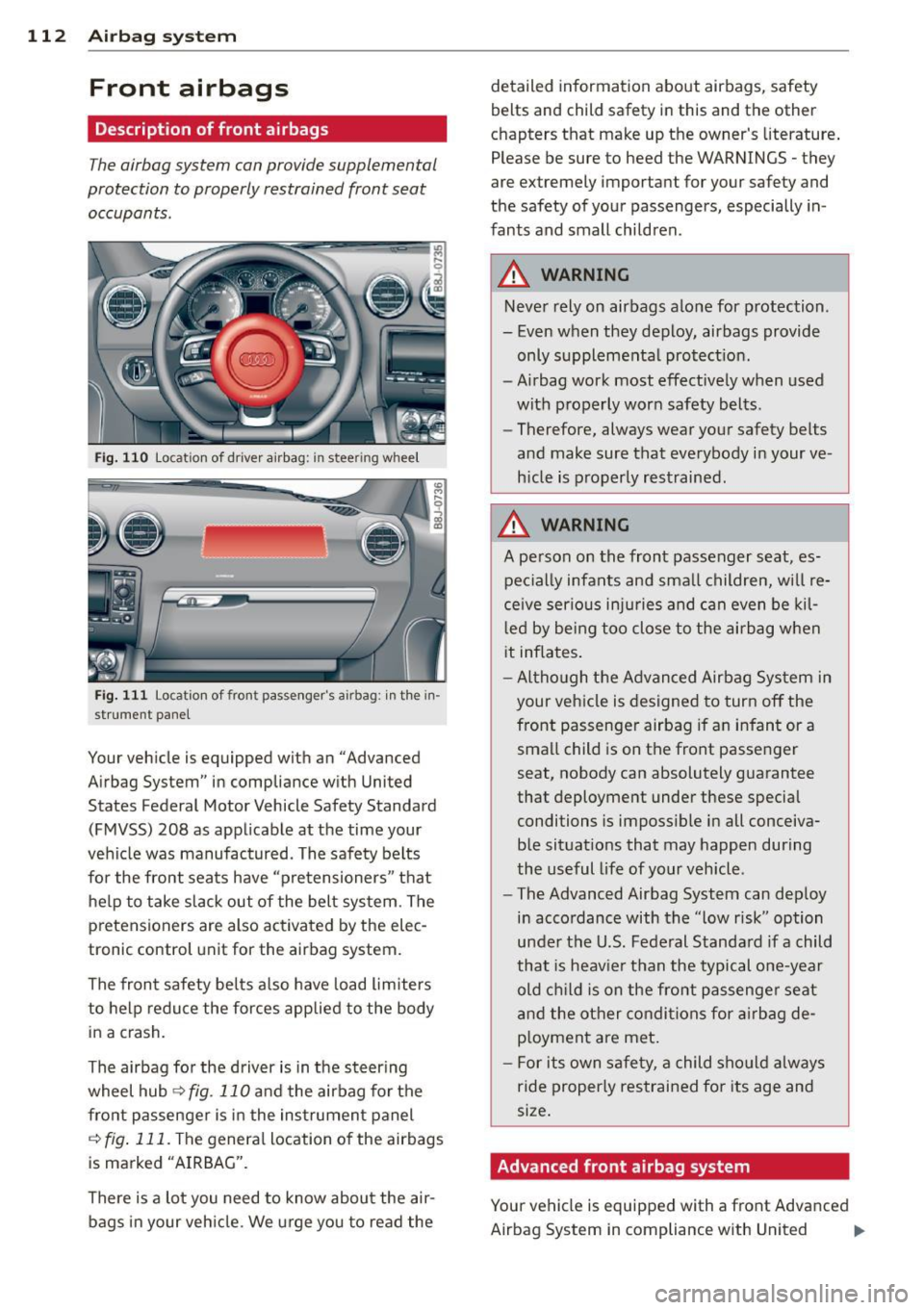
Fig . 110 Locat ion of driver airbag: in steering wheel
Fig. 111 Locatio n of front passenger 's ai rbag: in t he in·
strument panel
Your vehicle is equipped with an "Advanced
Airbag System" in compliance with United
States Federal Motor Vehicle Safety Standard
(FMVSS) 208 as applicable at the time your
vehicle was manufactured . The safety belts
for the front seats have "pretensioners" that
help to take slack out of the belt system. The
pretensioners are also activated by the elec·
tronic control unit for the airbag system.
The front safety belts also have load limiters
to help reduce the forces applied to the body in a crash.
The airbag for the driver is in the steer ing
wheel hub ¢
fig. 110 and the airbag for the
front passenger is in the instrument panel
¢
fig . 111. The general location of the airbags
is marked "AIRBAG".
There is a lot you need to know about the air
bags in your vehicle. We urge you to read the detailed information abo
ut airbags, safety
belts and child safety in this and the other
chapters that make up the owner's literature .
P lease be sure to heed the WARNINGS -they
are extremely important for your safety and
the safety of your passengers, especially in
fants and small children .
A WARNING
Never rely on airbags alone for protection .
- Even when they deploy, airbags provide only supplemental protect ion.
- Airbag work most effective ly when used
with properly worn safety belts.
- Therefore, always wear your safety belts
and make sure that eve rybody in your ve
h icle is p roperly restrained.
A WARNING
A person on the front passenger seat, es
pec ially infants and sma ll children, w ill re
ceive serious injuries and can even be kil
l ed by be ing too close to the airbag when
i t inflates .
- Al tho ugh the Advanced Airbag System in
your veh icle is designed to tur n
off the
front passenger airbag if an infant or a
small child is on the front passenger
seat, nobody can absolutely guarantee
that deployment under these special
conditions is impossible in all conceiva
b le situations that may happen during
the useful life of your vehicle .
- The Advanced Airbag System can dep loy
in accordance with the "low risk" option
under the U.S . Federal Standa rd if a child
that is heav ie r th an the typical one-year
old ch ild is on the front passenger seat
and the other condi tions for a irbag de
p loyment are met .
- F or its own safe ty, a child sho uld always
ride properly restrained for its age and
size .
Advanced front airbag system
-
Your vehicle is equipped with a front Advanced
Airbag System in compliance with United ..,_
Page 120 of 244
118 Airbag sys te m
- The inflating airba g will hit the child
safety seat or infant carri er w it h great
force and w ill smash the ch ild safety seat
and child against the backrest, cente r
arm r est, door or ro of.
- Ne ver install a r earward facing child
sa fety seat on the fro nt passenger seat
unl ess the
PASSENGER AIR BAG OFF
ligh t co me s on and stays on. If the PA S
SENGER AIR BAG OFF
ligh t does no t
come on and stay on, the inflating airbag
will hit the child safety seat or infant car
rier with great force and will smash the
child safety seat and child against the
backrest, door or roof. Have the airbag
system inspected immediately by your
authorized Audi dealer .
A WARNING
Objects between you and the a irbag will
increase the risk of injury in a crash by in
terfering with the way the airbag unfolds
or by being pushed into you as the a irbag
inflates.
- Never hold th ings in your hands or on
yo ur lap when the vehicle is in use.
- Never transport items on or in the area
of the front passenge r seat. Objects
c ou ld move into the area of the front air
bags dur ing braking or other s udden ma
neuver and become dange rous projec
tiles that can cause serious personal in
jury if the airbags inflate.
- Never place o r attach accessories or oth
er objects (such as cup ho lders, tele
phone brackets, large, heavy or b ulky ob
jects) on the doors, over or near the area
marked "AIRBAG" on the steering wheel,
instrument panel, seat backrests or be
tween those a reas and yourself. These
objects co uld cause injury in a crash, es
pecially when the airbags inflate.
- Never recline the front passenger's seat
to transport objects. Items can also
move in to the area o f the side airb ag or
the front airbag dur ing braking or in a
sudden maneuver. Objects near the air -
-
bags can become projectiles and cause
inju ry, partic ularly when the seat is re
clined.
A WARNING
The fine dust created when airbags deploy
can cause breathing prob lems for people
with a history of asthma or other breath
i ng cond itions.
- To reduce the risk of breath ing problems,
those with asthma o r othe r respiratory
conditions shou ld get fresh air righ t
away by getting o ut of the ve hicle or
open ing win dows or doors.
- I f you are i n a collision in which airbags
deploy, wash your hands and fa ce with
mild soap and wate r before ea ting.
- Be ca reful not to get the dust into your
eyes, o r into any c uts or s cratches.
- If the res id ue should get into your eyes,
flush them w ith wate r.
Monitoring the
Advanced Airbag System
tii Airbag monitoring indicator light
Two separate indicators monitor the function
of the Advan ced Airbag Sy stem: the airbag
monitoring indicator light and the
PASSEN
GER AIR BAG OFF
light.
T he Advanced A irbag Sys tem ( incl uding the
ele ctron ic cont rol unit, sensor circ uits and sys
tem wir ing) is monitored continuously to
make sure that it is functioning properly
whenever the ignition is on. Eac h time you
turn on the ignition, the a irbag monitoring in
dicator light . will come on for a few sec
onds (self diagnostics).
The system must be inspected when the
i ndicator light•=
-does not come on when the ignition is
sw itched on,
- does not go out a few seconds after you
have switched on the ignit ion, or
Page 123 of 244
-If you must install a rearward facing
child safety seat on the front passenger
seat because of exceptional circumstan ces and the
PA SSE NGER AI R BAG OFF
light does not appear and stay on have
the a irbag system inspected by your Audi
dealer.
- A tight tether or other strap on a rear
ward-fac ing child restra int attached to
the front passenger seat can put too much pressure on the weight-sens ing
mat in the seat and register more weight
than is actually on the seat. The heavier
weight registered can make the system
work as though an adu lt were on the seat
and deploy the Advanced Airbag when it
must be suppressed caus ing serious or
even fatal injury to the child .
- If, in exceptional circ umstances, you
must install a forward-facing child re
st raint on the front passenger seat, a l
ways move the seat into its rearmost po
sit ion in the seat's fo re and aft adjust
ment range, as far away from the airb ag
as possib le . The backrest m ust be adjust
ed to an upright position. Make sure that
the
PASSENGER AIR BAG OFF light
comes on and stays on all the t ime when
ever the ignition is switched on.
A WARNING
- If the PASSENGER AIR BAG OFF light
does not go out when an adult is sitting
on the front passenger seat after taking
the steps described above, have the air
bag system inspected by your Aud i deal
er before transporting anyone on the
front passenger seat.
(Di Tips
If the weight-sensing mat in the front pas
senger seat detects an empty seat, the
front airbag on the pa ssenge r side will be
t urned off, and
PASSENGER AIR BAG OFF
w ill stay on .
Airbag system 12 1
Repair, care and disposal of the airbags
Parts of the airbag system are i nstalled at
many diffe rent p laces o n your Aud i. Insta llin g,
removing, servicing or repa iring a part in an
area of the vehicle can damage a part of an
airbag system and prevent that system from
working properly in a coll is ion.
T he re a re some important t hings you have to
know to make sure that the effectiveness o f
the system wi ll not be impaired and that dis
carded components do not cause injury or pol
lute the environment.
A WARNING
Improper care, serv ic ing and repair proce
dures can increase the risk of personal in
jury and death by preventing an a irbag
from deploying when needed or deploying
an a irbag unexpec tedly:
- Never cover, obst ruct, or change the
steer ing whee l horn pad or airbag cover
or the inst rument panel or mod ify them
in any w ay .
- Never attach any objects s uch as c up
holders or telephone mountings to the
surfaces covering the a irbag un its .
- For cleaning the horn pad or instr ument
panel, use only a soft, dry cloth or one
mo istened with pla in water. Solvents or
cleaners could damage the airbag cover
or change the st iffness or strength of the
material so that the airbag cannot de
ploy and protect properly.
- Never repair, adjust, or change any parts
of the a irbag system.
- All work on the steering wheel, instru
ment panel, front seats or e lectr ica l sys
tem (including the installation of audio
equ ipment, cellular telephones and CB
radios, etc.) must be performed by a
qualified technic ian who has the training
and specia l equipment necessary.
- For any work on the airbag system, we
strongly recommend that you see your
author ized Audi dealer or qualified work-
shop.
~
•
•
Page 126 of 244
124 Airbag system
-in the event of a system malfunction (warn
ing/indicator light is on )
r=:> page 15.
.&_ WARNING
-Safety belts and the airbag system can
only provide protection when occupants
are in the proper seating position
¢page 117.
-If the airbag indicator light comes when
the vehicle is being used, have the sys
tem inspected immediately by your au
tho rized Aud i deale r.
How knee airbags work
The risk of injury to the leg area can be re
duced by fully inflated knee airbags.
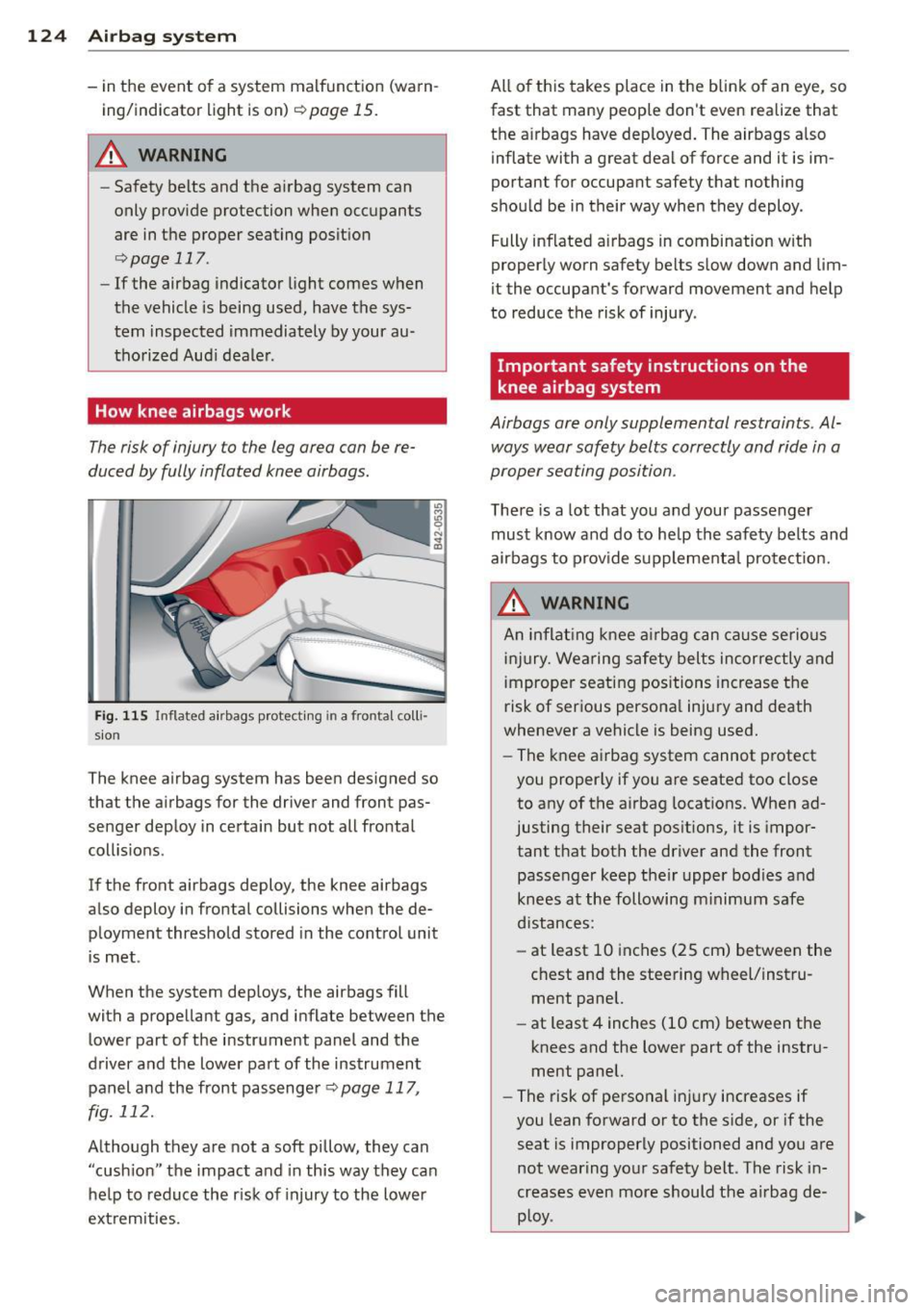
F ig . 115 Inflated a irbags p rotecti ng in a fro ntal coll i
s ion
The knee airbag system has been designed so
that the airbags for the driver and front pas
senger deploy in certain but not all frontal
coll is ions.
If the front airbags deploy, the knee airbags
also deploy in frontal collisions when the de p loyment threshold stored in the control unit
i s met.
When the system dep loys, the airbags fill
with a propellant gas, and inflate between the lower part of the instrument panel and the
d river and the lower part of the instrument
panel and the front passenge r<=>
page 117,
fig. 112.
Although they are not a soft pillow, they can
"cush ion" the impact and in this way they can
he lp to reduce the r isk of injury to the lowe r
extremities. All o
f th is takes place in the b link o f an eye, so
fast that many peop le don't even realize that
the a irbags have deployed. The airbags a lso
inflate with a great deal of force and it is im
portant for occupant safety that nothing
shou ld be in their way when they deploy.
Fully inflated a irbags in combination with
proper ly worn safety belts s low down and lim
it the occupant's forward movement and help
to reduce the risk of injury .
Important safety instructions on the
knee airbag system
Airbags are only supplemental restraints . Al
ways wear safety belts correctly and ride in a
proper seating position.
The re is a lot that you and you r passenger
must know and do to he lp the safety belts and
airbags to prov ide s upplemen ta l pro te ct io n .
.&_ WARNING
An inflat ing knee a irbag c an cause se rious
in ju ry. Wea ring safety belts incorrectly and
improper seat ing positions increase the
risk of ser ious persona l injury and death
whenever a vehicle is being used.
- The knee airbag system cannot protect
you properly if you a re seated too close
to any of the airbag locat ions. When ad
justing their seat pos itions, it is impor
tant that bot h the driver and the front
passenger keep the ir upper bod ies and
knees at the following minimum safe
d istances:
- at least 10 inches (25 cm) between the
chest and the steering wheel/inst ru
ment panel.
- at least 4 inches (10 cm) between the
knees and the lower part of the instru
ment panel.
- The risk of personal inj ury increases if
you lean forward or to the s ide, or if the
seat is improperly positioned and you are
not wearing yo ur safety belt . The risk in
creases even more should the a irbag de
p loy .
Page 132 of 244
130 Child Safety
8_ WARNING
If, in exceptional circumstances, you must
install a forward-facing child restraint on
the front passenger's seat:
- Always make sure the forward-facing
seat has been designed and certified by
its manufacturer for use on a front seat
with a passenger front and side airbag.
-Always follow the manufacturer's in
structions provided with the child safety
seat or carrier.
-Always move the passenger seat into its
rearmost position in the seat's fore and
aft adjustment range, as far away from
the airbag as possible before installing
the child restraint. The backrest must be adjusted to an upright position.
- Always make sure that the
PASSENGER
AIR BAG OFF
light comes on and stays
on all the time whenever the ignition is
switched on.
(D Tips
Always replace child restraints that were
installed in a vehicle during a crash. Dam
age to a child restraint that is not visible
could cause it to fail in another collision
situation.
Advanced front airbag system and children
Your vehicle is equipped with an "Advanced
Airbag System" in compliance with United
States Federal Motor Vehicle Safety Standard
(FMVSS) 208 as applicable at the time your
vehicle was manufactured.
The Advanced Airbag system in your vehicle
has been certified to meet the "low-risk " re
quirements for 3- and 6-year old children on
the passenger side and small adults on the
driver side. The low risk deployment criteria
are intended to reduce the risk of injury
through interaction with the airbag that can
occur, for example, by being too close to the
steering wheel and instrument panel when
the airbag inflates. In addition , the system has been certified to comply with the "sup
pression" requirements of the Safety Stand
ard, to turn off the front airbag for infants up
to 12 months who are restrained on the front
passenger seat in child restraints that are list
ed in the Standard.
Even though your vehicle is equipped with an
Advanced Airbag system, a child should al
ways ride in the seat properly restrained for
its age and size. The airbag on the passenger
side makes the front seat a potentially dan
gerous place for a child to ride. The front seat
is not the safest place for a child in a forward
facing child safety seat. It can be a very dan
gerous place for an infant or a larger child in a
rearward-facing seat.
Advanced Airbags and the weight
sensing mat in the front seat
The Advanced Airbag System in your vehicle
detects the presence of an infant or child in a
child restraint on the front passenger seat us
ing the weight-sensing mat in the seat cush
ion and the sensor below the safety belt latch
on the front passenger seat that measures the
tension on the safety belt.
The weight-sensing mat measures total
weight of the child and the child safety seat
and a child blanket on the front passenger
seat. The weight on the front passenger seat
is related to the design of the child restraint
and its "footprint", the size and shape of the
bottom of the child restraint as it sits on the
seat. The weight of a child restraint and its
"footprint" vary for different kinds of child re
straints and for the different models of the
same kind of child restraint offered by child
restraint manufacturers.
The weight ranges for the individual types,
makes and models of child restraints that the
NHTSA has specified in the Safety Standard
together with the weight ranges of typical in
fants and typical 1 year-old child have been
stored in the control unit of the Advanced Air
bag System. When a child restraint is being
used on the front passenger seat with a .,..
Page 143 of 244
Intelligent technology Notice about data
recorded by vehicle
control modules
Your vehicle is not equipped with an Event Da
ta Recorder (EDR), installed by some manu
facturers for the express purpose of capturing
data for retrieval after an accident or crash
event. EDR's are sometimes called "crash re
corders".
Some state laws restrict the retr ieval or down
loading of data stored by EDR's that were in
stalled in a vehicle for the express purpose of
retrieving data after an accident or crash
event without the owner's consent.
Although your vehicle is not equipped with an
EDR, it is equipped with a number of electron
ic control modules for various vehicle systems
such as, for examp le, engine function, emis
sion control, as well as for the airbags and
safety belts.
These electronic control modules also record
vehicle-related data during norma l vehicle op
eration for diagnostic and repair purposes.
The recording capacity of the electronic con
trol modules is limited to data (no sound is re
corded) and only a small amount of data is ac
tually recorded over a very limited period of
time and stored when a system fault or other
condition is sensed by a control unit. Some of
the data then stored may relate to vehicle
speed, direction, braking as we ll as restraint
system use and performance in the event of a
crash or other condition. Stored data can only be read and downloaded with special equip
ment.
Electronic Stabilization
Control (ESC)
Description
ESC helps to improve road holding and vehicle
dynamics to help reduce the probability of
skidding and loss of veh icle control. It works
only when the engine is running. ESC detects
Intelligent technology 141
certain difficult driving situations, including
when the vehicle is beginning to spin (yaw)
out of control and helps you to get the veh icle
back under control by se lectively braking the
wheels, and/or reducing engine power and
providing steering ass istance to help hold the
vehicle on the driver's intended course. The in
dicator light
B.J in the instrument cluster
blinks when ESC is taking action to help you
control the vehicle.
ESC has limitations .
It is important to remem
ber that ESC cannot overcome the laws of
physics.
It will not always be able to help out
under all conditions you may come up against.
For example, ESC may not always be able to
help you master situations where there is a
sudden change in the coefficient of friction of
the road surface. When there is a section of dry road that is suddenly covered with water,
slush or snow, ESC cannot perform the same
way it would on the dry surface. If the vehicle
hydroplanes (rides on a cushion of water in
stead of the road surface), ESC will not be
able to help you steer the vehicle because con
tact with the pavement has been interrupted
and the vehicle cannot be braked or steered .
During fast cornering, particularly on winding
roads, ESC cannot always deal as effectively
with difficu lt driving situations as at lower
speeds.
Always adjust your speed and driving style to
road, traffic §&and weather conditions. ESC
cannot override the vehicle's physical limits,
increase the available traction, or keep a vehi
cle on the road if road departure is a result of
driver inattention. Instead, ESC improves the
poss ibility of keeping the vehicle under con
trol and on the road dur ing extreme maneu
vers by usin g the driver's steering inputs to
help keep the vehicle going in the intended di
rection. If you are traveling at a speed that
causes you to run off the road before ESC can
provide any assistance, you may not experi
ence the benefits of ESC.
ESC includes and/or works together with the
anti- lock brake system (ABS), brake assist sys -
tem and anti-slip regu lation (ASR). ESC is
Ill>
•
•
Page 147 of 244
A WARNING
-You should perform brak ing maneuvers
for the purpose of cleaning the brake
system only if road cond it ions permit .
Other road users must not be put at r isk -
yo u may cause an acc ident!
- Before descending a steep grade, reduce
speed and shift transm iss ion into a lowe r
gear or lowe r driving range. Do not ride
the brakes or hold the pedal down too
long or too often . This cou ld cause the
brakes to get hot and diminish braking
efficiency.
- Do not "ride the b rakes" by resting your
foot on the pedal when yo u do not intend
to brake . Th is may cause the brakes to
overheat, premature wear and increased
stopp ing distance.
- Under certain climat ic and operating
condit ions such as passing throug h wa
ter, driving in heavy rai n or after wash ing
the vehicle, the effect iveness of the
brakes can be reduced. In winter, ice can
accumulate on the brake pads, lini ngs,
discs and d rums. Carefully apply brakes
f or a test . B rakes wi ll dry and ice coat
ings wi ll be cleaned
off after a few ca re
ful brake applications.
- Driv ing for an ex tended pe riod of time on
salt -covered roa ds without using your
brakes can also affect braking efficiency.
Clean
off accumulated salt coating from
brake discs and pads with a few cautious
brake applicat ions.
- If you damage the front spoiler, or if you install a different spoiler, be sure the air
flow to the front brakes is not obstruct
ed . Otherwise the brake system could
overheat reducing the eff ectiveness of
the ent ire brake system.
- Failure of one bra ke c ircuit will impair
the brak ing capability resulting in an in
cr eased stopp ing distan ce. Avoid dr iv ing
the ve hicle and have it towed to the near
est Aud i dea le r or q ualified workshop .
- Never le t the vehicle ro ll to a stop w ith
the engine shu t off.
Int ellig ent technolog y 145
-If the brake booster is not working, the
brake peda l must be pressed considera
bly harder to make up for the lack of
booster assistance.
Electro-mechanical
power assist
The ele ctro-mechanical power assist helps
the driver when steering .
The degree of power assist is electronically
matched to veh icle speed.
The powe r steering system assists the driver
so that he can steer the vehicle with reduced
physical effort.
Power steer ing will not work if the engine is
off . As a result, the steering wheel will be hard
to turn .
A WARNING
If the system develops a problem, you
must seek qualified professiona l assis
tance.
(D Note
-
If there is an electronic malfunction, ser
votronic
will still function like a conven
tiona l powe r steering system, providing a
constant steering support force tha t is no
l onger proportionate to the vehicle speed.
This is most noticeable when t urning the
steering wheel at low speeds (for example
when parking), - more effort w ill be re
quired than usual.
- Be aware of the different than usual
steering response and adjust your steer
ing force accordingly.
- Have the problem checked and set right
by an authori zed Aud i dea ler as soon as
possible.
- If a steering malfunction occurs, th is is
signa led w ith the
ls4 or .• indicator
lights and a warn ing tone, see. •
•
Page 148 of 244
146 Intellig ent technolog y
-If the power steering system should fail,
or if the eng ine is not running (for exam
ple, while being towed), yo u wi ll st ill be
able to steer the veh icle. However, more
effort will be requ ired to do so .
- If the power steering system is not func
tioning properly, contact your authorized
Audi dealer immediately .
Driving with your
quattro
App lies to vehicles: with all-wheel drive
With all-wheel drive, all four wheels are driv
en.
General information
W ith all-whee l drive , power is distributed to
a ll four wheels . This happens automa tica lly
depending on your dr iv ing sty le and the road
conditions at the time. See also ~
page 141.
The all-wheel drive concept is designed for
high engine powe r. You r vehicle is exception
ally powerful and has ex ce ll ent dr iving charac
teristics bot h under normal driving conditions
and on snow and ice. Always read and fo llow
safety precautions ¢
.&..
Winter ti re s
When dr iving in the w inte r, your ve hicle w ith
a ll-wheel d rive has an advantage, even with
regular tires . In winter road conditions it may
be advisable to mount winter tires (or all-sea
son tir es) for improv ed driveability and brak
ing: these tires must be mounted on
a ll fo ur
wheels . See also ¢ page 195, Win ter tires.
Snow cha in s
Where tire chains are mandatory on certain roads, this normally a lso applies to vehicles
with a ll-wheel drive¢
page 196, Snow
chains.
Replacing whe els /t ires
Vehicles wit h all-wheel drive mus t always
have tires of the same size . Also avoid tires
with different tread depths. For details see page
q page 191, New tires and replacing
tires and wheels .
Off-Road driving ?
Your Aud i does no t have enough g round clear
ance to be used as an off-road vehicle. It is
therefore bes t to avoid rough tracks and un
even terrain as much as possib le . Also refer to
¢ page 150 .
A WARNING
-Always ad just your dr iv ing to road and traf-
f ic conditions. Do not let the extra safety
afforded by all-wheel drive tempt you into
taking extra risks.
- Although the all-wheel drive is very ef
fective, always remember that braking capacity is lim ited by tire t raction . You
should therefore not d rive at excessive
speeds on icy or slippe ry road surfaces.
- On wet road surfaces, be careful not to
d rive too fast because the front whee ls
could begin to slide o n top of the water
(aquaplan ing). If th is should occur, yo u
will have no warning from a s udden in
crease in eng ine speed as wit h a front
wheel drive vehicle. Always drive at
speeds which are su ited to the road con
d itions. -risk of crash.
Energy management
Starting ability is optimized
Energy management controls the distribution
of electrical energy and thus optimizes the
availability of electrical energy for starting the engine.
If a vehicle with a conventional energy system
is not driven for a long per iod of t ime, the bat
te ry is discharged by idling cur rent consume rs
(e .g. immobili zer) . In cert ain circumstances it
can resu lt in the re being insufficient energy
available to start the eng ine.
Intelligent energy management in you r vehi
cle h andles the dis trib ution of e lectr ica l ene r
gy. Start ing ability is ma rkedly improved and
the life of the battery is extended . .,._
Page 183 of 244
-Never mount used tires on yo ur vehicle if
yo u are not sure of their "previous histo
ry." Old used tires may have been dam
aged even though the damage cannot be
seen that can lead to sudden tire failure
and loss of vehicle control.
- If you notice unusual vibration or if the
vehicle pulls to one side when d riving, al
ways stop as soon as it is safe to do so
and check the wheels and tires for dam
age .
(D Note
-Please note that summer and winter
tires are designed for the cond itions that
are typ ic al in those seasons. Aud i recom
mends using w inter t ires du ring the win-
Glossary of tire and loading terminology
Accessory weight
means the comb ined weight (in excess of
those standard items which may be replaced)
of automatic tra nsmission, power steering,
power brakes, power windows, power seats,
radio, and heater, to the extent that these
items are availab le as factory-installed equip
ment (whether installed or not) .
Aspect ratio
means the ratio of the height to the width of
the tire in percent . Numbers of 55 or lower in
d icate a low sidewall for improved steering re
sponse and better overall handling on dry
pavement .
Bead
means the pa rt of the ti re that is made of
steel wires, wrapped or reinforced by ply cords
and that is shaped to fit the rim.
Bead s eparation
means a b reakdown of the bond between
components in the bead.
Cord
means the strands forming the plies in the
tire.
Tire s an d wheel s 181
ter months . Low temperatu res signifi
cantly decrease the elastic ity of summer
t ires, which affects traction and braking
ability. If summer tires are used in very
co ld temperatures, cracks can form on
the tread bars, res ulting in permanent
ti re damage that can cause loud drivi ng
noise and unbalanced tires. Aud i is not
responsib le for this type of damage.
- Burn ished, polished or chromed rims
must not be used in winter weather. Th e
surfa ce of the rims does not have suffi
c ien t cor rosion pro te cti on for this and
c o ul d be pe rmanen tly damaged by road
salt or similar substances. This damage
is not covered by warranty.
Cold tir e inflation pressure
me ans the t ire press ure re commended by the
vehicle manufacturer fo r a tire o f a des igna ted
size that has not bee n driven for more than a
coup le of miles (k ilomete rs) at low speeds in
the three hour pe riod before the tire press ure
is measured or adjusted.
Curb weight
means the weight o f a motor vehicle with
standard equipment including the maximum
capacity of fuel, o il, and coolant, air cond i
tion ing and additional weight of optiona l
equipment.
E xtra load tire
means a tire designed to operate at higher
l oads and at higher inflation press ures than
the corresponding standard tire. Extra load
tires my be ident ified as "XL", "xl", "EXTRA
LOAD", or "RF" on the sidewall.
Gross Axle Weight Rating ("GAWR")
means the load-carrying capacity of a single
axle system, measured at the tire-ground in-
ter~ces.
~
•
•