fuel AUDI TT ROADSTER 2015 Owner's Manual
[x] Cancel search | Manufacturer: AUDI, Model Year: 2015, Model line: TT ROADSTER, Model: AUDI TT ROADSTER 2015Pages: 244, PDF Size: 60.74 MB
Page 162 of 244
160 Fuel supply and filling your fuel tank
Fuel supply and filling
your fuel tank
Gasoline
Fuel supply
Using the right fuel helps keep the environ
ment clean and prevents engine damage .
Fuel recommendation
The fuel recommended for your vehicle is un
leaded premium
grade gasoline . Audi recom
mends using TOP TIER Detergent Gasoline
with a minimum octane rating of 91 AKI (95
RON) . For more information on TOP TIER De
tergent Gasoline, please go to the official
website (www.toptiergas.com).
The recommended gasoline octane rating for
your engine can also be found on a label locat
ed on the inside of the fuel filler flap. This rat
ing may be specified as AKI or RON.
Your vehicle may also be operated using un leaded regular gasoline with a minimum oc
tane rating of 87 AKI/91 RON. However, using
87 AKl/91 RON octane fuel will slightly re
duce engine performance.
Use unleaded gasoline only. Unleaded gaso
line is available throughout the USA, Canada,
and in most European countries. We recom mend that you do not take your vehicle to
areas or countries where unleaded gasoline
may not be available.
For more information on refueling your vehi
cle, see ¢
page 161.
Octane rating
Octane rating indicates a gasoline's ability to
resist engine damaging "knock" caused by
premature ignition and detonation. Therefore,
buying the correct grade of gasoline is very
important to help prevent possible engine
damage and a loss of engine performance.
Gasoline most commonly used in the United
States and Canada has the following octane ratings that can usually be found on the filler
pump : -
Premium Grade: 91 -96 AKI
- Regular Grade: 87 -90 AKI
Explanation of the abbreviations:
AKI= Anti Knock Index= (R+M)/2 = (RON
+MON)/2
RON= Research Octane Number
MON = Motor Octane Number .
@ Note
-Do not use any fuel with octane ratings
lower than 87 AKI or 91 RON otherwise
expensive engine damage will occur.
- Do
not use leaded gasoline! The use of
leaded gasoline will severely damage
your vehicle's catalytic converter and its
ability to control exhaust emissions.
Blended gasoline
Use of gasoline containing alcohol or
MTBE (methyl tertiary butyl ether)
You may use unleaded gasoline blended with
alcohol or MTBE (commonly referred to as
oxygenates) if the blended mixture meets the
following criteria:
Blend of gasoline methanol (wood alcohol or
methyl alcohol)
- Anti-knock index must be 87 AKI or higher.
- Blend must contain no more than 3% meth-
anol.
- Blend must contain more than 2% co-sol-
vents.
Blend of gasoline and ethanol (grain alcohol
or ethyl alcohol)
- Anti-knock index must be 87 AKI or higher.
- Blend must not contain more than 10%
ethanol.
Blend of gasoline and MTBE
- Anti-knock index must be 87 AKI or higher.
- Blend must contain not more than 15%
MTBE.
Seasonally adjusted gasoline
Page 163 of 244
Many gasoline grades are blended to perform
especia lly we ll for winter or summer driving.
During seasonal change-over , we suggest that
you fill up at busy gas stations where the sea sonal adjustment is more likely to be made in
time.
Q;) Note
- Methanol fuels which do not meet these
requirements may cause corrosion and
damage to plastic and rubber compo
nents in the fuel system.
- Do not use fuels that fail to meet the
spec ified criter ia in this chapter .
- If you are unable to determine whether
or not a particular fuel blend meets the
spec ificat ions, ask your service station or
i ts fuel supplier .
- Do not use fuel for which the contents
cannot be identified.
- Fuel system damage and performance
problems resulting from the use of fuels
different from those specified are not
the respons ibility of Audi and are not
covered under the New Vehicle or the
Emission Control System Warranties.
- If you experience a loss of fue l economy
or driveability and performance prob l ems due to the use of one of these fuel
blends, we recommend that you switch
to unblended fuel.
Gasoline additives
A major concern among many auto manufac
turers is carbon deposit build-up caused by
the type of gasoline you use .
Although gasoline grades differ from one manufacturer to another, they have cer tain
things in common. All gasoline grades contain substances that can cause deposits to collect
on vital engine parts, such as fuel injectors
and intake valves. Although most gasoline
brands include additives to keep engine and
fuel systems clean, they are not equally effec
tive.
Fuel supply and filling your fuel tank 161
Audi recommends using TOP TIER Detergent
Gasoline . For more information on TOP TIER
Detergent Gasoline, please go to the official
website (www .toptiergas .com) .
After an extended period of using inadequate
fuels, built -up carbon deposits can rob your
engine of peak performance.
CJ) Note
Damage or malfunction due to poor fuel
quality is not covered by the Audi New Ve
hicle Limited Warranty.
Fuel tank
Fuel filler neck
The fuel filler neck is located on the right rear
s ide panel behind the fuel filler flap.
If the unlocking system should fail, you can
still open the flap manually -for detailed in
structions see
~ page 163.
You can find the fuel tank capacity of your ve
hicle in
~page 223 .
The label on the inside of the fuel filler flap
tells you the correct fuel for your vehicle. For
more information about fuel specifications,
see
~ page 160 .
Your vehicle fuel tank has an on-board refuel
ling vapor recovery system. This feature helps
to prevent fuel vapors from escaping from the
tank and pollut ing the environment while you
refuel your vehicle. In order to fill the tank
properly while protecting the environment,
please follow this refueling procedure careful
ly.
A WARNING ~
Under normal operating conditions, never
carry additional fuel containers in your car.
Gas canisters and other containers used to
transport fuel can be dangerous. Such con
tainers, full or empty, may leak and could
cause a fire in a collision . If you must
transpo rt fuel to use for your lawn mower, ..,.
•
•
Page 164 of 244
162 Fuel suppl y and filli ng your fuel t ank
snow blower, etc., be very careful and al
ways observe local and state laws regard ing the use, transportat ion and storage of
such fuel containers . Make certain the con
tainer meets industry standards (ANSI/
ASTM F852 -86) .
(D Note
Never drive your vehicle unt il the fuel tank
is completely dry . The irregular supply of
fuel can ca use misfir ing . Gasoline could
enter into the exhaust system and damage
the cata lytic conve rter.
Refuelling
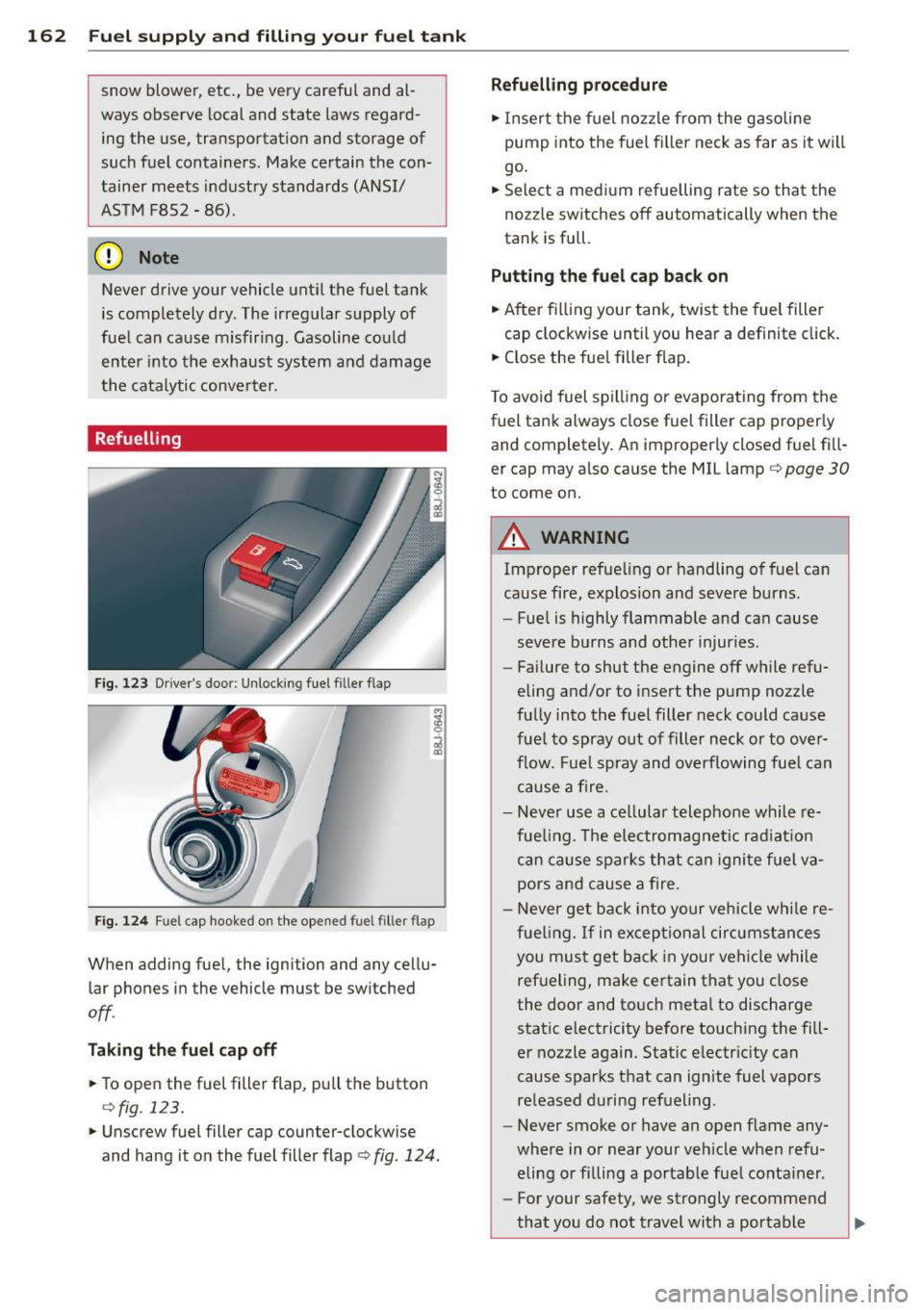
Fig. 123 D rive r's doo r: Unl ocking fuel filler flap
Fig. 124 Fu el cap hooke d on the opened fuel fill er fla p
When adding fuel, the igni tion and any cellu
lar phones in the vehicle must be swi tched
off .
Tak ing the fu el cap off
• To open the fuel fill er flap , pu ll the b utton
r=> fig . 123.
• Unscrew fuel filler cap counte r-clockwise
and hang it on the fuel filler flap
c> fig . 124.
Refuelling proc edur e
• Insert the fuel nozzle from the gasoline
pump into the fuel fi ller neck as far as it wi ll
go .
• Select a med ium r efuelling rate so that the
no zzle switches off automatically when the
tank i s full.
Putting th e fu el cap bac k on
• After f illing your tank, twist the fuel filler
cap clockwise until you hear a definite click.
• Close the fue l fill er flap.
T o avoid fuel spilling or evaporating from the
fuel tank always close fuel filler cap properly and completely. An improperly closed fuel fi ll
er cap may also cause the MIL lamp
c> page 30
to come on.
A WARNING
Improper refue ling or handling of fuel can
cause fire, explosion and severe burns.
- Fuel is highly flammable and can cause
severe burns and other injuries .
- Fai lure to shut the engine off while refu
eling and/or to insert the pump nozzle
fully into the fuel filler neck could cause
fuel to spray out of filler neck or to ove r
f low. F ue l spray and overflowing fuel can
cause a fire.
- Never use a ce llular telephone whil e re
fue ling . T he electromagnet ic rad iat io n
can cause spa rks that can igni te fuel va
pors and cause a fire.
- Never get back into your vehicle whi le re
fue ling.
If in exceptio nal circumstances
you must get back in your vehicle while
ref ueling, make certain that you close
the door and touch metal to discharge
static electricity before touching the fill
er nozzle again . Static e lectricity can
cause sparks that can ignite fuel vapors
re leased d uring refueling .
- Never smoke or have an open f lame any
where in or near your veh icle when refu
eling or filling a portable fue l conta iner .
- For your safety, we strongly recommend
that you do not travel with a portable
Page 165 of 244
fuel container in your vehicle. The con
tainer, full or empty may leak and co uld
cause a fire, especially in a crash.
- If, under exceptional circumstances, yo u
must transport a portable fuel container,
please observe the following:
- Never fi ll a po rtable fue l container
while it is anywhe re in or on the vehicle
(for examp le, in the luggage compar t
ment, or on the tr unk). Static electrici
ty can bui ld up while fi lling and can ig
n ite fue l vapors causing a fire .
- Always p lace a portable fuel container
on the gro und before filling.
- Always keep the fi ller nozzle comp lete
ly inside the portable conta iner before
and during filling.
- If filling a portable container made of
metal, the filler nozz le must always be
in contact with the container. Th is w ill
he lp prevent static electricity from dis
charging and cause a fire .
- Never sp ill fuel inside the vehicle or
luggage compartment. Fue l vapors are
h ighly flammable .
- Always observe local and state/provin
cial laws regarding the use, storage
and tra nsportation of fuel co ntainers .
- Make certai n the fuel container meets
industry standards (ANSI/ ASTM
F852 -86) .
(D Note
If any f uel has spilled onto the car, it
should be removed immediate ly to prevent
damage to the paint.
~ For the sake of the environment
As soon as the correctly operated nozzle sw itches off automatically fo r the fi rst
time, the tank is full. Do not try to add more fue l because fue l may spill out . In
add it ion, th e expans ion space in the fuel
t ank will be fi lled -causing the fue l to
overflow whe n it be come s w arm and pol
lute the env iro nment.
Fu el suppl y and filli ng your fuel t ank 163
@ Tips
- Running your eng ine whi le refue lling
may cause vapors to escape or even fuel
to spill out of the tank. This would then
shut off t he fue l nozz le before the tank
is f ull.
- Do not refuel your vehicle with the ign i
tion switched on. The fuel gauge may
ot herwise not ind icate the correct fue l
level after ref uell ing .
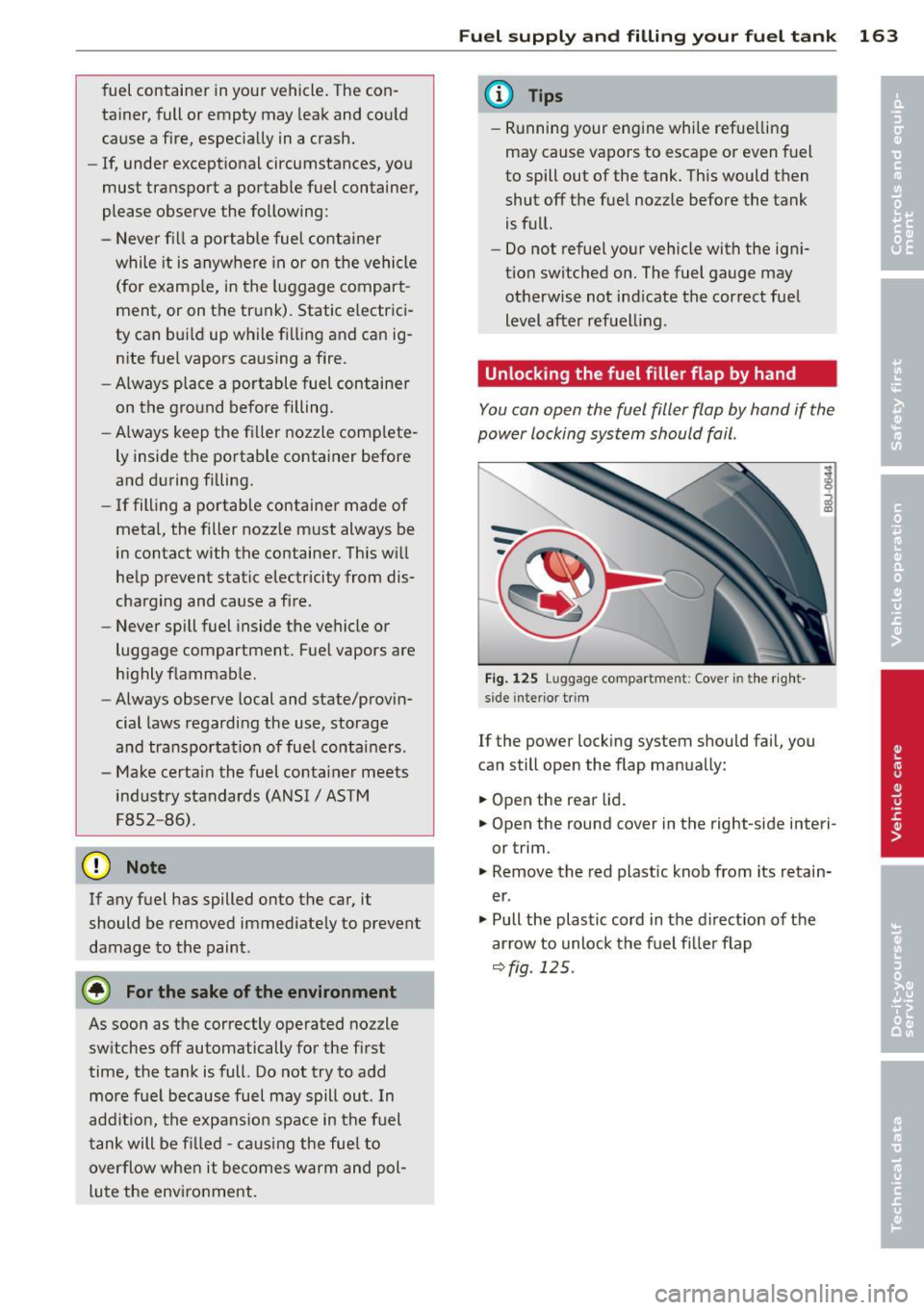
Unlocking the fuel filler flap by hand
You can open the fuel filler flap by hand if the
power loc king system should fail .
Fig. 12 5 Lu ggage co mpar tme nt: Cove r in the rig ht
si de interio r tri m
If the power lock ing system should fa il, you
can still ope n the flap ma nually:
.,. Open the rear lid .
.,. Open the round cover in the right-side interi
or trim.
.,. Remove the red plastic knob from its retain
er .
"' Pull the plastic cord in the d irect ion of the
ar row to unloc k the f uel f iller flap
~ fig. 12 5 .
Page 167 of 244
-Apply the parking brake.
- Move selector lever to "P" (Park).
- Always let the engine cool down. Hot
components will burn skin on contact.
- To reduce the risk of being burned, never
open the hood if you see or hear steam
or coolant escaping from the engine
compartment. Wa it until no steam or
coolant can be seen or heard before care
fully opening the hood.
- Keep children away from the engine com
partment .
- Never spill fluids on hot engine compo
nents. They can cause a fire.
- Never touch the radiator fan. The auxili
ary electric fan is temperature controlled
and can switch on suddenly.
- Never open the coolant reservoir cap
when the engine is still warm. The cool
ant system is pressurized and hot cool
ant could spray out .
- Protect your face, hands and arm from
steam or hot engine coolant by placing a
thick rag over the cap when you open the
coolant reservoir .
- Do not remove the engine cover under
any circumstances . This increases the
risk of burns.
- If work on the fuel system or the electri
cal system is necessary:
- Always disconnect the battery .
- Never smoke or work near heaters or
open flames. Fluids in the engine com
partment could start a fire.
- Keep an approved fire extinguisher im
mediately available.
- To avoid electrical shock and personal in
jury while the engine is running or being
started, never touch:
- Ignition cables
- Other components of the high voltage
electronic ignition system.
- If you must perform a check or repair
with the engine running:
Checking and filling 165
- First, fully apply the parking brake,
move selector lever to "P" (Park) .
- Always use extreme caution to prevent
clothing, jewelry, or long hair from get
ting caught in the radiator fan, V-belts
or other moving parts, or from contact
ing hot parts . Tie back hair before
starting, and wear no clothing that will hang or droop into the engine.
- Minimize exposure to emission and
chemical hazards~&. .
A WARNING
California Proposition 65 Warning:
- Engine exhaust, some of its constituents,
and certain vehicle components contain
or emit chemicals known to the State of
California to cause cancer and birth de
fects and reproductive harm. In addition,
certain fluids contained in vehicles and
certain products of component wear con
tain or emit chemicals known to the State of California to cause cancer and
birth defects or other reproductive harm.
- Battery posts, terminals and related ac
cessories contain lead and lead com
pounds, chemicals known to the State of
California to cause cancer and reproduc
tive harms. Wash hands after handling.
Q) Note
When adding fluids, always make sure that
they are poured into the proper container
or filler opening, otherwise serious dam
age to vehicle systems will occur .
@ For the sake of the environment
To detect leaks in time, inspect the vehicle
floor pan from underneath regularly . If
you see spots from oil or other vehicle flu ids, have your vehicle inspected by an au
thorized Audi dealer. •
•
Page 170 of 244
168 Checking and filling
Detergent additives in the o il will make fresh
oil look dark after the engine has been run
n ing for a short time . This is norma l and is not
a reason to change the oil more often than recommended.
D am ag e o r m alfun ction s due to lack of
m ainten ance
It is essent ial that yo u change your oil at the
recommended intervals using only engine oil
that complies with Audi oi l standard
VW 502 00 . Your Lim ited New Vehicle War
ranty does not cover damage or malfunctions
due to failure to follow recommended mainte
nance and use requ irements as set forth in
the Audi Owner's Manual and Warranty
&
M aintenance book let . Your dea ler will have to
deny warranty coverage un less you p resen t to
the dea ler proof in the form of Servi ce or Re
pa ir Orde rs that all schedu led maintenance
was performed in a timely manner.
Engine oil consumption
The engine in your vehicle depends on an ade
quate amount of oil to lubricate and cool all
of its moving ports.
I n o rder to prov ide effective lubr ication and
cooling of internal engine components, a ll in
ternal comb ustion engines consume a certain
amount of oil. Oi l consumption varies from
engine to engine and may change significantly
over the life of the eng ine . Typically, eng ines
with a specif ied break-in per iod (see
c::> page 149) consume more oil during the
break-in per iod than they consume after oil
consumption has stabilized .
Under normal conditions, the rate of oil con
sumpt io n depends on the quality and viscosity
of the oil, the RPM (revolutions per m inute) at
which the engine is operated, the ambient
temperature and road cond it io ns. Furthe r fac
tors are the amo unt of o il d ilution from wate r
condensation or fuel residue and the ox ida
tion level of the oi l. As any engine is subject to
wear as mileage bui lds up, the oil consump
tion may increase over t ime until replacement
of worn components may become necessary. Wi
th a ll these variab les coming into p lay, no
standard rate of oil consumption can be es
tab lished or spec ified. There is no alte rnative
to regular and frequent check ing of the o il lev
el, see
Note .
If the yellow engine oil leve l warning symbo l
in the instr ument cluster
1\1 lights up, you
sho uld check the oil leve l as soon as possib le
with the oil dipstick c::> page 169. Top off the
o il at your earliest conven ience
c::> page 169 .
A WARNING
-Before you chec k anything in the eng ine
compartment, a lways read and heed a ll
WAR NINGS
c::> .& in Working in the engine
comportment on page 164.
CI) Note
D riving with an insufficient o il level is like
l y to cause sever e damage to the engine.
(D Tips
- The oil pressure warn ing display. is
not an indicator of the oil level. Do not
rely on it . Instead, check the oil level in
your engine at r egular intervals, pr ef
erably ea ch time you refuel, and alway s
before going on a long trip.
- If you have the impression yo ur engine
cons umes excessive amoun ts of oil, we
recommend that you consult your Aud i
dea ler to have the cause of your concern
properly diagnosed. Keep in mind that
the accurate meas urement of o il con
sumption requires great care and may
take some t ime . Your Audi dea ler has in
st ruct ions about how to measure oil con
sumption acc urately.
Page 183 of 244
-Never mount used tires on yo ur vehicle if
yo u are not sure of their "previous histo
ry." Old used tires may have been dam
aged even though the damage cannot be
seen that can lead to sudden tire failure
and loss of vehicle control.
- If you notice unusual vibration or if the
vehicle pulls to one side when d riving, al
ways stop as soon as it is safe to do so
and check the wheels and tires for dam
age .
(D Note
-Please note that summer and winter
tires are designed for the cond itions that
are typ ic al in those seasons. Aud i recom
mends using w inter t ires du ring the win-
Glossary of tire and loading terminology
Accessory weight
means the comb ined weight (in excess of
those standard items which may be replaced)
of automatic tra nsmission, power steering,
power brakes, power windows, power seats,
radio, and heater, to the extent that these
items are availab le as factory-installed equip
ment (whether installed or not) .
Aspect ratio
means the ratio of the height to the width of
the tire in percent . Numbers of 55 or lower in
d icate a low sidewall for improved steering re
sponse and better overall handling on dry
pavement .
Bead
means the pa rt of the ti re that is made of
steel wires, wrapped or reinforced by ply cords
and that is shaped to fit the rim.
Bead s eparation
means a b reakdown of the bond between
components in the bead.
Cord
means the strands forming the plies in the
tire.
Tire s an d wheel s 181
ter months . Low temperatu res signifi
cantly decrease the elastic ity of summer
t ires, which affects traction and braking
ability. If summer tires are used in very
co ld temperatures, cracks can form on
the tread bars, res ulting in permanent
ti re damage that can cause loud drivi ng
noise and unbalanced tires. Aud i is not
responsib le for this type of damage.
- Burn ished, polished or chromed rims
must not be used in winter weather. Th e
surfa ce of the rims does not have suffi
c ien t cor rosion pro te cti on for this and
c o ul d be pe rmanen tly damaged by road
salt or similar substances. This damage
is not covered by warranty.
Cold tir e inflation pressure
me ans the t ire press ure re commended by the
vehicle manufacturer fo r a tire o f a des igna ted
size that has not bee n driven for more than a
coup le of miles (k ilomete rs) at low speeds in
the three hour pe riod before the tire press ure
is measured or adjusted.
Curb weight
means the weight o f a motor vehicle with
standard equipment including the maximum
capacity of fuel, o il, and coolant, air cond i
tion ing and additional weight of optiona l
equipment.
E xtra load tire
means a tire designed to operate at higher
l oads and at higher inflation press ures than
the corresponding standard tire. Extra load
tires my be ident ified as "XL", "xl", "EXTRA
LOAD", or "RF" on the sidewall.
Gross Axle Weight Rating ("GAWR")
means the load-carrying capacity of a single
axle system, measured at the tire-ground in-
ter~ces.
~
•
•
Page 198 of 244
196 Tire s and wheel s
was manufactured . Please see q page 192,
Speed roting (letter code) for a listing of the
speed rat ing letter codes and the maximum
speed at wh ich the t ires can be driven .
The speed rating letter code( ¢ page
183) is
on the side wall of the tire ¢ page 191.
A WARNING
Winter tires have maximum speed limits
that may be lower t han your vehicle's max
imum speed . Always know the maximum
speed before driving off . Never drive faster
than the speed permitted for your specific
w inte r tires. This will cause damage to the
tires leading to an accident and serious
pe rsonal inj ury to you and your passen
gers .
A WARNING
= ~
Driv ing faster than the maximum speed
for which the winter tires on your vehicle
were designed can cause tire fai lure in
cluding a blowout and sudden deflat ion,
loss of control, crashes and serious per
sonal injuries. Have worn or damaged tires
rep laced immed iate ly .
- Winter tires have maximum speed rat ing
that may be lower tha n your veh icle's
maximum speed .
- Never drive faster than the speed for
w hich the winter or other tires installed
on your vehicle are rated.
A WARNING
Always adjust your d riving to the road and
t raffic conditions. Neve r let the good ac
celeration of the wi nte r t ir es and all-whee l
dr ive temp t you in to taking extr a ris ks . A l
ways remember :
- Whe n bra king, an al l-wheel d rive vehicle
hand les in the s ame way as a front drive
vehicle.
- Drive c aref ully and reduce your speed on
icy and slippery roads, even winter tires
cannot he lp under black ice conditions.
{® For the sa ke of the environment
Use summer tires when weather condi
tions permit. They are qu ieter, do not wear
as quickly and reduce fuel consumpt ion.
Snow chains
Snow cha ins may be f itted only to the front
whee ls, and o nly to certain tire sizes . Ask your
autho rized Aud i deale r on which tire sizes
snow c hains ca n be used.
If you are go ing to use snow chains, then you
must i nstall them on the front whee ls at
least.
The snow chains must have low-prof ile links
and must not be t hicker than 0.53 inch
(13.5 mm), includ ing the lock .
Remove whee l center covers and trim discs
before putt ing snow cha ins on your vehicle
¢ \!) . For safety reasons cover caps must then
be fitted over the wheel bolts . These are ava il
able from autho rized Aud i deale rs .
A WARNING
Using the wrong snow chai ns for your veh i
cle o r in stall ing them in correct ly can in
crease the risk o f loss of cont ro l leading to
se rious personal injury.
- Snow chains are available in di fferent
sizes. Always make sure to follow the i n
structions provided by the snow chain manufacturer .
- When driving wi th snow cha ins never
d rive faster than the speed permitted for
your specific snow chains.
- Always observe local regulations .
(D Note
-Remove snow chain s before dr iv ing o n
roads not covered with snow to avoid
damaging tires and wearing the snow
chains down unnecessa rily.
- Snow chains, which come in to direc t con
t act with the whee l rim, can scrat ch or
damage it . Therefore , make sure that the
1J1-
Page 200 of 244
198 Tire s and wheel s
or ridges on the road, part icu larly if the tire is
u nderinflated .
I n o rder to m inim ize the o ccurrence of impact
damage to the t ires of your vehicle, we recom
mend that you observe the following precau
tions:
- Always maintain recommended infla tion
pressures. Chec k your tire pressure every
2,000 miles (3,000
km) and add air if neces
sary .
- Drive carefu lly on roads with potholes, deep
gullies or ridges. The impact from driving
t h rough or over such obstacles can damage
your tires. Impact with a curb may also cause damage to your tires.
- After any impact, immediately inspect your
tires or have them inspected by the nearest
authorized Aud i dealer. Replace a damaged
t ire as soon as possible .
- Inspect your t ires every 2,000 miles (3,000
km) for damage and wear . Damage is not al
ways easy to see . Damage can lead to loss of
air and underinflation, wh ich could eventu
ally cause t ire failure . If you be lieve that a
t ire may have been damaged, replace the
t ir e as soon as possible.
- T hese tires may wea r mo re quick ly than oth
ers.
- Please a lso remember that, wh ile these t ires
deliver respons ive handling, they may ride
l ess comfortably and make mo re no ise than
other choices.
Reduced performance in winter /co ld
sea son condit ion s
All ti res a re des igned for certa in pu rposes.
The low aspect ratio, ultra high performance
tires originally installed on your vehicle are in
tended for max imum dry and wet road per
formance and handling. They are not suitable
for cold, snowy or icy weather condit ions. If
you dr ive under those circumstances, you
should equip your vehicle with all -season or
winter tires, which offer better traction under
those cond it ions. We suggest you use the rec
ommended snow or all-season tires specified
fo r your vehi cle, or their eq uivalent. Refer to
q page 195
for more detailed infor
mation regarding winter tires.
Tire pressure monitoring system
General notes
Applies to veh icles: w ith tire pressure monitoring system
Each tire, incl uding the spare ( if provided),
sho uld be checked monthly when co ld and in
flated to the inflation pressure recommended by the veh icle manufacturer on the veh icle
placard or tire inflation pressure label. (If your
vehicle has tires of a different size than the
s ize indicated on the vehicle placard or tire i n
flat ion p ressure label, you should dete rmine
the p roper t ire infla tion p ress ure fo r th ose
t i res.)
As an added safety featu re, your ve hicle has
been equipped with a tire pressure mon itoring
system ( TPMS) tha t illum inates a low ti re
pressure tel ltale when one o r more of your
tires is significant ly under-inflated . Acco rding
l y, when the low tire pressure telltale i llumi
nates, you shou ld stop and check your tires as
soon as possib le, and inflate them to the
proper pressure. Driving on a sign ificantly un
der- inflated t ire causes the tire to overheat
and can lead to tire fa ilure . Under-inflat ion al
so reduces fuel effic iency and tire tread life ,
and may affect the vehicle 's hand ling and
stopp ing abili ty.
Please note that the TPMS is not a substitute
for proper tire ma intenance, and it is the d riv
er's respons ibility to maintain co rrect tire
pressure, even if under-inflation has not
reached the leve l to tr igger illum inat ion of the
T PMS low tire pressu re tellta le .
You r vehicle has also been equipped w ith a
T PMS ma lf u nction indicator to ind icate when
the sys tem is not o perating p roperly . Th e
T PMS ma lfunction indicator is combined w ith
t h e low tire pressure te lltale. When the sys
tem detects a malfunction, the telltale will
flash for approximately one min ute and then ..,_
Page 204 of 244
202 Tires and wheels
(80 km/h)
¢ page 202, Driving with run -flat
tires .
When it is not possible to continue
driving, even with run-flat tires?
- If the E lectronic Stabilization Control (ESC)
is not working or keeps coming on.
- If the Tire Pressure Monitoring System does
not work .
-If the tire has been severely damaged, in a
crash, for example. The tread can separate
from a damaged tire as the whee l turns , and
hit parts of the vehicle , such as the fuel tank
filler neck, fuel lines or brake lines.
- Do not continue driving if severe vibration
occurs or if the tire starts to smoke because
the tire is running hot.
- Do not continue driving if damage to the
tire, such as cracks in the sidewall, appears.
A WARNING
Improper use of run-flat t ires can cause
veh icle damage that can lead to loss of ve
hicle control, a crash and serious pe rsonal
injury.
- Run-flat tires can only be used with spe cial rims.
- Run-flat tires must always be mon itored
with a properly programmed Tire
P re
ssure Mon itor ing System.
- Always inspect a tire that has lost air to
make sure it is safe to drive with the tir e
in the run-flat mode.
- Never drive with run-flat tires that have
been damaged in a collision .
- Never drive with run-flat tires if heat
build-up causes the tire to give off
smoke .
- Never drive with run-flat tires if the vehi
cle shakes or v ibrates severely.
- Never drive with a run-flat tire that de
velops sidewall cracks or other damage
wh ile in use .
- If you switch between standard and run
flat tires, an authorized Audi dealer or qualified workshop must reprogram the
control module .
-
(D Note
Run-flat tires have specia l characteristics
and requirements, that are very different
from conventional tires. Run-flat tires re
quire special rims for run-flat use and can
not be used on conventional wheel rims.
(D Tips
- If you are not able to cont inue driving
with run-flat tires, please seek professio
nal assistance.
- Please contact your authorized Audi
dealer or Audi of America, Inc. if you
have questions about tires and rims .
Driving with run-flat tires
Applies to vehicles: wit h Run -flat tires
Handling characteristics change when tire
pressure is low .
Driving on tires with low tire pressure changes
the way a vehicle handles, particularly when
cornering and braking. The handling charac
teristics of run-flat tires do not seem to
change a lot even when driving on low pres
sure or in the run-flat mode . Nevertheless you
must still take specia l precautions when ope r
at ing a vehicle on run-flat tires when tire pres
sure is low o r the tire(s) is flat:
.,. The Electronic Stabilization Control (ESC)
must be switched on.
.,. Never drive faster than 50 mph (80 km/h)
¢&_ .
.,. Plan ahead when driving and anticipate
what you will have to do considering traffic
and road conditions up ahead .
.,. Accelerate carefully.
.,. Avo id unnecessary and sudden steering and
brak ing maneuvers.
.,. Reduce your speed in plenty of time before
intersections, curves and other places where
you may have to react quickly.
Please see :
¢ page 202, When it is not possi
ble to continue driving, even with run-flat
tires?